see programme here

Looking forward to this

Talking to a Tree Fern
1.
You’re not ashamed of your past.
It hangs there in rust-coloured layers
and you curve out of it
fully at ease.
2.
Behind you the bay
sports expensive speed boats. More and more
they force their vibrations right up
your root-tips.
3.
You used to live here with other natives.
Now willows and poplars flickering gold
have proudly established themselves.
4.
I’ve heard you discussed as an item
of our international trade. They
conceive of you standing in each
pebble garden of suburban Los Angeles.
5.
The man at the back
has asked how much I care about you.
He says you impede his view.
6.
In the bush near here
you gather in tight bunches
your pasts hanging down and spreading
over the ground like soft mats.
I want to crawl under there
I need to know what you’re chatting about.
7.
Rowing out as usual
to the calmest part of the lake
I hear a chain-saw preening itself
and sense the spikes stiffening on your trunks.
8.
Once I saw you at a Marist Centre
stiff and brittle like an empty erection,
no fronds, no flow.
Mary was cramped into a grotto nearby
totally into pleasing God.
9.
I was just wondering whether
Christ had risen again this year or not
(Good Friday was April Fool’s Day)
when I saw three fantails fooling around
in your fronds, in the rain.
10.
Under your dark arms
that night with no moon
I decided to let my life
climb up quietly
like the rata on your trunk.
11.
It leans so superbly
your long black trunk
perhaps it is frightening
the man at the back.
12.
Suddenly, in the city,
staked into a neat fence
you poke out your black tongue.
Keep coming and coming
back into my life.
©Dinah Hawken, from It Has No Sound and Is Blue, VUP 1987
Therese Lloyd writes:
“Talking to a Tree Fern”, like so many of Dinah Hawken’s poems, is one of those gentling breathing poems that I find myself returning to again and again. Despite the quiet, contemplative place this poem smooths out for the reader, it is also studded with glorious sparks of irony and cynicism. But make no mistake, this is also a fiercely political and feminist poem.
Broken into twelve discrete stanzas, each one acts like a tiny meditation, similar to a haiku, that brings the reader right into the present. The sections create a natural pause after each one before moving on to the next.
Part of the immense appeal of this poem is the way Hawken seamlessly weaves together such hefty concerns as spirituality, the natural environment, sexuality, patriarchy, and capitalism.
The fourth section for example, reads:
I’ve heard you discussed as an item
of our international trade. They
conceive of you standing in each
pebble garden of suburban Los Angeles.
While Hawken’s relationship with her tree fern is personal, here she ends each line with a distancing word, a way to remind her reader of the commodity humans have made of the earth.
The poem is also gorgeously sensual. Words like ‘curve’, ‘flickering’, ‘soft’, and ‘leans’, are peppered throughout. But then there’s the striking simile in Section 8 that always stops me in my tracks: ‘stiff and brittle like an empty erection’. It always makes me wonder, is this a sexy poem? I think it is. There’s Mary, that once pregnant virgin of course, ‘totally into pleasing God’, and the repetition and urgency of the final two lines, ‘Keep coming and coming/ back into my life’, have an undeniably seminal urge behind them.
Poems that resonate with me are the ones that change with each reading. Reading this poem now as a 44-year-old woman is a completely different experience to the one I had when I first read it in my 20s. Back then I was attracted to the poem’s gentle touch, the soft earth that the speaker wants to crawl under. When I read it now, in the light of huge global events such as #Me Too movement, and children marching for climate change, I’m inspired by its quiet bravery. Dinah Hawken’s poems have always found fascination in the way the natural world shapes our everyday human consciousness, and this poem is a brilliant example of that. But its power is in its gentle but firm insistence. Like the fern in the poem, it pokes out its tongue at us.

Therese Lloyd is the author of the chapbook many things happened (Pania Press, 2006), Other Animals (VUP, 2013) and The Facts (VUP, 2018). The Facts has been shortlisted for the 2019 Ockham New Zealand Book Awards.
Dinah Hawken’s first book, It has no Sound and is Blue, won the 1987 Commonwealth Poetry Prize for ‘Best First Time Published Poet’. Her seven subsequent collections include Oh There You Are Tui: Selected Poems and her most recent, There is no harbour, (2019). Four of her books have been shortlisted for the New Zealand book awards. In 2007 Dinah was named the winner of the biennial Lauris Edmond Award for Distinguished Contribution to Poetry in New Zealand. She now lives in Paekakariki on the Kapiti Coast.
Poetry Shelf review of There is no harbour
Vitoria University Press author page
CALL FOR FEATURED STUDENT POET
For a fine line magazine’s Winter edition, we are searching for our first Featured Student Poet.
Any New Zealand poets who self-identify as a student are welcome to send in their work for consideration.
The chosen poet will have their poetry featured in a fine line’s next edition, and they will receive a book token as payment for publication.
They will also receive the following prizes:
Students, please email a selection of up to 4 poems (max 40 lines each) to editor@poetrysociety.org.nz, with the subject line “Featured Student Poet”.
Deadline: 10 April 2019. Good luck!
see here

The night sky is full of
stars but
we are more clever than
most – we know
they are just
burned bones.
from ‘Spent’
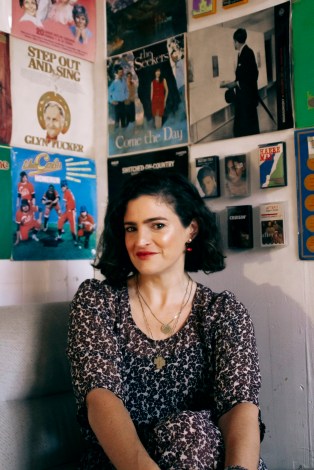
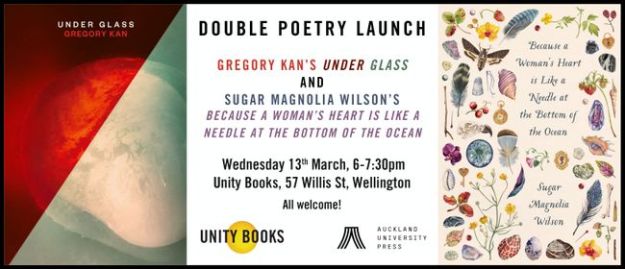
Sugar Magnolia Wilson is from Fern Flat, a valley in the far North. In 2012 she completed her MA in creative writing at the International Institute of Modern Letters at Victoria University of Wellington. Her work has appeared in a number of journals, both in New Zealand and overseas, and she co-founded the journal, Sweet Mammalian, with Morgan Bach and Hannah Mettner. Auckland University Press is launching Magnolia’s debut collection, Because a Woman’s Heart is Like a Needle at the Bottom of the Ocean on March 13th. The new collection is a reading treasure trove as it shifts form and musical key; there are letters, confessions, flights of fancy, time shifts, bright images, surprising arrivals and compelling gaps. Lines stand out, other lines lure you in to hunt for the missing pieces. There is grief, resolve, reflection and terrific movement.
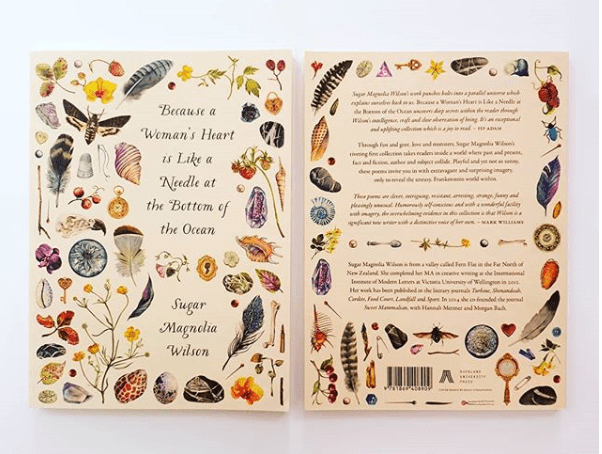
Paula: Tell me about the cover of your book. I just love it. I love the way it is rich in miniature things, a little like your poems are.
Magnolia: Isn’t it totally amazing? When I first received the email from Keely O’Shannessy with several cover design options, I was so blown away by it that I almost couldn’t see it. It was weird, like I was looking at running water in a stream or something and I felt like I might faint. I guess I’d never expected her to ‘get’ my work so completely or so quickly, I was prepared to have to go back and forth to fight for a cover I loved, but that never happened. My friend Kerry Donovan-Brown said it’s like someone took a blood sample from me, put it in a petri dish and looked at it under a microscope, and that the cover is what close up Magnolia Wilson blood looks like! Haha. I wish! Best compliment ever. It’s what my dream blood looks like. I wish my blood was jewellery.
And yes, rich in miniature things. One external review of my book mentioned that I seem to be obsessed with accumulation in my work, and it’s true. Lots of little collections of pins and clips, of food in bowls, jewellery, flowers. I grew up as an only child and I lived a rather sylvan kind of life. I loved to collect bits a pieces and when I was nine Mum, Dad and I travelled around the world (yes, lucky me), and I came home with a giant collection of buttons from different countries. I think it’s an innate desire to hang on to what is beautiful in life, to have proof that beautiful things happened, and is probably tied into grief somehow.
Paula: I first heard you read poems from this book at the National Library Poetry Day celebration and your ‘Dear Sister’ poems – they open the book – blew my socks off. The letter-writing voice drew me in, the sparkling detail, the mood and the mysteriousness. Where did this haunting sequence spring from?
Magnolia: I can kind of trace where they have come from, but like most creative stuff, the true meaning flutters off just before I can pin it down. So, ‘Pen Pal’ was written in 2012, and that’s a letter sequence, and I think that’s where I got the love for the freedom and mystery that epistolary poems allow, and in that same year I wrote a poem called Anne Boleyn, which is also in the book. I started writing the ‘Dear Sister’ sequence with the idea that is was Anne (pre-Henry) writing to her sister, Mary. But, I wasn’t trying to be factually correct I just sort of followed what the letter writer had to say. Slowly it morphed away from being Anne and simply became a woman from another time, struggling with a sense that she was immensely powerful but with no place to express that power. Hence the onset of a kind of ‘madness’ or, more accurately … going full Sybil / turning into a ‘witch’.
Paula: It is such a magnificent way of building a voice in a poem – fierce mixes with doubt, vulnerability, tenderness. This was poetry that I felt. Can you tell me a couple of poetry books that you have felt?
Magnolia: One of the first books of poetry ever gifted to me was Mary Oliver’s collection, American Primitive. My dad set off and travelled around the States after my mother passed away, and he must’ve come across it in his travels and sent it to me with the inscription, Magsie darling, I know you will love this. And I did! It makes me grieve for the majesty of the natural world. I love the way she honours the idea that beauty and love are inseparable from pain and the brutality of nature.
I also love that she is a Christian woman. Usually I would run a mile from a ‘Christian’ poet (probably because I am a bit basic in my thinking and have stereotyped Christians, as though there aren’t a billion different variations on what a Christian can be), but she was Christian in some kind of arcane, pagan way that I love – or that’s what I like to imagine, at least. Also, Mary Reufle’s poetry always makes me feel a lot of hard-to-put-words-to/liminal-space feelings. Her work is a kind of déjà vu. Also, Atsuro Riley’s collection, Romey’s Order, is completely beautiful and was a huge influence for my Pen Pal sequence – the tender, ever so delicate construction-work a child does to build their world.
Paula: Poetry may or may not be something you feel as either reader or writer; it might be a matter of music and mystery, story or ideas. Yet so often a poem knots a complex (scarcely visible) string of effects. Take your poem ‘Home Alone 2 (with you)’, for example. At the core of this poem are multiple loves (a movie, a lover, a mother) and a punch-gut moment. And the after effects last and the questions surface. This is the joy of poetry. You move in and out of self-exposure in the collection. Do you have limits? Is it a form of discovery?
Christmas time and we’ve been out all night.
You’ve been speaking mix of Korean and English,
the way you do when you’re drunk – and
because English is your second language
people can’t be sure if you’re
talking over their heads or if
you’re freestyling your own
kind of poetry.
from ‘Home Alone 2 (with you)’
Magnolia: Interesting. Yes, I definitely have limits. And not purposeful ones for creative constraint etc. They’re the limits of being the specific person that is me with my specific voice and set of issues, trying to write poetry. It’s 100 percent a form of discovery for me, a way of making sense of my world and of growing. I think going back to my interest in accumulation, of objects and imagery, I think maybe it’s a kind of armour.
The lake has a long memory a long
memory, a large imagination.
When my mother left the spring
on our land didn’t change. The water didn’t
stop didn’t stop bubbling up from below.
It didn’t cover itself in a shawl of blackbirds
to indicate grief.
Each litre of water that came up
was different from the next and the next
and each time and each time after that
when I took a drink a drink I became
a deep blue lantern teeming with invisible life.
from ‘The lake has a long memory’
In my poetry I definitely move between self-exposure/vulnerability and then away from it, and I tend to build my poems up and up with imagery like a larva building itself a protective pupa, in order to do its work within, safely. Lol. I think in my poems I build a space where I can work things through, maybe without confronting them directly. And I find that my poems keep on revealing things to me. ‘Muddy Heart’ is an old poem, but only two weeks ago I finally ‘got’ what it was saying. I read it out in an interview and suddenly I was like whoa! That’s what it means! It was so clear and I’d never seen it.
Maybe it’s totally obvious to the reader, I don’t know, but to me I only just got that it was about feeling abandoned by my father after my mum died. I think all creative work is like this, a process of many lives and many mini-deaths, which allow for new life and new understanding in turn.
Muddy heart
You’ll lie down one day on the field behind
your house and your heart will turn
to mud.
Dandelions will push up through the earth, your
blood mingling to a rich beet-coloured soil,
your bones some kind of ash like your father uses
around the strawberry plants.
Clover and pennyroyal will take seed on you.
You’ll call out in the fading light for your father,
who is, after all, just over the fence in the house – but you’ll
sound like the long grass, the frogs, the dogs herding cattle.
When eventually he comes looking for you,
how ever many years later
there will only be the green flush of land down toward
the road, the river and a patch of grass
where he will tend to st from now on.
Paula: It is such a layered sensual poem; I can feel the earth and smell a sharp kick of dandelions just as the image of the father in the fading light who ‘eventually comes looking for you’ is also a sharp heart-kick. And the potent last lines. I adore this poem. The main story might be missing but the feeling is acutely present.
What do you find hard when you write poetry? What gives you pleasure? Does doubt aid or hinder?
Magnolia: I think doubt is something I’m always struggling with in terms of writing. Before I did the IIML masters course, I never really thought much about writing, it was just something that happened to/for me from the age of nine! The IIML course was mostly a blessing and partially a curse. There’s a lot of shit poetry floating round in the world. Honing your editorial eye/ear is key if you want an audience for your work and want to grow as a writer, but, thinking critically about my work pushed me into a place where I felt like nothing was really good enough. I’m only now, seven years on, getting free from that thinking, I am no longer giving fucks.
I am a lyrical, image-laden, nostalgic, confessional poet and that’s totally fine. What I find hard when I write: getting started! I have so, so many failed starts at poems. For every one poem there are maybe 10 or 20 failures. What gives me pleasure: when the creative duende / spirit shows up, and writing just happens in a way that seems outside of my control. It doesn’t happen often but when it does it makes all of the failed attempts worth it.
Paula: Ah yes, I don’t think doubt ever leaves. But that mysterious hard-to-describe poem flow can be such a joy. Have you read any poetry books in the past few years that have given delight? Challenged you? Taken you outside your comfort zone. Given your pure reading uplift?
Magnolia: I’m more likely to love individual poems rather than have entire favourite collections. The poems that’ve struck me in some way or other recently (but aren’t necessarily ‘new’ works) have been: Kiki Petrosino – Witch Wife. Alice Te Punga Somerville – time to write (for Larry), Hannah Mettner, her whole book Fully Clothed and So Forgetful, Emma Barnes – all her poems but especially Ohio. Lynn Jenner – many poems, Rebecca Hawkes – the cave draws u in like a breath, Michael Steven – a sequence of poems he wrote about his son, August. Nina Powles – in the end we are humanlike. Jenny Bornholdt – Flight. Anna Jackson – her whole incredible chapbook, Dear Tombs, Dear Horizon. Faith Wilson – Lynette #1. Cynthia Arrieu-King – her whole book People are Tiny in Paintings of China. Alice Oswald – the whole collection Dart. Morgan Bach – her two new poems in Sport. SO MANY MORE.
Paula: Ok – books for me to track down there. I haven’t read that poem by Nina for a start. Where was it published? I love reading books outside my comfort zone, that are nothing like I will ever write in terms of style, form and content, but I also love those books that refresh my own writing preoccupations. What are key things when you write a poem? Could you narrow it down to three words?
Magnolia: The Nina one was published in The Shanghai Literary Review online.
Three words: really quite random! I don’t know how I write poems. It seems like a bizarre miracle every time it happens, and then I’m convinced I’ll never be able to write another one again.
Paula: I know that feeling – and the way you can pick up an old poem and it reveals new and surprising things to you (as you did with ‘Muddy Heart’). That feels like another miracle. Was there a poem in the collection that just arrived with ease and flow (almost in one sitting) and another that was much harder to form?
Magnolia: ‘The sleep of trees’ was a poem that was just ready and waiting to be written. There had been fragmented, short incarnations of it the year leading up to writing it, but they never worked, and then they all magnetically found their way into that poem, and it was written in about fifteen minutes. And then edited a bit over time.
this is the sleep of mothers – of
five thousand lit candles burning hot in the
dark hall of the body, eyes open
and flaming over the bars of a cot
the sleep of babies – restless turning
a sweet and angry clock
bending in space as it draws earthward, pushing
out and protesting against
the constraints
the boredoms
the repetitions.
from ‘The sleep of trees’
‘Glamour’ also kind of wrote itself. Harder to write – Newton gully mixtape – trying to capture the feeling of growing up in the 80s and visiting fashionable Aucklanders, the party scene my parents were involved in, but the emptiness of the scene at the same time. Don’t think I nailed it – because of course, it was way more nuanced than that. Lots of love and happiness too.
Paula: Your collection offers poetic pleasure because it has music, space and heart and that makes it both open and fertile. I was flying home from Wellington musing on your book and was drawn to the two-part ‘Conversation with my boyfriend’ where you ‘translate’ your experience together from English into Korean, and from Korean into English, not as language translations but as experience translations. I was thinking then how every poem is a form of translation – so capturing the 80s scene is like a flickery translation. I guess if you think of poetry as translation it becomes something new and intriguing with fragile lines to the original experience-thought-feeling.
You are always full of rice because you eat rice and you love rice and
your skin feels like rice when we hug – our bodies mould together
and we are a bread yin and a rice yang and although traditionally
Korean people don’t eat bread you are more than hungry to have me.
from ‘English into 한글’ in ‘Conversations with my boyfriend’
We should always be filled with rice: cooking it and eating meals
together, and rice is important before we die, too. We hug and your
skin is learning to love rice, or, at least starting to star the healthy
map of rice. Traditionally, Korean people don’t eat bread, but there
are now many patisseries in larger cities, and many children long to
be pastry chefs, and I am not so sure about this.
from ‘한글 into English’ in ‘Conversations with my boyfriend’
I loved the way as I closed the book the two translations merged; yin overlaying yang, yang overlaying yin. Would you ever see a poem as translation or at times as performance/acting out or as walking into discovery (like some poets do) or as an opening of the writing valves into a mysterious process (as you indicated above) that is never the same and simply happens?
Magnolia: Love the fact that they close over one another! Hadn’t even noticed that. I think all of those things are true about poems – they are translation, performance, an act of discovery and totally mysterious. Art is a way to translate human experience and I think life is a constant act of translation, layer upon layer of meaning being filtered through our own specific set of circumstances, beliefs and experiences, that have been filtered through someone else’s before us, and will go through someone else’s after us. That’s why I am not really into black and white dichotomies – left vs right, Labour vs Nats, the right thing to say vs the wrong thing to say, male vs female. Life is way, way too nuanced and strange for such basic framing. Hannah Mettner passed on the most excellent quote about poetry to me, by the poet Robin Robertson and it sums up all my moods: I’ve always thought that writing poetry has very little to do with the intellect. It’s not something one can explain and chat about very easily: certainly not about the making of it. It’s very resistant to explanation. It comes from a place that is occult, in the sense of being hidden. It attends to some of our deepest anxieties and hopes in the same way that dreams do.
Auckland University Press page
Magnolia reads ‘Betty as a Boy’
Following on from our February Lit Reads Book Club, we are extremely pleased to welcome Anne Kennedy to join us to talk about her book, The Ice Shelf.
Anne Kennedy is an inventive poet and fiction writer. She has also developed scripts and worked as an editor. In her first two collections of poetry, the poems appear in sequence, and focus on female protagonists. While her first book explores domesticity and motherhood, the second is focused on a family of giants, particularly a young woman giant. Her poems and short stories have been included in anthologies and journals, and she has received several key awards. Her collection, The Darling North, won the poetry category at the 2013 New Zealand Post Book Awards.


Pomīahias is in the garage molding
little men into being
fingers slick with clay
drying gradual into dust
the light casts shadows to move
the roller door is open to let the air in
he admires all the fishing rods
his lover has hung from the wall
Maui has caught some big ones
in his day
he sits his tiny figure up on the shelf
with the others
he can see it on their faces
(scrunched fingernail detailing)
they all want something
he isn’t sure he’s allowed to give
could he be as brave to draw a world
over the horizon against its will?
©essa may ranapiri
essa may ranapiri (takatāpui; they/them/ theirs) is a poet from Kirikiriroa. They have words in Mayhem, Poetry NZ, Brief, Starling, THEM and POETRY Magazine, and their debut collection RANSACK will be published by Victoria University Press in 2019.
Full details here
Material must not have been published elsewhere in any form previously, and please do not send us simultaneous submissions (material you have submitted or intend to submit to more than one journal/competition at the same time).
Starling is published twice yearly. Submissions may be made at any time to be considered for the next issue, so the best time to send your work is when you feel it is ready. The editors will read and respond to all submissions as soon as possible, and in any event no later than 8 weeks following the cut-off date for the issue. The editors are unable to enter into correspondence regarding individual submissions or selections.
Cut-off dates for work to be considered for each issue are 20 April for the July issue and 20 October for the January issue.
Poetry: send up to six poems.
Prose: Send up to two pieces, each up to a 5,000 word maximum. Prose may include short stories, creative non-fiction, personal essays or anything else you can surprise us with.
 NZ Poetry Shelf