Monthly Archives: July 2017

Poetry Shelf Winter Season: Johanna Emeney off-piste


Shaken Down


In the hospital corridor,

the one two of my shoes

on hard lino,

then something

sounds broken—


a thermometer—


I have left people here

in rooms

and cabinets.

They’ve gone cold

in others’ hands.


The spine of me

spills

into so many

ball bearings…


Orderlies wheel

prone passengers.

Nurses pass

with busy eyes,


until one pauses

to put on gloves,

coveralls, booties.

She sticks up a sign


[DANGER HAZARDOUS SUBSTANCE]


and calls

for a flashlight,

holds it at an angle

to find beads of me-

rcury lodged in cracks

between wall and floor.


Without a fuss

she gathers masking tape,

an eyedropper,

index cards,

and uses them to

corral what is herdable

into new glass tubing.

Her cards say:

MY MOTHER DIED

WHEN I WAS YOUNG TOO, LOVE


What miracle

to approach

naked breakage,

to chase it unafraid,

gather it up

and talk it back down

to something

resembling normal.


©Johanna Emeney,  Family History, Mākaro Press, 2017


Author note: “Shaken down” grew from two ideas rattling about—a fresh one and a memory:

1) A friend told me that one of the first jobs nurses learn is to shake down a thermometer.

2) I kept thinking of a nurse who had been exceptionally kind to me on the night my mother was killed. This nurse, probably about twenty years my senior, told me about losing her own mother, and how it had affected her.

This is the first poem I wrote that departs from naturalism, moving towards a very minor kind of magical realism. To start with, I was just trying to recapture the experience of walking alone down a hospital corridor, having lost my mother in a car accident, my father still in the ICU. The huge loneliness and disbelief still felt such that they called for more than a realist presentation. The broken thermometer, leaking its apparently irretrievable, noxious mercury, the I-speaker, her spine turning liquid and draining out of her body—together, they were what it was like.

The nurse in the poem who executes practical measures in tidying up the mess (I had to google “how to clean up a small Mercury spill”) is supposed to symbolise that beautiful truth about good nurses—their ability to balance the medical and the personal so adeptly.

Had I not ventured into territory more fantastical than my norm, I think the poem would have been sentimental and lacked emotional verisimilitude. That would have been a shame, because to express gratitude genuinely, you can’t sound mawkish or trite—in real life or in a poem.


Johanna Emeney’s two books of poetry are Apple & Tree (Cape Catley, 2011) and Family History (Mākaro Press, 2017). In 2018, Ibidem Press will publish her academic textbook The Rise of Autobiographical Medical Poetry and The Medical Humanities, based on her doctoral study, and she is currently working a chapter on poetry for Routledge’s Companion to Literature and Disability. Jo has a background in English Literature, Japanese and Education—subjects she read at Pembroke College, Cambridge. She works as a tutor at Massey University, Auckland, and co-facilitates the Michael King Young Writers Programme with Rosalind Ali.


From Paula: For Poetry Shelf’s Winter Season, I invited 12 poets to pick one of their own poems that marks a shift in direction, that is outside the usual tracks of their poetry, that moves out of character, that nudges comfort zones of writing. It might be subject matter, style, form, approach, tone, effect, motivation, borrowings, revelation, invention, experimentation, exclusions, inclusions, melody …. anything!

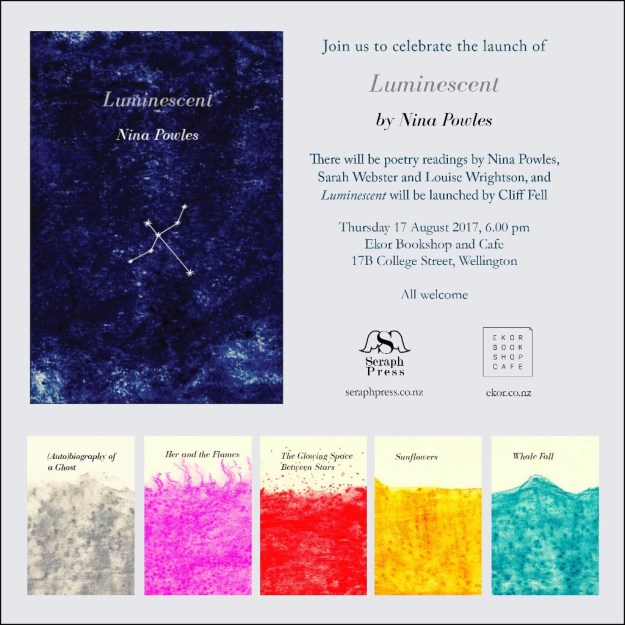
Invitation to launch of Luminescent by Nina Powles

dc10965e-f65b-4cd6-80eb-5c44f8a3eb4b.jpg06da5a13-4f07-4345-9e92-80f1401630eb.jpg

The latest Starling: fresh young voices, new poems by Chris Tse and a Bill Manhire interview


Ruby+Joy+Eade.jpg

The Starling Issue 4


Ok, I am a big fan of this.

This is an excellent issue. Featured writer, Chris Tse’s poems are rich in direction and effect.

Most importantly, the editors are adept at selecting fresh young voices that make you hungry for poetry (and short fiction ) and what words can do. I was going to single a few out – but I love them all! Eclectic, energising, electric, effervescent.


Screen Shot 2017-07-25 at 4.27.11 PM.png


Bill’s interview is a good read:

On rhyme: ‘On the other hand I think sound patterns are at the heart of poetry – they tug words away from meaning and towards music. And one bizarre thing is that the need to find a rhyming word can force you to move in directions you might not have otherwise imagined. Rhyme can make you surprise yourself.’

On needing a dose of humour: ‘The greatest danger for poets is self-importance. Some poets really do believe themselves to be wiser and more perceptive than the rest of the human race.’

On getting students to bring poems by published poets to share in class: ‘The main thing would be that no one in the class would have their minds made up beforehand; or be trying to bypass the poem in order to find out ‘what teacher thinks’. It’s much better for the students to bypass the teacher and get to know the poem directly. Paradoxically, a good teacher can help this happen.’

Poetry Shelf Winter Season: Courtney Sina Meredith off-piste


Uprising


Please be

an uprising


scissor my

black lace


indicate


be light


I’m scared of losing my faith

in people

/

I’m scared of losing my face

/

when I look into silver

your lips kiss all the shit away


I want an electric guitar

with a big circle amp


someone beautiful could sit there

& fuss over me


I like controlling the sea from my bedroom

bleeding & tearing the moon


I like howling at my octopus tits

one in every room


I’m a virgin

framed


a baby grand

next to mops and brooms


please keep calling me


so I can watch

your name flash angry blue

/

a storm

under my pillow

/

electric lines smile in the sky


with my smallest finger

in the smallest hour

I trace the maze


you were good at holding me

when the rain had nobody to fall on


you were good at knowing

souls from bodies


I still wear my organs like 80s leather

I still hear your voice in the corner              be light              be light


©Courtney Sina Meredith


Author note: I was 22 when I wrote this and in a lot of pain, I had no idea what was ahead of me, ignorance really is bliss. Months later I would undergo my first major operation and my endometriosis would be confirmed. I was channeling ancestors and trashing lovers and asking myself to keep on giving when I really felt like there was nothing left to give.

Courtney Sina Meredith is a poet, playwright, fiction writer and musician based in Auckland. She’s held a number of international writers’ residencies including the prestigious Fall Residency at the University of Iowa. In 2012 Meredith published her first book of poems, Brown Girls in Bright Red Lipstick, and in 2016 launched a collection of short stories, Tail of the Taniwha, with Beatnik Publishing.

Courtney Sina Meredith, 2017 Arts Queensland Poet in Residence, will talk to Annie Te Whiu of Queensland Poetry Festival about her poetry, and the importance of place and politics in her writing, see here.


From Paula: For Poetry Shelf’s Winter Season, I invited 12 poets to pick one of their own poems that marks a shift in direction, that is outside the usual tracks of their poetry, that moves out of character, that nudges comfort zones of writing. It might be subject matter, style, form, approach, tone, effect, motivation, borrowings, revelation, invention, experimentation, exclusions, inclusions, melody …. anything!


Writers on Monday poet & essayist Marianne Boruch

 Would anyone like to write this up for Poetry Shelf – for those of us sorry to miss it?

31 July The Little Death of Self: Marianne Boruch

American poet Marianne Boruch notes that ‘Both poetry and the essay come from the same impulse—to think about something and at the same time, see it closely, carefully, and enact it.’ A recent poetry collection Cadaver, Speak, sees her in the dissection room considering the ravages and resilience of the body, and in her new essay collection The Little Death of Self, Boruch’s restless curiosity ranges across science, music, medicine and art, asking questions such as ‘Why does the self grow smaller as the poem grows enormous?’ She is joined by poet and essayist Chris Price to explore how her poetry and essays approach the big topics of love, death and human knowledge.

Event runs from 12.15 to 1.15pm, Te Papa Marae,
Level 4, Te Papa
ADMISSION IS FREE, ALL WELCOME
Please note that no food
may be taken onto the Te Papa Marae

More from Poetry & the Essay Conference


Poet essayist Marianne Boruch at Writers on Mondays
Those of you in or near Wellington next Monday (31 July) will likely want to get yourselves along to this Writers on Monday session which looks like it will be right up our alley.

The Little Death of Self: Marianne Boruch
American poet Marianne Boruch notes that ‘Both poetry and the essay come from the same impulse—to think about something and at the same time, see it closely, carefully, and enact it.’ A recent poetry collection Cadaver, Speak, sees her in the dissection room considering the ravages and resilience of the body, and in her new essay collection The Little Death of Self, Boruch’s restless curiosity ranges across science, music, medicine and art, asking questions such as ‘Why does the self grow smaller as the poem grows enormous?’ She is joined by poetry and creative nonfiction convenor Chris Price to explore how her poetry and essays approach the big topics of love, death and human knowledge.

The Writers on Mondays events are open to the public and free of charge.

12:15pm to 1:15pm, 31 July 2017
Te Papa Marae, Level 4, Te Papa, Wellington

Find out more about Marianne Boruch on the Poetry Foundation website

Conference subtitle
You may also notice that the conference has now acquired a subtitle: Form and Fragmentation. While reading through all the wonderful proposals we have received and attempting to draft a programme, we came to realise that form and fragmentation was one of the key themes that was emerging. We’re sure it will be the topic of many interesting discussions.

Conference programme coming soon
We are delighted and overwhelmed by the proposals we’ve received – more than can possibly fit into a three-day unstreamed conference. We’re working on the programme and trying to include as much as we can. If you’ve submitted a proposal, we’ll be in touch soon.

We’ve decided to delay opening registrations until we’ve published the programme. We’re so excited – it’s going to be amazing!

Our mailing address is:
Dr Anna Jackson
School of English, Film, Theatre and Media Studies
Victoria University of Wellington
PO Box 600
Wellington 6140
New Zealand


Poetry Shelf Winter Season: Ian Wedde off-piste


From ‘A hymn to beauty: days of a year’


Beauty

you’re the trouble I’m in

because there’s a lot of sweetness in my life

with that rude kind of magnificence

as when they hung Le Bateau upside down,

unusually animated and sparking.

Happy Birthday Montgomery Clift:

Where did I see this guy—in Red River

or in From Here to Eternity?

Accept and you become whole

bend and you straighten.


I hung around a little too long

I was good but now I’m gone,

I may find myself in a tight spot

but forge ahead

where satellite images show Yongbyon

and a mariner in the distance appears cordial.

Happy Birthday Betty Hutton

who is to be found in the lines and gradations

of unsullied snow

for your heart will always be

where your riches are.


They’re Justified and they’re Ancient

and they drive an ice-cream van

so do what will help

and don’t worry what others think

if King Kong premieres in New York.

In his eyes, beauty may be seen.

Happy Birthday Lou Reed,

as fast as a musician scatters sounds

out of an instrument.

One thing only do I want

to marvel there.


©Ian Wedde Three Regrets and a Hymn to Beauty (Auckland University Press, 2005)


Note for poetry shelf

In ‘Enjoyment’, the preface to Selected Poems (2017), I ‘confess to restlessness and the enjoyment of subverting my own practice’, which is one way of saying I got bored with myself and switched tracks regularly over the years. In a selection covering fourteen collections these swerves look more abrupt than they were. One place where they converge is in ‘A hymn to beauty: days of a year’, a sequence of fifty-seven sections that sampled lines from songs, the day’s horoscope advice to Librans, a ‘today in history’ clip from the Evening Post, the birthday of someone famous, a quote from the shambolic literature of the Sublime, and a religious homily. It took up 22 pages in its original covers (Three Regrets and a Hymn to Beauty, AUP 2005) and I only stopped when a sensible little voice told me to—I was having too much fun. It took me out of an autoethnography groove, it allowed me to mess around with a complex word, beauty, without being trapped by aestheticising lyric conventions, and it construed narrative meanings that had nothing to do with my intentions. Fergus Barrowman first published the whole thing in Sport 32 (Summer 2004) for which I thank him. Here are three sections, the opening one and two more picked at random with my eyes shut.


Ian Wedde’s first (very small) book was published by Amphedesma Press in 1971 and in May this year his (fairly chunky) Selected Poems was published by Auckland University Press, with artwork by John Reynolds. A small book about the art of Judy Millar, Refer Judy Millar, is just out from Wunderblock in Berlin. His essay ‘How Not To Be At Home’ is in the anthology Home: New Writing just out from Massey University Press.


From Paula: For Poetry Shelf’s Winter Season, I invited 12 poets to pick one of their own poems that marks a shift in direction, that is outside the usual tracks of their poetry, that moves out of character, that nudges comfort zones of writing. It might be subject matter, style, form, approach, tone, effect, motivation, borrowings, revelation, invention, experimentation, exclusions, inclusions, melody …. anything!
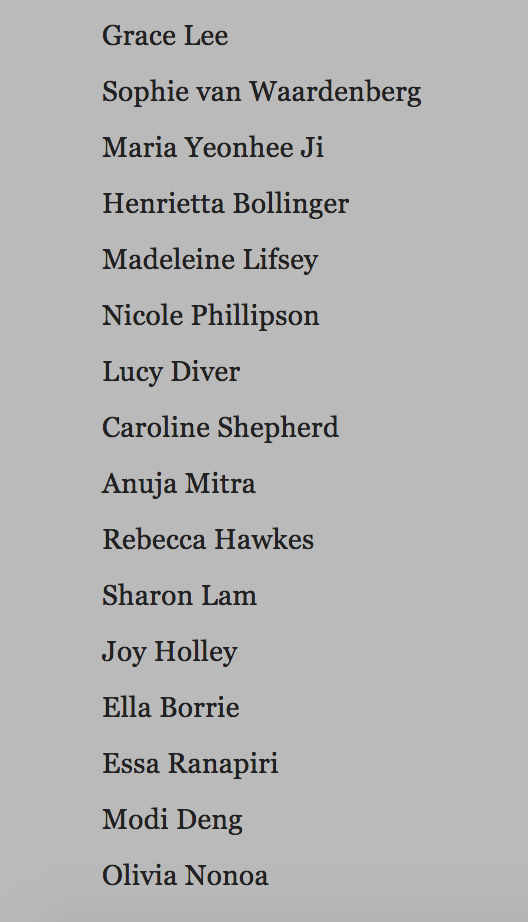


Poetry Shelf Winter Season: Poets off-piste


IMG_4387 (1).jpg


For Poetry Shelf’s Winter Season, I invited 12 poets to pick one of their own poems that marks a shift in direction, that is outside the usual tracks of their poetry, that moves out of character, that nudges comfort zones of writing. It might be subject matter, style, form, approach, tone, effect, motivation, borrowings, revelation, invention, experimentation, exclusions, inclusions, melody …. anything!

Coincidentally, I heard Bill Manhire talk at AWF17, and I liked the way he put it. He discussed the way he encouraged students to ‘jump the tracks, to go sideways from themselves’ and, out of this, produce poetry that mattered to them and would somehow be their own. He also talked about the way he wrote short stories to turn sideways from the comfort track he had settled into with poetry.

I have borrowed the ski analogy because there is something wonderful about heading sideways from the well-skied track to snow that is altogether more risky but offering surprising rewards.

I will be posting poems over the next fortnight.