Monthly Archives: February 2017

Blissful reading -Sweet Mammalian

Screen Shot 2017-02-14 at 9.10.09 AM.png


‘Teach me how to forget the colours of the city as we saw them, just as we left them, bright and full of drowning.’

Nina Powles, from ‘What it tastes like’


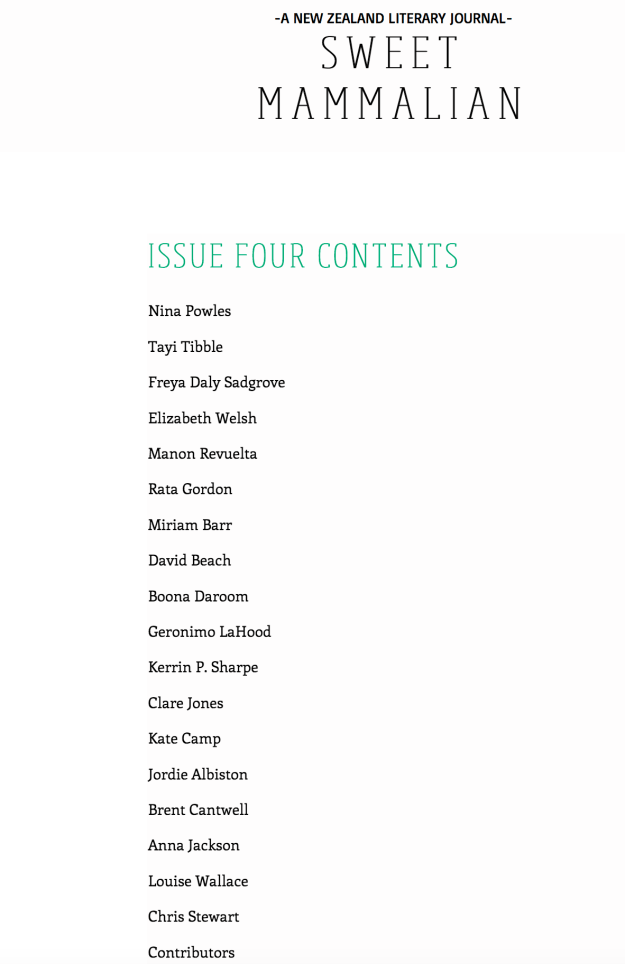
Sweet Mammalian Issue 4 is out now and it is a terrific read (almost finished!).


The magazine is edited by Hannah Mettner, Magnolia Wilson and Morgan Bach – three poets whose work I admire. Here is their goal:

‘We are all sweet mammalians.

This publication comes out of a wish to see more good, new writing out in the world. Our aim is to provide a fresh space for poetry that comes out of the complex, the absurd, the warm-blooded. Our aim is to provide a space for all kinds of writing.’


I got goosebumps reading these poems and I kept reading when I should have been doing other stuff. It felt like I entered a magical music palace where, whichever way I turned my ear, I would hear a different melody- heavenly or sharp. Plus there’s lots of colour!


Clare Jones muses beneath the surface of exquisite detail.

Manon Revuelta, lyrically adroit, employs colour hinges and fertile juxtapositions.

Elizabeth Welsh delivers a lyrical echo chamber, again vibrant with colour, with intense realism giving way to strangeness.

Rata Gordon delivers a surprising narrative coil. I want to read her first collection!

There is the acidic bite of Freya Daly Sadgrove that moves you by surprise.

Tayi Tibble catches a nostalgic light to the point her poem glows.

Nina Powles‘ evocation of memory, in its tilts and slips, is infectious.

There is sheer beauty when you read Chris Stewart.

Louise Wallace dedicates her poem to Rachel Bush, and I am hooked on the way expectation tricks, the way you can hear a hydrangea voice and the way a duet might stumble at the bridge.

Anna Jackson produces sunlight and dark, the easily viewed and the hard to see, yet there is a melodic lift.


You can read the latest issue here.


Screen Shot 2017-02-13 at 8.59.27 AM.png


Poetry Shelf The Summer Season: Poets pick poems – David Eggleton picks Ian Wedde


Mahmoud Darwish

from ‘The Andalusian Epilogue’


Because it’s our last evening on this earth we extract our days

From their leafy camouflage and count the coasts we’ll encounter

And those we’ll leave. There. On this our last evening

There’s nothing left to farewell and no time for fanfares.

This is how everything’s governed. How our dreams are renewed,

Our visitors. Suddenly irony’s beyond us

Because the place is set up to accommodate nothing.

Here, on the last evening

We moisten our eyes with mountains encircled by clouds.

Conquest and reconquest

And an earlier time that relinquishes our door-keys to the present.

Come into our houses, conquerors, and drink our wine

To the music of our mouwachah. Because we are the night’s midnight.

And no courier-dawn gallops to us from the last call to prayer.

Our green tea is hot, drink it, our pistachios are fresh, eat them,

The beds are of green cedar wood, yield to sleep

After this long siege, sleep on the duvet of our dreams.

The sheets are spread, perfumes placed at the doors

And by the many mirrors.

Go in there so we can leave, finally. Soon enough we’ll seek out

The ways our history wraps around yours in distant regions.

And at the end we’ll ask: Was Andalusia there

Or over there? On the earth . . . or in the poem?


(after the French translation by Elias Sanbar of Darwish’s poem in Arabic)


©Ian Wedde The Lifeguard: Poems 2008 – 2013 Auckland University Press, 2013.


The poem I have chosen, ‘Mahmoud Darwish’, is taken from Ian Wedde’s collection The Lifeguard: Poems 2008 – 2013 (Auckland University Press, 2013). This is a book mostly made up of sequences of interlocking poems. One of the sequences is called ‘Three Elegies’, and consists of three poems, titled, respectively: ‘Harry Martens’, ‘Mahmoud Darwish’ and ‘Oum Kalsoum’. These are connected through the life and work of the Palestinian poet Mahmoud Darwish (1941 – 2008). The elegy for Harry Martens remembers an exuberant traveller, linguist and poet, one Harry Martens, who translated Darwish, while the elegy for Oum Kalsoum celebrates a famous Egyptian singer and media star — acclaimed generally as the single most prominent Arab woman in twentieth-century history — who died in 1975. In this latter elegy, Wedde recalls hearing her in the early 1970s ‘singing Darwish in Cairo, /reprise after reprise’, a performance he watched at the time on a TV set in Amman, Jordan.

Of the central poem ‘Mahmoud Darwish’, it could be said rarely has a poem seemed more pertinent than this one right now, when, preening himself like an orange budgerigar, President Trump is obsessively chirping anti-Muslim, anti-Arab tweets on Twitter, intent on scapegoating and marginalising Arab citizens as the dangerous Other. Mahmoud Darwish (1941- 2008) was one of the most accomplished modern poets, not just of the Arab world, but internationally. Furthermore, he is one of the emblematic poets of loss of homeland and exile, of ‘destroyed identity’ — and the central literary figure in Palestinian culture.

The Israelis razed Darwish’s home village to the ground in 1948, when he was seven. He grew up in occupied Palestine. Emerging as a significant young writer in the 1960s, he was imprisoned for reciting his poems, harassed, banned, and eventually sent into exile by the Israeli authorities: a permanent refugee.

Ian Wedde, working with the Arabic scholar Fawwaz Tuqan, translated a number of Darwish’s poems into English in the early 1970s, and Carcanet Press in the UK published these as a Selected Poems in 1973. A copy of this slim volume in its now-faded yellow dust-jacket resides on my bookshelves.

‘Mahmoud Darwish’, however, is not a poem directly about the poet; instead it is a translation from an original poem by Darwish, filtered through a translation into French by Darwish’s friend and fellow Palestinian writer Elias Sanbar. One affinity between Darwish and Wedde is that they are both philosophical poets, ontological poets, concerned with exploring being-in-the-world through language. Another affinity is that they are both cosmopolitan poets, restlessly alert to contexts and cultural allusions. Many of the poems in The Lifeguard emphasise a kind of stream-of-consciousness effect, or are, in their reverie, even occasionally teasing reminiscent of Walter Benjamin on hashish.

‘Mahmoud Darwish’ picks up on the same phenomenological pressure, but then artfully opens out into a sort of liminal dream space. Its verbal music, at first acquaintance, seems to have an air of yearning, as it evokes what might be a mirage, an oasis, a sequestered courtyard. But gradually, reread, the poem becomes increasingly haunting, subtly plaintive, and the tone you might at first take for lassitude, world-weariness, melancholy, begins to resonate in a more complex way. Beneath the incantatory language and luscious imagery, the air of fatalistic resignation, is a smouldering anger and underlying bitterness.

Wedde has actually only selected the first of eleven poems in Darwish’s original ode sequence, titled by one translator ‘Eleven Stars Over Andalusia’, or as Wedde calls it ‘The Andalusian Epilogue’. All the poems in the original sequence are variants of classic Arabic verse forms, pushing and pulling and prescribed rhyme schemes and standard imagery.

Andalusia in southern Spain is a mythical homeland for the dispossessed Palestinians. It’s a region of medieval artistic accomplishments, where Muslims, Jews and Christians lived together in harmony for centuries until Muslim Spain — al-Andalus — was conquered by Christians from northern Spain in 1492. Darwish wrote this poem on the anniversary of the Fall in 1992, in part in response to Yassir Arafat’s peace negotiations with Israel at that time, which Darwish regarded — rightly, as it turned out — pessimistically. ‘Mahmoud Darwish’, then, is a poem about harsh realpolitik, only cast in sensual cadences; it’s a poem of disillusionment, affirming a lost cause. The tribal bard calls on his people’s collective memory to mark the ongoing occupation of the homeland and the intransigence of the conqueror — that conqueror’s policies of eradication, subjugation, apartheid  — in language reminiscent of the Song of Solomon.

 David Eggleton


David Eggleton lives in Dunedin, where he is a poet, writer, reviewer and editor. His first collection of poems was co-winner of the PEN New Zealand Best First Book of Poems Award in 1987. He was the Burns Fellow at Otago University in 1990. His most recent collection of poems, The Conch Trumpet, won the 2016 Ockham New Zealand Book Award for Poetry. He is the current Editor of Landfall, published by Otago University Press.

Poetry Shelf The Summer Season: Poets pick poems – Sue Wootton picks Rhian Gallagher


The Wash House


The turning on was slower done — the firebox stoked,

the wooden lid the copper had, gilded shine of its deep pan.

And side by side two great stone sinks

for suds and rinse, could hold a muddy child.


The place became a store — chook mash,

pig grits — housed a mat and dust of wares,

played host to mouse. Cat found a hide for bed

and laid her kittens there.


One small window choked with web,

light gave way across the floor; each step

softening to listen hard

though you could never say what for.


Warped tracks of tallboy teased, opened to a world of finds.

A jar of pennies turned to bank. Rust crept

along the blades of knives. And each oilskin coat, from its nail,

stiffened like a corpse impaled. The kittens ended in a sack.


The shedding held small lost endeavour, walls with cracks

poached by the weather, dissolved the meanest acts of time

where garden slept in seed sachets, the mewing

ghosts, the lynching strength of binder twine.


©Rhian Gallagher, Shift Auckland University Press, 2011.


Rhian Gallagher publishes beautiful poems, each one of them burnished to a sheen. Her first volume, Salt Water Creek, was published in the UK and shortlisted for the 2003 Forward Prize for best first collection.  In 2012, her second collection, Shift (Auckland: AUP), won the NZ Book Award for Poetry.

How to choose a favourite poem from her oeuvre? I can’t, actually – there are many poems from her two collections that I love. So it’s been a deep pleasure these past few days to read both books again in search of one poem to talk about. At random, here are a few of the Gallagher lines that slay me: What did I ask of you, water of no-going…? (“Salt Water Creek”);  Reaching for you was to hear the light expand (“A Winter’s Room”); Give us this day, cobbles worn to shine like water (“In the Old Town”); To walk off the edge of the green world (“Under the Pines”); It’s always been a wired country (“Paddocks”); Heat radiated from the schist, the air felt migrated (“The High Country”). The spirit animating these poems is open and alert; the writing is sensual and intelligent.

“The Wash House” is one fine example among many possible fine examples.

It’s a poem I simply cannot tire of. It casts its enchantment early through lulling lyricism, assonance, consonance and internal rhyme. I’m hooked before I know I’m hooked. Into this sound-cradle, Gallagher embeds concrete visual details: the firebox, the wooden lid of the deep and shiny copper, the stone sinks, a muddy child. Ah, you might think, how nostalgic. You would be wrong. As the poem progresses, its lyrical charm builds and intensifies. By the middle stanza, we’re hypnotised. Quietly and slowly, we step with the poet behind the “window choked with web”. We “listen hard”. Our eyes and ears adjust, and suddenly we’re in the “world of finds”, and what we find there is both brutally real and threaded through with the uncanny. Gallagher’s exquisite, multi-dimensional craftwork is invisible, but everywhere, in this poem (take the selection and placing of the last word, for one example). I recommend reading “The Wash House” aloud – I recommend learning it by heart.

Sue Wootton


Sue Wootton lives in Dunedin where she is a PhD student researching the affinity between medicine and literature. She is the selecting editor for the Otago Daily Times Weekend Poem column, and co-editor of the Health Humanities blog Corpus: Conversations about Medicine and Life. Her novel Strip (Makaro Press) is longlisted in the 2017 Okham NZ Book Awards. Her fifth poetry collection, The Yield, will be published in March by Otago University Press.

website here

corpus.nz

Poetry Shelf The Summer Season: Poets pick poems: Jeffrey Paparoa Holman picks James K Baxter


The Communist Speaks

Do not imagine I could not have lived

For wine, love or poetry,

Like the rich in their high houses

Walking on terraces above the sea.


But my heart was caught in a net

Woven out of strands of iron

By the bleak one, the thin one, the basket-ribbed

Coolie and rickshaw boy


Who has not learnt the songs that ladies like,

Whose drink is rusty water,

Whose cheek must rest on a dirty stone,

In whose hands lie the cities of the future.


©James K Baxter Runes Oxford University Press, 1973.

(Poem copyright the estate of James K. Baxter, used with permission.)


When Paula invited me to contribute my thoughts for her Summer Season: Poets on Poems, I knew pretty quickly it would be something from James K. Baxter. He was a huge influence on me in the early 70s and I leaned on what I learned from him for years. A year after he died, in 1973, Oxford University Press published his last collection Runes and I got to know my copy pretty well. Of course, I also had Jerusalem Sonnets, Autumn Testament, Jerusalem Daybook and Ode to Auckland, all read and re-read intensively – but somehow, the poems in Runes got under my skin.

Baxter could make personal vatic utterances in the middle of a poem that stuck with you, his philosophical bent dropping them into a flowing sequence about his father, or his daughter, or a night in some bush hut up the tops. These late poems were all pre-Jerusalem, before abandoning his family and suburbia, heading to Jerusalem; they were all South Island poems, too.

The one I thought I wanted to write about was the book’s last, ‘Letter From The Mountain’, closed off by the unforgettable line, “My door has forgotten how to shut”. It seems now a precursor poem to the Franciscan poverty verse of his Wanganui River sojourn amongst Ngā Mokai, The Fatherless. It still carried echoes; now curious, I went back and read the whole book. It was like visiting an old town where I’d grown up, or time travelling into a world that has disappeared, and my self, being long since changed, unable to quite belong.

Then I came to ‘The Communist Speaks’, a poem that also had haunted me, harking back to the time he spent in India with his family on a UNESCO Grant in 1959. Jacqui Sturm has since spoken on record about how this experience upended a man already on the margins; how the extreme poverty of those he saw unhinged his sense of who he was, and led ultimately to his rejection of the middle-class Kiwi lifestyle he’d always been wary of and critical towards.

It’s a simple, declarative poem of three short stanzas, more of a song, an incantation than any of the others in the collection, standing in bleak relief to the libidinous salvos that open the book: the love, lust and losing poems of Words To Lay A Strong Ghost. Who could forget the image of Egnatius (a nom de plume), “…the ugliest South Island con man…who cleans his teeth with AJAX” (The Party).

In ‘The Communist Speaks’, however, Baxter was laying out a road map for his own future, whether or not he quite knew it at the time – as well a laying down a wero, a challenge to us, his inheritors. This is a poem about inequality, about desperate poverty, of “the basket-ribbed/Coolie and the rickshaw boy/…/In whose hands lie the cities of the future”.

It is a poem that speaks to me afresh in a country where families sleep in cars and investors buy the houses beyond the reach of the poor who cannot afford them, then make a living off these less fortunate backs through charging high rents, taking money for food and other necessities off the table of the tenants – and their children. This is South Auckland today: Baxter may be dead but in a poem like this, he lives on.

Jeffery Paparoa Holman


Jeffrey Paparoa Holman has worked as a sheep shearer, psychiatric social worker, postman and bookseller. He is now a senior adjunct fellow in the University of Canterbury. He has published memoir, non-fiction and several collections of poetry. In 2014-15, he studied in Berlin on a Goethe-Institut scholarship, researching a family history project. His next collection, Blood Ties: New and Selected Poems 1963-2016 (Canterbury University Press) is due in February. Dylan Junkie, fanboy poems for His Bobness (Mākaro Press, Hoopla series) will appear in April.

Poetry Live Kicks off 2017 with Anne Kennedy (report from Carolyn Cossey)

AnneKennedy.jpg

Photo credit: MW Sellwood


You know that the year is settling into its groove when Tuesday nights are again occupied with a trip to the Thirsty Dog for Poetry Live. The first session for the year was held on the 7th of February,  with Anne Kennedy as the featured poet.

Anne has recently returned to Auckland from her year as Writer in Residence at Victoria University, to resume her teaching position at Manukau Institute of Technology’s creative writing programme.

Anne’s poems through the night were in turn political, and personal, and always wrapped in her wry humour. Her stage presence was somehow ethereal, and compelling. (Okay, I know, I’m fan-girling, but it really was that good!) She began by dedicating her first poem to the group of Indian students currently facing deportation from New Zealand due to their association with immigration fraud. She touched on Trumpism and its seed stock from observations during her Hawaiian years, with her sonnets.


‘That thing
on the rim of the glass is the sun going down
on America.’


There were familiar favourites, such as ‘Island Bay has a new sea wall’, but we were also privileged  with new material; Anne read from a series ‘Transformations’, based on a poem by her late brother. Her final poem was by fellow MIT lecturer Tusiata Avia, published in Ika 3, ‘We are the diasporas of all of us’.

The scene was set for the evening by the raw blues of MW Sellwood. Finally, the Poetry Live team announced the appointment of Sophie Proctor, to fill the vacant MC spot.


Carolyn Cossey

Poetry Shelf The Summer Season: Selina Tusitala Marsh picks Tusiata Avia


This is a photo of my house


It has pink bricks and a big tree. This is the driveway, you can lie on it in the summer, it keeps you warm if you are wet. This is the screen door, swallow. Front green door, hold your chest. The carpet is dark grey and hurts your knees, it doesn’t show any blood. Here are the walls, be careful of the small girl in the corner. Here is the door into the hall, be careful of that too. Here is the line where the carpet stops and the kitchen starts, that is a different country—if you are in the kitchen you are safe, if you are in the lounge on your knees you are not. Watch out for the corners. She isn’t going anywhere. There is the piano. There is the ghost. Here is the hall, it is very dark. Here is the bedroom. Here is the other bedroom, babies come from there. Here is the last bedroom, it is very cold, there is a trapdoor in the wardrobe, it goes down under the floor and you can hide if there is a flood or a tornado. There is the bath. The aunty punched the uncle in the face till he bled, they lived in the small room, the cold one, that was before I was born. Here is the lounge again, here is the phone: ringthepoliceringthepolice. Here is the couch, it is brown, watch out for the man, he is dangerous. Here is the beginning of the lino in the kitchen again, here is the woman. Watch out for the girl in the corner, she is always here. There is the woman, she just watches and then she forgets.

I am cutting a big hole in the roof. Look down through the roof, there is the top of the man, you can’t see his face, but see his arm, see it moving fast.

I am removing the outside wall of the bedroom. Look inside, there are the Spirits, that’s where they live.

Stand outside in the dark and watch the rays come out through the holes—those are the people’s feelings.


©Tusiata Avia,  Fale Aitu | Spirit House, Victoria University Press, 2016.


This is not a favorite poem.  It is not kind or gentle on the ears, eyes or heart.  But it is unforgettable.  Its quiet violence, the way it creates in-breaths of silent horror through concrete objects, the materiality of the powerful against the powerless in domestic spaces, the neutrality of nothing, imbalances me.  The manner of this poem reflects the nature of domestic violence – that all is seemingly known and visible, like a normal brick house on a normal street, and yet, inside the walls thrive secret spirits inhabiting the dark corners of our lives.  The voice in the poem remembers and pries open these walls, as one would do with a doll’s house.  She stands back and notices the pinprick light escaping through the openings she’s made.  This is how she begins to exorcise secret pain.  This is how memory might work.

Selina Tusitala Marsh


Selina Tusitala Marsh is Associate Professor of English and Pacific Literature at the University of Auckland. She is of Samoan, Tuvaluan, English, Scottish and French descent. Her first collection of poems, Fast Talking PI (Auckland University Press, 2009) won the 2010 NZSA Jessie Mackay Best First Book Award for Poetry. Selina was the Commonwealth Poet for 2016 and performed her poem, ‘Unity,’ for the Queen at Westminster Abbey. She was made Honorary Literary Fellow in the New Zealand Society of Authors’ annual Waitangi Day Honours, 2017.

Tusiata’s collection is longlisted for The Ockham New Zealand Book Awards.


Poetry Shelf The Summer Season: Poets pick poems – Airini Beautrais picks Gregory O’Brien


The clod of earth speaks


2004


I have come to Waitangi,

Said the leader of the opposition.

But I have always been here,

Said a clod of earth scooped from the ground.


We are for the leader of the opposition,

Sang the enclave of suits.

So am I,

Intoned the clod, mid-air.


2005


Although you didn’t recognise it at the time

I was your best idea


a thought bubble hovering just west

of your changeable complexion.


That, between the two of us, we might arrive at

some natural relation


between man and land, I was a hearing aid

that you might hear,


a handful of clay rubbed into your eyes

that you might see.


A year has passed, I am often asked

where the flying clod


finally came to rest. Up north

we have a saying:


the mud outlives

the man.


You never stood easily inside

your body – you needed


earth to steady you. That I offered.

Every gardener’s dream:


A good manuring. Time did not

stand still for me:


I was raised up, remembered

as ‘the high flying one’,


but also that most stationary of things,

the everything-returning earth.


©Gregory O’Brien Afternoon of an Evening Train Victoria University Press,  2005.


In 2004, Don Brash, then leader of the opposition, delivered a now infamous inflammatory speech at the Orewa Rotary club. Amongst other things he claimed that Māori were the recipients of unfair privilege, and described the Waitangi tribunal process as the ‘now entrenched Treaty grievance industry.’ The full text of Brash’s speech is available online.

The speech sent ripples of hurt throughout Aotearoa: amongst Māori, amongst non-Māori, amongst people working for reconciliation.

In 2004 I was 21, living in a flat with six staunchly political women and genderqueer people. Some of us were directly involved in working with treaty issues, particularly aiming to educate our wider communities about the history of the treaty and its importance in the contemporary world.

When Brash attended Waitangi Day celebrations in 2004, he was showered with mud and hit in the face with a clod of earth. It felt like the clod of earth was speaking for a lot of people. It was speaking for us.

Later, when Greg O’Brien’s poem ‘The clod of earth speaks’ appeared, I remember reading it and thinking ‘Yes.’

Responses to reading poems vary, even when poetry is one’s ‘thing.’ Sometimes I am quietly impressed. Other times I’m delighted by a poet’s technical skill. At times I’m ambivalent, at times I feel ‘that doesn’t work,’ and so on. The poems that have really stayed with me over the years have been the ones that reached me on an emotional level. Somehow these poems have said something I needed or wanted to hear; something that stops me in my tracks. ‘The clod of earth speaks’ is one of my favourite New Zealand poems for this reason. I remember being excited that O’Brien was willing to tackle this subject, one which might quickly be put in the ‘too hard’ basket by many writers. Few subjects in New Zealand have the potential to touch on so raw a nerve. For Pākehā poets it might be easy to say ‘That has nothing to do with me, I have no place writing about it, I’ll leave it for someone else.’ But it has everything to do with us. We live on this piece of earth.

I like the way this poem is divided into two sections, the first the symmetrical, call-and-response exchanges of Brash and the clod. I like the shift in tone in the second half, where the clod is given the last words, stating ‘I was your best idea . . . a hearing aid / that you might hear. . . .’ Ventriloquising through the clod, the poet asks a politician, but in fact all of us, to listen. The final line ‘the everything-returning earth’ is a call to humility: a reminder of our fallibility and mortality, and our responsibility to the land and to each other.

In the collection Afternoon of an Evening Train, this poem is included in a short section entitled ‘Two handfuls of earth’, alongside another political poem, ‘Dominion’. A number of other poems in the collection feature the story of Parihaka. There are strongly thematic concerns in the collection, various approaches to place being the most evident. ‘The clod of earth speaks’ marks an important moment in New Zealand history; Afternoon of an Evening Train is a significant waypoint in New Zealand poetry.

Airini Beautrais


Airini Beautrais is the author of three poetry collections. A fourth collection about the Whanganui river region is forthcoming later this year.


Poetry Shelf The Summer Season: Poets pick poems – Bill Manhire picks Louise Wallace

DSCN7357.jpg

Four Seasons on Poetry Shelf aims to widen the scope of voices, selections, opinions, poetry tastes, sidetracks, reading options in 2017 on the blog. Each season will be different.


First up, The Summer Season where, over the course of two weeks, New Zealand poets pick a favourite New Zealand poem and offer a few comments.

I have spent the past year reading, writing and researching my way through poetry by New Zealand women for my book. Sometimes a poem feels like a foreign country, a sea in which I haven’t the foggiest idea how to swim, and I feel like I am treading water, hopelessly. But sometimes, upon return, when the light catches the poem aslant (thanks Cilla McQueen!), I find myself swimming and it is heaven. Sometimes it’s just a matter of changing stroke, of navigating the tidal flow with different eyes. Different ears.

Reading outside your comfort zone, reading into the unfamiliar along with the much loved, is an absolute joy.

Yep, poetry is an absolute joy.


To launch the season, I am posting a poem Bill Manhire is very fond of:

‘Poi Girls’ by Louise Wallace (Since June, Victoria University Press, 2009).

Bill also suggested including a link to Louise’s excellent short note on the Best New Zealand Poems site. However Louise has granted permission to post both the poem and the comment. Thank you!

The Poi Girls

Kahu, Mere, and Faith
stand on the grass
by the corner.
They lean
on the fence and watch you
walk past –
spinning, twirling their poi.
Pou
Pou
Pou
The Poi Girls
say with their poi,
with each hard slap
of their poi.

On your way home
they’re in the same spot,
Kahu, Mere, and Faith.
Their older brothers and cousins
are fixing the car, out
on Mere’s lawn.
The boys stop as you
walk by.
They lean their hands
on the car’s sides and look out
from under the hood.
What
you
want?
The Poi Girls
say with their poi.

You’re walking
down the dip
but you have left
your shoes at school.
The yellow seeds
stick to your feet,
and when you get up
the other side, The Poi Girls
are looking
at you.
Om
Om
Om–mee
The Poi Girls
say with their poi.
Piss off,
you tell them,
leave me alone.
You don’t need
their crap as well.

You stuff Pak ‘n Save bags
into white plastic
and tie
them up with string.
You walk past the corner
twirling and spinning,
Hey
you!
Bumheads!
you say with your Pak ‘n Save poi.
The Poi Girls chase you
down the street
but you are too little and fast
for them,
especially for Faith, the fat one,
the one with the lighter skin.

One day in the cloakroom
It’s just you and Thomas
and he tells you
you have beautiful eyes –
green and brown,
just like his girlfriend, Jade’s.
The Poi Girls burst in, twirling.
You
kissed
Thomas!
The Poi Girls
say with their poi,
your cheeks
pounding flush.

Your sister tells you
to run through the mud
and you say you will
and that you don’t even care.
So you run
and halfway you sink
to your waist
and down the dirt road
come The Poi Girls, slowing
to a stop.
Ha!
You
egg
The Poi Girls
say with their poi
and leave
with your sister
in tow, twirling.

It’s sunny but cold
that morning, on the way
to school.
Mere’s front lawn
is filled with cars,
and there are people in suits
and old koros with sticks
and The Poi Girls stand
out the front.
Mere doesn’t
look at you today,
so Kahu and Faith
glare twice as hard for her.
The Poi Girls’ poi
hang still
from their hands
and today
say nothing at all.

©Louise Wallace Since June, Victoria University Press, 2009.


Louise comments:  ‘ “The Poi Girls” is one of those rare poems that came to me almost fully-formed in the middle of the night. I scribbled it down then and there, and I wish this happened more often! I grew up in Gisborne and the essence of this poem comes from there. The poem is about childhood, curiosity and the nature of difference, but contains a certain menace too. Through the sound of the poi and its repetition I hoped to convey the weight and seriousness that events so often have when you experience them as a child.’


Best NZ Poems

Listen to the poem here.

Poet honoured on Waitangi Day: Selina Tusitala Marsh, Honorary Literary

1456791150657

Acclaimed poet and scholar, Selina Tusitala-Marsh, has been made Honorary Literary Fellow in the New Zealand Society of Authors’ annual Waitangi Day Honours.
“As the country’s largest writers’ organisation, we believe it’s important to celebrate significant literary achievements, especially on the international stage,” said NZSA President, Kyle Mewburn. “Each year more and more kiwi writers are achieving exceptional things internationally. Last year was no exception.”
“As 2016’s Commonwealth Poet, this year’s NZSA Literary Fellow, Selina Tusitala-Marsh, was able to share her unique and powerful voice with the world. This included a memorable performance before the Queen at the Commonwealth Day of Observance in Westminster Abbey, which placed the diversity of our local poetry in the international spotlight,” Mewburn said.
“Fa’afetai tele lava for this lovely acknowledgment,” said Tusitala-Marsh. “The wondrous thing about a poem is that it’s an ‘ala’ – the proto-Polynesian word for ‘path’. As a ‘Tusitala’ my poems are paths between cultures and world views. In 2016 a poem found its way into Westminster Abbey connecting my Tuvalu grandfather with the Queen of England, Samoan philosophy with global ecology, and a New Zealand Fast Talking PI poet with the Commonwealth. How marvellous is that? Here’s to paving more poetic paths!”
First introduced in 2013, the NZSA’s Waitangi Day Honours celebrate success on the international stage.
“As the only writing awards bestowed by peers, they have become a highly regarded and prestigious honour,” Mewburn said.
Previous winners include Eleanor Catton, Paul Cleave and Philip Mann.