Monthly Archives: February 2017

Poetry Shelf The Summer Season: Poets pick poems – Anna Jackson picks Bob Orr


Swordfish . . . Far Hotel

That’s me up there cast in plaster

above the wide window

of a coastal pub’s vista bar.

I am the trophy of some forgotten fisherman.

Cigarette smoke fogs my vision

but I still see that day the trophy of my life was taken.

Again I feel. I feel the hook deep within me catch

I feel my anger whip

I feel the tackle tighten

I feel my guts explode

I feel the rainbow strength of colours in me leap

I feel the sky like a mirror smashing

I feel the sun across my dorsal fin get torn

I feel the waves beneath me again and again split open

I feel the blood in the protein church of my heart begin to chant

I feel the hook in my brain burning

I feel the trace against my jawbone cut

I feel time tight as a nylon line almost breaking

I feel the great poem of my life and I know that it is ending.

©Bob Orr Valparaiso Auckland University Press, 2002.


I found myself hesitating between two very different poems I could choose, Janet Charman’s “pin unpin pin unpin pin,” which so vividly recalls the intensity of new motherhood, or Bob Orr’s Hemingwayesque fishing poem, “Swordfish…Far Hotel,” told from the point of view of the fish, now caught and cast in plaster.  My reason for choosing the fishing poem is the experience I had of reading it out loud once at a National Poetry Day event at Te Papa, and feeling myself caught on the line of the poem just as it describes the fish caught on the fishing line.  It is an extraordinarily taut and powerful poem and reading it was one of the great poetry experiences of my life.  It can be found in Bob Orr’s 2002 collection Valparaiso, which is full of favourite poems of mine, including “Eternity” (“Eternity is the traffic lights at Huntly…”), “Remembering Akhmatova,” and “Friday Night…Alhambra Bar,” amongst others.

If we weren’t limited to New Zealand poems, I’d choose “Viewless Wings,” by Mark Ford, the poem which best captures the “lyric strangeness” that Alex Hollis and Simon Gennard have been talking about as what poetry is for, and what poetry needs.  It is the poem I would most wish to have written myself, and now am looking for some way to write past.

Anna Jackson


Anna Jackson lives in Island Bay, Wellington, lectures at Victoria University, and has published six collections of poetry, most recently I, Clodia (AUP, 2014).  With Helen Rickerby and Angelina Sbroma she quite often runs conferences and other events for talking and thinking about writing, this year a conference on Poetry and the Essay.


New Zealand Poetry Yearbook 2017 launch details


PNZ+yearbook+2017.jpg


The poets are descending on Devonport Library to celebrate the publication of the New Zealand Poetry Yearbook 2017, edited by Jack Ross and published by Massey University Press.

The book is being launched by Devonport’s own Michele Leggott, and the evening will include readings by ten poets, including Yearbook 2017’s featured poet Elizabeth Morton.

Words, wine, smiles …. It will be a night to remember!

Where:Devonport Library, 2 Victoria Road, Devonport
When:Tuesday 14 March, 7.30pm till late
Cost:Koha appreciated

A Devonport Library Associates Event


Poetry Shelf The Summer Season: Poets pick poems – Bernadette Hall picks Anne Kennedy


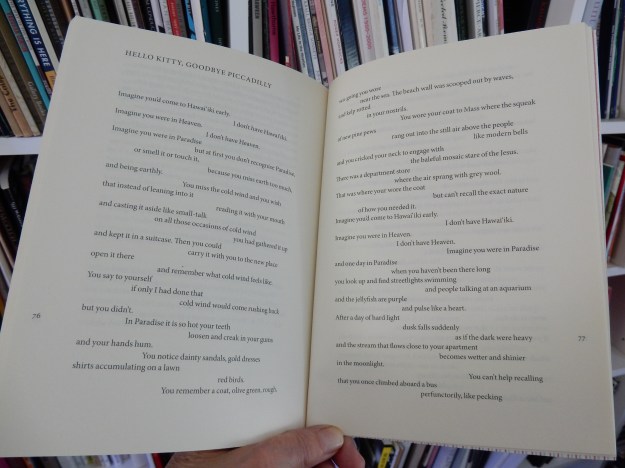
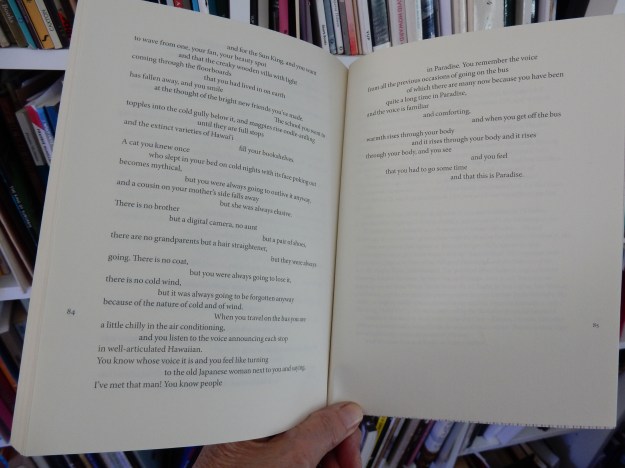
DSCN7352.jpg

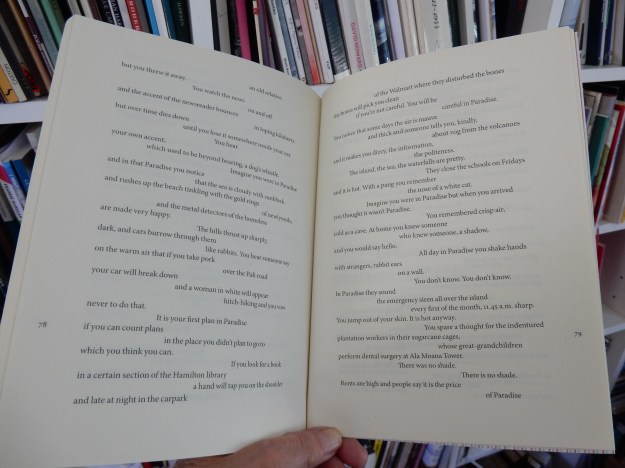
DSCN7353.jpg

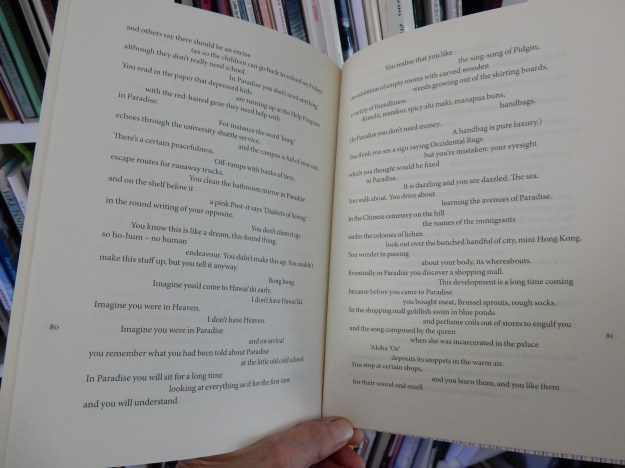
DSCN7354.jpg

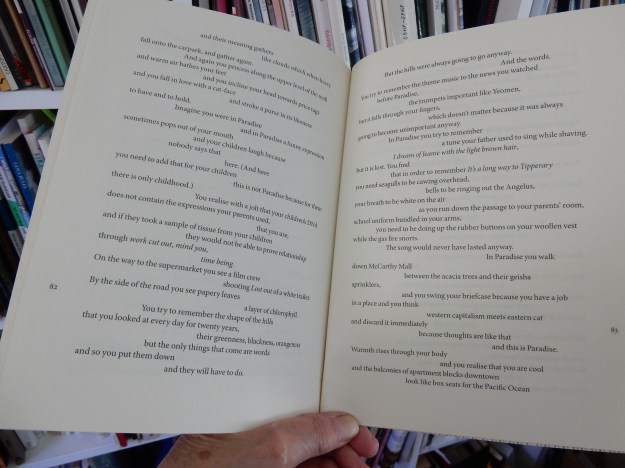
DSCN7355.jpg

DSCN7356.jpg


©Anne Kennedy, The Darling North, Anne Kennedy, Auckland University Press, 2012.


Bernadette Hall comments on the poem:


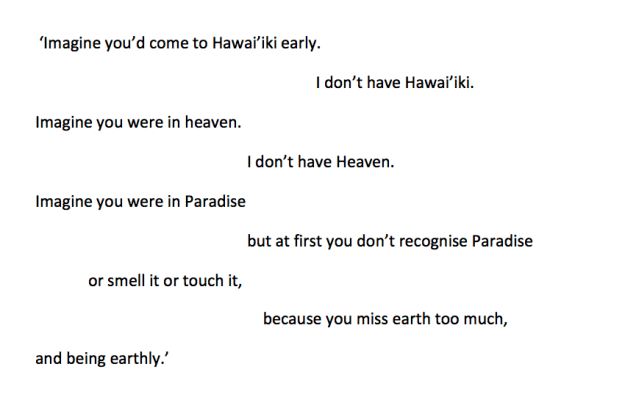
Screen Shot 2017-02-04 at 3.03.44 PM.png


I first read these lines in 2012. Anne Kennedy’s book had just come out. I read the lines and I fell in love with them. I held onto the poem that held onto them as if it was a life-raft. Every time I read that poem, Hello Kitty, Goodbye Piccadilly, (and I read it often) I have the same feeling of home-coming. The thinking is within the same territory I’m fixated on: the tension between the dream places, the places of beginning, of origin, the places that arise from myth. And the materiality of here and now, the stuff that arises from star dust just as our world does and everything including us within it.

On the one hand there’s the ancient dreaming, the naming and the renaming of myth and ritual. Of religion and philosophy. The stuff of the mind, the soul and the imagination. The stuff of desire. And then there’s the solid ground beneath our feet. There’s a collision here surely. How are we to shape a language that it is capacious and mobile and courageous  enough to handle collision and complexity?

It’s an ancient curiosity, this, to ask the existential questions : unde? whence? quo? whither? cur? why? Philosophers and theologians are the professionals. But so often their thinking has been disembodied. Maybe it was up to poets to explore the connective tissue between concrete and abstract, to make new alliances between thought and matter. The body, the mind, the heart, the soul. How serviceable the old language was. But how are we to reveal ourselves to ourselves today?

The framework of Hello KittyGoodbye Picadilly  is the shift from New Zealand with its theatre of memories to Hawai’i. It’s a move north, away from the cold wind – ‘you wish you had gathered it up / and kept it in a suitcase’ – to a Pacific ‘Paradise’. The kind of place the French sailors with Marion du Fresne thought they’d found in Tahiti. But then they went on and found a Pacific ‘Hell’ when they landed in the Bay of Islands in 1772. (I’m fresh from reading Joanna Orwin’s marvellous novel ‘Collision’ that explores these things with spectacular success.)

What I love about the poem is that it arises out of uncertainty, out of questioning. Out of a sense of what’s missing.

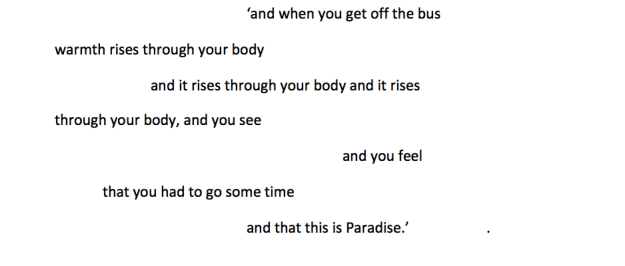
There are those repeated lines, the repeated negatives : ‘I don’t have Hawai’iki’    ‘I don’t have Heaven’. Isn’t this the Socratic method, using negatives to slash away the debris and then see what’s left standing? ‘In Paradise you will sit for a long time / looking at everything as if for the first time / and you will understand.’ So we’re back to the very beginning, in need of language, in need of thinking. But then ‘You wonder in passing / about your body, its whereabouts’. And there’s the female body, the human body, the body, not as something corruptible but as an equal.

Maybe memory is the cache where everything holds together, where everything lasts:


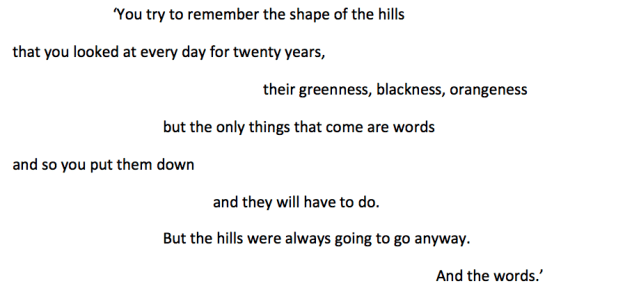
Screen Shot 2017-02-04 at 3.10.11 PM.png


Almost at the very end of the poem there’s a recounting of losses:


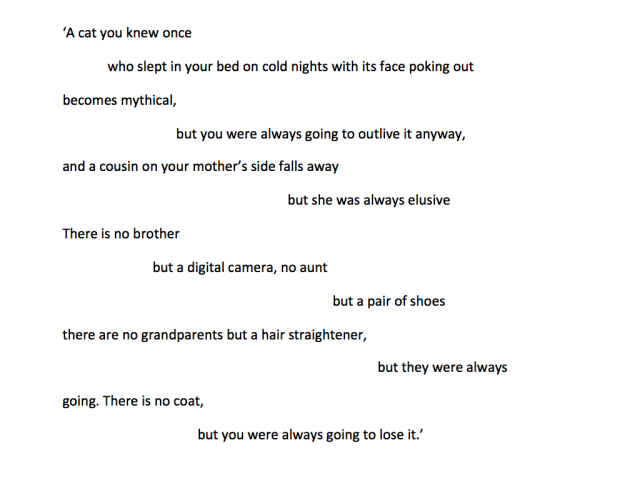
Screen Shot 2017-02-04 at 3.11.53 PM.png


And my heart turns over. I guess these lines just get richer as I age. As the whole question of getting up and leaving the room becomes more present. How is this to be done?

There’s a scene in J. M Coetzee’s novel ‘ Elizabeth Costello’ where the aged academic finds herself at the gates of what we might call heaven.  She has to face judges there, she has to answer difficult questions. Her life as a writer, a life spent of making up things, is under scrutiny.

‘Is childhood on the Dulgannon another of your stories, Mrs Costello? Along with the frogs and the rain from heaven?’

‘The river exists. The frogs exist. I exist. What more do you want?’

Indeed, what?

The final move in the poem is from loss to uplift.  Once again it’s repetition that’s the key turning in the lock, multiplying the ways to enter the text:


Screen Shot 2017-02-04 at 3.07.34 PM.png

.


I love this kind of thing. The depth and the nourishment I find here. The way Anne Kennedy’s writing, like that of Coetzee, opens up new rooms in my head and in my heart.

Bernadette Hall


Bernadette Hall lives at Amberley Beach in the Hurunui, North Canterbury. She has published 10 collections of poetry, the most recent being Life & Customs VUP 2013 and Maukatere, floating mountain, Seraph Press, 2016. The latter includes drawings by the Wellington artist, Rachel O’Neill. In 2015, Bernadette received the Prime Minister’s Award for Literary Achievement in Poetry. And in 2017, she was invested as a member of the New Zealand Order of Merit for her Services to Literature.

National Flash Fiction Day Competition now open


Competition is open.

The 2017 National Flash Fiction Day runs February 15 – April 30.

Send your best 300-word story * Cash prizes * Two categories this year

Adult (19+)

First Prize: $1000

Second Prize: $400

Third Prize: $100

Judges: Michael Harlow and Emma Neale

Youth (18 and under)

First Prize: $200

Second Prize: $100

Third Prize: $50

Judges: Fleur Beale and Heather McQuillan

Winners will be announced June 22 at the NFFD celebrations, and all winners are invited to attend and share their stories.

NFFD 2017 in Auckland, Christchurch, Dunedin, Wellington


HOW TO ENTER

To enter the 2017 National Flash Fiction Day competition, please follow these easy steps:


Payment

  1. Make your payment here, either online or in a ANZ branch near you:

ANZ / NZ Flash Fiction / Acct No 06-0594-0182592-00
include ‘Surname/ First initial’ as a reference

2. Once you’ve transferred your entry fee, send proof of payment (a screen shot will do) along with your NFFD story/ stories to nationalflash@gmail.com.

3. You will receive confirmation of your entry within 72 hours.

4. All entries must be received electronically. If you are not online and wish to submit, please have a friend submit via email.

2017 fees:

19+ category: $7 per story or $18 for 3 stories (3 stories max per entrant)

Youth (up to 18 years) category: $5 per story or $10 for 3 stories (3 stories max per entrant)


Submission guidelines

  • submissions open 15 February – 30 April 2017
  • competition open to all NZ citizens and residents
  • open competition; no theme or prompt
  • only previously unpublished* work will be considered
  • deadline for submissions: 30 April 2017 (midnight)
  • word limit for all submissions (both categories): 300 excluding title
  • 1.5 or double spaced, please
  • no font requirements, but make it clean
  • maximum 3 stories per entrant; if you submit more than one story, please include all submissions in one document
  • electronic submissions only, emailed to nationalflash@gmail.com 
  • please indicate in the Subject line of the email if yours is a youth submission
  • submissions must be sent as attachments (not in the body of the email)
  • send one of the following formats: .doc, .docx, .rtf; please, no pdfs
  • please, no pdfs!
  • submissions must be received  no later than midnight, 30 April 2017
  • Your name may be on the email and any enquiries made to NFFD in the gmail account, but do not include your name or contact info on the attachment. Any submissions with author name on the attachment with the story text will be disqualified.
  • Judges’ decisions are final. No feedback will be offered on an individual basis.
  • Winners and short-listed stories will be published in a special winter edition of Flash Frontier: An Adventure in Short Fiction.

*Published means anything that has already appeared anywhere in print or online, including personal websites or blogs.

The Long List and subsequent Short List will be posted in late May/ early June.  Winners will be announced at the NFFD events in June. More information about the prize-giving celebrations updated on the Events page.


2017 NFFD COMPETITION JUDGES

MICHAEL HARLOW and EMMA NEALE, Category for ages 19+

harlow-2017Michael Harlow’s Nothing For It But To Sing, the Kathleen Grattan Award for Poetry, was published in 2016 by Otago University Press. He has been awarded the Beatson Prize for poetry, and in 2014 the Lauris Edmond Memorial Award for Distinguished Contribution to Poetry in NZ. He has published ten books of poetry, two of which have been short-listed for the National Book Awards.  In collaboration with NZ-Suisse composer Kit Powell, he has composed, as a librettist, some thirteen Performance Works, many of which have been performed in Switzerland, Germany, France and New Zealand.  He lives in Central Otago (NZ) and works as a writer, editor and Jungian therapist.

*

emma-neale-2017Emma Neale has held the Todd/Creative New Zealand New Writer’s Bursary and the inaugural Janet Frame/NZSA Memorial Prize for Literature. Her novel Fosterling was short-listed for the youth category of the Sir Julius Vogel Award. Her poetry collection The Truth Garden won the Kathleen Grattan Award in 2011. She has been a University of Otago Burns Fellow, a University of Otago/Sir James Wallace Pah Homestead Fellow and a recipient of the Beatson/NZSA Fellowship. Her fifth collection, Tender Machines(2015), and her recent novel, Billy Bird (2016), have both been long-listed for the annual Ockham New Zealand Book Awards. Emma lives in Dunedin with her husband and their two  children.


FLEUR BEALE and HEATHER MCQUILLAN, Youth Category: ages 18 and under

pp_fleur_beale_2010Based in Wellington, Fleur Beale has written over twenty novels for teenagers. In 1992, Beale released her first novel Slide the Corner, which subsequently won the Storylines Gaelyn Gordon Award in 2007. She has been short-listed several times in the New Zealand Post Children’s Book Awards, and in 2011 her novel Fierce September won the Awards’ Young Adult Fiction section. Fleur Beale won the 2012 Storylines Margaret Mahy Medal. Beale regularly participates in the Writers in Schools programme, and also leads Professional Development sessions for teachers.

*

heather-2017Heather McQuillan is a writer, teacher and student. She lives in Christchurch where she is a tutor with the School for Young Writers. She writes books for young people as well as writing short stories, flash fiction and poetry. In 2016 she won the NZ Flash Fiction Day prize and the Micro Madness prize, and she placed third in the Sunday Star Times Short Story Awards.She is currently working on a Masters of Creative Writing Thesis investigating  the flash fiction form.


* * *


PAST JUDGES

2016 competition judges were the award-winning poets, novelists and short story writers James Norcliffe (more at his website and at his New Zealand Book Council page) and Elizabeth Smither (more at her New Zealand Book Council page).

2016 competition winners here.

*

2015 competition judges were widely acclaimed New Zealand short story writers, novelists and poets Owen Marshall (more can be found at his New Zealand Book Council site and at his website) and Fiona Kidman (more can be found at her New Zealand Book Council site and at her website).

2015 competition winners here.

*


Poetry Shelf The Summer Season: Poets pick poems – Tim Upperton picks Bill Manhire


Kevin


I don’t know where the dead go, Kevin.

The one far place I know

is inside the heavy radio. If I listen late at night,

there’s that dark, celestial glow,

heaviness of the cave, the hive.


Music. Someone warms his hands at the fire,

breaking off the arms of chairs,

breaking the brute bodies of beds, burning his comfort

surely to keep alive. Soon he can hardly see,

and so, quietly, he listens: then someone lifts him

and it’s some terrible breakfast show.


There are mothers and fathers, Kevin, whom we barely know.

They lift us. Eventually we all shall go

into the dark furniture of the radio.


©Bill Manhire, Lifted  Victoria University Press, 2005.


The eldest of my children published a poem in a recent issue of Sport about the two of us. The poem ends, “We don’t like Kevin but we both like ‘Kevin.'” I forget who Kevin was, but of all the poems of Bill Manhire’s that I admire, this one, “Kevin,” this secular prayer, is the one I admire most. It reminds me of Matthew Arnold’s “Dover Beach,” another secular prayer: what is there, when we all must die, and we have lost religious faith? Arnold finds an answer, of sorts, in personal relations: “Ah, love, let us be true / To one another!” Manhire finds it in human continuity, perhaps the poetic tradition he has inherited, which includes Arnold: “There are mothers and fathers, Kevin, whom we barely know.” The man “breaking off the arms of chairs, / breaking the brute bodies of beds, burning his comfort / surely to keep alive” is no doubt a metaphor, but I think of the great Russian poet, Marina Tsvetaeva, in the winter famine of 1918-1919, who did exactly this. This poem conveys harsh truths, unironically, sympathetically, and in its hopelessness – as in Arnold’s hopelessness – there is a glint of hope, or consolation. Perhaps the only afterlife is in “the dark furniture of the radio” – one of those stained oak radios of my childhood, its transistors humming, a vehicle for the voices of the living and the dead. “They lift us” – “lift” being a particularly resonant word for Manhire – in the way that hymns lifted previous generations. This is such a sad, desolate poem, but every time I read it, it cheers me.

Tim Upperton


Tim Upperton’s poems have been anthologised in The Best of Best New Zealand Poems (VUP) and Essential New Zealand Poems (Random House). His second book, The Night We Ate The Baby (Haunui Press), was a finalist in the Ockham New Zealand Book Awards in 2016.

The Charles Causley International Poetry Competition: Liz Breslin’s winning poem

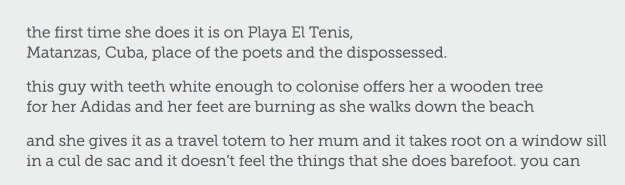
Screen Shot 2017-02-15 at 8.42.43 AM.png

extract from ‘Walk A Mile/ Stepping Out’


‘Liz Breslin is the 3rd prize winner for this year’s Charles Causley International Poetry Competition. Her winning poem is ‘Walk A Mile/ Stepping Out’ and was selected by our head judge Sir Andrew Motion.

As a child in the UK, Liz Breslin memorised Charles Causley’s poems, sitting in the bath. She now lives in Hawea Flat, New Zealand and writes poems, plays, stories, articles, and a fortnightly column for the Otago Daily Times. She also edits, parents, partners, skis badly, gardens sporadically, coordinates a school student volunteer programme, drinks too much coffee and loves getting her feet wet.’


For the full comments and complete poem see here. I loved the way the poem moves – and especially love the ending!

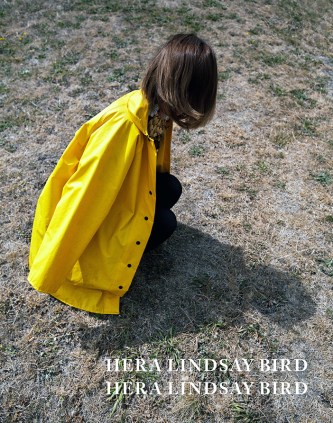
Hera Lindsay Bird reads a poem for Valentine’s Day @radionz @jessemulligan

ca5ff196-de28-4704-a12b-2d6a1292d767

On Radio National this afternoon, a little uplift:

Hera Lindsay Bird reads a poem for big fan, Jessie Mulligan, to celebrate Valentine’s Day.

Listen to ‘If you are an ancient Egyptian Pharoah’ here.

It is so very good!

Poetry Shelf The Summer Season: Poets pick poems – Simone Kaho picks Sarah Broom


Rain

She’s been lying
on the jetty for weeks,
cheek flat on the wet
wood, mouth an inch
from a fishgut stain
knife at her elbow.

The rain just keeps
coming down.

She’s as naked
as a shucked scallop,
raw and white
on the splintered planks.

Her breath is as slight
as the sea’s sway

Up there in the bush
all the trees lean down
and inwards, longing
for the creek
which longs
for the sea.

And the grey ocean
nuzzles the sand,
its waves as gentle
as tiny licks of kisses,
their small collapse
an everytime surrender.

Don’t touch her.
Let it rain.
Let it rain.


©Sarah Broom, Tigers at Awhitui  Auckland University Press, 2010.


I find this a terrifying poem, I feel it offers me hopelessness and acceptance intermingled.  There is spiritual movement away from a body before the body is dead, an exquisitely rendered vulnerability, a painfully sensual strength.

The poem opens on a woman who has been lying on a jetty ‘for weeks’; stopped in the middle of gutting fish, to drop her knife and be still, her mouth close to the fouled wood, which has not been cleansed by the continuous rain.

Some violence has been done on her, she is naked, shucked from her clothes, her position of power – she is as a scallop, an image both sensual and visceral. She has swapped places with the sealife – someone/thing else now holds the knife.

The image of the scallop caught me, an icon of fine dining. It’s tender vulnerability is its delectability; I see the taut white quiver of her on the splintered wood.

In the next line we learn she is still alive, breathing, aware. Unable, then, to move – or unwilling. Is she being punished – is she being defiant?

The likening of her breath to the sea’s slight sway is a dizzying; she is at once barely alive, and conversely, a goddess; inexorable and elemental.

We move up and away into the bush with the curved yearning trees, and the sustaining creek – all longing for the sea, which is far away, with this woman.

The sea in the sixth stanza is like an animal or a lover:

‘its waves as gentle
as tiny licks or kisses,
their small collapse
an everytime surrender.’

This verse holds all the tension of lovemaking.  The woman on the jetty is soothed by the sea, it surrounds her, supporting her breath – the elements are the only things that can reach her now.

This is confirmed for us in the next line where for the first time we are given instructions:

‘Don’t touch her.
Let it rain.
Let it rain.’

We are powerless like her. We must not touch her, we must allow nature.

I think of the rain. How we rush to be out of it because of its wetness and coldness. How I knew my cats were ready to die when they didn’t move out of the rain. Here, it replaces human touch, releasing, relentless.

This poem is spare; precisely descriptive and rhythmic. Small sways of lines like shallow breathing. It presents us injury, danger and paralysis – a helpless naked female, who has not lost her allure despite her diminishment, and her vulnerability – yet prevents us from helping or even empathising. Rather asks us to bear witness to her passage. Her transcendence into an elemental rhythm which we cannot take part in.

I feel this poem has helped me understand my father’s death from cancer more, and given me a glimpse into a pain beyond anything I have experienced or imagined.

Simone Kaho


Simone Kaho is an Auckland performance poet and a graduate of the International Institute of Modern Letters in Wellington. Lucky Punch, Simone’s first book, was launched November 2016. It bridges poetry and memoir as the narrator comes of age in New Zealand’s rich and confusing intersection of pacific and colonial culture. Simone has been interviewed on TV by Tagata Pasifika and will be featured in an upcoming Landfall.


The Sarah Broom Poetry Prize is now open for entries, closing March 2nd. Details here.