Monthly Archives: November 2016

Invitation to send small postcard pieces or photos on Wellington’s LitCrawl for a Poetry Shelf feature

Masses of fans can’t be in Wellington to join the crawl so I would love to share highlights of the LitCrawl

anyone who wants to contribute a few sentences or a paragraph or photos ….

send to paulajoygreen@gmail.com

…. that would be      w o n d  e r f u l


thanks, Paula


The Guardian: Anne Carson’s fragmentary writing and its rewards

Full piece in The Guardian here

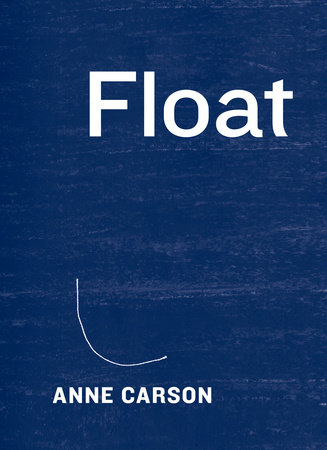
9781101946848.jpg

Refreshing breaks: how fragmented stories can be fulfilling reading

“Reading can be freefall,” runs the blurb on the back of Anne Carson’s new poetry collection, one of several recently published books to offer readers a more interactive way to engage with the printed word. Historically, fragmentation has been used as a troubling effect, or to indicate a subject under stress. These books, however, attempt to unleash the fragment’s liberating force. The effect can be exhilarating.

If the title of Carson’s collection, Float, suggests a lack of direction, so does its format: a transparent slipcase housing 22 chapbooks that we are invited to read in any order. Does that mean the collection doesn’t, then, possess an overall unity? Or is it possible for we readers to supply meaning ourselves?

In 2002, Carson published her translations of Sappho’s poetry, a body of work that, bar a single poem, only exists in fragments because the papyri on which they were written are so damaged. As Carson writes in Float of one work by Sappho: “Half the poem is empty space.” Her translations communicate this fragmentation to the reader, using brackets to convey where the source texts are torn or disintegrated. “Brackets,” she writes in her introduction to the poems, “are exciting. Even though you are approaching Sappho in translation, that is no reason you should miss the drama of trying to read a papyrus torn in half or riddled with holes or smaller than a postage stamp – brackets imply a free space of imaginal adventure”.

Charles Brasch Young Writers’ Essay Competition celebrates Landfall’s 70th Birthday

Charles Brasch portrait by Clifton Firth.jpg

(Charles Brasch was a strong supporter of other writers, notably women poets, who were overlooked elsewhere!).


Press release:

In 2017 Landfall will celebrate its 70th birthday. To mark the occasion, editor David Eggleton and Otago University Press are pleased to launch the Charles Brasch Young Writers’ Essay Competition, open to writers aged 16 to 21.

The competition is named after Dunedin editor, poet and patron Charles Brasch, who founded Landfall in 1947 and was its editor for the next two decades.


Brasch’s influence on New Zealand literature and art is significant and far-reaching: as well as being a meticulous and demanding editor, he was a philanthropist and (often anonymous) patron of the arts. He gave generous support to individual artists and writers, was involved in establishing the University of Otago’s Burns, Hodgkins and Mozart arts fellowships, and bequeathed his extensive collection of New Zealand art and literature to the Hocken Library.

As founding editor of Landfall, Brasch aimed to forge links between literature and its social and political contexts. He published imaginative writing and literary criticism alongside social and cultural commentary, and wanted the journal’s perspective to be ‘distinctly of New Zealand without being parochial’.


Current Landfall editor David Eggleton says the purpose of the competition is to encourage young writers towards achieving the highest standards of literary expression in the art of the personal essay. ‘The ability to write in a sparkling, informed, questioning, self-aware way on any subject — to make it new all over again — is the mark of the finest writing. Landfall wants to receive essays that show this promise from the next generation of emerging writers.’


The Charles Brasch Young Writers’ Essay Competition will be an annual award. Entries will be judged ‘blind’ by Landfall editor David Eggleton. The winner receives $500 and a year’s subscription to Landfall.

Entries for the inaugural competition open on 1 December 2016 and the closing date for receipt is 31 March 2017. The winning essay will be published in Landfall 233 in May 2016.


For further details about the competition visit our website


Escalator Press debuts its first poetry book


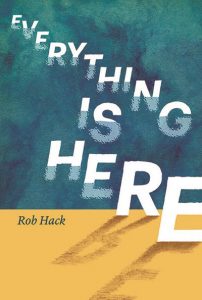
Everything-is-here-Web-Cover-72dpi-202x300.jpg

Not just some poetry hack

Everything is here is Rob Hack’s first collection of poems. It explores his relationship to his Rarotongan heritage as well as his connection to Niue and New Zealand, and the places where his family lived when he was growing up.

Award-winning New Zealand poet Dinah Hawken describes Everything is here as: “…stories from Porirua East, Niue, Paris, Rarotonga, Sydney, the Kapiti Coast; stories told in spare, accessible poems that are both strongly placed, and full of people and day-to-day things. What delightfully holds everything together is Rob’s easy tone and his characteristic, understated humour.”

Hack is a graduate of the Whitireia Creative Writing Programme and completed his Masters at the International Institute of Modern Letters, Victoria University, and is also a jack-of-many-other-trades.

This is the first book of poetry from Escalator Press. The cover is designed by internationally renowned graphic designer Sarah Maxey.


About the author

Rob Hack was born in Invercargill. His mother was from the Cook Islands and his father from New Zealand. He’s worked as an insurance salesman, greenkeeper, builder, night shift worker, personal trainer, cattle station worker and more. He currently spends his handyman earnings on petrol to visit his grandchildren each week and on second-hand poetry books. He’s lived in Paekakariki since 2005 and has performed his poems in Kapiti and Wellington for 15 years. Rob hosts a poetry show on Paekakariki FM called ‘Not at the Table: poetry and stuff ’.

About Escalator Press

Escalator Press is an imprint set up by the Whitireia Creative Writing Programme, and publishes work by new and established writers associated with Whitireia. With production and marketing by the Whitireia Publishing Programme – New Zealand’s highly regarded training course for the publishing industry – Escalator Press is built on traditional publishing values, whether in print or digital media, while developing its own distinctive model and publishing exciting new voices.


Whangarei poetry readings

some northern poets for you:

Poets at Bohemia 14 Rust Avenue Whangarei Thursday 17 November  5 to 8pm

Poets at Bohemia 14 Rust Avenue Whangarei Thursday 15 December 5  to 8 pm

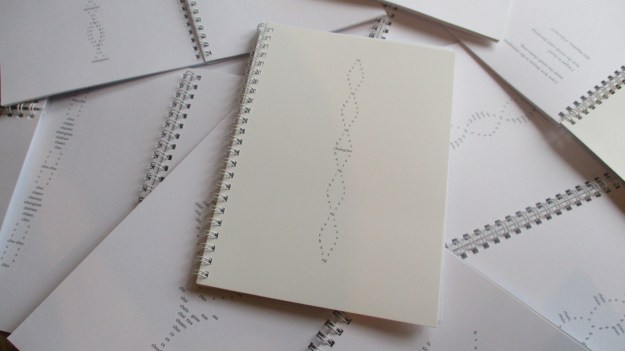
A spiral-bound notebook of visual poems, created in response to the word ‘chaingrass’ from Bill Manhire’s poem ‘Falseweed’

chaingrassimage.jpg


A spiral-bound notebook of visual poems, created in response to the word‘chaingrass’ from Bill Manhire’s poem ‘Falseweed’, has just been released in the UK by zimZalla.

zimZalla is a publishing project which makes literary objects. It is administrated by poet and publisher Tom Jenks and operates out of Manchester.

The poems were made by Catherine Vidler and the book designed by Tom Jenks.

The notebook is preceded by two other ‘chaingrass’ collections which Catherine has made and which have been published this year. A large collection of poems and patterns was published by Stale Objects dePress in Sydney in September, and a PDF chapbook of the poems together with an interview with Catherine, was recently featured in the journal Jazz Cigarette in the United States.

an interview and poem

stale objects


Emma Neale and Sarah Jane Barnett in conversation on Pantograph Punch

9780143770053

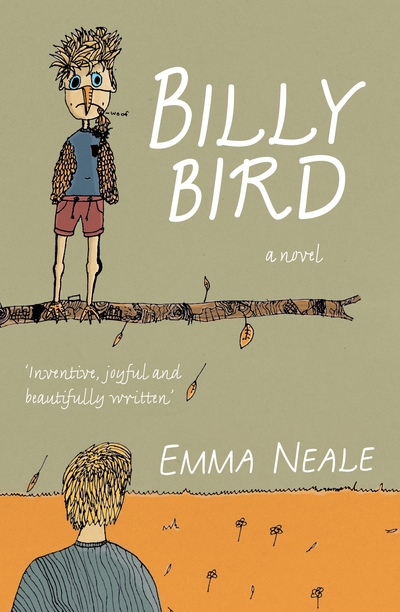
Billy Bird is such a terrific novel; it grips you tight with its poignant family tensions, its heartache boy at the centre, its sweetly crafted sentences. I loved it. I would be disappointed not see it on the forthcoming book-award fiction list as it has been one of my favourite reads of the year.

Hot off the press: Sarah Jane Barnett is the new Books Editor at Pantograph Punch – it is relaunching today! Great news. And a great interview to relaunch with!


Here is the start of an interview that explores the novel (among other things!). Full interview here.

Sarah Jane Barnett: First, a belated congratulations for the long listing your poetry collection Tender Machines at the 2016 Ockham Awards. It’s a beautiful collection. You’ve also recently launched a new novel Billy Bird, which – among many things – is about a family, a tragic event, and a young boy who takes on the persona of a bird. One of the reasons that I find your work so exciting is the way you write honestly and unabashedly about families. It took me a long time to feel comfortable writing about being a parent, possibly because the experience is as tough and brutal as it is joyous. It felt exposing, but in the end unavoidable. How, emotionally, did it feel to write Billy Bird?

Emma Neale: I understand the reluctance to write about parenthood, actually: a number of hesitations can turn people away from it as a subject. I’ve talked to writers who want their creative life to be a complete break from parenthood, as they find its contradictions, frustrations and sheer exhaustion too debilitating to revisit on the page; to writers who go in fear of the personal, full stop; or who agonise over what their own children will think of the work when they’re adults; or who fear that their work will be dismissed as ‘only’ domestic.

For me, the experience of parenthood has at times been so dividing, so challenging and shaking – potentially major early health issues for our children as babies; postnatal depression; pulling through that and wanting to be as present for the children as possible, but also to keep up some form of intellectual and creative life, and make a financial contribution (however small) to the family; that I found that even when I had carved out solitude for writing, there was so much teeming around in my head about family dynamics, and childhood development, that frequently these subjects jostled out others.

On the other hand, I’ve always been interested in how identity is shaped by our early family environments – and my own role as a mother was inevitably going to be ‘field research’! I also think, as time has gone on (one son is 14, one is nearly 7), I’ve been more able to see that each phase in their lives truly is a phase. Moments of crisis don’t have to signal permanent disaster. Some of the vulnerabilities and fears of early motherhood have just naturally dissipated as I’ve watched the children grow into confident, humorous, thoughtful, warm, wacky, creative adventurers.
img_3702

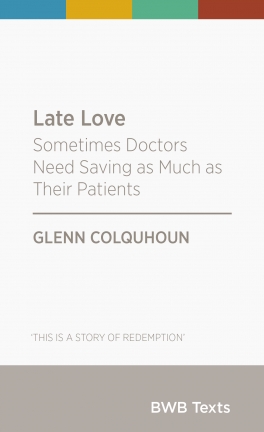
Glenn Colquhoun’s new book

BWB7760_Text_Cover_LateLove_High Res-1.jpg


E-Tangata published an extract from Glenn’s new book. For the full extract go here.


In this extract from his new book Late Love: Sometimes Doctors Need Saving as Much as Their Patients, he writes about how his poetry has leaked into his medicine, and changed the way he practises. 


The High Chaparral

For most of my career medicine has not been so friendly. I have struggled with doubt. I have always felt that at any point I might do the wrong thing. For a long time this meant that consultations were noisy with my own thoughts. Life was lived in two parts. In one I would go to work and be unsure and struggle with the waiting room and paper trails and fires popping up. In the other I would imagine. I would dream that I could fly. I would soar up over the world like a young seagull and look down and be amazed. Moments would open up like a ranch slider. Inside I found they were timeless. Poetry was good and medicine was bad. I joked that poetry was the first girl I ever loved, the one I always wanted but never felt confident enough to ask out, and that medicine was the girl I got pregnant behind the bike shed and thought I had to make an honest woman of.

A few years ago I began to compile a book based on the stories of a group of patients I saw over the course of one day in general practice. For a year I visited as many of them as I could and asked them about their lives leading up to that consultation. I saw them in their homes and among those things they cared about, then afterwards flew up into the sky like a seagull with an old piece of string and looked down. When I came to write about them I saw them with wet eyes — the sort of love that poetry demands of those who write it.


Copyright © 2016 Glenn Colquhoun

This is an extract from Glenn Colquhoun’s book Late Love: Sometimes Doctors Need Saving as Much as Their Patients, published by Bridget Williams Books.