Monthly Archives: March 2016

Cilla McQueen Conjures the Past: A Poet’s Memoir

In a Slant Light - Cilla McQueen


Press release from Otago University Press:


… can’t be sure about the authenticity of memory,

but by my lights it’s all I’ve got to go on.


So begins Cilla McQueen’s entrancing poetic memoir, In a Slant Light. One moment brought to light leads to another unfolding – as in the writing of a poem: In A Slant Light is a layered, intuitive interaction with the past.

‘The joy of writing a memoir,’ says Cilla, ‘is the wonderful sense of discovering the past as you go; writing itself becomes an act of memory.’


McQueen, one of New Zealand’s major women poets, leads us over the stepping stones of childhood recollections, some half submerged, some strong and glinting in the light of her wit:

I tried the magic trick of pulling the tablecloth out

from under our plates of tomato soup. This didn’t work.


With humour and openness, clarity and grace, the journey continues through her teenage years and the excitement and turbulence, the expansion and vulnerability, of university days and early motherhood in the 1960s and 1970s … raising a young child alone, falling in love with Ralph Hotere and witnessing his deeply immersive artistic practice …


This account of the life of an extraordinary verbal artist is immensely warm and welcoming. The lightness of Cilla’s touch coupled with the grit of her endurance through challenging personal circumstances makes the reader feel privileged to be invited in to the quiet wisdom worn here with both integrity and modesty.


This is a book not only for those who love Cilla McQueen’s poetry, but for anyone fascinated by the social, artistic and literary history of New Zealand.


Bluff poet Cilla McQueen was the New Zealand Poet Laureate 2009–11. She has published 14 volumes of poetry and has won the New Zealand Book Award for Poetry three times. Her work has been extensively anthologised. Cilla’s most recent publication was Edwin’s Egg and other poetic novellas (OUP, 2014).


In a Slant Light

A poet’s memoir

By Cilla McQueen


Release Date: March 2016

ISBN 978-1-877578-71-7

$35, hardback with ribbon

OUP

Poetry Shelf Review: Roger Horrocks and Song of the Ghost in the Machine – as you readwalk you feel invigorated, refreshed, and ready to write

ghost_cover_front__73226.1427153026.220.220   ghost_cover_front__73226.1427153026.220.220   ghost_cover_front__73226.1427153026.220.220


Song of the Ghost in the Machine

Roger Horrocks

Victoria University Press

2015


I confessed the day the Ockham NZ Book Award short lists came out I had not read this book as it felt too close to something I had in my head. Truth is I have finished a draft that I am leaving for a decent period of time before lifting it into something that works. The link with my starting point is tenuous. But it loomed large at the time.

Roger’s new collection comes out of walking. Walking in the physical world, walking through books, ideas, memory. Each section is prefaced by the biggest stack of quotations I have seen in ages in a poetry book. If ever! –  when I think further. It means there are two different reading approaches at work here. You can go shopping within the quotes and find the ones that stick.

Like a little reading map for the reader pedestrian. The sources are eclectic. Surprising.

Then there is the poetry, and this is infused with the way age changes things. For some poets, it prompts a new alertness to the world, to what matters. Roger is absorbing the world as he walks and leaving shiny traces of it in the poems.

‘This is the world I saw.’

For some poets, age is the body changing, under threat, slower. Death seems closer. Death seems to push and nudge the poems and make itself felt. For Roger, it is there in a health scare, in the passing of loved ones.

‘The body supplies the beat’

Mostly the poems are made of long lines in thick stanzas and generate the fluency of walking. One poem, ‘One Hundred Descriptions,’ amasses aphorisms, miniature thoughts, like miniature steps.

‘a square peg in the round hole of the world’

Throughout the book, as you meander and read, sidetrack and read, loiter and read, certain things leap out at you. Just like when you walk in the physical world and see the cat asleep in the flowerpot.

‘Like shoehorn, a mind is meant to ease you/ into the world, but his makes a poor fit.’

‘My cargo is close to bursting – years of sights/ and smells, ideas and anxieties, mistakes and regrets -/ but for the moment I’m still mobile, still fossicking.’


What changes the poetry when death seems that little bit closer? With this collection it invigorates it. The ideas about self and writing and how we fit in the world. How we belong. How we make attachments. How we can use words to make shadows on the page like Plato’s cave.

In his note at the back of the book, Roger talks about poetry. In my view, when I scan the decades of NZ poetry I have read, I believe poetry does anything and everything. It busts out of compartments. Not all poetry is preoccupied with self (Roger proposes much is), yet find me a poem where traces of the poet don’t flourish like tiny signatures (ah begone Barthes!). Tiny alluring signatures that reflect bias. Bias that snags on ideas, physical views, opinions, musicality, experience, poetic choices, subject preferences.

This terrific poetry collection is like walking in the world because as you readwalk you feel invigorated, refreshed, and ready to write.

Congratulations on a well deserved spot on the short list, Roger.


VUP page


A Circle of Laureates, a galaxy of poetry

This event prompted me to hunt for cheap fares to Wellington because it seemed like a rare and special poetry occasion. And it was! A sold-out event!

The National Library, as current administrator of the NZ Poet Laureate awards, hosted the evening as part of Wellington Writers Week.  John Buck from Te Mata Wines instigated the Laureateship in 1997, with Bill Manhire taking the debut spot. John was there with wine to share. He still retains an involvement.

Fergus Barrowman from VUP was the MC. He made the important point that the award is ‘an activist portfolio not just an honour.’ The earliest debut publication by a Laureate was in 1964 while the most recent debut was 1988.  Three generations of poets! Cilla McQueen and Michele Leggott calculated over 700 years of life/poetry experience across the ten laureates to date.

Bill Manhire (1997) spoke about what the Laureateship meant to him and the two ways it expanded his sense of what he might do as a poet, as a public figure. Firstly he began to write poems with some kind of public dimension. Secondly he explored the way the role centred on the promotion of poetry. He wanted to ‘talk it up.’ Both are options we can be thankful for. Bill’s poems that stand on a public stage are poems that embrace the knots and crests of humanity. I talked about the way ‘Hotel Emergencies’ does this on Summer Noelle in January.

Bill read ‘Erebus Voices’ and I sat there thinking this is a poem that belongs in the world and can be heard again. And again. And then again. Because it both moves and matters. Bill shows so adeptly the way poems can shift us to laughter, to wry grins at the surprise of it all, but also lead to far more unfathomable movements of the heart.

‘I am here beside my brother, terror./ I am the place of human error.’

I especially loved the way he started with the poem of a fellow poet. He ‘talked her poem up,’ and I fell in love with it all over again: Rachel Bush’s ‘The Strong Mothers.’


Hone Tuwhare was represented by his son Rob. We listened to Hone read ‘No Ordinary Sun,’ we listened to Rob read Hone and then Rob picked up his guitar and sang a Graham Brazier version of one of the poems. A version of friendship. Quiet, haunting, utterly melodic. This was love. Hairs standing on your arm on end from start to finish in the Tuwhare bracket.

‘Oh tree/ in the shadowless mountains/ the white plains and/ the drab sea floor/ your end is at last written.’


Elizabeth Smither read a cross section of poems that delighted the audience. But one as-yet-unpublished poem in particular stuck to me. Kate Camp, her mum and I – all went ‘wow.’ I adored the story of Elizabeth seeing her mother move through her house, the windows bright, unaware of the daughter driving by. By the time I got to congratulate her, dear Elizabeth had already signed her copy for Kate. How lovely! Like a bouquet of flowers. Elizabeth emailed the poem so I can read and write about it for my book.

‘It was all those unseen moments we do not see/ the best of a mother/ competent and gracious in her solitude’


Brian Turner with his delicious wit said: ‘I’ve been called a political animal many times and it’s not always a compliment!’ And that is what makes his poems so enduring. The way he hits the right pitch of land and sky but with a deep love that is unafraid to match beauty with issues. He read a cluster of short poems where every word sang. Gee whizz this was good. Here are few lines I loved without the line breaks (sorry):

‘and the shadows are mauve birthmarks on the hills’

‘If the sky knew half of what we were doing down here it would be inconsolable and we would have nothing but rain’

‘where a river sings, a river always sang’

See what I mean!


Jenny Bornholdt

Jenny rued the way Wellington Writers Week has dropped ‘readers’ from the title. She said she would reclaim readers, in the perfect setting (the library), with a longish poem: ‘A long way from home.’ This was a highlight for me. The poem is all about illness and reading; the ability to read and a time when it flees. Here are some sample lines:

‘How as a child, books were the lens// through which I eyed the muddy track to adulthood’

‘For six weeks now I’ve been outside weather/ and of reading. Outside of myself.’

‘I have tried to read but nothing/ sticks. That anchor of my life has been raised and// I’m all at sea.’


Michele Leggott, like Bill, brings poetry to a a public arena through her tireless promotion and expansive love. Michele read an extract from a long work (‘The Fasciclies’) that bridges Taranaki and Lyttelton, the 1860s and the 1970s, and the connections between two women.

My notebook is full of Persian-like doodles of birds and shapes interspersed with notes but, as I listened to Michele, my pen stalled. I felt like I could hear Robin Hyde with her luminous detail and observations in the seams. For this was luminous writing. There is a bridge between reader and poem. Sometimes you cross it. Sometimes it seems impassable. I just wanted to cross the bridge and read the whole poem.

You can find the whole piece here.


Cilla McQueen read ‘Ripples’ a long poem that showcases her strengths as a writer. It is in her latest collection, The Radio Room (2010). Another highlight. Other poets make an appearance, Joanna and Hone. Moving. Uplifting in a way.

‘After the funeral service you leaned down towards me out of a cloud;/  “Kia mau!” you shouted into my mind.’

Cilla McQueen’s memoir is due next week from Otago University Press.


Ian Wedde also has a childhood memoir out, The Grass Catcher, which is on my must-read list. Ian’s poetry produces my ideal poetry trifecta of relations: music, ideas, heart. Oh! And singing its way through, a sense of story. He read from ‘The Life Guard.’ Ha! It’s all here. Listen to the start:

‘You have to start somewhere/ in those morose times,/ / a clearing in the forest say,/ filled with golden shafts of sunlight// and skirmishes’


Vincent O’Sullivan has a new book out from VUP, which I am about to review for a newspaper, so perfect to hear him read his poetic contours. He has the ability to refresh anything. To tilt tropes, to enhance the music of a line, to poke you with an idea, to make you feel. Once again I got caught up in the moment of listening and didn’t catch lines in my notebook.


Ck Stead is the current Poet Laureate. He began with a poem about Allen Curnow, who he felt would have been Laureate if he had lived within the Laureate time span. Karl had struggled over whether to read a top-hit kind of poem or read new things. I know that feeling and first thought I would only ever read a poem once in public when first published. That soon fell by the wayside.

It was a moment of audience empathy as Karl confessed he thought he would read it, then wouldn’t, then finally after hearing Bill, decided he would. And we were glad, indeed, as he read an elegy for his mother. Utterly moving.

Poetry is such a love for Karl. He made this clear when I was filming his ‘thank you’ speech for the Sarah Broom Poetry Award. And hearing him read on this occasion, lifted the poems off the pages where I have loved them, to a new life in the air/ear.

from ‘Elegy’ but without that scattered layout that makes much of white space (sorry):

‘She’s there somewhere/ the ferryman/ assures me.// He tells me/ she was reluctant to go/ but silent – // stood in the prow/ no tears/ and never looked back.’

Karl filled the room with the warmth of poetry. Music. Heart. Ideas. A perfect end.


The tokotoko table, with all the talking sticks carved especially for each poet, was like a quilt with stories. I wished someone had held up the mother tokotoko for all to see and told that story. And indeed held up each tokotoko, for each tokotoko has its own.

Karl will get his at the Matahiwi ceremony in April. I am honoured to be part of this occasion along with Gregory O’Brien and Chris Price.


A Circle of Laureates was a magnificent occasion. I bumped into Elizabeth Knox the next day and we were both enthusing about how good it was. Peter Ireland from the National Library had put in all the hard work! Kindly acknowledged on the night by Ian. Every poet held my attention. There is a big age range here, but to me, it is a way of honouring our poetry elders.

As a poet, I write with one foot in the past and one foot in the future.I want to know who I’m writing out of. This is my tradition. This is my innovation. This circle.

It reminded me of Selina Tusitala Marsh’s’s poem ‘A Circle of Stones in her debut collection where she honours the women she writes from, towards and beside.

Thank you to everyone who made this event possible. It was worth my spur-of-the-moment cheap flight, my accidental data blow out, my misbooking home that meant a new booking, the chance to hear the Lauris-Edmond finalists, and losing myself in Jessie Mackay in The Alexander Turnbull Library.  Thirty-six hours of poetry. Heaven.

Thanks! Ten Poets Laureate to celebrate!


My first book review in The Sunday Star Times

25614298

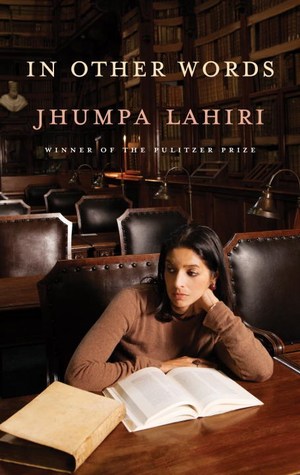
This time: Jhumpa Lahiri’s In Other Words.

Not poetry but raised all kinds of issues for me as the book was written in Italian and then translated by someone else.

Check out the review here.


Some photos and thoughts on The Lauris Edmond Memorial Poetry Award

This award was launched by the Canterbury Poets’ Collective and The NZ Poetry Society in 2003. Five poets read in a festival slot and one poet gets the award. Originally the event was staged during the Christchurch Writers’ Festival but, after the earthquake, it moved to Wellington (with one brief return).

This year Dinah Hawken, Bob Orr, Claire Orchard, Chris Tse and Harry Ricketts read. The festival as a whole seems to short change poetry somewhat, so I welcomed the opportunity to hear this group. Ultra small venue which was full to max. Would there be an audience to fill something a little bigger?

But smallness is intimate and the readings were a treat. I was especially keen to hear Claire Orchard read as I have her debut book next on my pile to read and already have a strong relationship with the work of the other poets. I loved her reading.

The winner: Bob Orr. It feels like this award casts light on a poet who deserves a little more attention. Bob has the ability to take you to all four corners of the world and show you a vital snapshot. Something that gets to the very heart of place, of people, of experience. His poetry comes out of strong attachment to home but is wide in its reach. Wonderful!

Bob thought he had just come to read a couple of poems  so was quite surprised to get the package with a cheque.

A few years ago I was delighted to launch a collection of Bob’s at the Grey Lynn Library. It was packed to the rafters with poetry fans of all ages. So seldom do I see such a turn out. The warmth and affection for Bob and his poetry in that room was exactly why he deserved this award.

Congratulations!

The Ockham NZ Poetry short list- two reviews, an interview and a book in my bag

I am heading off to Wellington this morning to go to A Circle of Laureates, the Lauris Edmond prize event and do a smidgeon of reading in between. Thought I would share these first:
1411440756602

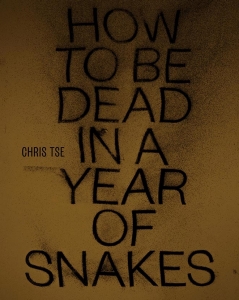
How to Be Dead in a Year of Snakes Chris Tse, Auckland University Press

Chris Tse is a writer, musician and actor whose poetry first appeared in AUP New Posts 4 (Auckland University Press, 2011). He resides in Wellington, his home town.

Chris’s debut collection, How to Be Dead in a Year of Snakes, responds to a moment in history not so much by narrating that history but by installing a chorus of voices. He takes an event from 1905 when Lionel Terry went hunting for a Chinaman in Haining Street, Wellington and ended up murdering Joe Kum Yung. Within the opening pages, the chilling event is situated in a wider context where laws proscribe the alienness that situates  Chinese as outsiders. This is what gets under your skin as you read.

The poems draw upon and draw in notions of distance, defeat, guilt and forgiveness. There are the unsettled imaginings of what it is to be home, to be at home and to be out of home to the extent that home becomes difficult and different. Mostly it is a matter of death (and casting back into life) whereby phantoms stalk and cry about what might have been and what is: ‘You spend your thoughts drowning in your family-/ missing from this vista- and contemplate a return with nothing to show/ for your absence.’

The collection harvests shifting forms, voices and tones that promote poetry as mood, state of mind, emotional residue. Yes, there is detailed evidence of history but this is not a realist account, a story told in such a way. Instead the poetic spareness, the drifting phantom voices give stronger presence to things that are much harder to put into words. How to be dead, for example. How to find the co-ordinates of estrangement, of that which is unbearably lost and is hard to tally (family, home, what matters in life). On page four you move from a matter-of-fact representation of the law to page five and the wife in Canton (‘you carry her bones in your body’). Two disparate but equally potent aches.

For the rest of the review see here
 

OLYMPUS DIGITAL CAMERA       $_35


From an interview I did with David Eggleton last year:

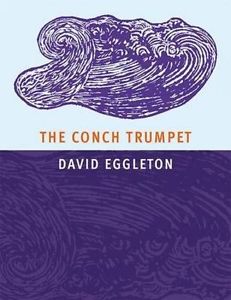
I love the title of your new collection (The Conch Shell, Otago University Press). The blurb suggests that this collection ‘calls to the scattered tribes of contemporary New Zealand.’ What tribes do you belong to? What literary tribes? How does the word ‘contemporary’ modify things?

Yes, I’m blowing my own (conch) trumpet at sunrise. That title refers to tide-lines of life, to surf-like sounds, to gathering good vibrations, to gods of the sea who, clarion-like, lull the waves, and to the summer of shakes, the year of quakes. And so on, to the final burnout of the run-ragged consumer. The rest is the tribal outcast, and everything you cannot pin down, or ascribe a bar code to.

In fact, the word ‘tribe’ is fraught. I think James K. Baxter brought it into the literary realm. My own tribal background is distinctly heterogeneous rather than Fonterra-homogenous, but if I look around at my contemporaries, poets and otherwise, I see most of them making it up as they go along. A poem tests a proposition; it doesn’t always prove it.


These new poems offer shifting tones, preoccupations, rhythms. What discoveries did you make about poetry as you wrote? The world? Interior or external?

My poems like to dwell on the silver wake of a container ship, or the wet sand beneath the upturned hull of a dinghy, or the half-seen, the overheard. Poets re-arrange, but they have duties of care. X.J. Kennedy has pointed out that: ‘The world is full of poets with languid wrenches who don’t bother to take the last six turns on their bolts.’

It’s been five years since my last poetry collection Time of the Icebergs appeared, and one reason my collections have been regularly spaced that far apart is the need for more elbow-grease and line-tightening to get the burnish just so.

The poet’s mind, like anyone else’s is made up of reptilian substrate, limbic empathy and neo-cortical rationality. These shape your reveries and hopefully together lift them out of banality. Our ideas are dreams, styles, superstitions. We rationalise our temperaments, draw curtains over our windows, but poems carry an anarchic charge that reveals the force that through the green fuse drives the flower.

A poet is in the business of the unsayable being said, showing you fear in a handful of dust. A poet is amanuensis to the subconscious ceaselessly murmuring, and indeed to the planetary hum, the gravitational pull of the earth, the wobble of placental jellyfish in the womb — anything alive, mindless and gooey.


Is there a single poem or two in the collection that particularly resonates with you?

Every poem resonates on its own wavelength, but I found constructing an immediate elegiac response to my father’s death one of the most turbulent. A bit like getting to grips with a storm, with a howling wind that has shape and substance.


Returning to the notion of detail, I see the accumulation of things in your poems as an overlay of highways to elsewhere whether heart, issues, ideas, fancy, memory. Yet the things also pulsate as things in their own right. What draws you to ‘the thisness of things’ (the blurb)?

Things accumulate in my poems in almost haptic fashion, wrestled there like sculptural ingredients. They accumulate, as in the random haphazard assemblages of the Dadaist Kurt Schwitters, built out of found objects in the streets. Yes, I want to acknowledge the ‘thisness’ of things, but not in the sense of ‘property’. Rather, in the sense of: he who kisses the joy as it flies, lives in eternity’s sunrise.


For the complete interview see here

 

Tim-FB 9780473288396-TU

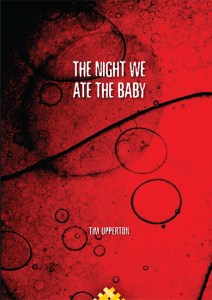
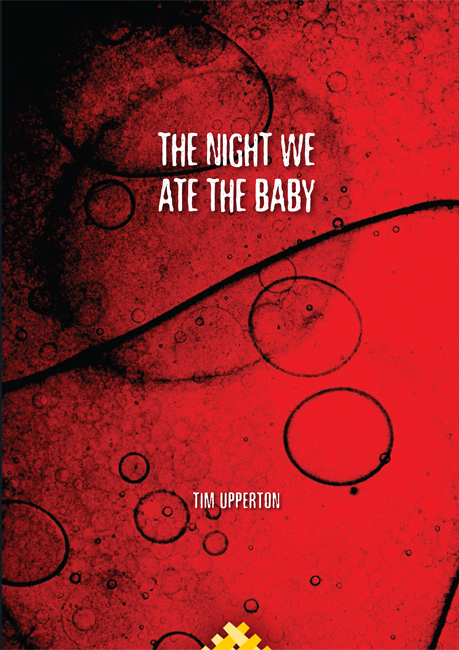
Tim Upperton, The Night We Ate The Baby HauNui Press, 2014

Tim Upperton’s debut poetry collection, A House on Fire, was published by Steele Roberts in 2009. Since then, his poetry has been published in numerous journals and he has won awards for a number of them. The poems for this new collection were written with the assistance of a Doctoral Scholarship from Massey University of New Zealand, so perhaps they form/formed part of his doctoral submission. Tim will be reading as part of the Haunui Press ‘Deep Friend Poetry Reading’ series at Vic Books on 26th March. Details here.

This latest book is unlike any other collection I have seen in New Zealand; chiefly in terms of the measure of discomfort. The forms are various, scooping an edgy wit into prose blocks, villanelle, triplets, couplets and freer patterns. Yet there is connective glue at work here, and that is what makes this collection stand out. I think it comes down to voice (whether or not it is the personal voice of the poet doesn’t really matter) because the voice steering the poems is sharp, forthright, witty, edgy, grumpy. It unsettles. It keeps you on your toes. On the back of the book, Ashleigh Young suggests that ‘[t]hese willfully, calmly disagreeable poems have tenderness and courage at their heart.’ I would agree. Therein lies the pleasure of reading these poems; there is more to the brittle edginess than meets the initial eye.

The first poem, ‘Avoid,’ very clearly announces that this is a poet who loves language, that is unafraid of rhyme and rhythm working arm in arm. The poem is a miniature explosion of sound effects — with sliding assonance, bounding consonants, near rhyme and sumptuous aural connections. It brought to mind the refrain in Don McGlashan’s song,  ‘Marvellous Year,’ and Bill Manhire’s glorious ‘1950s’ in the use of rhythm and rhyme, and aural trapeze work that is ear defying. Whereas Don’s song represents a potted portrait of the world in all its warts and glory (in a marvellous year), and Bill’s poem is a nostalgic recuperation of things, Tim sets up the collection’s  negative disposition and itemises things to avoid!

For the rest of the review see here


ghost_cover_front__73226.1427153026.140.215   ghost_cover_front__73226.1427153026.140.215   ghost_cover_front__73226.1427153026.140.215

Roger Horrocks Song in the Ghost Machine

I haven’t read this book! Last year I picked it up to review then found something about it was very close to a fragile starting point I had for a book in my head. I can’t talk about poems I am writing until they are written. I didn’t want to scare my starting point off so left in the pile to read.

Now that I am hard at work writing about NZ women’s poetry, my starting point is in a little holding bay where it may or may not survive. It has been there for over a decade though and has moved to second place in  a queue.

So I am throwing caution to the wind and taking this book to read on the plane.


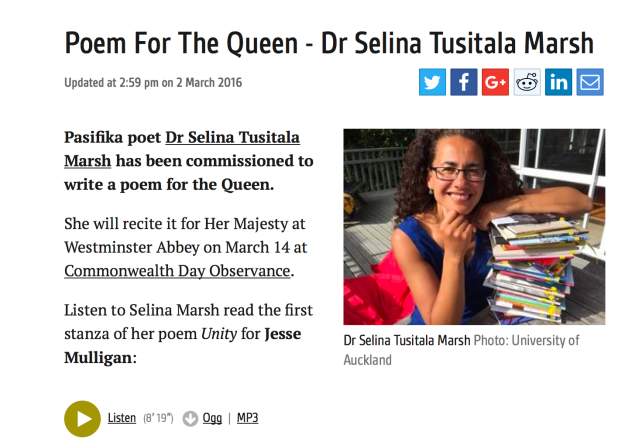
Poet Selina Tusitala Marsh shares a stanza for the Queen with Jesse Mulligan

Screen Shot 2016-03-09 at 2.46.13 PM


For link to listen go here

Launch of new poetry books by Chris Price and Lynley Edmeades

I am currently reading Chris Price’s new collection … it is fabulous! Want to savour slowly. Have loved everything I have seen by Lynley so far — so  eagerly await the book.


Screen Shot 2016-03-09 at 12.00.10 PM