Monthly Archives: May 2015

Counting blessings @JohnJCampbell @CampbellLiveNZ

photo

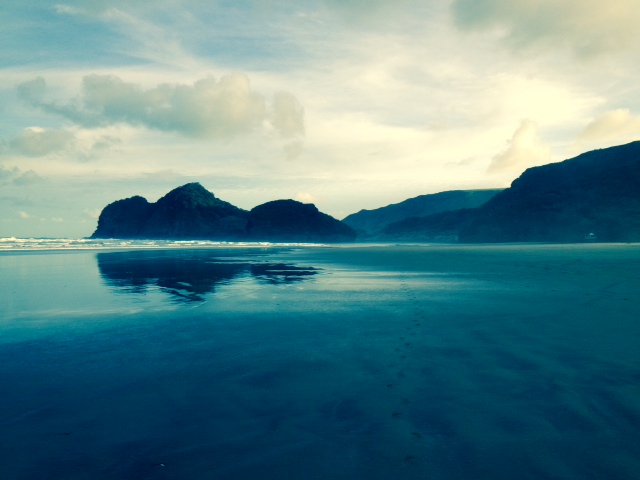
Running (again) into the beauty of Bethell’s this morning and instead of the zen-like empty head breathing in and out, or the line for a poem or a picture-book story flicking though, I began to count blessings. It has been a punch in the gut of many to axe (that brutal word) Campbell Live. And now a flurry of why this is so on social media and other places. I felt like I was running into a pocket of grief. A word that crops up in tweets, blogs and articles is John’s humanness. His ability to care. To take a stand. He is a good person and in this age of greed, violence and hunger we need good people. He shows us  … us. The little stories, the big stories. The famous people, the Joe Greens. Yes, I should be at my desk starting work on this fabulous new project I have invented, but today I feel stalled by grief at the implications of this loss.

The balm. To count sidetracking blessings as I ran into the wild beauty pitch of the West Coast.

1. National Radio and all its presenters, reporters. Thank heavens for Morning Report. For Guyon and Suzie. For the astute and searching mind of Kathryn Ryan, her humanness and that warmth. For Lynn Freeman for drawing us into our wider arts, so beautifully.

2. To courageous blogs such as Public Address. Thank you Russell Brown.

3.  To The Listener (thank you Jane Clifton) and Metro for showcasing New Zealand books and issues.

4. For The Herald for publishing incisive commentary. Thank you Toby Manhire (see Toby on John Campbell here).

5. For New Zealand publishers publishing New Zealand books against all odds. Thank you.

6. For New Zealand booksellers selling New Zealand books against all odds. Thank you.

7. For Anne O’Brien and her team creating an astonishing literary festival in Auckland that celebrated us here and now as much as the wider world. Thank you.

8. For everyone who has the courage to stand and make a difference in both a world and a ‘here’ that is damaged by greed, hunger, violence. To what extent are our decisions always motivated by the good of ourselves as opposed to the good of the whole?

Campbell Live, in whatever measure we care to assign, acted as a conscience of society — a role universities once exemplified in their ability to critique the ideologies, the customs, the structures, the laws, the expectations, the narratives and the images that both sustain and constrain us.

Thank you John Campbell. Heck, that moment when you came out to introduce Carol Ann Duffy, and there was this extraordinary lingering applause, with whoops and heartfelt cries, gave us goosebumps. Even then we were on the verge of tears. That is us now. In that auditorium, giving the whoops and the claps. But now it is a standing ovation. Cheers, John.


Katherine Mansfield Menton Fellowship: Applications now open

APPLICATIONS INVITED FOR 2015 KATHERINE MANSFIELD MENTON FELLOWSHIP Established and mid-career New Zealand writers are invited to apply for the Katherine Mansfield Menton Fellowship 2015. The Fellowship is one of New Zealand’s longest-standing and most prestigious literary opportunities. In 2015 it offers a residency of three months or more in Menton, France and an allowance of NZ$35,000 to cover return travel to France and living and accommodation expenses. The support of the city of Menton enables a New Zealand author to work at the Villa Isola Bella, where Katherine Mansfield lived and wrote during the latter part of her life. Applications are sought from established writers across all genres of creative writing: fiction, poetry, literary non-fiction, children’s fiction and playwriting. Since it was established in 1970, there have been 45 recipients of this fellowship including Janet Frame, Michael King, Lloyd Jones, Witi Ihimaera, Vincent O’Sullivan, Bill Manhire, Ian Wedde, Elizabeth Knox, Dame Fiona Kidman, Jenny Pattrick, Ken Duncum and the 2014 recipient, Mandy Hager. The Fellowship is an initiative of the Winn-Manson Menton Trust and is administered by Creative New Zealand. Applications close at 5pm on Friday 26 June, 2015 For application information on The Katherine Mansfield Menton Fellowship To find out more about the Fellowship go here.

Winner announced at AWF- Sarah Broom Poetry Prize 2015


 Diana Bridge

Wellington poet Diana Bridge was announced as the winner of the Sarah Broom Poetry Prize at the Auckland Writers Festival on Sunday 17 May.

Bridge has published five collections of poems, the latest of which, Aloe & other poems, came out in 2009. She was awarded the Lauris Edmond Memorial Award in 2010, for her distinguished contribution to New Zealand poetry, and her essay, “An attachment to China” won the 2014 Landfall essay competition.


The award-winning Irish poet Vona Groarke was guest judge for the prize in 2015. She describes Bridge’s poems as “colourful and playful, but also careful, thoughtful and wise.”  “There is a kind of fierce beauty to this work, alongside its rigorous intellect and formal grace.” Bridge accepted the $12,000 award at the Sarah Broom Poetry Prize event.


“I am overwhelmed and proud to be the recipient of an award set up to honour the work of Sarah Broom”, she says.

“I like to think that a tiny particle of her courage served to stiffen my spine the day I chose the poems I sent off. For I picked poems not in the hope that they might just work in a New Zealand context, or in what I imagined might be the context of the competition. I chose the poems that mattered most to me.”

“So – in went the story of Arjuna, from the Hindu text, the Baghavad Gita; in went a poem that was a response to the whole – prolific – output of the formidable professor of poetry at Oxford, Geoffrey Hill; in went a poem called ‘The Henrys’ that tackles all those terrible medieval and Tudor executions we have been subjected to in print and on the screen in recent years.”

“I am excited that we are ready for poems that spring from anywhere on the globe.”

The prize, now in its second year, was established to celebrate the life and work of Sarah Broom (1972-2013), author of Tigers at Awhitu and Gleam.


Vienna-based Alice Miller and Wellington’s Ashleigh Young were also shortlisted.


Diana Bridge
Bridge, who has a Ph.D. in Chinese poetry, has worked on the China-based poems of Robin Hyde and published an essay, “O to be a dragon”, and a Translation Paper, “An Unexpected Legacy: Xie Tiao’s poems on things”.  She is at present working on the translation of a selection of classical Chinese poems.

Vona Groarke writes: “Whether it is the violence of medieval history, the engagement with nature, or a re-imagining of Ovid that is the subject, Diana Bridge’s poetry has authority and elegance. Technically sophisticated, this work is complex but never obscure; lyrically charged but never sentimental. It is unflinching in its observational commitment, but also enjoys its ability to fashion unusual and arresting imagery. There is a kind of fierce beauty to this work, alongside its rigorous intellect and formal grace. In a description that rings true of much of her work, her poem ‘Prospero’s Stones’ notes, ‘driven phrases that lap /around each other’: this is a poetry that is linguistically alert, but that also remembers to ply sound and meaning into the kind of poetic weave that is colourful and playful, but also careful, thoughtful and wise.”


#AWF 2015 A Letter to Poetry Shelf: Laurence Fearnley on being a Festival Chair

This is a terrific letter — open, honest, generous, thoughtful and it is the mark of the kind of writer Laurence is, the kind of woman she is. I was at her session, and yes, I felt uncomfortable at the point she got heckled. For the audience, for the other panelists and for Laurence herself. To be honest, I was sitting in the front row, and because I could almost reach out and touch the speakers, at times I almost started joining in! Truely, I had to stop myself and say, no I am NOT on this panel! That is a measure of the vitality of the conversation. Yes, there might be ways to improve as chair (I always feel this no matter what I do!) but this session sparked all kinds of thoughts in my head. All credit to the chair. I was also utterly impressed with Laurence’s level of engagement with the work. When someone takes time out to read your books and to think about your books it is incredibly moving (not all chairs do this!).

I think there are many ways to be a chair. We are all different as this glorious festival demonstrated. You had the nerves and infectious enthusiasm, that utter passion for poetry from John Campbell, and the ensuing poetry conversation with Carol Ann Duffy. A special occasion indeed. You had the measured way of Jim Mora that welcomed the general reader as much as the writer when he spoke with Tim Winton. Equally special. You had the sparkling reach of Noelle McCarthy in conversation with Helen Macdonald. Gold! All different, all producing different kinds of vital conversations. These are all professional talkers so does it make a difference when the chair is a writer?

I like the fact Laurence asks for help here. Perhaps the festivals could build a short list of experienced chairs willing to briefly mentor (answer the questions of) fledgling chairs. In a reply to my festival post Laurence poses some of the questions she might ask.

What about the heckler? I agree with the points below wholeheartedly,  but I have been guilty of this to the point I ended up on the front page of the Sunday Star Times and was hounded by reporters. At the now infamous session that Kim Hill chaired where she was rude to the international panelists, and talked at length without allowing them to speak, I yelled at her from the back “We have come here to hear three fabulous writers speak, not three fabulous writers under attack.’  Etched in brain. The audience stood and clapped in unison. I felt like I was going to faint. You had to be in the room to understand what happened. Perhaps I am responsible for this new species of festival hecklers. I am the hugest fan of Kim’s radio show, her interviews are the best but I felt a line was being crossed. I guess Kim has never forgiven me. I was rude. Alice Sebold hugged me. There is always a price when you speak out publicly, even as a heckler.

It all comes back to that word that Eleanor Catton floats: kindness. We need kindness. We need critical debate. But we don’t need to knock the stuffing out of people. Read the article  I posted before this one on reviewing books.

If I could, I would reach and give Laurence a hug. Thanks heavens someone did. I admire your courage enormously.

Paula Green


Hi Paula

You raised the issue of chairing in your blog and I’d like to reply. At the weekend I chaired a session ‘Art of the Novel’. Despite having been a writer on upwards of 50 panels, it was my first time as a chair for a group of novelists and the combination of my inexperience, nerves, and over-enthusiasm (and probably over-thinking) proved to be a a disaster. Twenty minutes into the session an audience member started heckling me. I couldn’t hear what he was saying but it was soon communicated that I was talking too much and interrupting.

As the Auckland festival becomes larger I can see problems concerning chairing increasing. Audience members clearly have little tolerance for poor chairs so dissatisfaction will increase.

There are some fantastic, skilled chairs out there (Fiona Farrell, Paula Green, Kate de Goldi, Jolisa Gracewood, Emily Perkins to name a few I have had the pleasure of meeting) and I was wondering if there might be value in including a back-stage, 40 minute chairing session at the start or end of each festival day for people like me who have not chaired a panel, or for people who feel a little rusty. I know we are sent notes on chairing (which I re-read, believe me) but it would have been fantastic for my nerves if I had been able to ask an experienced chair a couple of questions concerning problems I had. For example: reading the panelists works raised some complex ideas that I wished to discuss. How could I have communicated those questions, maintaining the complexity of the idea without the question becoming confused, and needing additional clarification or follow-up questions that interrupted the writer? I am sure, that with your experience, you would have ideas on how to tackle those problems.

So, would any of you be prepared to offer help in this way?

I don’t think heckling is the answer to shaking up a poor session. I think it creates a flee or fight response in the chair, makes the audience apprehensive (is it a one-off heckle, is the audience member nuts and will continue heckling, what impression is this making on the panelists), and the panelists uncomfortable (because they are usually nice, sympathetic people).

After my panel – when I had already got the message – a woman came up to me, grabbed my arm and snapped, “learn to button your lips.” It was a shit remark, coming at the end of a bad session, and surplus to requirements. Thank God for the kindness of Stephanie Johnson, Jill Rawnsley and Charlotte Henry.

Laurence Fearnley


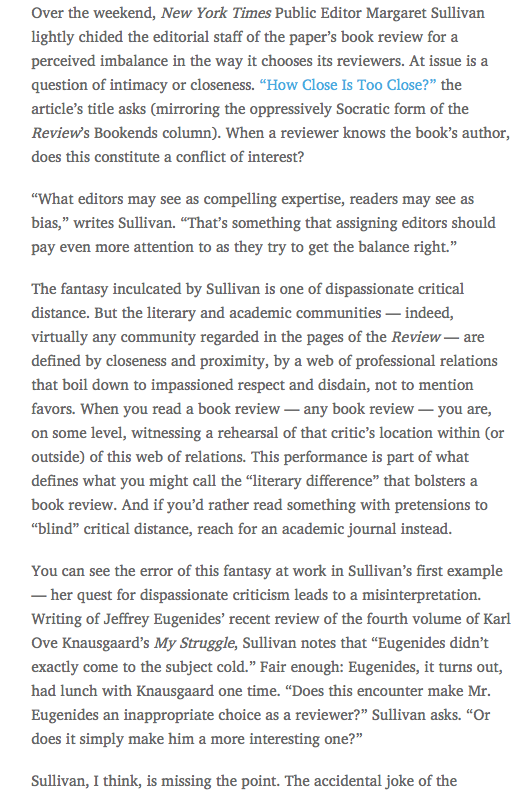
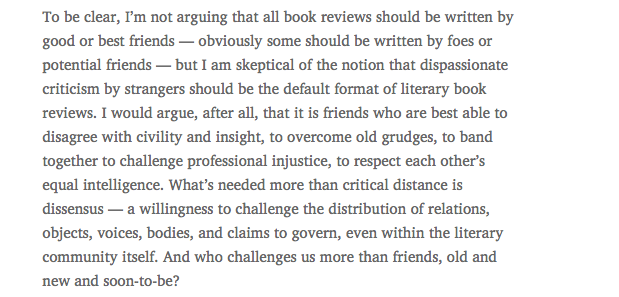
Jonathon Sturgeon on Literature as a Chain Letter Among Friends: On the Fantasy of Critical Distance

This is interesting. I review a fair volume of NZ poetry books (not enough by any measure, so many miss out!). Yet I know a fair chunk of the poets to different degrees. I have lunch and dinner with some. I go for walks with others. I discuss poetry with many. I tell my own secrets (not those of others!) to a handful. I have also reviewed a lot of New Zealand novels because that was my primary love at university and the focus of my Masters and Doctoral theses. Again the same shades of friendship apply. Should I be doing this when I am clearly embedded in this intricate web of connections and friendships? I found this piece fascinating. It was posted on Flavorwire.


Here is the start of the blog:

Screen shot 2015-05-19 at 9.06.07 AM


You can read the middle here.


Here is the end of the blog:

Screen shot 2015-05-19 at 9.06.33 AM

AWF15 bouquets and brickbats

This morning I ran along the beach into the hit of the west-coast wind, and it felt like a hinge between four glorious days at the Auckland Writers Festival and getting back to work. As I ran, I pictured myself asking Murakami running questions. Where does he like to run? Is it in a wild space where you hardly see another soul as I do and your mind empties as the rhythm of the run takes over. You might see a puffed up dotterel out of the corner of an eye or a pied stilt wading. The rhythm of the run sends me into a pre-writing state but mostly it is is just me and breathtaking beauty.

This morning as I ran it took awhile to get into that equilibrium of silence as the festival keep drifting through. What I loved. What I loved a little less.


My bouquets in no particular order

1. To Anne O’Brien and her team for creating a dazzling programme that pulled me out of hermithood into the city for four full-to-the-brim, glorious days, that filled an auditorium over and over, that offered free sessions. This was one of the best festivals I have attended yet in terms of the range and quality of voices on offer. The audiences.

2. The new dedicated focus on children’s writing with the School Days, Family Day and sessions featuring a children’s author. I was coming out of a session and saw David Walliams at his signing table and was incredibly moved. He was looking with careful attention at a picture a young child had drawn for him, taken the time to pause and wonder, when his signing queue had stretched out into the square at the start of my session. It seems to me the festival has also become a gift for our emerging readers and writers, our thinkers and our scientists, our comics and our leaders. Thank you!

3. The amount of poetry this year. Sure I still love a line up of ten poets like a tapas tasting lunch that shows you the terrific width of our poetry communities. But I love the way poets now read along side international authors and local fiction writers in panels. This exposes our poets to a much wider audience. One stand out for me (sadly I missed some poets I had wanted to see due to clashes) was John Dennison. I have just reviewed his stunning debut collection on the blog but his poems lifted and became even more exquisite as I listened and shut my eyes. Two poets came to mind: Gregory O’Brien and Bill Manhire. I could hear a faint, appealing somethingness  of them in John’s intonations, the pauses, the repetitions, the stresses — the downright joyous musicality. If you don’t have John’s book, I highly recommend it. Maybe you can find him reading a poem or two on YouTube.

4. More poetry. The session with Anna Jackson and Daniel Mendelsohn on translation gymnastics was fascinating. I had Anna’s new book, I, Clodia, and a bilingual edition of Catallus in my bag all weekend as I am working on a review. I think I will save some of the gems from Anna until I do the review. But hearing the poems read aloud, we all leaned forward into the beauty of them. Gorgeous!

5. The Gala Night story tellers hit the mark. Sometimes I have been at previous ones counting how many to go. Not this time. The last one spoke, the time was up and I had stayed glued to every word.

6. Mrs Dalloway: I was in awe of Rebecca Vaughan maintaining those weaving voices for ninety minutes, pulling us into the shifting detail, moods, revelations.

7. Amy Bloom in conversation with Carole Beu. I had just read Lucky Us. Sparkling, scintillating, sent me straight to the book stall to buy the short stories.

8. Kim Thúy, a Vietnamese-Canadian novelist, in the panel session on Asian Histories. I didn’t know her at all but loved the little stories that ballooned out from a single word. Loved it when she said Vietnamese don’t show the feelings so much, and that her parents never asked her how she felt, but would ask her if she was hungry, then feed her mood. Dashed to the bookstall and bought Man. This writing is astonishing and I want to read everything she has written. I bumped into her when she was talking to her friend Anne Kennedy and so she inscribed my book. Ah the joy of lucky moments at festivals.

9. More poetry. Hearing Chris Tse reading a breathtaking selection from his debut collection How to Be Dead in the Year of Snakes.

10. Some favourite chairs: John Freeman, Carole Beu, Noelle McCarthy, Catherine Robertson, Christine O’Brien, Ruth Harley (many I missed sadly).

11. The privilege of sitting on stage with Edwin Thumboo to talk about poetry and Singapore was an utter highlight. He is, as I said in the session, like Margaret Mahy was, and Michele Leggott and Bill Manhire are: writers whose work fills you with endless admiration but who also occupy the world as writers in a way that is extraordinary. He is a Singaporean national taonga, so how good he read and spoke to a packed house. We barely scratched the surface of what we could have traversed, but to hear his poems hit the air/ear was such a treat. Preparing for the session sent me on new paths of thinking. I am so grateful to the festival for this opportunity.

12. David Mitchell in two sessions. In the first he was jet lagged and in the second, in a panel. Here are some of the gems I loved: He used to make his own Middle Earths with card and paper. He was a low maintenance kid! He stalled on a sip of tea then talked on the über novel, then cautioned new writers to be careful naming things as the name sticks. On character: A character moving into a new book brings a suitcase of credibility from previous ones. On discussing how to pronounce ‘archipelago’ with Catherine Robertson,  they both slide into an hilarious word jam. On links between books: there are doors wormholes tunnels from one book to next but not many. Ponders on how to make many different things coexist in one book: one way is to compartmentalise. He apologises for bringing his wife into the discussion (she was back stage!) on entering the female mind as a writer of his protagonist. He has five friends on earth, three of whom don’t read him! Question: Do you have an attic mind?  Mitchell: a junk shop mind. On names: high scrabble scores generally make useful names. They stick to the eyeball.  On the intensity of writing: You get through the intense immersion of the current novel underway ‘with little kisses of thinking about the next one.’ On fear: you should go outside your comfort zone. Have I bitten off more than I can chew? is important. He offered to read a Stephanie-Johnson draft when she said showing unfinished novels to others was an imposition. He said he wasn’t a novelist; he writes novellas with bridges and tunnels between. [I love this idea the connection can go through air or underground!].

13. Emily St. John Mandel on editing: Retype your entire draft, read the whole thing aloud to yourself, edit pages in random order.

14. Helen MacDonald. Now I have to read her book, H is for Hawk. Things I loved she said: We use nature to prove our concepts to us. On the joy of festivals: They let thoughts and words be said that aren’t normally available in everyday life.  There’s no past or present when you are flying a hawk. When you have a big loss: After a year of grief, I started to grow around the holes. It was all about love.

15. Carol Ann Duffy. Carol Ann Duffy. Carol Ann Duffy.  Carol Ann Duffy. Hearing her read. And loved this bit from John Campbell on the joy of reading her poems: (can’t quite remember exact words) but ‘drilling down into your particular way of knowing.’

16. The fabulous Tim Winton: I  think perhaps people are wired to hope.

17. Hearing Ashleigh Young read her remarkable new poems, especially the casino one and the road one. They felt like a glorious step up from her debut. Fresh, elastic, lyrical, effervescent, surprising. I am going to post one on the blog as soon as possible so I can talk about it. I do hope a new book is on the horizon line.

18. Anne Kennedy talking about Janet Frame’s Owls Do Cry, the Great Kiwi Classic this year. She was so lucid, so on the button, with what she said. Reading the book for her was like a sock between the eyes. She loved the way the vernacular had been transformed into the poetic, but that it was above all a triumph of kiwiness. Anne said Janet rescued kiwiana and polished it like a gem. For Courtney Sina Meredith reading it was like a rite of passage. She said she was terrified of it at university (if you can’t get into this, you can’t get into New Zealand literature) but then she became deeply connected. Wonderful! Damien Barr cried after he read it (hearing his autobiographical anecdote I am not surprised). Great session steered by Kate De Goldi, but more audience involvement would have been good. I think that is the intent of the NZ Book Council that it becomes a very interactive session.

19. The Honoured NZ Writer: CK Stead. Wonderful movement through his life and career. Loved the poems breaking into the conversation. Like the way he said Catallus gave him a persona where he could go to the edge of things that had sometimes happened to him, or that were an invention. It became an area of freedom when he was not mentally a confessional poet. He had returned to NZ because he wanted to be a NZ writer and turned down the option of a very different academic career in Britain. He doesn’t regret it but sometimes ponders the possibilities of that different track.

I have been especially drawn to Karl’s recent poetry collections, their reflectiveness, musicality, ability to matter and move. You saw that a bit in the conversation. On being a critic: I was too dogmatic, too excited, things could have been said more subtly. I discovered what it was like to be characterised by what was a small part of me. On rereading Death of the Body for this ‘ordeal’ decided it was so much cleverer than I am now. A terrific way to end the festival.

20. Hearing fabulous Irish poet, Vona Groarke read her own poems and talk so beautifully about the finalists in the Sarah Broom Poetry Awards. I am so tempted to get to Wellington to hear her talk and read for a whole hour!

21. Stepping into the shoes of Alice Miller to read her finalist poems at The Sarah Broom Poetry Awards. I was amazed at how reading the poems of another poet out loud in front of an audience drew me so much closer into the very heart of them. The poems were breathtakingly good. I should do this more often. Find a special place to stand and read aloud the poems of another.

22. Ah! Murakami. Ah what a tremendous session. Ah! Ah! My daughter gave me some of his novels to read over summer and I was hooked. How had I not read him before? The outright surprise, wonder and delight of where he leads you. So to find out he was coming to the festival was the absolute highlight. I loved the fact he wrote his first novel and cast it into the bin as dreadful. He then wrote it in English as he had a limited vocabulary and stock of phrases. He translated it back into Japanese and achieved the simplicity, the economy and clarity of writing that is now his trademark. He likes his writing to be unpredictable to himself, which it is why it is so gloriously unpredictable to the reader. He feels he can be anybody when he writes (not all writers feel this!). He enjoys reading his books that have been translated into English (a few years after the original) as it is like reading it afresh and he can’t remember what happens. He likes Japanese tofu and donuts! Maybe a tofu donut! The chair, John Freeman, was exceptional. What made this session so utterly special were the silences, the long pauses that became little pivots of contemplation for both speaker and audience. One writer said Murakami says more in his silences than some writers say with truckloads of words. The t shirt he was wearing:

Keep

calm

and

read

Murakami


23. The volunteers, the lovely stage crew, the festival team and of course all the readers and writers who filled the Aotea Centre with a buzz of ideas and response. Astonishing!

Thank you thank you thank you


The brickbats that aren’t really brickbats at all

I. I wish Anne O’Brien could get to see more than the odd session. To sit back and enjoy the fruits of her labour.

2. Missing out on a ticket to The World’s Wife. My fault. From all accounts it was fabulous.

3. I was a chair, so feel free to criticise me (like all chairs I walked away wondering how I could have done a better job!), but sometimes the research and commitment as chair takes over whereas it should take the back seat along with your own ego. It seems we now live in an age where audiences have no problems in letting a chair know when they are dominating the conversation. Fair enough maybe, as it keeps us on our toes. The other tricky thing is that the audience will be a clashing mix of expectation, and equally varied mix of experience of the subject and writing under the spotlight. We are all different kinds of readers searching for different things. The sessions where the writers opened out into a warm and and sparking conversation were gold.

4. Why didn’t I run to the free sessions to make sure I got a seat?! Missed out on a few gems.


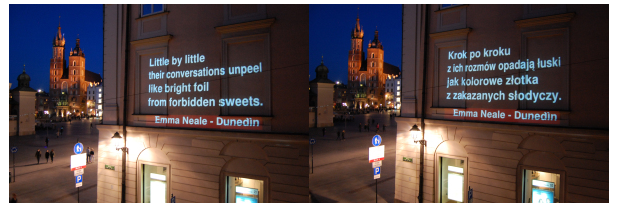
Sue Wootton on Vona Groake at Dunedin Writers’ Festival (what a delicious breakfast!)

Vona Groake in conversation with Liam McIlvanney, Dunedin Writers’ and Readers’ Festival

10 May 2015

It was a dreadful slot on the schedule—nine o’clock on a Sunday morning, on Mothers’ Day, to boot—but an hour with Vona Groake? No contest. The conversation between her and Professor Liam McIlvanney (here wearing his academic-teacher-of-contemporary-Irish-poetry hat, not his crime writer’s hat) was an absolute delight. Liam’s well-informed but gentle and open-ended questions prompted a flowing conversation, further extended and deepened near the end of the session when Vona responded to questions from the floor. Liam’s approach allowed Vona to articulate—uninterrupted!—some ideas on the source and sustenance of her craft. Their erudite, thought-provoking (and often funny) discussion probed the way that poetry grows out of language itself, looked at the influence of tradition on contemporary poem-makers, and was interspersed with readings of some of her poems. Ah, nourishment. And what a delicious breakfast.

Sue Wootton


Where else to catch Vona:

Auckland: Vona is at the Auckland Writers Festival this weekend where she is announcing the winner of The Sarah Broom Poetry Award and reading a few of her poems.

Upper NZI Room, Aotea Centre, Sunday May 17th, 1.30 to 2.30 


Wellington: On Thursday May 21st (12.15 to 1.15) Vona is conversation at the City Gallery in Wellington.

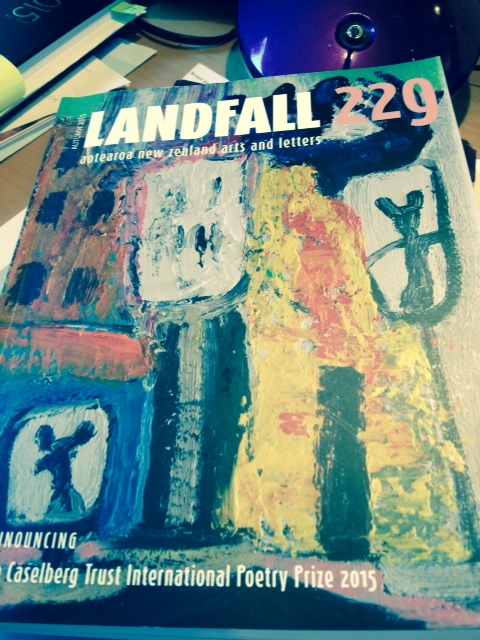
Ten things to love about Landfall 229

photo


Shortly after Sport arrives in my box, I get a bright new issue of Landfall. My little list below maps my ‘loves’ so far — like little ‘like’ ‘share’ ‘favourite’ or ‘retweet’ buttons. Editors might compile a journal with an arc of contours (aural, thematic, emotional pitch, genre, experimentation, quietness and so on) as I have always done with an anthology so you move through shifting readerly experiences from start to finish. However, I never read a journal like this.  It’s dip and delve.

1. Straight to the review section to books I have missed, and books I have reviewed. Ha! I Have missed (all meanings intended) reading Ian Wedde’s The Grass Catcher: A digression about home (Victoria University Press). Martin Edmond’s scintillating review meditates on the implications of writing the past alongside his critique of Ian’s illuminations of his own. ‘Home’ was a key notion that came under scrutiny within my doctoral thesis and within the context of Italian women writing novels in the twentieth century. It still fascinates me. This review has sent me scuttling to buy the book. In particular: ‘This is not one of those writer’s memoirs that says: here is how I became the resplendent creature I am today. It is too multi-faceted, too in love with the world, you might say, to serve such a purpose.’

2. Rata Gordon’s poem  ‘Tinkering’ is like an electric train on electric tracks. You get to the end and you want to travel that route again. Wow!

3. Discovering Michael Harlow picked  Sue Wootton’s poem, ‘Luthier,’ as the winning entry in The Caselberg Trust International Poetry Prize (2015). This poem is sumptuous in detail and that detail evokes mood, music, character, place in a transcendental kind of way. I would love to hear this poem read aloud to hear the poet lift and connect and pause, the hit of certain words on the line (flitch, slink, Sitka, bedrock). Sue demonstrates the way a poem can take a small moment/thought/action/thing and then open out intimately for the reader. A word that comes to mind and that is so overused when speaking poetry is luminous. But this poem is utterly and breathtakingly luminous.

4. Discovering Christina Conrad still writes poems.

5. Short poems can be very very good. So much happens in the white space that holds them This is the case with Louise Wallace’s ‘Mirage/Arizona.’

6. Tina Makeriti’s essay, ‘This Compulsion in Us.’ Strikes a chord because I am fascinated by museums too; enthralled by the things that stick to the objects that only you can see or hear or feel. Loved Tina’s exploration of a museum’s paradox, in that it preserves treasures yet ‘also captures and immobilises things that make sense only in motion, that should breathe and transform.’

7. Runner-up in The Caselberg Trust International Poetry Prize (2015), the opening lines in Jessica le Bas’s ‘Four Photographs from a Window’ : ‘The first is a shot in the dark/ buttoned up and black suited’

8. An Elizabeth Smither short story that underlines what an exquisite hand she has when it comes to fiction (‘The Trees’).

9. The way Sue Reidy’s poem, ‘The primitive,’ became etched on my skin.

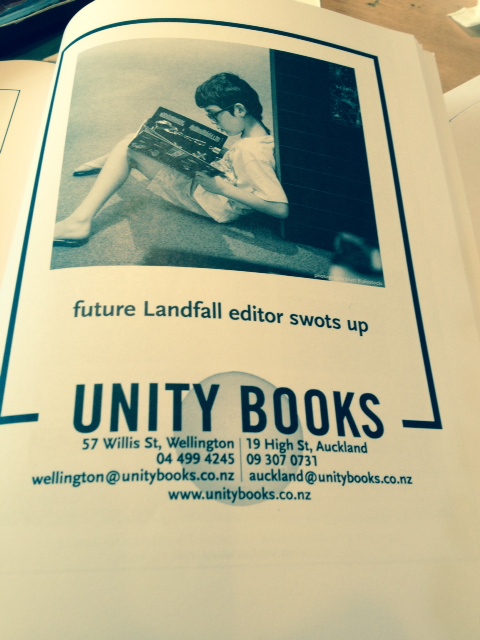
10. Lots more delights but I have to mention the Unity-Books, standout ad. A child reading a book, thank you!

photo