Tag Archives: poetry shelf monday poem

Poetry Shelf Monday poem: Cilla McQueen’s ‘Festival Time’

Festival Time

Pearl-grey moiré silk

above a base-line of pewter,

high top notes cloudy gold.

Oyster Festival tomorrow,

the day the road is jammed with traffic,

the day Bluff is invaded by lovers;

thousands of salt-sweet mouthfuls

dredged from their seabed, shucked deftly,

swallowed alive by the roistering crowd.

Too many people – I’m staying home.

After this rain the paradise ducks will come

down to the green field patched with sky.

Cilla McQueen

Cilla McQueen lives and writes in the southern port of Bluff. A recipient
of multiple awards for her poetry, she eats oysters as often as possible. Cilla’s most recent works are In a Slant Light: a poet’s memoir (2016) and Poeta: selected and new poems (2018), both from Otago University Press.

Poetry Shelf noticeboard: Lily Holloway’s ‘Tidewrack’

Tidewrack

Everything is beached in the apocalypse

bathed in eggplant light as I trundle

past lines of tidewrack and lemons

spitting with sandhoppers

Pink cephalopods suck armoured worms 

from where holes bubble and froth

muscle pulled thick and stubborn

I can hear their beaks cracking

tentacles grasping and it’s painful

to see through their pellucid skin

When I look again, now closer to that line of debris

fluorescent seaweed are strands of thin balloons 

blues and yellows simply twisted and segmented

overlapping scuttlers 

a carrier crab with an urchin settled on its carapace

an offering or mardi-gras hat

People have written cryptograms with sticks

just under the surface of the water

tic-tac-toe and boxes made of scallop shell

preserved in the stillness of it all

The sand path around the cliffside grows thin

and I walk like there’s less gravity 

in a jacket that rustles and clinks

pockets full of the clarity I’m bootlegging

Lily Holloway

Lily Holloway (she/they) has been published in StarlingScumThe Pantograph Punch, Landfall and other various nooks and crannies (see a full list at lilyholloway.co.nz/cv).  She is an executive editor of Interesting Journal and has a chapbook forthcoming in AUP New Poets 8. Lily is based in Tāmaki Makaurau, is a hopeless romantic and probably wants to be your penpal! You can follow her on Twitter @milfs4minecraft.

Poetry Shelf Monday Poem: James Brown’s ‘Their Feelings’

Their Feelings


Their feelings are like a mosquito sliding
its proboscis into a freckle. Their feelings are like
light through blinds in an 80s music video.
Their feelings are like techno under aurora in Norway.
Their feelings are like swimming in sunlit sea and
seeing a shadow. Their feelings are like when they’ve
taken bath salts that turn out to be bath salts, and they
end up in A&E and their mothers have flown in from
Hamilton and are holding their hands and crying, but
all they can think about is how their lives have become a
TV hospital soap which they could have been written out of
or out of which they could have been written.
Their feelings are like a Mindful Self Compassion course
when someone asks where the hyphen goes in the title
and the convenor says ‘Anywhere’ and the person says
‘I don’t think this is what I am looking for.’

James Brown

James Brown’s Selected Poems was published by VUP in 2020. He is working on a new book.

Poetry Shelf Monday Poem: Grace Iwashita-Taylor’s ‘Prelude to Lagimalie’

Prelude to Lagimalie

when imposed on a body birthed from the moana

it squeezes the vastness

into tiny confined spaces

compact

identified 

and foreign


the body birthed from the moana twists

when the breath is not honoured

craves the salt

how you expand at the sea


but the body remembers where it once was


tā & vā   |   time & space

is malleable

multidirectional

multidimensional

multitransactional


our nervous system                           a sacred internal ecosystem

                                           not            a shock absorber


restore lagimalie    |    balance

Grace Iwashita-Taylor

Grace Iwashita-Taylor, breathing bloodlines of Samoa, England and Japan. An artist of upu/words led her to the world of performing arts. Dedicated to carving, elevating and holding spaces for storytellers of Te Moana nui a Kiwa. Recipient of the CNZ Emerging Pacific Artist 2014 and the Auckland Mayoral Writers Grant 2016. Highlights include holding the visiting international writer in residence at the University of Hawaii 2018, Co-Founder of the first youth poetry slam in Aoteroa, Rising Voices (2011 – 2016) and the South Auckland Poets Collective and published collections Afakasi Speaks (2013) & Full Broken Bloom (2017) with ala press. Writer of MY OWN DARLING commissioned by Auckland Theatre Company (2015, 2017, 2019) and Curator of UPU (Auckland Arts Festival 2020 & Kia Mau Festival 2021). Currently working on next body of work WATER MEMORIES.

Poetry Shelf noticeboard: Alice Te Punga Somerville’s ‘room’

room

there are captain cooks amongst us too – bullies,
throwing their weight around

they think they are the centre of the room but that’s only because
they have never been anywhere but there
they have no idea about the edges or even how far the room extends
one day they will realise that we in the corners are really in other centres
they will realise there are no corners
no walls

is it a room? is it a room then, when there are no walls?

i used to want to tell them to move over because they take up all the room
but there’s no room
there is no room

no walls, no room – just links and connections and space

you’re not at the centre; there are no centres
you’re just standing there
one node in a massive network
like the rest of us

Alice Te Punga Somerville

Alice Te Punga Somerville (Te Āti Awa, Taranaki) is a scholar, poet and irredentist. Her poetry has been published in various venues including Ōrongohau: Best New Zealand Poems 2018, Te Rito o te Harakeke, Tātai Whetū, 4th floor, Puna Wai Kōrero, Ora Nui, Mauri Ola and Whetū Moana. Her scholarly publications include Once Were Pacific: Maori Connections to Oceania (Minnesota 2012) and 250 Ways To Start an Essay about Captain Cook (BWB 2020).

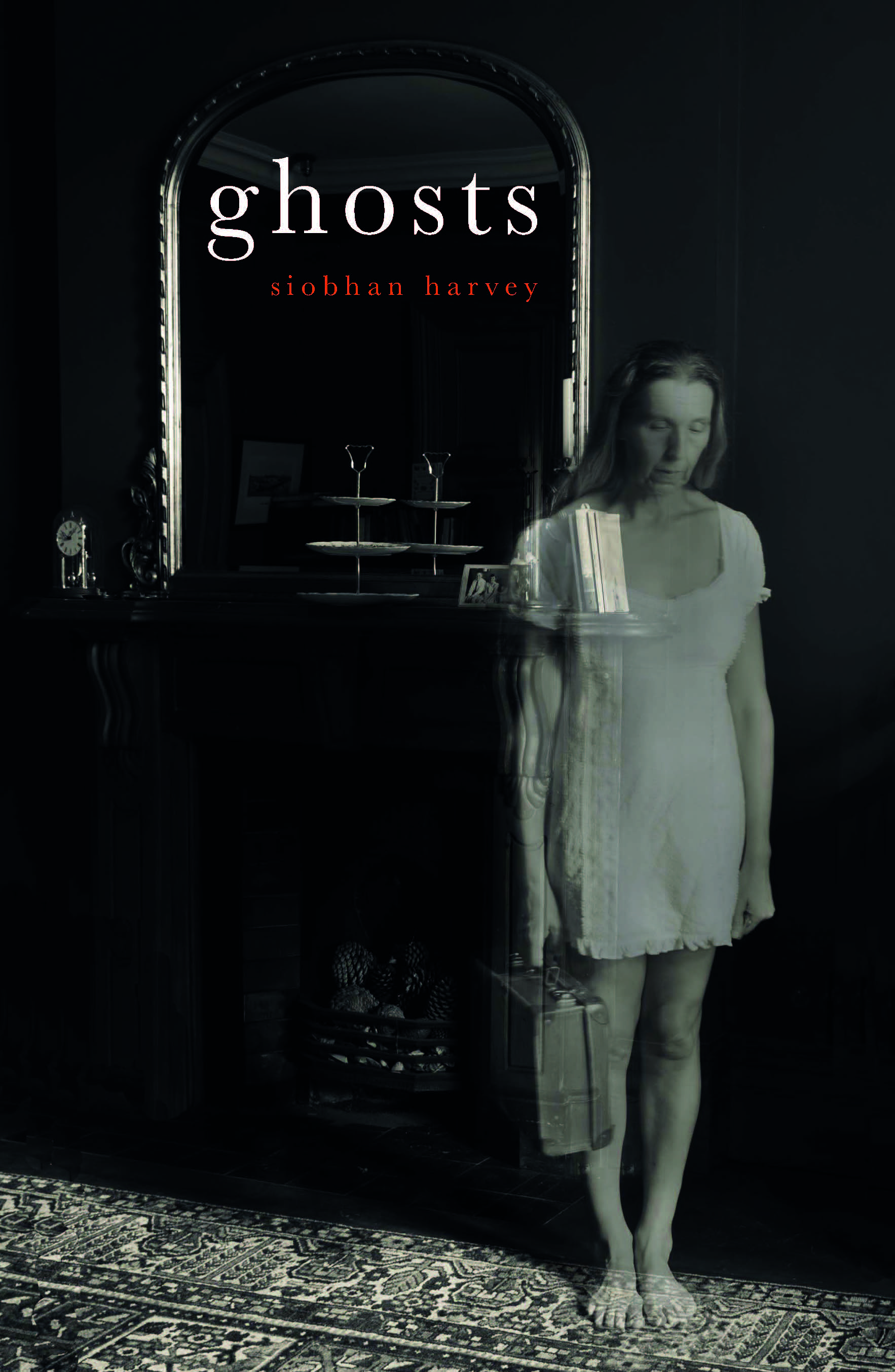
Poetry Shelf celebrates new books: Siobhan Harvey reads from Ghosts

Siobhan Harvey, Ghosts, Otago University Press, 2021

Siobhan Harvey is the author of eight books, including Ghosts (Otago University Press, 2021) and 2013 Kathleen Grattan Poetry Award-winning Cloudboy (OUP, 2014). She received the 2020 NZSA Peter & Dianne Beatson Fellowship, and won the 2020 Robert Burns Poetry Award and the 2019 Kathleen Grattan Award for a Sequence of Poems. Her work appears in recent anthologies: Arcadian Rustbelt: Poets Emerging 1980–-1995 (University of Liverpool Press, 2021), Feminist Divine: Voices of Power and Invisibility (Cyren US, 2019) and, translated into Italian, in Alessandra Bava (ed.), HerKind: Anthology of Contemporary New Zealand Poets (Editione Ensemble, 2021).

Otago University Press page

Siobhan in conversation with Lynn Freeman, Standing Room Only, RNZ

The Friday Poem: ‘If befriending Ghosts’ from Ghosts

Kiri Piahana-Wong review for Kete Books

Poetry Shelf Monday Poem: Oscar Upperton’s ‘The surgeon’s brain’

Intro from the author

Doctor James Barry was a nineteenth-century surgeon. He performed great medical feats, argued with almost everyone he met and duelled some of them too, survived a gay sex scandal in South Africa and travelled across the Atlantic with a goat and his white dog Psyche. He was also a nerd, obsessed with hygiene and hospital administration. He is one of a handful of transmasculine people whose stories have been passed on to us.

This poem is from my upcoming book The surgeon’s brain, an attempt to tell Doctor Barry’s story from the inside out.

The surgeon’s brain

It’s not a trifling thing. A man’s brain is, to some, the man himself. Forget this soul nonsense. He has cut into a thousand bodies and never seen a soul.

He has seen brains frozen, brains shucked from the skulls of criminals, brains in jars. There must be brains in the bogs, he finds himself thinking, Irish brains in Irish mud. There is something in the bogs that preserves. Frightful bodies have been pulled from the mire, twisted and browned like tree roots. Only the skin survives, the innards drained and pulped by the bog, but he imagines the brain laid in rushes, like an egg, like Jesus in the manger. 

In an English church on an African Cape, his thinking stumbles and he is a child again, watching from an upstairs window a beggar walking door to door. She has a bad leg, that’s what people say, like a bad dog, just incorrigible. Young Barry wonders about that leg. 

Later that night, he thinks about how his mind moved from church to street, from Cape to Ireland. He considers a way to observe the brain: a clean room and scalpel, a bone saw, an array of mirrors. He would need assistance for the sawing but could do the rest himself. He would not like another staring at his brain; it would be akin to being naked. The limitation, of course, is that he could only observe his brain thinking about his brain; he could not see what it looked like thinking of roses, for instance, or of prison cells. Perhaps at the point his attention shifted—he could catch that—the second between thoughts. What would that look like? 

It feels to him like there is more than just his brain inside his skull. There is something that he thinks of as the mind, which he pictures as a shiny black spider moving through a web. The brain is static but the mind, his mind, feels as though it is always moving. This is why feelings must be disregarded in the study of anatomy. 

Living outside the brain of Dr Barry, as we all do, it is possible to make only a few observations. For example, we can assume his brain weighed between 1.3 and 1.4 kilograms. 

He wonders whether anyone has ever been as unhappy as he. Sometimes he wonders if anyone has ever been as happy as he. Sometimes he dances around his room in delight. His dog dances with him. If you were to ask them why they were dancing they would no doubt say, Because the other fellow was. 

He imagines a lecture. He holds a thin rod, with which he taps a blackboard. On the blackboard is the word HYGIENE. Under the word HYGIENE are twenty-seven numbered points. He takes his students through each point. The lecture is four hours long. When he finishes, the students don’t want to leave. Sir, is there more you could teach us? Please sir, we want to hear everything. He chuckles, thinking about it, and decides to indulge them. His assistant rolls in a new blackboard. This blackboard is headed DISPOSAL OF EFFLUXIONS.

From where do these dreams come? Sometimes he is standing on a hillside, quite alone. An army mills beneath. His army – men he has trained from birth. He turns and runs and his army follows him, chases him, out of loyalty and bloodlust. I taught you this! he screams. He is lost to their spears. 

Other times he is putting a child to bed. She is tired but strong, and hangs her arms around his neck. Patients call from behind the door. They need me, he says. Please let go. 

I need you, she whispers. She opens her mouth and cholera climbs out.

He bounces baby Augusta on his knee. Her brain is growing fast. When she was born, it would have been smaller than a clenched fist.  Since then it must have tripled in size. He doesn’t tell her parents this. They would ask how he knew. 

Imagine a body without a brain. Monster. Demon. Ghost. Imagine a brain without a body, not in a jar but alive somehow, perhaps submerged in a pool of blood. How to feed it? How to communicate? Would it be an it, or still the person it was? Is? 

Dr Barry, he imagines saying to his brain. Dr Barry, listen to me. Today we have done something truly remarkable.

Oscar Upperton lives in Wellington. His first collection New Transgender Blockbusters was published by VUP in March 2020. His second collection, on the life of nineteenth century surgeon Dr James Barry, is upcoming.

Poetry Shelf Monday Poem: Anuja Mitra’s ‘the widow stands trial’

the widow stands trial

I’ll miss the attention,

that much is true.

the neighbours clutching

bags of flour at my door

as if all I could think to do

was eat. I appreciate the show

of sympathy, though of course

some hungers are larger

than that. winter bit like a dog

that year. I watched my breath

feathering the window

as our men prised

last life from the land, scouring

her cold cheeks for plunder.

funny: to them Mother Earth

is a harsh mistress

and not the first woman

we learned how to ruin.

but I digress — all this is just scenery

and you want to hear of the death.

see, severed from one husband

I wed Rumour in the night,

placed a band on my finger

and pledged to be his. now

my hand throbs pleasantly

as the villagers talk:

see how her face betrays

guilt not grief. she must have

done it. she must have

snapped.

much mythology there is

around the snap.

sometimes it happens

when you are slicing an apple

and a spider slinks out

from its bowels.

sometimes it happens

the third time he strikes you

(though rarely at moments

so climactic as that).

and sometimes it happens

alone in the fields,

hills pulled flush

against the gash of horizon

when something in you unlatches

and swings free like a gate

to some forbidden arch, some space

for the soul to surge through.

perhaps my story needs more

of a relatable flavour.

very well. to the judge

who asks how I plead,

I’ll say I’ve been pleading

all my life:

for some measure of grandness

to fill my wifely days,

some passion to slip through

the cracks of those hours

when I stood fishing ants

from the sugar.

a life for a life. his concluded

to make way for mine.

or so my accusers would say.

gentlemen of the jury, you must examine

my account; turn it round in the light

like some lovely old clock

whose hands you are not sure

you can trust.

there lies the question

you are asked to decide:

what unseemly things

have these hands seen?

let us put that to rest

as I did my good husband —

and while you deliberate

you may find me in the fields;

arms raised heavenward,

light catching my knife

like a smile.

Anuja Mitra

Anuja Mitra lives in Auckland. Her writing has appeared in TakaheMayhemCordite Poetry ReviewStarlingSweet MammalianPoetry Shelf and The Three Lamps, and will appear in the AUP anthology A Clear Dawn: New Asian Voices from Aotearoa New Zealand. She  has also written theatre and poetry reviews for TearawayTheatre ScenesMinarets and the New Zealand Poetry Society. She is co-founder of the online arts magazine Oscen.

Poetry Shelf Monday Poem: Erik Kennedy’s ‘We’re Nice to Each Other After the Trauma’

We’re Nice to Each Other After the Trauma

Christchurch, after 15 March 2019

We’re nice to each other after the trauma.

It’s emotional labour spent in a good cause,

like signing a birthday card at work or volunteering

to clean a beach. In the geography of care

the grieving city is bright, busy, sensitive

to extraordinary needs, able to flex and soothe.

It’s one of a series of temporary truths,

a glimpse of something not quite representative

that we wish could stay once it’s there.

We wish we couldn’t see it disappearing

into routine, because we were desolately happy because

we were nice to each other after the trauma.

Erik Kennedy

Erik Kennedy is the author of There’s No Place Like the Internet in Springtime (Victoria University Press, 2018), and he is co-editing a book of climate change poetry from Aotearoa New Zealand and the Pacific forthcoming from Auckland University Press later in 2021. His poems, stories, and criticism have recently been published in places like FENCE, Hobart, Maudlin House, Poetry, Poetry Ireland Review, the TLS, and Western Humanities Review. Originally from New Jersey, he lives in Christchurch, New Zealand.

Poetry Shelf Monday Poem: Kay McKenzie Cooke’s ‘cannot believe my eyes’

cannot believe my eyes

At the inlet the resident pair

of paradise ducks

trumpet their usual dismay

at my approach;

the white-headed female’s call

a high-pitched wail of fear,

her dark-plumaged mate’s

placating response a constant offer

of reassurance

against unfounded alarm.

And seagulls strutting

like meat inspectors, folded wings

placed just so behind their backs.

The tide’s out and in the air,

the waft and weave of mud, weed,

algae and imminent rain.

*

Ahead, a young man jogs,

a small black-and-white dog

bouncing along at his heels.

An incongruous pair, him in sports gear

and the dog looking like it’d be happier

in a handbag.

Then, to my horror, the man kicks the dog.

I cannot believe my eyes. Until

it becomes clear that

without my glasses,

what I thought was a dog,

is in fact a soccer ball.

*

Nearly back home now,

I stop to take photos

of a blue, wooden garden seat,

a well-constructed wall

and on the footpath

the broken-crockery pieces

of strewn autumn leaves,

my own dark shadow

like black water

pouring out from under my feet.

Kay McKenzie Cooke

Kay McKenzie Cooke’s fourth poetry collection was published by The Cuba Press in June 2020 and is titled Upturned. She lives and writes in Ootepoti / Dunedin.