Tag Archives: NZ Poetry review

JAAM 2013: my taster of treats (so far)

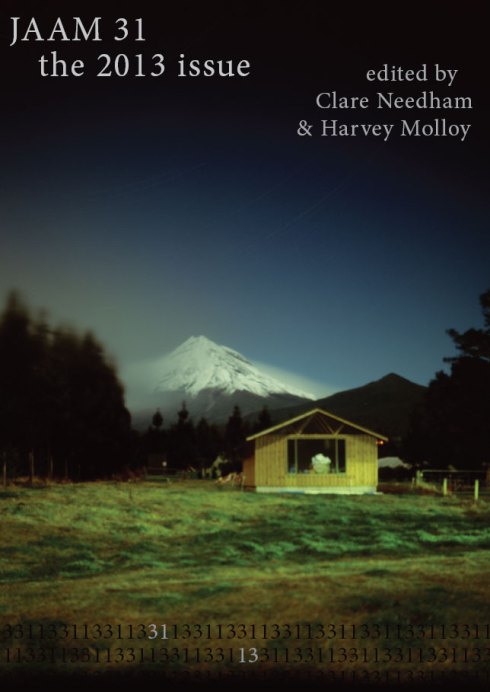
jaam31-cover

Harvey Molloy (poet and teacher) joined with Clare Needham (JAAM‘s co-managing editor) to edit ‘The 2013 Issue.’ While not enforcing a particular theme, the editors did present several questions that contributing poets could bear in mind: What are you thinking about now? What is your 2013 issue?

This bumper issue is a mix of prose and poetry from established and emerging writers, and reflects the way New Zealand writing absorbs an eclectic range of thought and issues (stunning cover BTW!).

Here is taster of my poem treats so far:

Emma Barne’s ‘I am in bed with you’ is a lushly detailed, astonishing roller-coaster of a poem. It’s hypnotic pattern of decreasing lines and increasing ellipsis takes you back to 1994 and to the white-hot core at the poem’s end.

Helen Yong’s ‘The Tea Ceremony’ is refined in focus. The sweetly crafted detail of the teapot ceremony offers cues to a relationship (he and she, then we).

Vaughan Rapatahana’s ‘it’s 3 a.m. in papatoetoe,’ exudes visual playfulness that makes music chime in your ear.

The melodic narrative is both strange and compelling in Joanna Preston’s ‘Fare.’

There’s the terrific discovery of Natasha Dinnerstein; from the sheer elegance of ‘Articulated’ to the hot beat and pulsing detail of ‘Grecian Urn Dance Remix.’

And Helen Heath’s short poem broken into two parallel blocks (a shudder of silence or synchopation down the middle) like two frontal lobes.

Or David Howard’s dynamic ‘Venture My Word’ that also used parallel blocks of verse to play with breath and movement.

The surprise and vitality of Rachel Fenton’s ‘The Scientist’ (I loved the structure). Loved this poem!

I haven’t started the prose yet, and there still poems to read. I don’t know why, but I always dip in and out of journals, landing wherever a page falls open. This doesn’t provide a view of the editors’ crafted arc, but it is a perfect way to slip poetic treats into a day. In response to the editors’ questions, regardless of whether the contributors addressed them directly, NZ poets have all manner of things on their mind—and like a prism, the poems catch myriad traces of time and place in their light.

Guest editor for 2014 is Sue Wootton.

JAAM link.

Wonderful! Gregory O’Brien’s Citizen of Santiago with photographs by Bruce Foster

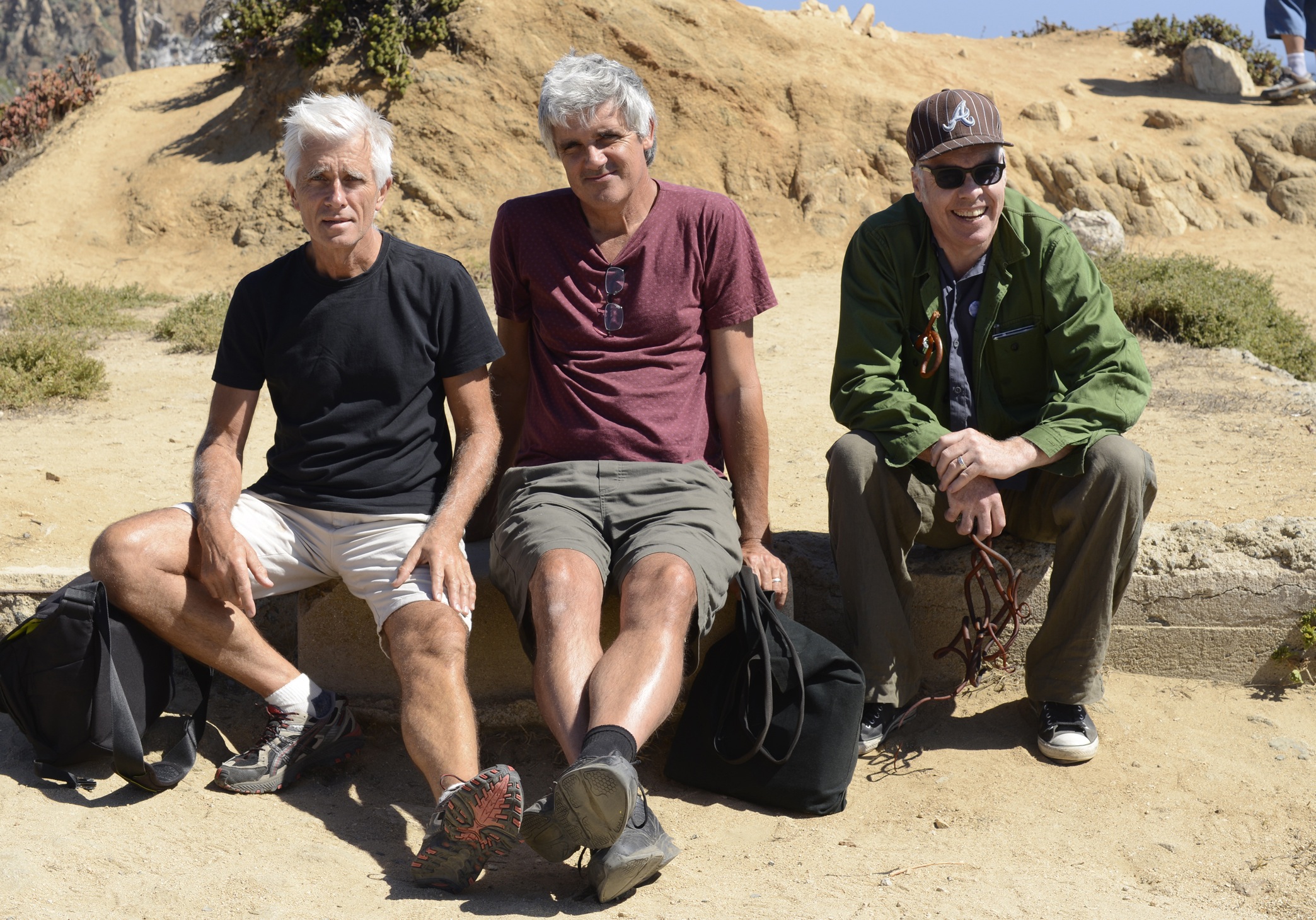
Bruce_Greg_John

Photo: Bruce Foster, Gregory O’Brien and John Reynolds at Quintay, a short distance from Santiago on the Chilean coast, March 2013

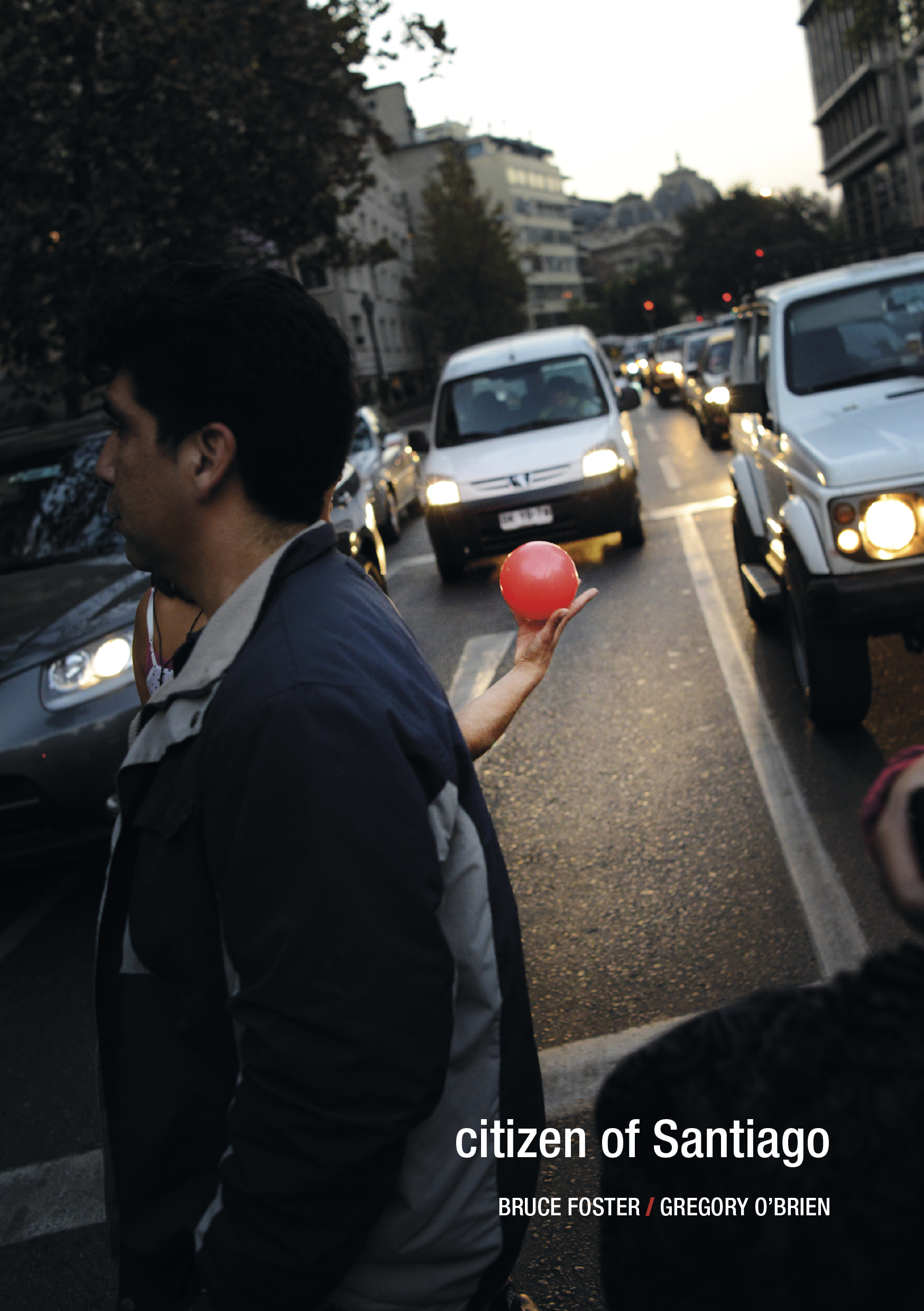
Citizen of Santiago poems by Gregory O’Brien, photographs by Bruce Foster (Wellington: Trapeze, 2013)

As participants in the travelling exhibition, ‘Kermadec — Art Across the Pacific,’ Gregory O’Brien and Bruce Foster stayed in an apartment in Santiago de Chile between March and May in 2013 while the show was on. Both men went exploring the city, one with camera and one with pad and pen. The urban navigation resulted in Citizen of Santiago — a delightful collection of poems and photographs.

citizen of Santiago cover    citizen of Santiago cover

I have always been a fan of Gregory’s poetry and have often wondered what it is that draws me to it. Partly, I think, the uniqueness of voice; the quirky mind that accumulates detail as the poet inhabits the world, and then the way that detail prompts little tracks of thought that surprise and tumble and turn.

The opening poem, ‘sombrereria,’ goes way beyond the tourist snapshot. The poet takes hold of an object that catches his attention, ‘the hat,’ and then burrows in deeper (trademark O’Brien). This poem is modulated by place (we get details that might attract the tourist eye), but to me the poem goes beyond a specific location (the hat nourishes imagination and intellect, and acts as a pivot of meditation).  Lines ring out splendidly: ‘A hat goes a long way/ to making up its mind’ ‘A hat is also an ear/ listening in on/ the head’s business.’

The afterword mentions the story that the Architect Cristian Valdes told of the origins of the Valdes Chair (in a nutshell, father and son were playing tennis, and then the broken tennis racquet was transformed into a chair). It also describes how Cristian’s exhibit at the Kermedes show (two free-standing, gib-board structures) might be a prototype for a summer house that could be folded away to one wall in the off season. Gregory’s poem replays the story told, but also acts as a metaphor for the way a poem can be unfolded and refolded. This gets to the heart of what I love about Gregory’s poetry: the way his poems fold in on themselves, delicately, wittily, not just at the level of syntax but also at the level of thought and the layering of music). His lines are flipping what you see or think or feel back in on itself (like philosophical or poetic peelings — you hold the potato peeler).

Bruce Foster’s photograph’s also sidestep the expected tourist snapshot. As with the poems, there is repetition, echoes, images folding back into themselves, (easels, legs walking). The photographs place human activity centre stage; a city is more than bricks and mortar, it is a psychological state of mind, communities of people. Strangenesses. Points of empathy. Universal registers (father and son laughing in Bruce’s photo). Accumulating narratives.

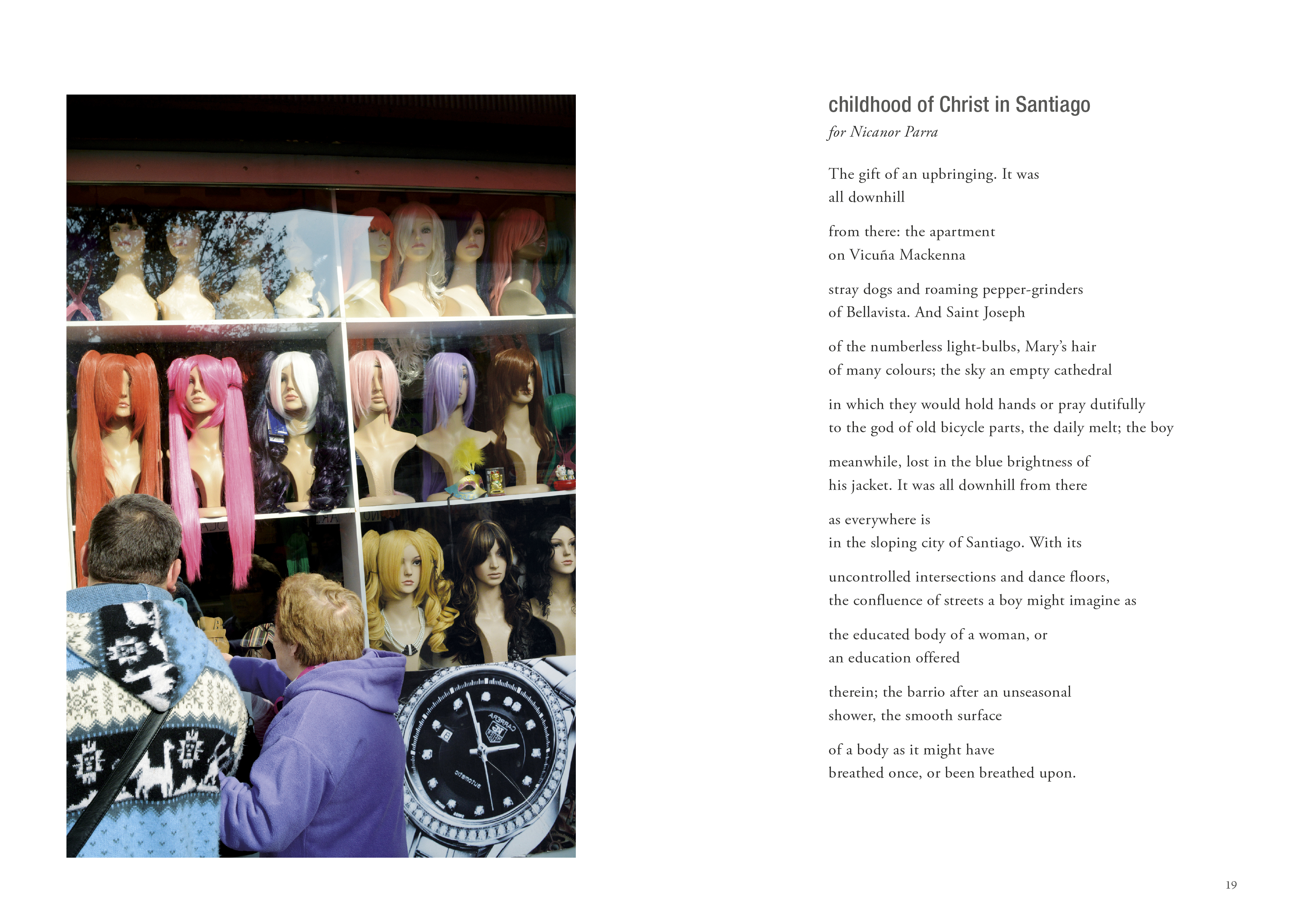
In one poem, I read: ‘It was all down hill from here/ as everything is/ in the sloping city of Santiagio.’ In one photo, there is a man half hidden by a slanted tree — the tree denies us access to his face (really we only ever get a partial view on any page), but the detail within the frame is electric. The bright pink, plastic crates match the man’s trousers; you leapfrog from the hole in the tree to the diamonds in the crates to squares in the windows. In both poem and photograph, the detail is fertile ground for visual, aural and semantic pleasure.

The book, through both image and line, sets you upon the slopes of reading and viewing, and then sends you skating and skimming and stalling in this foreign place. It is a poetic treat.

citizen of Santiago spread pp18-19

The Kermadec show- Artists in the South Pacific here

Kermadec Gregory O’Brien page

Kermadec Bruce Foster page

Gregory O’Brien Beauties of the Octagonal Pool AUP

Gregory O’Brien NZ Book Council page

Bernadette Hall’s Life & Customs– such readerly movement is a like a breath of fresh air

IMG_1396

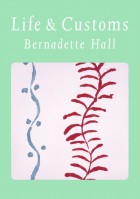
Bernadette Hall, Life & Customs, Victoria University Press, 2013

Bernadette Hall is an award-winning poet, mentor and anthologist living on the coast north of Christchurch. She has published numerous collections of poetry including the terrific The Lustre Jug (2009). She edited Like Love Poems: Selected Poems of Joanna Margaret Paul and The Judas Tree: Poems by Lorna Staveley Anker (see my review of the latter here). She has held a residency in County Cork, Ireland and has visited Antarctica courtesy of Antarctica New Zealand. Both those experiences have found their way into her poetry. You can read my interview with Bernadette here.

life_and_customs_front__40765.1372036384.140.215   life_and_customs_front__40765.1372036384.140.215   life_and_customs_front__40765.1372036384.140.215   life_and_customs_front__40765.1372036384.140.215

Bernadette’s latest book, Life & Customs, is a substantial collection that draws upon the layers of the world with such poetic finesse it is impossible not to fall in love with it. The book is in two parts with a ballet interlude. Bernadette opens with a quote by Wallace Stevens (this bit stood out for me: ‘Life’s nonsense pierces us with strange revelation’). It seems the perfect epigraph for the collection, as the poems enact moments of ‘life’s nonsense’ (you could say — strangeness, surprise) along with those ‘revelations’ (also unexpected, nourishing).

This is a book of home, of shifting geographies and roots laid down, of memory flashes and of loving attachments (‘this is all part of the long slow plunge into memory’). So it is no surprise the first poem, ‘how lovely to see you,’ is like a welcome mat. More than any other book I have read in an age, Bernadette welcomes you into a nook of poetic warmth. This book exudes warmth, there is no extravagant game playing or showing off – instead you get led into the heart of living and life. Such readerly movement is like a breath of fresh air.

The first joy of this collection is the simplicity. I am not going to use the word plainness but opt instead for a word that registers beauty, stillness, contemplation, attentiveness and a zen-like deportment. Take these lines for example: ‘the sea comes in and kisses my feet/ then it goes back out again.’ This line appears after a small list of strange and not so strange things (like kinks in the day): ‘the little boy has swallowed/ a sadness bean.’

The second joy is the music, something that I have written of before in my appreciation of Bernadette’s poetry. Take any poem in this book and you will discover its musical contours – the way each line is pitch perfect in its undulating sounds and tones (‘We don’t need the pucker and slip of a tablecloth’). There is delicious assonance (tick clicky kids drift); there is heavenly rhyme (father/ harbour); there are words that coo on the ends of lines (plunge Mamaku); there are sharp words that sound off key (fatal); there is silence breaking into a line; there are sounds scattered like aural glitter or glue (‘m’ sounds in ‘The view from the lookout’).

The third joy is the humour. There is chuckle and body mirth in many of these poems. In ‘The day Death turned up on the beach’ the narrator invites Death over for scones with jam and cream. There is the book you can borrow but you can’t open to read. ‘In Search of Happiness’ humour mixes together with the surreal in a fablesque poem. There are two islands – one goes up in smoke and one drowns.

The fourth joy is the use of memory that takes you to and fro in nostalgic movements. ‘The Grinder’ takes you back to ‘way back when’ and there you are winding wool and making mince out of cold roast meat. There are things we take for granted that suddenly pulse on the page.

As I read the ballet interlude, I wondered who could turn this into ballet, but as I read, I choreographed the lines into a visual feast in my mind.

Bernadette writes with the poetic poise and insight of Dinah Hawken. To read these earthy and heavenly attachments is to fill with joy at what poetry can do. This is a marvellous collection.

Thanks to VUP, I have a copy of the book to give to someone who likes or comments on this post.

Victoria University Press page

New Zealand Book Council page

New Zealand Electronic Poetry Centre page

Canterbury University Press page

Best NZ Poems edited by Bernadette Hall here

My review of The Lustre Jug in The NZ Herald