Tag Archives: Jenny Bornholdt

Book Launch: Jenny Bornholdt’s new poems and Ashleigh Young’s essays


Victoria University Press warmly invites you to the launch of

Selected Poems
by Jenny Bornholdt

&

Can You Tolerate This? Personal Essays
by Ashleigh Young

6.00pm–7.30pm, Thursday 11 August
at Unity Books
57 Willis St, Wellington.
All welcome.

Buy both books on the night for only $60 (normally $70).
This offer applies at the Unity Books launch only.

For more information click on the titles below:
Selected Poems by Jenny Bornholdt
$40, hardback
Can You Tolerate This? Personal Essays by Ashleigh Young
$30, paperback

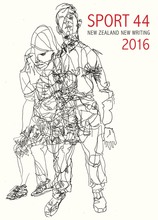
Reading Sport 44 on a wet Sunday keeps the blues away

Sport_44_Cover__64545.1456369674.220.220.jpg Sport_44_Cover__64545.1456369674.220.220Sport_44_Cover__64545.1456369674.220.220

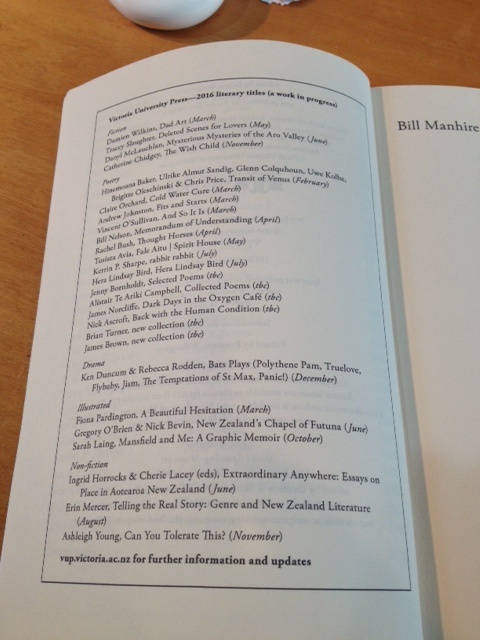
The new edition of Sport includes 8 essays along with the usual spread of poetry and fiction. At the start of the book is an impressive advertisement for Victoria University Press’s forthcoming publications. This Press is a consistent and exemplary supporter of New Zealand writing whether poetry, fiction or non-fiction.


Why I am singing VUP’s praises:

There are 15 poetry collections in the offing (okay some might not appear until next year, but still!). We are going to see books by Tusiata Avia and Hera Lindsay Bird over the next few months.

Sarah Laing‘s new book is out in October (Mansfield and me: A Graphic Memoir).

There are 4 works of fiction (Catherine Chidgey has a new novel out in November!)

And I am looking forward to the collection of essays Ingrid Horrocks co-edited having tasted some in Ruapehu and Ashleigh Young‘s essays (November).


Sport 44

some preliminary highlights:

Usually, I read all the poems first but this time I was in the mood for a bite of fiction so I dove straight into Kirsten McDougall‘s ‘A Visitation.’ The story responds to the collapse of the internet and the arrival of Clarice Lispector to make a batch of eggs to tempt an indifferent palate. I adored this story so much it made me want to take up writing short fiction. It is sweet writing; warm, witty, funny, thoughtful, polemical. I do hope there is a new collection in the pipelines. I read this on a plane with two hours sleep and it was such an uplift. ‘I saw anew the detritus in the house I had allowed to build up like a plaque to the heart.’

The journal always puts in me in touch with writers I am unfamiliar with. This time a glorious suite by Oscar Upperton: ‘The ship is a sort of dark undoing.’

And Philip Armstrong‘s utterly inventive narrative, ‘Life of Clay,’ which keeps you on your toes as you read: ‘I can tell you it began with nothing/ but the wide white bare and empty endless plain/ but there was something there already there.’

I have already posted some of Rachel Bush‘s poems here.  Movingly, achingly beautiful. Written when life has fingertips against death.

Jenny Bornholdt‘s exquisite haiku: ‘It is eight degrees/and the Thorndon outdoor pool/ is swimming with leaves.’

Ashleigh Young‘s ‘Process’ which is sad and happy and a little bit witty and a little bit true: ‘On this day our city is a perfect haircut, its losses gently layered/ and what is left, falling gracefully.’ Oh word shivers!

Tusiata Avia‘s ‘Gaza’ which brings heart and politics together and rips your easy Sunday slumbering with poetic teeth: ‘I cannot write a poem about Gaza because I cannot eat a whole desert.’

The stillness, the extraordinary image, the enigmatic bridge between title and poem in Louise Wallace‘s ‘The body began to balance itself’. You just have to read the whole thing!

Hannah Mettner‘s ‘The day Amy died’ that takes a moment that pricks with sharp detail and pricks even deeper when the moment is declared and time and noise go haywire.

Maria McMillan‘s ‘The Ski Flier’ is a whoosh of a poem that sucks you up into story and music and is so evocative: ‘And/ there is a moment when they pass,/ the snow and the ski flier,/ each taking on the character of the other.’

Harry Rickett‘s ’14A Esmonde Road’ exudes the mood of place, that historic property where Janet and Frank lived; and you can just feel the phantoms stalking the poem until you get to the perfect ending.

The first poem, ‘Falseweed,’ is by Bill Manhire and was published as a little pamphlet by Egg Box Publishing in Norwich. It has a different feel to some of Bill’s recent poems. The words are scattered like seeds on the expanse of white page. Or pebbles. But I like the idea of seed as they are so fertile. I can see the roots and buds bursting out. There is linguistic inventiveness that boosts both music and image, particularly in compound words:

leafcandle  pencilheart  wintertwig  scribblegrass  anchorwhite  tongue-true.

I felt like I was following a dandelion kiss and pausing to see where it landed. The poem is about childhood and writing and a mind floating, roaming. Words floating, roaming. It is beautiful and mesmerising: ‘I began to recall/ how the words came knocking.’ ‘Oh pencilheart –/ oh smudge of lead.’


And still much to read; more poems, more fiction and the bundle of essays. This is a terrific issue.

The VUP ad:

IMG_3295


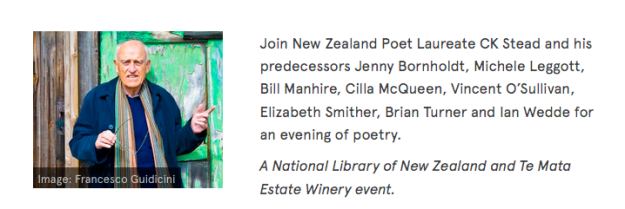
A Circle of Laureates, a galaxy of poetry

This event prompted me to hunt for cheap fares to Wellington because it seemed like a rare and special poetry occasion. And it was! A sold-out event!

The National Library, as current administrator of the NZ Poet Laureate awards, hosted the evening as part of Wellington Writers Week.  John Buck from Te Mata Wines instigated the Laureateship in 1997, with Bill Manhire taking the debut spot. John was there with wine to share. He still retains an involvement.

Fergus Barrowman from VUP was the MC. He made the important point that the award is ‘an activist portfolio not just an honour.’ The earliest debut publication by a Laureate was in 1964 while the most recent debut was 1988.  Three generations of poets! Cilla McQueen and Michele Leggott calculated over 700 years of life/poetry experience across the ten laureates to date.

Bill Manhire (1997) spoke about what the Laureateship meant to him and the two ways it expanded his sense of what he might do as a poet, as a public figure. Firstly he began to write poems with some kind of public dimension. Secondly he explored the way the role centred on the promotion of poetry. He wanted to ‘talk it up.’ Both are options we can be thankful for. Bill’s poems that stand on a public stage are poems that embrace the knots and crests of humanity. I talked about the way ‘Hotel Emergencies’ does this on Summer Noelle in January.

Bill read ‘Erebus Voices’ and I sat there thinking this is a poem that belongs in the world and can be heard again. And again. And then again. Because it both moves and matters. Bill shows so adeptly the way poems can shift us to laughter, to wry grins at the surprise of it all, but also lead to far more unfathomable movements of the heart.

‘I am here beside my brother, terror./ I am the place of human error.’

I especially loved the way he started with the poem of a fellow poet. He ‘talked her poem up,’ and I fell in love with it all over again: Rachel Bush’s ‘The Strong Mothers.’


Hone Tuwhare was represented by his son Rob. We listened to Hone read ‘No Ordinary Sun,’ we listened to Rob read Hone and then Rob picked up his guitar and sang a Graham Brazier version of one of the poems. A version of friendship. Quiet, haunting, utterly melodic. This was love. Hairs standing on your arm on end from start to finish in the Tuwhare bracket.

‘Oh tree/ in the shadowless mountains/ the white plains and/ the drab sea floor/ your end is at last written.’


Elizabeth Smither read a cross section of poems that delighted the audience. But one as-yet-unpublished poem in particular stuck to me. Kate Camp, her mum and I – all went ‘wow.’ I adored the story of Elizabeth seeing her mother move through her house, the windows bright, unaware of the daughter driving by. By the time I got to congratulate her, dear Elizabeth had already signed her copy for Kate. How lovely! Like a bouquet of flowers. Elizabeth emailed the poem so I can read and write about it for my book.

‘It was all those unseen moments we do not see/ the best of a mother/ competent and gracious in her solitude’


Brian Turner with his delicious wit said: ‘I’ve been called a political animal many times and it’s not always a compliment!’ And that is what makes his poems so enduring. The way he hits the right pitch of land and sky but with a deep love that is unafraid to match beauty with issues. He read a cluster of short poems where every word sang. Gee whizz this was good. Here are few lines I loved without the line breaks (sorry):

‘and the shadows are mauve birthmarks on the hills’

‘If the sky knew half of what we were doing down here it would be inconsolable and we would have nothing but rain’

‘where a river sings, a river always sang’

See what I mean!


Jenny Bornholdt

Jenny rued the way Wellington Writers Week has dropped ‘readers’ from the title. She said she would reclaim readers, in the perfect setting (the library), with a longish poem: ‘A long way from home.’ This was a highlight for me. The poem is all about illness and reading; the ability to read and a time when it flees. Here are some sample lines:

‘How as a child, books were the lens// through which I eyed the muddy track to adulthood’

‘For six weeks now I’ve been outside weather/ and of reading. Outside of myself.’

‘I have tried to read but nothing/ sticks. That anchor of my life has been raised and// I’m all at sea.’


Michele Leggott, like Bill, brings poetry to a a public arena through her tireless promotion and expansive love. Michele read an extract from a long work (‘The Fasciclies’) that bridges Taranaki and Lyttelton, the 1860s and the 1970s, and the connections between two women.

My notebook is full of Persian-like doodles of birds and shapes interspersed with notes but, as I listened to Michele, my pen stalled. I felt like I could hear Robin Hyde with her luminous detail and observations in the seams. For this was luminous writing. There is a bridge between reader and poem. Sometimes you cross it. Sometimes it seems impassable. I just wanted to cross the bridge and read the whole poem.

You can find the whole piece here.


Cilla McQueen read ‘Ripples’ a long poem that showcases her strengths as a writer. It is in her latest collection, The Radio Room (2010). Another highlight. Other poets make an appearance, Joanna and Hone. Moving. Uplifting in a way.

‘After the funeral service you leaned down towards me out of a cloud;/  “Kia mau!” you shouted into my mind.’

Cilla McQueen’s memoir is due next week from Otago University Press.


Ian Wedde also has a childhood memoir out, The Grass Catcher, which is on my must-read list. Ian’s poetry produces my ideal poetry trifecta of relations: music, ideas, heart. Oh! And singing its way through, a sense of story. He read from ‘The Life Guard.’ Ha! It’s all here. Listen to the start:

‘You have to start somewhere/ in those morose times,/ / a clearing in the forest say,/ filled with golden shafts of sunlight// and skirmishes’


Vincent O’Sullivan has a new book out from VUP, which I am about to review for a newspaper, so perfect to hear him read his poetic contours. He has the ability to refresh anything. To tilt tropes, to enhance the music of a line, to poke you with an idea, to make you feel. Once again I got caught up in the moment of listening and didn’t catch lines in my notebook.


Ck Stead is the current Poet Laureate. He began with a poem about Allen Curnow, who he felt would have been Laureate if he had lived within the Laureate time span. Karl had struggled over whether to read a top-hit kind of poem or read new things. I know that feeling and first thought I would only ever read a poem once in public when first published. That soon fell by the wayside.

It was a moment of audience empathy as Karl confessed he thought he would read it, then wouldn’t, then finally after hearing Bill, decided he would. And we were glad, indeed, as he read an elegy for his mother. Utterly moving.

Poetry is such a love for Karl. He made this clear when I was filming his ‘thank you’ speech for the Sarah Broom Poetry Award. And hearing him read on this occasion, lifted the poems off the pages where I have loved them, to a new life in the air/ear.

from ‘Elegy’ but without that scattered layout that makes much of white space (sorry):

‘She’s there somewhere/ the ferryman/ assures me.// He tells me/ she was reluctant to go/ but silent – // stood in the prow/ no tears/ and never looked back.’

Karl filled the room with the warmth of poetry. Music. Heart. Ideas. A perfect end.


The tokotoko table, with all the talking sticks carved especially for each poet, was like a quilt with stories. I wished someone had held up the mother tokotoko for all to see and told that story. And indeed held up each tokotoko, for each tokotoko has its own.

Karl will get his at the Matahiwi ceremony in April. I am honoured to be part of this occasion along with Gregory O’Brien and Chris Price.


A Circle of Laureates was a magnificent occasion. I bumped into Elizabeth Knox the next day and we were both enthusing about how good it was. Peter Ireland from the National Library had put in all the hard work! Kindly acknowledged on the night by Ian. Every poet held my attention. There is a big age range here, but to me, it is a way of honouring our poetry elders.

As a poet, I write with one foot in the past and one foot in the future.I want to know who I’m writing out of. This is my tradition. This is my innovation. This circle.

It reminded me of Selina Tusitala Marsh’s’s poem ‘A Circle of Stones in her debut collection where she honours the women she writes from, towards and beside.

Thank you to everyone who made this event possible. It was worth my spur-of-the-moment cheap flight, my accidental data blow out, my misbooking home that meant a new booking, the chance to hear the Lauris-Edmond finalists, and losing myself in Jessie Mackay in The Alexander Turnbull Library.  Thirty-six hours of poetry. Heaven.

Thanks! Ten Poets Laureate to celebrate!


Poetry Highlights at Wellington’s Writer’s Week in March

For the full programme see here but this is the poetry on offer.


I would love to go to the Laureate Circle but can’t make it at this stage (might just fly down on a whim!). I would really like to post pieces on any of the poetry events at the festival. Any takers?


Friday March 11th 7pm  A Circle of Laureates

Screen shot 2016-01-30 at 9.48.49 AM


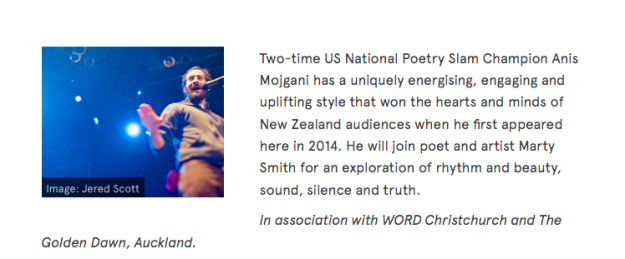
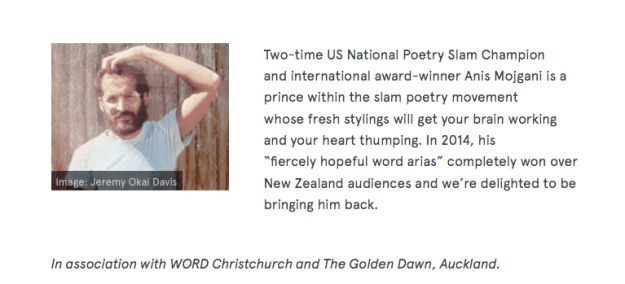
Friday March 11th 5pm   Anis Mojgani and Marty Smith

Screen shot 2016-01-30 at 9.55.17 AM


Thursday March 10th 1.45pm Anis Mojgani

Screen shot 2016-01-30 at 9.57.28 AM


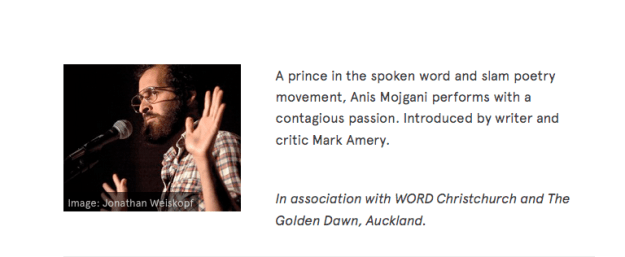
Sunday 13th March 2.30 pm  Anis Mojgani with Mark Amery

Screen shot 2016-01-30 at 9.59.20 AM


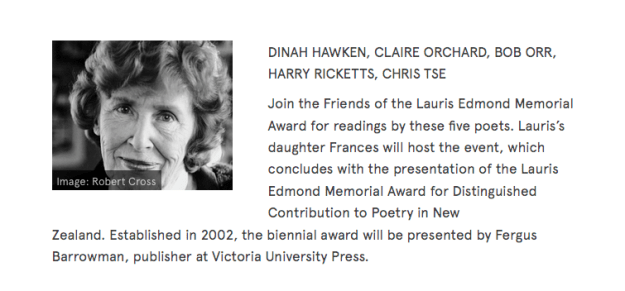
Saturday 12th March 3.30 pm Five Poets and a Prize


Screen shot 2016-01-30 at 10.00.52 AM

Jenny Bornholdt’s A Book is a Book is the loveliest book I have read in years

ViewImage   ViewImage   ViewImage   ViewImage

Sometimes a book arrives in the world and you know that it is a very special thing. It is a book you want to give everyone for Christmas and for birthdays and on days when you just feeling like giving someone a book.

A Book is a Book by Jenny Bornholdt (one of my favourite New Zealand poets) with illustrations by Sarah Wilkins is one such precious thing (Whitireia Publishing and Gecko Press, 2013). It is a little, hardcover book with a paper-dust jacket and exquisite drawings. It feels like it is from another age, perhaps the 1960s, so it takes me right back to when I was a young girl and I loved the magic of a new book (I still do!).

As the title tells us, this book is all about books — about reading books. Each page only has one or two sentences, but each page shimmers with wisdom, humour and truthfulness (I kept thinking that is so exactly right as I read!). Such a mix means that it is a very happy book! To sit down with a book that is so HAPPY it makes you feel HAPPY which is a very good thing.

To be honest, I couldn’t bear to finish this book for ages (in fact I left a little bit for today); like a box of chocolates I wanted to go on and on. Every page is a favourite page, but here is one I love:

‘If it’s Sunday and it’s raining,

a book is the perfect thing.

Even a small book, because

boredom can be very big.’

You will find places to read books, what to do if you don’t have a book, what’s inside books, about a -glow–in-the-dark book, games you can play with books …

… but as soon as I start to describe what the book describes, I know I have to stop because all Jenny’s word magic is gone.

This, my number-one-book-I-have-read-in-a-very-long-time book, you just have to read for yourself, and then get another copy to give your best friend. Because it is the perfect book to read when you want to feel good about life.

Thank you Whitireia Publishing and Gecko Press for the gorgeous production, thank you Jenny for the terrific words and thank you Sarah for the delicious, little paintings that are just perfect.

To celebrate my love of this book that has filled me with such book joy, I am going to host a three-week READING FESTIVAL on NZ Poetry Box starting on Monday with all kinds of prizes and surprises. If you want to paint a picture of your reading life as a child in 500 words or less let me know. paulajoygreen@gmail.com      http://nzpoetrybox.wordpress.com

ViewImage   ViewImage   ViewImage   ViewImage