The body you gave me’s wearing thin: I won’t patch a scarecrow’s coat. The plains of the east I tilled are stippled with wheat; magpies nest
in the hair of my head, my heart is all marching feet. This night I lie beside my wife; the moon creaks over
the sill: I breathe, “You’re a tinny sod!” and tilt in the coffin of sleep. I dream of what’s left in this sliver of life, the reins my hands can’t reach.
Jeffrey Paparoa Holman London 1993
This poem was written in London in the mid-1990s, at a time when I was working in a central city bookshop – Waterstones – and devoting myself to writing. Short stories and poetry, going along to writing programmes at City Lit adult education centre in WC2H, and making friends with Dylan Horrocks, also at the same Charing Cross Road branch, doing his drawings and cartoon strips in lunch breaks, evenings and weekends. We all now know the result of his apprenticeship to the art. Quite when or why this poem emerged, it’s too far gone to remember, but it’s fair to say, is part of a self-appointed midlife apprenticeship to my lifelong writing urges. It was time to get serious and ‘Wheat in the East’ belongs there. 1997, I was back in New Zealand for good – in both senses – returning to university to finish a rusty, abandoned 1970s BA. I decided the following year, to put together a self-published 36 pp chapbook, with Johnathan of Molten Media as my guide. In 1998, we produced Flood Damage, where this poem, with many other London-birthed works appear. I was away. There was no stopping now. I couldn’t know it, but I was on my way to publishing what became As Big As A Father, with Steele Roberts, in 2002. The title poem here had also been written in our London council flat. This poem was part of that journey, so resides in my heart, with affection.
Jeffrey Paparoa Holman writes poetry, short fiction, history and memoir. He has published seven volumes of poetry; Best of Both Worlds (history, 2010); The Lost Pilot (memoir, 2013); Now When it Rains (memoir, 2017). As Big As A Father (Steele Roberts, 2002) was shortlisted in the Montana Book Awards, Poetry, 2003. Best of Both Worlds: the story of Elsdon Best and Tutakangahau (2010) was shortlisted in the Ernest Scott Prize, History (2011, Australia). His most recent work, a family history, Lily, Oh Lily – Searching for a Nazi ghost, is published by Canterbury University Press.
entering the silence that is not a silence remains of a shoe by the mouth of a shaft rusted boiler at a fork in the creek pond of eels where the dredge dismantled ended its song in a valley of tailings entering the silence that is not a silence
enter a silence that never was the wheels of a lokie sprouting fern a railway signpost clothed in lichen the sign to a mine where the dead still linger lost to lovers dear to mothers enter a silence that never was
enter then the world without knocking digging drilling sluicing felling fishing farming ploughing a dream hauling an island from the constellations into the glare of an alien reign enter then the world without knocking
enter the silence enter the dark enter the hive of the invitation enter the majesty enter the wine enter the wilderness while you may enter with flags and enter with instruments enter the silence enter enter
Jeffrey Paparoa Holman
Paula: I recently reviewed Jeffrey’s new poetry collection for Kete Books. In conclusion I wrote: “Holman writes with a measured step, with distinctive and diverse musical keys, with an ear attuned to the everyday and to a refreshing uplift of language. Repetition is a useful device, appearing like a refrain in a book of song, as a subterranean reminder that history repeats itself. Death, ruination, love, joy. This is a collection of poetry that will echo and nourish as we move through uncertain days.”
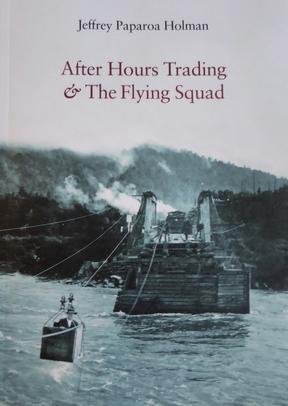
After Hours Trading & The Flying Squad, Jeffrey Paparoa Holman, Carbide Press, 2021
“The handpiece” for Jack Gilbert
“when the mobile library comes”
“Grinding the gear, 1969”
Jeffrey Paparoa Holman is a Christchurch poet and non-fiction writer. His collection, Blood Ties: selected poems, 1963-2016 was published by Canterbury University Press in 2017. A memoir, Now When It Rains came out from Steele Roberts in 2018. The most recent collection – After Hours Trading & The Flying Squad – has just been released by Carbide Press, his own imprint (29 October 2021).
Recent work has also appeared in Poetry New Zealand Yearbook 2021, an essay on prison reform, and poetry; his work has also been included in The Cuba Press anthology, More Favourable Waters – Aotearoa Poets respond to Dante’s Purgatory (2021).
He makes his living as a stay-at-home puppy wrangler for Hari, a Jack Russell-Fox Terrier cross. Hari ensures that little writing takes place, while psychogeography and excavating parks happens daily.
After Hours Trading & The Flying Squad, Jeffrey Paparoa Holman, Carbide Press, 2021, ISBN 9780473584047
Jeffrey in conversation with Lynn Freeman Standing Room Only RNZ National
I had two introductions to poetry. The first was through my husband who insisted that my apathy towards the form was because I was going about it all wrong. Poetry had to be read aloud to be understood, he told me. He read Cassandra’s Daughter and As big as a father in the living room of our home on a hill on the south coast of Wellington and I conceded, he was right.
The second introduction was through the arrival of Tayi Tibble. Tayi is a gateway drug, and once I’d read In the 1960s An Influx of Māori Women I read everything else she had written and, still hungry, found Hera Lindsay Bird and Nicole Titihuia Hawkins. Type Cast and Monica sit together, a matched set of sitcoms from the 90s, deconstructed and devastated, repurposed.
These young women brought me home to J.C. Sturm, a writer whose collection of short stories I stole from my university’s library as a graduation gift to myself last year. Her poem Coming Home reaches across the years since her death into the heart of our collective ache for identity and belonging. Sturm writes with clarity and prescience and her work sits comfortably alongside the best of Aotearoa’s contemporary poets.
Emma Espiner
The poems
In the 1960s an Influx of Māori Women
Move to Tinakori Road in their printed mini dresses Grow flowers on white stone rooftops to put in their honeycomb vases. Dust the pussy-shaped ashtray their husbands bought on vacation in Sydney. Walk to Kirkcaldie and Stains while their husbands are at work. Spend their monthly allowance on a mint-green margarita mixer. Buy makeup at Elizabeth Arden in the shade too-pale-pink. Buy vodka and dirty magazines on the way home from the chemist. Hide the vodka and dirty magazines in the spare refrigerator in the basement. Telephone their favourite sister in Gisborne. Go out to dinner with their husbands and dance with his friends. Smile at the wives who refuse to kiss their ghost-pink cheeks. Order dessert like pecan pie but never eat it. Eat two pieces of white bread in the kitchen with the light off. Slip into the apricot nylon nightgown freshly ordered off the catalogue. Keep quiet with their husbands’ blue-veined arms corseting their waists. Remember the appointment they made to get their hair fixed on Lambton Quay. Think about drowning themselves in the bathtub instead. Resurface with clean skin, then rinse and repeat.
Tayi Tibble
from Poūkahangatus, Victoria University Press, 2018
As big as a father
I lost him the first time before I could grasp who he was, what he did, where he fitted with her
and it’s always seemed so dumb: how to lose something as big as a father.
I lost him the next time to the rum-running Navy who took him and took him and kept right on taking
and it wasn’t my mistake losing a vessel as big as a father.
I lost him a third time to a ship in a bottle that rocked him and rocked him and shook out his pockets
and no kind of magic could slip me inside with my father.
I lost him at home when floorboards subsided as he said and she said went this way and that way
and dead in the water I couldn’t hang on to my father.
The last time I lost him I lost him for good: the night and the day the breath he was breathing
and death’s head torpedoes blew out of the water the skiff of my father.
Jeffrey Paparoa Holman
from As big as a father, Steele Roberts, 2002
Cassandra’s Daughter
Cassy for short. We’re discussing the colour green and why. And how last night in her dreamtime a wooden-horse appeared. And look–how the wind puts shivers in the water, shaking the keys in their locks. Only five years old, she is already in love with how one word wants another with astonishing ease. Inside the alphabet now, inside the lining of a word she asks me as we sit on the garden wall under plum-coloured sun: why were you born at seven o’clock that night? I was a morning baby my mum says, the best kind. I was born with my eyes open, you see? Would you like to hear me sing? I can almost dance, too. Would you? I can hear that she knows, Priam’s daughter, all her years to heaven– that every word was once a poem, isn’t it?
Michael Harlow
from Cassandra’s Daughter, Auckland University Press, 2005
Typecast
I want Shortland Street to cast us a fat brown woman with a pretty face, wild hair & an ass that could clap back against the haters when she plays T.K, Vinnie & Maxwell sleeping with them all at the same time.
I want Shortland Street to cast us a girl gang of Māori women who eat the weight of their feelings in cheese at wainanga & help each other craft responses to cultural appropriation, Govt. Depts & fuckbois.
I want Shortland Street to cast us an exhausted junior Dr. tall & thin, newly-vegan who still eats hāngī on the marae Waka Blonde Ngāti Kahu Khaleesi fangirling over Lance O’Sullivan addicted to kawakawa ointment.
I want Shortland Street to cast us a fair-skinned Kāi Tahu Boss Lady an expert in her field who gets nominated for awards invited home to speak on panels who snapchats her friends from the wharepaku saying she feels like a fraud on her own whenua.
I want Shortland Street to cast us an overworked social science teacher wearing Hine & Whitewood to work teaching Harry, Ula & Jasmine Whare Tapa Whā & The Native Schools Act her passionate tangents hashtagged #WhaeasRants.
I want Shortland Street to cast us a solo Mum in her 40’s whose babies are to different men rose quartz, ratchet 90’s home done tā moko on her big boobs spilling from a pilling lace bra from Kmart as she rushes late from school gate to mahi.
I want Shortland Street to cast us a long-grey-haired Kui with a moko kauae who talks to our tīpuna in her dreams, by night kaumātua kapa haka, rewana bug feeding, by day.
I want Shortland Street to cast us a Ngāti Porou Aunty who sets Marge, Kirsty & Leanne straight when they mispronounce her reo takes her own time to teach them then vents to Vasa at Box Fit that they complained to the boss she was telling them off.
I want Shortland Street to cast us a co-sleeping breast-feeding Māmā who laughs at the Plunket nurse when she tells her to leave her baby to cry in a cot calling it sleep training.
I want Shortland Street to cast us a young emerging talent raising eyebrows even higher than her skirt hems rubbing shoulders with the top surgeon’s fathers Chris Warner wrapped around her dusky middle finger.
Nicole Titihuia Hawkins
from Sport 47, 2019
Monica
Monica Monica Monica
Monica Geller off popular sitcom F.R.I.E.N.D.S Is one of the worst characters in the history of television She makes me want to wash my hands with hand sanitizer She makes me want to stand in an abandoned Ukrainian parking lot And scream her name at a bunch of dead crows Nobody liked her, except for Chandler He married her, and that brings me to my second point What kind of a name for a show was F.R.I.E.N.D.S When two of them were related And the rest of them just fucked for ten seasons? Maybe their fucking was secondary to their friendship Or they all had enough emotional equilibrium To be able to maintain a constant state of mutual-respect Despite the fucking Or conspicuous nonfucking That was occurring in their lives But I have to say It just doesn’t seem emotionally realistic Especially considering that They were not the most self-aware of people And to be able to maintain a friendship Through the various complications of heterosexual monogamy Is enormously difficult Especially when you take into consideration What cunts they all were
I fell in love with a friend once And we liked to congratulate each other what good friends we were And how it was great that we could be such good friends, and still fuck Until we stopped fucking And then we weren’t such good friends anymore
I had a dream the other night About this friend, and how we were walking Through sunlight, many years ago Dragged up from the vaults, like Old military propaganda You know the kind; young women leaving a factory Arm in arm, while their fiancées Are being handsomely shot to death in Prague And even though this friend doesn’t love me anymore And I don’t love them At least, not in a romantic sense The memory of what it had been like not to want To strap concrete blocks to my head And drown myself in a public fountain rather than spend another day With them not talking to me Came back, and I remembered the world For a moment, as it had been When we had just met, and love seemed possible And neither of us resented the other one And it made me sad Not just because things ended badly But more broadly Because my sadness had less to do with the emotional specifics of that situation And more to do with the transitory nature of romantic love Which is becoming relevant to me once again Because I just met someone new And this dream reminded me That, although I believe that there are ways that love can endure It’s just that statistically, or Based on personal experience It’s unlikely that things are going to go well for long There is such a narrow window For happiness in this life And if the past is anything to go by Everything is about to go slowly but inevitably wrong In a non-confrontational, but ultimately disappointing way
Monica Monica Monica Monica Geller from popular sitcom F.R.I.E.N.D.S Was the favourite character of the Uber driver Who drove me home the other day And is the main reason for this poem Because I remember thinking Monica??? Maybe he doesn’t remember who she is Because when I asked him specifically Which character he liked best off F.R.I.E.N.D.S He said ‘the woman’ And when I listed their names for him Phoebe, Rachel and Monica He said Monica But he said it with a kind of question mark at the end Like……. Monica? Which led me to believe Either, he was ashamed of liking her Or he didn’t know who he was talking about And had got her confused with one of the other Less objectively terrible characters. I think the driver meant to say Phoebe Because Phoebe is everyone’s favourite She once stabbed a police officer She once gave birth to her brother’s triplets She doesn’t give a shit what anyone thinks about her Monica gives a shit what everyone thinks about her Monica’s parents didn’t treat her very well And that’s probably where a lot of her underlying insecurities come from That have since manifested themselves in controlling And manipulative behaviour It’s not that I think Monica is unredeemable I can recognize that her personality has been shaped By a desire to succeed And that even when she did succeed, it was never enough Particularly for her mother, who made her feel like her dreams were stupid And a waste of time And that kind of constant belittlement can do fucked up things to a person So maybe, getting really upset when people don’t use coasters Is an understandable, or at least comparatively sane response To the psychic baggage Of your parents never having believed in you Often I look at the world And I am dumbfounded that anyone can function at all Given the kind of violence that So many people have inherited from the past But that’s still no excuse to throw A dinner plate at your friends, during a quiet game of Pictionary And even if that was an isolated incident And she was able to move on from it It still doesn’t make me want to watch her on TV I am falling in love and I don’t know what to do about it Throw me in a haunted wheelbarrow and set me on fire And don’t even get me started on Ross
Hera Lindsay Bird
from Hera Lindsay Bird, Victoria University Press, 2016
Coming home
for Peter
The bones of my tupuna Safe in secret places up north Must wait a little longer Before they claim me for good The love of my second parents Unconditional from the beginning Unrelenting to the end Never quite made me theirs That tormented paradoxical man Father of my children Convinced me we belonged together But then moved on. The young ones (our young) he left behind Claimed my castle as their own Being themselves a part of me Always, bone of my bone Years earlier, a much younger self Lay face down in the hot dry sand – Salt on her skin, the smell Of green flax pungent in the heat, Summer a korowai Around bare shoulders – And felt in her bones Without knowing why She belonged to that place. Nearly a life-time later On another beach – the sea A blinding shield at our feet, Behind us a dark hill fortress With sentinel sea birds Circling and calling – I lay down beside you in tussock And felt without warning I had come home.
J. C. Sturm
from Dedications, Steele Roberts, 1996, published courtesy of J. C. Sturm estate
Emma Espiner (Ngāti Tukorehe, Ngāti Porou) is a doctor at Middlemore Hospital. Emma hosts the RNZ podcast on Māori health equity, Getting Better which won best podcast at the Voyager media awards in 2021. She won Voyager Opinion Writer of the Year in 2020. Emma’s writing has been published at The Spinoff, Newsroom.co.nz, Stuff.co.nz, The Guardian, and in academic and literary journals.
Hera Lindsay Bird was a poet from Wellington. She hasn’t written a poem in a long time, and no longer lives in Wellington.
Michael Harlow has written 13 books of poetry, and was awarded the prestigous Prime Minister’s Award for Literary Achievement for Poetry in 2018. A collection of his poems, Nothing For It But To Sing was the Kathleen GrattanAaward forPoetry, and in 2014 he was awarded the Lauris Edmond Memorial prize for Distinguished Contribution to New Zealand poetry. He has been awarded a number of Writers’ Residences including the Robert Burns Fellowship, the Katherine Mansfield Menton Fellowship to France. This past year The Moon in a Bowl of Water was published by Otago University Press.He lives and works in Central Otago as a writer, editor, essayist and Jungian Psychotherapist.
Nicole Titihuia Hawkins (Ngāti Kahungunu ki Te Wairoa, Ngāti Pāhauwera) is an emerging writer, avid home-baker and pro-level aunt. She lives in Te Awakairangi, hosts Poetry with Brownies and runs side hustles with her besties. She is most commonly found teaching English, Social Studies & Māori Activism at a local High School. Her debut poetry collection will be published by We Are Babies Press in 2021.
Jeffrey Paparoa Holman is a poet and non-fiction writer, most recently, Blood Ties: selected poems, 1963-2016, Canterbury University Press (2017); a memoir, Now When It Rains, Steele Roberts (2018); Poetry New Zealand Yearbook 2021, an essay on prison reform; poetry in More Favourable Waters – Aotearoa Poets respond to Dante’s Purgatory, (The Cuba Press, 2021).
J. C. Sturm (1927 -2009), of Taranaki iwi, Parihaka and Whakātoa descent, is thought to be the first Māori woman to graduate from a New Zealand university (First Class Hons, Philosophy, Victoria University of Wellington Te Herenga Waka). She initially wrote short fiction, and her work was the first to appear by a Māori in an anthology. Her debut collection, Dedications (Steele Roberts, 1997), received an Honour Award at the 1997 Montana NZ Book Awards. She published further collections of poetry, and received an honorary doctorate from Victoria University of Wellington Te Herenga Waka.
Tayi Tibble (Te Whānau ā Apanui/Ngāti Porou) was born in 1995 and lives in Wellington. In 2017 she completed a Masters in Creative Writing from the International Institute of Modern Letters, Victoria University of Wellington, where she was the recipient of the Adam Foundation Prize. Her first book, Poūkahangatus (VUP, 2018), won the Jessie Mackay Best First Book of Poetry Award. Her second collection, Rangikura, was published in 2021 (VUP).
Spring Season
Tara Black picks poems Victor Rodger picks poems Peter Ireland picks poems
Poetry is a way of bridging the faraway and the close at hand. A poem can make the achingly distant comfortingly close. Poetry can be a satisfying form of travel, whether to the other side of the world, to the past or to imagined realms. Reading poems that offer the faraway as some kind of presence, I feel such a range of emotions. Moved, yes. Goose bumps on the skin, yes. Boosted, yes. This is such a fertile theme, I keep picturing a whole book moving in marvellous directions.
I am grateful to all the poets and publishers who continue to support my season of themes.
The Poems
Remembering
if you can you can try to recall
the sun across the roof and you
knee-deep in childhood playing
near the fence with the storm
of daisies still impressionable
in the way of dreams still
believing leaves had voices
and you might then remember
curtains drowned in burnished light
how at night the sky emptied
into a field of stars leaching out
the guilt you’d soon forget unlike
the woman you called Nana who kept
knitting you hats while you kept not
writing back and maybe then you’d know
the injustices you had no part in
the lady who bought your house how
she ravaged your kingdom while
you were away oh these memories
spiralling into memories into
nothing this helter skelter art of
remembering this bending
over backwards running out of light
Anuja Mitra
from Mayhem Literary Journal, Issue 6 (2018)
Drifting North
Acknowledgement to David Eggleton
She said we discussed post
structuralism in a post modern
context. She said in order
to remember such crucial
poetic phrases she had bought
a small exercise book in which
to record them.
It was, she said, a book
of semantic importance.
She said we considered
the deception of disjointed
parody and the fragmentation
of shallow consumer culture.
I can only remember
a girl
in her pale blue cardigan
drifting north
in a zither of light.
Jenny Powell
from Four French Horns, HeadworX, 2004
apricot nails
I want to paint my nails apricot as an homage to call me by your name and the fake italian summer I had last year —
fake because I didn’t cycle beside slow streams or in slow towns
Instead I lay on a 70 euro pinstripe lounger and couldn’t see the water only other tourists
And the apricots I ate came from peach spritzes at sea salt restaurants and clouded supermarket jars
But all the shops are shut and the closest nail colour I have is dark red
I want to be somewhere in northern italy with light green water and deep green conversations
I want to pick fresh apricots from drooping branches and kiss a boy I shouldn’t on cobblestone paths against cobblestone walls
I want to lick a love heart on to his shoulder so that when he gets on a train my hands shake like a thunderstorm
and I can’t cycle home past the fields we held each other in and mum has to pick me up from the station
I want to walk down a staircase with winter at the bottom waiting to sweep me into snow
I want the phone to ring when the sky is white and hear an apricot voice ripe and ready to be plucked from the tree
he’ll say how are you and I’ll slowly leak
Rhegan Tu’akoi
from Stasis 5 May 2020, picked by Aimee-Jane Anderson-O’Connor
Wearing Katherine Mansfield’s Shawl
Seventy years on, shut
in a cardboard box in the basement
of City Hall, you might think
the shawl would have lost
its force to charm, the airy fragrance
of its wearer departed, threads
stripped bare as bones,
yet here it is, another short story:
it felt like love at the Hôtel
d’Adhémar the moment you placed
the silk skein around my shoulders,
the dim red and rusty green fabric
and a fringe gliding like fingertips
over my arm, a draught of bitter
scent – Katherine’s illness,
Virginia’s sarcasm – and
yes, a trace of wild gorse
flowers and New Zealand, not
to mention the drift of her skin
and yours during the photograph,
the stately walk through the town.
Fiona Kidman
from Where Your Left Hand Rests, Godwit, Random House, 2010
Sparks
On the occasion of the Sew Hoy 150th Year Family Reunion, September 2019
Here in this earth you once made a start
home treasure watered with sweat, new seeds
a fire you can light and which gives off sparks
the gleam of gold glowing in darkness
an open door, warm tea, friendships in need
here on this earth you once made a start
sometimes you imagined you left your heart
elsewhere, a woman’s voice and paddies of green
a fire which was lit, remembering its sparks
but even halfway round the world, shoots start
old songs grow distant, sink into bones unseen
here in this earth you can make a new start
with stone and wood you made your mark
built houses of diplomacy and meaning
a new fire was lit, with many sparks
flame to flame, hand to hand, heart to heart
150 years, sixteen harvests of seed
here, in this earth, you once made a start
A fire was once lit. We all are its sparks.
Renee Liang
Heavy Lifting
Once, I climbed a tree
too tall for climbing
and threw my voice out
into the world. I screamed.
I hollered. I snapped
innocent branches. i took the view
as a vivid but painful truth gifted
to me, but did not think to lay down
my own sight in recompense.
All I wanted was someone to say
they could hear me, but the tree said
that in order to be heard I must
first let silence do the heavy lifting
and clear my mind of any
questions and anxieties
such as contemplating whether
I am the favourite son. If I am not,
I am open to being a favourite uncle
or an ex-lover whose hands still cover
the former half’s eyes. I’ll probably never
have children of my own to disappoint
so I’ll settle for being famous instead
with my mouth forced open on TV like
a Venus fly-trap lip-synching for its life.
The first and last of everything
are always connected by
the dotted line of choice.
If there is an order to such things,
then surely I should resist it.
Chris Tse
from he’s so MASC, Auckland University Press, 2018
My city
drawing blank amber cartridges in windows
from which we see children hanging, high fires
of warehouse colours, a reimagining, my city fluttering
far and further away with flags netted
and ziplining west to east, knotted
and raining sunshine,
paving cinder-block-lit-tinder music in alleys
where we visit for the first time, signal murals
to leapfrog smoke, a wandering, my city gathering
close and closer together a wilderness
of voices shifting over each other
and the orchestra,
constructing silver half-heresies in storefronts
to catch seconds of ourselves, herald nighttimes
from singing corners, a remembering, my city resounding
in and out the shout of light on water
and people on water, the work of day
and each other,
my city in the near distance fooling me
into letting my words down, my city visible
a hundred years from tomorrow,
coming out of my ears and
forgiving me,
until i am disappeared someways and no longer
finding me to you
Pippi Jean
Looming
I call it my looming
dread, like the mornings I wake
crying quietly at the grey
in my room, like whispering to my sleeping
mother – do I have to
like the short cuts I can’t take
like the standing outside not breathing
like my hand on the doorknob
counting to twenty and twenty
and twenty.
Tusiata Avia
from Wild Dogs Under My Skirt, Victoria University Press, 2004
mothering daughter
I am coming home to myself
while watching
my mother going away from herself.
Every move you make
an effort
so much slower now, mother
like your body is trying to keep pace
with your mind
everything about you reads as
tired
but sometimes I read as
giving up
FUCK THIS! silently salts my tongue
a tight fist slamming the steering wheel
gas under my foot
tears choking my ears
smoke swallowing my chest.
I am a mother:
Mothering her son,
a motherless daughter mothering her mother.
It’s hard somedays not to be swallowed.
Grace Iwshita-Taylor
from full broken bloom, ala press, 2017
Memoir II
Preparing for death is a wicker basket.
Elderly women know the road.
One grandmother worked in munitions, brown
bonnet, red stripe rampant. the other, a washerwoman:
letters from the Front would surface, tattered.
You must take the journey, ready or not.
The old, old stream of refugees: prams
of books and carts with parrots.
Meanwhile the speeches, speeches: interminable.
When the blood in your ears has time to dry: silence.
The angel will tie a golden ribbon to the basket’s rim.
You will disappear, then reappear, quite weightless.
Jeffrey Paparoa Holman
from Blood Ties: New and Selected Poems 1963- 2016, Canterbury University Press, 2017
fever
moving away from the orchard plots,
laundry lines that sag under the macrocarpa.
moving away from the crystalline skies,
the salt-struck grasses, the train carts
and the underpasses. i astral travel
with a flannel on my head, drink litres
of holy water, chicken broth. i vomit
words into the plastic bucket, brush
the acid from my teeth. i move away,
over tussock country, along the desert
road. i chew the pillowcase. i cling
my body to the bunk. the streets
unfurl. slick with gum and cigarettes.
somebody is yelling my name. i quiver
like a sparrow. hello hello, says the
paramedic. but i am moving away from
the city lights, the steel towers.
and i shed my skin on a motorway
and i float up into the sky.
Elizabeth Morton
from This Is Your Real Name, Otago University Press, 2019
Black Stump Story
After a number of numberless days
we took the wrong turning
and so began a slow descent
past churches and farmhouses
past mortgages and maraes
only our dust followed us
the thin cabbage trees were standing
in the swamp like illustrations
brown cows and black and white and red
the concrete pub the carved virgin
road like a beach and beach like a road
two toothless tokers in a windowless Toyota
nice of you to come no one comes
down here bro – so near and
yet so far – it takes hours
not worth your while –
turned the car and headed back
shaggy dogs with shaggy tales
Murray Edmond
from Fool Moon, Auckland University Press, 2004
The Poets
Tusiata Avia is an internationally acclaimed poet, performer and children’s author. She has published 4 collections of poetry, 3 children’s books and her play ‘Wild Dogs Under My Skirt’ had its off-Broadway debut in NYC, where it took out The Fringe Encore Series 2019 Outstanding Production of the Year. Most recently Tusiata was awarded a 2020 Arts Foundation Laureate and a Member of the New Zealand Order of Merit for services to poetry and the arts. Tusiata’s most recent collection The Savage ColoniserBook won The Ockham NZ Book Award for Best Poetry Book 2021.
Murray Edmond, b. Kirikiriroa 1949, lives in Glen Eden. 14 books of poetry (Shaggy Magpie Songs, 2015, and Back Before You Know, 2019 most recent); book of novellas (Strait Men and Other Tales, 2015); Then It Was Now Again: Selected Critical Writing (2014); editor, Ka Mate Ka Ora; dramaturge for Indian Ink Theatre. Forthcoming: Time to Make a Song and Dance: Cultural Revolt in Auckland in the 1960s, from Atuanui Press in May, 2021.
Jeffrey Paparoa Holman is a Christchurch poet and non-fiction writer. A poetry collection, Blood Ties: selected poems, 1963-2016 was published by Canterbury University Press in 2017. A memoir, Now When It Rains came out from Steele Roberts in 2018. He makes his living as a stay-at-home puppy wrangler for Hari, a Jack Russell-Fox Terrier cross. Hari ensures that little writing takes place, while psychogeography and excavating parks happen daily. Recent work has appeared in Poetry New Zealand Yearbook 2021, an essay on prison reform, and poetry; also, an inclusion in The Cuba Press anthology, More Favourable Waters – Aotearoa Poets respond to Dante’s Purgatory.
Grace Iwashita-Taylor, breathing bloodlines of Samoa, England and Japan. An artist of upu/words led her to the world of performing arts. Dedicated to carving, elevating and holding spaces for storytellers of Te Moana nui a Kiwa. Recipient of the CNZ Emerging Pacific Artist 2014 and the Auckland Mayoral Writers Grant 2016. Highlights include holding the visiting international writer in residence at the University of Hawaii 2018, Co-Founder of the first youth poetry slam in Aoteroa, Rising Voices (2011 – 2016) and the South Auckland Poets Collective and published collections Afakasi Speaks (2013) & Full Broken Bloom (2017) with ala press. Writer of MY OWN DARLING commissioned by Auckland Theatre Company (2015, 2017, 2019) and Curator of UPU (Auckland Arts Festival 2020).
Pippi Jean is eighteen and just moved to Wellington for her first year at Victoria University. Her most recent works can be found in Landfall, Starling, Takahe, Mayhem, and Poetry New Zealand Yearbook among others.
Fiona Kidman has written more than 30 books and won a number of prizes, including the Jann Medlicott Acorn Fiction Prize for This Mortal Boy. Her most recent book is All the way to summer:stories of love and longing. She has published six books of poems.In 2006, she was the Katherine Mansfield Fellow in Menton. The poem ‘Wearing Katherine Mansfield’s shawl ‘is based on an event during that time. Her home is in Wellington, overlooking Cook Strait.
Renee Liang is a second-generation Chinese New Zealander whose parents immigrated in the 1970s from Hong Kong. Renee explores the migrant experience; she wrote, produced and nationally toured eight plays; made operas, musicals and community arts programmes; her poems, essays and short stories are studied from primary to tertiary level. In recent years she has been reclaiming her proud Cantonese heritage in her work. Renee was made MNZM in 2018 for Services to the Arts.
Anuja Mitra lives in Auckland. Her writing has appeared in Takahe, Mayhem, Cordite Poetry Review, Starling, Sweet Mammalian, Poetry Shelf and The Three Lamps, and will appear in the AUP anthology A Clear Dawn: New Asian Voices from Aotearoa New Zealand. She has also written theatre and poetry reviews for Tearaway, Theatre Scenes, Minarets and the New Zealand Poetry Society. She is co-founder of the online arts magazine Oscen.
Elizabeth Morton is a teller of poems and tall tales. She has two collections of poetry – Wolf (Mākaro Press, 2017) and This is your real name (Otago University Press, 2020). She has an MLitt in creative writing from the University of Glasgow, and is completing an MSc in applied neuroscience at King’s College London. She likes to write about broken things, and things with teeth.
Jenny Powell is a Dunedin poet and performer. Her work has been part of various journals and collaborations. She has a deep interest in music and used to be a french horn player.
Chris Tse is the author of two poetry collections published by Auckland University Press – How to be Dead in a Year of Snakes (winner of Best First Book of Poetry at the 2016 Ockham New Zealand Book Awards) and HE’S SO MASC – and is co-editor of the forthcoming Out Here: An Anthology of Takatāpui and LGBTQIA+ Writers From Aotearoa.
Rhegan Tu‘akoi is a Tongan/Pākehā living in Pōneke. She is a Master’s student at Victoria and her words have appeared in Turbine | Kapohau, Mayhem and Sweet Mammalian. She has also been published in the first issue of Tupuranga Journal
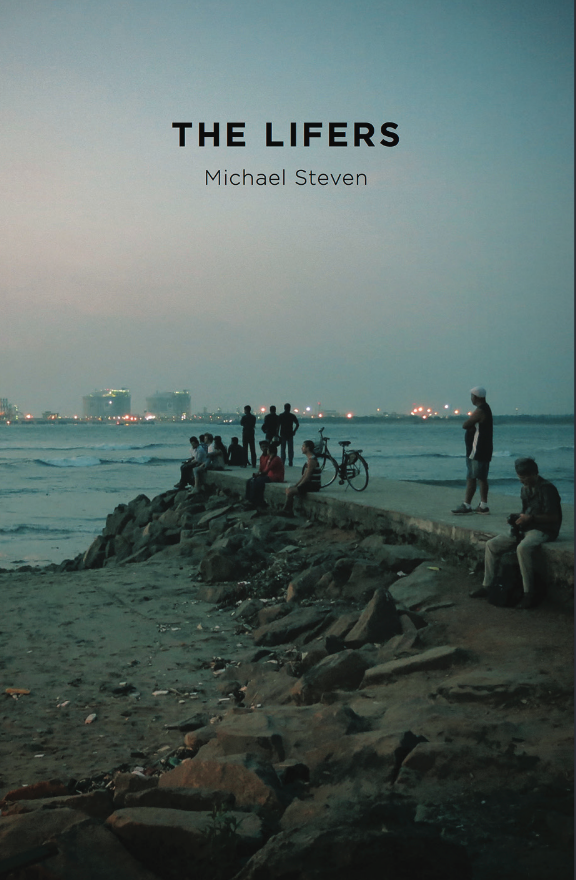
This is poem 7 from a sequence called ‘Leviathan’ in The Lifers (Otago University press, 2020).
Jeffrey reads ‘7’
Jeffrey Paparoa Holman:
There is a whakapapa of prison poetry that links Michael Steven’s poem on men behind bars in The Lifers, his recent second volume from Otago University Press. The poems in this book have gritty echoes that François Villon would hear and feel; a deep well of humanity also that Oscar Wilde would appreciate, from his cell in Reading Gaol. Whether we are watching users scoring, thieves preparing a raid, a friend mourning the suicide of a kindred lost soul, there opens up before us a vision of brokenness elegised with compassion through an unsparing binocular lens. The poem considered here – Sonnet 7 from a series, Leviathan – captures precisely the cold realities of those sentenced to life for the most serious of crimes. The effect is so visual, it returned to me a memory of Van Gogh’s ‘Prisoners Exercising’, painted in 1890 while he was in the asylum at Saint-Rémy, suffering deep depression. Most Fridays, with two other poets, Bernadette Hall and Jeni Curtis, we take part in a reading group at Christchurch Mens Prison; I recently took copies of this poem and shared it. The silence that greeted its reading attested the truth Michael Steven has captured, from the inside. This poem – and the rest of his fine and developing oeuvre – invite your close attention.
Jeffrey Paparoa Holman is a Christchurch poet and non-fiction writer. His most recent poetry collection, Blood Ties: selected poems, 1963-2016 was published by Canterbury University Press in 2017. A memoir, Now When It Rains came out from Steele Roberts in 2018. He is currently working on a book chapter for a collection of studies on early 20th century ethnographers. He makes his living as a stay-at-home puppy wrangler for Hari, an eight-month old Jack Russell-Fox Terrier cross. Hari ensures that very little writing happens, but Victoria Park is explored and mapped daily.
Michael Steven is the author of the acclaimed Walking to Jutland Street (Otago University Press, 2018). He was recipient of the 2018 Todd New Writer’s Bursary, and his poems were shortlisted for the 2019 Sarah Broom Poetry Prize. He lives and writes in West Auckland. The Lifers (Otago University Press) was recently launched at Timeout Bookshop.
todavía persisten perdido a los amantes queridas madres
entrar en un silencio que nunca fue
introducir entonces el mundo sin llamar
la excavación de perforación sluicing tala
agricultura pesca arando un sueño
acarreando una isla de las constelaciones
en el resplandor de un reinado extranjero
introducir entonces el mundo sin llamar
entrar en el silencio entrar entrar la oscuridad
la colmena de la invitación entrar
la majestad Introduce el vino entrar
el desierto mientras que usted puede entrar en
con banderas y entrar con instrumentos
entrar en el silencio entrar entrar
enter the silence
entering the silence that is not a silence
remains of a shoe by the mouth of a shaft
rusted boiler at a fork in the creek
pond of eels where the dredge dismantled
ended its song in a valley of tailings
entering the silence that is not a silence
enter a silence that never was
the wheels of a lokie sprouting fern
a railway signpost clothed in lichen
the sign to a mine where the dead
still linger lost to lovers dear to mothers
enter a silence that never was
enter then the world without knocking
digging drilling sluicing felling
fishing farming ploughing a dream
hauling an island from the constellations
into the glare of an alien reign
enter then the world without knocking
enter the silence enter the dark enter
the hive of the invitation enter
the majesty enter the wine enter
the wilderness while you may enter
with flags and enter with instruments
enter the silence enter enter
geben Sie die Stille
Eingabe der Stille, die keine Ruhe
bleibt eines Schuhs durch den Mund einer Welle
verrosteten Kessel mit einer Gabel in den Bach
Teich von Aalen, wo der Bagger abgebaut
beendete seine Songs in einem Tal der Tailings
Eingabe der Stille, die keine Ruhe
geben Sie eine Stille, die niemals war
die Räder eines Lokie Sprießen fern
ein Eisenbahn Wegweiser in Flechten bekleideten
das Zeichen, um eine Mine, wo die Toten
noch verweilen, um die Liebhaber lieb Mütter verloren
geben Sie eine Stille, die niemals war
Geben Sie dann die Welt, ohne anzuklopfen
Graben Bohrungen Schleuseneinschlag
Fischerei Landwirtschaft Pflügen einen Traum
Schleppen eine Insel von den Sternbildern
in die Blendung einer fremden Herrschaft
Geben Sie dann die Welt, ohne anzuklopfen
geben Sie die Stille einzugehen die dunkle eingeben
der Bienenstock der Einladung geben
die Majestät geben Sie den Wein geben
die Wüste, während Sie können eingeben
mit Fahnen und mit Instrumenten geben
geben Sie die Stille geben geben
from an unpublished series called ‘Wild Iron’
Jeffrey Paparoa Holman is a Christchurch poet and a writer of non-fiction, and senior adjunct fellow in the School of Humanities and Creative Arts at the University of Canterbury. Born in London, Jeffrey immigrated to New Zealand in 1950, growing up in the Devonport naval base in Auckland, then the coal mining town of Blackball on the West Coast of the South Island. He has worked as a sheep-shearer, postman, psychiatric social worker and bookseller.
Jeffrey’s poetry collection As Big as a Father was longlisted for the Montana New Zealand Book Awards (2003). In 2007, Jeffrey and Martin Edmond won the Copyright Licensing Limited Award giving them $35,000 each towards a non-fiction project. Best of Both Worlds: The Story of Elsdon Best and Tutakangahau, was published by Penguin in 2010. Jeffrey was the 2011 Waikato University Writer-in-Residence and in the same year shortlisted for the Ernest-Scott History prize, Australia. In 2012, he was awarded the Creative New Zealand University of Iowa Residency. The resulting book, The Lost Pilot: A Memoir was published by Penguin NZ (2013). In 2014, Jeffrey travelled to Berlin on a Goethe-Institute scholarship, pursuing research for his current project, a family history based on links with his German relations.
Jeffrey’s SHAKEN DOWN 6.3: Poems from the Second Christchurch Earthquake was published by Canterbury University Press in 2012. His most recent collection, Blood Ties: New and Selected Poems was published by Canterbury University Press in 2017.
It feels like months since I’ve come near to anything like writing poetry. Sometimes it just happens like that: there’s a season, not that the well is dry, just that the bucket hasn’t been lowered. The first few months of this year have been taken up with getting myself ready to leave my position at the University of Canterbury, deciding not to re-apply for another three years as an adjunct. Time to go, after nine productive and stable years.
I tell people, “I’m not retiring, just moving offices”, which is true, but it is a major change. Every weekday morning, Jeanette and I have cycled out to the Ilam Campus, stopping off for a coffee most days near Hagley Park. Now, I don’t have to go anywhere, which is different from having nowhere to go, but it will take some getting used to.
What I won’t forget is that in the last two weeks of my tenure, all has been overtaken and devoured by what happened on the afternoon of the fifteenth of March when the whole campus was locked down as a result of what we were first told was, “ a firearms incident at the Al Noor Mosque”. It soon became obvious it was a fatal shooting, there had been many casualties, that some were dead, and as the afternoon wore on, the numbers climbed as the scale of the tragedy was revealed.
So much has happened in this city since that day, on a public stage and in private places, that don’t need any reminders here. The stories, the narratives of grief, shock, anger and even a kind of numbness are all being woven together, in a community that knows disaster, that must now confront terrorism and its aftermath at our very heart – a place of worship.
I had no intention, no inclination, to write anything resembling a poem. It was enough just to try and get my head around what was happening and as well, carry on clearing my desk, saving files, changing email addresses and saying goodbye to good friends on the staff of Canterbury.
Jeanette and I sometimes go for breakfast at Under The Red Verandah, a famous city eatery reborn after the poet and publisher Roger Hickin’s original establishment was wrecked in the earthquakes. While we were there on Thursday morning, my wife asked me if any poetry was there in the wake of what had happened, and I recall saying, no, I couldn’t even contemplate writing a poem.
But as I walked around afterwards, I heard a line, an insistent phrase, quite clearly: “Normal service will not be resumed”. It just sat there. Then another: “There has been a slaying”. It isn’t often I feel I must obey an instinct as strong as this, but started to write what was really a form of litany, compressing the underlying horror I felt. The poem came in couplets that began with what sounds like a public service announcement, which the next line undermines. At least I hope that is the effect.
I worked on it during the day, and on Friday I took it out to Christchurch Mens’ Prison, Paparua, where every week, three Christchurch poets – Bernadette Hall, Jeni Curtis and I – run a book group in the library overseen by Susan, our wonderful librarian.
There was a security lockdown that day and we had no prisoners turn up. We all sat around and shared our lives, and the poem was read. Susan took a copy for the prison’s monthly library magazine. Whatever it is worth, a silence for me was broken and some of the men in that jail will get to read it, maybe even give a response at a later group.
W. B. Yeats once wrote, “…but all that is personal soon rots; it must be packed in ice or salt”. For Yeats, style, form – made new – was vital in preventing the poet from lapsing into subjective egotism. A disaster like this is not about me, but the victims.
Normal service
mō ngā mate Mahometa e rima tekau i hinga ki Ōtautahi 15 Māehe 2019
Normal service will not be resumed
There has been a slaying
Normal service is impossible
Children executed
Normal service disconnected
Mothers slaughtered
Normal service is terminated
Elders eliminated
Normal service makes no sense
Terror is walking
Normal service is banned for life
Blood on the welcome
Normal service is now shut down
Thank you for weeping
Jeffrey Paparoa Holman
4 April 2019
Jeffrey Paparoa Holman writes poetry, memoir and history. His most recent work is Now When It Rains: a writer’s memoir, published by Steele Roberts (Aotearoa) in 2018.
Rob Stowell, the videographer at Canterbury had recorded this reading of the poemW
Jeffrey Paparoa Holman reads ‘Toroa Feeding – Taiaroa Heads’, from Fly Boy (Steele Roberts: 2010).
Jeffrey Paparoa Holman is a Christchurch poet and a writer of non-fiction, and senior adjunct fellow in the School of Humanities and Creative Arts at the University of Canterbury. Born in London, Jeffrey immigrated to New Zealand in 1950, growing up in the Devonport naval base in Auckland, then the coal mining town of Blackball on the West Coast of the South Island. He has worked as a sheep-shearer, postman, psychiatric social worker and bookseller.
Jeffrey’s poetry collection As Big as a Father was longlisted for the Montana New Zealand Book Awards (2003). In 2007, Jeffrey and Martin Edmond won the Copyright Licensing Limited Award giving them $35,000 each towards a non-fiction project. Best of Both Worlds: The Story of Elsdon Best and Tutakangahau, was published by Penguin in 2010. Jeffrey was the 2011 Waikato University Writer-in-Residence and in the same year shortlisted for the Ernest-Scott History prize, Australia. In 2012, he was awarded the Creative New Zealand University of Iowa Residency. The resulting book, The Lost Pilot: A Memoir was published by Penguin NZ (2013). In 2014, Jeffrey travelled to Berlin on a Goethe-Institute scholarship, pursuing research for his current project, a family history based on links with his German relations.
Jeffrey’s SHAKEN DOWN 6.3: Poems from the Second Christchurch Earthquake was published by Canterbury University Press in 2012. His most recent collection, Blood Ties: New and Selected Poems was published by Canterbury University Press in 2017.
The inaugural Blackball Readers and Writers Festival, to be held at Labour Weekend, will bring established writers to the Coast to read from their work and to have conversations before the audience of Coasters and those from afar. The festival will be modelled on the underground coal mine and will therefore seek work ‘from the underground’ which can be interpreted in many different ways e.g. that which has been forgotten, or that which has become for a time, marginal, or that which has deep roots in the earth or the past.
The festival is organised by the Bathhouse Co-operative, a subsidiary of Te Puawai Co-operative Society, a co-op set up to incubate projects on the Coast (http://www.tepuawai.co.nz). The members of the co-op are: Catherine Woollett who runs the Shades of Jade shop in Greymouth; Jeffrey Paparoa Holman, London born but Blackball bred and one of NZ’s major poets; and Paul Maunder, a playwright, theatre director, filmmaker and author who lives in Blackball. Support comes from Creative Communities and the Department of Internal Affairs. The Festival could lead to the creation of a boutique publishing house on the Coast. As well, with the establishing of the Paparoa Great Walk, the festival could become part of a wider package.


 NZ Poetry Shelf