

In 2014, Helen Rickerby and Anna Jackson organised a conference at Victoria University entitled Truth or Beauty: Poetry and Biography. It drew poets and scholars from across New Zealand and Australia. Over three days the participants shared readings, papers, panels and informal discussions.
To celebrate the event, the organisers have released a gorgeous chapbook containing poems by the participants that highlight meeting points between poetry and biography, truth and/or beauty.
In the introduction, the editors (Anna and Helen are joined by Doctoral student, Angelina Shroma) suggest that some of the poems ‘are more straightforward retellings of a life, but most take a poetic twist — are impressionistic, episodic, mythic, abstract or undermine the very idea of being able to know factual truth.’
Seeing the line-up of poets included gives some indication of the stretch and vitality of ideas exchanged along with poetry shared: Jordie Albiston, Airini Beautrais, Amy Brown, Geraldine Burrowes, Zarah Butcher – McGunnigle, Max L Chapnick, Majella Cullinane, Toby Davidson, Joan Fleming, Janis Freegard, Maureen Gibbbons, Helen Heath, Kerry Hines, Anna Jackson, Shari Kocher, Saradha Koirala, Bella Li, Vana Manasiadis, Karlo Mila, Robynanne Milford, Vivienne Plumb, Jenny Powell, Nina Powles, Chris Price, Helen Rickerby, Harry Ricketts, Jack Ross, Erin Scudder, Anna Smaill, Marty Smith, Robert Sullivan, Leilani Tamu, Chris Tse, Jessica Wilkinson, Karen Zelas.
Some of the poems took me back to books I have already loved (Autobiography of a Marguerite, Dear Neil Roberts, I, Clodia, and Other Portraits, Crumple, Girls of the Drift, My Iron Spine, Just Then, Horse with a Hat, How to be Dead in the Year of Snakes, Captain Cook in the Underworld) while previously unpublished poems were miniature temptations of new works to come (Joan Fleming’s ‘New Margins,’ Helen Heath’s ‘Radiant,’ Chris Price’s ‘A natural history of Richard’) and some poems and poets were new to me and are now on my radar now (Shari Kocher, Robynanne Milford). I haven’t read many poems by Erin Scudder but her deliciously inventive word play in ‘Hollywood Hills Woman’ catches at story, character, language, space and life. This was a gem.
This is a beautiful hand-bound book; I got to the end and just wished I had been able to attend the conference. This makes up for it slightly.
Web page here
Copies are available for purchase for NZ$20, plus NZ$5 for overseas postage. Email Helen.Rickerby@paradise.net.nz to order and arrange payment.
Anna Jackson, associate professor at Victoria University of Wellington, has published six collections of poetry, most recently I, Clodia, and Other Portraits (Auckland University Press, 2014). The first half of this collection is based on the life of Clodia Metelli, the ‘Lesbia’ who was the subject of the most passionate poetry written by Catullus in late Republic Rome.
Helen Rickerby has published four books of poetry, most recently Cinema (2014), which includes biographical poems about film-makers and her friends. Her 2008 collection, My Iron Spine, features biographical poems about women, many of whom have been neglected by history. She is the managing editor of Seraph Press, a boutique poetry publisher, and is co-managing editor of JAAM literary magazine.
Angelina Sbroma is a doctoral student in English literature at Victoria University of Wellington. Her thesis focuses on children’s fantasy literature.
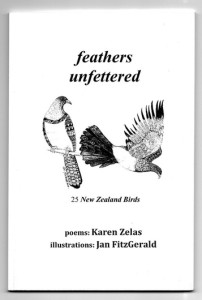
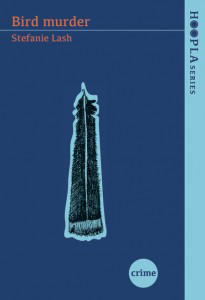
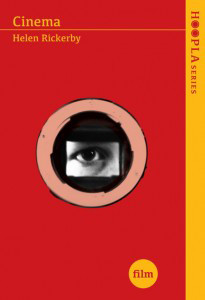
Tim Jones’s review of Cinema by Helen Rickerby, Bird Murder by Stefanie Lash and Feathers Unfettered by Karen Zelas is now up at Landfall Review Online here.
Chris Tse
I emerged from a film festival-induced haze to find that my to-read pile has grown exponentially. (Fittingly, one of the books that I’ve recently finished and enjoyed is Helen Rickerby’s Cinema for its wistful and charming tales of reality colliding with the world of movies.) Near the top of my daunting pile are Maria McMillan’s Tree Space and Hinemoana Baker’s waha | mouth (both VUP, 2014), and Sam Sampson’s Halcyon Ghosts (AUP, 2014). I’ve also been itching to get stuck into When My Brother Was an Aztec by Natalie Diaz (Copper Canyon Press, 2012). I stumbled across her poem ‘My Brother at 3am’ and then went searching for whatever else I could find by her.
I’ve been dipping in and out of books by two American poets (there’s a spooky synchronicity with their titles): Scarecrone by Melissa Broder (Publishing Genius Press, 2014) and Scary, No Scary by Zachary Schomburg (Black Ocean, 2011). Both write deliciously dark poems, which read like fables that speak of how terrifying and confusing the modern world can be. At times these poems have an irreverent edge to them, and both poets use such precise language and ominous images to conjure up worlds of unease.
Chris Tse‘s first poetry collection, How to be Dead in a Year of Snakes (AUP), will be available in stores and online from 22 September.
Hinemoana Baker
Bird murder When I closed this book after reading it for the first time, my exact words were ‘Now that’s how it’s done.’ Bird murder is a dark chronicle of close-packed language and noir thrills. Being a bird-lover from way back, I delighted in the book’s central murder, and I secretly hoped it was the Stellar’s Jay itself that did it. Overall, though, it’s simply the exceptional quality and music of the sentences that blows me away. An example from ‘Setting’:
Mrs Cockatrice, pink hair a-boule
sets the table for her guests.
Her ornamental milking stool
will do for a child.
And one more, from ‘Solar midnight’:
I came from a lake with an island on it
and on the island there was a lake.
The water was so silver. I had feathers then.’
– Bird murder by Stefanie Lash, Mākaro Press, Hoopla Series. Eastbourne, 2014.
The Red Bird I was alerted to Joyelle by Shannon Welch, whose Iowa Writing Workshop I attended at the IIML in 2003. It would be hard to overstate the effect it had on me reading these lines from ‘Still Life w/ Influences’:
Up on the hill,
a white tent had just got unsteadily to its feet
like a foal or a just-foaled cathedral.
I’ve been known to say loudly, on several occasions since, if I’d written that I could die happy. A glib hat-tip but the feeling is entirely genuine. This particular book travels from whales to guitarists to car accidents and beagles and doubles back. In the introduction, Allen Grossman says Joyelle ‘is a poetic realist. Her poems are neither reductive nor fantastic. But they are profoundly mysterious in the way any truthful account of the world must be.’
– The Red Bird by Joyelle McSweeney, Fence Books / Saturnalia Books. New York NY, 2002.
Hinemoana Baker‘s latest collection of poetry, waha | mouth, has just been released by Victoria University Press. I will review it on Poetry Shelf.
Karen Craig
Two poets I’ve been spending a lot of time with recently are Thom Gunn and Mark Doty, prompted by my job at Auckland Libraries, where we’ve been working on adding some lists of recommended reads in GLBTQI fiction and literature to our website. Thom Gunn is an old acquaintance who never ceases to awe me with the hard (yet supple — how they suited his poems, those black leather biker jackets) intelligence of his vision and the cool leanness of his language. The book I’m reading now is the Selected Poems edited by August Kleinzahler (Farrar, Straus and Giroux, 2009), which includes my favourite poem ‘Considering the Snail’, where the snail “moves in a wood of desire,/ pale antlers barely stirring/ as he hunts.” That’s already good. “What is a snail’s fury?” That’s genius, for me.
Mark Doty is a new find for me. A friend recommended his memoir Dog Years for a “Sadness” display we did at Central Library, saying it was the saddest book she’d ever read. If I tell you it’s over 200 pages and I read it all in one day and night, that will give you an idea of how this man gets inside your heart. He’s one of those people that when I was in high-school we used to call “beautiful”, and, when we used the term in our English essays, be told — rightly — that it was too imprecise. So to be more precise on Mark Doty’s beauty: a largeness of spirit, a sense of wonder and mystery, emotivity and desire, the musicality of the ordinary. I’m reading Paragon Park (David R. Godine, 2012), a collection of his early poems, while waiting for the more complete collection Fire to Fire (New York : HarperCollins, c2008). To match Thom Gunn’s snail, an amazing “Turtle, Swan”, where he addresses his lover, at the start of the AIDS epidemic, “you with your white and muscular wings / that rise and ripple beneath or above me, / your magnificent neck, eyes the deep mottled autumnal colors / of polished tortoise — I do not want you ever to die.”
On an other note, I’ve got Michele Leggott and Martin Edmond’s Beyond the Ohlala Mountains: Alan Brunton, poems 1968-2002 (Titus Books, 2013) from the library. I’ve just started dipping in, but I could see immediately that this is the kind of book which makes you really understand what is meant by “labour of love”. Beautifully composed, a careful, pondered – never ponderous – and, subtly, poetic introduction, which will have something for everyone. And the poems! A universe, no, a multiverse, of raptures and pandemoniums.
About me:
I work at Auckland’s Central City Library promoting fiction and literature both on the shelves and off the shelves, through book launches, author talks, lectures and — with great joy, always – poetry celebrations, including National Poetry Day evenings in conjunction with nzepc, Stars of Pasifika Poetry every March, and The Day of the Dead Beat Poets, every November 2. For the next 12 months I’m serving in a just-created role focussing on initiatives across the libraries to raise awareness of our collections. I write the Books in the City (http://albooksinthecity.blogspot.co.nz/) blog.
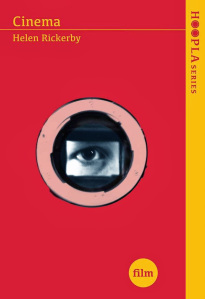
Helen Rickerby, Cinema, Mākaro Press, 2014 (part of the Hoopla Series)
‘With a whirr and a click/ we’ve conquered distance and memory’
There is an anecdote that the Italian film directors, the Taviani brothers, saw a movie when they were adolescents that rebounded a version of their world back to them (the constellation and collision of worlds that we know as Italy) and they dramatically said, ‘Cinema or death!’ Such boldness in the light of this shared epiphany.
Helen Rickerby’s terrific new poetry collection takes you into the world of cinema. Fittingly, the first poem is entitled ‘When the Lights Go Down.’ I immediately stalled on the title and pondered on the shared experience of reading poetry and watching a film. Even in the public space of a cinema, there is something intimate and private about your immersion in the cinematic world. It is comparable to entering a splendid poem and letting the world fade to pitch black along with the barking dog and the wet laundry— it’s just you and the poem.
In this book, ‘cinema’ is a thematic glue that gives the collection cohesion, but it is also the ingredient that animates at the level of detail. If you love film, and you have a history of film viewing, then this collection offers abundant rewards.
An early poem, ‘Revolutions,’ leads you into various meanings of the word from the click and whirr of the camera and the projector to the daring work of pioneer filmmakers. And so it is with the poems– the poetic effects are various, whether humorous, confessional, inventive, challenging, insightful, quirky.
There are a series of wry poems that re-imagine the life of a friend or Helen herself as directed by a particular filmmaker (Ken Russell, Sergio Leone, Quentin Tarantino, Stanley Kubrick, Jane Campion, and so on). ‘Chris’s life, as directed by Ken Russell’ is particularly witty. When Chris awakes to find ‘an anteater on my chest/ tearing at my throat’ it is , as Ken says, ‘the anteater of self-doubt.’
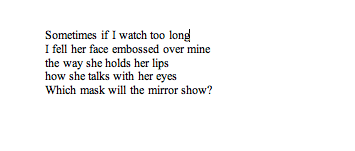
There is the way cinematic life has the ability to seep into and become saturated in your own (or vice versa) as the title of one poem suggests (‘Impressionable and impressed’). Thus the last verse of this poem hooks you:
What these poems do, too, is capture the magical, mysterious pull of cinema where there is a physical interplay between light and dark that then shifts beyond the material to an interplay between intellectual and emotional levels. Light and dark’s electric connections become the connections between life and death, desire and indifference, ghosts and humanity, real life and fantasies. In ‘Camera’ there are numerous such ripples —and the opening lines signpost the burgeoning magic: ‘There are lots of different stairs to be climbed/ each with a different kind of railing.’
The collection has an intermission! As though we can make our way out of the dark to collect popcorn or ice cream. I have never thought of this before, but I feel like I install a miniature intermission after each poem I read (if it is any good!) in order to absorb the poetic complexities or savour the poetic simplicity.
I love the way Helen’s collection pulls you into a poetic mis-en-abyme—into layers and levels of translucence, symbols, self exposure, tangible details, ephemeral details and above all a contagious love of film. Not that it’s a terrifying vortex! It is just deliciously complex.
Several longer poems stood out for me. I love the glorious ‘Two or three things I know about them’ which carries you along the white-hot tension between Jean-Luc Goddard and François Truffaut, and their different approaches to making a film. I also particularly loved ‘Symbols that make up the breaking up girl,’ a lush poem in parts where each part exudes a joy of language. Then there is the wonderful density and intensity of detail, with shifting tones and fitting repetition, in ‘A bell, a summer, a forest.’ I also delighted in ‘Nine movies,’ a sequence of poems that filter love and personal life through somebody else’s movie plot, incidents and discoveries.
Each poem in this collection is like an aperture into the magical world of cinema which in turn is an aperture into the magically fizzing world we inhabit—in all its shades of light and dark. And this then becomes poetry. As a big cinema fan, I loved it.
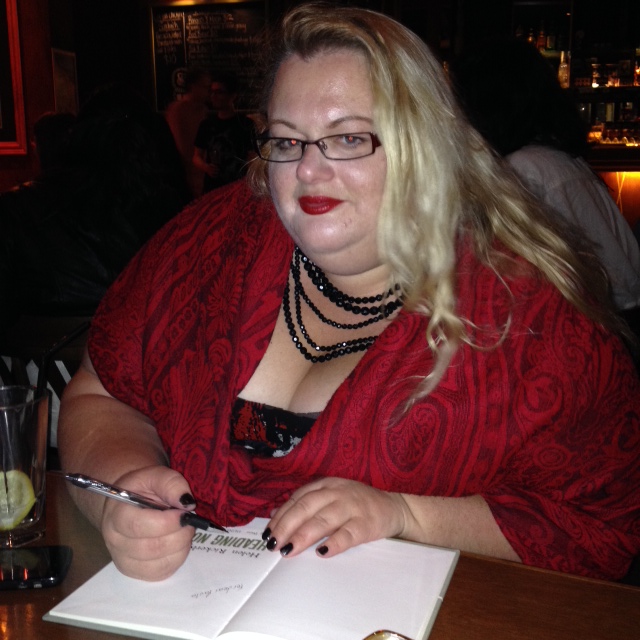
Helen is a poet, publisher and public servant with three previous poetry collections to her name. She runs the boutique Seraph Press and is the co-managing director of JAAM. Along with Anna Jackson and Angelina Sbroma, Helen is organising Truth or Beauty: Poetry and Biography, an upcoming conference at Victoria University. Details here.
Mākaro Press website Hoopla page
Helen Rickerby’s Seraph Press
Helen’s blog Winged Ink
An interview with Helen
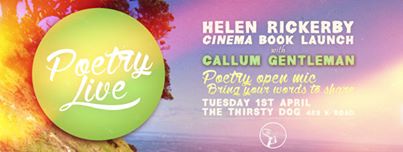
Tuesday, April 1 at 8:00pm
Thirsty Dog 469 Karangahape Road Auckland
Music by Callum Gentleman, open mic, Cinema will be launched by Anne Kennedy. Helen Rickerby will read some poems. Cinema, and the other Hoopla books (Bird Murder by Stefanie Lash and Heart Absolutely I Can by Michael Harlow) will be available for $25 (cash or cheque only).
 NZ Poetry Shelf