

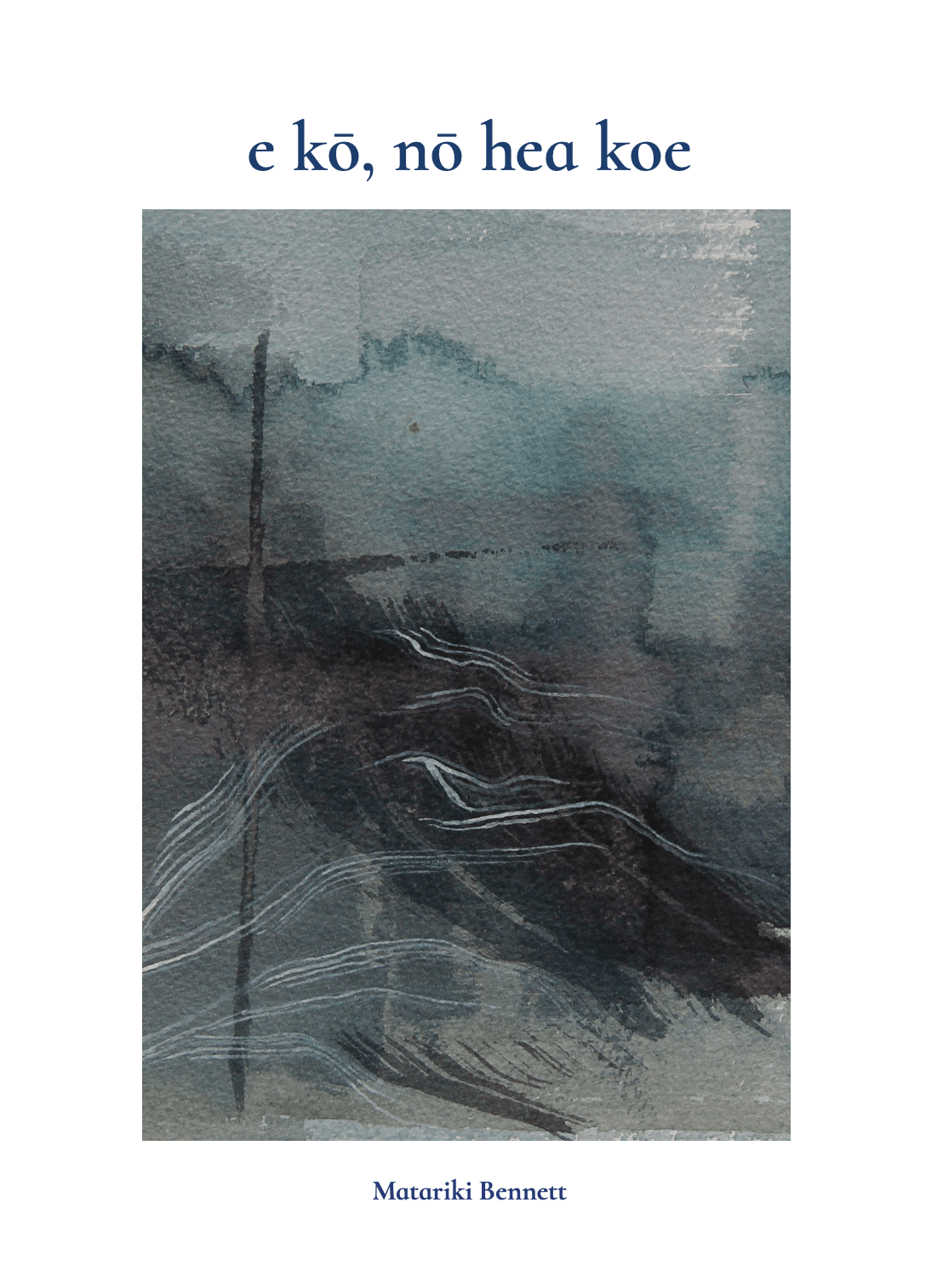
e kō, e nō hea koe, Matariki Bennett
Dead Bird Books, 2025
kareao
kareao is a vine native to our ngahere
she finds her strength in a tree
spends her life reaching for tama-nui-te-rā
kareao is used in our rongoā
she is a natural healer
ka ora te whenua
ka ora te tangata
we have always been people of the land
with korokoro tūī
an understanding of te ao tūroa that transcends this realm
kia whakatōmuri te haere whakamua
when they came
te reo pākehā was embraced as pītau
a new beginning
we learnt their reo
wrote with rau and rākau
always going back to our rawa taiao to maintain this balance between
onamata
and anamata
when they came
tino rangatiratanga was agreed to
a promise in our language for sovereignty
while their māngai salivated for a taste of
our wāhine
their puku bloated from
our kai
their pockets stuffed with
our whenua
when they came
we pulled stakes from the belly of papatūānuku
told her not one more acre until she no longer recognised us
when they came
we saluted the queen of a country that refused our name
instead called us savages
kept our heads as trophies
to gawk at
like our people are only valuable when they’re dead
when they came
arero unfamiliar with our mita
|with the native schools act they scraped language from our tongues til we
spat out our culture like poison
when they came
teachers made their students cut kareao
then beat them
with the thickest and strongest vines
for speaking our reo
on our whenua
weaponising our taiao
against us
kei hea taku kāinga|
kua ngaro kē
where else could we go if not to our healers
|what else could we do if not to heal
he ahi
e tahu ana
i taku korokoro
there is a fire
burning
in my throat
Matariki Bennett
“In the mid-1980s Sir James Henare recalled being sent into the bush to cut a piece of pirita (supplejack vine) with which he was struck for speaking te reo in the school grounds. One teacher told him that ‘if you want to earn your bread and butter you must speak English.”
I am a child of kohanga. A child who learnt two languages by the age of 5. A child of a father who only knows one and has spent this lifetime yearning for his reo. I am a moko of a grandfather whose generation was forbidden to speak. Whose generation were beaten for speaking. I watch as our language is skinned from the walls of parliament. Our culture is a political football. Our government is hellbent on causing division. I have seen the mamae our people hold not being able to speak. I know that this was no coincidence. To sever a people from their language is like severing root from tree. My poems speak to all that will never be forgotten. Everything my pāpā cannot say. Everything his pāpā couldn’t.
Matariki Bennett
Poetry Shelf review
It’s the first time I have ever celebrated ten books in ten days, but I was so drawn to the Ockham NZ Books Awards poetry long list I decided to embark on this crazy plan. Crazy yes with my small energy jar, but absolutely wonderful. Every single poetry book has offered tilt and truth – to borrow two poem titles from Emma Barnes. It’s like these ten poetry collections deliver little electric shocks, sweet miniature startles, skin prickle thrills – all feeding into and out of what it is to be human, what it is to write, to be mother father daughter son friend lover. What it is to navigate the dark and the light of past and present and maybe future, because so many on then longlist do this. And yes, more than ever, we are all, collectively, hand-in-hand navigating the dark and the light, at personal and global levels. And maybe my reviews are strange and not reviews and more like miniature biographies and odes to poem writing, and to surviving light and dark because I am drunk on poetry.
Matariki Bennett is the only poet whose work I had not yet encountered on the longlist, who I have not seen in performance. It feels like Matariki’s writing in e kō, nō hea koe has ignited a solar system of connections in my head. Wow! I felt like putting Jimi Hendrix’s famous guitar solo on full blast, or lying on the grass by the mānuka watching the pīwawaka dance bush poems, and then holding Matariki’s writing to my heart because more than anything, her poetry reminds me of the miracle of life. Maybe it’s because it’s the last day of my intense ten-day poetry sojourn where I have been reviewing at 4 am and reading at ten pm. Extraordinary. Extraordinary, too, to discover the cover artwork, ‘motherlines’ is by Matariki’s mother, Jane Holland, and the interior artworks are by her sister,
Māhina Bennett.
Where to begin Perhaps with the stars and moon and sun. There in the poet’s name, matariki. There in the poem where necessary protest is projected “all the way up to the moon”. There when the poet is looking out from a poem’s scene to the stellar sky, and on one occasion, holding someone close under “a blanket of stars”. The first two words that I write in my notebook are wisdom and wonder because in the opening poem the grandmother is pondering the stars, wondering why light outlives them. And then, many poems later, within the steady and glorious currents of wonder curiosity recognition, the grandmother and granddaughter meet again in a poem:
grandmama reckons i’m just as mad as she is
i reckon we are bits of the same star
we have always known where we come from
we have always known each other
from ‘what am i to a star?’
Where to begin Maybe with the echo-chamber question, where are we? And embedded in that, like an origami flower: where are we from? And in that who and how and maybe even why are we? I am holding the book title close, and lingering on where are we from, e kō, nō hea koe. This is the poem laying whakapapa on the page to open out. This is the poet connecting with her father and his father. This is the poet in her kitchen, connecting with her maternal lines, and yes, it’s poetry as the trickle on our cheek, the heart glitter:
i lock eyes with her, glitter crusting in the corners of my smile
while i light a ciggy for us in the glow of stars.
mum looks back from the danube towards home
i lock eyes with her from the kitchen of my flat in te aro, writing a poem
about our mother line
as it trickles down my cheek.
from matarua
Where to begin The way what we speak is utterly vital, tattooed on skin and yes heart, speaking te reo Maori is speaking home and bloodlines, and now, still now, especially now, we are challenging anything and everything that damages that. Because more than ever, language is our skin and blood and bones. In ‘koro’ Matariki writes: “my reo is the closest thing i have to home”.
Where to begin Perhaps with music, with the father’s playlist, or the album on the turntable, maybe Sinead, or Arihia on the ukulele, or the singing like starlight, or the lullabies, or the way Matariki’s poetry is poetry to be performed as much as read because every line is music in the ear. And that translates to music in the heart.
Where to begin Maybe with the youth knowing there’s “an expiry date on being young and outspoken” or maybe with the grandmother living in her memories or when “it’s time to grow the fuck up”. It’s maybe silence and sheddings, silence and sheddings rippling across days and days and months and months of writing and talking and being. All this.
Where to begin Let’s follow the trails and seeds of what it is to write, what it is to pick up a pen, in and out of each day, memory, strengthening relationship, little epiphanies, larger insights, landscape views. It is this:
kōrero mai e pā
kei kōnei mātou hei whakarongo
every poem i write has been generations in the making
it is everything my pāpā cannot say
from ‘koro’
More than anything it is also this:
my dad lost his dad when he was 18. for the last few weeks of his lifegrandpa could only whistle.
dad tells me this in a restaurant in morocco.
there’s an old man strumming peace on a guitar.
a woman dances between tables.
i excuse myself to the bathroom to cry.
every piece of writing feels like a eulogy.
dad wants me to come home.
i want my writing to whistle.
heaven.
something that’ll survive
us all.
from eulogy
Where to begin. Pick up the book and start reading. Feel the blanket stars, the moon light drops, the light emanating from each poem, because on a day when my news feed and social media is flooding with doom and devastation and despair, I feel so grateful for Matariki’s book, for its light and its aroha, its te reo Māori and its groundings, its fragilities and its protest, its whanau and its bridging breath. Pick up the book and start dreaming.
Matariki Bennett is a 23 year old award-winning Slam Poet and Filmmaker. She released her first book, e kō, nō hea koe in May 2025. She is a founding member of Ngā Hinepūkōrero, a bilingual Wāhine Māori Slam Poetry Collective, who in 2021, were honoured with the Creative New Zealand Ngā Manu Pīrere Award, recognising outstanding emerging Māori artists. In 2023, Matariki was the Wellington Poetry Slam Champion. Matariki co-wrote and co-directed, ‘Te Kohu’ (2022)’ and directed the short documentary, ‘Wind, Song and Rain (2022)’, she also wrote and directed ‘Tōku Reo’ (2019).
Whakapapa, Te Reo Māori and Hītori are the tūāpapa of Matariki’s storytelling.
He uri tēnei nō Ngāti Pikiao, nō Ngāti Whakaue hoki, ko Matariki Bennett tōku ingoa. He Kaituhi Toikupu, he Kaihanga Kiriata ahau. I puta mai taku pukapuka tuatahi i tēnei tau, ko ‘e kō, nō hea koe’ te ingoa. Ko au tētahi o te tokowhā o Ngā Hinepūkōrero, he rōpu Toikupu i riro i te tohu Ngā Manu Pīrere i te tau 2021 hei whakanui i ngā ringatoi Māori. I te tau 2023, ko au te toa o te whakataetae Toikupu ki Te Whanganui-a-Tara. Ko au te Kaituhi, ko au te Kaitohu o te kiriata, ‘Te Kohu’ (2022)’, te kiriata, ‘Wind, Song and Rain (2022)’ me te kiriata, ‘Tōku Reo’ (2019).
Ko tōku whakapapa, ko Te Reo Māori, ko te Hitori te tūāpapa o ōku mahi katoa.
Dead Bird Books page
Matariki Bennett will be in the Schools Programme at the AWF 2026
A kōrero with Read NZ
 NZ Poetry Shelf