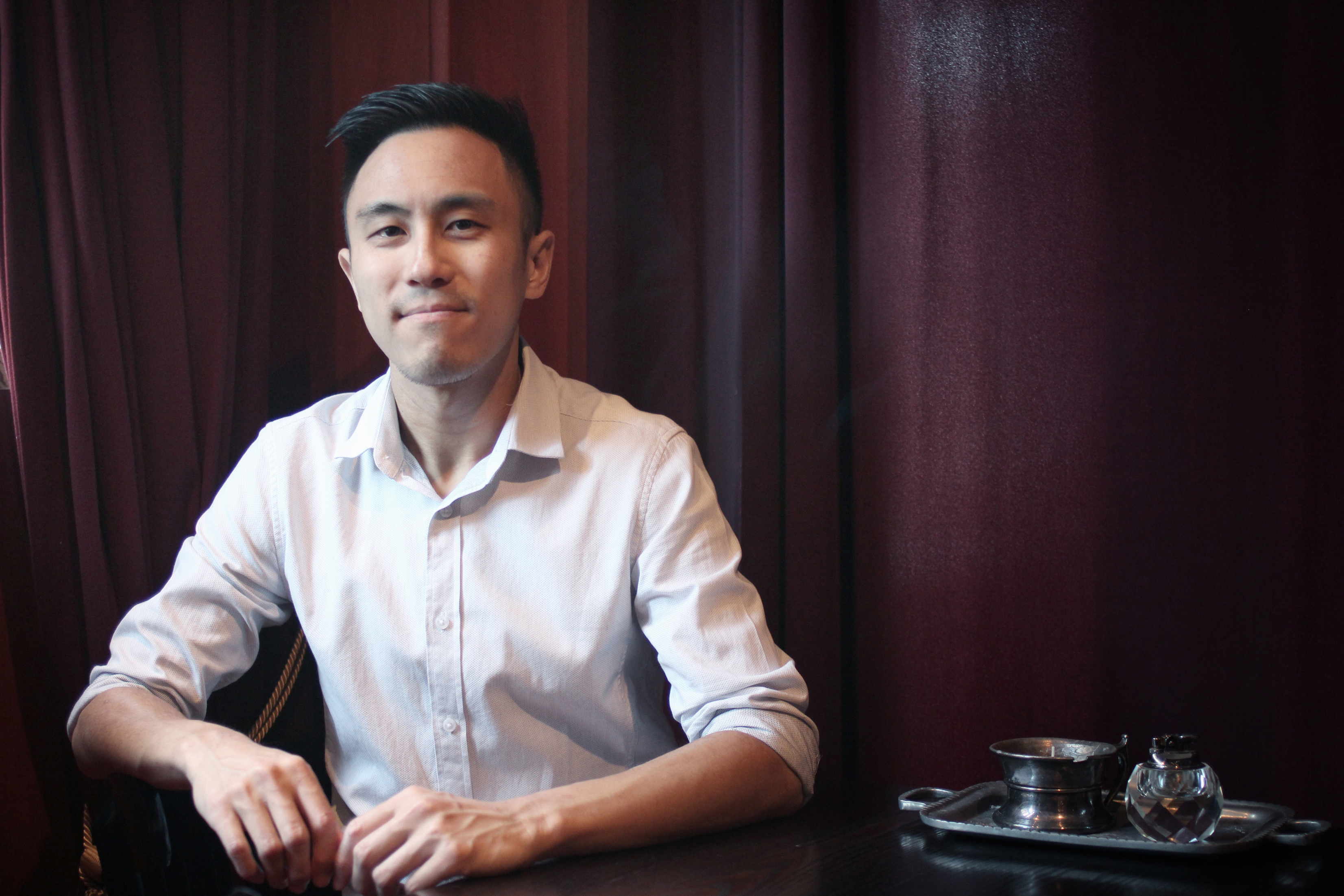
Chris Tse
I emerged from a film festival-induced haze to find that my to-read pile has grown exponentially. (Fittingly, one of the books that I’ve recently finished and enjoyed is Helen Rickerby’s Cinema for its wistful and charming tales of reality colliding with the world of movies.) Near the top of my daunting pile are Maria McMillan’s Tree Space and Hinemoana Baker’s waha | mouth (both VUP, 2014), and Sam Sampson’s Halcyon Ghosts (AUP, 2014). I’ve also been itching to get stuck into When My Brother Was an Aztec by Natalie Diaz (Copper Canyon Press, 2012). I stumbled across her poem ‘My Brother at 3am’ and then went searching for whatever else I could find by her.
I’ve been dipping in and out of books by two American poets (there’s a spooky synchronicity with their titles): Scarecrone by Melissa Broder (Publishing Genius Press, 2014) and Scary, No Scary by Zachary Schomburg (Black Ocean, 2011). Both write deliciously dark poems, which read like fables that speak of how terrifying and confusing the modern world can be. At times these poems have an irreverent edge to them, and both poets use such precise language and ominous images to conjure up worlds of unease.
Chris Tse‘s first poetry collection, How to be Dead in a Year of Snakes (AUP), will be available in stores and online from 22 September.
Hinemoana Baker
Bird murder When I closed this book after reading it for the first time, my exact words were ‘Now that’s how it’s done.’ Bird murder is a dark chronicle of close-packed language and noir thrills. Being a bird-lover from way back, I delighted in the book’s central murder, and I secretly hoped it was the Stellar’s Jay itself that did it. Overall, though, it’s simply the exceptional quality and music of the sentences that blows me away. An example from ‘Setting’:
Mrs Cockatrice, pink hair a-boule
sets the table for her guests.
Her ornamental milking stool
will do for a child.
And one more, from ‘Solar midnight’:
I came from a lake with an island on it
and on the island there was a lake.
The water was so silver. I had feathers then.’
– Bird murder by Stefanie Lash, Mākaro Press, Hoopla Series. Eastbourne, 2014.
The Red Bird I was alerted to Joyelle by Shannon Welch, whose Iowa Writing Workshop I attended at the IIML in 2003. It would be hard to overstate the effect it had on me reading these lines from ‘Still Life w/ Influences’:
Up on the hill,
a white tent had just got unsteadily to its feet
like a foal or a just-foaled cathedral.
I’ve been known to say loudly, on several occasions since, if I’d written that I could die happy. A glib hat-tip but the feeling is entirely genuine. This particular book travels from whales to guitarists to car accidents and beagles and doubles back. In the introduction, Allen Grossman says Joyelle ‘is a poetic realist. Her poems are neither reductive nor fantastic. But they are profoundly mysterious in the way any truthful account of the world must be.’
– The Red Bird by Joyelle McSweeney, Fence Books / Saturnalia Books. New York NY, 2002.
Hinemoana Baker‘s latest collection of poetry, waha | mouth, has just been released by Victoria University Press. I will review it on Poetry Shelf.
Karen Craig
Two poets I’ve been spending a lot of time with recently are Thom Gunn and Mark Doty, prompted by my job at Auckland Libraries, where we’ve been working on adding some lists of recommended reads in GLBTQI fiction and literature to our website. Thom Gunn is an old acquaintance who never ceases to awe me with the hard (yet supple — how they suited his poems, those black leather biker jackets) intelligence of his vision and the cool leanness of his language. The book I’m reading now is the Selected Poems edited by August Kleinzahler (Farrar, Straus and Giroux, 2009), which includes my favourite poem ‘Considering the Snail’, where the snail “moves in a wood of desire,/ pale antlers barely stirring/ as he hunts.” That’s already good. “What is a snail’s fury?” That’s genius, for me.
Mark Doty is a new find for me. A friend recommended his memoir Dog Years for a “Sadness” display we did at Central Library, saying it was the saddest book she’d ever read. If I tell you it’s over 200 pages and I read it all in one day and night, that will give you an idea of how this man gets inside your heart. He’s one of those people that when I was in high-school we used to call “beautiful”, and, when we used the term in our English essays, be told — rightly — that it was too imprecise. So to be more precise on Mark Doty’s beauty: a largeness of spirit, a sense of wonder and mystery, emotivity and desire, the musicality of the ordinary. I’m reading Paragon Park (David R. Godine, 2012), a collection of his early poems, while waiting for the more complete collection Fire to Fire (New York : HarperCollins, c2008). To match Thom Gunn’s snail, an amazing “Turtle, Swan”, where he addresses his lover, at the start of the AIDS epidemic, “you with your white and muscular wings / that rise and ripple beneath or above me, / your magnificent neck, eyes the deep mottled autumnal colors / of polished tortoise — I do not want you ever to die.”
On an other note, I’ve got Michele Leggott and Martin Edmond’s Beyond the Ohlala Mountains: Alan Brunton, poems 1968-2002 (Titus Books, 2013) from the library. I’ve just started dipping in, but I could see immediately that this is the kind of book which makes you really understand what is meant by “labour of love”. Beautifully composed, a careful, pondered – never ponderous – and, subtly, poetic introduction, which will have something for everyone. And the poems! A universe, no, a multiverse, of raptures and pandemoniums.
About me:
I work at Auckland’s Central City Library promoting fiction and literature both on the shelves and off the shelves, through book launches, author talks, lectures and — with great joy, always – poetry celebrations, including National Poetry Day evenings in conjunction with nzepc, Stars of Pasifika Poetry every March, and The Day of the Dead Beat Poets, every November 2. For the next 12 months I’m serving in a just-created role focussing on initiatives across the libraries to raise awareness of our collections. I write the Books in the City (http://albooksinthecity.blogspot.co.nz/) blog.