to the magazine! Sport 42 ‘long times spent sitting/ looking at the view so long’

42_cover_front__63802.1392602823.220.220   42_cover_front__63802.1392602823.220.220   42_cover_front__63802.1392602823.220.220

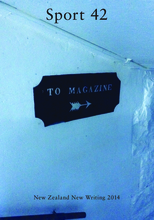
I love Sport‘s cover photograph snapped by Damien Wilkins at the Royal Albatross Colony in Dunedin. It features a sign indicating the direction ‘to the magazine.’ There is a delicious ripple of irony as the editor and publisher of Sport, Fergus Barrowman, had last year announced the journal’s demise due to a lack of funding from Creative New Zealand.  Sport had momentarily lost its way, much to the consternation of readers throughout the country. But as the journal secured funding from elsewhere, we now have a terrific issue to savour over the coming year. Yeeha!

This issue, along with the usual mix of fiction and poetry, includes four essays. I would love to see more of this (sounding a bit Rick Steinish in the face of both good food and endangered species!) How stimulating to read Mark Williams’ lively and inventive approach to New Zealand poetry in ‘When You’re Dead You Go on Television: Sex, Death, and Household Objects in Some New Zealand Poetry.’ It was the sort of essay that got you thinking about other poems in relation to his three themes and the fertile possibilities of exploring these three themes in the one critical space.

I haven’t finished reading Sport 42 yet, because I like to dip and delve over months rather than weeks, and I am not going to comment on the fiction (which I haven’t even started upon) other than to say I spotted some must-read names: Lawrence Patchett, Pip Adam, Tina Makereti, Breton Dukes and Charlotte Simmonds along with a cluster of those new to me.

There is an equally tempting list of poets that range from some beloved landmarks on our poetry landscape (Bill Manhire, Geoff Cochrane, Elizabeth Smither, James Brown, Chris Price) to the recently emerged (Sarah Jane Barnett, Amy Brown, Kerrin P Sharpe). There are about 39 poets and a number of these are brand new sparkling voices!

Here is a tasting plate of what has struck a poetic chord so far:

Amy Brown has a sequence of poems that take her into temporal elsewhere, and that highlight the power of an object to take you in multiple semantic and nostalgic directions (as though the poem is a little like a pocket memory theatre). I particularly ‘Names’—a poem that is evocative, tender and vibrant, and that embodies loss in aching detail.

Chris Price‘s poem, ‘The also-ran,’ reminded me how much I like her poetry. Here the disgruntled ‘runner’ is a misfit on the hunt for the elusive or the grass-that-is-greener or self recognition. Price relishes musical fluency as her miniature narrative is punctured into stanzas (broken breath) with sweet enjambment that connects, keeping both runner and reader on track.

Lynn Davidson‘s ‘Kapiti Island Welcomes Back the Girl and Her Mother,’ is steered by the deft hand of both storyteller and musician: (‘They cut through weed and current/ flicker and fin to get in’ and ‘to make words make/ this wind that howls/ make the frequencies for language’). AAhhh!

Sarah Jane Barnett‘s long poem, ‘Running with My Father,’ also adopts the rhythm of running, but her poem strengthens in its shifting style. The early morning run absorbs the father figure in memory flashes, the way the puff and pant of lungs and heart working hard draw in different images and insights. This is a glorious poem that pulls you in closer to thoughts of death and of life.

Frances Samuel is not a poet that I am familiar with, but I was struck by her poems and was delighted to see VUP will publish her debut collection later this year. Her poems have serenity, simplicity, a meditative quality, an offset quirkiness running through them that is utterly alluring. One poem begins: ‘There are so many ways to write about dying.’ Another start: ‘In the very earliest time/ autumn trees stretched to the sky/ raking the reds and pinks of the sunset.’

I found myself half singing Bill Manhire‘s selection then wanted Hannah Griffin to take over— her heavenly voice igniting ‘Rikkitikkitavi/ you’re so charming/Rikkitikkitavi/ oh my darling.’ Is this a bad thing? You get Bill’s cheeky wit on the page, the sweet pull of repetition and rhyme, and then you want to sit in a dimly lit room and hear these poems sung.

And I loved Damien Wilkin‘s found poem —the titles of books Bill Manhire left behind on his shelf.

Next up the rewards of James Brown and Elizabeth Smither ….


.
Michele Leggott’s book launch– Heartland drew us in close

cp-heartland  cp-heartland

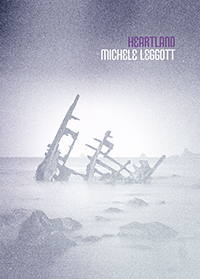
Michele Leggott, Heartland, Auckland University Press, 2014

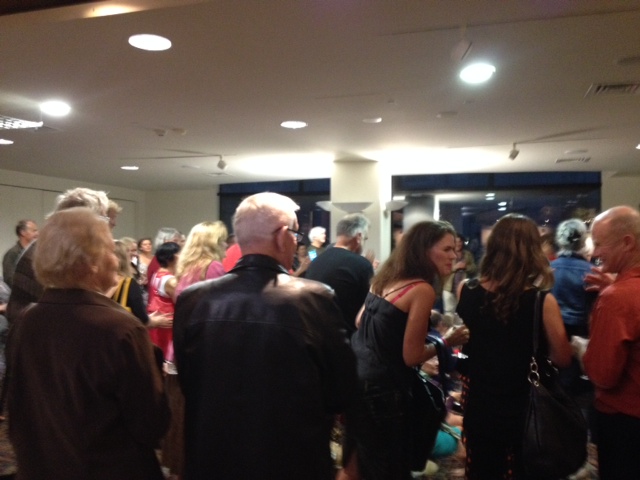
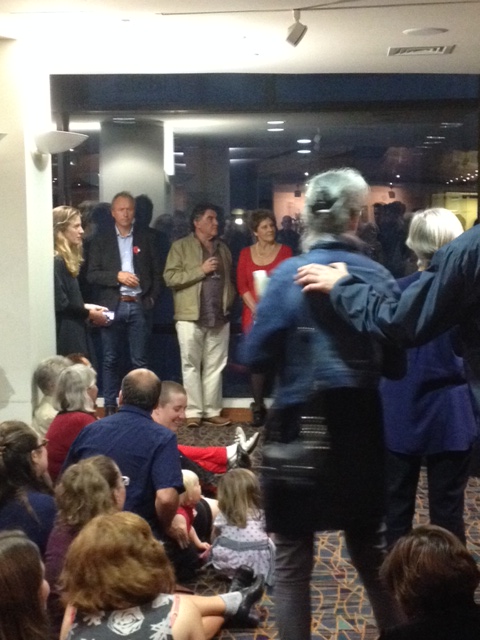
It was a feisty storm in Auckland but a good crowd turned out to help Michele Leggot launch her new collection, Heartland, at Auckland Central Library last Thursday.

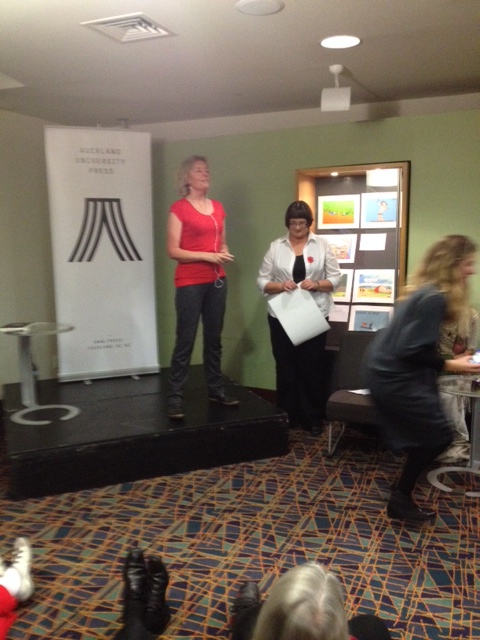
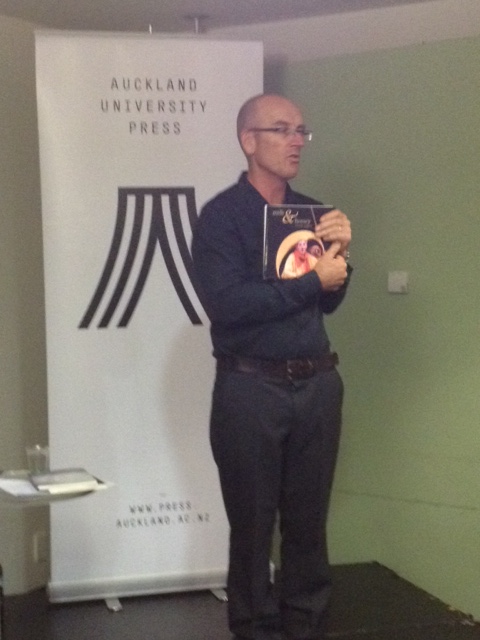
John Newton took us on a tour of the shapes of Michele’s books and reminded us how they have shifted from landscape to portrait, and how that physical shift also saw a shift in other ways. The poems have become more transparent, have embraced narrative to a greater degree and have employed a less fragmented syntax. John also suggested, and I think this is the case for many poets, that Michele’s body of work is like one long poem in installments (perhaps the landscape poem and now the portrait poem).

As John was talking, I went off on a train of thought. I feel that Mirabile Dictu and now Heartland have opened themselves wider to the words and narratives in the world that is close at hand. These books draw in family in way that is close, intimate and touching in both semantic and linguistic choices. And then it is as though these books are held open for family, so these loved ones may gain entry as readers.

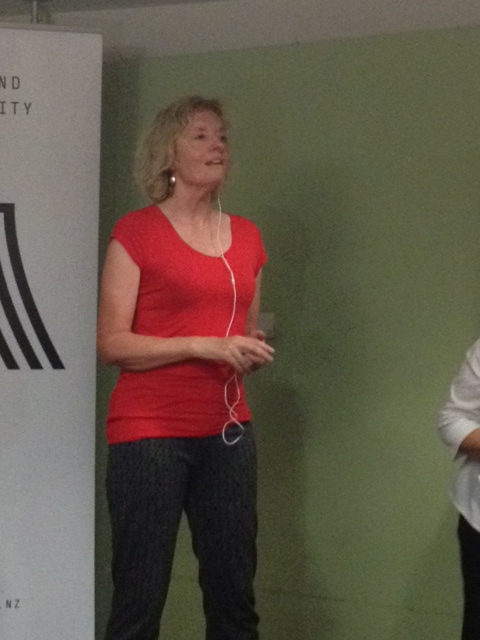
Michele read three short poems using her listening device rather than the book. It was just wonderful to hear her voice lift the words from the page. I was particularly taken with this comment: ‘Every book should have a way of stepping out of it—by stepping into what’s coming next.’ In this case the Matapouri poem in the book. I am fascinated by the way certain geographical locations have white-hot resonance. Having grown up in Whangarei and spent most summers on the Tutakaka coast (and still do) that physical landscape triggers all kinds of poetic responses in my secret writing life. I can’t wait to see where Michele is heading next.

photo photo 1 photo 2 photo 1

photo

The Totally Official Launch of Pen Pal by Sugar Magnolia Wilson

1981892_287549788068665_2082679686_n

An invitation from Cats & Spaghetti Press:

where: 19 Tory Street, Wellington                 when: 7pm Friday 16th May

We’re going to be having a bit of a shindig to say welcome to the world to Pen Pal. There’ll be readings by Sugar Magnolia Wilson and special guests Hannah Mettner, Jackson Nieuwland, Carolyn DeCarlo and Morgan Bach.

Come along to get your copy and have a drink and maybe even a bit of a dance in celebration.

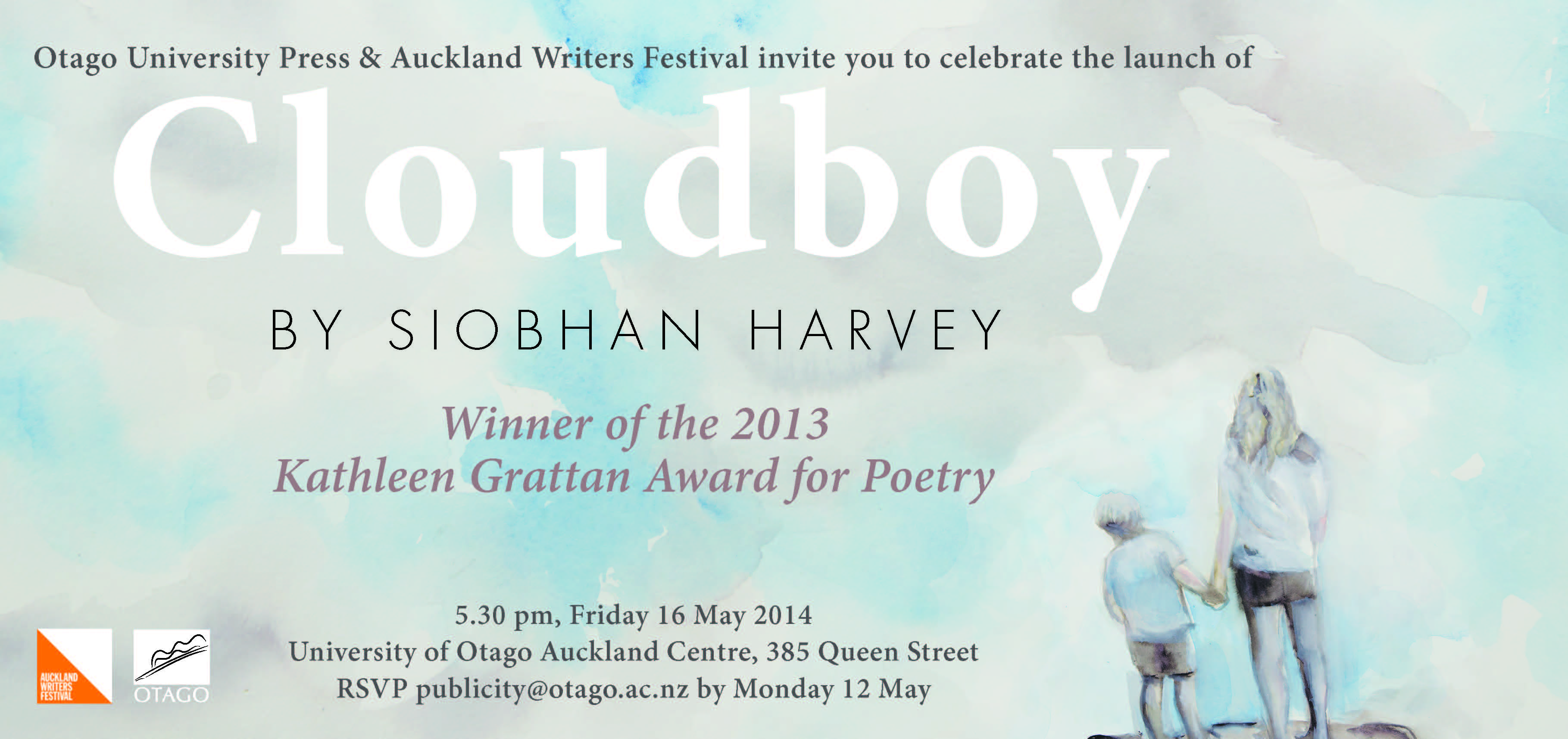
An invitation to the launch of Siobhan Harvey’s Cloudboy

Harvey launch invitation for emailing_Page_1

I heard Siobhan read a bit from this at the Pah Readings and witnessed the degree to which the audience was moved.  Was rather special.

Join Compound Press to launch poetry chapbooks by Steven Toussaint & Lee Posna

New Zealand seems to be a fertile ground for independent poetry presses and bookshops. Wonderful!


Time Out Bookstore

Saturday April 26th 4.30 pm until 8pm

Join Compound Press to launch poetry chapbooks by Steven Toussaint & Lee Posna.

 Fiddlehead by Steven Toussaint : Re-imagines Rangitoto as Dante’s mountain island of purgatory.

Arboretum by Lee Posna : A posthumous reflection on the bounds of the empire of artistic vision.
The poets will be present to read a little – perhaps from these books, perhaps something else entirely.

A few drinks will be provided.
Handmade books available for purchase for $10.


Ashleigh Young goes biking!

Check out this terrific post from Ashleigh Young:

A bike ride with James Brown


I’ve been a big fan of James Brown’s poems for a long time. The first poem of his I read was ‘Loneliness’, in 2001. It’s probably still his most well known poem, all these years later. I wonder if James is a bit tired of it now, has made a real effort to leave it behind, the way Radiohead have left behind ‘Creep’ but a stubborn faction of people still want them to play it and wish they’d go back to their roots. Anyway, after I read it and Lemon, his second book, I became preoccupied with tracking down a copy of his first book, Go Round Power Please. It was out of print, but that eerie crowd of little pottery faces on the cover haunted me, and eventually I stumbled across a copy in a secondhand bookstore, and when I read that book, I knew that James’s poems would end up being permanent fixtures in my head.

The full post is here

Autobiography of a Marguerite reached its Pledge-Me target– a note from Hue & Cry

This message from Hue & Cry


‘Thank you so much for supporting our campaign for Zarah’s book, Autobiography of a Marguerite. You’ll be happy to know that the manuscript is now with our designers. This means we’re on the home run and on the countdown to launch night.

And for those of you based in or near Wellington, we have a confirmed venue and date for the official launch event. This will take place at the City Gallery Wellington on Thursday 5 June, 5.30PM. So put it in your diary now, as you’re all invited. And you can collect your rewards at the event as well. We’ll also be holding an Auckland reading  a little later in June, so stay tuned for information about this.’

Chloe

Libby Hart is creating an international poetry book review journal, and is interested in receiving NZ titles

Call out: What the Bird Said

What the Bird Said will be devoted to online criticism of a diverse array of the best contemporary and international poetry and is especially keen to hear from authors and publishers of poetry collections and anthologies written in English.
Please send a query email to Libby Hart at libbyhartfile@gmail.com if you are interested in having your book reviewed.
Libby Hart is author of Fresh News from the Arctic (Anne Elder Award) and This Floating World (shortlisted for the Victorian Premier’s Awards and the Age Book of the Year Awards). Her new poetry collection, Wild, is forthcoming from Pitt Street Poetry in 2014. Please see libbyhartfile.blogspot.com for more details.


Libby Hart
Email :: libbyhartfile@gmail.com
Website :: http://libbyhartfile.blogspot.com
Postal mail :: PO Box 1289, Brighton Road LPO, Elwood 3184, Australia

Three Poets on Love

9781869797621

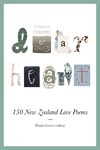
I was invited to contribute a piece on Love to Awkword Paper Cut blog run by Michelle Elvy (it draws in writers from NZ and USA to write on writing). Even though I edited an anthology of love poems (Dear Heart) and I feel I write primarily out of love, I don’t write many love poems.  It was a fascinating thing to do– to write the piece.

You can read the three pieces here.


Earlier this year, I read ‘Iambic pentameter’ by Patricia Sykes, a poem about voice and rebellion and learning to stand on one’s own two feet. In Sykes’ bio, I read of her collaboration with composer Liza Lim, and I was so intrigued by this project that I followed the links to Lim’s webpage and found myself lingering late one night over her piece called ‘Love Letter, 2011’ – inspired and linked in various ways to James Tenney’s ‘Postal Pieces’. Tenney’s experiment is described as a “meditation on acoustics, form, or hyper-attention to a single performance gesture”. Lim’s ‘Love Letter’ is similarly experimental, something she describes as a mere “prompt, an invitation to the performer to participate in a process of honouring someone (‘their beloved’) [while] all the true work lies with the performer” – something which prompted me to reflect even more on ideas linking passion, voice, heartbeat and distances we traverse both physically and spiritually in the name of love.

– See more at: http://www.awkwordpapercut.com/13/post/2014/04/writers-writing-about-writing-about-love.html#sthash.Nnocbapg.dpuf