Hagley Writers’ Institute seeking applications for 2015
Leave a reply

The Bookshow with Graham Beattie and Carole Beu reveals promising signs for Independent Booksellers and small Publishers. You can watch last night’s episode here where they talk to the Publisher of Upstart Press and Jenna from Timeout Bookstore.
One interesting point made was the continued growth in non-fiction and children’s books and the signal that fiction might digitalise more and more.
I know a lot of poetry books get published in New Zealand by a range of presses as I have such a stack in my study to share on this blog (more than I can possibly do), but I wonder how they go in terms of sales. Poetry is rarely a strong feature in a bookshop (I have made a separate page on Poetry Box for all the stores that have great displays of children’s poetry) and maybe that’s because we don’t buy that much of it. Ahh!
I still believe the life of poetry in book form will endure because we pay so much attention to the book as object, the hold of the book in the hand, the look of the poem on the page, the cover and so on.
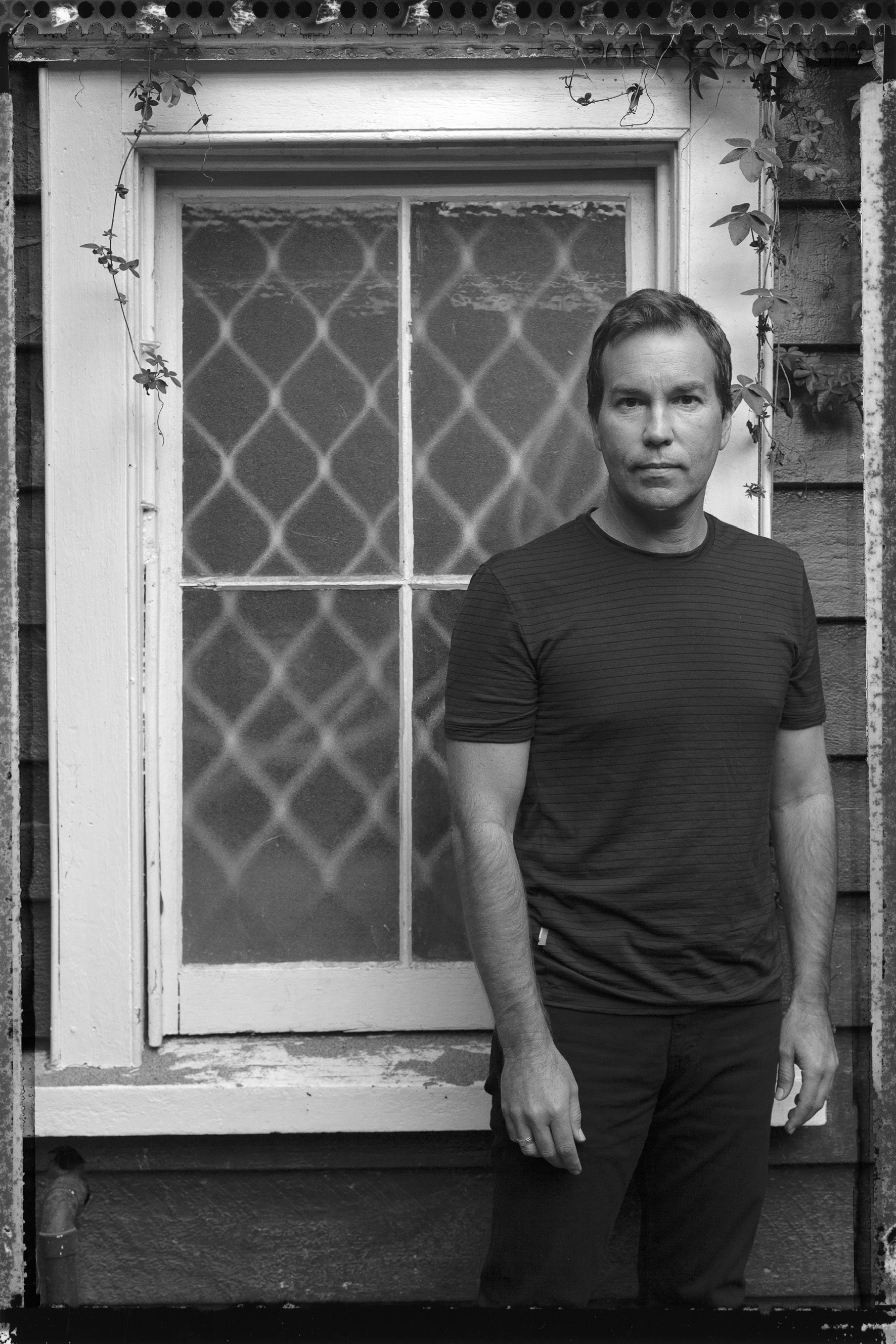
Photo Credit: Harvey Benge
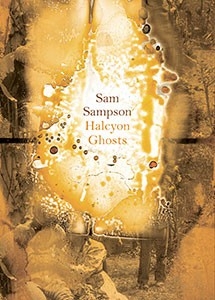
Sam Sampson, Halcyon Ghosts, Auckland University Press, 2014
Sam Sampson’s new poetry collection, Halcyon Ghosts, brings together ‘thirteen shapes of knowing.’ It comprises thirteen poems that form various shapes or stamps upon the page. You can trace a bloodline to concrete poetry where the visual mark is as much a protagonist as the poem’s internal movement. You witness debts to the legacy of language poetry and you absorb the lyrical score. These poems are crafted by a poet who is part musician, part philosopher, part documentary filmmaker, part family archivist.
At times the physical detail is luminous — as though capturing the landscape, the living breathing world momentarily (‘white melodious throat’ ‘riparian light/ blinking on a dark field’ ‘ceramic wind chimes/ charred grape seeds’). Or snatches of action and activity whether strange or unsettling (‘picadored green people tethered to years’ ‘ghost moths generate night skermishes’). Words can be snapped in half across line breaks. These are poems caught in half-light, in fragmented sideways glances (‘to seize shadows I grab them by the sleeve’). Words zigzag across the page in discrete phrasing. Making authorial imprints. Stammering and staccato, as though this poet is out of breath, holding back, puffing out poems in little linguistic clouds.
In ‘The Kid,’ it is as though you can hear the click and stutter of Chaplin’s reels as the shifting frames catch light and dark (‘listen in-/tently to that blind/ mazy course/ running wild’). Colons are separated out to prolong the resting spots, the moment of pause (‘a mil : ‘). They act as little hinges, pivots in a collection where juxtaposition is a fertile device (‘Circles the expanse expands dirt’ ‘pin-pricks of the world … name-sakes’). Such pairings provoke an oscillation of mind and eye, a semantic quiver, a visual twitch.
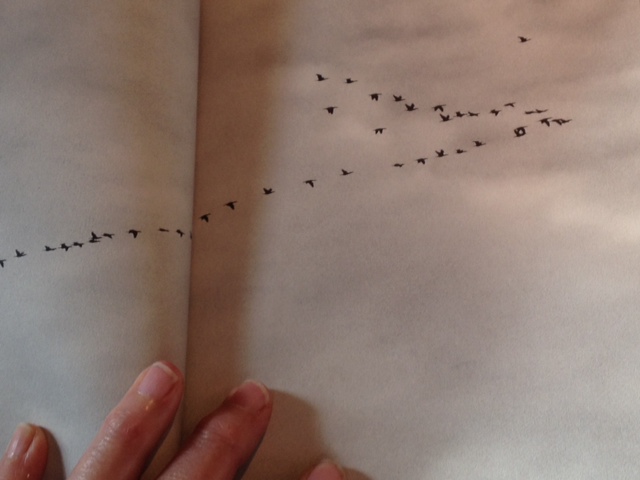
I loved the sequence, ‘Halcyon Ghosts,’ where the poem’s shapes imitate so perfectly the photographs of birds in flight upon the preceding pages. Here the words take pleasure in the measured steps of lift and fall. These are poems of return, with the flight path etched in your mind ready to accept the swift wing beat of the bird. Glorious.
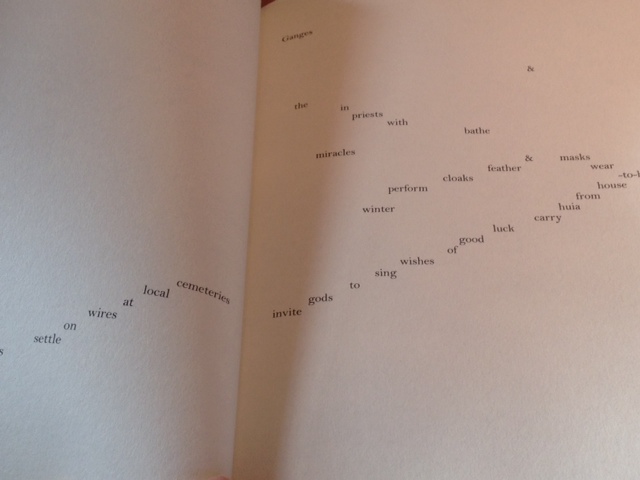
Elsewhere a horizon line imprinted on the page breaks a poem in two as though refracting and reflecting. Yes, the poems are visual gifts for the eye, but what instils a deeper imprint is the intellectual and lyrical movement. The language is eclectic and difficult, yet there is heart here. Life. Experience. Contemplation. Surreal twitches. Sam has refreshed the life and expectations of concrete poetry, he has a bloodline back to Language Poetry but has stepped out of its limitations and has composed a symphony in parts where words are substitutes for the musical notes of melody. Breathless and breathtaking.
Thanks to Auckland University Press I have a copy of this book to someone who likes or comments on this post (NZ addresses only).
Jeffrey Paparoa Holman
A poet I have become almost evangelical in promoting since discovering his work in a Paris Review interview in 2005 is the late Jack Gilbert (1925-2012). His Collected Poems (Knopf, 2012) includes The Great Fires (1982), the first of his books I bought, with one of his signature poems, Steel Guitars which ends “The heart in its plenty hammered/by rain and need, by the weight of what momentarily is”. This book is the harvest of a brave life lived deep in poetry; his work impelled me to seek him out on a visit to California, making it literally days before he died on 13 November 2012. This is what I wrote of that visit:
I feel in the same way about Gilbert as I did when I came across Pablo Neruda in 1971 – here was a world I could inhabit without exhausting its gifts.
My local love of recent times has been John Pule’s wonderful The Bond of Time (Canterbury University Press, 2014). I was invited to write an introduction and spoke there of “a net of words across the Pacific”, which hardly does this remarkable and precocious epic justice. Pule was only twenty one when he composed the poem in 1985 and this is its third richly deserved appearance. Unique and essential.
Jeffrey Paparoa Holman writes poetry and non-fiction and the occasional Paparoa blog post on WordPress. He is presently working on a memoir, ‘Burning The Libraries’ and another history project to do with German family connections in the Nazi era.
Hera Bird
I never could muster much enthusiasm for the war poets, possibly because most of what we studied in secondary school was from the British canon, which I never fell in love with, and there are only so many tender battlefield reminiscences about the distant fields of the mother country you can read before returning to the New York School for a stiff drink. But I’ve recently discovered Dunstan Thompson, a gay American war poet who faded into obscurity after returning from WWII, taking up Catholicism & renouncing homosexuality. His earlier work is hard to find (although there is a selection of his later, religious poems available online) but his poetry has been criticized for inconsistency – moments of brilliance flaring into tepid endings. But read “Lament for the Sleepwalker” and tell me the half doesn’t overcome the whole:
An excerpt:
I am chilled, as though a star
Of mobs and children came by traitor’s gate
And climbed the water stair to break his neck
On the axe king’s block, all in winter sunshine.
His brain in ice, his guts in melting jelly,
As barefoot fellow bound for high-heel gallows,
Peer of the Presence like a spaniel licks
Cracked lips to ease his vomit back; then stumbles
On the ladder going up to hell.
Dunstan Thompson ‘The Prince, His Madness, He Raves at Mirrors’ in On the Life and Work of a Lost American Master D.A Powell (Pleiades Press, 2010)
The other poet whose work I’m really excited about is Danez Smith, whose book ‘[insert] Boy’ is forthcoming from YesYes Books. Danez Smith is an amazing slam poet from the states whose work I’ve been seeing reposted a lot on the internet in response to the recent Ferguson shooting, particularly this poem ‘alternate names for black boys.’ Until his book comes out, I’ve been reading bits and pieces from his website:
an excerpt from ‘alternate names for black boys’
Paula Green
I know I review books on the blog ( I will be having quite a flurry after my Hot Spot Poetry Tour I promise!), but I just wanted to flag this as it stuck with me. Sugar Magnolia Wilson’s Pen Pal published by Cats and Spaghetti Press earlier this year. It is not so much a book as a paper-fold-out that tucks in your bag and can very neatly fold and unfold in waiting rooms. The poems themselves are letters that fold into poems and poems that fold into letters. I love the idea of the shadowy figure to whom the letters are addressed, unreachable, yet gaining in presence in the light of what the writer chooses to reveal. The letters are surprising. ‘I’ve only just started/ witchcraft so this letter/ includes some hairs.’ The hidden fold may be of magic spells as though these poems are talismans or charms that work some kind of subterranean effect upon you as you read. I love the flashes of anecdote (‘Did I tell you/ in July a meteorite fell?’ whether true or false). Every poem seems off-centre, quirky, surprising, reverberating (‘Yesterday I carried my grief tree/ down to the mailbox/ to be milled by a letter’). The letter-poem-spells come out of a childhood, a mum and a dad, with hurt and ache and back-yard digging. I highly recommend tucking it in your bag to unfold and refold and let the spells take hold.
I write to you from
the witching hour.
He is out in the night
calling to his garden –
he is a big-hearted grasshopper
licked over by the long, red
tongue of sadness.
The Bookman teams up again tonight with bookseller Carole Beu for another session of author interviews, book reviews and news.
Face TV is Sky Channel 83. If you don’t have Sky or miss the show then it will be linked here and here tomorrow morning. The show also screens on Thursday October 2nd at 12.30pm on Face TV.
This week Graham Beattie is talking to crime fiction author Paul Thomas while Carole chats to poet/author Paula Green.
Here is the link to Tim Upperton and the final post. A timely reminder to go back and check all the pages I missed.
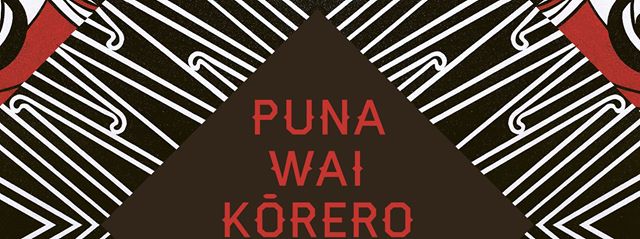
Launch of Puna Wai Kōrero: An Anthology of Māori Poetry in English Edited by Reina Whaitiri & Robert Sullivan (Auckland University Press)
Where: Monday, September 29 at 5:30pm
When: Waipapa Marae at The University of Auckland. Auckland.
Listen to Gregory O’Brien in conversation with Kim Hill about the book.
Gladstone School was the Auckland winner of The Third Fabulous Poetry Competition. So I am spending today and tomorrow at the school. Thanks to The Nw Zealand Book Council for supporting this competition and helping me pick the winners.
First up the Year One and Twos. Here are the poems we made up. They sat for a whole hour and were hooked on poems.
Gladstone Road Shoes
Rubber shoes
Slipper shoes
Velcro shoes
Sore Shoes
Sparkly shoes
Monkey shoes
Basketball shoes
Broken shoes
Running shoes
Dinosaur shoes
Blue shoes
Yellow shoes
Lightning shoes
Shoes are cool!
Lily
My Russian blue cat
scratches all the time
like a tiger,
sleeps and purrs
tricks,
frisky cat.
My cat likes
to eat tuna
lasagna
and cheese,
scrumple scrumple.
My cat likes
to sleep in my bed
on the sofa
on the cushions
on the table.
She does a somersault.
She brushes my tail.
My Kite
Rainbow kite
Kite flies
Fairy kite
Kite swishes
Disco kite
Kite twirls
Golden kite
Kite glazes
Butterfly kite
Kite races
I love my kite.
The Adulterators (Cliff Fell & John Newton) w/ Mahoney Harris
Wed Oct 8 at 7:30pm to Thu Oct 9 at 10:00pm
The Dog’s Bollix in Auckland, New Zealand
Three Chords and the Truth: an evening of music and poetry for grownups
 NZ Poetry Shelf