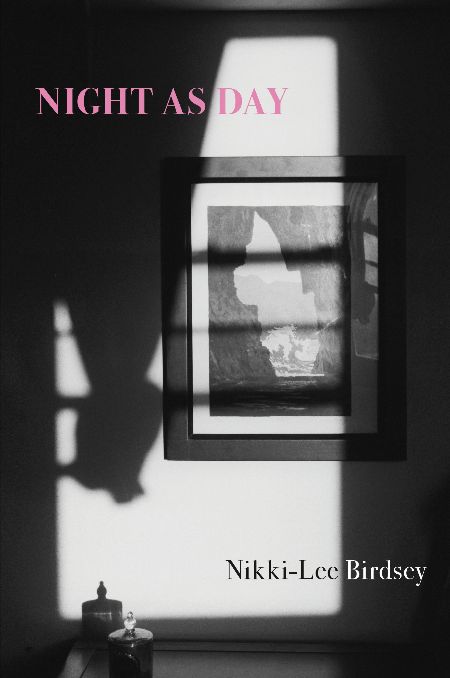
VUP warmly invites you to the launch of
Night as Day
by Nikki-Lee Birdsey
at Unity Books, 57 Willis St, Wellington
on Tuesday 9 April, 6pm–7.30pm
Night as Day will be launched by Anna Smaill.
All welcome.
p/b, $25.

VUP warmly invites you to the launch of
Night as Day
by Nikki-Lee Birdsey
at Unity Books, 57 Willis St, Wellington
on Tuesday 9 April, 6pm–7.30pm
Night as Day will be launched by Anna Smaill.
All welcome.
p/b, $25.
This letter from Stephen Wainwright Chief Executive – Pou Whakahaere Creative NZ
extends an open invitation to create beautiful things #CreateAroha
Poetry can play a part.
Kia ora tātou katoa
As – Salaam – Alaikum
The hate, gun violence and crimes directed against the faithful at the Masjid al Noor and Linwood Islamic Centre in Christchurch have left us bewildered, feeling vulnerable, struck to the core. We have had to accept that an act of terrorism has been inflicted on our people and our national innocence has been lost. We are hurt; we are grieving.
Our thoughts are with the affected Muslim families, and their communities in Christchurch, in Aotearoa and around the world. We hold dear the people of Christchurch, who have already endured so much but have responded with warmth and love, and acknowledge that our country is in mourning. In time, this tragedy will be marked by formal commemorations.
Right now though, we are feeling raw or numb. It’s not a situation we are familiar with or could prepare for, and people are thinking about how to respond. Some are finding a way.
You may have seen some beautiful examples of creative expression in the past few days, including Wellington artist Ruby Jones’ image “This is your home and you should have been safe here”, Māori artist Akoni Pakinga’s tribute to the Muslim community “Kotahitanga”, a beautiful collection of poems “I keep walking”, and the many other examples outside mosques and in public spaces. Just this morning we heard renowned novelist Witi Ihimaera’s heartfelt karakia for Christchurch.
These are reminders of the power of the arts and the impact creative expression can have on our individual and collective wellbeing. Turn to your creative skills. Take comfort from them. Share them if you think it would help others.
We invite you to share words, images, videos of your creative expression and related events using the hashtag #CreateAroha. We, in turn, will share them on our social media platforms. Nothing is too small or too big. I see each creative expression as a thread denoting dignity and mana, woven into a digital korowai to nourish and protect us, and demonstrate our unity, in solidarity against hatred.
While discussion and debate continue about the roles these platforms play in spreading hate, let’s fill them with positivity.
In time, our country’s artists and creatives will express their response to this tragedy through major works. These too will help us reflect and grapple with this difficult kaupapa. To grieve. To make sense of our fractured world. To come to terms with what has happened. To challenge. To push for a better future.
Professor Peter O’Connor put it beautifully when talking about the role of the arts in healing traumatised communities, and particularly children, on Radio NZ: “I would hope in the coming days that we make beautiful things in defiance of the acts of ugliness that were created on Friday. Every time we make something beautiful, either as individuals or as communities, we act in defiance. We reject the hate of Friday.”
The deeper extremist agenda is to divide and conquer, and pull us apart so that we lose faith in our shared humanity. Let’s instead embrace what unifies us. Let’s embrace this necessary work together. We need to make every effort to be part of a community that stands up for diversity and tolerance, where unity and peace are the norm.
Mā te kotahitanga e whai kaha ai tātau
In unity, there is strength
Stephen Wainwright
Chief Executive – Pou Whakahaere
Kia ora organisers, poets, librarians, teachers, book clubs, creatives and lovers of poetry.
It is with heavy hearts we contact you in the wake of such terrible events. We can only hope you are determined, like us, to promote and rejoice in ALL New Zealand voices, louder than ever. As poet, Paula Green says, “poetry connects us to human experience, to how we live and love and mourn. It is a window, it is a balm and it is an eye-opener. This is a time to reach out and make connections, to listen.”
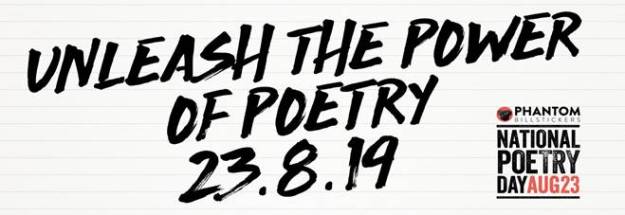
Welcome to Phantom Billstickers National Poetry Day, 23 August 2019. Registrations are open.
Returning 2018 organisers: Last year was huge – let’s do it again!
To those returning after a break: Welcome back.
To the newcomers: Phantom Billstickers National Poetry Day is an annual celebration of the power of poetry – in all its manifestations. Open to all ages, it is a chance to make poetry accessible, inclusive, and to showcase how extraordinary it can be. Events, activities or competitions can be large or small, from handing out free poems, making a Poet-Tree, or chalking on pavements, to larger-scale events such as workshops, readings with guest poets and book launches. At every level, Phantom Billstickers National Poetry Day is a chance to make poetry soar.
Registrations and applications for seed-funding remain open until 5pm, Wednesday 22 May 2019.
Visit our website for more information on how to register and/or apply for seed-funding, how to run an event, and for general guidelines and templates here.
Or you can follow this link straight to our …
Registration Form 2019
We look forward to unleashing the power of poetry across Aotearoa and beyond on Friday, 23 August 2019.
If you have any queries, reply on a separate thread to: National Administrator | Jacqui Hammond | poetryday@nzbookawards.org.nz. Otherwise we look forward to receiving your registration!
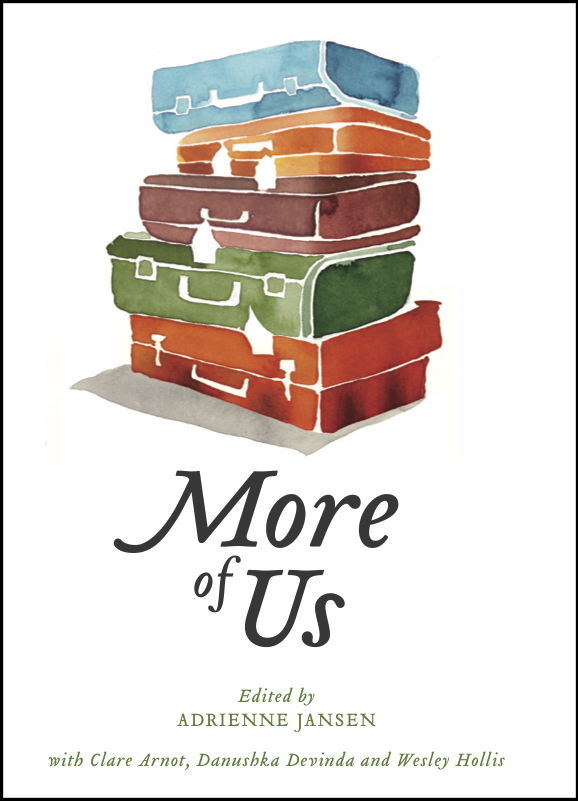
More of Us, edited by Adrienne Jansen with Clare Arnot, Danushka Devinda and Wesley Hollis, Landing Press 2019
46 writers from 29 countries, all now living in New Zealand, award-winning poets and high school students
The journey of football
Lebanon
In Lebanon my brother and I
used to play football on the street.
There were shops on the right
and houses on the left.
The shops were a dairy, Express (fast coffee),
a farouge that sold alive and dead chickens.
The houses were old, full of Syrian families.
We passed the ball between each other,
wasting time because the days were long.
The sun was shining with no cloud,
the birds were standing on the trees,
their heads were darting, but they were singing.
Then I joined them and started to sing,
‘I believe I can fly’.
New Zealand
I feel nervous, scared,
happy and strong.
I hear the whistle
and we are all running
to get the ball.
We are running like hedgehogs
to score a goal.
It starts to rain,
the wind bashes you back
if you try to run forward.
It is raining so hard
our clothes are all wet.
The grass is muddy and slippery.
I can see people falling.
It is cold, but it gives me a very good feeling.
It makes me forget everything hurting,
it makes me forget all the sad moments.
It makes me live here in this moment.
Mohammad El Fares
Mohammed: I’ve been in New Zealand for two years and I love playing
football. My high school teachers say I’m a very friendly
student who gets on well with everyone, and I’m happy
about that.
When we came here
I didn’t know how to sleep
in Aokautere’s silence,
the hush of darkness
was something I didn’t know
how to touch.
My childhood had been a field
of people. They didn’t feature
in our photo albums or come
round for tea. Instead they made
a clatter, rumble, shuttle, rush
just outside the window.
Kirsten le Harivel
Kirsten: I am a writer, programme manager and mother based on
the Kāpiti Coast. I was born in Scotland and am of Scottish,
English and French descent. I have an MA in Creative
Writing from Victoria University and run the annual
Kahini Kāpiti Writers’ Retreat and Kāpiti Workshop Series.
Landing Press page
Landing Press is a small cooperative press based in Wellington that focuses mainly on poetry.
‘
I am listening to poet and journalist, Mohamed Hassan, on National Radio, and his short video piece on the terror attack (you can find this on his Facebook page), and again his poems, because local poets are sharing links to them on social media. Like everyone he is lost for words, lost in the way words stretch and struggle at a time of such human catastrophe. And like so many Aotearoa Muslims he speaks.
This week my blog has faltered, my normal blog features have stalled – my internet was down all day yesterday but, more than that enforced silence, my blog felt numb mute wrong.
When such an inhuman ignorant incomprehensible event wounds the hearts of communities, of a country, it is hard to know how to continue. Many journalists and media platforms are bringing us Muslim voices, are questioning how media questions and presents a terror attack – its terrible effects, its deep-reaching context and the ongoing issues, a desire for unity.
We are what we speak.
Poetry is such a little thing, a little drop in the massive seas of human endeavour – yet like stories – poetry connects us to human experience, to how we live and love and mourn. It is a window, it is a balm and it is an eye-opener.
This is a time to reach out and make connections, to listen.
Mohamed Hassan ‘The Muslim Women Who Raised Me’
Mohamed Hassan ‘(un)LEARNING My Name ⁄ Spoken Word’
Mohamed Hassan ‘Secrets of the Sea – (for Alan Kurdi)’
You can also listen to Mohamed at Radio NZ’s ‘Public Enemy’s’ series: This series looks at the growing Muslim communities in the United States, Australia and New Zealand, and how elections, counter-terrorism policies, war and xenophobia have impacted their lives.
In this episode, Mohamed Hassan looks at how the events of 9/11 kicked off an ‘us versus them’ attitude around Muslims in the West.
He speaks to Muslims living in the United States and in New Zealand and gets their perspective.
Heard this again the other night and it is essential listening.
Mohamed Hassan is a poet and journalist from Auckland, and co-founder of the Waxed Poetic Revival.
Read more details here
Recipients have been selected for the New Zealand Society of Authors Mentorship Programme 2019 with thirteen chosen from a pool of 79 applicants. With a high level of commitment shown by the applicants and a wide variety of fascinating projects the judges had quite a task making their selection.
Our 2019 mentees are emerging writers with unique voices who have chosen to write in a diverse array of genres including Poetry, Literary Fiction, Historical Fiction, Contemporary fiction, Short fiction – flash, speculative, Young adult fiction, Poetry, Biographical Novel, Short fiction and Biography/Memoir.
The 2019 recipients are: Semira Davis, Frank Eggleton, Saige England, Mia Gaudin, Jenna Heller, Katie Levendis, Anna Mahoney, Ria Masae, Simone McKegg, Sinead Overbye, Jackson Payne, Marnie Walters, Anna Woods.
They will spend the remainder of 2019 honing their skills and developing their craft under the mentorship of some of New Zealand’s finest professional writers.
Selection panel convener Mandy Hager commented that: ‘It was a privilege to meet these writers through their work. Everyone who applied showed dedication and a serious approach towards their craft. It was a daunting task trying to whittle down 79 applications to just 13 but the successful applicants stood out for their interesting projects and strong writing samples. It’s exciting to see the range and depth of our writing talent’.
Mentorships are offered by the NZSA every year with the intent of fostering and developing emerging writers with the support of established practitioners. The NZSA has run a highly successful mentoring programme for writers since 1999 and it is supported by funding from Creative New Zealand.

the words we use
the words we use
15.3.19
This poem can hold the sky for you to see
you will fall into the wide blue of hope
and the wide blue of the next day and the day before
and you will see beauty and you will pause
at the sight of the plunging kereru
but this poem is different because it struggles to hold
the surge of grief and the loss of words so so
so poetry feels helpless because
what good a poem in the face of massacre
what good a poem against the home made unsafe
what good a poem in my white skin
what good a poem when my skin is crying
what good a poem when we feel so bad
what good a poem for the bereft families
what good a poem when life’s fabric changes
what good a poem for intolerance
what good a poem against the racist taunt
what good a poem when mothers fathers
grandparents children friends are dead
or when the Muslim family is detained at the airport
or when the young girl in hijab is abused on her way to school
or when a detained Muslim poet shares his dream
or when you are told to go back where you came from
which is here
which is home
which is where
your children
are born
and so and so
this poem is holding out you a fragile pronoun
not knowing who will fit and who will agree
you and you and you and we are in mourning
and so and then
when our children marched for the good of the planet
and when we will all march for the good of the planet
and when we will all march and we will all speak for the good
of the beating heart of the planet which is you and you and we
and I am writing heart and we will keep writing heart
because the heart of the planet depends on
kindness and respect and love and open arms
and in this surge of tears and voices speaking
as we stand and sit and bow and pray in solidarity
and I hear National Radio
and I cannot stop listening
to Mohamed Hassan’s podcasts
and a Sikh taxi driver speaks of human solidarity
and a Muslim looks at his neighbours laying flowers
and they are all lost for words and he speaks
and the white flowers are laid and the family gathers
and the families gather and a nation gathers
and candles are lit and vows are made to
make this place home to make this our home and to
stand against racism and this is yes you and you and your
and we are heart to heart and I am holding out words
yes these words after making salty bread and spreading butter
and trying to move through the day and writing words
like white flowers like a wreath of sadness
like human warmth like human peace like hope for we
Paula Green
Anagram Poems
Like many obsessions, my preoccupation with anagrams began by accident. I am writing my doctoral thesis at the moment, and had been struggling with my topic: alter egos in elliptical poetry. To put it bluntly: all of the alter ego poetry that I was writing for the creative section of my thesis was terrible; not so terrible that it was not even recognisable as poetry, but that uglier low level kind of terrible you get when you’re mining an area that has been all mined out and the work that results is simply boring. So I was on the lookout for inspiration, trawling for ideas that were more interesting than my thesis “starter idea”, when U.S. poet Dora Malech’s latest collection of poetry, Stet (2018), landed on our veranda in an Amazon package. My first thought on reading the poems was, “Huh?”; second thought, “What even is this?”; and then a series of thoughts that tumbled out on top of each other such as, “How does she do this?” “This is amazing!”, and “Wow, I’m so jealous, I wanna write anagram poems, too.”
Stet is a book of poetry which is composed primarily of anagrams, with a side of erasures. Malech states that she is influenced by the German artist and poet, Urnica Zurn, who wrote a series of vivid and disquieting anagram poems in the 1950s, as well as the French school of poetry Oulipo, which uses various restrictive forms to enable creativity, of which the anagram is one.
Thus began my obsession with this form–and the way that you can mine a single sentence or word or, in the case of the third section of Malech’s book, an entire poem (she writes a series of poems which are anagrams of the Sylvia Plath poem “Metaphors”)–and resulting questions (some of which Malech explores in Stet), such as: How can lyric subjectivity survive within such a tight machine? Is this kind of poetry too sterile and fragmented to really connect with a reader? I am at the beginnings of my explorations in this area, so don’t have any firm answers yet. But writing anagram poems (in which, for example, an entire poem may be made out of a single line, re-arranged) is kind of like build-your-own-nightmare. You get to choose the particular brand of nightmare, and that ambit of it, but within very tight parameters. To put it more another way, it’s like performing back flips in a very tight space; but if you pull it off, the thrill is real.
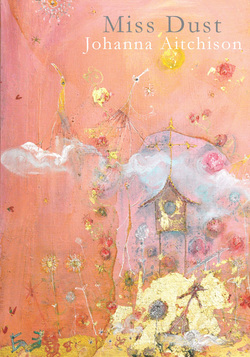
Johanna Aitchsion
Johanna Aitchison is a doctoral student at Massey University, Palmerston North, examining anagrams and erasures in hybrid poetry. Her most recent volume of poems, Miss Dust (Seraph Press, 2015), was described by reviewer Sarah Quigley as “Emily Dickinson for the 21st century”. Her poetry has appeared in anthologies such as Best New Zealand Poems 2008 and 2009, and Best of Best New Zealand Poems (2011). She was a 2015 resident at the International Writing Program at the University of Iowa and the 2012 Visiting Artist at Massey University.