
I dream of you in a white tuxedo. It is a wedding. It is not our wedding.
But the face that you affix to yourself when you look into me is the face
of the man viewing the woman. Hello this is love. Your square jaw. Your
soft, capable, all knowing mouth. Hello even your bluest and greenest
eyes. Everyone is wearing white. I look down at myself and I am lace over
pearlescent white water wings and I am shaking with adrenaline. We walk
holding hands and you’re a helium balloon I tug to earth with my
unexpected weight. Your hands slip over me. You in a white fitted shirt
with your head thrown back. We lie in bed together wrapped tightly in disbelief.
Some of our best moments were sleeping. Some of our best
moments were only in our eyes. You tilt your head to turn to me and the
whole world follows behind you.
Emma Barnes
The poem was originally published in the journal, Sweet Mammalian 3
Note from Tate Fountain:
I rarely pass specific poems on to friends, despite the amount I read and my general penchant for sharing. ‘White Tuxedo’, however, was immediately dispatched to the other side of the globe: this is a very good poem, I told my best friend, the link attached in a Twitter DM. And it is, of course, precisely that. A very good poem. A bittersweet one, which accomplishes so much in something so seemingly simple.
‘White Tuxedo’ balances the delightful with the devastating, and both elements are augmented for the presence of the other. There is an ease to Barnes’ language, unadorned yet undoubtedly calculated, which lends both to fine poignancy—‘Your/ soft, capable, all knowing mouth’—and to forward propulsion—‘lace over/ pearlescent white water wings […]’. The fourth ‘sentence’, if you will—‘But the face that you affix to yourself when you look at me is the face/ of the man viewing the woman’—pierces. It verbalises a distinct discomfort, and the inescapable air of objectification, that I’ve so often found in ‘heterosexual’ experiences. (This is perhaps furthered by the wedding in the poem, and how pointedly it is not that of the narrator and the subject.) Of course, this line might just as well signal romance to someone else (‘Hello this is love’): perhaps an ode to the archetypes of affection by which they have seen themselves represented. This may be the loving look of literature, of cinema, of song—which is a valid interpretation, and a testament to the multitudes Barnes’ phrasing can contain (though it may also be the kind of feminine subjecthood that Barnes, in penning this particular poem, has explicitly reversed).
What I love most about ‘White Tuxedo’, though, is entrenched in each and every phrase: say it with me, gang—the intimacy of it all. This intimacy is a condition that I’m always looking for in poetry; in art, in life. The knowing of somebody, and an existence shared with them, that cannot be erased by the conclusion of it. The enormity of that understanding; making macro of the minute. Really, I have always had to share this poem just for its final statement, in which Barnes handles the depth of these ideas with sparing, rapturous clarity: ‘You tilt your head to turn to me and the/ whole world follows behind you.’ It’s delicious. It’s immediate, and it’s immense. It says everything it needs to. It’s very, very good.
Tate Fountain is an Auckland-based writer, actor, and academic, whose recent work can be found in Starling, Perception, Gold Hand and MIM. In 2018, she self-published the chapbook Letters, which found readers around the world, and she has just begun a literary newsletter, which she hopes might be read by five people.
Emma Barnes lives and writes Te Whanganui-ā-Tara. She’s working on an anthology of Takatāpui and LGBTQIA+ writing with co-conspirator Chris Tse. It’s to be published by AUP in 2021. In her spare time she lifts heavy things up and puts them back down again.
Allies: A Checklist
Allies: A Checklist Revisited
Ally: Definition
A country that has agreed officially to give help and support to another one, especially during a war:
If Patriarchy is the Country, Women are at war.
If Women is the Country, Patriarchy is the war.
Ally: Definition
Someone who helps and supports someone else.
Doesn’t takeover. Doesn’t redefine. Doesn’t reinterpret. Doesn’t tell you about you. Doesn’t tell you how you can do you better. Doesn’t make it about them. Just doesn’t.
Ally: Definition
Someone who helps and supports someone else by – helping and supporting, someone else.
Maraea Rakuraku
Musician and actor Moana Ete read this heart-stunning poem at the Wild Honey National Poetry event at Wellington’s Unity Books and you could hear a pin drop the silence was so deep.
Tonight I am celebrating Wild Honey in Palmerston North, and tomorrow I am heading from the airport to RNZ to talk favourite books, music, poetry and movies with Jessie Mulligan on the Bookmarks spot. It feels like this intensely wonderful time I have had drawing my new book into the world is moving into a different phase. I can retreat into my quiet life and do secret things for a while. Time to recharge the empty fuel tank.
It is utterly fitting to post Maraea’s poem that muses on the word ‘ally’. The past weeks have been a time of poetry friendship, of warmth, empathy and connections. I am so grateful to everyone who has attended and participated in the Wild Honey events.
And I am so moved by Maraea’s poem – it makes my heart sing.
‘Sister, the light is enough for us all. Come. Here. Join me. Join us.’
Maraea Rakuraku is an award-winning playwright, poet, short story writer, critic, reviewer and broadcaster who lives in Wellington and the Bay of Plenty. She creates work that investigates, examines, calls out and celebrates Te Ao Māori and our navigation of 21st century Aotearoa New Zealand.
Her thoughtful, fierce intellectualism, and grounding in her Tūhoe and Ngāti Kahungunu identity, is matched only by her heart and commitment to giving voice.
With Vana Manasiadis, Maraea is the co-editor of and contributor to Tātai Whetū: Seven Māori Poets in Translation (Seraph Press, 2018). In 2018 she started a PhD in Creative Writing at the International Institute of Modern Letters, Wellington.
Wednesday
It used to be on your forehead.
a blackened smudge
filtering through punctured skin,
entering the blood stream
until your cuts and scrapes became
Communion for forgotten sins
and you dripped the sermons
delivered in the precipices
of your childhood.
Give us today our daily bread
Forgive us our gluten intolerance
Like a bartender
who only serves
true crime podcast theories
or a stamp collector
who collects other stamp collectors,
habits reimagined
still ask you to bear the same weight.
Deliver us from temptation
Like a reverse Uber Eats
The smudge is still there,
bystanders can’t see it
nesting, in the coil of your
skull, calcified, waiting
to be exhumed and finally
rest behind glass or
stay dormant in the cave
surrendering to the moss,
never to be resurrected.
Jordan Hamel
Jordan Hamel is a Pōneke-based poet and performer. He was raised in Timaru on a diet of Catholicism and masculine emotional repression. He is the current New Zealand Poetry Slam champion and has words published or forthcoming in Takahē, Poetry NZ, Mimicry, Sweet Mammalian, Glass Poetry, Queen Mob’s Teahouse and elsewhere.

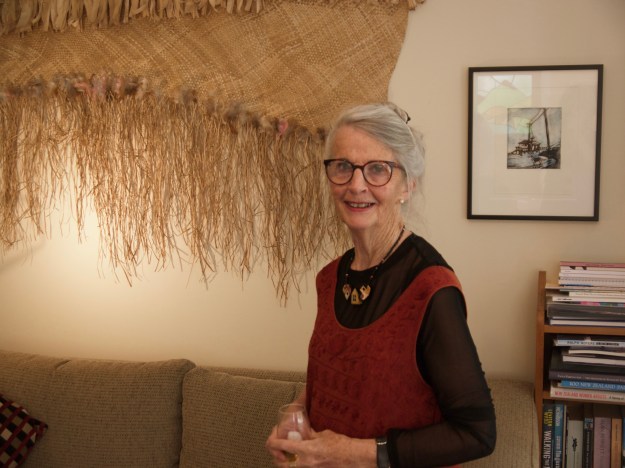
On Friday 6th September I was in Dunedin to celebrate Wild Honey with local poets. The occasion was moving in its connections and warmth, but made even more so by the sadness many felt at the death of much loved Dunedin poet, Elizabeth Brooke-Carr that afternoon.
Elizabeth Brooke-Carr was a poet and writer. She taught English in secondary schools for twenty years and has tutored creative writing evening classes. Her work includes The Soldier and the Poet, a collaborative piece with Clair Beynon. Her poems, and her short story ‘Jimmy the Needle’, have been published in the Otago Daily Times. Her articles on social justice and environmental issues have appeared on the web, in Touchstone, the National Methodist Newspaper, as an exemplar in NZ Secondary Schools Scholarship Examination, and in Connections a collection by Philip Garside Publishing. Her 2005 essay won the open section in the Dunedin City Council’s competition about the built environment. She was awarded an NZSA mentorship in 2007, and in 2009 was winner of the NZSA 75th anniversary National Competition. Elizabeth was the inaugural writer-in-residence, Down the Bay, at the Caselberg Trust cottage in 2010.
I have invited some Dunedin poets to pay tribute to Elizabeth. Jenny Powell shares the poem of Elizabeth’s that she read at the Wild Honey event. I have also included the introduction to the new 8 Poems plus one which became a wee letter-press-printed anthology of 9 poems in order to publish Elizabeth’s this year rather than next. The anthology was released in time for her to see it and depended upon an act of kindness from Riemke Ensing. Thanks to The Pear Tree Press I have also included Elizabeth’s poem.
Elizabeth’s page at Otago Writers network
Jenny Powell:
I chose Elizabeth’s poem to read partly because it’s about a Clydesdale horse and partly because there are a series of coincidences attached to the poem.
Kay McKenzie Cooke and I, otherwise known as touring poets J & K Rolling, posed with Clydesdales for the photo we use on our posters. Elizabeth loved the photo. It reminded her of childhood days, and so she went on to write her poem.
J & K Rolling have a shared trait of getting lost. It’s not a great quality when you’re on tour. Last year, inland from Owaka, we were driving down a country road looking for the farmhouse where we were staying the night. After a while we came to an old dairy factory and Kay decided we weren’t on the right road, so we turned around and drove back. Coincidentally, directly across the road from the dairy factory was the setting for Elizabeth’s poem. It was the site of the farm where she lived as a child.
But I wasn’t prepared for the final coincidence.
Elizabeth died this afternoon.
Nobby and Joseph
He hauled the bulky leather collar from a peg
at the back of the high walled barn,
heaved it up in a crane-swing arc
to fasten around Nobby’s burnished shoulders,
a soft word or two blurted into his neck
with awkward country affection,
a rub of his jaw, a nudge, and down to the garden
they trudged, Joseph close behind
the old Clydesdale, silky leg feathers
flaring wide in a lumbering dance, through the gate
harnessed to a single-furrow plough
nosed firm into the earth.
Joseph held the reins lightly, the hand grips hard
turned the sod slice by slice,
like strips of blubber flensed from
the sides of a dark-fleshed whale, rolling them
over onto the back of the last neat row
until the whole field was an ocean
of green fringed waves. His turf is kept by another
now, who sits astride a ride-on mower,
smoke wafting, incense-blue,
from the exhaust-pipe thurible, rumbling deepthroated
down swathes of sombre lawn
flanked by granite headstones,
one, with Joseph’s name and a few shy words
of love, tethered in gold letters,
blinks in the sinking sun.
Elizabeth Brooke-Carr
Dunedin, New Zealand
Sue Wootton
I selected several of Elizabeth’s poems for the ODT when I was editing the poetry column, and also had the privilege of publishing a couple of pieces by her, recently, for Corpus. “All hitched up” is about receiving her first dose of chemotherapy and contains her poem “The Vein Whisperer”.

With kind permission from The Pear Tree Press, here is the ‘Introduction’ and Elizabeth’s poem; from 8 Poems plus 1 by New Zealand Poets 2019,designed by Tara McLeod (Auckland: The Pear Tree Press, 2019):
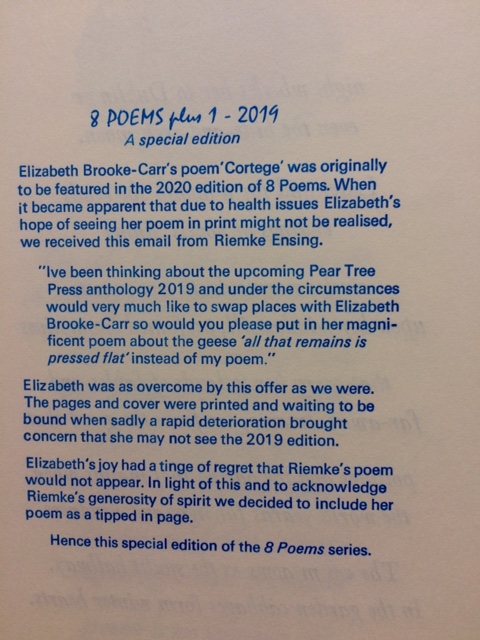
‘All that remains is pressed flat’ Elizabeth Brooke-Carr, 8 Poems plus 1:

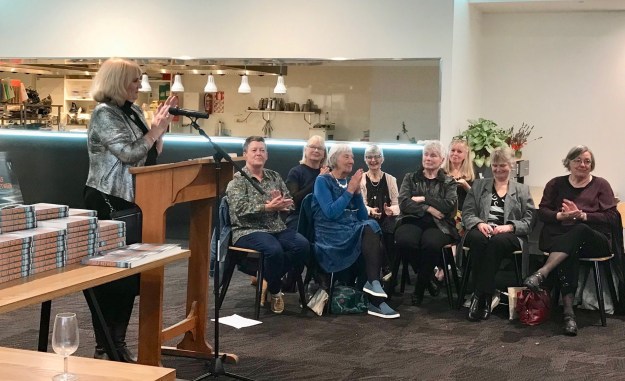
Claire Beynon shares one of Elizabeth’s poems that recently came to light after quite a search. ‘I took it to our writing meeting yesterday and read it out to the group – it’s a poem that Paddy Richardson especially loved. She said it had stayed with her long after first being published in the ODT’s Monday Poem series (several years ago, when Diane Brown was editor).’
When bright red was eclipsed by silver shoon
You see your teacher perched on a spare desk
at the front of the classroom. A dusty blackboard
behind, frames her there, skirt tucked tight around
her calves. She stares across the top of your head,
draws a long, deep breath, Silver, she says, pausing
to open the book on her lap. She begins to read.
You are captivated by her bright red lipstick,
it goes right to the corners of her mouth.
You hear your mother say scarlet is for show-offs
and only clowns take lipstick out to the corners.
Your teacher knows none of this.
She is enchanted by Silver. Her lips, full and lucent,
send tiny stars wheeling off into the round,
as she aspirates each soft, silvered sound.
You forget bright red and what your mother said.
Everything is silver.
Your teacher is swaying a little, peering this way
and that as she reads. You know she’s walking
with the moon, and soon you catch up.
You’ve never heard of shoon, or casements,
but now you see them, glistening. You reach out,
touch silver fruit on silver trees, step around
the sleeping dog, look up to doves. Startle
when a mouse darts by. You’re moveless near the
edge of a silver stream when you become aware
your teacher has stopped reading. She has
closed the book, a far-away look in her eyes.
Ah, girls, she sighs, Walter de la Mare!
She speaks his name in a spangle of stars,
clasps him close to her chest as she swoons
and steps down to the floor. You’re still thinking
of the moon, leaving the sky to come and walk
with you at bright red noon, slowly, silently
to the end of your days, in her silver shoon.
Elizabeth Brooke-Carr
From Jane Woodham:
Listen to Elizabeth read an extract from her novel Greywacke
All that remains is pressed flat,
a strip of bare earth up on the hillside
and, between the leaves of a book
she was reading that morning, four stiff stalks
bearing sunrise petals. A softly coiled feather
brats the air when she turns the page.
from ‘All that remains is pressed flat’, 8 Poems plus 1

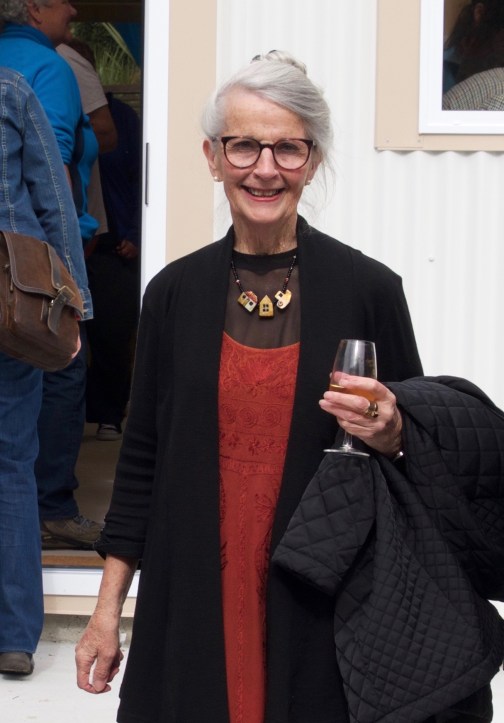
(Image of Carolyn DeCarlo by Tabitha Arthur)
Launched in 1999, AUP New Poets first introduced readers to Anna Jackson, Sonja Yelich, Janis Freegard, Chris Tse and many other significant New Zealand voices. Relaunching this year under the editorship of Anna Jackson and with a bold new look, AUP New Poets 5 includes substantial selections from the poetry of Carolyn DeCarlo, Sophie van Waardenberg and Rebecca Hawkes.
Go here to listen
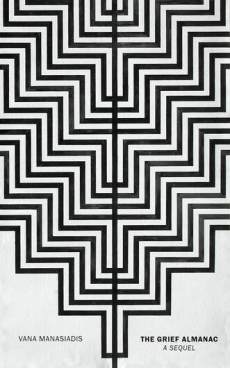
Vana Mansiadis reads ‘Hieroglyph 3 (or Colin McCahon’s Gate III in 1993)’
Published in The Grief Almanac: A Sequel Seraph Press, 2019
Seraph Press author page
Note from Wen-Juenn Lee:
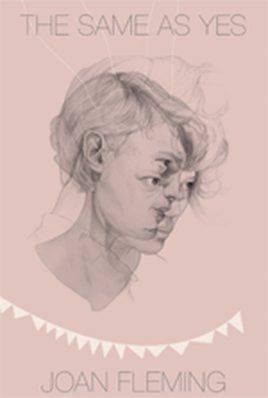
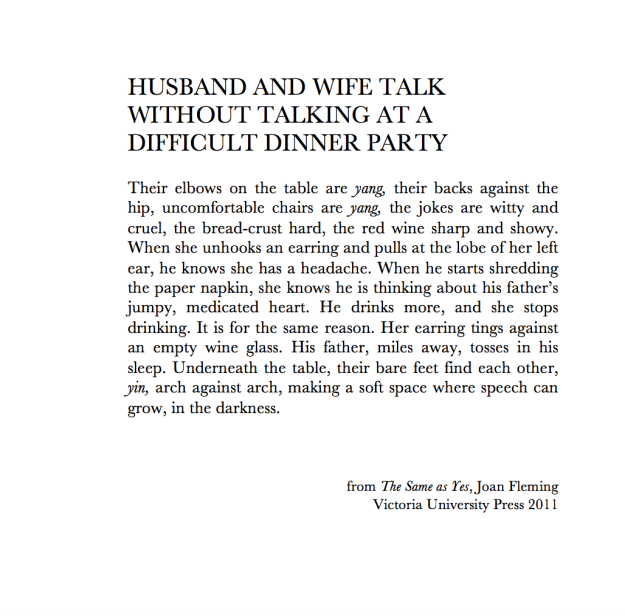
I first read Joan Fleming’s ‘Husband and Wife Talk Without Talking At A Difficult Dinner Party’ at university, when something about the simple domesticity yet the ‘intolerable solitude’ of love (‘Translations VI’, Failed Love Poems) struck me – at a time when I was just beginning to read tragic, suburban love stories by Raymond Carver. (I liked the line, ‘He drinks more and she stops drinking. It is for the same reason’ and I did not know why, until later I realised that it reminded me of the wife in ‘The Student’s Wife’, who wakes up in the middle of the night and calls her husband’s name, but he does not answer.)
Love is different in ‘Husband and Wife Talk Without Talking At A Difficult Dinner Party’, different because it is not marked by suffocating drabness, but sleepy attentiveness, knowing the patterns of someone else with the instinctiveness you know it’s going to rain when storm clouds appear. (Simone Weil: ‘Attentiveness is the rarest form of generosity.’) It is with this attentiveness that the poem breathes: there is the hard brittleness of a wine glass, the clattering of forks, underpinned by the softness of silent communion. A couple sits, one drinks and one doesn’t, and they suffer quietly, and maybe they’ll leave and go to bed, alone with their griefs and little traumas. Maybe they will talk without saying anything important at all.
Here, we have the external actions of people, yang, and the inarticulate feelings they have, yin. This heartbeat of yin and yang underpins the very heartbeat of the poem. Yang, the boundaries in self between you and me, yang, the face I present to the wider world: of husband shredding his napkin, of wife touching her earlobes. In this, I am reminded of my parents who interact with the formality of Chinese tradition. My parents do not say, ‘I love you’, but ask ‘have you eaten?’ Yet. They know I talk loudly when I’m tired and they know when I’m irritated and trying to disguise it with forced cheer; they would just never tell me they know. To the outsider, someone walking past the window, a plus one at the party, anyone that isn’t the husband or wife, maybe they would notice the shredded napkin, the unnecessary earlobe-touching, but they can only guess; they can observe but never decode. This is a poem of extended people-watching, in the sense that we too, are outsiders with the privilege of understanding a couple’s private state, if only fleetingly.
When we are lucky enough to know people that know us intimately, that know us well, they will know the difference between your laugh and your forced laugh, and this is where the duality of yin and yang can occur. Husband and wife are having a conversation without using their words at all. She says, I have a headache. He says, I’m worried about my father. The dinner party is Difficult because maintaining your yang is Difficult in the face of your worries, because expressing your yin is near impossible. I found the last line in the poem so devastating, not because it ends with silence, but something of the frail and incomplete yin, ‘a soft space where speech can grow’. This tender, fragile possibility of communion (in whatever form that takes) is part of the larger love letter I see in Joan Fleming’s The Same As Yes. It struck me then, as it strikes me now, how ordinary intimacy and its limits can feel to me more concrete, more sorts of tragic, than anything else.
Wen-Juenn Lee works in Melbourne, and writes when she can. She writes about Wellington, her family, and her feelings. Her work has appeared in Landfall, Southerly, and other publications.
Joan Fleming is the author of two collections of poetry, The Same as Yes and Failed Love Poems, both from Victoria University Press, and the chapbook Two Dreams in Which Things Are Taken (Duets). Her new collection Dirt is forthcoming with Cordite Books. She holds a PhD in ethnopoetics from Monash University, Melbourne, and is the New Zealand/Aotearoa Commissioning Editor for Cordite Poetry Review. She currently lives in Madrid, and in 2020 she will travel to Honduras for the Our Little Roses Poetry Teaching Fellowship.
Victoria University Press author page