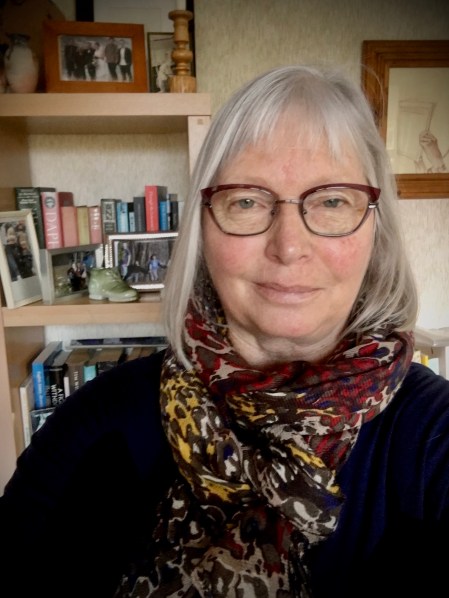
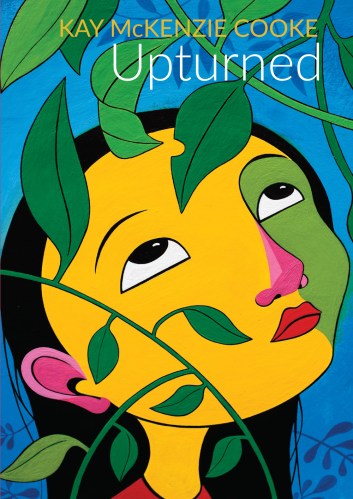
Kay McKenzie Cooke, Ngāti Tahu, Pākehā, is an award winning poet and short story writer. Her debut collection Feeding the Dogs was awarded the 2003 Jessie Mackay Best First Book Award for Poetry at the Montana NZ Book Awards. She lives in Dunedin, and spends part of her year in Berlin. Kay’s new collection with The Cuba Press Upturned is an evocative tribute to family, place, childhood, nature. The poems address attachment and kinship, love and grief. Some poems are southern based while others navigate Berlin. The poetry is a celebration of life and that celebration is of great reading comfort.
Paula What were the first poetry books that mattered to you?
Kay The first poet that comes to mind is Dylan Thomas. I have this idyllic memory of me at thirteen years old sitting under a silver birch tree reading his poetry. It was on a particularly sunny day at Wendon Primary School in Northern Southland. This may well be a false memory! But the delicious revelation, surprise and impact of Thomas’s particular brand of poetry, is not.
Enid Blyton was an early influence (typical 1950’s-60’s child I guess.) I also loved Walter de la Mere and I remember a book of poems by Christina Rossetti featuring in my childhood. And A.A. Milne.
Dare I confess that Rod McKuen was a poet I adored for a (very) short time in the early ‘70’s?
Paula What poetry books are catching your attention now?
Kay Another Confession: Lately I have been so buried in my own poetry I haven’t been able to really take a look at what else is out there. There is such a rich seam of recent poetry to be mined. I would not know where to start. I have a lot (a lot!) of books and poets to catch up on. Both from new poets and from established favourites. And that’s just in Aotearoa.
Wild Honey is one I’ve been enjoying as a treasure to dip into. And the latest Landfall (239) as well.
Oh. Does Joni Mitchell’s beautiful book, Morning Glory on the Vine, count? That’s the book I got for my birthday recently and which I’m also dipping into at present.
Paula What else do you like to read?
Kay Autobiographies, biographies, modern novels, murder mysteries, non-fiction books about nature. Historical books. The classics.
Paula Any standout poetry events you have attended either as an audience member or as a participant? Do you enjoy performing your work?
Kay Jenny Powell and I have formed a poetry reading duo called J&K Rolling. We take poetry out into southern rural areas and discover what poetry is to be found in these places.
After five years of us travelling to many varied rural areas, I have a heap of memories of poetry readings performed in halls, art galleries, libraries, show grounds and even a restored, historical bake house. I enjoy performing poetry in such venues and at these low-key events with a small, attentive audience. It’s deeply satisfying.
The Bluff ‘06 organised by nzepc is a standout. Twenty-two poets from all over Aotearoa took part in poetry readings in Motupōhue / Bluff and in Rakiura / Stewart Island.
Reading in Paris at the Chat Noir in 2013 is a poetry reading I will always remember and treasure.
Another more recent reading organised by Jim Gedddes at the beginning of this year with David Eggleton, Cilla McQueen, Richard Reeve, Jenny Powell and myself reading in the Eastern Southland Gallery, is another memorable occasion.
Again – too many to list here. They’re all wonderful events. I feel privileged to have taken part in so many.
One day, back when
everything was only as big
as the span of my forthright steps,
the world shattered into hailstones.
from ‘Hail’
Paula Your new collection Upturned is assured, pitch perfect on the line, multilayered yet runs with sweet economy. What matters to you when you write a poem?
Kay Thank you!
I guess where and how the line ends is important to me. I like each line to chime. Also how a poem begins and ends matters to me. I guess that it does for all poets.
I favour shorter poems. I used to write haiku. Maybe this is where my love of the succinct and economical comes from. Redundancy is something I try to avoid. I like to write tight poems, but not corset-tight.
Paula In the poetry of others?
Kay For me, poetry needs to have music that I can pick up as a tune. A consonance. And I do like poems to, in some way, tell a story.
I like poems that surprise me, with unexpected imagery. Poems that take me somewhere; that go somewhere.
It’s important, personally speaking, that they make sense even if that’s not on the first reading. There needs to be some point at which the real poem emerges from any ‘camouflage.’ This revelation always feels like a special treat.
Some poems I’ve read recently are tending to the lengthy, the clever, startling, oft-times irreverent and angry or edgy and crude. They’re sometimes surreal streams of consciousness with lines that dance, burst, curse, swirl, meander, fly, divert and segue. Sometimes these scattered lines are safely tethered to a subject – sometimes dangerously free-falling. I’m left startled. Is it good? It’s different. To use an old-fashioned term, even rather fetching. Taking off in new directions. Poetry as performance. Poetry using 21st century vernacular. I can’t keep up. Then again, I don’t need to. It’s all good. All is well.
The cotton dress Mum made for me, purple daisies
on black, with puff sleeves, was not the ballgown I longed for
in real satin, electric-blue. And my hair. Too high. Too
stiff. Set with hairspray.
My partner, Maurice, with no idea how to dance,
was not the partner I preferred.
from “Many moons ago, Maurice’
Paula I kept musing on the idea of poet as gardener, memoirist, musician, traveller, daydreamer, archivist as I read. What were you as you wrote this collection?
Kay I think you may have covered it, Paula.
I guess I was me being all of those at different times … plus chronicler. I like the word chronicler with its connotations of recording time.
I am aware that my poetry falls into poems about memory, place, childhood, whanau, tīpuna / ancestors, grief, daily life, ageing …
I think I am most pleased at your idea of ‘musician’. It’s a nice thought to think of my poetry as a kind of music.
I visit her iron-fenced bones
as the sea thumps
below the cliffs of the cemetery,
and I name her: Mary Frances Reilly,
my great-great-grandmother,
and use whatever is left of her
in me
to picture first the girl,
then the woman.
from ‘Name her’
Paula Poetry as keepsake? Family is so important in these poems.
Kay Keepsake is another word I like. It makes me think of a locket. Something treasured and kept safe; kept close.
When one experiences, as I have, the sudden death of a parent at a young age, keeping hold of memories becomes a way of surviving that brutal shock. It’s a way of holding on to a life that has seemingly (or literally) instantly disappeared into some unattainable, unreachable void.
To think someone leaves this world without any trace or memory of their place in it, is an unacceptable thought for me. I just can’t abide the thought of ‘no trace’. Of time itself sweeping away all aspects of a life or valued experiences. And so in my poetry I record. I chronicle. I keep.
I’d sat and read a whole book.
Time-wise we are all losers,
fooled back into memory.
Back then, eating a blackberry’s beaded cushion,
my tongue, my teeth, boring down
to its core,
its tiny wooden heart.
from ‘Blackberry days’
Paula I love the structure of the book. Can you tell me about that?
Kay The poems are divided into four sections. The ones about Berlin were of course easy to place into the one section. However, in order to prevent having too many nature, landscape or place poems together; or bunching-up childhood memories, grief poems, or family poems; it seemed pertinent to switch and mix them around a little. To a certain extent, chronological aspects also had to be taken into account – poems from before and after the Berlin experience for example.
The team at The Cuba Press (especially Mary McCallum) helped me with the structure. The result is pleasing. I like how the different poems speak to each other and how one poem often leads naturally on to the next – sometimes just by the natural extension of an image, key word, idea or impression.
Sing old kettle of slung light
that spins on through
this backyard
that could be the last kitchen
or the first. Old kettle, singing kettle,
let the heat of the days rock you.
from ‘Sing,sing, sing’
Paula Reading your poetry is a sensory experience. Do you have motifs you are particularly fond of?
Kay Yes! I do. And I have to watch that I don’t over-use these favourite motifs.
Mary helped me with that as well. She asked if I realised how many times I use the motifs of air, sun, sky, water … and I also realised that I needed to take out a few too many stones, grasses …
I am perhaps a little too fond of nature’s motifs. Birds are a motif for me as well. They, along with deer and horses, are members of my spirit-animal world.
For days now
the unpegged washing of snow
has lain in the mud of Dunedin’s hills
where a giant hawk of cloud
lifts off, its talons
Mount Cargill, a sag of grey.
from ‘Nor’esterly’
Paula I am reminded of Ruth Dallas’s attachment to the land in her poems, she made herself at home in her beloved south as she looked through an urban window. I have seen it in Sue Wootton’s poetry too. How does the land matter? Do you have go-to places?
Kay As a child brought up in the country way down in the same beloved south, I believe the spirit of that southern rural landscape is in my blood and firmly rooted in my innermost being. As deep as it can go. Even living happily as a city dweller for nearly fifty years has not diminished this relationship I have with this land; this integral part of my being.
Despite its buried streams running underground, Otepoti / Dunedin (as I believe is the case with all cities in Aotearoa) has never lost its relationship with the land. A strong identification with nature is part of its character as a city.
Being tangata whenua has its influence on my relationship with the land too – especially with Murihiku. Nothing needs to be conjured. It’s just there. Even on those days where I don’t leave my house – or even my writing room – my relationship with the land is still a beating heart.
Of course, actually going to places is a helpful and enjoyable top-up of the actual. There is nothing to match looking at a mountain close up, or smelling the seaweed smell of a favourite beach or hearing a mean sou’westerly whining in power lines.
I am eating the language of the ocean
on this last day of summer, Sommer,
eating the language
my granddaughter speaks.
She does not care
what they are, foxes of squirrels, Fuchs or Eichhörnchen –
it is simply her favourite dress
for now anyway, as she eats potato cake
with apple sauce and hardly ever looks at me
drinking her in with my eyes.
from “Foxes or squirrels’
Paula Home is so important but so too is the wider world in your writing. What changes when you write about or from elsewhere?
Kay When I am somewhere unfamiliar, it can manifest as dislocation. This is reflected most in the poems about Berlin which I wrote during and after lone trips there to stay with my son, his wife and their two small children.
While there, I felt something that was akin to homesickness. Keeping a journal helped to chronicle what was happening, both internally and externally. Then once I was back home again, the material in the journal with all its ramblings, jottings and sketches, was what I drew from for the Berlin poems. The many photos I’d taken also triggered poems and helped me to remember cityscapes, trees, pavements, people, sensations and emotions.
Paula The Cuba Press has published Upturned along with two others written by poets at an older age (Rachel McAlpine’s How to Be Old and John Tāne Christeller’s Fragments from an Infinite Catalogue). What has changed for you as a poet across the decades (if anything?)? How does age change things?
Kay As a young child I wrote poems about fairies. As an adolescent and young adult, about coffee and rain. As a young woman, descriptive pieces about what I could see in front of me – some of which were written as haiku.
Then in my late thirties, I started to study poetry, reading nothing but poetry for ten years.
Writing-wise, this stage was excruciating. I remember often being brought to tears because I couldn’t properly put down on paper what was in my head. Then one day – or so it seems – I hit my stride. I found my voice and I was away.
Age-ing is certainly a weird experience. Some part of me thinks it’s all backwards. The older we grow, the younger we feel. We don’t look the age we feel inside. I can’t explain. Maybe it’s time to write some poems about it.
I remember when I was young, I loved reading personal accounts about what it was like to reach the age of eighty. This gives me hope that there may be a younger audience interested in reading about what it’s like to be old.
I am sometimes tempted to feel out of step with younger writers. Doubt threatens to creep in, until I remind myself that everyone is relevant. One of the features that make the regular Dunedin poetry readings so valuable, is the lively cross section of ages and stages of those that attend and read. All are accepted. All are represented. No-one is made to feel redundant or irrelevant, no matter the age.
Paula Were there poems you found hard to write? In terms of doubt or of subject matter – you do face grief and loss, along with joy?
Kay They are not hard poems to write, the ones about grief and loss. They seem to emerge from a place in me that is never empty. Rather than being hard to write, it’s almost like it’s hard to stop writing about these subjects. Poetry heals. And as long as we have stuff to heal from, poetry is there to help with that. Of course it needs to be achieved without maudlin or sentimental cliches. Isn’t there a saying about when describing a funeral, you don’t describe the tears mourners are weeping, but instead you describe the flowers on the casket? Something like that.
Daughter
My daughter told me about how Ace got run over.
She said that all along she knew it wasn’t a good idea
to let the dog run along beside the car,
but that Kris told her he’d seen his mates do it
and it’d be okay. ‘He should’ve listened to me,’ my daughter said,
‘but he’s too “she’ll be right”. Always with the “she’ll be right”.
Said I’m just being paranoid.’
Then, of course, what she thought would happen
happened: the dog’s leg slipped under the car’s wheel.
She asked me to help her take him to the vet
and carried him to the car like a baby.
‘A twenty-kilo baby at that,’ she said,
‘equivalent to twenty bottles of milk.’
The dog sat in the back seat
with a tartan rug draped over his head
like a Highland shawl, underneath, his face
all screwed up like an old person
trying to remember something.
In the waiting room, my granddaughter and I
decided that from underneath, the turtle in the tank
looked like a grenade with legs,
its cake-rack-patterned
tummy the shade of milky custard,
its head a thumb. The vet’s X-ray showed
that Ace’s injury was just a sprain.
Afterwards we had a cup of coffee at Rhubarb.
‘What’s more,’ my daughter said, referring back,
‘he hasn’t said sorry nearly hard enough.’
On the way home, from the top of Roslyn,
the sea is distant, kidney-shaped,
and my daughter said, ‘Don’t you just hate it
with the sky all white like it is today and no sun?
We may as well all be locked inside
a chilly bin.’ And I think: Daughter, it has to be
one of the most beautiful words.
Kay McKenzie Cooke
Paula Is there a poem that has particularly worked or mattered to you?
Kay The poem about my daughter. She is extra-precious to me because she was adopted out as a baby and we reconnected – or found each other – twenty-three years ago now. (I write more about this in my third book, Born to a Red Headed Woman.)
The poem, called ‘Daughter’, is a slice of life that highlights for me the relationship my daughter and I now have. A relationship I treasure at a very deep level.
Paula Has Covid 19 affected you as either reader or writer? Did you write any poems in lockdown?
Kay I wrote about four poems – mostly about birds. Birds became highlighted for me during that time of lockdown. Possibly because they were symbolic of a freedom to fly or rise above all the fuss, worry and fear.
I thought I’d write screeds. But I was too busy editing Upturned with Mary to write new stuff. Too busy to even take notes from which to write poems from later.
Whatever I write about this strange time may not even be in the form of poetry. We’ll see after I’ve processed it all.
Paula What do you like to do apart from writing?
Kay Watch Netflix and listen to true crime podcasts.
I like to walk and take photos. Spend time with whanau. Go on roadies south.
Watch birds. Pick up stones and shells. I like reading – can’t wait to fully start reading again, to catch up on new poets and read new books from established poets. And add to my murder mystery reading. I’ve spent a whole year just on writing. It’s time to read. It’ll be my summer project.
Paula If you could curate a festival poetry reading, drawing upon any time or place who would you invite?
Kay I would invite: John Keats. Dylan Thomas. Gerald Manly Hopkins. Marianne Moore. Diane Wakoski. John Dolan. Wendy Cope. Fleur Adcock. Cilla McQueen. Ruth Dallas. Talia Marshall. Jeanne Bernhardt. Nick Ascroft. Richard Reeve. David Eggleton. Jenny Powell. Tony Beyer. Matsuo Basho.
The Cuba Press page
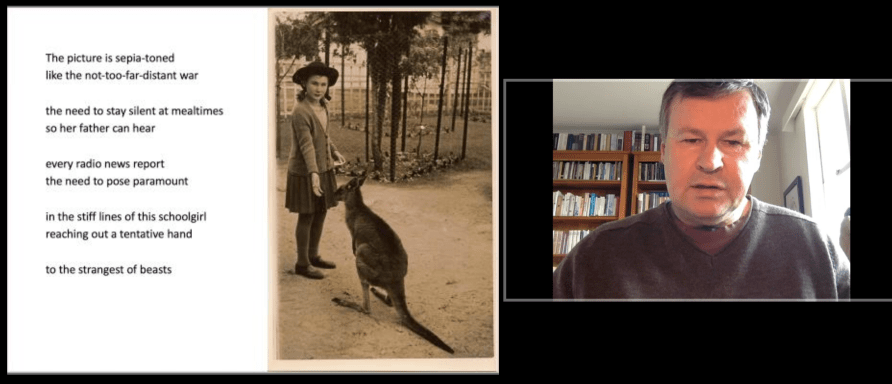
Kay reads and responds to a poem


 NZ Poetry Shelf