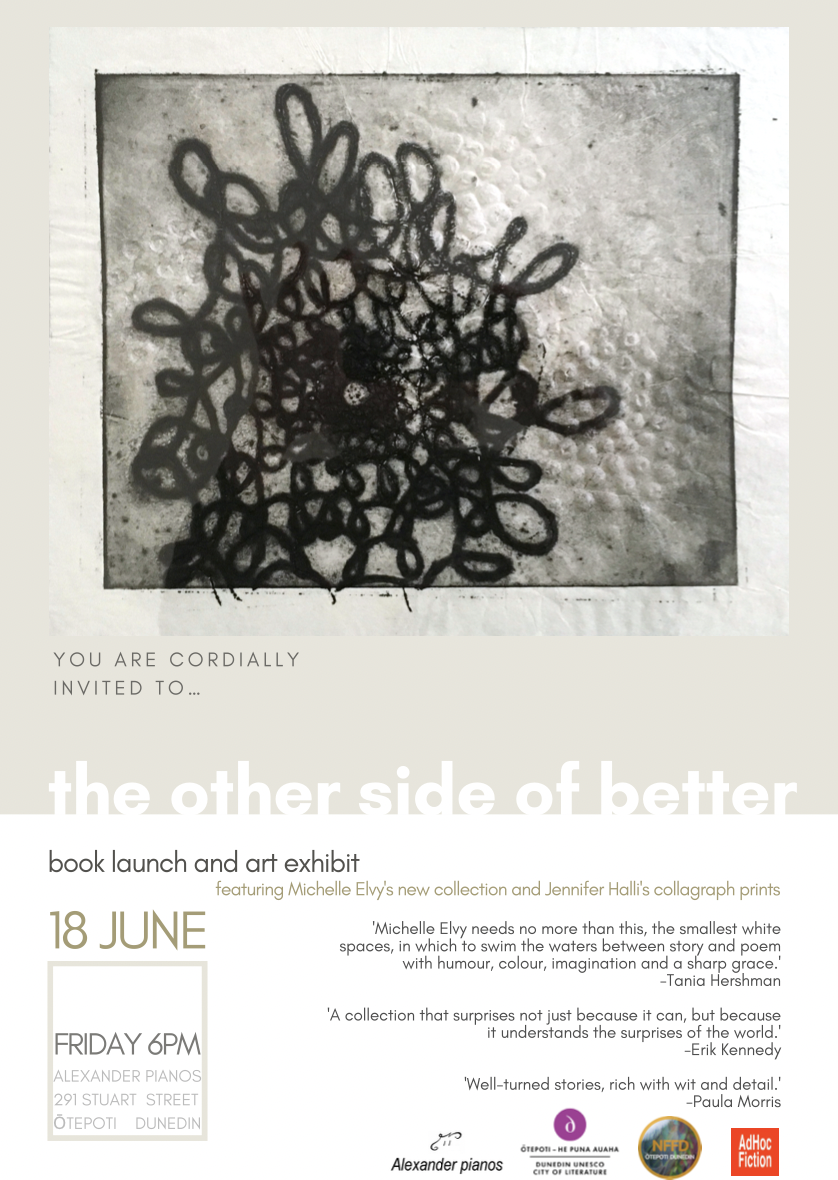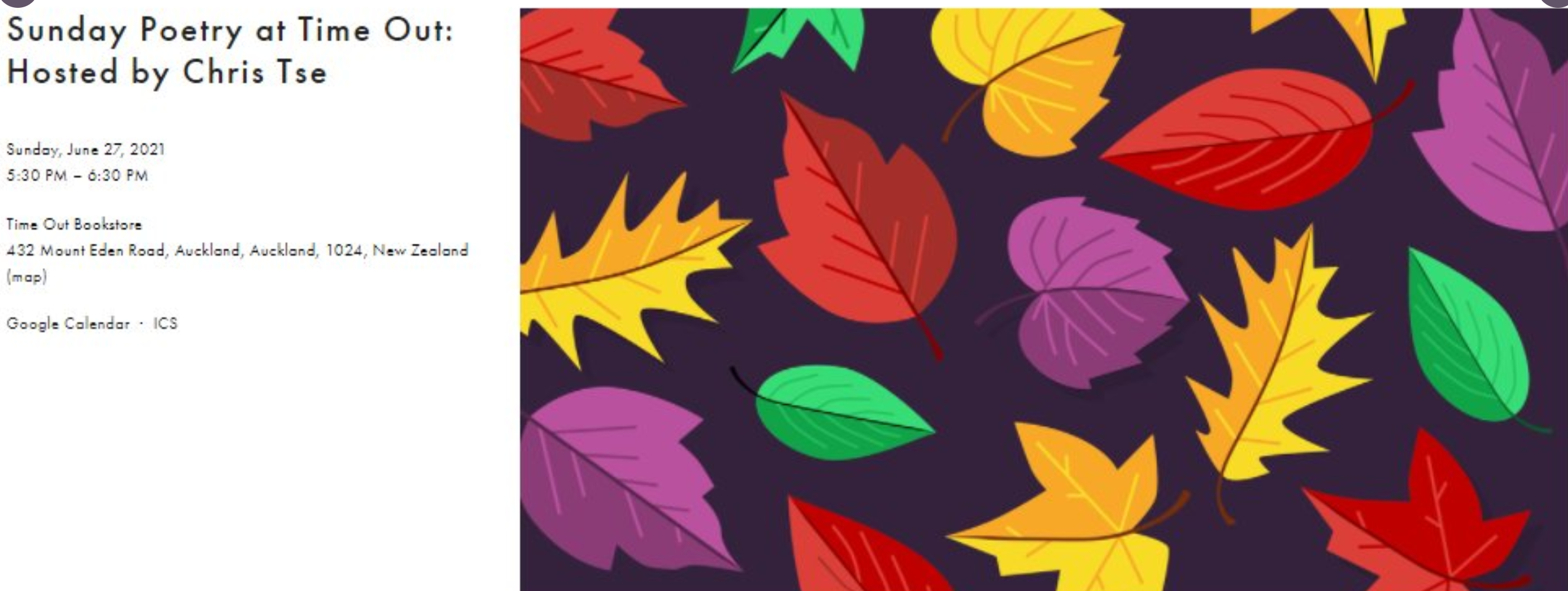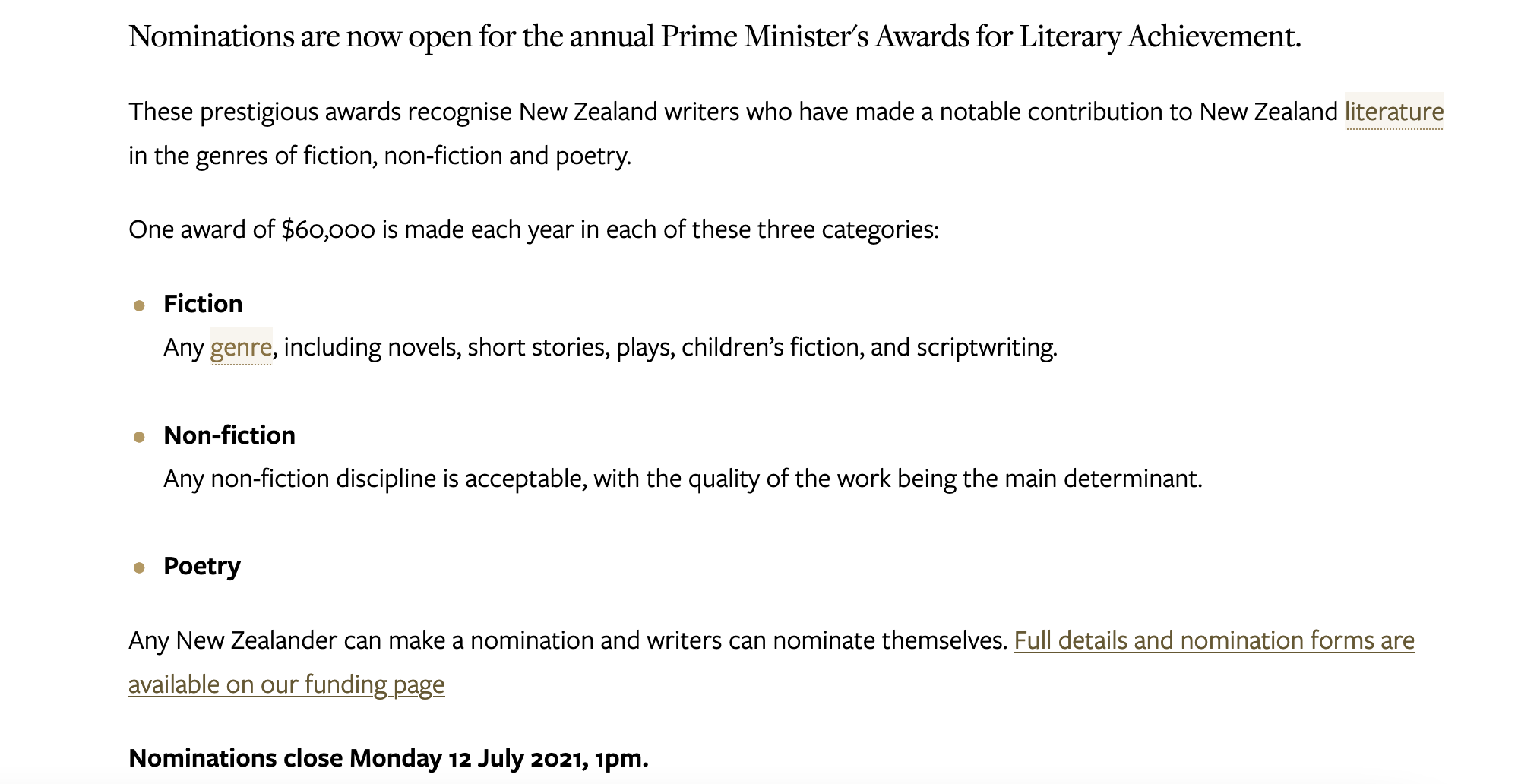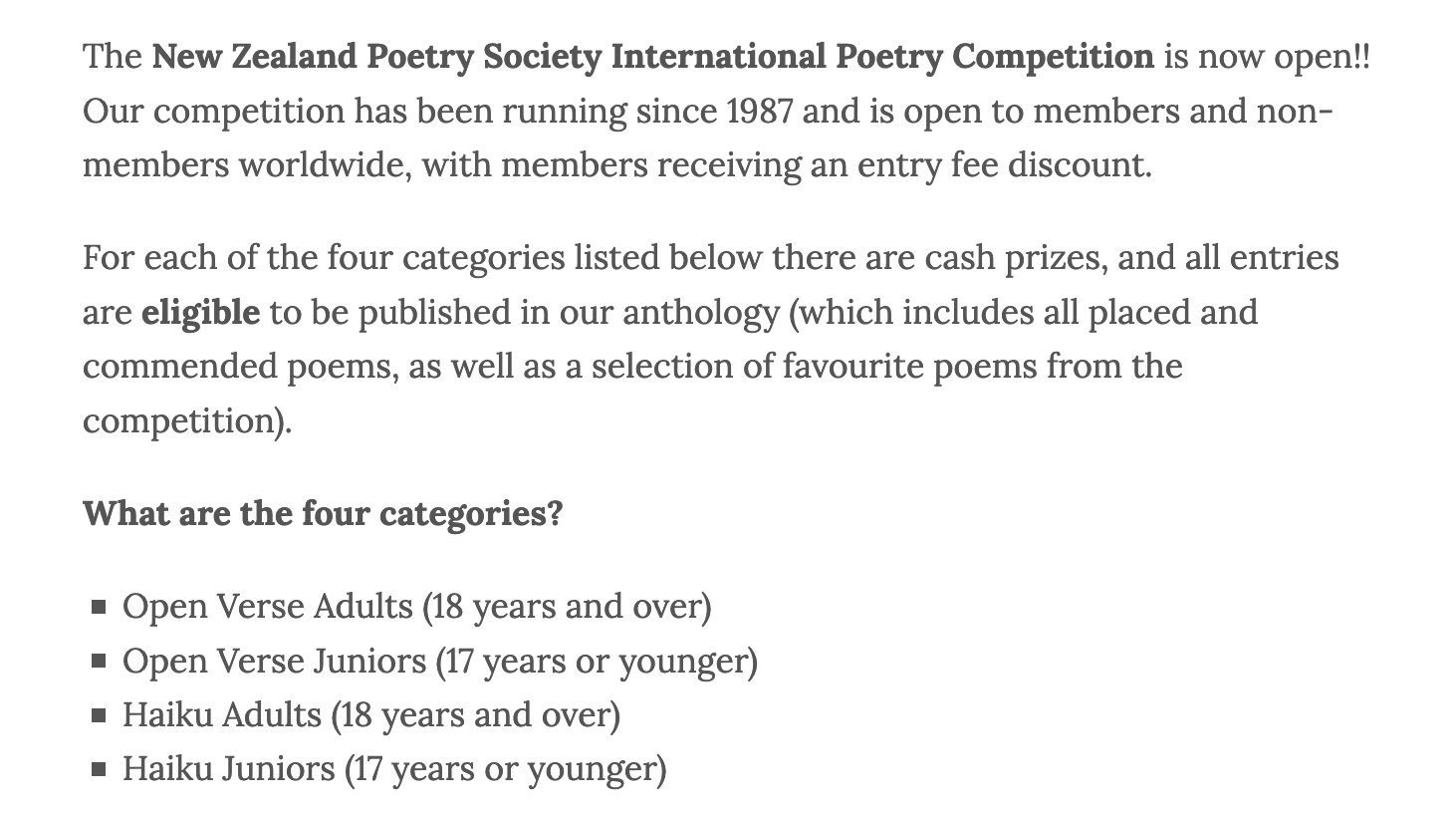
Go here for information

Go here for information

We (Carolyn DeCarlo & Jackson Nieuwland) are opening a bookshop in Wellington that will feature exclusively books by independent publishers and small presses. This is an expansion of our project Food Court, a reading/zine series that we’ve been running for the past six years. Poetry will obviously be a big focus for us at the bookshop!

Go here to contribute

‘She Cut Her Face Shaving’ essa may ranapiri
(from ransack, Victoria University Press, 2019)
essa may ranapiri’s work frequently explores the uncomfortable boundaries that exist in binary gender, and uses form and technique to push readers away from conventional approaches to both gender and poetry. Everything in their piece ‘she cut her face shaving’ works to push the reader towards a new space, from the vocabulary and imagery to the way the lines are arranged on the page.
The arrangement of the work on the page exemplifies the subtle ways that ranapiri affects the reader. Rather than proceeding straight down the page, ‘she cut her face shaving’ begins to drift right from the second line. The final shape evokes images that reflect those in the poem – the drip of blood, the curve of a neck- but also reflect a preoccupation with resisting convention. Throughout their collection ransack, words drift and explode across the page in varying arrangements. The visual aspect connects to the subject matter, which centres on ranapiri’s identity as a takatapui and non-binary individual. This poem is a microcosm of an effect found throughout this work- the reader’s eye is physically drawn away from conventional pattern, into a new space and shape that ranapiri has created.
Form and content collide again in the fifth line. Ending this line with the word testosterone is a confirmation of a non-cis experience that is only hinted at the beginning of the poem. Positioned at half-way, this line offers an opportunity to the reader to consider the first section in a new light, and prepares them for the impact of the second section. The deliberate use of pronoun immediately afterwards reinforces this transitionary moment. The pronoun use is sparing throughout this work, but rich with meaning, drawing connection between ownership and the body. The title itself gives context to the poem, ‘her chin’ positions the reader as an outsider in this situation. Garments and body parts that could be ascribed ownership are not, instead they become ‘the pencil skirt’, ‘the hair’, ‘the jaw’. Ownership appears again in this vital fifth line- ‘that testosterone/ bought her’. After this moment, both the Adam’s apple and the ‘lateness’ become hers again. The pronouns here own this experience, and are unafraid to do so.
The slash is a dominant feature of this poem, and serves multiple purposes. One that immediately pushes itself forward is the echo, again, of the ink on the page and the action of the work. Lines that are not broken up by the slash are broken up instead by the line break. Nothing goes on for longer than four words. These short, sharp lines, remind the reader of the pattern of shaving, the short strokes, and in one particularly poignant use – the ‘/cut/’ of hair seems at once to reference the ‘cut’ of the title. Additionally, it breaks the flow of the reader. There appears to be no particular rhythm to the slashes or line breaks, simply a disruption. The disruption to the face by the cut, perhaps, or the disruption to the presumed reader represented by a non-binary figure.
Another strong use of the slash is the way it abstracts the body. Every part of the body, down to the clothes being worn, have their own line. Here the body is represented not as a whole, but as separate pieces. The reader is invited to consider the way we read these pieces as masculine or feminine within the context of the poem and its title. The limited pronoun use works in conjunction with this, separating the pieces not only from each other, but also from a singular ownership of this body. Once this space between body and self is established, ranapiri jams the masculine and feminine together, setting the reader off balance. Gender has remained ambiguous before this moment, and could be intentionally misread to provide a more cis-normative view. ranapiri quashes this in the seventh line, bringing that all important ‘her adam’s apple’ into play. Immediately the subject of the poem comes into view, shedding new light on to the readers experience, and preparing us for the final two lines.
What all of these techniques have in common are the spaces both literal and figurative in the story. ranapiri seems to be again referencing the final part of their work. What is missed out, what we are ‘late’ to, preoccupies this poem, haunting every line and every sparing word. ranapiri creates in this work a space where identity can be celebrated and mourned in the same breath, the past and present as well as hopes for the future tumbled up together.
Rachel Lockwood
Rachel Lockwood is Hawke’s Bay born and bred but now living in Wellington and studying a BA at VUW. She was a 2019 National Schools Poetry Award finalist, and has previously been published in Starling.
You can hear Rachel read her poem in Starling 10 here
essa may ranapiri (Ngāti Raukawa/Tainui/Ngāti Takatāpui/Clan Gunn/Highgate) is a person or some shit / or whatever / they wrote a book of poems called ransack / it’s still in th world / the only time they use they/them pronouns for themselves is in these bios / isn’t that funny / thx goes out to their ancestors / who are as big as everything / just wow / just everything / they will write until they’re dead
Monday Poem: You can read essa’s poem ‘when i was born i didn’t say anything’ here


Photos credits: Bala Murali Shingade and Joanna Forsberg
Erena Shingade in conversation with Murray Edmond — the podcast-style interview is about 1 hour long and takes Murray’s unpublished memoir as the base from which to cover some big-picture questions about him and his creative practice.
Murray Edmond: Born Kirikiriroa 1949, lives in Glen Eden, Auckland. Poet (14 books, Shaggy Magpie Songs, 2015, Back Before You Know, 2019); critic (Then It Was Now Again: Selected Critical Writing, 2014); fiction-writer (Strait Men and Other Tales, 2015); editor, Ka Mate Ka Ora; dramaturge for Indian Ink Theatre. Forthcoming: from Indian Ink, Paradise or the Impermanence of Ice Cream, Q Theatre, October 2020. Ka Mate Ka Ora #18, October 2020. Time to Make a Song and Dance: Cultural Revolt in Auckland in the 1960s, from Atuanui Press in 2021.
Erena Shingade writes poetry and essays from Tāmaki Makaurau. Her most recent long form project contemplates neoliberal workplace psychology and the promise of spiritual salvation offered through self-help literature. Previously she completed an MA thesis on the Zen Buddhist poetry of Richard von Sturmer, whose practice confronts language at the moment of perception. Erena’s writing can be found on platforms such as The Spinoff, Art + Australia, Landfall, Mimicry, Blackmail Press, Atlanta Review, Ka Mate Ka Ora, and the New Zealand Electronic Poetry Centre. During the day she works as a publicist for Allen & Unwin book publishers.


Sold out events, packed open mics and searing hot verse screams out that poetry is alive and kicking in the capital.
The winners will get the chance to compete for the title of New Zealand Slam Champ!
Be quick, this event always sells out!
Come prepared for a CASH ONLY bar.
Part of the Festival of Slam Wellington. A handful of spoken word and poetry groups in Wellington have banded together to create a day of poetry facilitation, workshops and events.
More details at Motif Poetry website
The National Library is fully wheelchair accessible. Download an accessibility map for the venue.
Due to COVID-19 some of our events can be cancelled or postponed at very short notice. Please check the website for updated information about individual events before you come.
For more general information about National Library services and exhibitions have look at our COVID-19 page.
Gossamer
1
It’s muttonbird time, oyster time –
tītī tio
autumn, amber sun, long shadows
Gazing for ever down the long main street
towards the Club Hotel, Sir Joseph Ward in white marble
whose mother, Mrs Hannah Ward Barron,
arrived from Melbourne in 1863.
Her business was shelter – she had a family to support –
first a store for gold miners at Greenhills,
then when the railway came through in 1867
to ‘the southernmost railway station in the British Empire’,
the Railway Hotel,
which after fires, rebuilds and renovations
became The Club.
What was your life in Bluff like, Mrs Ward Barron?
In your warm hotel of welcoming shelter
comfort and laughter
you were at the heart of the town.
2
It seems that History is full of holes –
flaws – moths’ jaws –
gaps
in the ruined building
might we find
a HOLE to let us in?
Not pretty – that’s neglect, but the old bones are there.
Additions and alterations, a united front.
Across the road the skate park, green space
where the Railway Station used to be – end of the line –
still is, but for the oysterbeds.
Demolition will leave a mighty gap, a gummy length, a tooth on either side,
new Post Shop at one end, old Post Office at the other
What of the authentic? What is it?
What has been lost, is being lost so easily
or do those very Holes Protect us?
3
Same place, a later time
1997
a wedding breakfast at the Club Hotel
where Mr Flynn the publican regales
Bluffies and bemused Dunedin guests
with oysters, crayfish, muttonbirds, paua,
alcohol of all varieties
a large pork roast on the festive table
seen legging it up Gore Street
before the speeches were over
music, dancing, shouting, laughter
alcohol of all varieties
all
night
long
4
Grey plaster, ornaments, architraves deep ochre.
Two-storeyed, across the top: CLUB HOTEL.
Sixteen arched windows, columns, balustrades,
(a seagull perching on the roof)
Behind the façade, an accommodation
of four old buildings joined by corridors and archways,
refurbished, renewed, enlarged
in all or in part –
four times up in flames – wrecked, blackened
empty window arches, sky
in 1903, among the losses, valuable manuscripts
in the possession of Mr Joostens;
in 1914, three fatalities,
a ship’s carpenter, found ‘in the tangled wreckage of his bedstead’
a hotel porter ‘who saw service against the slave traders of Madagascar’
a railway employee who hailed from Lumsden.
5
Layers of pearl inside a paua shell,
the past within the past.
Back and back in the timescale of Motupohue,
Time’s long warp holds strands together
history going into holes memories lost
naturally it rots, frays flaws in the weft
of language
heard and spoken.
Time stops, changes, wraps around
a cloak of old names, old blessings, curses,
for there would have been curses.
Silent now the ancient
voices
6
A force-field shimmers around the Club Hotel,
a lizards’ nest of histories,
tales still telling
in the empty building.
Spirits from the past still in the place.
(old gold light in the west)
All the years of language and laughter
still tucked behind cornices, wallboards,
in flakes and grains of dust.
A spectral sign in empty windows,
on dusty doors,
please do not disturb
*
Cilla McQueen
Motupōhue, Bluff
Cilla McQueen MNZM has lived in Bluff since 1996. During her life as a poet and artist she has published fifteen poetry collections, three of which have won the New Zealand Book Award for Poetry. She was the second National Library of New Zealand Poet Laureate, from 2009-2011. In 2010 she was awarded the Prime Minister’s Award for Literary Achievement in Poetry. Her latest book is Poeta (OUP 2018).
One of the things I like about what poetry can allow is the holding open of a sense of mystery even when there is nothing obvious that needs to be solved. I find this in Bill Manhire’s elliptical “Across Brooklyn.” That it is a poem about mortality is no mystery: the very first line places the speaker of the poem in “the street where they still make coffins.” We are given, in fact, a very vividly realised scene, with concrete details we can visualise, and hear – planks and nails, darkening entrances, the sound of someone whistling. Yet the significance of these details doesn’t seem quite limited to the literal meaning of them, though it is hard in this poem to point to any obvious symbolic meaning they might hold. The mystery of the poem is, perhaps, simply the mystery of our unease about our own mortality, in this poem figured as a kind of uncanny tourism:
Across Brooklyn
This is the street where they still make coffins:
the little workshops, side by side.
I pass them with my daughter on our walk to the river.
Are we seeking the bridge itself,
Or the famous, much-reported view?
A few planks and nails lie around,
And each of the entrances seems to darken.
Far back, out of sight, someone is whistling.
Yes, I suppose we do walk a little faster.
There is a faint noise of hammering, too.
Bill Manhire
from Lifted Victoria University Press, 2005, reissued as a VUP Classic in 2018
The first line of the poem introduces the coffins that the rest of the poem seems to try to run away from, passing the coffins by on the way to the bridge. Brooklyn Bridge is well known for its view – these are tourists, looking for well-known sights – but this is a bridge well known in poetry too, so well known that I misremembered the title of the poem not as “Across Brooklyn” but as the more expected “Across Brooklyn Bridge.” I might have been thinking of Walt Whitman’s “Crossing Brooklyn Ferry,” or Hart Crane’s “To Brooklyn Bridge.” Even reading poetry we can read like tourists, wanting to keep revisiting familiar or famous sites, seeing what we expect to find, getting ahead of ourselves. But in our search for the already-famous, we might find something unexpected, something unsettling – though what could be more famous than death?
The coupling together of tourism and mortality does something strange to the sense of audience, too, that this poem evokes. Lyric poetry often involves a certain strangeness of address, so that reading a poem can be like eavesdropping on an improbable relationship, as a poet addresses a rose, or talks to themselves, or addresses a lover whose replies can only be imagined. This poem seems to draw particular attention to the strangeness of lyric address, the last couplet in particular throwing a sense of address somehow off kilter. The ending, with the introduction of “a faint noise of hammering, too,” is curiously inconclusive, bringing in one more additional detail, as if in a hurry to get it in before the poem ends. It comes as the second line of a couplet that seems to have been already interrupted by its own first line, “Yes, I suppose we do walk a little faster.” This seems to be a reply – but no one has asked a question. Yet there is a sense, perhaps, of someone else present, someone this anecdote is being reported to. Perhaps this sense of someone else there, but not there (are we, the readers, beginning to feel a little ghostly ourselves?) might add to the unease of the poem, a poem that seems to speed up as if hurrying past its own subject matter. This is no ordinary tourism anecdote, that we might expect to be told in the past tense, perhaps with some pictures to accompany it. If this is a tourism anecdote, why is it being told in the present tense? Is it still happening? Are we ever going to get across Brooklyn to the bridge, let alone to the other side?
Anna Jackson
Anna Jackson made her debut in AUP New Poets 1 before publishing six collections with Auckland University Press, including I, Clodia, and Other Portraits (2014). She has a DPhil from Oxford and is now an associate professor in English literature at Victoria University of Wellington. Jackson is the author of Diary Poetics: Form and Style in Writers’ Diaries 1915–1962 (Routledge, 2010) and, with Charles Ferrall, British Juvenile Fiction 1850–1950: The Age of Adolescence (Routledge, 2009).
Bill Manhire’s most recent books include Some Things to Place in a Coffin (2017), Tell Me My Name (with Hannah Griffin and Norman Meehan, 2017) and The Stories of Bill Manhire (2015). He was New Zealand’s inaugural poet laureate, and founded and until recently directed the International Institute of Modern Letters at Victoria University of Wellington. He has edited major anthologies, including, with Marion McLeod, the now classic Some Other Country: New Zealand’s Best Short Stories (1984).

dear poetry fans
I am on a WordPress learning curve so my blog appearances are way down at the moment. Everything takes me ages but I am on track to be an active source of news, reviews, videos, audio and poetry connections in Aotearoa soon.
Thanks to everyone who got in touch with offers of help!
I have a swag of inviting local poetry books to share with you – yes there’s a mountain of fabulous books out and it feels like the new releases this year are missing out on both launches and threatened review pages. I want to help.
Good though to see new ventures taking off and stalwarts working hard to make our books visible. The Coalition of Books for one.
For the first time in my life I got enmeshed in politics to a heightened degree: I felt layers of anxiety about the covid world, about the despicable and untrustworthy behaviour of some politicians both here and abroad, about the destructive force of conspiracy theorists, about the hunger for power at the expense of communities, about ideology to which we become immune, about the challenge we face in putting the health of the planet and the people ahead of our individual desires …. all of this and so much more became a big soupy mess in my head and heart, and I felt obliged to keep saying NO to it all on social media.
Fermenting such a soupy mess has made me feel ill.
So although I want to stay informed about the state of things, from the local to the global, I need to focus on what keeps me well – celebrating our diverse and heart-feeding poetry communities.
Poetry is a way of challenging, connecting, singing, musing, contemplating, strolling.
No matter the personal challenges I face, poetry is a wellbeing kit – for me as reader, writer and blogger.
I hope Poetry Shelf will continue to offer you, the poetry fan, avenues to pursue and small additions to your own wellbeing kit.
kia kaha
keep safe
aroha nui
Paula Green
ALL WRITERS
CALL FOR SUBMISSIONS!!!
‘FLYING SOLO’
ANTHOLOGY OF NZ WRITING
Are you interested in submitting your work to be considered
for inclusion in a themed anthology on the experience of single parenting?
*
We want to read your take on ‘solo parenting’
─ whether humorous, enlightening, or challenging ─
in the genre of your choice: poetry, prose (creative non-fiction), or short fiction.
You may be a solo parent or the child of a solo parent, you may be a teacher, counsellor, doctor, friend, or anyone with a unique take on this phenomenon.
*
ENTERTAIN US, SURPRISE US, PROVOKE US, MOVE US
WITH YOUR CREATIVE WRITING
ON THIS COMPELLING THEME.
*
Please submit your piece in Word format to jen-b@xtra.co.nz
by 15th November 2020 (date extended).
Prose – Max 3000 words (negotiable) ; Poetry – Max 3 pages (negotiable)
A submission fee of $30 is required per piece.
(Concessions for students, superannuitants, and others on application.)
Funds raised to go towards printing costs.
Kiwibank 38-9016-0287406-00
* A NZ publisher has been confirmed and the project
will go to press early next year for release mid-late 2021.
The anthology will be edited
by Paddy Richardson and JCL Purchase.
very fine lace knitting
this is a picture of my house
wallpaper silvery with birch trees
covering the workbook
the stories and the pictures
red and yellow blue and blue-green
the smiling suns
jack in the box on the window sill
see Sweetie run
the high shelf in the toyshop
I want to be a ship
the umbrella poem
the oak tree and its acorns
the blue eyes that wouldn’t
the bar of chocolate and our mother at a high window
angelic openings in the calendar
circus elephants on the road at Waitara
hot black sand and the donkey rides at Ngāmotu
but we came ashore after the others
Mama still pale and no baby sister
though we begged her to tell us
when we might see her again
hush darlings she said
look at the tents and the lovely black sand
we will camp out until there is a house for us
but that house burned down right away
and Papa had no watch
or any instruments to make drawings with
and all of us felt sad
because the ship had gone
perhaps with our baby sister hidden somewhere inside
crying to us but we couldn’t hear
now Papa must cut the Sugar Loaf line
now Mama must tell us a new story
and when the earth shakes and the rats run across our blankets
we will not think of her
our sister outside in the dark
beside the rivers and wells
that wait to drown children less wary than us
when my mother was a girl
she thought all grown men had to go to jail
and feared to find her father one day
among the figures working in the prison gardens across the river
under the watchful eye of Marsland Hill
how did she know
afternoon sun slanting through eucalypts
stream curving or carving the valley that divides
here from there, us from them
now from then
or not at all
how did she know
that her grandfather was locked up
for three months pending trial
for the attempted murder of his wife and child
on the farm at the top of Maude Road
and that she, our great grandmother
would drop the charges, needing him
at home and claiming he would often shoot at her
going down the road, for target practice
he was cautioned against excessive drinking and released
to lose the farm and start over
as a teacher in country schools
how did my mother know
that her father, a young man in a country town
was put in the lock-up for two weeks in the year before the war
for sending indecent literature to the girl who jilted him
two postcards and a photograph
he is named but she is not
in the police report that went to the local paper
he was in the second draft
leaving for Palmerston North
dark hair brown eyes five foot seven
oblique scar on left forearm
August 1914
We were too small to remember
the trouble that took Papa to prison
for losing all his money
were we there too we ask Mama
did you take us did we all live in prison for a while
she will tell us only
that it wasn’t so bad
that everyone helped out and soon
he was home again I cannot now recall
how long we were away
but I was glad enough to leave that place
though I was not in favour of the long voyage
to the other side of the world
and dreaded confinement at sea
Well that is another story
now your father ties off his lines
for the company and remembers Cornish hills
Somerset hills and Devon hills under his pencil
he sees the nature path in the valley of the Huatoki
and knows it will take him to slopes covered in red and white pine
rimu and kahikatea
where a house may be built or brought
on land bought with remittances from England
the small child in the big photo
dark hair dark eyes pixie face
is my mother’s sister
they share a middle name
the child in the photo could be a year old
she is holding onto a stool with baby fingers
her feet are bare and she wears a dress
of soft white wool knitted by my grandmother
in whose bedroom the photo hangs
above the treadle sewing machine we are pumping hard
for the noise it makes up and down up and down
up and down and we are never told to stop or be quiet
we know the child in the photo died long ago
before she had time to become my mother’s sister
but we never ask our grandmother
about the very fine lace knitting
of the photo that hangs in her room
when at last we go looking for
the child who would have been our aunt
the trail is cold the dates stones or tears
Date of death: 20 September 1923
Place of death: Stewart Karitane Home Wanganui
Cause or causes of death: Gastroenteritis 2 1/2 Months, Exhaustion
Age and date of birth: 19 Months, Not Recorded
Place of birth: Stratford
Date of burial or cremation: 21 September 1923
Place of burial or cremation: Kopuatama Cemetery
we see our grandfather thrashing the Dodge
between Stratford and Whanganui
and the journey home with the little daughter
he will bury next day at Kopuatama
was our grandmother there
in the car at the Karitane Home at the graveside
the two and a half months of sickness
the birth of a second child
our Uncle Jack
8 July 1923
up and down up and down up and down
noise to cover a heartbeat under soft white wool
I look upon these letters and do not like to destroy them
they are a house of memory and when I read
I am my mother on deck at last
searching for a ripple on the flat Pacific Ocean
I am my father making delicate waves
around each of the Sugar Loaves on the map going to London
I am my brother in a choir of breakers
that bring his body to the landing place
I am my sister in the boat
outside the orbit of the moon and the orbit of the sun
I am my sister a bell-shaped skirt
between ship and shore
I am my sister painting a rock arch
that became fill for the breakwater
I am my sister exhausted
by travelling and the house to clear
I am my sister writing poems
that lie between the thin pages of letters
I am my sister singing
ship to shore choir of breakers alpine meadow
I am myself on the other side of nowhere
waiting for a knock on the door
my mother is taking a photo
of herself and our baby sister
in the mirror on the wall of silvery grey birches
it’s summer and she has propped the baby
between pillows in the armchair
holds the Box Brownie still
leans over the back of the chair smiling
into the mirror
she and her baby by themselves
reflected in silvery light
not for a moment aware of the child
whose passing long ago
mirrors to the day
the arrival of our sister
whose middle name my mother took
from the light of Clair de Lune
and so the daughter library
remakes itself and is not lost
though great libraries burn and cities fall
always there is someone
making copies or packing boxes
writing on the back of a painting or a photo
always there is someone
awake in the frosty dark
hearing the trains roll through and imagining
lying under the stars at Whakaahurangi
face to the sky on the shoulder of the mountain
between worlds and mirror light
***
Michele Leggott
Michele Leggott was the first New Zealand Poet Laureate 2007–09 under the administration of the National Library. She received the Prime Minister’s Award for Literary Achievement in Poetry in 2013. Her collections include Mirabile Dictu (2009), Heartland (2014), and Vanishing Points (2017), all from Auckland University Press. She cofounded the New Zealand Electronic Poetry Centre (NZEPC) with Brian Flaherty at the University of Auckland where she is Professor of English.
Auckland University Press page
Poetry Shelf review of Mezzaluna