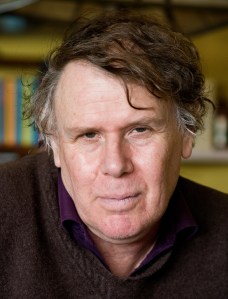
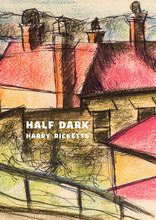
Harry Ricketts has written over twenty-five books, and while poetry is a primary love, he also writes in other genres. These include literary biography (The Unforgiving Minute and Strange Meetings:The Poets of the Great War), personal essays (How to Live Elsewhere and How to Catch a Cricket Match), and has co-edited a number of New Zealand poetry anthologies (including Spirit in a Strange Land, The Awa Book of Sports Writing and 99 Ways into NZ Poetry). He teaches English Literature and creative writing at Victoria University of Wellington. Half Dark (Victoria University Press, 2015) is Harry’s tenth collection of poems. To celebrate this new book, he recently answered some questions for Poetry Shelf.
Did your childhood shape you as a poet? What did you like to read? Did you write as a child? What else did you like to do?
My yo-yoing childhood certainly shaped me as a person. My father was in the British army, and we moved every couple of years. This has made me see everything as temporary, provisional, also to think of the present as the moving edge of the past. I read novels, the longer the better: Rosemary Sutcliff, Arthur Ransome, C S Lewis, Tolkien, Conan Doyle ‒ and endless comics. Not much poetry, though at school we had to learn poems by heart: “The Highwayman”, “Cargoes”, “Gunga Din”. They had good thumping rhythms which, together with the rhyme, made them easy to memorise. We then had to stand up and recite them in class – quite an ordeal. I still remember some of those poems and others that ‘sing in the head’, and I’m sure that contributes to my enjoyment of poets like James Fenton and Derek Mahon who use metre and rhyme much more subtly. I remember once we had to write a poem for homework. The title and subject were up to us. My effort was feeble: rhymed, of course, complete doggerel – in every sense, it was even about our dog. But one of the other boys was asked to read his poem out loud in front of the class – a great mark of favour. All I can remember about his poem is that it contained the phrase “curly kale”. And that alliterative phrase, so simple, visual and exact, has always stayed with me. Also the sudden feeling I had when he read it out: a mixture of excitement and envy. I knew that he had somehow managed to pull off something quite beyond me, but which I now felt might be possible. But mostly from the age of eight I was mad about cricket.
When you started writing poems as a young adult, were there any poets in particular that you were drawn to (poems/poets as surrogate mentors)?
I started writing poems when I was sixteen. I still thought poems had to rhyme and be metrical, and felt very daring when, trying to copy T S Eliot (whom we were studying), I wrote in what I thought was free verse. I did read quite a lot of poetry: poets were we studying like Wordsworth and T S Eliot, but also Ezra Pound, Wilfred Owen, and Holub and Cavafy (in the Penguin translations that were popular at the time). I particularly liked Cavafy and tried to imitate him.
Did university life (as a student) transform your poetry writing? What kind of discoveries did you make?
Personally university wasn’t helpful as far as writing poetry went, though I came out knowing a bit about a lot of English poetry from the Anglo-Saxon “Seafarer” to Spenser to Marvell to Gray to Byron to Browning to W H Auden. Nothing contemporary – in fact, nothing post-WW2. We had to write weekly essays – last week Wordsworth, this week Coleridge, next week Keats. It was like a whistle–stop tour of poetry’s greatest hits – wonderful in a way, but also intimidating. Sometimes I felt I was turning into a dial-a-quote.
I do remember reading some Sylvia Plath which was edgily thrilling and liking Roger McGough and Adrian Mitchell because they were funny and expressed political opinions I agreed with. I bought and read Ted Hughes’s Crow when it came out. I don’t think I ‘got’ the poems at all, but I enjoyed their dark laughter (though I wouldn’t have put it like that). This was the time when Gormenghast and Catch–22 were obligatory reading, and Bergman’s Seventh Seal and Godard obligatory viewing. We all said things like “really weird”, “far out” and “freaky”. We were terrified of being normal or at least being thought normal. It had a lot to do with the music we were obsessively listening to: Dylan, the Doors, the Stones, the Velvet Underground, Pink Floyd, later Steely Dan. Each new album was like a bulletin from another, more exciting world. We wanted our lives to be like those songs – “Strange days have found us”; “Remember what the dormouse said” – and fantasised that they were. It was very heady, and I don’t regret it, but it didn’t lead to me writing any halfway decent poems, though I did eventually write some lyrics for songs.
What about as a lecturer?
I think initially being a university teacher was another inhibiter because I only ever taught poems from earlier centuries ‒ often wonderful but not much help (at least in any direct way) with trying to write my own poems. More helpful was the only poetry writing course I’ve attended. This was a two–day affair in 1979, I think, at the Lancaster Arts Festival, run by a poet called Gavin Ewart. He was a playful-serious poet, who, like Auden, used poetic form as a starter-motor and could do everything from villanelles to clerihews, from prose poems to McGonagallesque doggerel. His poems were (are) clever, also often funny (a rare gift in poetry).
The workshop was memorable. The first day Ewart got us to write haiku and limericks and one–line poems, and one man soon got stroppy and said this wasn’t poetry and that only the rather pretty girl with black hair was producing anything remotely interesting and then he stormed out – never to return. Personally I found trying to do the forms useful and helpful, partly because it got me away from Romantic ideas of the muse having to strike – I was still very hung up on Wordsworth and Keats and notions of the creative mood, sometimes ‘suitably enhanced’. And I do think the class generally encouraged me to be less earnest, that play was okay. The second day we workshopped poems we’d sent in advance and that was helpful. Ewart was very hot on line-endings and about not being lazy with rhyme (if you used it): every word had to pay its way.
I was teaching in Leicester at the time and, partly as a result of the workshop, I joined a small group of local poets. We’d meet and discuss our work, but it all tended to be too polite, and when one member won quite a big national prize, the group combusted from envy. But I do think of that as the time when I slowly started to take writing poems more seriously. This coincided with having children, and I’d blue-tack drafts of my poems to the walls and think about them as I walked around at night, holding wakeful babies. Sometimes the poems were about my children (I had step–children too), and I think becoming a parent not only made a huge difference to me as a person but gradually also to the poems I was beginning to write. It’s not a coincidence that the first poem of mine I think is any good – “Your Secret Life” written in my mid–thirties – is about my (then six-year-old) daughter and imagining her as a teenager.
Some people want to let their poems speak for themselves while others are happy to offer provisional entry points. What do you think your role is when you ‘teach’ poetry?
I think if you’re giving a reading, it’s a good idea to say something between poems, offer an entry point, but not so as to swamp the poem. It is hard to listen to poem after poem without a break, particularly if you haven’t read or heard them before. (I have been to readings like this.) Teaching others to write poems or at least trying to help them is a different matter. It’s not your poem, so your role is more like that of a facilitator or midwife, perhaps. Sometimes your own experience can be helpful, but it’s mostly attention and encouragement. And urging them to read as much poetry as possible.
Another terrific example of poetic entry points that work is your book on the war poets (Strange Meetings: The Poets of the Great War). To me it was scholarly yet satisfyingly fresh in its approach. Your book opens rather than closes the experience of reading these writers. What did you hope to achieve with this book?
That’s very kind of you. I wanted to write a book that demythologised those WWI poets and restored them to a sympathetic human scale, something closer to the people who actually wrote the poems, who together with the horror of the war, had friendships, fallings-out, tried to find a language adequate to their experience.
We wrote 99 Ways into NZ Poetry together a few years ago. Writing the book was a way of viewing the poetry landscape in new lights for me. What discoveries did you make?
New lights for me, too, and many discoveries. You really helped me to read Michele Leggott, a poet I’ve always found very hard.
I love the way your poems reflect shifting forms, pitch, moods, preoccupations and rhythms, yet there is always a clarity of line, a sharpness of detail, the essential moment. What are key things for you when you write a poem?
That’s difficult to answer. Sometimes I’ll deliberately try to write a poem about some event, occasion or person. More usually, I’ll be doing something else altogether ‒ like writing this for you now ‒ and a word or phrase or maybe a memory will suddenly press itself on me, and I’ll find it prompts a line or another phrase and a sense of excitement. Often things just switch off; nothing more happens. But sometimes I have to keep coming back to it (whatever it is) and have to fiddle away, try this, try that. That’s the best part, don’t you think, being inside a new poem? Nothing better. When it’s finished, or as finished as it can be, you’re back in the cold again.
I like that idea — the best bit is when you are inside the poem. Really, your heart starts beating faster. The outside world fades to black (or light). Harry, you have lived both in New Zealand and Britain (like Peter Bland), but I don’t find a relentless niggling tension between here and there in your poems. It is as though a poem steered by you can lay its roots in either place. Are your poems a way of forging home? Laying roots? Being elsewhere?
That’s very perceptive. Temporary roots, anyway. I think the ricocheting childhood thing. I do think that not quite belonging to where you live can be an advantage to a writer.
I agree. Do you think your writing has changed over time?
Yes, I’m not so inhibited, not so hung-up about perfection, more prepared to try things.
Prompted by Eleanor Catton, this question: Do you think we have a history of thinking and writing about the process of writing poetry in New Zealand? Any examples that sparked you? Have you done this?
Well, there are poets who have written about this (Allen Curnow, James K Baxter, Michele Leggott, Bill Manhire among others). But I think there is a fairly general distrust of seeming to proselytise or sound too arty or up-yourself. Some cultures (France, America) seem to be able to talk about the arts (including poetry) more naturally or with less inhibition. But the rise of creative writing schools has definitely increased some writers’/poets’ ability, and desire, to talk about process. It’s a question as to whether this will help to produce better work. Good if it does, but writers sometimes, even often, write best when they break their own precepts.
What poets have mattered to you over the past year? Some may have mattered as a reader and others may have been crucial as a writer.
The Irish poet Derek Mahon and Auden always matter to me. I constantly read and reread them, and learn from them.
What international poets are you drawn to?
The American poet Mary Ruefle has been a belated discovery.
She is a fabulous discovery for me too! I feel like I want to secretly do some MR poems and see what happens. Particularly the white-out pages. What New Zealand poets are you drawn to now?
In the last year or two? Fleur Adcock’s last two collections ‒ terrific. Ian Wedde’s recent poems.
Ian’s The Commonplace Odes would have to be one of my top NZ picks. Name three NZ poetry books that you have loved.
Jenny Bornholdt’s The Rocky Shore. James Brown’s Lemon. Bill Sewell’s Ballad of Fifty-one.
You write in a variety of genres (poetry, non-fiction, critical writing). Do they seep into each other? Does one have a particular grip on you as a writer?
Yes and no, but poetry is the thing.
What irks you in poetry?
Poems that presuppose a trust they haven’t earned.
What delights you?
Surprises. Also wit.
I was drawn to the title of your new collection (Half Dark) because for me it signals the way poems emerge from and move in and out of the shadows (as opposed to a glass is half full kind of thing). Why this title?
It’s a phrase in one of the poems. As you say, it suggests movement in and out of shadows. It also suggests the mood and tone of many of the poems.
These new poems are like a steaming road with heart, memory, ideas, anecdote, sights rising up and simmering above the surface— poems that steam with life and possibilities. For me this is one of your best books yet. What discoveries did you make about poetry as you wrote? The world? Yourself?
One discovery, as I’ve explained in a note in the collection, was about a form called the triolet. I’d never imagined trying this short form with repeated lines, had shared a fairly common sense of superiority towards the form. But an Australian poet-friend Cath Vidler confessed to having become addicted to the form and suggested I try it. I found she was right; it is addictive. More interestingly, I discovered that though usually used for light verse (which is fine, ‘light’ doesn’t have to mean ‘slight’) in fact you can use the triolet for serious, even heart-breaking, subjects. It’s much more flexible than it looks. And, as poets have done with the sonnet and other rhyming forms, you can empty out the rhyme and just keep the shadowy shape. Discoveries about the world? Well, with the death of friends and family, my world is getting colder, half-dark.
I love your triolets– reading them prompted me to write one myself. I can see why they are addictive. There is a honeyed overlap of repetition and within that echo the subtle nuance of difference. Nuances steered by shifting juxtapositions. Is there a single poem or two in the collection that particularly resonates with you?
The last poem, “About”, means a lot to me. I started it in 1980 and it’s changed over the years as I have, and I kept losing it and then finding it again. “Noddy” (about a dead university friend) brings him strongly to mind.
I love the blurb on this book. First it references your poem about the phrase ‘Mind the gap’ from the London Underground (that has haunted me too!) and then it introduces the collection as one that ‘addresses the people and places that fill a life and the gaps they leave behind.’ Gaps are so crucial in poems. For me, this entry point heightens my response to your poems. Tell me about the role of gap in this new collection.
It’s all gaps.
Indeed. Is doubt a key part of the writing process along with an elusive horizon of where/when you are satisfied with a poem?
Yes, doubt is key. Also gratitude.
The constant mantra to be a better writer is to write, write, write and read read read. You also need to live! What activities enrich your writing life?
Travel.
Some poets argue that there are no rules in poetry and all rules are to be broken. Do you agree? Do you have cardinal rules?
Rules are to be broken, but it’s worth knowing what they are first. Personally I don’t end lines with words like ‘a’, ‘the’ ‘in’ or ‘of’, unless there is a really good reason.
Do you find social media an entertaining and useful tool or white noise?
A bit of all of these.
Finally if you were to be trapped for hours (in a waiting room, on a mountain, inside on a rainy day) what poetry book would you read?
W H Auden’s Collected Poems.
Thanks Harry!
Victoria University Press author page
NZ Book Council page

 NZ Poetry Shelf