Category Archives: NZ Poetry reading

The Poet Laureates are heading to Dunedin in May – from my experience it’s unmissable


poet-laureates-010_1_orig.jpg


I got to see the Wellington Writers and Readers Festival version of A Circle of Laureates – and it was a rare and special occasion. I just loved it to bits, as did everyone in the packed-out room. I can’t recommend it highly enough.  My post on the event.


At the Dunedin Writers Festival in May:

A rare treat: nine of the ten New Zealand Poet Laureates will gather to read their work, with Rob Tuwhare joining them to represent his late father, Hone Tuwhare. Twenty years ago, John Buck of Te Mata Estate Winery created the Te Mata Estate Laureate Award; in 2007 the government took over funding of a Poet Laureate and vested responsibility for the Award with the National Library. This session of New Zealand’s poetry elite features Bill Manhire, Elizabeth Smither, Brian Turner, Jenny Bornholdt, Rob Tuwhare for Hone Tuwhare, Michele Leggott, Cilla McQueen, Ian Wedde, Vincent O’Sullivan and current Laureate C.K. Stead. Fergus Barrowman (Publisher, Victoria University Press) will MC the event.
Tickets can be booked here.
In association with the National Library of New Zealand Te Puna Mātauranga o Aotearoa. 

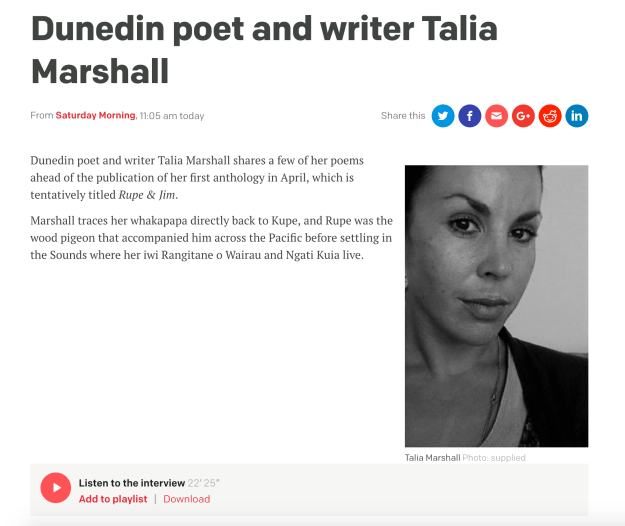
Fabulous poems from Talia Marshall on Radio NZ National

Screen Shot 2017-01-28 at 4.04.37 PM.png

Good to see Radio NZ National deleting excellent poetry.

Poems can be heard here.


Tusiata Avia’s book launch gave me the goose bumps

0b1eb042-a027-4f9f-bae5-5ca96dfd4ed5.jpg       IMG_3432

Fale Aitu / Spirit House Tusiata Avia, Victoria University Press, 2016

Last night I drove into the city into some kind of warm, semi-tropical wetness —like a season that no longer knew what it ought or wanted to be — to go to the launch of Tusiata Avia’s new poetry collection. Tautai, the Pacific Art Gallery, was a perfect space, and filled to the brim with friends, family, writers and strong publisher support. I loved the warmth and writerly connections in the room. I have been reading Tusiata’s book on planes as poetry now seems to be my activity of choice in the air. I adore this book and have so much to say about it but want to save that for another occasion. I was an early reader so have had a long-term relationship with it.


the launch

The room went dark and an MIT student, bedecked in swishes of red, performed a piece from a previous collection, Blood Clot. Mesmerising.

Tusiata’s cousin and current Burns Fellow, Victor Rodger, gave a terrific speech that included a potted biography. I loved the way he applauded Tusiata not just as a tremendous poet, but as a teacher and solo mother. Her names means artist in Samoan and he saw artist in the numerous roles Tusiata embodies. Writing comes out of so much. He identified her new poems as brave, startling, moving and political. Spiky. I totally agree.

Having dedicated her book to her parents, Tusiata said that it was hard to be the parent of a poet who wrote about family. When she told her mother what she was writing, her mother embraced it. She opened her arms wide. She said the skeletons need to come out. The atua. Tusiata’s speech underlined how important this book is. It is not simply an exercise in how you can play with language, it goes to the roots of that it means to be daughter, mother, poet.  It goes further than family into what it means to exist, to co-exist, in a global family. When a poet knows how to write what matters so much to her, when her words bring that alive with a such animation, poise and melody, it matters to you.

Four poems read. Lyrical, song-like, chant-like, that place feet on ground, that open the windows to let atua in and out, that cannot turn a blind eye, that hold tight to the love of a daughter, that come back to the body that is pulsing with life.

Yes I had goose bumps. You could hear a pin drop.

Fergus Barrowman, VUP publisher, made the important point that these poems face the dark but they also face an insistent life force.

Congratulations, this was a goosebump launch for a goosebump book.


My two poetry readings to launch my new book feature some of my favourite poets

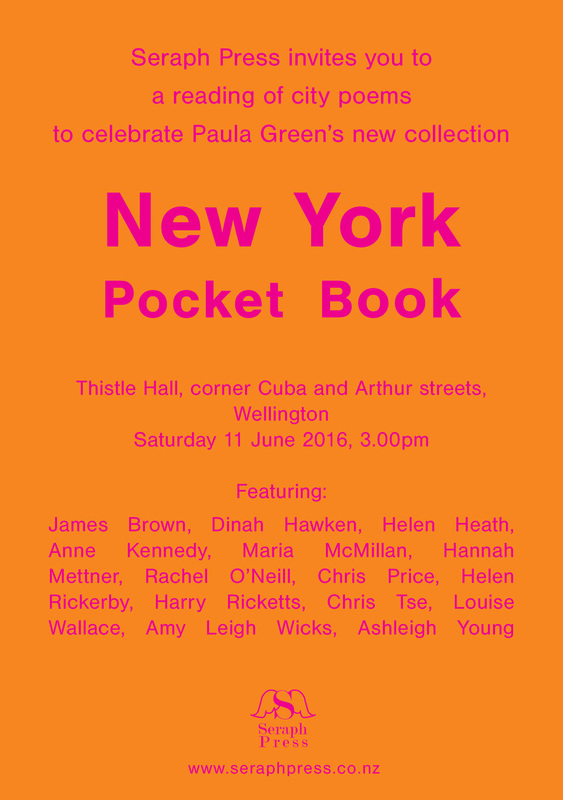
Like so many poets, I loathe people making speeches about me or my work. Much better to stage a poetry reading and celebrate the pull of cities.

My new poetry collection comes out of ten exceptional days I spent in New York with my family awhile ago. So I have invited a bunch of poets I love to read city poems by themselves and others. Big line-ups but it will free flow and leave time for wine and nibbles.

Once I got to fifteen I realised what poetry wealth we have in these places. I could have hosted another 15  in each place easily. That was so reassuring.

If I had time and money, I would have staged similar events in Christchurch and Dunedin where there bundles of poets I love too.

Please share if you have the inclination.

And you are ALL warmly invited!

Auckland:


7601147_orig.jpg


Wellington:


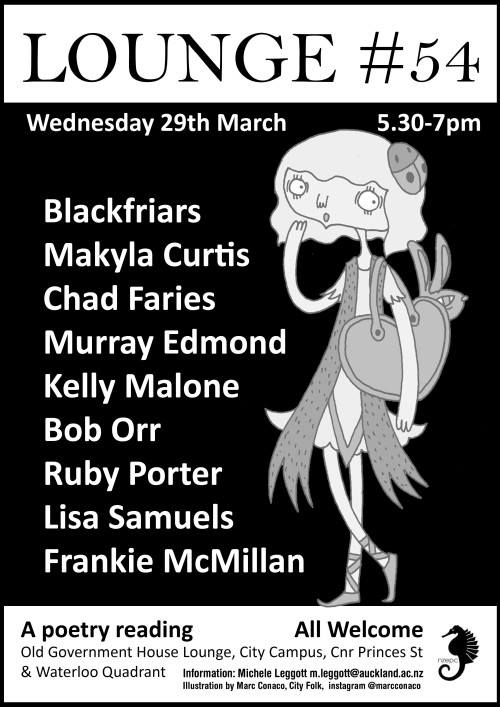
Auckland:2434463_orig.jpg

A Circle of Laureates, a galaxy of poetry

This event prompted me to hunt for cheap fares to Wellington because it seemed like a rare and special poetry occasion. And it was! A sold-out event!

The National Library, as current administrator of the NZ Poet Laureate awards, hosted the evening as part of Wellington Writers Week.  John Buck from Te Mata Wines instigated the Laureateship in 1997, with Bill Manhire taking the debut spot. John was there with wine to share. He still retains an involvement.

Fergus Barrowman from VUP was the MC. He made the important point that the award is ‘an activist portfolio not just an honour.’ The earliest debut publication by a Laureate was in 1964 while the most recent debut was 1988.  Three generations of poets! Cilla McQueen and Michele Leggott calculated over 700 years of life/poetry experience across the ten laureates to date.

Bill Manhire (1997) spoke about what the Laureateship meant to him and the two ways it expanded his sense of what he might do as a poet, as a public figure. Firstly he began to write poems with some kind of public dimension. Secondly he explored the way the role centred on the promotion of poetry. He wanted to ‘talk it up.’ Both are options we can be thankful for. Bill’s poems that stand on a public stage are poems that embrace the knots and crests of humanity. I talked about the way ‘Hotel Emergencies’ does this on Summer Noelle in January.

Bill read ‘Erebus Voices’ and I sat there thinking this is a poem that belongs in the world and can be heard again. And again. And then again. Because it both moves and matters. Bill shows so adeptly the way poems can shift us to laughter, to wry grins at the surprise of it all, but also lead to far more unfathomable movements of the heart.

‘I am here beside my brother, terror./ I am the place of human error.’

I especially loved the way he started with the poem of a fellow poet. He ‘talked her poem up,’ and I fell in love with it all over again: Rachel Bush’s ‘The Strong Mothers.’


Hone Tuwhare was represented by his son Rob. We listened to Hone read ‘No Ordinary Sun,’ we listened to Rob read Hone and then Rob picked up his guitar and sang a Graham Brazier version of one of the poems. A version of friendship. Quiet, haunting, utterly melodic. This was love. Hairs standing on your arm on end from start to finish in the Tuwhare bracket.

‘Oh tree/ in the shadowless mountains/ the white plains and/ the drab sea floor/ your end is at last written.’


Elizabeth Smither read a cross section of poems that delighted the audience. But one as-yet-unpublished poem in particular stuck to me. Kate Camp, her mum and I – all went ‘wow.’ I adored the story of Elizabeth seeing her mother move through her house, the windows bright, unaware of the daughter driving by. By the time I got to congratulate her, dear Elizabeth had already signed her copy for Kate. How lovely! Like a bouquet of flowers. Elizabeth emailed the poem so I can read and write about it for my book.

‘It was all those unseen moments we do not see/ the best of a mother/ competent and gracious in her solitude’


Brian Turner with his delicious wit said: ‘I’ve been called a political animal many times and it’s not always a compliment!’ And that is what makes his poems so enduring. The way he hits the right pitch of land and sky but with a deep love that is unafraid to match beauty with issues. He read a cluster of short poems where every word sang. Gee whizz this was good. Here are few lines I loved without the line breaks (sorry):

‘and the shadows are mauve birthmarks on the hills’

‘If the sky knew half of what we were doing down here it would be inconsolable and we would have nothing but rain’

‘where a river sings, a river always sang’

See what I mean!


Jenny Bornholdt

Jenny rued the way Wellington Writers Week has dropped ‘readers’ from the title. She said she would reclaim readers, in the perfect setting (the library), with a longish poem: ‘A long way from home.’ This was a highlight for me. The poem is all about illness and reading; the ability to read and a time when it flees. Here are some sample lines:

‘How as a child, books were the lens// through which I eyed the muddy track to adulthood’

‘For six weeks now I’ve been outside weather/ and of reading. Outside of myself.’

‘I have tried to read but nothing/ sticks. That anchor of my life has been raised and// I’m all at sea.’


Michele Leggott, like Bill, brings poetry to a a public arena through her tireless promotion and expansive love. Michele read an extract from a long work (‘The Fasciclies’) that bridges Taranaki and Lyttelton, the 1860s and the 1970s, and the connections between two women.

My notebook is full of Persian-like doodles of birds and shapes interspersed with notes but, as I listened to Michele, my pen stalled. I felt like I could hear Robin Hyde with her luminous detail and observations in the seams. For this was luminous writing. There is a bridge between reader and poem. Sometimes you cross it. Sometimes it seems impassable. I just wanted to cross the bridge and read the whole poem.

You can find the whole piece here.


Cilla McQueen read ‘Ripples’ a long poem that showcases her strengths as a writer. It is in her latest collection, The Radio Room (2010). Another highlight. Other poets make an appearance, Joanna and Hone. Moving. Uplifting in a way.

‘After the funeral service you leaned down towards me out of a cloud;/  “Kia mau!” you shouted into my mind.’

Cilla McQueen’s memoir is due next week from Otago University Press.


Ian Wedde also has a childhood memoir out, The Grass Catcher, which is on my must-read list. Ian’s poetry produces my ideal poetry trifecta of relations: music, ideas, heart. Oh! And singing its way through, a sense of story. He read from ‘The Life Guard.’ Ha! It’s all here. Listen to the start:

‘You have to start somewhere/ in those morose times,/ / a clearing in the forest say,/ filled with golden shafts of sunlight// and skirmishes’


Vincent O’Sullivan has a new book out from VUP, which I am about to review for a newspaper, so perfect to hear him read his poetic contours. He has the ability to refresh anything. To tilt tropes, to enhance the music of a line, to poke you with an idea, to make you feel. Once again I got caught up in the moment of listening and didn’t catch lines in my notebook.


Ck Stead is the current Poet Laureate. He began with a poem about Allen Curnow, who he felt would have been Laureate if he had lived within the Laureate time span. Karl had struggled over whether to read a top-hit kind of poem or read new things. I know that feeling and first thought I would only ever read a poem once in public when first published. That soon fell by the wayside.

It was a moment of audience empathy as Karl confessed he thought he would read it, then wouldn’t, then finally after hearing Bill, decided he would. And we were glad, indeed, as he read an elegy for his mother. Utterly moving.

Poetry is such a love for Karl. He made this clear when I was filming his ‘thank you’ speech for the Sarah Broom Poetry Award. And hearing him read on this occasion, lifted the poems off the pages where I have loved them, to a new life in the air/ear.

from ‘Elegy’ but without that scattered layout that makes much of white space (sorry):

‘She’s there somewhere/ the ferryman/ assures me.// He tells me/ she was reluctant to go/ but silent – // stood in the prow/ no tears/ and never looked back.’

Karl filled the room with the warmth of poetry. Music. Heart. Ideas. A perfect end.


The tokotoko table, with all the talking sticks carved especially for each poet, was like a quilt with stories. I wished someone had held up the mother tokotoko for all to see and told that story. And indeed held up each tokotoko, for each tokotoko has its own.

Karl will get his at the Matahiwi ceremony in April. I am honoured to be part of this occasion along with Gregory O’Brien and Chris Price.


A Circle of Laureates was a magnificent occasion. I bumped into Elizabeth Knox the next day and we were both enthusing about how good it was. Peter Ireland from the National Library had put in all the hard work! Kindly acknowledged on the night by Ian. Every poet held my attention. There is a big age range here, but to me, it is a way of honouring our poetry elders.

As a poet, I write with one foot in the past and one foot in the future.I want to know who I’m writing out of. This is my tradition. This is my innovation. This circle.

It reminded me of Selina Tusitala Marsh’s’s poem ‘A Circle of Stones in her debut collection where she honours the women she writes from, towards and beside.

Thank you to everyone who made this event possible. It was worth my spur-of-the-moment cheap flight, my accidental data blow out, my misbooking home that meant a new booking, the chance to hear the Lauris-Edmond finalists, and losing myself in Jessie Mackay in The Alexander Turnbull Library.  Thirty-six hours of poetry. Heaven.

Thanks! Ten Poets Laureate to celebrate!


Poetry Shelf, Poet’s Choice: Sam Sampson gets choosing

ghost_cover_front__73226.1427153026.220.220   ghost_cover_front__73226.1427153026.220.220   ghost_cover_front__73226.1427153026.220.220

An online publication that I’m still engaged with, and keeps giving, was the collection: A Festschrift for Tony Frazer, which celebrated the 64th birthday of Tony Frazer, the editor of Shearsman. As one of many writers with a poetry book published through Shearsman Books, and poems published within Shearsman Magazine, I follow, revisit, and greatly admire Tony and his Shearsman imprint. As outlined on the publication homepage, Tony is one of the great poetry editors of our time, publishing more than 300 writers; but more importantly, encouraging and validating the writing process through championing new writers, writers in translation, a Classics series, and working tirelessly to promote poetry. Here is an insightful quote that sums Tony up perfectly:

‘Tony Frazer must be held to account for he is a publisher who resolutely fails to be everything a publisher should be: he is enthusiastic, literate and does not concern himself with projected sales figures. What can be done to stop him? Very little, I fear’ Marius Kociejowski


Over the years I’ve purchased volumes from Shearsman, such as Gael Turnbull’s There are words…Collected Poems, discovered Gustaf Sobin, Theodore Enslin, Anthony Hawley, Frances Presley, Anne-Marie Albiach, Pablo de Rokha…and at this moment, are reading poems by one my favourite poets, the late Lee Harwood Collected Poems.


On the local front, this year I had the privilege of being part of a poetry reading with Roger Horrocks Song of the Ghost in the Machine (Victoria UP, 2015) – and hear first hand the meditative ghost ambling to-and-fro, from word-to-world. From what I understand, it was Roger’s first poetry reading in 30 years. A great occasion and a great book!

Another highlight this year was being invited by Michele Leggott to be part of the Six Pack Sound #2 series at the nzepc. The second series included recordings by Stephanie Christie, Makyla Curtis & Hannah Owen-Wright, Doc Drumheller, Selina Tusitala Marsh and Jack Ross. Thanks to Michele Leggott, Brian Flaherty and Tim Page for making this happen.


Sam Sampson

Serie Barford’s book launch

Screen shot 2015-11-07 at 7.35.41 AM

Kia ora koutou,

You are warmly invited to the launch of Serie Barford’s poetry and short story collection, Entangled Islands, published by Anahera Press, and held in conjunction with Poetry Live. With music by Brendan and Alison Turner, and readings from the book by Serie. MC-ed by Kiri Piahana-Wong. Entangled Islands will be launched by Karlo Mila. Food and drink available from the bar. Thanks to Creative New Zealand for supporting the publication of this book.

8 pm: Brendan and Alison Turner (folk/blues duo)
8.45 pm: Book launch
9.15 pm: Poetry Live resumes with open mic – all welcome to read

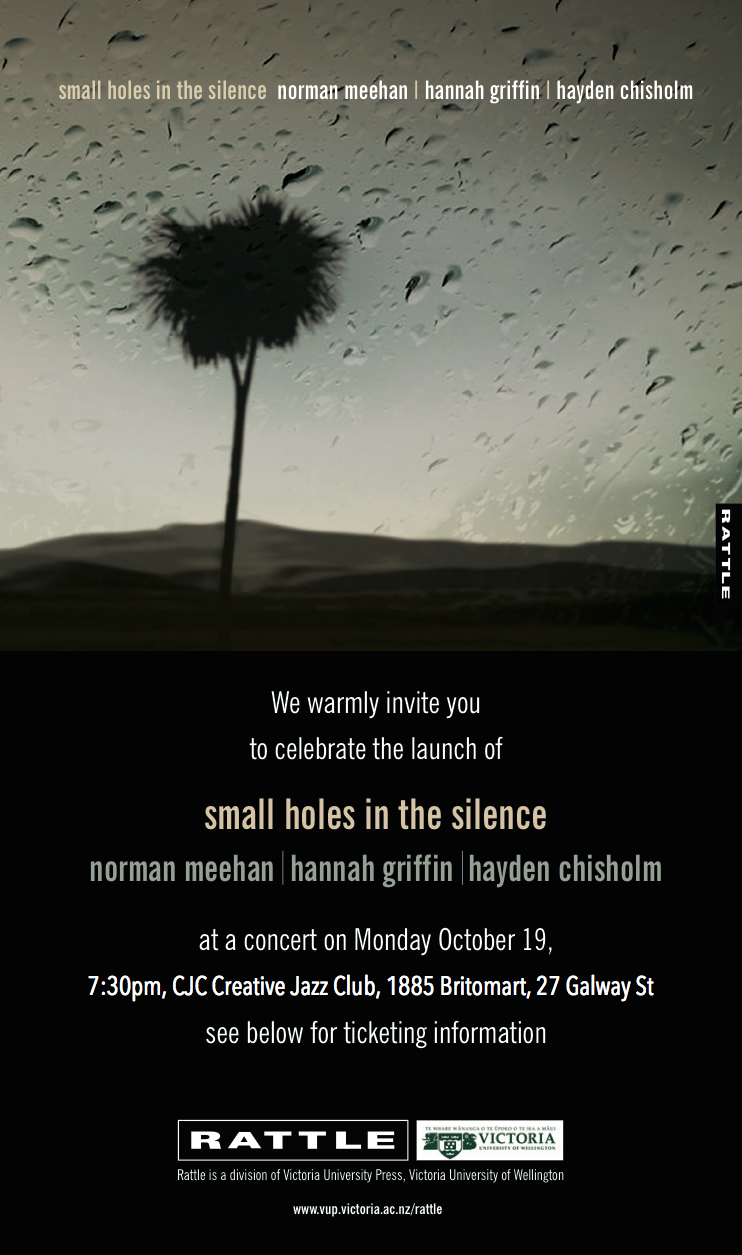
Auckland concert launch of Small Holes in the Silence CD – I’ve heard a few tracks and they’re tremendous

Manhire Auckland Concert flier

‘The approach taken by Bill, Norman, Hannah and Colin has been one that seeks to marry the words and music as seamlessly as possible. Performances include readings of the poems by Bill, sometimes accompanied by an anecdote or brief explanation to illuminate the poem’s genesis followed by performances of the poems as songs. Hannah’s nuanced interpretation of these words is complemented by Colin’s obligatos and solos and as a trio (with Norman at the piano) the three make delicate music that draws from European jazz, from the folk traditions of Great Britain and New Zealand, and from popular song.’

Bill Manhire (narrator)
Hannah Griffin (voice)
Norman Meehan (piano)
Colin Hemmingsen (clarinet,bass clarinet, saxophone)
Blair Latham (clarinet, bass clarinet, saxophone)
See details of the rest of the Chamber Music tour here