Category Archives: NZ poetry book

On reading Sport 43

Sometimes a literary journal is just the ticket for rainy-day blues, diversion, or the need to put a finger on a literary pulse. Ha! The notion of a literary pulse is where debate ensues. Each finger will be sensitive to different nuances, different implications.  I strongly believe that national anthologies that claim to represent a wide group ( New Zealand, for example) must be challenged if gender, ethnicity, age or geographic-location biases fuel significant blind spots. For decades, women were the blind spot in anthologies and journals, and now, at times it seems there is token representation of  work by Māori, Pasifika and Asian authors. Literary journals, however, are often the bloodline of a place, a niche, a literary disposition, and nearly always reveal the predilections of the editor. Sport comes out of Wellington, and it is to a great degree of Wellington (not in subject matter, but in terms of authors selected). It is a celebration of the writing by both established and emerging writers that have some connection with the city, often through Victoria University or its Press.  I have no problem with this.  I most definitely have no problem with this when the work included catches my attention and sends me in directions both familiar and unfamiliar.

The latest issue worked a treat for my rainy-day blues.

Seven essays are sprinkled through the selection of poetry and fiction, and if this is a new feature, it is a feature I applaud in this climate of idea-sharing in creative and stimulating forms. Long may it continue.

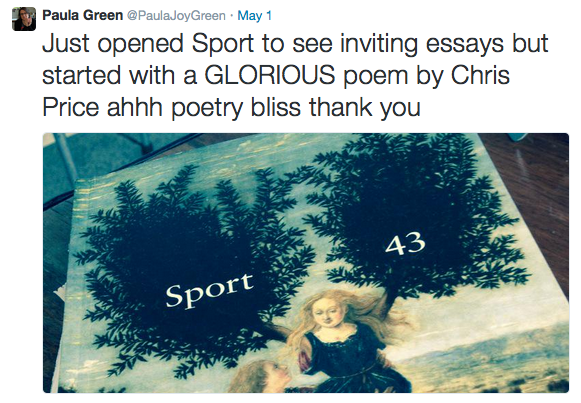
When I first picked up the book, I went straight to Chris Price (out of longing for a new collection perhaps) and immediately did a tweet review. Tucked away at the back of the book, it felt like the best had been saved for last with the playful, audacious flick and flash of words that catch your ear and send you flying to a nursery rhyme or Murphy’s Law or cheeky wit or the subtle twist and let’s-be-serious of the last word, ‘unspoken.’
Screen shot 2015-05-12 at 10.14.03 AM

This time I went to an unfamiliar name first, ‘Ruth Upperton,’ and what a discovery. Think I must have yearning for the comfort and absolute pleasure of poetic musicality (why I like the poems of Michele Leggott and Bill Manhire so much). Ruth has appeared in other journals, has just finished a law degree and lives in Palmerston North. Her five poems are different, the one from the other, but are linked by gorgeous rhyming (off, aslant, sliding), infectious repetitions, aural chords, sumptuous words. There is poetry out of sentences and there is poetry out of curiosity. You shift between comfort and strangeness.


from ‘The lonely crow’

Nothing sadder than a lonely river.

Nothing darker than a single crow.

Shiver at the strong’s surrender.

Play a tune on your June piano.


James Brown’s terrific poem, ‘Mercy,’ made me hungry for a new James Brown collection.

Anna Jackson’s three cooking-show poems suggest she is just getting better and better ( I am working my way through Catallus so I can review her new collection soon). I love the way the ingredients (excuse the pun) in these poems shift and flicker from one poem to the next, and in their new baking dishes taste a little different. The sort of poems that evoke a steady engagement at the level of sound and narrative.

Sarah Jane Barnett’s sequence of poems, Addis Ababa,’ caught me by surprise. They take me to an elsewhere, the elsewhere of  displacement, of otherness, of immigrants. The poems step up from everything Sarah has previously written, and then take another step into risk, empathy, inquiry, experience. What a combination.


Rachel Bush’s ‘Long and short,’ is a poem that moved me with its exquisite detail and revelation, a family story (true or false) that catches in the throat. The poetic glue: the baked bread.


So many things accumulate. They weigh us

off balance. We struggle to stay upright,

we lurch and are precarious. Our feet are flat

and sudden. It was easier when we had

a mum and dad. Easily we could blame them

when we were less than we desired.


Still most essays and fiction to read, but started here: Damien Wilkinson’s lecture/essay navigates a subset of the ‘ought’ and ‘ought not’ of narrative: the way it ought/ ought not represent some kind of personal change (character based). Fascinating following the thread of argument. Is this a requisite ingredient in poetry? That poems ought to navigate some kind of change? I raise this because, and I am shifting tack a little here, I am fond of poems that exhibit some kind of movement (and movement may be zen-like and hold change within its sameness and vice-versa). Poetic movement need not be on a grand, spectacular scale. It might be miniature shivers in the poem, sweet little movements that you catch out of the corner of your eye, or a flicker in your ear, or a faint tremble of your heart, or the tug of an idea that is itching to confound, challenge and pull you elsewhere. That is what I felt when I read, ‘She cannot work,’ Ashleigh Young’s foray into fiction. It is what I felt reading this issue of Sport, a catalogue of movements that displaced my state of fatigue.


Sport: miniature shivers in the writing, sweet little movements that you catch out of the corner of your eye, or a flicker in your ear, or a faint tremble of your heart, or the tug of an idea that is itching to confound, challenge and pull you elsewhere.
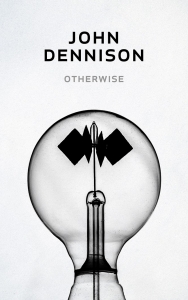


John Dennison’s Otherwise — a literal evocation and a metaphorical ripeness


1423778022214   1423778022214

Otherwise, John Dennison, Auckland University Press, 2015

John Dennison was born in Sydney, raised in Tawa, studied in Wellington and St Andrews, Scotland, and is currently a university chaplain at Victoria University. His debut poetry collection, Otherwise, carries glowing endorsements from Vincent O’Sullivan and Gregory O’Brien on the back. It is a co-publication with Carcanet Press in the UK. He has also authored Seamus Heaney and the Adequacy of Poetry (forthcoming from Oxford University Press in 2015).

This debut collection is a collection to slip in a pocket and savour on a daily basis.

Otherwise is imbued in love. Take ‘Touch and Go’ for example. You see ‘love’ in a moment caught within the poem’s frame; a blackbird, the game played, relations, life, dusk. And then the game becomes other. Like a tantalising elsewhere, so that just as things hide and seek, the world slips and slides and settles, in view out of view, a world hiding and a world revealed, open closed. Throughout  the collection, there is a consistent sway between a need to be literal, to celebrate this thing and that moment, and a need to lay the trope of elsewhere. A literal evocation and a metaphorical ripeness. And that sway gives the poems a delicious, almost metaphysical shimmer. A shiver almost. Like the sight is steam rising after rain upon the summer path.

There is also a love of language that is contagious. You want to keep reading and you want to start writing. Delicious phrasing abounds: ‘hot glob of dust’ ‘My lighthouse, my love, the rocks are night all around.’ Musicality is scored deftly upon each line: ‘small branches fret the roofing iron.’ Individual word choices refresh and surprise, particularly in the case of verbs and nouns: ‘this acupuncture of light’ ‘You wake as you home across London’s/ threshold.’ There are the repetitions, a word or phrase that slips to reappear a few lines later because ‘some things bear repeating.’ Comfort for the ear and then a shift in meaning.


Many poems stand out. For example, John’s reprisal of Allen Curnow’s ‘Lone Kauri Road.’ This carries the gold of Allen’s poem in its veins and then it moves elsewhere. One of the best reprisal’s I have read in ages. Here is how it ends:


(…)  Forgive my making light of

the glass half-empty and you weighing up the dregs;


but I will get up like a love-cast father

awakening to children’s voices, the night-

time true underfoot, who hears their laughter


and finds, at the unclosed door, the seam of light.


You will fall upon spiritual traces, stepping stones if you like, along an underlay-stream: ‘a congregation welling up’ (geese), ‘this sometime church’ (a swimming pool), ‘the joining of hands,’ ‘when by grace we vowed to enter marriage.’

The title of the collection signals ‘otherwise’ and it is there in the title poem: ‘We are so otherwise, and elsewhere lies our hope.’ This is the joy of the collection: the way the poem grounds you  in the marvellous detail of the here and now so you feel earthed, and then uplifts you to the transcendental possibilities of elsewhere. To a state of philosophical musing. Not all the poems held my attention, but unlike similar experiences with other books, I know it is a matter of returning at a different time to find that captivating entry point. This is a tremendous debut.


Auckland University Press page


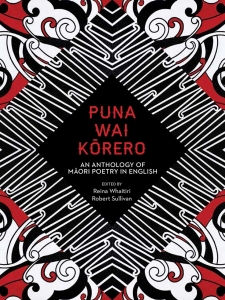
Puna Wai Kōrero: An Anthology of Māori Poetry in English — I flipped a question that I carried with me through my doctoral thesis

1411441130757

Puna Wai Kōrero: An Anthology of Māori Poetry in English editors Robert Sullivan and Reina Whaitiri (Auckland University Press, 2014)

I am curious as to how many Māori poets we can name beyond a handful, beyond the much loved Hone Tuwhare. Open a New Zealand literary journal and do we still fall upon a Pākehā bias? The arrival of Puna Wai Kōrero: An Anthology of Māori Poetry in English (2014) presents us with a selection of writing that celebrates a wide and vibrant field. The editors, Robert Sullivan and Reina Whaitiri have brought a glorious range of voices into the spotlight.

Robert, of Ngāpuhi/Irish descent, is a poet and anthologist, and is currently Head of the Creative Writing Programme at Manukau Institute of Technology. Reina, of Māori/ Pākehā descent, is also a poet and an anthologist, and has taught English at the Universities of Auckland and Hawai’i. Along with Albert Wendt, Robert and Reina edited Whetu Moana (AUP, 2003) and Mauri Ola (AUP, 2010).

Puna Wai Korero is a moving feast. The poets selected come from a variety of locations, circumstances, backgrounds, writing preferences. The choices of style, tone, subject matter and poetic techniques are eclectic. There is humour, inward reflection, love and loss. There are poems of the marae and poems of elsewhere. There are mothers, fathers, sons and daughters. There is politics on the quiet and politics loud and clear. There is grief. There is home. There are familiar voices, there are those that are not. There are writers known for their fiction.

Through all this, I flipped a question that I carried with me through my doctoral thesis (does it make a difference if the pen is held by a woman?) to ask: Does it make a difference if the pen is held by a Māori. Do some writers deliberately and gloriously foster a Māori voice (perhaps, where the poet stands and writes from, how the poet stands and writes from, how the oratory traditions of the marae inflect the poetry, how genealogy inflects the poem and so on). I spent seven years hauling my question through politics, law, history, psychology, familial relations, art, literature, history, patriarchy within an Italian context and the Italian language. Over the past months, I have held a book that drew me in close to all of these things within the miniature frame of a poem and within the context of Aotearoa. You can view the poems within whatever cultural luggage you bring to them (a Western paradigm of how to write a poem and how to break a poem, both cemented by tradition and innovation). Or you can step out of that luggage and approach these poems afresh, and in doing so open out the ways in which we can make and read and hear poetry.

This was the first joy of reading this anthology — navigating the burgeoning questions for which I felt inept at answering.

The second joy, the equally sustaining joy, was the discovery of new writers along with a return to those well loved (whenever I visit secondary schools I share my James K Baxter/Hone Tuwhare anecdotes that kickstarted me on the path of poetry in 1972). A wee taste of what I have loved: a tingle in reading Hilary Baxter’s ‘Reminiscence,’ the heart and gap in all of Hinemoana Baker’s poems, the sharp kick of Arapera Hineira Blank’s ‘After watching father re-uniting with sons in prison,’ the utter joy of Bub Bridger’s ‘Wild daisies,’ the force of Ben Brown’s ‘I am the Māori Jesus,’ the insistent catch of Marewa Glover’s ‘Pounamu,’ the evocative laying of roots in Katerina Mataira’s ‘Restoring the ancestral home,’ the pocket narrative in Trixie Te Arama Menzies’s ‘Watercress,’ the piquant detail of Paula Morris’s ‘English grandmother,’ the subtle shifts in Kiri Piahana-Wng’s ‘Four paintings,’ the verve and aural steps of Vaughan Rapatahana’s ‘Aotearoa blues, baby’ (I want to hear him read this!), the sumptuous detail in Reihana Robinson’s “God of ugly things,’ the poetic and political and personal stretch of Alice Te Punga Somerville’s ‘mad ave,’ all of JC Sturm (especially ‘At times I grieve for you’), Robert Sullivan (especially ‘Voice carried my family, their names and stories’), Apirana Taylor (especially ‘Te ihi’ and ‘Haka’) and Hone Tuwhare (especially, most utterly especially ‘Rain’).

This is a book of returns, to be kept on every shelf. Bravissimo!

This is a poetry collection I am so looking forward to …

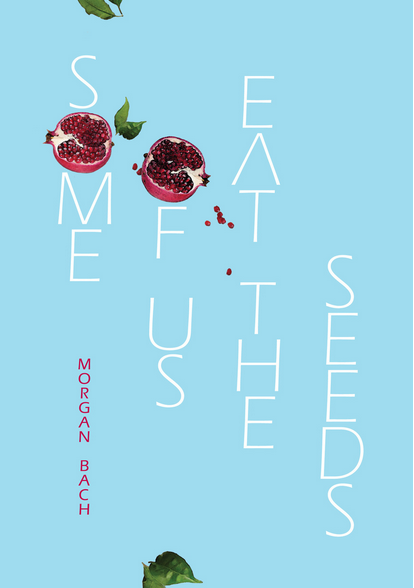
I can’t wait to read this new offering, a debut poetry collection by Morgan Bach, coming soon from Victoria University Press. What an adorable cover.

Morgan Bach’s author page is here.

Screen shot 2015-03-30 at 9.41.21 PM