Category Archives: NZ poetry

Poetry Shelf The Summer Season: Poets pick poems – Bill Manhire picks Louise Wallace

DSCN7357.jpg

Four Seasons on Poetry Shelf aims to widen the scope of voices, selections, opinions, poetry tastes, sidetracks, reading options in 2017 on the blog. Each season will be different.


First up, The Summer Season where, over the course of two weeks, New Zealand poets pick a favourite New Zealand poem and offer a few comments.

I have spent the past year reading, writing and researching my way through poetry by New Zealand women for my book. Sometimes a poem feels like a foreign country, a sea in which I haven’t the foggiest idea how to swim, and I feel like I am treading water, hopelessly. But sometimes, upon return, when the light catches the poem aslant (thanks Cilla McQueen!), I find myself swimming and it is heaven. Sometimes it’s just a matter of changing stroke, of navigating the tidal flow with different eyes. Different ears.

Reading outside your comfort zone, reading into the unfamiliar along with the much loved, is an absolute joy.

Yep, poetry is an absolute joy.


To launch the season, I am posting a poem Bill Manhire is very fond of:

‘Poi Girls’ by Louise Wallace (Since June, Victoria University Press, 2009).

Bill also suggested including a link to Louise’s excellent short note on the Best New Zealand Poems site. However Louise has granted permission to post both the poem and the comment. Thank you!

The Poi Girls

Kahu, Mere, and Faith
stand on the grass
by the corner.
They lean
on the fence and watch you
walk past –
spinning, twirling their poi.
Pou
Pou
Pou
The Poi Girls
say with their poi,
with each hard slap
of their poi.

On your way home
they’re in the same spot,
Kahu, Mere, and Faith.
Their older brothers and cousins
are fixing the car, out
on Mere’s lawn.
The boys stop as you
walk by.
They lean their hands
on the car’s sides and look out
from under the hood.
What
you
want?
The Poi Girls
say with their poi.

You’re walking
down the dip
but you have left
your shoes at school.
The yellow seeds
stick to your feet,
and when you get up
the other side, The Poi Girls
are looking
at you.
Om
Om
Om–mee
The Poi Girls
say with their poi.
Piss off,
you tell them,
leave me alone.
You don’t need
their crap as well.

You stuff Pak ‘n Save bags
into white plastic
and tie
them up with string.
You walk past the corner
twirling and spinning,
Hey
you!
Bumheads!
you say with your Pak ‘n Save poi.
The Poi Girls chase you
down the street
but you are too little and fast
for them,
especially for Faith, the fat one,
the one with the lighter skin.

One day in the cloakroom
It’s just you and Thomas
and he tells you
you have beautiful eyes –
green and brown,
just like his girlfriend, Jade’s.
The Poi Girls burst in, twirling.
You
kissed
Thomas!
The Poi Girls
say with their poi,
your cheeks
pounding flush.

Your sister tells you
to run through the mud
and you say you will
and that you don’t even care.
So you run
and halfway you sink
to your waist
and down the dirt road
come The Poi Girls, slowing
to a stop.
Ha!
You
egg
The Poi Girls
say with their poi
and leave
with your sister
in tow, twirling.

It’s sunny but cold
that morning, on the way
to school.
Mere’s front lawn
is filled with cars,
and there are people in suits
and old koros with sticks
and The Poi Girls stand
out the front.
Mere doesn’t
look at you today,
so Kahu and Faith
glare twice as hard for her.
The Poi Girls’ poi
hang still
from their hands
and today
say nothing at all.

©Louise Wallace Since June, Victoria University Press, 2009.


Louise comments:  ‘ “The Poi Girls” is one of those rare poems that came to me almost fully-formed in the middle of the night. I scribbled it down then and there, and I wish this happened more often! I grew up in Gisborne and the essence of this poem comes from there. The poem is about childhood, curiosity and the nature of difference, but contains a certain menace too. Through the sound of the poi and its repetition I hoped to convey the weight and seriousness that events so often have when you experience them as a child.’


Best NZ Poems

Listen to the poem here.
Poet honoured on Waitangi Day: Selina Tusitala Marsh, Honorary Literary

1456791150657

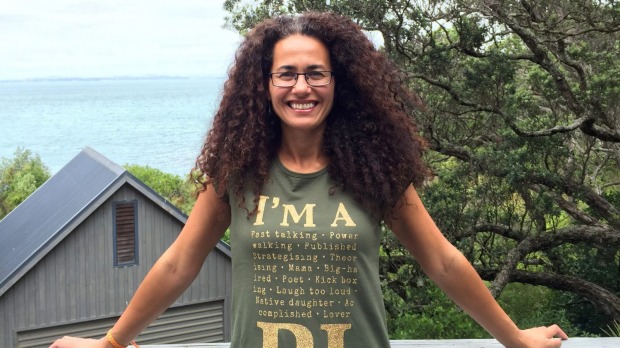
Acclaimed poet and scholar, Selina Tusitala-Marsh, has been made Honorary Literary Fellow in the New Zealand Society of Authors’ annual Waitangi Day Honours.
“As the country’s largest writers’ organisation, we believe it’s important to celebrate significant literary achievements, especially on the international stage,” said NZSA President, Kyle Mewburn. “Each year more and more kiwi writers are achieving exceptional things internationally. Last year was no exception.”
“As 2016’s Commonwealth Poet, this year’s NZSA Literary Fellow, Selina Tusitala-Marsh, was able to share her unique and powerful voice with the world. This included a memorable performance before the Queen at the Commonwealth Day of Observance in Westminster Abbey, which placed the diversity of our local poetry in the international spotlight,” Mewburn said.
“Fa’afetai tele lava for this lovely acknowledgment,” said Tusitala-Marsh. “The wondrous thing about a poem is that it’s an ‘ala’ – the proto-Polynesian word for ‘path’. As a ‘Tusitala’ my poems are paths between cultures and world views. In 2016 a poem found its way into Westminster Abbey connecting my Tuvalu grandfather with the Queen of England, Samoan philosophy with global ecology, and a New Zealand Fast Talking PI poet with the Commonwealth. How marvellous is that? Here’s to paving more poetic paths!”
First introduced in 2013, the NZSA’s Waitangi Day Honours celebrate success on the international stage.
“As the only writing awards bestowed by peers, they have become a highly regarded and prestigious honour,” Mewburn said.
Previous winners include Eleanor Catton, Paul Cleave and Philip Mann.

The gift shop


The gift shop


When Josephine leaves Ellis Island she is not yet sure what she takes away with her, and what she leaves behind in the glass cabinets, and she wonders if the gift shop sells little blue bottles of hope, gathered as carefully as saffron, to keep in a coat pocket and season the next day, and then the day when it is most needed.


© Paula Green New York Pocket Book Seraph Press, 2016.


Liz Breslin, placed third in Charles Causley International Poetry Competition Winners 2016

Screen Shot 2017-02-01 at 7.17.09 PM.png

The Winners:

1st: ‘The Load’ by Jack Thacker (Bristol) – £2000 and a week at Cyprus Well

2nd: ‘The Year You Turned Into A Fish’ by Joanne Key (Cheshire) – £250

3rd: ‘Walk A Mile/ Stepping Out’ by Liz Breslin (Hawea Flat, NZ) – £100


As a child in the UK, Liz Breslin memorised Charles Causley’s poems, sitting in the bath. She now lives in Hawea Flat, New Zealand and writes poems, plays, stories, articles, and a fortnightly column for the Otago Daily Times. She also edits, parents, partners, skis badly, gardens sporadically, coordinates a school student volunteer programme, drinks too much coffee and loves getting her feet wet.

Liz’s first collection of poems, Alzheimer’s and a Spoon, will be published by Otago University Press in 2017. She is comfy on the page and the stage, was second runner up in the 2014 New Zealand Poetry Slam in Wellington and did an audience-response poem at the 2016 TEDx Queenstown. Liz took part in the ‘52’ project in 2014, where she discovered new voices and fantastic practices. Her poems can be found in Landfall, Café Reader, Takahē and other places in NZ, overseas and online, as well as brewing in the bath. Poems give her hope, connection and stoke. http://www.lizbreslin.com


Full details here.

Comments from Liz here.

You can find some of her poems here and they are good!

Exciting to see Liz has a collection out with Otago University Press this year.

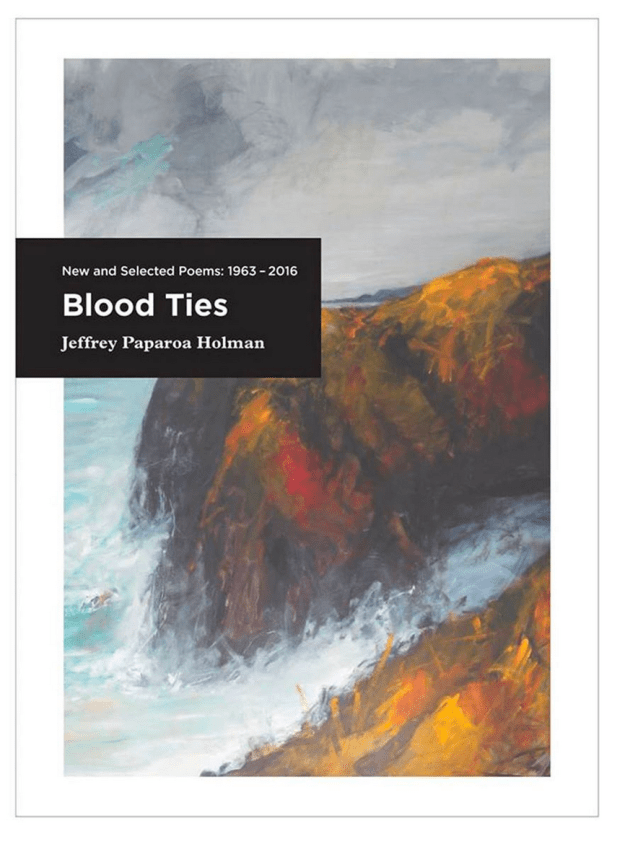
A Selected Poems from Jeffrey Paparoa Holman is out this month

BLOOD TIES: New and Selected Poems 1963-2016.
Jeffrey Paparoa Holman, Canterbury University Press,
978-1-927145-88-3, $25.00, due February 2017.

‘Blood Ties is a journey through a lifetime that is a parable of settlement, one man’s response to the challenge of living responsibly and with sensitivity to the question of where we are and what we must be. There are strong ancestors throughout, but, at the same time and very distinctively, the urgent sound of this river of poetry is all this fine poet’s own.’
Patrick Evans


Screen Shot 2017-02-01 at 7.10.52 PM.png

Poetry Live relaunches with Anne Kennedy and MW Sellwood

Screen Shot 2017-02-01 at 7.06.14 PM.png


Come one, come all, to our opening night of the year!

GUEST POET: ANNE KENNEDY
Anne Kennedy is a poet, novelist and screenwriter. Her awards include the NZ Post Book Award for Poetry for Sing-song and the Montana New Zealand Book Award for Poetry for The Darling North. Her novel, The Last Days of the National Costume, was shortlisted for the NZ Post Book Award for Fiction in 2014. In 2016 Anne was Writer in Residence at IIML, Victoria University of Wellington. She teaches fiction and screenwriting at Manukau Institute of Technology.

GUEST MUSICIAN: MW SELLWOOD
MW Sellwood is an up-and-coming Auckland blues artist from the city’s thriving underground music scene. Equally at home performing tunes on stage or a street corner, his groovy electric guitar riffs and playful vocals combine for a fresh take on Blues music in the new millennium!

POETRY OPEN MIC

KOHA ENTRY

MC: KIRI

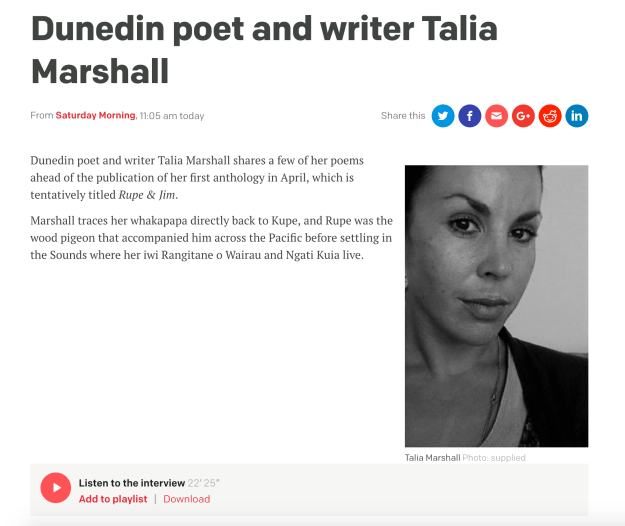
Fabulous poems from Talia Marshall on Radio NZ National

Screen Shot 2017-01-28 at 4.04.37 PM.png

Good to see Radio NZ National deleting excellent poetry.

Poems can be heard here.


A week of poems: Bernadette Hall’s ‘This for the end of a year’


This for the end of a year

        from a chorus of short-tongued alpine bees


Let us give thanks for the flushes and zones of colour

in the herb-field, for the alpine genera,

the wire rush and the tangle fern, the sheep sorrel

and the cats-ear, the gentians and the astelias and everything

that grows under the edge of a melting snow-bank.


Let us give thanks for the cranesbill geranium and

the mouse ear  myositis, for the ranunculus (little frog mouth,

little friend), for the feathered myrrh of the nival zone,

for the bog moss in the tarn,

for all that is and all that has been and all that is to come.


It is for us to keep our courage firm,

to nurse our appointed pain,

to await ‘that which springs ablaze of itself. ’


©Bernadette Hall

(first published under a different title in Life & Customs VUP 2013)


A week of poems: Gregory O’Brien’s ‘Poplar Tree, Tukituki River I and II’


Poplar tree, Tukituki River I

Head-

quarters of this

bird-brained

valley–

early summer–

tui brush

the sky’s blue

a quivering branch

signals another departure

endless comings and

goings–the blueness

of each black bird.


Poplar tree, Tukituki River II

Greenery, blue-

tail, tui

bloomery.


©Gregory O’Brien