Category Archives: NZ poems

A poem from Jo Thorpe’s new collection: This Thin Now


This lovely hand of yours


The fine warmth and pulse of it – beauty gets

a sounding in the oldest skin, it takes

the flutterings of veins and chimes them through.

The mind slows and alters – as in the grove

of midnight you place a hand on top of mine

then sleep, full-upright in your blue-winged chair,

TV on, the weekend’s busy-ness – a grand-

daughter’s wedding – now over.  Dark clocks round,

intimate and mute.  Inside the space that

two hands make, I have you travelling with the stars,

your palm – enclosure of will and deed – lit

with the scripts of all your being and becoming,

the long, long story of your time.

In this gift of moment, I find myself

humming and whole, stopped at the centre

of whatever your hand has held,

between the moon’s abundance and the sun’s.


©Jo Thorpe This Thin Now, HoopLa Series, Mākaro Press 2018


Jo Thorpe was born in Wellington in 1948. She grew up in Gisborne, and graduated from Auckland University before settling in Wellington. Jo is the author of two previous poetry collections: Len & Other Poems (Steele Roberts Aotearoa, 2003, written in part as a response to the work of Len Lye and Roger Horrocks’ biography of the visionary kinetic artist); in/let Steele Roberts, 2010.

Jo has a masters in creative writing from the International Institute of Modern Letters, Victoria University. She taught Dance History at the NZ School of Dance in Wellington (2003-15), danced with the Crows Feet Dance Collective (2002-15) and has written dance criticism for a variety of publications.

Jo has three daughters, five grandchildren and now lives in Turanganui-a-Kiwa/Gisborne.


Poetry Shelf Monday Poem: from Gregory Kan


Moving from one world to another

is like dying in a dream

of hands and water.

Nothing is forgiven because

nothing is remembered

but the desires remain the same:

to be in a room with others

satisfied

tired of wonder

holding each other

with the good secret

of no longer having to insist on going

where we think we have to go.


©Gregory Kan

Gregory Kan’s work has featured in literary journals including Atlanta Review, Cordite, Jacket, Landfall, The Listener, SPORT and Best New Zealand Poems, as well as art exhibitions, journals and catalogues. His first book of poetry, This Paper Boat, was shortlisted for the 2017 Ockham New Zealand Book Awards. His second book of poetry, Under Glass, is forthcoming with Auckland University Press in 2019.


On reading Short Poems of New Zealand


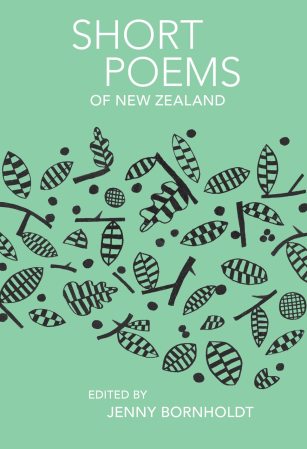
Short_Poems_of_New_ZealandRGB__74017.1533875435


Short Poems of New Zealand, edited by Jenny Bornholdt, Victoria University Press 2018


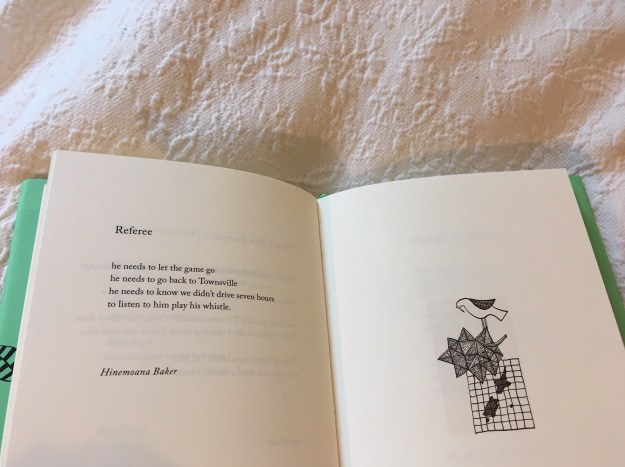
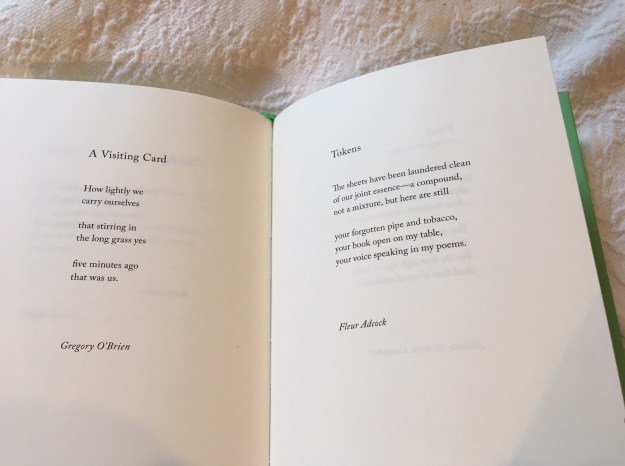
Jenny Bornholdt has edited an anthology of short poems illustrated by Gregory O’Brien. She began collecting short poems eight years ago and  rediscovered her folder last year. In her introduction she likens short poems to the ‘small house movement’.


‘I’ve begun to think of short poems as being the literary equivalent of the small house movement. Small houses contain the same essential spaces as large houses do. Both have places in which to eat, sleep, bathe and sit; they’re the same, except small houses are, well, smaller.’


She gave herself a line limit (nine lines) because ten lines seemed to be that much roomier.

She favoured magnetic attractions in her arrangements.

I emailed Jenny and asked what had drawn her to the short poem.


‘They tend to offer one strong, memorable image or thought – it’s this concentration of language that appeals, I think. Short poems often work as the commas in a collection, so it’s interesting to pay them close attention and see what happens when you put a selection of such intense ‘pauses’ together.’


Why do I like short poems and consider this beautifully produced collection an exquisite object? Because I love poetry that has room to breathe – where white space is the silent beat, the clean sheet, the place to meditate. A short poem is like a complex note. It vibrates. Like a guitar string. Or wine. Or the ocean in the heat.

One of my favourite poems in the collection, ‘Night’ by Albert Wendt, epitomises the way a short poem becomes large. The image is strange and captivating. I never tire of reading this poem. You can hear Albert read it here. You will never tire of listening.

Some poems, like Hone Tuwhare’s ‘Haiku 1’, Bill Manhire’s ‘My World War I Poem’ or Angela Andrews ‘Grandparents‘ have been in a room in my head for ages. These tiny poems are perfect to savour when you have waiting moments. Again you will never tire of listening.

I recommend placing the book beside the bed and reading one poem before you go to sleep as a keepsake for the night – or one poem before you rise as a keepsake for the day.


Victoria University Press page

Jenny Bornholdt is the author of many poetry collections, including The Rocky Shore (Montana New Zealand Book Award for Poetry, 2009) and Selected Poems (2016), and many chapbooks. She has co-edited several notable anthologies, including My Heart Goes Swimming: New Zealand Love Poems. Her most recent book is The Longest Breakfast (illustrated by Sarah Wilkins, Gecko Press, 2017). She was the Te Mata Estate New Zealand Poet Laureate from 2005–6.


img_46641.jpg


IMG_4663.JPG


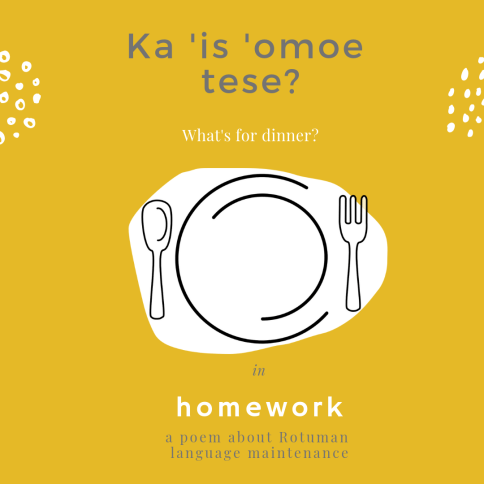
Poetry Shelf audio spot: Mere Taito’s ‘Homework’


Homework image.png


Mere Taito is a Rotuman Islander poet and flash fiction writer living in Hamilton with her partner Neil and nephew Lapuke. She is the author of the illustrated chapbook of poetry titled, The Light and Dark in Our Stuff.


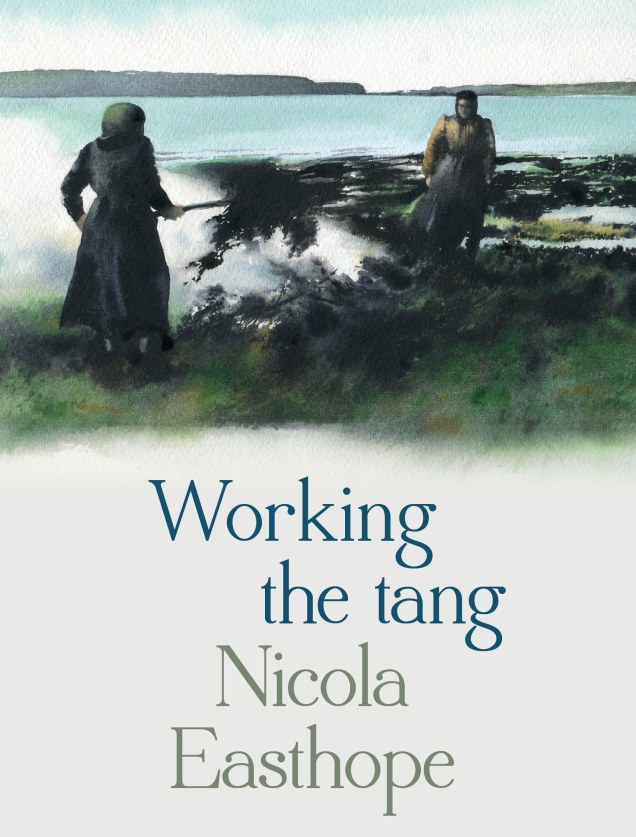
a poem from Nicola Easthope’s new collection – Working the Tang


Working the tang, Birsay


These women are wrapped for the weather.

The fleece of long-nosed black sheep

so knitted into their skin, when their men

undress them there is often a little blood.


The weather wraps in gales of Arctic ice.

They gather seaweed: tremendous heaps

of tang and ware, dragged up the sloping beach

to the dry. These women burn


it steadily, crackling heather and hay in great pits

of stone until the white powder

of potash and soda is all that remains.

The men pound and pound,


cover with stones and turf. Leave overnight.

The ash shifts, cools, and lumps of toil

settle on their backs. They sleep with

the weight of a body on the chest.


Ghost dust drifts into livestock,

limpets. Fish are driven away.

The women are wrapped in the drapery

of ash, the cloak of salt, the taste of tang.


Their kelp-making for the laird’s gain.

Their backs spent for soap and glass.


©Nicola Easthope, from Working the Tang  The Cuba Press 2018


Nicola Easthope is a teacher and poet from the Kāpiti Coast. Her first book of poems, leaving my arms free to fly around you, was published by Steele Roberts Aotearoa in 2011. ‘Working the tang, Birsay’ is inspired by her Orcadian roots and the etymologies and experiences of the Norse word for seaweed (among other things). She was a guest poet at the Queensland Poetry Festival in 2012, and last month, the Tasmanian Poetry Festival.

Working-the-tang-front-cover-updated.jpg


Poetry Shelf Monday Poem: Heidi North’s ‘Piha Beach, Winter’


Piha Beach, Winter 


My feet punch bruises in the black sand

and I am back in the burn of childhood summers


the circle of sentinel gulls

their grey wings tipped to catch the light


warn me back

but I go down to the white foam edge


bluebottles boated with their pretty poison

yield to the sharp edge of my stick


I go down to the place

where the wind kicks holes through my heart


and there is a child down there

too close to the ribbony horizon line


holding his blue kite

towards the updraft


still smiling as it lurches

against the wide white blaze of sky –


and I smile and laugh and I run with him because how can I tell him

all the brutal things are yet to come


©Heidi North


Heidi’s poem was written during her Nancy King Foundation residency in Piha in 2017.

Heidi North’s first poetry book Possibility of Flight was published by Mākaro Press in 2015. Her poetry and short stories have been published in New Zealand, Australia, the US and the UK. She won an international Irish award for her poetry in 2007, and has won New Zealand awards for her short fiction. She joined the Shanghai International Writers Programme in 2016 as the NZ fellow. She was awarded the Hachette/NZSA mentorship for 2017 to work on her first novel. She has a Masters in Creative Writing from The University of Auckland and lives in Auckland with her partner and their two children.


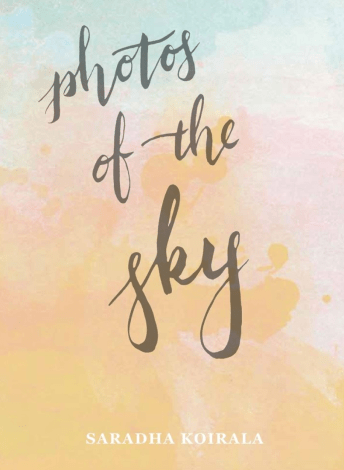
Poetry Shelf audio spot: Saradha Koirala reads ‘Snapshot’

Screen Shot 2018-11-05 at 3.56.08 PM


Saradha Koirala reads ‘Snapshot’  from Photos from the Sky (Cuba Press, 2018)


Saradha Koirala is a writer and teacher living in Melbourne. Her book Lonesome When You Go won a Storylines Notable Book Award. She has published two previous poetry collections.


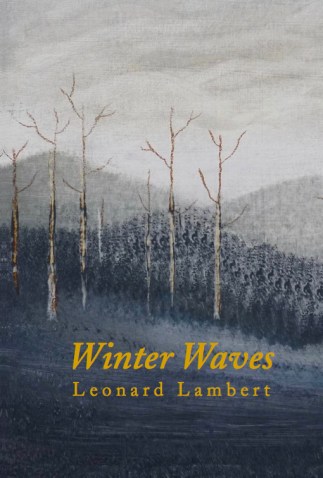
A poem from Leonard Lambert’s new collection: Winter Waves


The Dolphin Badge


In a carton in a corner of a drawer

I came across a badge, sky-blue, the size of a coin:

for proficiency in the pool,

the Dolphin Badge, the dream of years, the grail . . .


And so, or so it seems to me,

the odd dishonour of discarded things, their sad dismay,

is maybe telling us life is too fast

for the right living of it;

and maybe too in some scrambled dawn

the notion might come

of a press of tiny judgements,

some essential fabric torn.


©Leonard Lambert from Winter Waves (Cold Hub Press, 2018)


9780473457693.jpg

Leonard Lambert is a long-established NZ poet with a publication history stretching from A Washday Romance (John McIndoe, 1980) to Somewhere in August: Selected Poems 1969-2016 (Steele Roberts, 2016). He is represented in Essential NZ Poems (2003 and 2014), Swings & Roundabouts (2008), and Poems from the Pantry (2017). Between poems he paints beautiful and mysterious works which he exhibits regularly in Hastings and in his home town of Napier.


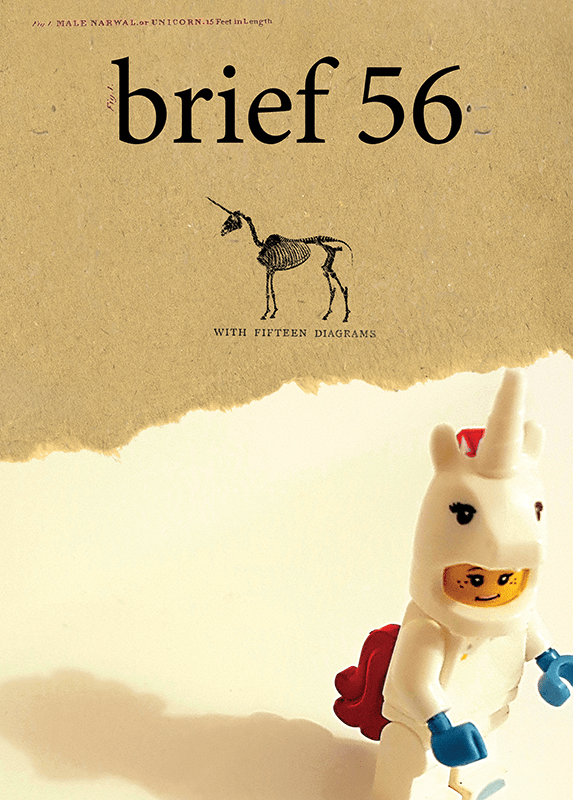
Reading ‘brief 56’


Issue56.png


After all manner of ‘changes, transformations, alterations, mutations, re-orderings, transfigurations, conversions, variations, reorganisations, evolutions, metamorphoses, modifications and reconstructions’ Brief has re-emerged.

Olivia Macassey remains editor and  the issue is dedicated to Jill Chan, poet and writer (1973 – 2018).

This is a journal where writers play with what words on the page do but not to the point they are denied heart, art or musical impact. The reading effects are multiple. Take essa may ranapiri – with their spiky yet lyrical movements from body to more body (desirable?) to falling lark to unsated tabby.

In Brief‘s pages words are inclined to go bold, stretch out or drift and float on the white space of reading. Loren Thomas’s ‘Wrists’ ( I have not read her before!) offers friendship links, bracelets and then pulls that into question with the white-space hiccups in the middle.

Then again you might delight in John Downie’s poetry sequence; it’s built along a time line in stanzas hugging the left-hand margin and a strong sense of narrative. It may be autobiography or invention but I look forward to the forthcoming book with accompanying images it is taken from: The Only Time: an autobiography in twelve pictures.

The mark of a good journal is that it keeps you moving through diverse and distinctive fascinations. I move from the single breath piece by Carin Smeaton (‘what to do with them all’) that I just want to hear read aloud to the agile wit of Nick Ascroft’s ‘Bring Me a Pie’ (just love this couplet: ‘pull itself through the spitty drizzle,/ the rice pudding of town’).

I delight in the tropical heat of Lisa Samuels where words block out the immediate world because it is just you and the poem and you want to set up residence. I am thinking tropical because her writing shimmers in ways that are both intensely real and satisfyingly unreal.

Then again there is the audacious imagination of Chris Stewart’s ‘My father is an elephant’ that reads like a strange and wonderful children’s story written for adults:


I have a grey memory

of my father the elephant.

His ears brushed the dust

on my mother, but I never

heard his trumpet fountain

any water when her skin was dry.


I checked his bio and he won The Margaret Mahy Prize at the Hagley Writers’ Institute in Christchurch. I can see why. His poems have appeared in multiple journals but it is clearly now time for a collection!

I have barely scratched the surface because my fascinations include writing by Iain Britton, John Adams, Vaughan Rapatahana, Jack Ross, Erik Kennedy, Bronwyn Lloyd.  I am super conscious that the issue is so varied in direction and intent that a reader will find quite different points to linger over with heart and intellect on diverse settings.

I am a fan of literary journals because at their best they reacquaint  me with old favourites, introduce new voices, make me hungry for more and most importantly, make me want to write. brief 56 is no exception.


Dust to Dust


Five hundred years from now,

we’ll, of course, be dead.

Perhaps archaeologists

will unearth our bodies

and miss our minds.

How they will dare to think.

What will they find of us ?

What does the heart leave behind

that is not buried,

that is not saved?


Jill Chan


Brief 56 page

John Dwnie’s poem and colour reproductions