The book is near! Launch on
9 March at University Book Shop in Christchurch, 5.30pm.
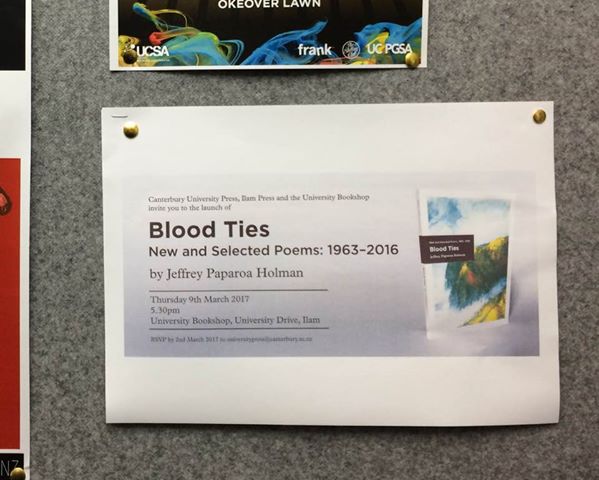

The book is near! Launch on
9 March at University Book Shop in Christchurch, 5.30pm.
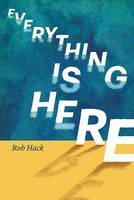
Rob Hack, Everything is Here, Escalator Press
‘Rob Hack’s poems have itchy feet. They are the product of transience, a ‘driftwood life’. Hack moves from Cannons Creek, Porirua, to Niue, to Rarotonga, Australia, and even Paris and Verona. Understated, yet evocative, these poems are cinematic postcards to all the homes where the heart might find itself. Hack is a citizen of the global village. One feels ‘everything is here’ and then here, and here too. There is a feeling that Hack is Outsider, though, that he is never realised as a person of one place.’
Full review here
On Poetry Shelf

VUP warmly invites you to the launch of
Fully Clothed and So Forgetful
by Hannah Mettner
on Thursday 16 March, 6pm–7.30pm
at The Guest Room, Southern Cross, 39 Abel Smith St, Wellington.
Refreshments will be served. All welcome.
Books will be available for purchase courtesy of Vic Books.
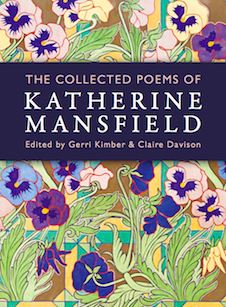
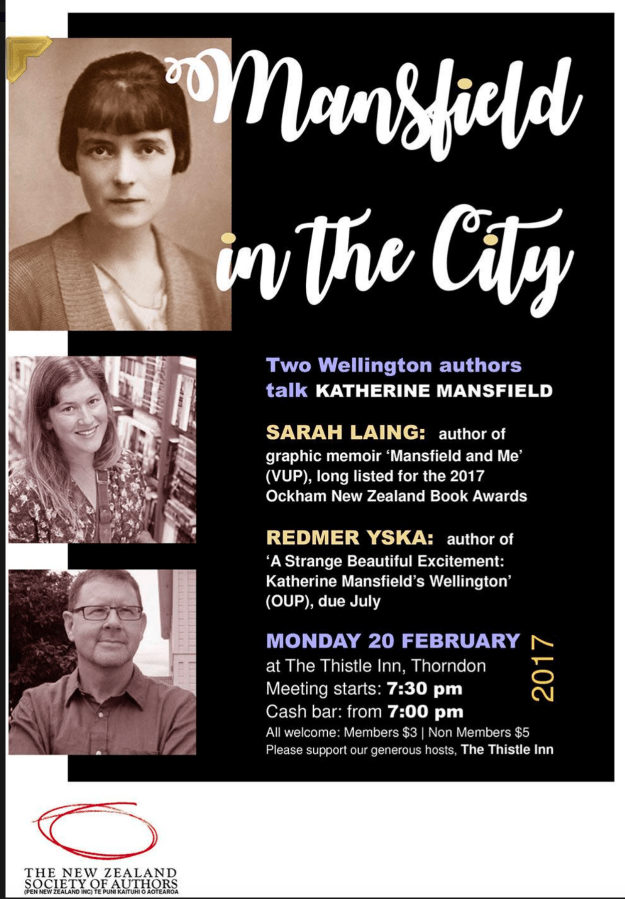
The Collected Poems of Katherine Mansfield edited by Gerri Kimber and Claire Davsion, Otago University Press, 2017
Otago University Press recently released a beautiful hard-cover edition of Katherine Mansfield’s Collected Poems edited by Gerri Kimber and Claire Davison.
Gerri Kimber is a visiting professor in the Department of English at the University of Northampton, UK. She is co-editor of Katherine Mansfield Studies and chair of the Katherine Mansfield Society. She devised and is series editor of the four-volume Edinburgh Edition of the Collected Works of Katherine Mansfield (2012–16).
Claire Davison is professor of modernist studies at the Université Sorbonne Nouvelle – Paris III. She is the author of Translation as Collaboration: Virginia Woolf, Katherine Mansfield and S.S. Koteliansky (2014). Her ongoing research focuses on trans-European modernist links on the radio in the 1930s–40s, and the links between modernist literature and music.
When Vincent O’Sullivan edited a smaller selection in 1988, he did not have access to the more recent discoveries such as ‘The Earth Child’ sequence, and he purposefully omitted Mansfield’s ‘mawkish Child Verse: 1907.’ O’Sullivan introduces Mansfield and her poetry in a somewhat different vein than the editors of the new book do. He suggests that John Middleton Murray scrambled to get Poems by Katherine Mansfield out the year after her death, but that she had not attempted to get this work published herself. Indeed O’Sullivan suggests that while ‘she returned to writing verse at different times during her life, Mansfield made no claims to being a poet.’ O’Sullivan offers two reasons to read the poetry of Mansfield:
‘We may regard her poetry now as Mansfield herself tended to think of it—unassuming, often slight, serviceable enough for occasional published excursions into inherited effects and derived styles, yet capable too of unexpectedly inventive turns and intensity. Or we may read it for its vivid biographical faces, the quick clarities of her attention as it catches at angles of memory or self-scrutiny’ (‘Introduction,’ Poems of Katherine Mansfield).
I read my way through the Collected Poems before I read the poem notes or either introductions because I wanted to make up my own mind about what Mansfield’s poetry was doing. Would the poetry afford interest at the level of the poem or would it simply seduce me with biographical traces? I find myself positioned halfway between O’Sullivan’s approach and that of the new editors. I find the biographical residue fascinating and I find poems that startle and shine but I also spent a long time pondering the way in which the child drives the poetry. I am not going to write Mansfield’s poetry off as naive and child-like, but it is a complicated and intriguing issue that I want to explore elsewhere. Having spent the past year researching early New Zealand women poets, it seems that Mansfield was producing something altogether different.
Kimber and Davison make big claims for Mansfield in their introduction:
‘Mansfield’s poetic art may lie in briefly surveyed scenes, passing voices and imagist-type glimpses, but they constantly connect to the wider socio-political realities around her. Hers is a poetic voice that requires us to rethink the lyric, and recall that, across the centuries, lyric poetry has never been synonymous with simply ‘being lyrical.’ Even when Mansfield’s immediate subject matter may be mere snippets of everyday life, and even when the poetic voice appears to be laughing, her “cry against corruption” is still clamouring to be heard: war, the condition of women and other socially marginalised groups, poverty, class consciousness, sickness, bereavement—these themes too can provide the stuff her poetry is made of (‘Introduction’ p21-22).
Despite various quotations from Mansfield’s letters to clarify her relationship with poetry, I am not convinced that poetry was her number-one writing love. Poetry served a purpose, perhaps multiple purposes, at particular times, and on many occasions, represented exquisitely framed observations, memories, feelings. The poem became a vehicle of self, both introspective and outward reaching, and drew upon some of the themes Kimber and Davison list.
What makes the collection essential reading for me:
The opportunity to follow the absorbing development of Mansfield’s poetry from young girl to young woman
The way child-like things endured
The way the persistent themes of love, isolation, natural beauty, freedom and illness nourished the poetic ink
The way KM stepped (wrote) outside herself in order to see (write) herself
The way some things (New Zealand, her husband, her writing life) were barely visible or audible but left a presence on the tongue as I read
The way some things (her brother, her grandmother) were sharp and potent and surprising like little keepsakes to be borne forever
If Mansfield’s poetry requires us ‘to rethink the lyric,’ so do a number of New Zealand women poets writing at the time. Perhaps I am more inclined to say we need to re-tune how we read these early women poets. I see Mansfield’s poetry evolving outside the labyrinth of local women, but like these pioneering writers, there are continual adjustments to rhythm, rhyme, revelation, reserve, ideas, feelings, aims; to the writing of the lyric. For me Mansfield’s poetry is still a puzzle that I need to think and write about more extensively before I can make any claims, however tentative they might be, particularly in view of the child. But I am caught in the clarity of her writing, the distilled or vivacious mood, the melancholy, and I like it.
What I can do is offer a tasting plate of some highlights as I read:
from The […] Child of the Sea (1906)
Here in the sunlight wild I lie
wrapt up warm with my pillow and coat
Sometimes I look at the big blue sky
from ‘London London I know what I shall do’ (1907)
London London I know what I shall do
I have been almost stifling here
And mad with love of you
from Little Brother’s Story (1908)
I made up one about a spotted tiger
That had a knot in its tail
But though I liked that about the knot
I didn’t know why it was put there
from Loneliness (1910)
Now it is Loneliness who comes at night
Instead of Sleep, to sit beside my bed.
Like a tired child I lie and wait her tread,
I watch her softly blowing out the light.
from Sea Song (1910)
Memory dwells in my far away home.
She is nothing to do with me.
from Violets (1910)
The room is full of violets –
And yet there’s but this little bowl
Of blossoms on the mantle-piece.
from Scarlet Tulips (1913)
Strange flower, half opened, scarlet
So soft to feel and press
My lips upon your petals
Inhaled restlessness
from Camomile Tea (1916)
Our shutters are shut, the fire is low,
The tap is dripping peacefully;
The saucepan shadows on the wall
Are black and round and plain to see.
from ‘Lives like logs of driftwood’ (1916)
Lives like logs of driftwood
Tossed on a watery main
from Pic-Nic (1918)
And she crawled into a dark cave
And sat there thinking about her childhood
Then they came back to the beach
And flung themselves down on their bellies
Hiding their heads in their arms
They looked like two swans.
from Men and Women (1919)
I get on best with women,’
She laughed and crumbled her cake.
from The New Husband (1919)
Who’s the husband – who’s the stone
Could leave a child like you alone.
from Et Après (1919)
She was hard to please
They’re better apart.
from The Wounded Bird (1922)
In the wide bed
Under the green embroidered quilt
With flowers and leaves always in soft motion
She is like a wounded bird resting on a pool.
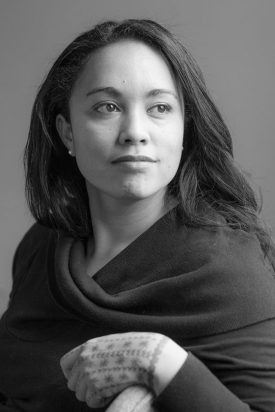
Form-bending writer and 2017 Ockham long-lister for Tail of the Taniwha, Courtney Sina Meredith opens her notebooks to us, from her prestigious 2016 residencies at the International Writing Program, University of Iowa, and at the Island Institute in Sitka Alaska.
an extract:
Iowa City September
Because she was so unlike moonlight
Because the night arranged itself according to height
Because everyone read the same books and said the same things
Because the buses were dependable
Because she settled like dust
Because the days were numbered according to weight
Because she was impatient
For the full journal see here.
Photo credit: Thomas Langdon


Swordfish . . . Far Hotel
That’s me up there cast in plaster
above the wide window
of a coastal pub’s vista bar.
I am the trophy of some forgotten fisherman.
Cigarette smoke fogs my vision
but I still see that day the trophy of my life was taken.
Again I feel. I feel the hook deep within me catch
I feel my anger whip
I feel the tackle tighten
I feel my guts explode
I feel the rainbow strength of colours in me leap
I feel the sky like a mirror smashing
I feel the sun across my dorsal fin get torn
I feel the waves beneath me again and again split open
I feel the blood in the protein church of my heart begin to chant
I feel the hook in my brain burning
I feel the trace against my jawbone cut
I feel time tight as a nylon line almost breaking
I feel the great poem of my life and I know that it is ending.
©Bob Orr Valparaiso Auckland University Press, 2002.
I found myself hesitating between two very different poems I could choose, Janet Charman’s “pin unpin pin unpin pin,” which so vividly recalls the intensity of new motherhood, or Bob Orr’s Hemingwayesque fishing poem, “Swordfish…Far Hotel,” told from the point of view of the fish, now caught and cast in plaster. My reason for choosing the fishing poem is the experience I had of reading it out loud once at a National Poetry Day event at Te Papa, and feeling myself caught on the line of the poem just as it describes the fish caught on the fishing line. It is an extraordinarily taut and powerful poem and reading it was one of the great poetry experiences of my life. It can be found in Bob Orr’s 2002 collection Valparaiso, which is full of favourite poems of mine, including “Eternity” (“Eternity is the traffic lights at Huntly…”), “Remembering Akhmatova,” and “Friday Night…Alhambra Bar,” amongst others.
If we weren’t limited to New Zealand poems, I’d choose “Viewless Wings,” by Mark Ford, the poem which best captures the “lyric strangeness” that Alex Hollis and Simon Gennard have been talking about as what poetry is for, and what poetry needs. It is the poem I would most wish to have written myself, and now am looking for some way to write past.
Anna Jackson
Anna Jackson lives in Island Bay, Wellington, lectures at Victoria University, and has published six collections of poetry, most recently I, Clodia (AUP, 2014). With Helen Rickerby and Angelina Sbroma she quite often runs conferences and other events for talking and thinking about writing, this year a conference on Poetry and the Essay.
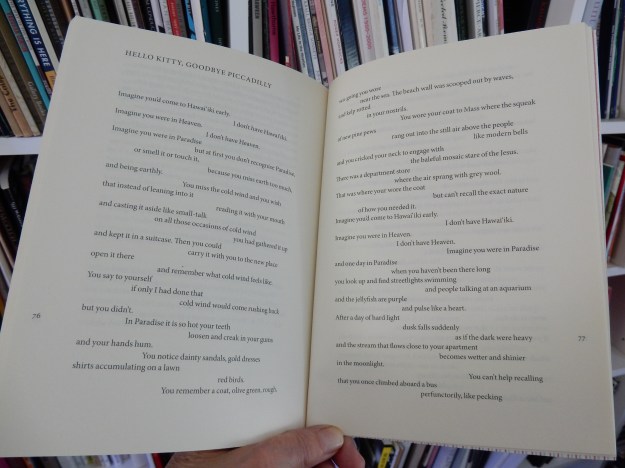
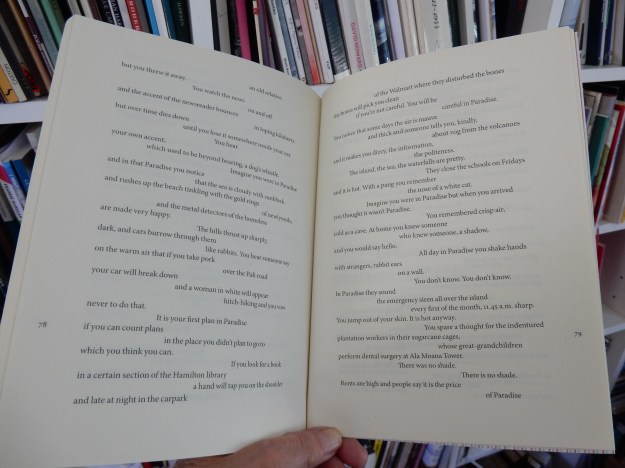
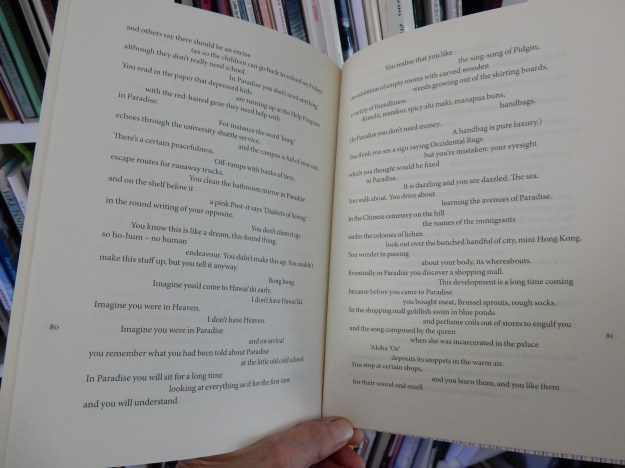
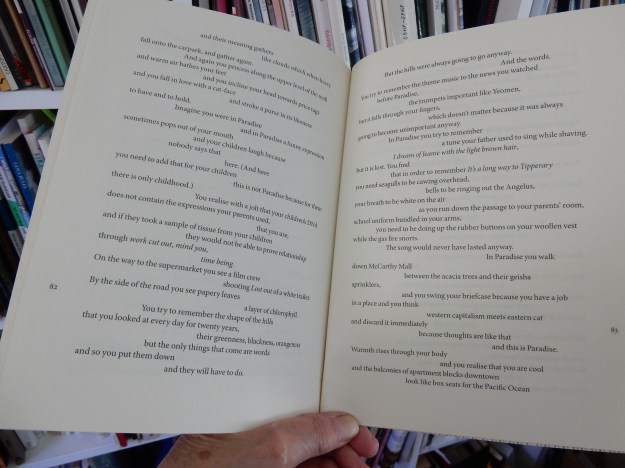
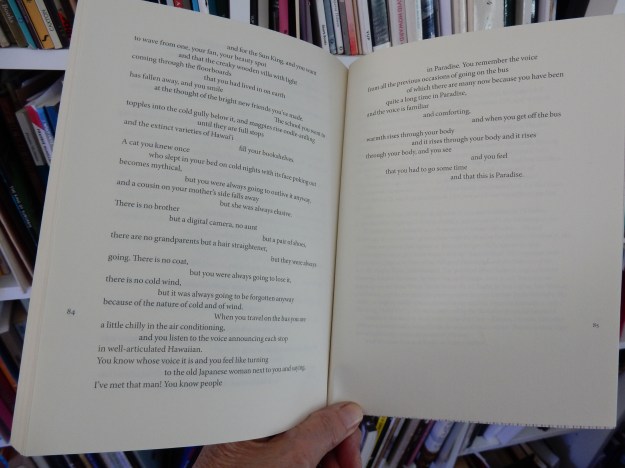
©Anne Kennedy, The Darling North, Anne Kennedy, Auckland University Press, 2012.
Bernadette Hall comments on the poem:
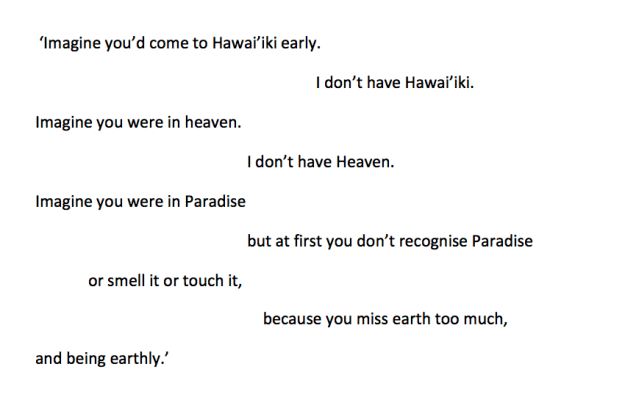
I first read these lines in 2012. Anne Kennedy’s book had just come out. I read the lines and I fell in love with them. I held onto the poem that held onto them as if it was a life-raft. Every time I read that poem, Hello Kitty, Goodbye Piccadilly, (and I read it often) I have the same feeling of home-coming. The thinking is within the same territory I’m fixated on: the tension between the dream places, the places of beginning, of origin, the places that arise from myth. And the materiality of here and now, the stuff that arises from star dust just as our world does and everything including us within it.
On the one hand there’s the ancient dreaming, the naming and the renaming of myth and ritual. Of religion and philosophy. The stuff of the mind, the soul and the imagination. The stuff of desire. And then there’s the solid ground beneath our feet. There’s a collision here surely. How are we to shape a language that it is capacious and mobile and courageous enough to handle collision and complexity?
It’s an ancient curiosity, this, to ask the existential questions : unde? whence? quo? whither? cur? why? Philosophers and theologians are the professionals. But so often their thinking has been disembodied. Maybe it was up to poets to explore the connective tissue between concrete and abstract, to make new alliances between thought and matter. The body, the mind, the heart, the soul. How serviceable the old language was. But how are we to reveal ourselves to ourselves today?
The framework of Hello KittyGoodbye Picadilly is the shift from New Zealand with its theatre of memories to Hawai’i. It’s a move north, away from the cold wind – ‘you wish you had gathered it up / and kept it in a suitcase’ – to a Pacific ‘Paradise’. The kind of place the French sailors with Marion du Fresne thought they’d found in Tahiti. But then they went on and found a Pacific ‘Hell’ when they landed in the Bay of Islands in 1772. (I’m fresh from reading Joanna Orwin’s marvellous novel ‘Collision’ that explores these things with spectacular success.)
What I love about the poem is that it arises out of uncertainty, out of questioning. Out of a sense of what’s missing.
There are those repeated lines, the repeated negatives : ‘I don’t have Hawai’iki’ ‘I don’t have Heaven’. Isn’t this the Socratic method, using negatives to slash away the debris and then see what’s left standing? ‘In Paradise you will sit for a long time / looking at everything as if for the first time / and you will understand.’ So we’re back to the very beginning, in need of language, in need of thinking. But then ‘You wonder in passing / about your body, its whereabouts’. And there’s the female body, the human body, the body, not as something corruptible but as an equal.
Maybe memory is the cache where everything holds together, where everything lasts:
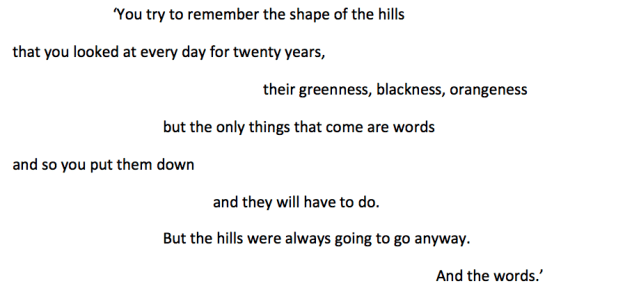
Almost at the very end of the poem there’s a recounting of losses:
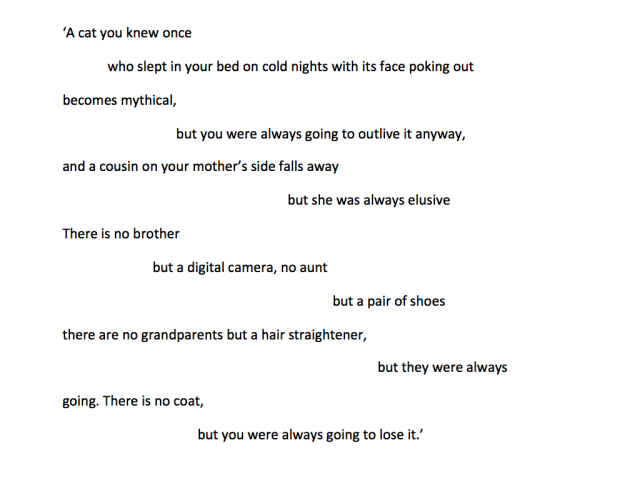
And my heart turns over. I guess these lines just get richer as I age. As the whole question of getting up and leaving the room becomes more present. How is this to be done?
There’s a scene in J. M Coetzee’s novel ‘ Elizabeth Costello’ where the aged academic finds herself at the gates of what we might call heaven. She has to face judges there, she has to answer difficult questions. Her life as a writer, a life spent of making up things, is under scrutiny.
‘Is childhood on the Dulgannon another of your stories, Mrs Costello? Along with the frogs and the rain from heaven?’
‘The river exists. The frogs exist. I exist. What more do you want?’
Indeed, what?
The final move in the poem is from loss to uplift. Once again it’s repetition that’s the key turning in the lock, multiplying the ways to enter the text:
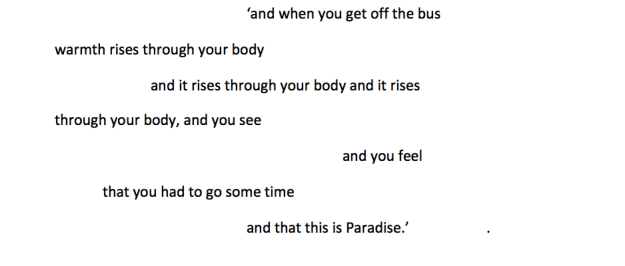
.
I love this kind of thing. The depth and the nourishment I find here. The way Anne Kennedy’s writing, like that of Coetzee, opens up new rooms in my head and in my heart.
Bernadette Hall
Bernadette Hall lives at Amberley Beach in the Hurunui, North Canterbury. She has published 10 collections of poetry, the most recent being Life & Customs VUP 2013 and Maukatere, floating mountain, Seraph Press, 2016. The latter includes drawings by the Wellington artist, Rachel O’Neill. In 2015, Bernadette received the Prime Minister’s Award for Literary Achievement in Poetry. And in 2017, she was invested as a member of the New Zealand Order of Merit for her Services to Literature.
 NZ Poetry Shelf