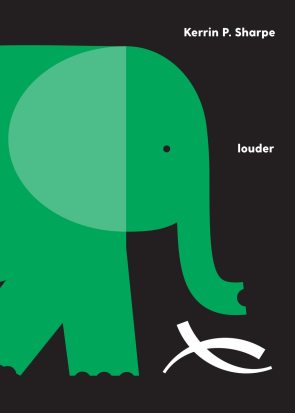
Kerrin P Sharpe has published poetry in a wide range of journals, both in New Zealand and overseas. Louder is her fourth collection of poetry (Victoria University Press, 2018). She lives in Christchurch.
I was immediately drawn to Kerrin’s new title because I envisioned poetry that spoke out. Politics and poetry have had a long relationship in New Zealand, with diverse forms and registers, whether on political or personal issues. When I was doing my Italian studies I encountered politically motivated poets who wanted their message to be clear; tricky poetics were not to get in the way of issues at hand, the message was paramount, particularly with feminist women writing and thinking outside the academy. At the time, I felt that here, we had often addressed political issues in softer voices and in subtle ways; and that poetry that used loud political voices was more open to criticism. Yet the more you look, the more you discover a rich vein of political poetry. I am thinking of the way the political bite of Hone Tuwhare’s ‘No Ordinary Sun’ is sharpened by the solar metaphor, the searing detail. Or Selina Tusitala Marsh’s various responses to racism in Tightrope. Or Mary Stanley’s 1950s poem, ‘The Wife Speaks’. I loved writing a chapter for Wild Honey on women poets speaking out because the poetry, and the issues, were so diverse. Women have spoken out from the messy knot of the personal and the political since they first started publishing in New Zealand with loud voices, quiet voices, veiled messages, clear ideas.
2108 seems to be a time when we need to speak out from the comfort/discomfort of our lives, from the shelter/shelterlessness of our own homes, from the fullness/emptiness of our own stomachs, from the embrace/diaspora of our own communities, from the wound of our own healing/abuse, from the shared earth we stand on that is under wide threat.
Kerrin’s reflective book is utterly personal yet entirely political. She leads us from threatened species to unjust power plays to dislocated refugees to the toxic waste of human greed. To celebrate the arrival of Louder, we embarked on an email conversation.
Paula: Your new collection struck me because it gives voice to issues that affect us all. I am really fascinated by the myriad way politics and poetry meet in New Zealand poems. When I asked if you would like to have this email conversation, you made some important points. I wondered if you would like to share those as I think ‘personal’ and ‘politics’ forge vital relationships.
Kerrin: Though as I said earlier I’m not really a ‘political person’ – not in a party-political sense anyway – I do believe ‘political poems’ in a broader sense of the phrase, have the power to sometimes influence and change thought and even behaviour at times. This was what I wanted my poems in LOUDER to do.
As anyone reading the poems in LOUDER will have noticed, they spring from a personal well of concern for endangered animals, refugees, global warming and pollution. When I came to shape the final collection into specific sections, the poems all seemed to work together and together they became even LOUDER.
The volume of the voices vary of course. Some poems are soft but yet still insistent; others clamour for our attention. But none of them whatever their individual volume, let us forget what we should be doing.
Paula: I really like the title because it suggests you have to speak your concern for these important issues a little louder without necessarily yelling. I was reminded of some of our early women poets who expressed deep concern for issues of the time. I am thinking of the way Jessie Mackay and Blanche Baughan spoke out for the suffragette movement, for prison reform, displaced people, the underprivileged and so on. They wrote poems but they were more inclined to write articles and letters to newspapers. They kept in touch with global issues through letters, journals and newspapers that travelled by ship. How do you keep in touch with the issues your poems navigate, whether global or local?
Kerrin: To use the stolen phrase ‘the writer as a thief’, I keep in touch with important issues through reading and watching environmental programmes on TV. I saw the idea for the poem ‘louder’ and the direction of the whole collection, when I was in the barber’s one day waiting for a haircut. In one of the magazines was a picture of an elephant with his tusks cut off. I could hardly look at the picture, but it gave me a powerful image I’ll never forget. Naturally, the barber himself is a recurring character in the LOUDER collection.
Paula: ‘Louder’ is the opening poem in the collection. It makes it clear that the poetry is linked to issues and that the poems move in intricate ways. It moved me as reader. The poem juxtaposes the beauty of a tribe of elephants with the mutilated bodies, tusks removed.
and if you can imagine
thousands of elephants
all in outdoor studios
painting themselves and their tribe
as whole elephants
even as guns are raised
and calves stumble
from ‘louder’
I was also moved by the sequence, ‘where will the fish sleep’. The poem is equally intricate. It looks like water lines, long ripples across the page that connect different places in the world. What prompted this sequence of vignettes? How difficult (or easy) is it to write of issues located elsewhere along with the way we are affected locally?
Kerrin: The fourth and final section of LOUDER offers the reader 10 multi-choice answers to the question ‘where will the fish sleep?’. I like your analogy that they are ‘water lines’ or ‘ripples’ and for me, writing about issues outside New Zealand gives me a greater freedom to explore connections that interest and intrigue me. This group of poems is all concerned with water and its behaviour due to weather events or global warming. We have just seen again the destructive effects both to land and life in Japan and more recently Indonesia. I like to think many of the poems in LOUDER carry on working beyond the covers of this collection. It is deliberate on my part that in the last poem, ‘how they leave the world’, polar bears in their ‘bubbles of blurry fur’ use soft but very firm voices to beg the reader to now act.
he tickles a thick-bodied trout that throws itself
back to unveil the path of the Arahura River
what remains in his square hands?
bones of water enough to mix with shingle
river sand wild grass to grow a daughter
up on the steep riverbank his empty fishing kete
with soft shearwater feathers
from ‘from the Arahura River’ in ‘where will the fish sleep?’
Paula: Water becomes the vital link in this sequence as it highlights such basic human and planetary needs. Selina Tusitala Marsh’s latest poetry collection, Tightrope, is also a form of ‘louder’. She speaks on issues that matter and affect her. In ‘Apostles’, Selina refers to Alice Walker’s claim that ‘poetry is revolutionary’. Selina is not quite sure that she believes Alice but Tightrope becomes a form of speaking out. Do you ever feel helpless when contemplating so many issues, so many injustices? And what point is poetry?
Kerrin: The many obvious injustices in the world inspire me to write with more conviction. They empower me to feel I must try to raise awareness of what is happening around me.
When I am writing I frequently ask of my writing, ‘What is the point of this? What is its purpose in the poem?’ If I have just written a series of word images that have no real or meaningful ideas or concepts underlying them, then I feel this isn’t the direction in which I should be going with this piece of writing.
As a poet I feel poems should be real, urgent and necessary of themselves and evoke a response in the reader. At least this is what I am attempting to do with my writing.
Paula: Did you read any poetry books that explored similar issues in ways that were perhaps ‘real and urgent’ – or simply stuck with you?
Kerrin: The British poet, Alex Houen’s poetry collection Ring Cycle (Eyewear Publishing) impressed me. He explores the world in a real, urgent and innovative way. Another British poet, John Clegg’s Holy Toledo, (Carcanet Press) has also influenced my writing with his poems; they are both playful yet also powerful.
For a long time, George Szirtes, a Hungarian poet living in England, has intrigued me with his writing which is often concerned with social issues. He raises challenges and perspectives that can only come from an ‘outsider’. His latest collection is Mapping the Delta (Bloodaxe).
I met all three of these poets when I was last in England and I talked with them about many of the issues and topics that come up in my poems in louder and I felt reassured by their feedback that I was on the right track. In fact they told me that the social and environmental topics I explore in louder were also starting to emerge in poetry written in Britain and in some cases were being explored by British poets in a very vigorous way indeed.
Paula: How wonderful to have that acknowledgement from writers you admire. There is something quite magical about conversations with people who get what you are doing. Are there any local writers who have caught your attention with issue-inspired poetry? I was really taken with Airini Beautrais’ Flow: Whanganui River Poems. The politics of the river, the land, the everyday lives infused the work on so many levels. I also wondered whether you have a support crew of local writers in terms of both poetry and speaking out?
Kerrin: Yes, Erik Kennedy a local writer from Christchurch has just released his new collection of poems, There’s No Place Like the Internet in Springtime (VUP) and many of the poems in his collection are quite innovative and fresh in the way they address important issues like war and climate change.
Gregory O’Brien’s two poems ‘Mihi’ and ‘Conversation with a mid-Canterbury braided river’ are clever and strong in the way they challenge us about our threatened waterways.
I tend to do much of my writing alone. I am well known for heading down to a local cafe in Merivale, Christchurch each Saturday and Sunday morning to write. I love the atmosphere and the buzz of people about me.
I often chat with Frankie McMillan a well known Christchurch writer, and we frequently discuss our writing with each other; I read her my recent work and she gives me feedback and suggestions that send me back to refine what I’ve written. I also chat with other writers about my work and theirs and they too keep me grounded and encouraged.
Paula: I really like the shifting tones and forms in your collection, from the little poem breaths in ‘what we hear’ (like haiku) to the personal revelation, the mother’s appearance in ‘my mother darns the windsock’. It suggests there are multiple ways to speak louder and draw attention to issues that matter. Is there are poem that particularly worked for you?
Kerrin: Yes Paula, I do tend to employ changes in tone and form in my poems though sometimes I must admit it is as likely to be unconscious as conscious. One of the ‘drivers’ of this is that I have a fear that my poems will all look and sound alike if I don’t look to innovate in the way they sound, their shape and in their tone and form. Often the changes in my poems arise from ideas I get when reading the poems of other writers who themselves are experimenting with tone, shape and form.
Obviously in the context of my louder collection you picked up that I have experimented on several levels with some poems in an attempt to make them speak louder and more insistently.
To give you an illustration. When I visited England earlier this year, I was shown around the historic chapel designed by Sir Christopher Wren at Pembroke College at the University of Cambridge. Inside this beautiful chapel was a blue cross made from a refugee boat and some votive candles. As I was looking at this fascinating symbol, I began to think of the beginnings of a poem that I began to write in my head and the title of it of course became wick which I later included in my new collection.
I wrote the first draft of ‘wick’ on the train coming back from Cambridge and when it was complete I recognised that it had very strong links to the other poems in the collection about refugees: ‘they are found in the sea’ and ‘the bear’.
It probably sounds a bit quixotic but I like the way that ‘wick’ as a poem seemingly jostles to be heard and to extend itself beyond the written words on the page.
wick
from the flicker of a boat
in the Aegean Sea
they took the heart
they built a cross
a twisted pale blue beak
they sky they followed
still and blue like the toddler
carried ashore by a soldier
carried through our televisions
the terrible cries of his father
that cross and a bowl
of votive candles
in the chapel at Pembroke
every candle a voice
between wick and flame
a Syrian refugee
who never arrived
Paula: You work a lot with school-age writers. Do you think they are concerned with issues that threaten our world? Do you ever explore political and ecological issues with them through poetry?
Kerrin: I love working with school-age writers. And yes, I find them very open and aware of issues that threaten our world and they are not at all afraid to write passionately about many of the things we as adults are concerned about as well.
Recently one of my students designed a set of tea towels each with a haiku she had written printed on the tea towel. Her haiku were from a series of haiku she had written called ‘Haiku for Humanity’. Among her haiku are ones that draw our attention to the sad plight of many refugees in different parts of the world – a subject that as you know, is very close to my own heart. As a postscript, last I heard, her haiku tea towels were very popular with her student customers; I even have a couple myself!
Other creative writing students I work with participate in the Young Poets’ Network, based in London and have had poems on subjects such as global warming published on the Network.
Paula: We have a Prime Minister who uses the word ‘kindness’ in her discussions on governance, she keeps the well-being of children (and a nation) centre frame and resists attack politics and bullying. We have yet to see how Jacinda’s talk is converted into widespread action, but this approach, with the initial welcome moves, gives me hope for people and for the planet. What gives you hope?
Kerrin: As I said earlier, while my poetry in Louder is often about environmental and social issues and can therefore perhaps in that sense be described as political, I don’t have a lot of faith in politicians, whether it be the current Prime Minister or anyone else.
What does give me hope in our world are people, the people I meet every day in my local community, the people I work with, the children I teach creative writing – a creative writing class full of children is a magical place for me – my husband, family and friends.
I don’t expect politicians to bring about a better world. Positive change in our world, if it comes, will come because there are more and more people in our world with open, loving hearts, people who are honest and people who care deeply about others who need caring for.
One of my greatest joys is working with children. When I am in a class of children and we are all working on our creative writing; it’s then that I feel most a sense of hope in our future and what we can become.
Victoria University Press page






 NZ Poetry Shelf