Author Archives: Paula Green

Poetry Shelf noticeboard: Opening of The long waves of our ocean: New responses to Pacific poem


Opening of The long waves of our ocean: New responses to Pacific poems

Friday 25 November
5.30pm to 7.30pm

The National Library of New Zealand Te Puna Mātauranga o Aotearoa is delighted to invite you to the opening of our next exhibition The long waves of our ocean: New responses to Pacific poems at 5.30pm on Friday 25 November 2022. 

Please join us in the foyer of Te Ahumairangi Ground Floor at the National Library (entrance via 70 Molesworth St, Thorndon) for refreshments, performance and kōrero.

For this exhibition, early-career artists Sione Faletau, Ayesha Green, Turumeke Harrington, Ana Iti, Sione Tuívailala Monū, Ammon Ngakuru and James Tapsell-Kururangi have created new artworks made in response to a selection of poems by Alistair Campbell, Keri Hulme, J. C. Sturm, Hone Tuwhare and Albert Wendt. These artists and writers address Te Moana-nui-a-Kiwa in its varied and shifting roles, engaging with fictions and histories and encouraging us to inhabit new perspectives. 

On Saturday 26 November from 11am to 12pm, join curator Hanahiva Rose and some of the contributing artists for a tour of the exhibition. 

RSVP here

Poetry Shelf Occasional Review: Chris Holdaway’s Gorse Poems

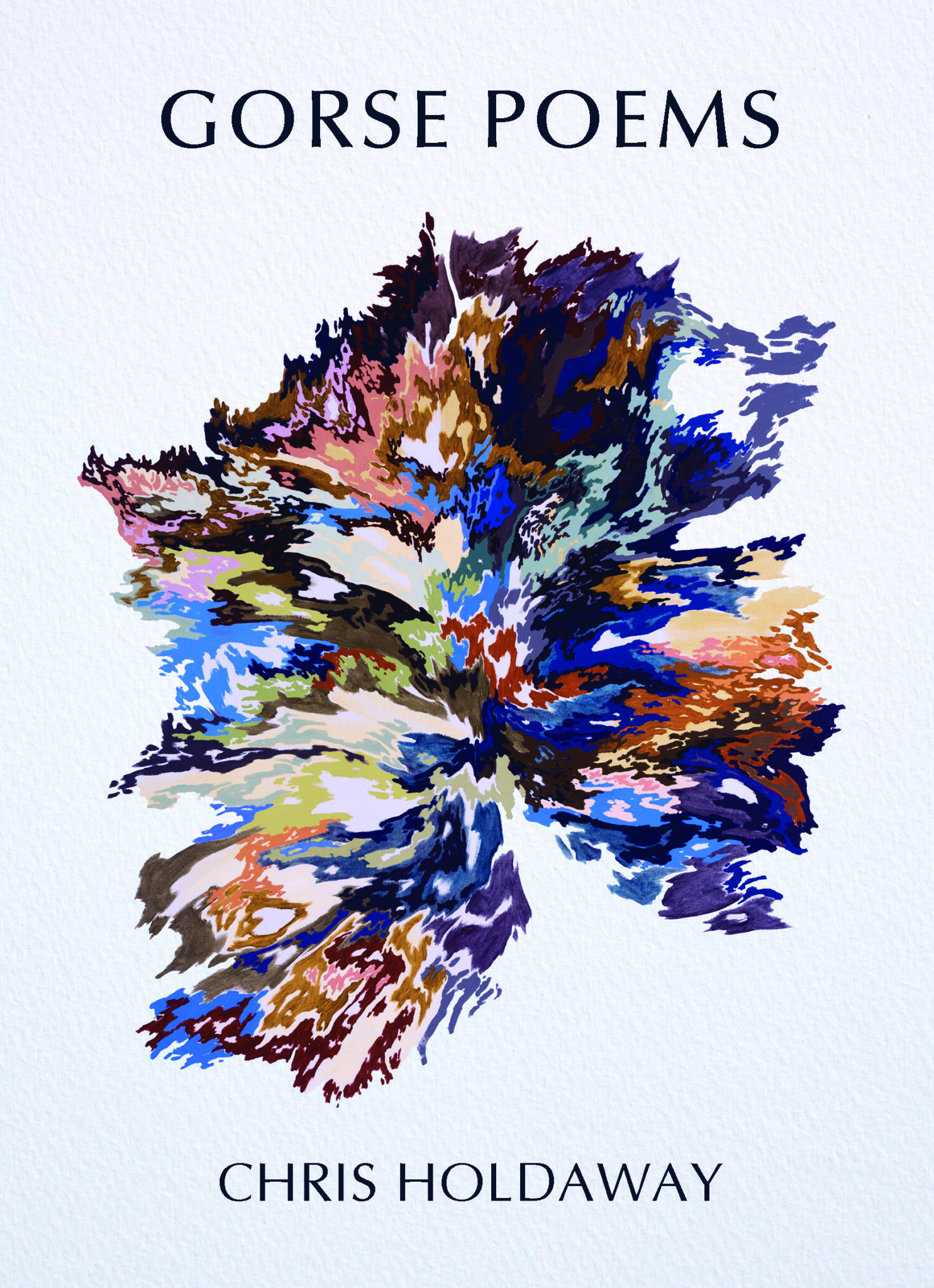
Gorse Poems, Chris Holdaway, Titus Books, 2022

As near to Hart Crane’s open bones as I am spiritually
Capable to experience. Each bridge formed by the Platonic
Form of space between pylons; an allegory
of the cave projected on a stone wall.

from ‘Sea burial’

Chris Holdaway’s debut collection Gorse Poems, is under the influence, and perhaps above the surface of gorse and the American poet Hart Crane. Gorse and poetry as spiky reading tracts. I stall on ‘gorse’ in the book’s title, and think invasive threat, eye-catching bloom, postcolonial and colonial narratives, textured realities.

The poetic fluency is made from cloud soft and mechanical spike. Ambiguity matters. Naming matters. In ‘Cirrus’, the waves are standing, and then they are shifty and hard to pin down. Poetry becomes tidal with personal bearings – and ‘tidal’ resonates as much as you like.

The poetic density resembles thickets on the page, tuned to a frequency of difficulty. If you think this, if you consider the collection as a series or accumulation of poetry thickets, then the reading paths are myriad. You push into light and you propel into dark. Smudging is inevitable. Sidetracks mandatory. Pauses essential.

Chris’s poetry delivers concentrated thickness, a thickness that sways between abstraction and physicality.

          Sit on this mountain of Eden and wonder how
Little sunrise resembles sunset. How clouds are
The ultimate test in geometry—their folding nets
The sun at different angles flat in the distance.
What bottom line for a suburban volcano; a gable
Long before any state bungalow unfurled upon
Blitzed shoulders. Nominal sovereignty—mission
-ary neologism—name badges with translations
The original never found. Crown mantle refusing
The title of extinction in a language whose empire
Makes centuries of millennia—patient castles of
Scoria by and large hillsides turned into the roads
Around hillsides.

from ‘Aucklandii’

At first I found the capital letters running down the left-hand margin resembled a wall, disconcerting, a way of displacing a poem as smooth flowing stream. But then I embraced the judderbar movement. And the capital letters nodded to different poetic traditions.

I am thinking Gorse Poems delivers the music of a present world in strife, of a past world in strife, of a future world in strife. And how we need such avenues of viewing and wondering. Gorse Poems, I am concluding provisionally, is a book of wonder, a collection of wander, a fertile undergrowth.

       I first fell in love with you tearing up
Gorse at a conservation site without permission
—a soldier away at the longest running
World War: deforestation. We’re all illicit
Gardeners I suppose. But rather than extract
This thorn from my hand I’m determined
To let it decompose inside me; choose to fill
My mouth with vinegar then suckle wounds.
Cobwebs form between my hat peak and glasses
—bridge of my nose—like art. How long will
Anatomical features stick in memory when
There’s nothing constant to trust in even
Geology so why the body? No functional diff
-erence between dense bush and landslide,—
Not enough sky to stop me turning to smoke
Alone contributing to the heat death of Earth.

from ‘Bioluminescence’

Titus Book page

Chris Holdaway co-founded both the poetry journal Minarets, and the award-winning publishing outfit Compound Press. He is the author of the chapbook HIGH-TENSION/FASHION (Greying Ghost, 2018) and his poetry has been published in various journals including Brief, Cordite, Cream City Review, Landfall, Oversound, Poetry NZ Yearbook, The Seattle Review and Shearsman Magazine.

Poetry Shelf occasional Poems: Lynn Davidson’s ‘Yellow & Blue’

Yellow & Blue


Night     and I go to frangipani trees
to locate what drifts through our open windows
     to undo the mystery that shakes the membrane
between worlds. Creamy the petals and yellow the heart.

I pick the one flower I can reach and come down off my toes into
a kind of falling through  
hot soles on black grass
and the brute broken notes
of war     

a frightened scudding
fall, the cane toad’s icy stare
I skitter up floating steps and through
the door

morning floods the lowlands and the levels, but not the eucalypts on the rise
           not their soft blue exhalation
            of flammable oils


Lynn Davidson


Lynn Davidson’s latest poetry collection Islander was published by Shearsman Books, Bristol,  and Victoria University Press, Wellington, in 2019. Lynn had a Hawthornden Fellowship in 2013 and a Bothy Project Residency in 2016.  She won the Poetry New Zealand Poetry Award, 2020, and was 2021 Randell Cottage Creative New Zealand Writer in Residence.  

Poetry Shelf Occasional Reviews: Leanne Radojkovich’s ‘Hailman’

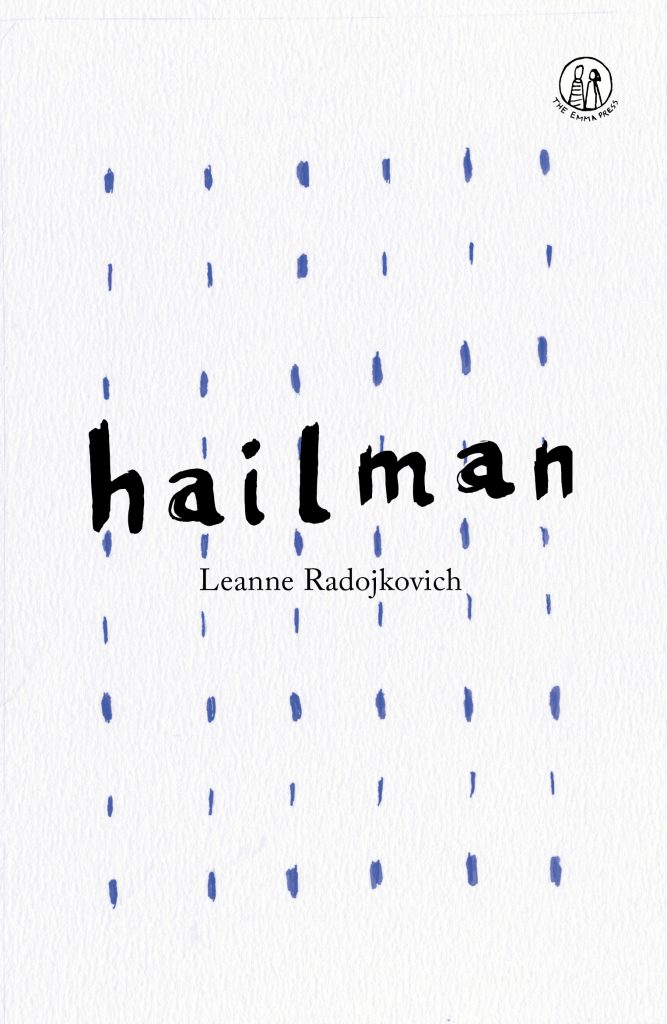
Hailman, Leanne Radojkovich, The Emma Press 2021

Leanne Radojkovich’s short story collection is a satisfying and nuanced mix of redeeming light and dark notes. Scenes are stripped back to the potency of the unsaid, and yet people and place are exquisitely present through the power of detail. A woman talks with “pins her mouth”, while “liquid fabrics, shimmering falls of sequins” are nearby. The scene becomes physically luminous, the undercurrents contextualised.

The collection is invigorated by recurring themes. Grief and loss form a connective tissue. Birds, scents, buildings, the weather and flowers, physically anchor loss, rape, infidelity, inadequate parenting, parental death. Human glow versus human pain and loss. It is the physical world that is fleshed out, not the back stories behind the dark and the painful.

I savour Leanne’s collection as narrative tapestry, with its fine stitching and craft. There is remembering and forgetting, slants and prisms, epiphany and release.

For some reason that burst of yolks disturbed me. I left the café and continued along the road, registering all the changes with the strange double-vision sensation I couldn’t explain. I wasn’t sure if the time zone was affecting me, or whether it was my adult life coming up against my child life. I took note of everything: pigeons, nikau palms, the For Lease signs, an op shop with a naked one-legged mannequin. The fruit shop, grill rooms and womenswear had become a mini-mart, a Korean BBQ and a karaoke with private booths. The knitting shop which had once belonged to Nan now sold bric-a-brac. A taxidermied owl sat on a formica table staring out the window. My legs felt so heavy just then; I saw another time when the shop was lined with honeycomb shelving units stuffed with balls of wool, and knitted ‘garments’ as Nan called them, on satin-covered coat hangers.

from ‘Where the river meets the sea’


Perhaps I love this collection so much, because it is a book I feel. I feel what is present and I feel what is absent. I choose the word ‘prism’ to underline how the thematic hues spark and shift. You see life in sensory gleams. You experience life in pieces, yet there are underlying themes that are significant to us. The present forms a bridge to the past, the past forms a bridge to the present. Pockets of emptiness and loss are countered by an expanse of recollection and musings. It is a collection to lose yourself in and then discover multiple rewarding paths to your own bridges and connections. It’s narrative as nourishment.

All the rest home doors have name tags. Mum’s has a typo: Irina. Although Irena isn’t her born name – only she knows what that is, and she’s never told, never discussed the war. Says she was born the day she reached Wellington harbour with papers stating she was a ten-year-old Polish orphan. Dad said not to ask about the European years, and my brother and I never did. Now they’ve both died and there’s just me and Mum, and she’s in a rest home with a mis-spelled name on her door.


Leanne Radojkovich’s debut short story collection First fox was published by The Emma Press in 2017. Her work has been anthologised in Bonsai: Best small stories from Aotearoa New Zealand and the forthcoming Best Small Fictions 2021. In 2018 she won the Graeme Lay Short Story Competition and was a finalist in the Anton Chekhov Prize for Very Short Fiction. She was longlisted for the 2020 Short Fiction/University of Essex Prize and shortlisted for the 2020 Sargeson Prize. Leanne holds a Master of Creative Writing (First Class Honours) from AUT Auckland University of Technology. She has Dalmatian heritage and was born in Kirikiriroa Hamilton. She now lives in Tāmaki Makaurau Auckland, where she works as a librarian.

The Emma Press page

Leanne Radojkovich page

Poetry Shelf Occasional Poems: Kate Camp’s ‘I think I’ll remember where the cleaning eye is but I know I won’t’

I think I’ll remember where the cleaning eye is but I know I won’t

This is how tired you get, the plumber says,
when you have two seventeen-year-old daughters
you can fall asleep
when one of them is driving.

And he says, I’ve been here before, scrolling his phone
so he can slice again through woven grass
remove a square and place it to the side
like my father burying the family dog.

As a young man he went to Canada, he tells me,
worked the ski fields, some words about how lucky
we are and then – sound of metal, ceramic –
he has found the cleaning eye

go inside and run the tap he tells me
in and out I go proud as a child.
Next, the machine
hosepipe of tightly coiled spring

feeds itself in
he is wearing the special glove
the moral of the story is
always wear the special glove.

Can you hear that? Cocks his head like a bird
and I want to say I can but he can, water
running free way along the section
deep underground he hears it.

The grass fitted back in place
grows lusher than before
and now I’m sitting up in bed
balanced on my head

the LED light that changes colour
I’ve set to purple so on the top trapdoor
of my head I feel the weight
of a perfect purple cube

this is the thing I know how to do
right now
to keep that weight centred
above the bony chambers of my skull

and then I am up
and at the mirror
– why?
For human company?

I am wearing every garment I have
woollen boots, pants splashed with bleach,
a long robe like a Biblical prophet and two hoods
as if the monk in me were clothed by the polar explorer in me.

I look across to my only friend, the butternut pumpkin
on his jaunty angle. Dry, dry mouth.
Cars pass as if they were waves.
I am alone.

Kate Camp

Note on the poem

I did a week-long online poetry retreat with Mark Doty and Ellen Bass in late April – because of the time difference I got up each day at 4am to listen to a craft talk from one of them, then we had writing time, and re-grouped at 9am for a three hour workshop, where we shared what we had written in the morning.

I was staying up at our bach so that I could be in “Total Immersion” which was the name of the course. As it happened I got covid at the same time, so my total immersion and legal isolation were combined, quite usefully. This poem originated in that slightly surreal setting.

I think it makes a nod to Jenny Bornholdt’s “Then Murray Came” – the friendly stranger who comes into your home and shares a little – maybe a lot – about their life, then disappears again. Bornholdt’s work has been such an important influence on me as it is on so many New Zealand poets.  

Kate Camp is a Wellington-born poet, author of seven collections from Victoria University Press: Unfamiliar Legends of the Stars (1998), Realia (2001), Beauty Sleep (2005), The Mirror of Simple Annihilated Souls (2010), Snow White’s Coffin (2013), The internet of things (2017) and How To Be Happy Though Human: New and Selected Poems (2020), co-published by Victoria University Press in New Zealand and House of Anansi Press in Canada. Her memoir, You Probably Think This Song Is About You, was published in 2022 by Te Herenga Waka University Press.

Poetry Shelf Occasional Reviews: Jordan Hamel’s ‘Everyone is Everyone Except You’

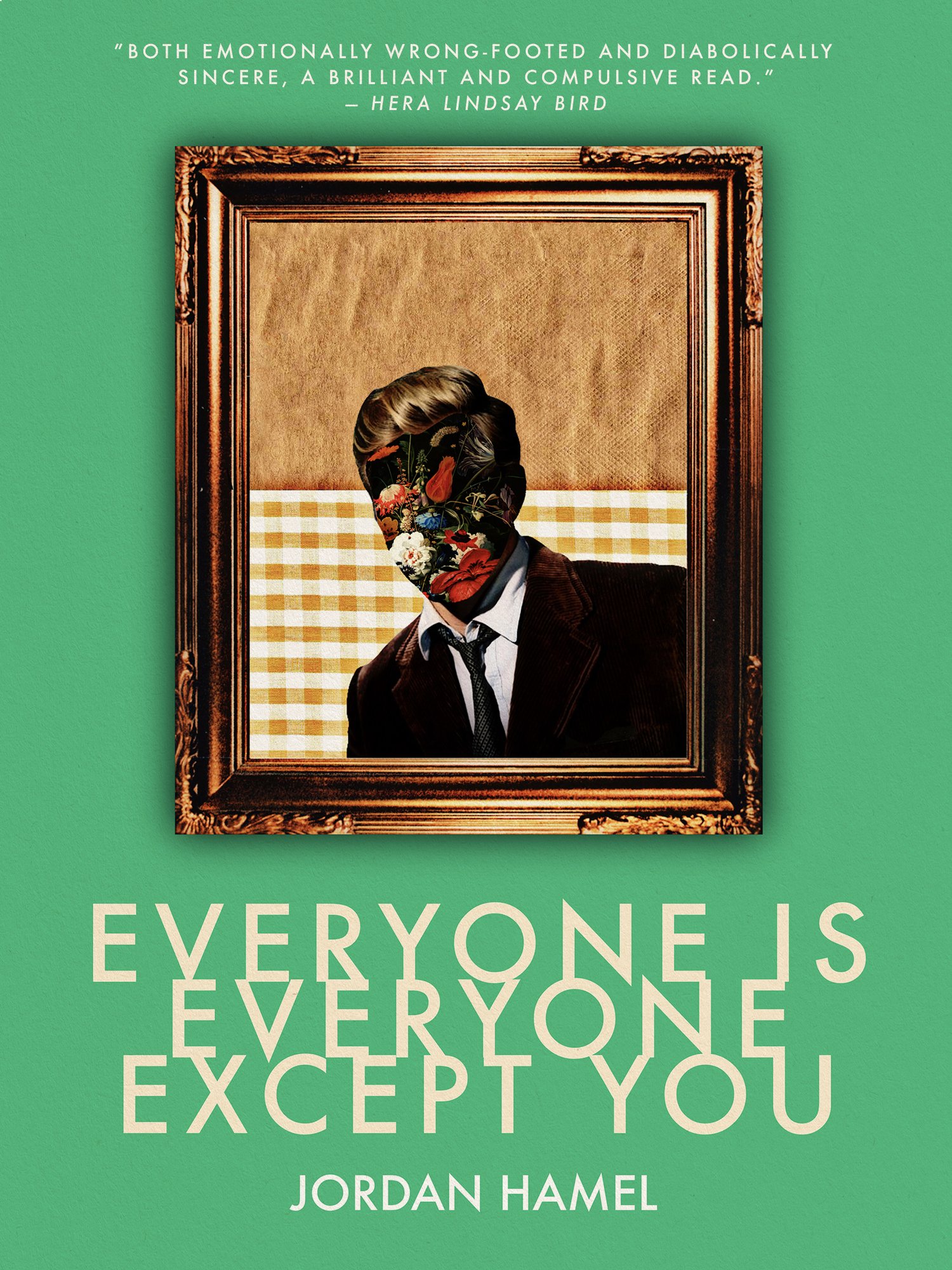
Everyone is Everyone Except You, Jordan Hamel, Dead Bird Books, 2022

In this city you can be whoever you want
and I’m still so much myself it’s disgusting

nothing else fits, nothing is comfortable,
I just want comfort, I want, I want

poorly-aged fish-out-of-water celebrity voyeurism
to remind me living can be so, um, uncomplicated

there’s nothing left for me here except reality
sleep demons waving performance plans

mandatory psychometric pub quizzes
where every answer is a ghost you’ve buried


Jordan Hamel, from ‘The Simple Life’


Three poets whose writing I admire immensely – Hera Lindsay Bird, Tracey Slaughter and Tayi Tibble – endorse Jordan Hamel’s debut poetry collection on the back of the book. That is enough to make it essential reading. I read their comments once I finish the book and have mused upon its effects. I begin by pirouetting on ‘everybody’ and ‘someone’, pulled between the wide-reaching ALL and the particular ME. The poems deliver ‘I’ and ‘you’, and I am fascinated by the movement these pronouns/entities/gaps generate. You could say there’s a swing bridge between them, an interface, a hammock, and however you visualise the link, it is a link with traffic. And out of that glorious energised traffic, you find poetry.

Jordan’s deft ear and eye, his ability to craft words and lines, underline myriad ways to read and travel in a poem. Writing (reading) becomes a route beneath your own skin, a way of stretching writing to embrace the universal and the personal. This is writing of comfort and discomfort, of need and want. It is vulnerable and it is direct.

Rebecca Hawkes writes very different subject matter, but I absorb a similar verve and vitality, an ability to reveal spikes and judder bars, and to conceal. Jordan’s speaking voice is one of self scrutiny, self doubt, even perhaps self erasure. And then the whole process turns upside down, and the poetry is the act and art of self preservation, self testing, self nourishment. This affects me deeply as reader (and as secret writer).

The self deprecation is scattered thought out:

and the last old man          I’ll ever disappoint      is me

where I grew up      men don’t get sick     they rust
like grizzled house cats      under the ute      they crawl
with a quiet    they’ve always carried            they don’t die
just become another blunt saw    you never throw away


from ‘The worst thing that will ever happen to you
hasn’t happened yet’

The final poem ends on blank space, on pause, reset, refill, silence, breath intake. It is over to us how we respond, engage. We now inhabit “you”, which also becomes a way of reflecting upon “I”, whichever “I” that is, whether anybody everybody somebody. These lines form the final musical notes of a haunting book that is such a rich and open reading experience.

                   the perfect poem is just                                     blank space


the perfect you is just


from ‘Human resource’         

Dead Bird page

Jordan Hamel website

Wellington City Libraries video interview

Jordan Hamel (he/him/his) is a Pōneke-based writer, poet and performer. He was the 2018 New Zealand Poetry Slam champion and represented NZ at the World Poetry Slam Champs in 2019. He is the co-editor of Stasis Journal and co-editor of a forthcoming climate change poetry anthology from Auckland University Press. He is a 2021 Michael King Writer-in-Residence and recently placed third in the 2021 Sargeson Prize judged by Patricia Grace. He has recently had words published in The Spinoff, The Pantograph Punch, Newsroom, NZ Poetry Shelf, Landfall, Turbine | Kapohau and elsewhere.

Poetry Shelf Occasional Reviews: James Brown’s The Tip Shop

The Tip Shop, James Brown, Te Herenga Waka University Press, 2022

Alex Grace writes on the back of The Tip Shop: “Funny, dark, insightful and nothing close to a chore to read. Poetry, but it doesn’t suck.” Ha! Some poetry must suck, even be a chore to read, like a school assignment! James Brown’s poetry is cool – ok a lazy-tag adjective children are often forbidden to use as what does it actually mean? It means James’s poetry is hip, electric, agile on its poem toes, lithe on its heart beat, and is immensely readable.

The opening poem, ‘A Calm Day with Undulations’, places visual waves on the page and sets you up for all manner of undulations as you read the collection: wit, heart, life. In the poem, James uses an ocean metaphor to write about cycling which is a way of writing about living. Think surf / swell / naval surface / roll up and down / wave length / lull / pool.

It’s a calm day with undulations.
My tyres flow freely
across the naval surface.

The Tip Shop appraises and pays attention to scenes, moments, events, potential memory, language. The detail ranges from measured to madcap. Questions percolate. Poetry rules are invented. Words are played with. Dialogue is found. Poems stretch and poems repeat. Herein lies the pleasure of poetry in general, and a James Brown collection in particular: there is no single restrictive model when it comes to writing a poem. Within the collection as a whole, and within the frame of an individual poem, James resists stasis.

A poem that epitomises intricate delights is ‘Schrödinger’s Wife’. It delivers a miniature story laced with wit and puzzle. Here is the first stanza:

Mary didn’t walk with us Sundays. She ran.
With earbuds, she could keep reading. Her shop,
Schrödinger’s Books, was a tough mistress.
‘Are you working today?’ we’d ask. ‘Yes and no,’
she’d reply. She just needed to ‘finish the books’.
Can the books ever be finished? They wink at us
as though there are uncertain things
they think we ought to know.

I am drawn to repetition, to a concatenation of detail, especially in list poems, overtly so or nuanced. Three examples in The Tip Shop, establish A to Z lists. Another poem juxtaposes ‘I must not’ and ‘I must’. A found poem, like a form of canine play, lists dog owner dialogue. And then the delight in repetition dissolves, and time concentrates on the washing and peeling of fruit. In ‘Lesson’, a single elongated moment becomes luminous when caught in the poem’s frame. We are implicated, and are returned to an (our) apple: “When was the last time you / washed a green apple”.

Three longer poems stretch into telling a yarn, spinning a story, as the repeated indents mark the intake of a storyteller’s breath. Glorious.

‘Waiheke’ pares back to an ocean moment, and I am imagining the scene imbued with love. So much going on beneath, on and above the surface of the poem, whether in the breaststroking, in the prolonged looking.

You yearn so much
you could be a yacht.
Your mind has already
set sail. It takes a few days
to arrive

at island pace,
but soon you are barefoot
on the sand,
the slim waves testing
your feet

The Tip Shop is piquant in its fleet of arrivals and departures. It is poetry as one-hundred-percent pleasure – it makes you laugh and it makes you feel. It encourages sidetracks and lets you rollercoast on language. What a poetry treat.

James Brown’s poems have been widely published in New Zealand and overseas. His Selected Poems were published in 2020. Previous books include The Year of the Bicycle (2006), which was a finalist in the Montana New Zealand Book Awards 2007, and Go Round Power Please (1996), which won the Best First Book Award for Poetry. His poems are widely anthologised and frequently appear in the annual online anthology Best New Zealand Poems. James has been the recipient of several writing fellowships and residencies, including the 1994 Louis Johnson New Writers Bursary, a share of the 2000 Buddle Findlay Sargeson Fellowship, the Canterbury University Writer in Residence, the Victoria University of Wellington Writer in Residence. James works as an editor and teaches the Poetry Workshop at the International Institute of Modern Letters at Victoria University of Wellington. 

Te Herenga Waka University Press page

Poetry Shelf Occasional Poems: Hebe Kearney’s ‘monarch wings’

monarch wings

risingholme park
ten years before the
/ earth cracked open /

the pine trees were filled with sleeping butterflies

looking up
sails of their orange wings
closed to triangle points
nestled in the needles
childhood haze / gold in memory

and then one night suddenly
/ frost /

looking down
the next day
orange confetti / green grass
disembodied wings
fluttered from death

we gathered their softness / into a basket

went to the dairy on the way home
and when man behind counter saw
eyes went wide / heard him thinking:
butterfly murderers
and i just didn’t know how to
/ explain /

Hebe Kearney

Hebe Kearney (they/them) is a poet who lives in Tāmaki Makaurau. Their work has appeared in publications including: Mantissa Poetry Review, Mayhem, Starling, samfiftyfour, Tarot, takahē, and Poetry New Zealand Yearbooks. You can find them at @he__be on Instagram.

Poetry Shelf Occasional Reviews: No Other Place to Stand

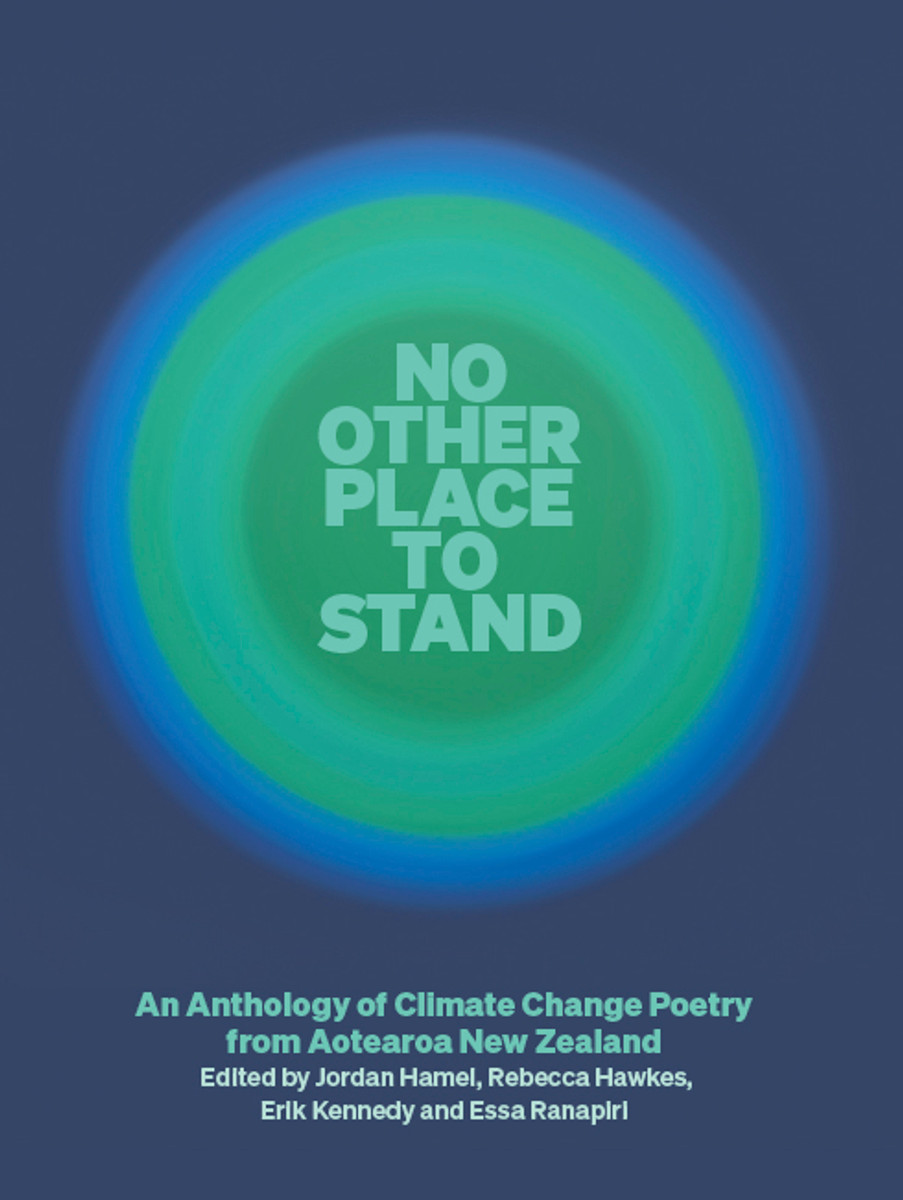
No Other Place to Stand: An Anthology of Climate Change Poetry from Aotearoa New Zealand, Jordan Hamel, Rebecca Hawkes, Erik Kennedy and Essa Ranapiri, Auckland University Press, 2022

Auckland University Press is to be celebrated for its stellar poetry anthologies. No Other Place to Stand: An Anthology of Climate Change Poetry from Aotearoa New Zealand offers an eclectic, and indeed electrifying, selection of climate change poetry. The editors, Jordan Hamel, Rebecca Hawkes, Erik Kennedy and Essa Ranapiri, are all frontline poets themselves.

The dedication resonates and stalls your entry into the book because it is so apt: “To those fighting for our future / and those who will live it.”

A terrific foreword by Alice Te Punga Somerville establishes a perfect gateway into the collection. Alice wonders, when climate change is such a mammoth issue, “about the value of the particular, the specific, the local, the here, the now”. What difference will reading and writing make when the world demands action? Alice writes: “Every single poem in this anthology speaks to the relationship between words and worlds.” That in itself is enough of a spur to get a copy of the book, and open up trails of reading, wonder and challenge.

I am spinning on the title. I am turning the word ‘stand’ over and over in my mind like a talisman, a pun, a hook. I am thinking we stand and we speak out, I am thinking we stand because we no longer bear it, and I am thinking we stand together.

The poems selected are both previously published and unpublished. The sources underline the variety and depth of print and online journals currently publishing poetry in Aotearoa: Minarets, Starling, Spin Off, Mayhem, Pantograph Punch, Poetry NZ, Blackmail Press, Overland, Sweet Mammalian, Turbine | Kapohau, Takahē, Stasis, Landfall.

No Other Place to Stand is an essential volume. You can locate its essence, the governing theme, ‘climate change poetry’, yet the writing traverses multiple terrains, with distinctive voices, styles, focal points. I fall into wonder again and again, but there is the music, the political, the personal, the heart stoking, the message sharing. There is the overt and there is the nuanced. There is loud and there is soft. There is clarity and there is enigma. You will encounter a magnificent upsurge of younger emerging voices alongside the presence of our writing elders. This matters. This degree of bridge and connection.

Dinah Hawken has long drawn my eye and heart to the world we inhabit, to the world of sea and bush and mountain, stones, leaves, water, birds. Reading one of her collections is like standing in the heart of the bush or next to the ocean’s ebb and flow. It is message and it is transcendental balm. Her long sublime poem, ‘The uprising’, after presenting gleams and glints of our beloved natural world, responds to the wail that rises in us as we feel so helpless.

6.a.

But all I can do is rise:
both before and after I fall.
All I can do is rally,

all I can do is write
– I can try to see and mark
where and how we are.

All I can do is plant,
all I can do is vote
for the fish, the canoe, the ocean

to survive the rise and fall.
All I can do is plead,
all I can do is call . . .

from ‘The uprising’

I am reading the rich-veined ancestor currents of Tayi Tibble’s ‘Tohunga’, the luminosity of Chris Tse’s ‘Photogenesis’, the impassioned, connecting cries of Selina Tusitala Marsh’s ‘Unity’ and Karlo Mila’s ‘Poem for the Commonwealth, 2018’. Daily routines alongside a child’s unsettling question catch me in Emma Neale’s ‘Wanting to believe in the butterfly effect’. I am carried in the embrace of Vaughan Rapatahana’s ‘he mōteatea: huringa āhuarangi’ with its vital, plain speaking call in both te reo Māori and English.

Take this heart-charged handbook and read a poem a day over the next ninety days. Be challenged; speak, ask, do. I thank the editors and Auckland University Press for this significant anthology, this gift.

Auckland University press page

Jordan Hamel is a Pōneke-based poet and performer. He was the 2018 New Zealand Poetry Slam champion. He uses poetry and performance to create awareness and discourse about environmental and political issues. He is the co-editor of Stasis Journal and his debut poetry collection Everyone is everyone except you was published by Dead Bird Books in 2022.

Rebecca Hawkes is a poet/painter from Canterbury, living in Te Whanganui-a-Tara. Her chapbook ‘Softcore coldsores’ was published in AUP New Poets 5 in 2019. Her first full-length poetry collection, Meat Lovers, was recently unleashed by Auckland University Press. Rebecca edits Sweet Mammalian and is a founding member of popstar poets’ posse Show Ponies.

Erik Kennedy is the author of Another Beautiful Day Indoors (Te Herenga Waka University Press, 2022) and There’s No Place Like the Internet in Springtime (Victoria University Press, 2018), which was shortlisted for best book of poems at the 2019 Ockham New Zealand Book Awards. He lives in Ōtautahi Christchurch.

Essa Ranapiri (Ngāti Wehi Wehi / Ngāti Takatāpui / Clan Gunn) is a poet from Kirikiriroa. They are part of puku.riri, a local writing group. Their book ransack was published by Victoria University Press in 2019. Give the land back. It’s the only way to fix this mess. They will write until they’re dead. And after that, sing.

Poetry Shelf Occasional Poems: Jenny Powell’s ‘The Girl and the Poet Read Tea Leaves in Paris-Gore’

The Girl and the Poet Read Tea Leaves in Paris-Gore

Spilt tea settles between Formica
flicks of colour, flecks of leaves
turn on a red table.

In front of them a collusion of fate,
a collision of cups in a clumsy act,
the leaves of a script set out before them.

Butter sizzled and browned on a black griddle,
hoisted flags of wet washing hung
in a damp wait, a forgotten cigarette smoking
in the ashtray, the teapot cosy
in crocheted stripes.
On the red Formica table,
pikelets dripped the thin juice of melted syrup
down her fingers, onto her dress.

They change their table, order a new
pot of tea and a plate of hot pancakes.
The syrup melts thin and juicy, drips

down her fingers onto her dress. He gives
her a serviette to soak up the mess.
She folds it in half for her own plot.

Jenny Powell