She kisses him goodbye with her eyes still wet and alight from their
last swim in the Awatere River. At the train station celebration, she
leads the kapa haka but her voice keeps breaking under and over itself
like waves. Like last night, on the riverbank, between the moss and the
baby’s-breath, where he had kissed her sticky until she cried out from
her chest. And she was thinking about the rolls of white fabric her
sister kept in the shed and how she would make a dress pressed with
shiny bits of shell. She could even fix a veil from a fishing net or wear
knots of pale hydrangeas like a crown upon her head. Then together
they would move to the empty plot of ancestral land forgotten by the
sea and have little brown babies that she would make sure to stuff fat
with potatoes and wobbly mutton.
from ‘Hoki Mai’
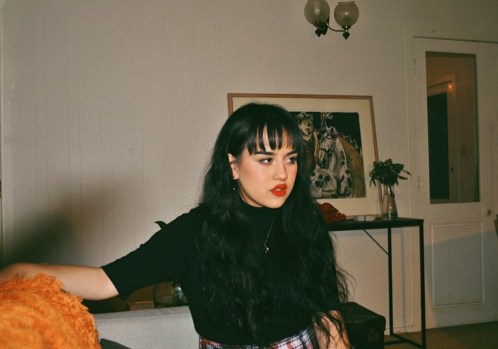
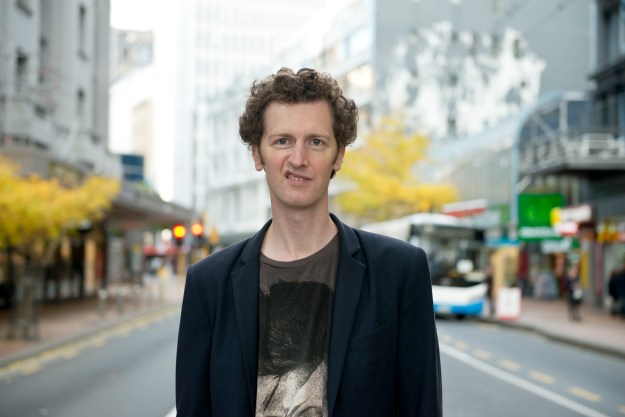
Photo credit: Curti Angle
Tayi Tibble (Te Whānau ā Apanui/Ngāti Porou) completed her MA in Creative Writing at the International Institute of Modern Lettters in 2017, where she was awarded the Adam Foundation Prize. She currently lives in Wellington. Her debut collection, Poūkahangatus, has already and understandably attracted widespread media attention. The poetry is utterly agile on the beam of its making; and take ‘beam’ as you will. There is brightness, daring and sure-footedness. The poems move in distinctive directions: drawing whanau close, respecting a matrilineal bloodline (I adore this!), delving into the dark and reaping the light, cultural time-travelling, with baroque detail and sinewy gaps. The collection charts the engagement of a young, strong woman with her worlds and words – and the poetic interplay, the sheer joy and magnetism of the writing, is addictive.
Tayi and I embarked on a slowly unfolding email conversation over the past month.
Paula: I am always curious about the books that shaped us when we were children. What did you read as a child? Did you read poetry?
Tayi: As a child I read all sorts but particularly fantasy and young adult fiction. I remember reading a lot of dragon books like Eragon, The Hobbit, The Dragon Riders of Pern, The Narnia Chronicles etc. I also read the hell out of The Jacqueline Wilson books, especially The Girls in Love series. I loved The Sisterhood of The Travelling Pants books and this series called The It Girl Novels, written by Cecily von Ziegesar, who also wrote Gossip Girl. My grandparents also had this collection of, I think they were Reader Digest condensed classic books or something? There was like four titles in one book, all hardback with foiled damask prints on the cover. So I’d read bits of The Grapes of Wrath, Huckleberry Finn, Wuthering Heights etc. I also remember being aware that I read a lot of tabloid magazines a kid, because my Nana would buy all three; Woman’s Day, Women’s Weekly, and New Idea every week.
Poetry I came to in my preteens and early teens. The intermediate that I went to had really great diverse teachers who taught us Hone Tuwhare, and Apirana Taylor poems, and made us write our own. When I started high school was when I started reading poetry; Carol Ann Duffy, Sylvia Plath, Allen Ginsberg, and then also like, Robert Frost, Shakespeare’s Sonnets, Tennyson, Lord Byron which we had to do for English, but I was into it.
Paula: Ha! I remember reading classics like that on my relation’s bookshelves in the summer holidays. It was like I had a child’s understanding of the Brontë sisters, then years later that of an adult!
What poetry books have affected you in different ways in the last few years? Sometimes you meet the right book at just the right time, with all kinds of reactions.
Tayi: I discovered a lot of great writers during my MA year, last year. I got heavily into Kaveh Akbar, an American-Iranian poet and his chapbook Portrait of an Alcoholic and then Calling a Wolf a Wolf. I also read Claudia Rankine’s Citizen, and that was a whole big thing for me, and gave me a sense of permission. Teaching My Mother How to Give Birth by Warsan Shire, both stunned and influenced me greatly. She writes about family, dysfunction, race and religion, with lush imagery – often grounded in the body and always people oriented. I also discovered Cate Marvin, who I think is really brilliant. Her poetry is feminine and feminist and so bold and funny. I especially love her books Fragment of the Head of a Queen Head and Oracle. I think Harmony Holiday is the poet I adore the most. I think her poetry is very stylish. She writes mostly prose-poetry, combining the politics of being black in America with celebrity and pop culture. I think her book Hollywood Forever, is just the coolest thing ever.
And in New Zealand, Courtney Sina Meredith’s Brown Girls In Bright Red Lipstick had a big impact on me. I first discovered her work at Litcrawl in 2015. She was reading from it and I was in the audience wearing a bright red dress and matching bright red lipstick and as she was reading the title poem I felt both entirely seen and see-through. I had similar experiences reading This Paper Boat by Gregory Kan and Chris Tse’s How to Be Dead in a Year of Snakes and He’s So Masc too. Tusiata Avia’s Fale Aitu became a real touchstone text for me too. Reading her poem, White Sunday, always makes my chest tighten, but it always helps me to kind of, get out of my own way and re-align my writing intentions. This might be passé, but that books that affect me the most are the ones that make me feel personally liberated, and inspires a sense of bravery or urgency on the page.
Paula: Oh how spooky I was just sitting here gazing at the wind in the manuka imaging organising a poetry reading in Wellington and I was musing upon Chris, Greg and Tusiata (with a few others!) because their poetry electrifies every bit of me: heart, mind, skin, blood. I agree with you. It does come down to bravery and urgency because, and here I am also anxious I sound clichéd, I am drawn to poetry that matters. That makes the world and people and ideas and feelings and the music of words matter.
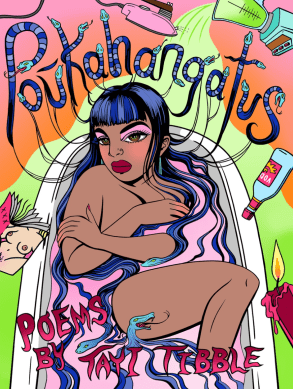
You dedicate your debut collection to your mother. I am moved by this. What prompted this dedication?
Tayi: That line up would be incredible. Yeah, I love poetry that gives me physical sensations, when words ring in the body—a transfer of energy. Dedicating the book to my mum was such an obvious decision; I can hardly give words to it. On one hand the presence of maternal figures is very prominent in the book, so dedicating the book to my mum made sense thematically, but also rather simply, a dedication is a thank you, and there’s no one I am more thankful for, then my Mum.
I did debate whether it should read ‘For Adrienne’ instead, but I also liked the idea that maybe, someone somewhere might give the book to their mum. Then the book can be for them too, which is pretty geeky, but still nice, I think.
Paula: Yes I liked ‘for Mum’ for the same reasons and the way it was a perfect gateway into the women in the book. I treasure this book for its kaleidoscopic female relations and views of women. Was this a strengthening thing to do? To make women the vital overcurrents and undercurrents of the collection?
Our nan wears black leather pumps
and dries wishbones from chicken carcasses
in an empty margarine container on top of the fridge
She’s not my real nan
but I have always wished she was.
I wished I was born with her
blood in my veins, her dark
Waikato DNA, high cheekbones
and heavy wet eyes just like my sister.
from ‘Our Nan Lets Us Smoke Inside’
Tayi: It was definitely strengthening to do. That’s a really good way to put it. Once I let the women take over, the writing really flowed and I knew pretty early on, that I might be making something quite cool. Having the different generations of women was also a good way to get away from ‘myself’ and prevent the work from becoming super me-centric, while simultaneously supporting my own experiences haha. During the process of writing and imagining the experiences of Māori women in different points in history, I felt as though my own experiences were legitimised, contextualised even. I think their inclusion elevated the kind of storytelling that I wanted to do. I think their inclusion made the themes of colonialism, inequality, intergenerational trauma that I seemed to be circling, feel more integral to work, and also robust. I guess including these maternal figures also just kind of gave me a bit of company and confidence on the page. It felt important to me, and that gave me a lot of drive and motivation.
Paula: So much poetry by Māori women is invisible – there is a history of groundbreaking Māori women poets that is not easy to access. That your collection shines a light on your whakapapa, and that te reo is a vital beam on the line, matters. Does this feel personal or political or a mix of both?
Smile at the wives who refuse to kiss their ghost-pink cheeks.
Order dessert like pecan pie but never eat it.
Eat two pieces of white bread in the kitchen with the light off.
Slip into an apricot nylon nightgown freshly ordered off the catalogue.
Keep quiet with their husbands’ blue-veined arms corseting their waists.
Remember the appointment they made to get their hair fixed on Lambton Quay.
Think about drowning themselves in the bathtub instead.
Resurface with clean skin, then rinse and repeat.
from ‘In the 1960s an Influx of Māori Women’
Tayi: It’s definitely both, and largely for the simple fact that politics are personal to me. I’ve experienced politics my whole life. My body, my skin, my hair are all politicised and I can’t divorce myself from that. I don’t want to divorce myself from that either. And the politics wouldn’t be effective at all if they weren’t rooted in the body, in the people, in the day to day experiences and interactions. I think the place where the personal and politics meet is the perfect place for poetry. I think that’s where language can get really interesting.
I can’t really tell if poetry by Māori women is invisible – certainly disproportionately underrepresented in publishing. But I have always actively looked for it, been brought up around it and sought it out for myself, so it’s visible to me. I have also been lucky, for example, to have had Hinemoana Baker for my course-convenor during my undergrad poetry course at the IIML. I also took this really amazing history paper convened by Airini Loader about the history of Māori literacy and you’re right, the history of Māori female poets is astounding and so interesting! I know not everyone has access to education, but I do think that anything can be accessed if you actually want to look. So I don’t know if Māori Female poetry is invisible, but maybe people are wilfully blind, and keep their eyes shut.
Paula: I guess I am talking about poets in the 60s and 70s and a time when men hogged the limelight. And when I looked in Puna Wai Kōrero: An anthology of Māori poetry in English, edited by Robert Sullivan and Reina Whatiri, there are great women poets who I would just love to read more from. Jacq Carter for example. Ah so much to say about this!
I love the kaleidoscopic effect of your book; the way it is edgy and dark and full of light. The way it catches living from popular culture to family relations, the way it carries sharp ideas and equally sharp feelings. Do you have any writing taboos? Do you prefer to disguise autobiography or are you happy to get personal?
Poūkahangatus
in 1995 I was born and Walt Disney’s Animated Classic Pocahontas was
released. Have you ever heard a wolf cry to the blue corn moon? Mum has.
I howled when my mother told me Pocahontas was real but went with John
Smith to England and got a disease and died. Representation is important.
from ‘Poūkahangatus’
Tayi: Well, that’s interesting because I’m more reserved than people might think, but I’m also of a generation who grew up oversharing on the internet everyday so I quite often have conflicting feelings about the autobiography in this book lol! There is definitely material in this book that’s sensitive, and I have spent some time worrying about its implications and what assumptions people might make about me. But I also think that self-consciousness can be pretentious and also, yolo who cares it’s not that deep.
So I wouldn’t say that I’m necessarily happy to get personal, but I’m definitely prepared to. This is going to sound really intense but I’d go pretty far and pretty hard for a poem if the poem demands it. I also think I’m properly a really good writer. I trust my taste and my ability to walk a fine line. I trust that I have my own back, and that on a subconscious level, I know what I’m doing. And it’s not like I’m just blabbing about my whole boring life on the page. It might only be a moment that’s autobiographical. I wouldn’t say I disguise the autobiography, but I manipulate it for the poem, and then the poem has its own life and I don’t have to feel so caught up about it.
In terms of writing taboos, my morals are pretty neutral tbh and I don’t even know what a taboo is. I’m pretty curious about a lot of awful things and I’m super non-judgemental. I think I’d probably be a better person if I was a little more judgemental so I’ll work on that, but I passionately hate self-righteousness. I have a strong distaste for crudeness, like toilet humour and gratuitous violence, but that’s more taste than principles.
I do try my best to be ethical when writing about other people or shared experiences and I try to go about it in most respectful way I can. I’d never publish anything that was written from a place of ill-intention because that’s not the vibe I’m trying to throw out into the world. Chris Price said close attention is an act of love, and poetry is all about close attention so I think about that all the time, and use that as my sort of measuring stick.
Paula: I love attentiveness in poetry and often reference it in reviews: attentiveness to small details, or the way a poem sounds, or movement, revelation/non-revelation, humanity. Books that both catch and hold you and demand attention. I also like the traffic between attention and an act of love. Interesting. I guess that is happening as I read your book – the poems snag me and demand attention!
you know this story because
your grandmother wrote it down
in a brown photo album
she kept poorly hidden
from ‘Shame’
In an interview you were asked to pick a favourite poem. Tough! Sometimes though the stars align in a poem and it just feels right. The one where lightning strikes. Did you feel that with any? Sometimes a poem hides in the shadows but has intense meaning for the poet. Or was a struggle to get down. Can you share a couple of quite different relationships you have with poems in the collection?
Tayi: My favourite poem is the title poem, ‘Poūkahangatus’. I wrote it as an exercise very early on during my MA year. I thought it was cool and my class was very receptive. It was also my first time experimenting with a different form. Previously I had been writing very concentrated, small poems. I discovered that I loved writing in the longer lines and I got really into prose poetry after that. I didn’t know it at the time, but now I think that essay really changed the direction of my writing. One of the last decisions I made in the manuscript before hand-in, was moving the essay to the front of the book and that really elevated the collection in my opinion. I thought it just perfectly touched on all the themes I was interested in. It acts almost like a foreword. And I still think it’s really fresh even though it’s probably the oldest poem in the book.
In the Beginning
The earliest memory to survive the red fog of infancy reveals your great-
grandmother on her bed, cutting the thick peppery plait falling down her
back with a blunt pair of orange-handled scissors. Remember the resistance.
Imagine if the ropes of Māui had snapped and the world had been plunged
back into the womb of darkness. After she died, you found it again, coiled
and paled like the skin of an ancient snake. You held it to your throat,
between her unwanted fur coats, and felt like Cleopatra deciding not to wait
for the Romans.
from ‘Poūkahangatus’
My other favourite poems are Vampires versus Werewolves and Red Blooded Males, just because I think I got the words right. They satisfy me. I also really love Hoki Mai and In the 1960s an Influx of Māori Women because I think they’re beautiful and in service to something bigger than myself. I also adore Black Velvet Mini, LBD and Pania, they’re stylish. Ode to Johnsonville’s Cindy Crawford, I think is really good because it’s so in my own voice, but so much so that it’s almost makes me cringe, like hearing yourself on recording.
She plays Hendrix on guitar
at her teen daughter’s party.
She finds a room full of Gregg Araki
cyberspace stoners who recommend
a remedy for her shoulders
the bones softened and sore from the weight
of religious condemnation.
So she gives up the Bible verses.
from ‘Black Velvet Mini’
Shame was the hardest poem to get on the page and I wanted to cut it quite often because I kept thinking it felt unfinished until I realized that it was just discomfort I was feeling. It’s an uncomfortable poem, but that’s its intended effect. Shame has to feel insidious, and lingering and unfinished because that’s what shame is like.
Receipt is maybe the poem that’s lowkey in the book, but means a lot to me personally. I love the energy, the humour and bizarreness of it. I had a relationship that for a long time afterwards, really annoyed me, but I didn’t know how to articulate it until I wrote this poem and was able to kind of just channel these frustrations about power dynamics and money into this one weird item, the rose-gold bathtub, and then it was funny. I love it’s placement in the book, towards the end. I think it lifts the book a little. I actually dislike the word sassy, but it’s got that kind of energy. To me it’s very much feels like a reclamation and a refusal. It’s the exact opposite of holding your breath or holding your tongue. I’m fond of its tone. It’s a little obnoxious. It’s a little wicked.
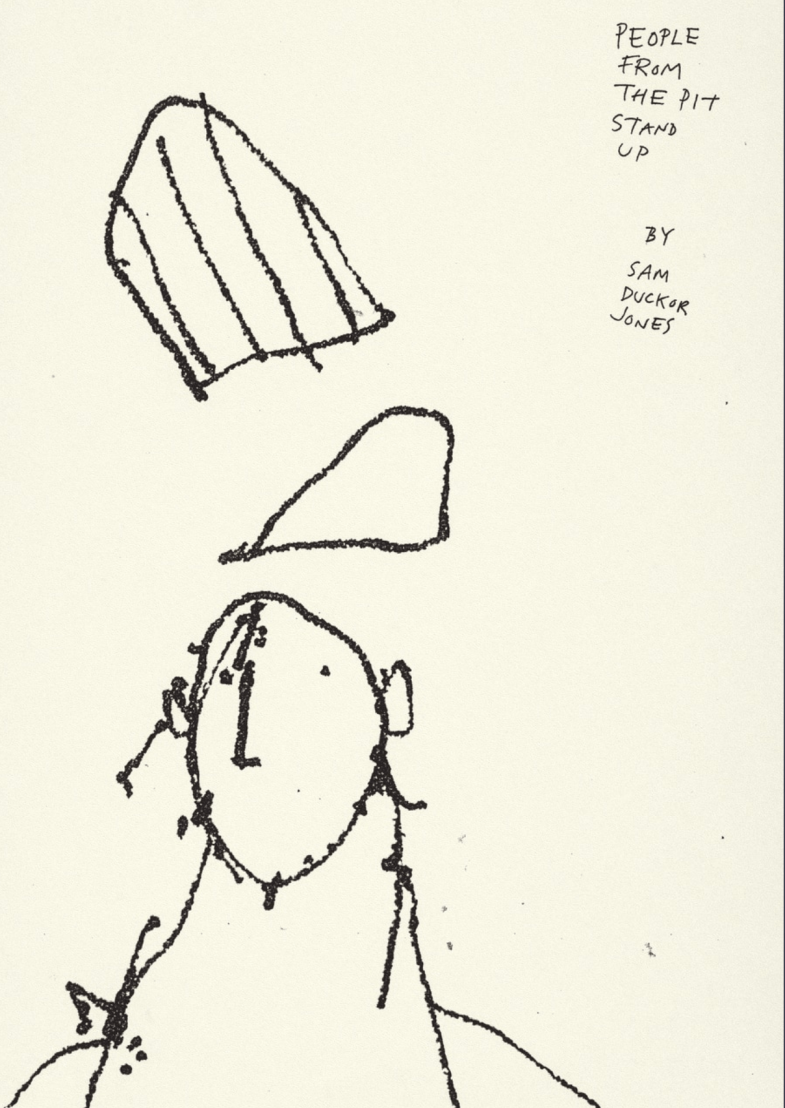
Paula: Thanks Tayi. I have loved our unfolding conversation. I want to finish with a section from a sequence I loved because in being so surely placed within a scene, a story, I felt the world. And who wants to be immune or numb? The gorgeously paced detail pricked my skin. After that, as a sweet postscript, I am sharing Hinemoana Baker’s fabulous blurb on the back cover. As with Sam Duckor-Jones, I feel like I could reflect on poetry and your book with you for weeks! It is a book of glorious returns.
The Ghost
They washed their hands because everyone else was washing their
hands. There were two sawn-off mik bottles and a mossy trough
filled with rainwater. They watched their mother make the shape of
a cross across her chest while the nannies tossed handfuls over their
shoulders, so they copied but with tactful aim, again and again, until
their father got so mad that they were sent to bed with no tea and no
Chocolate Thins for supper. Angry in their sleeping bags, Hera told
them that she had heard from their mean aunty that if they didn’t
wash their hands seriously then the ghosts would come and pull
their eyeballs out, which made Hemi too scared to close his eyes, and
in the middle of the night he woke Hera up with desperate puppy
begging. He asked her soft and whakamā to please take him to the
bathroom and help him wash his hands again, just to be sure.
from ‘Tangi in the King Country’
Victoria University Press page
Book launch reading via NZ Book Council
Reading picks for NZ Book Council
Poem in Starling
The Spinoff interview