
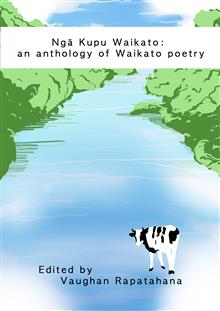
Vaughan Rapatahana is a terrific champion of poetry in Aotearoa – he shines a light on poetry and poets that deserve far more attention than they currently get, particularly in his articles posted at Jacket2. He has also edited multicultural books of poetry with poetry exercises for secondary schools (Poetry in Multicultural Oceania – Book 1 and Book 2); and he is a much admired poet in his own right.
Vaughan’s latest project is a much-needed anthology of poetry from the Waikato region. As editor his criterion for submission was that the poet had lived in the area for a minimum of one year. Themes are multiple but the river is a strong presence in the collection as a whole, while the 41 poets are stylistically and culturally, as well as politically and poetically, diverse. They range from our poetry elders (poets whose work we have loved across decades) and the electricity of emerging voices; from Bob Orr, Murray Edmond and Vincent O’Sullivan to Aimee-Jane Anderson-O’Connor and essa may ranapiri. There is an introduction by Dr Mark Houlahan from the University of Waikato.
Here is a tasting platter:
Stephanie Christie’s poem, ‘H-town’, is aware she lives on ‘land that was taken’, that like her parents she tried to leave but she has returned:
but here I am
writing poetry, prospering
in the city’s glittering vision
and the milk in my coffee
the twisting river –
O, jewel of the Waikato.
I’m the child of the future
in whose name the work
was done. History persists
in every one of us.
Many of the poems are home or origin anchors. Olivia Macassey’s is like a song, held together by the repeated line – ‘I am from’ – that opens each stanza, the physical detail gleaming:
I am from the dry hollows
below the cabbage tree and the mahoe
where other trees wait with us to grow up, the rātā
curling its thoughtful fingers;
and like the fat female eel,
I swim out and return.
Other poems evoke a sense of place to such a degree you become embedded in place as you read; the way a physical location reverberates with such intensity you are transported to a version that builds in your head. Again it forms a physical anchor. In ‘Frost’, a skinny backbone of a poem, Mohamad Atif Slim does just exactly that:
the river in
town
will be steaming
like hot soup.
the neigbour’s horse
grunts. his breaths are
puffs of
spun sugar.
a dog
barks.
inside my house
it’s still,
and still
dark.
For Bob Orr, in ‘Waikato karakia’, the river becomes glorious song, a chant, a loving homage that calls the river rhythm into being on the line.
Here is the river
here is sunlight on the river
here sunlight weaves harakeke patterns on the river
here by the unending course of the university of the river
I saw a broken branch waving a green leaf on its way down the river
Fairfield Bridge up to its concrete knees in the river
a museum of dreams reflecting the mysterious fact of the river
Murray Edmond, in ‘Matakitaki, 1822’, draws back into the region’s heartbreaking massacres, a queen’s visit, a rugby club.
here was the place of our greatest slaughter
an old green shed in a field of grass
an old green shed in a field of grass
MUSKET OVERCAME THE MERE
bronze words on a monument
And some poems are fiercely political – shifting our view point so we may no longer carry disabling historical narratives. Reading the collection is like sitting by the river through all seasons, feeling the way it runs through the blood of the poet writing, a lifelong current, carrying anecdote, beauty, history. It is both the spine and heart of the collection that draws me in closer again and again. A Waikato treasure.
singing the old songs
This is the way the old story keeps passing though
Reihana Robinson from ‘O Moehau Mountain (How much can you take?)’
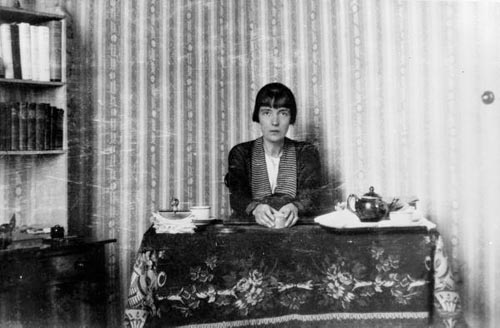
Applications open for the Katherine Mansfield Menton Fellowship, with the successful fellow travelling to France in 2020.
Founded in 1970 it has been awarded to some of our most successful writers including Maurice Gee, Carl Nixon, Kate Camp, Anna Jackson, Mandy Hager, Greg McGee, Bill Manhire, Janet Frame, Witi Ihimaera, Elizabeth Knox, Lloyd Jones, Dame Fiona Kidman, Roger Hall, Marilyn Duckworth, Michael King and Allen Curnow.
Katherine Mansfield Menton Fellowship allows the successful fellow to live for up to six months in Menton, France with access to a writing room beneath the terrace of Villa Isola Bella, where Katherine Mansfield did some of her most significant writing. They receive a $35,000 grant to cover all costs including travel to Menton, insurance, living and accommodation costs.
The fellowship is generated by a fund managed by the Arts Foundation of New Zealand, which was made possible by generous donors including many individuals, the Winn-Manson Menton Trust, Creative New Zealand and the New Zealand France Friendship Fund.
Detailed information about the fellowship and how to apply is available at the Arts Foundation’s website:
Applications open Monday 27 May and close 5pm Monday 1 July. The recipient will be announced at new Arts Foundation event, NZ Arts Ball on Saturday 31 August in Auckland.
Signal
The crossing signal twitches
like it’s filled with hot
crickets
and they whisper
touch touch touch
and so you reach out
press the cold metal button
press the cold metal
just to say:
I’m here,
I’m here, please,
let me cross safely.
Aimee-Jane Anderson-O’Connor was awarded the 2018 Charles Brasch Young Writers’ Essay Prize, and the 2017 Monash Prize for Emerging Writers. Her poem ‘Instructions’ was named by The Spinoff as the best poem of 2018. Her work has appeared in a number of literary journals, including Starling, Mayhem, Poetry New Zealand, Landfall, Mimicry, Turbine, and Min-a-rets. She writes thanks to some of the best people on this great watery rock.

Anagram Poems
Like many obsessions, my preoccupation with anagrams began by accident. I am writing my doctoral thesis at the moment, and had been struggling with my topic: alter egos in elliptical poetry. To put it bluntly: all of the alter ego poetry that I was writing for the creative section of my thesis was terrible; not so terrible that it was not even recognisable as poetry, but that uglier low level kind of terrible you get when you’re mining an area that has been all mined out and the work that results is simply boring. So I was on the lookout for inspiration, trawling for ideas that were more interesting than my thesis “starter idea”, when U.S. poet Dora Malech’s latest collection of poetry, Stet (2018), landed on our veranda in an Amazon package. My first thought on reading the poems was, “Huh?”; second thought, “What even is this?”; and then a series of thoughts that tumbled out on top of each other such as, “How does she do this?” “This is amazing!”, and “Wow, I’m so jealous, I wanna write anagram poems, too.”
Stet is a book of poetry which is composed primarily of anagrams, with a side of erasures. Malech states that she is influenced by the German artist and poet, Urnica Zurn, who wrote a series of vivid and disquieting anagram poems in the 1950s , as well as the French school of poetry Oulipo, which uses various restrictive forms to enable creativity, of which the anagram is one.
Thus began my obsession with this form–and the way that you can mine a single sentence or word or, in the case of the third section of Malech’s book, an entire poem (she writes a series of poems which are anagrams of the Sylvia Plath poem “Metaphors”)–and resulting questions (some of which Malech explores in Stet), such as: How can lyric subjectivity survive within such a tight machine? Is this kind of poetry too sterile and fragmented to really connect with a reader? I am at the beginnings of my explorations in this area, so don’t have any firm answers yet. But writing anagram poems (in which, for example, an entire poem may be made out of a single line, re-arranged) is kind of like build-your-own-nightmare. You get to choose the particular brand of nightmare, and that ambit of it, but within very tight parameters. To put it more another way, it’s like performing back flips in a very tight space; but if you pull it off, the thrill is real.
Johanna Aitchison
Johanna Aitchison is a doctoral student at Massey University, Palmerston North, examining anagrams and erasures in hybrid poetry. Her most recent volume of poems, Miss Dust (2015), was described by reviewer Sarah Quigley as “Emily Dickinson for the 21st century”. Her poetry has appeared in anthologies such as Best New Zealand Poems 2008 and 2009, and Best of Best New Zealand Poems (2011). She was a 2015 resident at the International Writing Program at the University of Iowa and the 2012 Visiting Artist at Massey University.

Chris Tse’s ‘wish list – permadeath’ was recently published in Queen Mob’s Teahouse: Teh Book (Dostoyevsky Wannabe, 2019).
Chris Tse is the author of two collections of poetry published by Auckland University Press: How to be Dead in a Year of Snakes (winner of the Jessie Mackay Award for Best First Book of Poetry) and HE’S SO MASC. His work has recently appeared or is forthcoming in Best New Zealand Poems 2018, Queen Mob’s Teahouse: Teh Book (Dostoyevsky Wannabe, 2019), The Spinoff and Peril. Chris and Emma Barnes are currently co-editing an anthology of contemporary LGBTQIA+ Aotearoa New Zealand writers.

Auckland poet Kathleen Grattan, a journalist and former editor of the New Zealand Woman’s Weekly, died in 1990. A member of the Titirangi Poets, her work was published in Landfall and other volumes including Premier Poets, a collection from the World Poetry Society. Her daughter Jocelyn Grattan, who also worked for the New Zealand Woman’s Weekly, shared her mother’s love of literature. She has generously left Landfall a bequest with which to establish an award in memory of Kathleen Grattan.
This prestigious biennial poetry award from Landfall and the Kathleen Grattan Trust is for an original book-length collection of poems, by a New Zealand or Pacific permanent resident or citizen.
Individual poems in the collection can have been previously published, but the collection as a whole should be unpublished.
Entries are accepted until 31 July 2019.
The result will be announced in Landfall 238 (November 2019), and the winner receives $10,000 and a year’s subscription to Landfall. Otago University Press has the right to publish the winning collection.
For full entry details, and to learn more about Kathleen Grattan and the history of the award, go here
The judge for the 2019 award is Jenny Bornholdt, who has published ten books of poems, the most recent of which is Selected Poems (VUP, 2016). She also edited the 2018 anthology Short Poems of New Zealand (VUP).
Her collection The Rocky Shore was made up of six long poems and won the Montana New Zealand Book Award for Poetry in 2009. She is the co-editor of My Heart Goes Swimming: New Zealand Love Poems and the Oxford Anthology of New Zealand Poetry in English. Jenny’s poems have appeared on ceramics, on a house, on paintings, in the foyer of a building and in letterpress books alongside drawings and photographs. She has also written two children’s books.
Kāpiti poet Alison Glenny was the winner of the 2017 Kathleen Grattan Award with ‘The Farewell Tourist’, a poetry collection inspired by a visit to Antarctica.
 NZ Poetry Shelf