
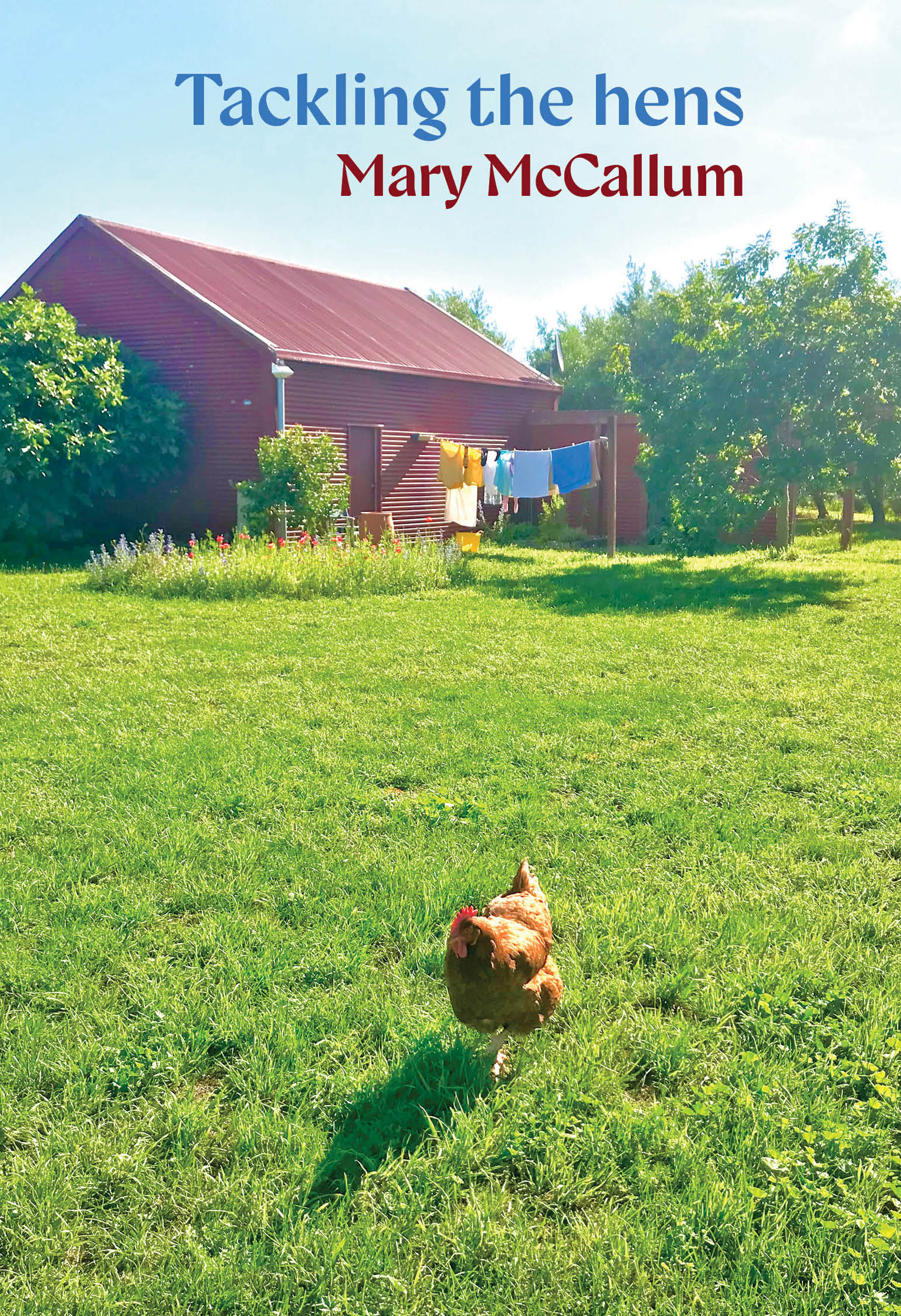
Tackling the Hens, Mary McCallum
The Cuba Press, 2026
Mary McCallum’s latest poetry collection, Tackling the Hens (2025), is a poetic engagement, both intimate and intricate, with the world close at hand, the world remembered and the world experienced. I am carried along multiple currents of poetic fluency, stalling on scenes that move and delight, savouring motifs that shimmer and dance. I follow threads of sadness, difficulty, joy. This book is life. This book is living. This book is loss. This book moves me so very much.
To celebrate its presence in the world, Mary responded to a few questions and recorded a few poems. I was moved by the book, I feel deeply moved by the conversation and the reading. Thank you Mary. Thank you.
Cauliflower
What to say, except I thought
it just a vegetable, but when
my friend told me of her gift
to the neighbour with the sick
boy—a perfect fresh cauliflower
I brought you from over the hill—
her standing at the door holding
it with two hands like treasure,
shy green leaves curled to cup
the curd—so perfectly white,
not a mark on it, florets tucked one
to another—the neighbour in front
of her assailed from all sides by
sickness and hope, by grief, by
what would be the death of a child—
the grim maw of that—and here
it was, cauliflower, something close
to heaven in its physical perfection
and the dear kindness of its delivery,
I could never see it the same way again.
Mary McCallum
Paula: Tackling the hens is dedicated to your mother, a woman who left poetry lying around for you to find, an anthology that’s now in a drawer by your bed, for example. For me, the collection is imbued in both your mother’s presence and heart-felt absence. I found this very moving. I am curious about the poetry books you stumbled upon, but more importantly, how a maternal pulse is at the heart of the book. Was it hard or restoring or necessary to be writing this precious book?
Mary: It moves me to think that you feel Mum’s presence so strongly in the book, Paula. I was close to completing the poems for Tackling the Hens when she died unexpectedly. I was travelling overseas and couldn’t get back in time to see her. Shocked and grieving, I couldn’t think about the book for a while, not just because I’d lost my mother so suddenly, but because I’d lost the person who had opened the door to poetry and lived it with me. But I’ve always found poetry to be a solace in difficult times, so before long I was back inside the collection with work to do.
I saw how the poems with my mother in them had become elegiac and a way of honouring her, and I knew I needed to get that right. I made small revisions, making a little more of her in the opening poem, where she’s ‘hopeful in pastel trouser suits’, and taking time to explore what I was trying to say in ‘Hunting for Cavafy’, a poem that I’d not had the courage to show her. I found mentions of Mum in the collection that I’d forgotten were there.
Over the coming months, I surprised myself by writing a poem about her death and one that gestured to it. And of course there’s the dedication. So, the short answer to your question is that working on the collection after Mum died was restorative and helped with my grief.
Poetry was a thing I thought all households had as a backdrop. Mum had poetry on her bookshelves, stacked on coffee tables, beside her bed – books from the library (she was a librarian and huge library user), books she’d bought or was given, and a basket of them in the loo. There were the classic English and American poets that she loved, poets in translation (like Cavafy), popular collections by writers like Spike Milligan and Pam Ayres, and the New Zealand poets, which she was discovering. Mum was born in England and when she left for Africa in her early twenties she took two poetry books with her: Other Men’s Flowers and Palgrave’s Golden Treasury, and a novel, Elizabeth Gaskell’s Cranford. She left Cranford on a train. The other two precious books were there for me to read growing up and were placed on her coffin at the funeral.
The anthology ‘shedding itself in the drawer by my bed’ is a collection of poems by English and American poets that was Mum’s once. I don’t have it with me as I write – it’s at our home over the hill in the Wairarapa – so I can’t tell you its name! The pages are crisp and yellowed and falling out; I can’t think how often they have been handled and read. Here I discovered poems like ‘The Highwayman’ by Alfred Noyes and ‘Home Thoughts from Abroad’ by Robert Browning and learnt them by heart. They still reside in my head.
I found Kiwi poets lying around the house too. I remember impressing a teacher at Wellington Girls’ College by quoting ‘Song of Allegiance’ by R.A.K. Mason in an essay. My feminist mum read the poetry that burst forth in 1975 from women writers like Rachel McAlpine and Fiona Kidman. She loved two West Coast poets, Bub Bridger and Keri Hulme, and adored the work of Margaret Mahy. A story she delighted in telling was when she drove Mahy across Wellington in her orange Fiat Bambina to deliver her to an event at Newtown Library, Mahy’s head poking through the sunroof wearing her trademark orange wig.
Paula: I am even more moved reading this. At what point did you pick up a pen and start writing poems?
Mary: I loved writing from the age of four, and I started writing actual ‘things’ when I was five – short stories, like my version of Rapunzel, which went on for pages. I was seven or eight when I first remember writing a poem. It was a sunny day at Karori West School and our teacher told us to lie outside in the playground and shut our eyes. After a while we sat up and had to write what we’d ‘seen’. I still have this poem somewhere. The whole process excited me. I wrote about the colours under my eyelids – blues and greens – ending the lines where I felt they should end and finishing with ‘I said to the sun you’re the love of it all’, which nicely repeated the word ‘all’ used earlier. I felt like a magician – transforming my sunlit experience into four lines on the page and in doing that making the sun a character I could talk to! Could anything be better?
Fast forward to the age of nine or ten, and I am at the dining room table with Mum getting dinner ready through the door in the kitchen. There’s a stack of paper, enough pens. I’m writing funny poems about people and birds. I like reading funny stories and want to try and write them. I can’t remember how often I did this, but I know Mum would have encouraged it and made me feel what I was doing was worthwhile. She’d have made the paper available and the pens, and when I’d finished and was clearing up and setting the table, she’d have read my writing with interest and declared that what I’d written were poems. Then she’d have filed them away as something worth keeping. I have them still.
I kept writing into my teens, getting published in my school magazine and in a national anthology of school writing, You Can’t Eat A Poem. I was commended for the Denis Glover Award, which led to a poem published in Landfall, and awarded PEN Young Writer of the Year! Then I was accepted for Bill Manhire’s new creative writing course, called Original Composition, at Victoria University. In the class with me were Kirsty Gunn and Jean Watson. I felt I’d arrived. I continued writing poems and stories, but it took twenty years for me to get back to publishing my work, distracted as I was by travel, journalism and starting a family.
Paula: Can you choose five (or so) words that signal what is important to you when you write poetry?
Mary:
Clearing (the physical space and time to write, a clearing for poetry in the forest of thought and feeling, openness to what comes, working through the layers to find the real poem underneath)
Curiosity and compassion (these give me my poems – people fascinate me and the natural world too – I want to know and understand more, get inside their skin and discover what makes them tick)
Joy and hope (I hope to find it somewhere as I write a poem, even a glimpse)
Emotion (used with restraint, so the reader can connect)
Rhythm and sound (gives a poem a heart and legs)
Shape and form (gives the poem spine and helps the eye)
Paula: Oh Mary, such key words. They totally resonate with me. Joy to hold to your heart. A clearing for writing but also reading and for living.
What is important to you when you read a poem by someone else? What poetry books have travelled with you, vitally, essentially?
Mary: A poem has to invite me in. The title and first line and the shape on the page probably do that first, and then the language, the syntax and rhythms, the story it tells. The poet has to have a voice all their own. Compassion and curiosity don’t go amiss. And I also need to feel that the poet has spent time with and crafted the poem, that they care about it.
For books that have travelled with me – there have been different ones at different times of my life, but there are those volumes that have travelled with me for the longest time that I need to know are at arm’s length. The ‘dog-eared’ anthology in the drawer by my bed is one. A ratty copy of Selected Poems by WB Yeats edited by A Norman Jaffares that I bought at university another. Also on the pile: a much-thumbed paperback of Sylvia Plath’s Ariel, Gerard Manley Hopkins’ Poems and Prose edited by WH Gardner, and a volume of the Collected Poems of WH Auden – my poem ‘After reading Auden’ refers to this book. An Anthology of Twentieth Century New Zealand Poetry edited by Vincent O’Sullivan, published in 1976, is the book that introduced me to many New Zealand poets, and while I don’t read it now – it’s been overtaken by hundreds of slim poetry volumes hot off the press – I like to know it’s there.
Paula: I find there are many engaging reading paths through your collection. I love how I am drawn into the domestic scenes, not skating past but on a slow pause, like the bread rising in the bowl (‘Bread’), a poem that made me muse on the way a poem might rise within the bowl of writing (and reading). What draws you to the domestic realm, to the personal?
Mary: Hah! I love that about a poem rising. I am a domestic creature, so writing about the domestic world seems natural, and more so when I still had children at home, which is when some of the Hens poems were written. I’m also curious about people, and I think the work people do – domestic or otherwise – says so much about them. In the poem ‘Bread’, we see my daughter’s partner, Jonas, and the love he puts into the food he makes for her, work that’s largely invisible, like the yeast in the dough. In ‘Beastly’ the incident in our pantry with me, my builder son and a mouse with its nose in a trap, shows how we can be trapped by who we are (a woman needing a breast scan and expected to have a mouse-free pantry/a mouse needing to eat), but a single kind gesture explodes all that. ‘Compost’ shows the huge emotional wrench of moving from a family home and how it can be interrupted by the thought that we leave some of ourselves behind in the compost bin – all that food we shared, all that work to make it! – ‘warm with rotting’.
Paula: There are many flora and fauna motifs – I love the bees, rats, hens, the oak tree. I was musing on how these things are there in the domestic or rural scene – they enhance a scene or memory visually and then might resonate on metaphorical levels. What motifs really struck a chord for you as you wrote?
Mary: Oh, creatures. I am drawn to them. I love how they skitter through our lives, often unnoticed, and yet they are our connection with the natural world and constantly challenge our humanity. I think of all the animals making their way into my poems the hens surprised me most. One popped in at the end of my opening poem ‘Weightless’ in the line ‘the benevolence of hen’. What was I thinking of – their gifts of eggs (their golden yolks)? Or was it simply the assonance that got me there. No doubt a bit of both. And the chooks in the eponymous poem ‘Tackling the Hens’ – that poem was fun to write like the hens (I never knew birds could be so much fun). It was only after the book was published that I realised this poem is really about the delightful chaos of family, which drives us nuts and sustains in equal measure, and that we miss terribly when its gone.
Paula: I also love how both living and writing open a sense and state of belonging? Does writing feel like that for you?
Mary: Yes, it does! As an immigrant to New Zealand, aged four, I’ve found so much of my writing has been a way to better understand the country my parents chose to live in and our place in it. ‘Strangers everywhere,’ my father said about my family in ‘Weightless’, and I guess that’s the lot of the immigrant to work at not being a stranger. In writing about a place and the people and animals that inhabit it you come closer to understanding them and yourself, closer to that thing called ‘belonging’. Tackling the Hens is structured to follow a progression from that feeling of strangeness through places we’ve lived as a family, the places we’ve come from, the places we’ve called home.
Paula: Choose a poem from the collection for the reader of our conversation to linger on. Why this poem?
Mary: Thank you, Paula, for your wonderful and generous questions. I’d like to finish with ‘Shines’. This was a poem that was commissioned for a collection called More Favourable Waters: Aotearoa poets respond to Dante’s Purgatory edited by Marco Sonzogni and Timothy Smith and published by my publishing company, The Cuba Press. All the poets were given lines from the Clive James translation of Purgatory that they had to respond to and include verbatim somewhere in their poem. The last six lines of ‘Shines’ from ‘Know this, you know it …’ are Dante’s. They feel fresh and energetic and not 700+ years old at all. Knowing I would finish with these lines influenced the rhythm and tone of the whole poem, and gave me my story, which is the power of a prompt like this – to provoke a writer into something new. More Favourable Waters is a fine collection of poems with 33 shining poets and I’m proud to be in it.
What I also love about this poem is the reaction I’ve had from the family I wrote about: young Moss, and his mother with wild hair. As I did ten years ago, they are moving from where they live across the harbour in the ‘house that smelled of oiled wood like a church’ to live elsewhere, and in preparing for the move they find they’ve been reading ‘Shines’ with fresh eyes. They’ve discovered in there an expression of their own grief at leaving, which is enough to make any poet’s heart leap, and read in the final lines a positive call to embrace their new life, which is all Dante, of course. What a guy!
Shines
Day calls you to attention, asks
you out the door to the hard jaw
of the city. Most mornings there’s
enough to gentle it: the woman
in a frilled shirt, the laughing clutch
of builders, Moss making coffee
at the hissing machine—the wide
grin. You know him from long ago,
watch as the dark liquid spills
into a cup, think of where he lived
across the harbour, on the hill:
the house that smelled of oiled
wood like a church; his mother,
her wild hair. The bush track
at the top of their road where you
walked the mongrel—a nervous
dog, loyal, lean. How you breasted each
rise, the land soft and hummocky,
your steps blessed by beech leaves,
the dog an unreliable guide and
gone now. Out of reach, too,
those wāhine toa with wild hair,
the boy’s mother one of many, and
all the children, your children, who
pleat your heart. But here’s
Moss handing you a keep cup,
and you’re crossing the street
between buses. Know this, you
know it, this is the way: from here on,
you yourself must be your guide. Steep
ways and tight opposed you. You came
through. The sun shines on your brow.
Now see the grass.
Mary McCallum
a reading
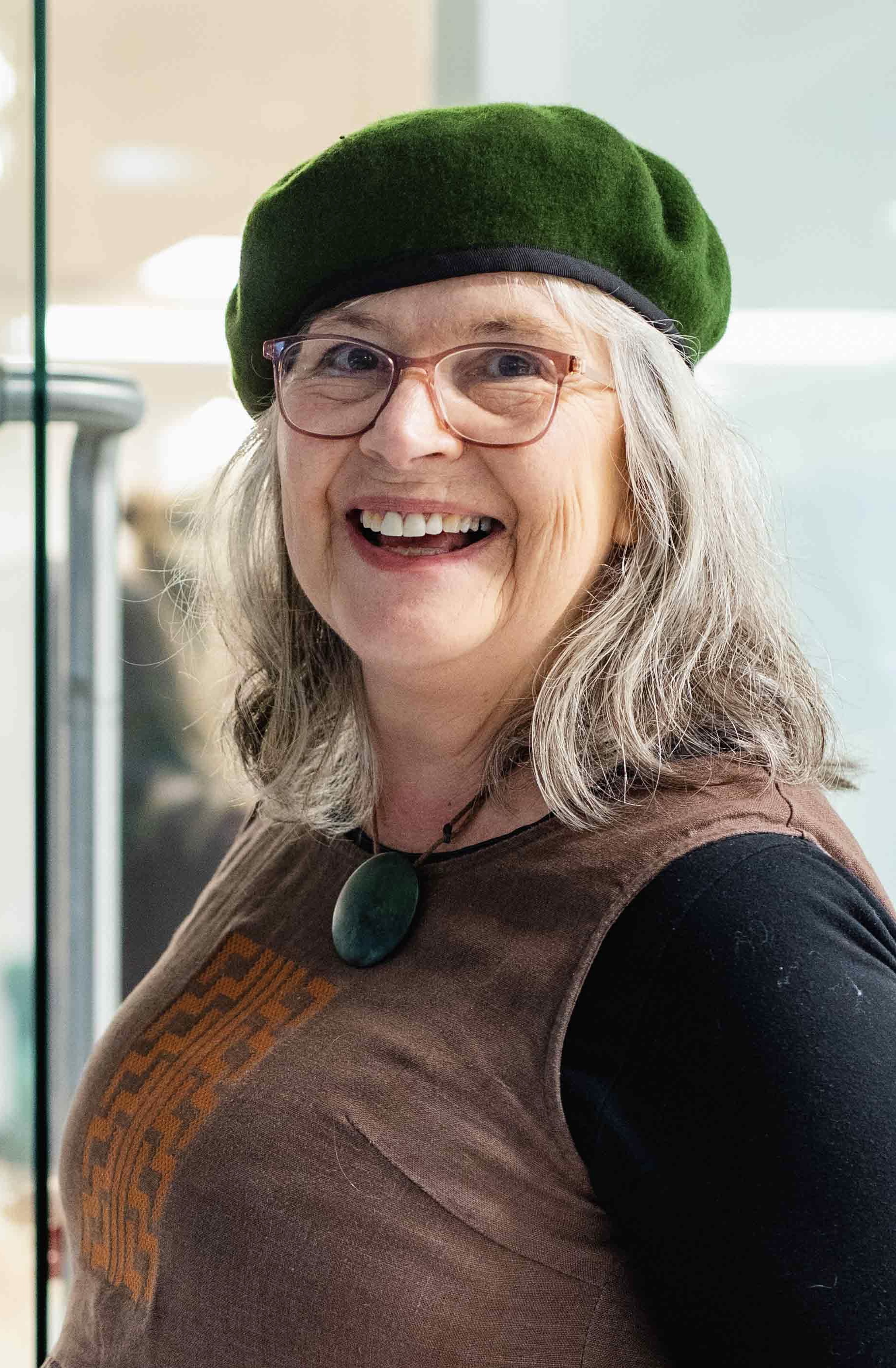
Photo credit: Trinity Thompson-Browne
‘Hare’
‘Hunting for Cavafy’
‘Mouth’
Mary McCallum is a writer and publisher who lives in the Wairarapa and Pōneke. Her own published work includes award-winning novel The Blue, a poetry book XYZ of Happiness and a children’s novel Dappled Annie and the Tigrish. She won the inaugural Caselberg Trust International Poetry Prize and her poem ‘Sycamore Tree’ was selected for Best NZ Poems. She is the director of Mākaro Press and The Cuba Press.
The Cuba Press page

