
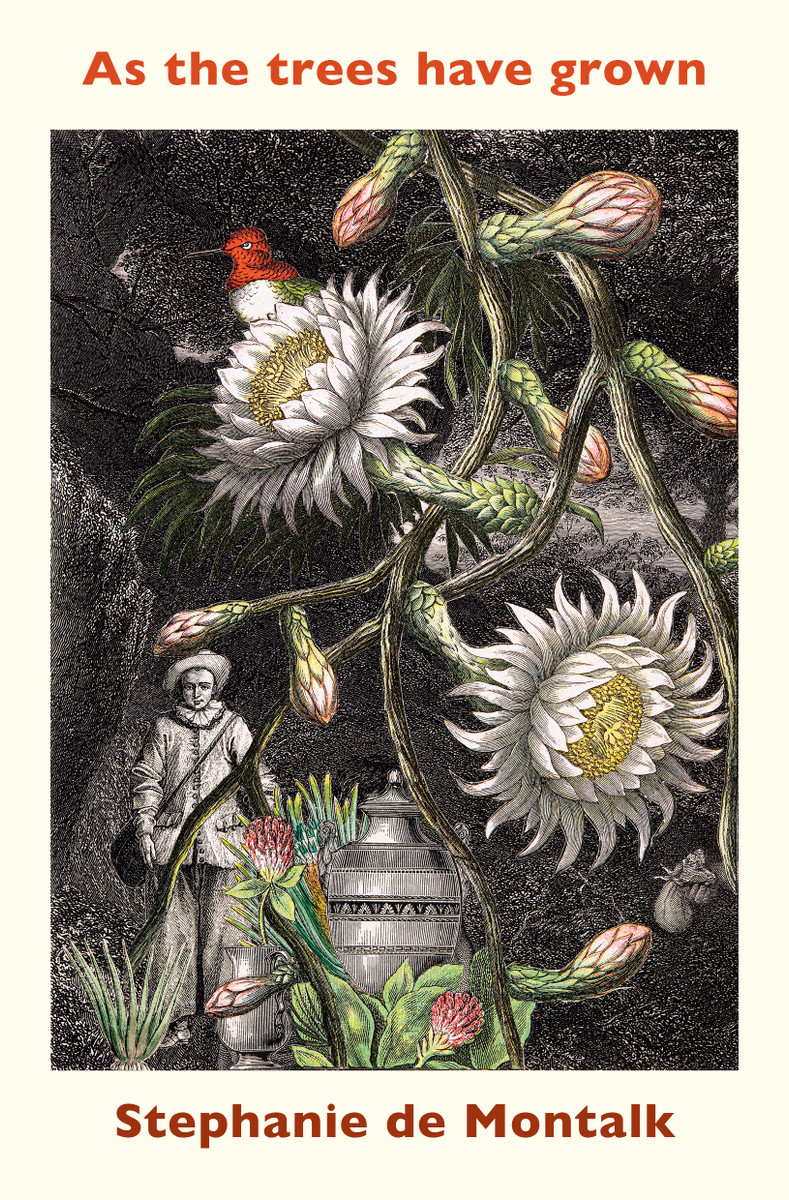
As the trees have grown, Stephanie de Montalk
Te Herenga Waka University Press, 2023
We heard neither
gasps of admiration
nor ecstatic interpretations
of radiance that afternoon—
only the sighs
of wind-blown sand
awakening our
desert thirsts
to the marvellous
from ‘Trance’
Many of the poetry collections I read, reinvigorate the idea of writing, plural rather than singular, expanding and refreshing the scope of what poems can do. Stephanie de Montalk’s new collection, As the trees have grown, is no exception. Writing becomes memory, elevation, diversion, celebration, uplift, grounding. Writing becomes heart, and all heart’s embedded words resonate within the poems: art, ear, tear, hearth, health, earth.
Art vibrates on the cover in the form of Brendan O’Brien’s terrific artwork, a collage made using 19th-century engravings with pencil and ink additions, with its intricate detail of bloom and mysterious dark. He created it after revisiting her poetry, having created covers for her first two collections. Inside, the art of the poet laces plants and wildlife, weather and luminosity with subterranean pain. It’s heart. It’s the allure of a physical moment that is transcendental in its physicality. In ‘Allurement’, you move from cobalt skies and bright hills to lawn sleeping cats to:
and all day there was
a deep, white light
and everything
with an edge to it.
A significant current, a vital skein, is that of health, as the poet negotiates physical challenges, ‘limitations’ as it states in the blurb, the tear and pain in daily equilibrium. Critical illness is an undercurrent, understated, there in signposts whiffs and analogies, as much as it is admitted, referenced, factored in. The opening poem, ‘Heartfelt’, lays down the threshold admission, introduces the impaired heart and its skew whiff music. Everything proceeds from this point. The writing. The absorbing. The living.
The rolling slopes and groves
of my lissom, evergreen heart,
struck by the dysfunction of left
ventricular damage—were at risk
of fatal erosion.
A poem, ‘Amor fati’, features a brown trout that allegedly accompanied a Scottish steam train driver on his daily trips between London and Edinburgh. I am musing how this found narrative stands in for the love of fate, amor fati, an embrace of the cards dealt, whether good or bad. And I am drawn back to the exquisite ‘Allurement’, and its pulsing beauty of an outdoor scene. Elsewhere an ailing lemon tree is watered to offer relief, or in ‘Events’, under the threat of flood and storm and power lost, plans are made: ‘What to do but bake bread and brew tea / before the occurrences peak’. Ah, how the doing is reinforcing the being. The imperative of trees and butterflies, sunsets and sunrises, earth in all its marvel and magnificence, is so vital.
Now I come to ear, the arrival of music, the longer lines, the shorter lines, the propensity for melody. Some poems favour length, but many accumulate short phrasings, a puff-breath syncopation, white space to savour, the measured beat, an economy that builds image, physical presence, nourishment. In ‘Imperium’, the poet bends her ear to the music of the bush, the pitch of tree, the operatic score of a physical view, and it is opening and it is open, as is the whole collection:
Massed choir
or spot-lit
solo performance?
The grace of long
gliding strides
or a glissandi
of light, rapid steps?
Stephanie de Montalk’s As the trees have grown is a rejuvenating map of bush tracks through living and breathing, seeing and sensing, where hospital ward becomes garden and garden becomes hospital ward, where each poem holds out ‘space and weight’, where the joy of words becomes the joy of unpackaging each day. The poetry so resonant. The poetry heart a marvel. The reading a gift of ‘hope and possibility’. This is a book to savour.
Stephanie de Montalk is the award-winning author of four collections of poems, including Animals Indoors, which won the 2001 Best First Book Award, the novel The Fountain of Tears, the biography Unquiet World: The Life of Count Geoffrey Potocki de Montalk, and How Does It Hurt?, a memoir and study of chronic pain. Described by Damien Wilkins as ‘groundbreaking and riveting and beautiful’, How Does It Hurt? was published to critical and medical acclaim, and received a Nigel Cox Award at the 2015 Auckland Writers’ Festival. It was published as Communicating Pain: Exploring Suffering through Language, Literature and Creative Writing by Routledge in 2018. Stephanie was the 2005 Victoria University Writer in Residence, and she lives in Wellington.
Te Herenga Waka University Press page
 NZ Poetry Shelf