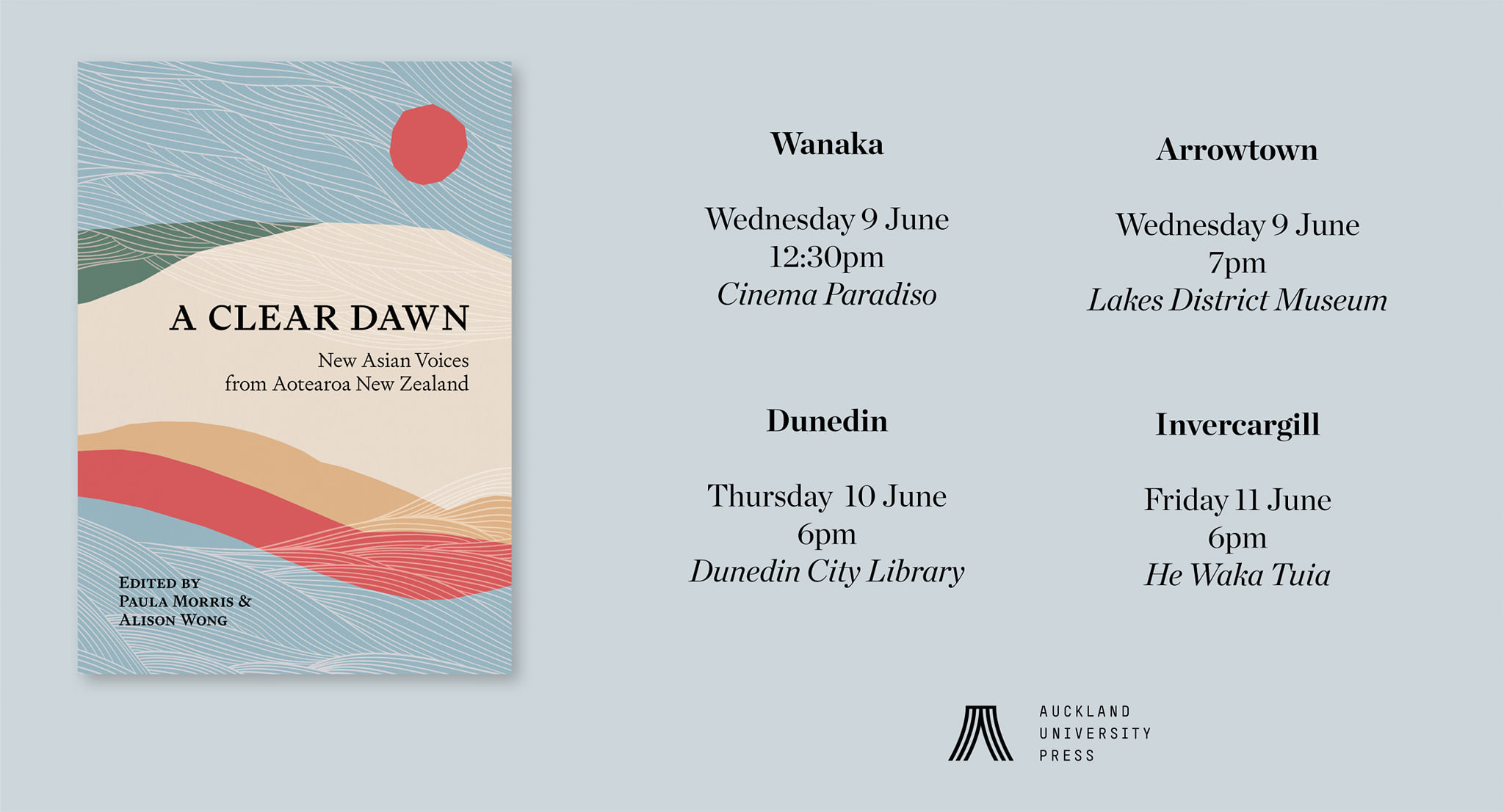
This week Alison Wong and Paula Morris are taking A Clear Dawn on a tour of the South Island! If you’re in Wanaka, Arrowtown, Dunedin or Invercargill, we’d love you to join us in celebrating this landmark anthology. Everyone is welcome and more event details can be found here
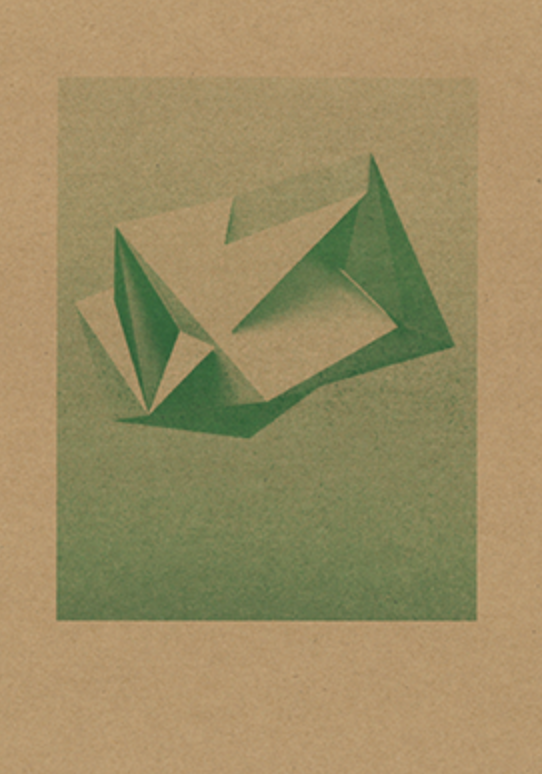
Min-a-rets 10, Compound Press, editor Sarah Jane Barnett
Poetry Shelf has put me in the sublime position of receiving pretty much every poetry book and journal published in Aotearoa NZ – but I never have enough time or energy to review everything. Yes I only review books I love, but I don’t get a chance to feature all of them. There is always a hopeful pile of books and journals that have enchanted me but that I have not yet shared. I guess it is even worse this year as I have cleared space for my own writing in the mornings and I don’t want to encroach upon that. I am really grateful that most poets don’t badger me and expect superhuman efforts on a blog that runs on the currency of love and my fluctuating energy levels. I have decided to make little returns to that hopeful stack and, every now and then, share something that you might want track it down.
I sometimes pick a poetry book hoping it will offer the right dose of rescue remedy – a mix of poetic inspiration along with heart and mind sustenance. My return to Min-a-rets10 did exactly that. Poet Sarah Jane Barnett has edited an issue that is supremely satisfying. In her introduction she expresses anxiety at not being ‘cool’ or young enough to edit a journal that is to date cutting edge, experimental, younger rather older. But once she had read the 100 or so submissions, her fears were allayed. I totally agree with her summation of the Min-a-ret gathering:
In the end I had nothing to worry about. The poems I’ve selected are beautiful, painful, challenging, thought-provoking, heartbreaking and funny. They reminded me that good poems shine no matter their genre or when they were written. They make life feel intense and bright. While this issue includes mid-career poets, there’s definitely a new generation stepping forward, and I have admiration for their commitment to craft, and to sharing an authentic experience—to not conforming. That’s cool.
10 poets with art by Toyah Webb. A slender hand-bound object published by Compound Press. Within a handful of pages, the poetry prompts such diverse reactions, it is like the very best reading vacation. I laughed out loud, I stalled and mused, I felt my heart crack. Above all I felt inspired to write. That exquisite moment when you read the poetry of others that is so good you feel compelled to write a poem.
essa may ranapiri has written a counting poem from tahi to iwa, with deep-rooted personal threads that underline there are myriad ways to count self and the world and experience. Memory. Then the honeyed currents of Elizabeth Welsh’s mother poem that free floats because motherhood cannot be limited. And yes Erik Kennedy made me laugh inside and then laugh out loud as the ending took me by surprise. Aimee-Jane Anderson-O’Connor transports me from the optician leaning in to staring at strangers to probability to ‘wow’. I am so loving the little leaps that intensify the scene.
Oh the aural genius of a Louise Wallace poem, especially when she pivots upon the word ‘trying’.
Or Joan Fleming’s line ‘Some confessions stick like stove filth’. Or Travis Tate: ‘Love is the sky, pitched black, radiant dot / of white to guide young hearts to this spot’. Or Eliana Gray’s: ‘We can’t save the people we love from drowning when it / happens on sand’.
Two list poems from Jackson Nieuwland, a witty serious funny precursor to their sublime award-winning collection I am a human being (Compound Press). And finally the laugh-out loud glorious prose poem by Rachel O’Neill where reason becomes raisin: ‘If only there was one good raisin left in the world, you think.’
Read this body-jolting issue and you will surely be inspired to get a subscription.
Kia Mau Festival is excited to announce ‘Before I Go Home’, a night of poetry celebrating migrant voices of Pōneke, at Food Court Books on the 12th of June, 6pm. Curated by Wellington poets Khadro Mohamed and Ronia Ibrahim, Before I Go Home features popular and emerging Pōneke poets from migrant backgrounds, including Chris Tse, Vanessa Crofsky, Emma Shi, Nuzha Salem, Areez Katki and Adriana Che Ismail. Join us in the heart of Newtown for a rich and diverse poetic experience, that brings the diverse voices of migrant and tauiwi identities to the forefront of Aotearoa poetry.
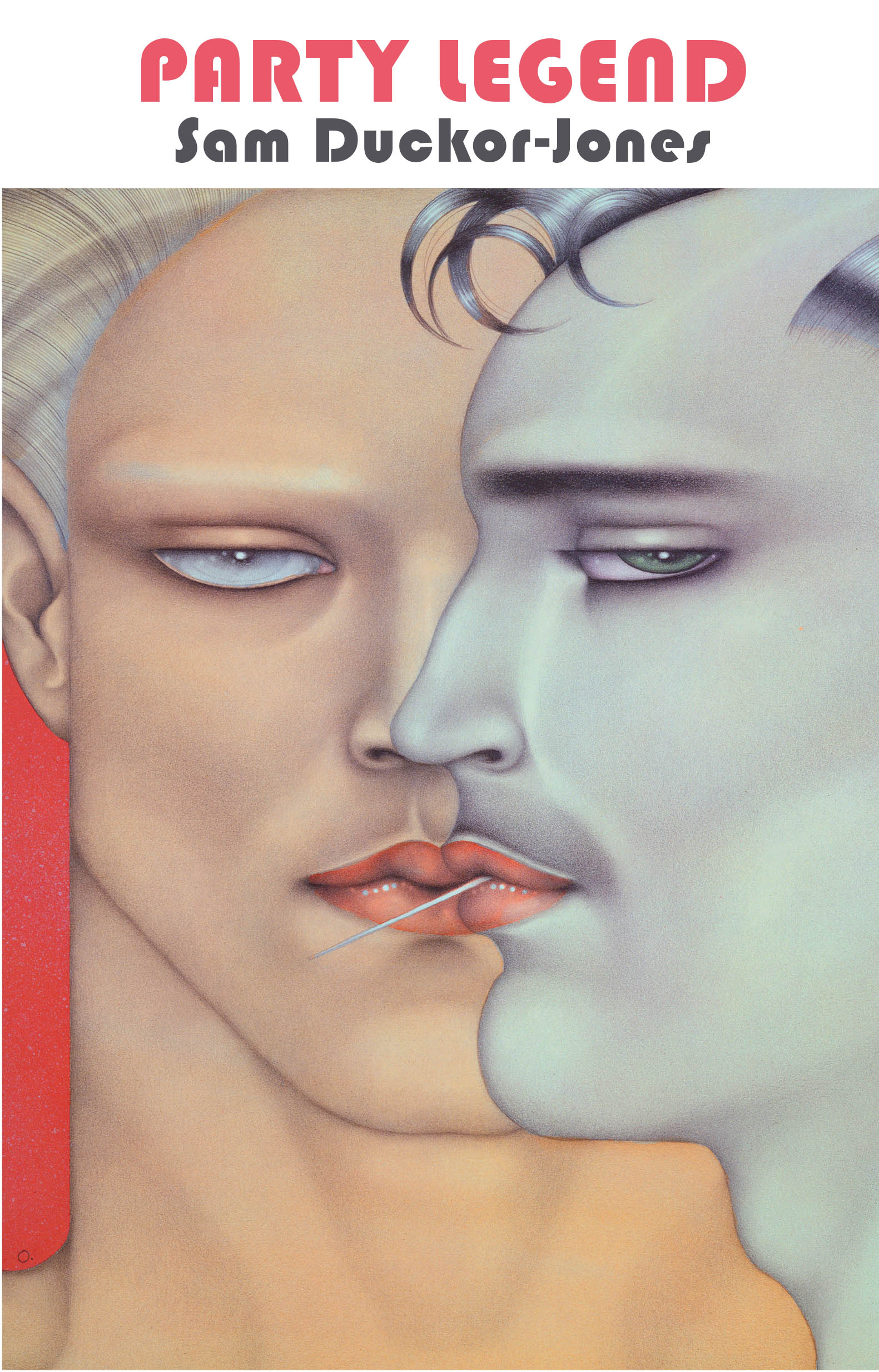
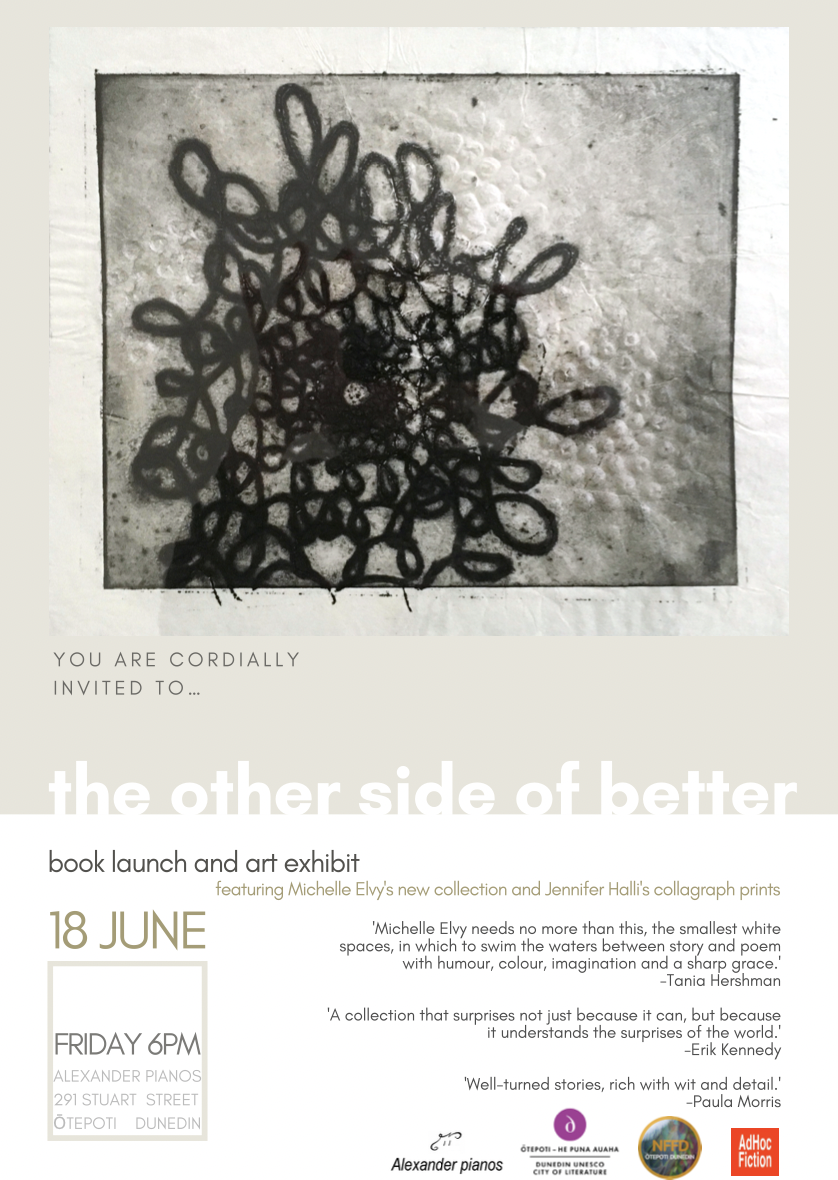
the other side of better is published by Ad Hoc in the UK, the same publisher who produced the everrumle in 2019. As with the everrumle, I’ve been lucky to work with an artist for the cover design. Wellington-based Jennifer Halli will be at the Dunedin launch on Friday, June 18, for a joint reading and art show. I’m attaching the poster for this event, so you can see her beautiful artwork (and you can find more about the artist here).
I’m also excited to be doing readings in Auckland (July 02, introduced by Paula Morris) and Christchurch (July 08, introduced by James Norcliffe), as well as online readings in July, for friends and colleagues who are not in Aotearoa New Zealand. More about those coming soon…
To pre-order the book or find out more, please see the publisher’s page. They ship worldwide! And in New Zealand, you can find the book at Nationwide or in book shops near you as of mid-June.
Jordan Hamel is a Pōneke-based writer, poet and performer. He was the 2018 New Zealand Poetry Slam champion and represented NZ at the World Poetry Slam Champs in the US in 2019. He is the co-editor of Stasis Journal and co-editor of a forthcoming NZ Climate Change Poetry Anthology from Auckland University Press. He is a 2021 Michael King Writer-in-Residence and has words published in The Spinoff, Newsroom, Poetry New Zealand, Sport, Turbine, Landfall, and elsewhere.
Poetry is a way of bridging the faraway and the close at hand. A poem can make the achingly distant comfortingly close. Poetry can be a satisfying form of travel, whether to the other side of the world, to the past or to imagined realms. Reading poems that offer the faraway as some kind of presence, I feel such a range of emotions. Moved, yes. Goose bumps on the skin, yes. Boosted, yes. This is such a fertile theme, I keep picturing a whole book moving in marvellous directions.
I am grateful to all the poets and publishers who continue to support my season of themes.
The Poems
Remembering
if you can you can try to recall
the sun across the roof and you
knee-deep in childhood playing
near the fence with the storm
of daisies still impressionable
in the way of dreams still
believing leaves had voices
and you might then remember
curtains drowned in burnished light
how at night the sky emptied
into a field of stars leaching out
the guilt you’d soon forget unlike
the woman you called Nana who kept
knitting you hats while you kept not
writing back and maybe then you’d know
the injustices you had no part in
the lady who bought your house how
she ravaged your kingdom while
you were away oh these memories
spiralling into memories into
nothing this helter skelter art of
remembering this bending
over backwards running out of light
Anuja Mitra
from Mayhem Literary Journal, Issue 6 (2018)
Drifting North
Acknowledgement to David Eggleton
She said we discussed post
structuralism in a post modern
context. She said in order
to remember such crucial
poetic phrases she had bought
a small exercise book in which
to record them.
It was, she said, a book
of semantic importance.
She said we considered
the deception of disjointed
parody and the fragmentation
of shallow consumer culture.
I can only remember
a girl
in her pale blue cardigan
drifting north
in a zither of light.
Jenny Powell
from Four French Horns, HeadworX, 2004
apricot nails
I want to paint my nails apricot as an homage to call me by your name and the fake italian summer I had last year —
fake because I didn’t cycle beside slow streams or in slow towns
Instead I lay on a 70 euro pinstripe lounger and couldn’t see the water only other tourists
And the apricots I ate came from peach spritzes at sea salt restaurants and clouded supermarket jars
But all the shops are shut and the closest nail colour I have is dark red
I want to be somewhere in northern italy with light green water and deep green conversations
I want to pick fresh apricots from drooping branches and kiss a boy I shouldn’t on cobblestone paths against cobblestone walls
I want to lick a love heart on to his shoulder so that when he gets on a train my hands shake like a thunderstorm
and I can’t cycle home past the fields we held each other in and mum has to pick me up from the station
I want to walk down a staircase with winter at the bottom waiting to sweep me into snow
I want the phone to ring when the sky is white and hear an apricot voice ripe and ready to be plucked from the tree
he’ll say how are you and I’ll slowly leak
Rhegan Tu’akoi
from Stasis 5 May 2020, picked by Aimee-Jane Anderson-O’Connor
Wearing Katherine Mansfield’s Shawl
Seventy years on, shut
in a cardboard box in the basement
of City Hall, you might think
the shawl would have lost
its force to charm, the airy fragrance
of its wearer departed, threads
stripped bare as bones,
yet here it is, another short story:
it felt like love at the Hôtel
d’Adhémar the moment you placed
the silk skein around my shoulders,
the dim red and rusty green fabric
and a fringe gliding like fingertips
over my arm, a draught of bitter
scent – Katherine’s illness,
Virginia’s sarcasm – and
yes, a trace of wild gorse
flowers and New Zealand, not
to mention the drift of her skin
and yours during the photograph,
the stately walk through the town.
Fiona Kidman
from Where Your Left Hand Rests, Godwit, Random House, 2010
Sparks
On the occasion of the Sew Hoy 150th Year Family Reunion, September 2019
Here in this earth you once made a start
home treasure watered with sweat, new seeds
a fire you can light and which gives off sparks
the gleam of gold glowing in darkness
an open door, warm tea, friendships in need
here on this earth you once made a start
sometimes you imagined you left your heart
elsewhere, a woman’s voice and paddies of green
a fire which was lit, remembering its sparks
but even halfway round the world, shoots start
old songs grow distant, sink into bones unseen
here in this earth you can make a new start
with stone and wood you made your mark
built houses of diplomacy and meaning
a new fire was lit, with many sparks
flame to flame, hand to hand, heart to heart
150 years, sixteen harvests of seed
here, in this earth, you once made a start
A fire was once lit. We all are its sparks.
Renee Liang
Heavy Lifting
Once, I climbed a tree
too tall for climbing
and threw my voice out
into the world. I screamed.
I hollered. I snapped
innocent branches. i took the view
as a vivid but painful truth gifted
to me, but did not think to lay down
my own sight in recompense.
All I wanted was someone to say
they could hear me, but the tree said
that in order to be heard I must
first let silence do the heavy lifting
and clear my mind of any
questions and anxieties
such as contemplating whether
I am the favourite son. If I am not,
I am open to being a favourite uncle
or an ex-lover whose hands still cover
the former half’s eyes. I’ll probably never
have children of my own to disappoint
so I’ll settle for being famous instead
with my mouth forced open on TV like
a Venus fly-trap lip-synching for its life.
The first and last of everything
are always connected by
the dotted line of choice.
If there is an order to such things,
then surely I should resist it.
Chris Tse
from he’s so MASC, Auckland University Press, 2018
My city
drawing blank amber cartridges in windows
from which we see children hanging, high fires
of warehouse colours, a reimagining, my city fluttering
far and further away with flags netted
and ziplining west to east, knotted
and raining sunshine,
paving cinder-block-lit-tinder music in alleys
where we visit for the first time, signal murals
to leapfrog smoke, a wandering, my city gathering
close and closer together a wilderness
of voices shifting over each other
and the orchestra,
constructing silver half-heresies in storefronts
to catch seconds of ourselves, herald nighttimes
from singing corners, a remembering, my city resounding
in and out the shout of light on water
and people on water, the work of day
and each other,
my city in the near distance fooling me
into letting my words down, my city visible
a hundred years from tomorrow,
coming out of my ears and
forgiving me,
until i am disappeared someways and no longer
finding me to you
Pippi Jean
Looming
I call it my looming
dread, like the mornings I wake
crying quietly at the grey
in my room, like whispering to my sleeping
mother – do I have to
like the short cuts I can’t take
like the standing outside not breathing
like my hand on the doorknob
counting to twenty and twenty
and twenty.
Tusiata Avia
from Wild Dogs Under My Skirt, Victoria University Press, 2004
mothering daughter
I am coming home to myself
while watching
my mother going away from herself.
Every move you make
an effort
so much slower now, mother
like your body is trying to keep pace
with your mind
everything about you reads as
tired
but sometimes I read as
giving up
FUCK THIS! silently salts my tongue
a tight fist slamming the steering wheel
gas under my foot
tears choking my ears
smoke swallowing my chest.
I am a mother:
Mothering her son,
a motherless daughter mothering her mother.
It’s hard somedays not to be swallowed.
Grace Iwshita-Taylor
from full broken bloom, ala press, 2017
Memoir II
Preparing for death is a wicker basket.
Elderly women know the road.
One grandmother worked in munitions, brown
bonnet, red stripe rampant. the other, a washerwoman:
letters from the Front would surface, tattered.
You must take the journey, ready or not.
The old, old stream of refugees: prams
of books and carts with parrots.
Meanwhile the speeches, speeches: interminable.
When the blood in your ears has time to dry: silence.
The angel will tie a golden ribbon to the basket’s rim.
You will disappear, then reappear, quite weightless.
Jeffrey Paparoa Holman
from Blood Ties: New and Selected Poems 1963- 2016, Canterbury University Press, 2017
fever
moving away from the orchard plots,
laundry lines that sag under the macrocarpa.
moving away from the crystalline skies,
the salt-struck grasses, the train carts
and the underpasses. i astral travel
with a flannel on my head, drink litres
of holy water, chicken broth. i vomit
words into the plastic bucket, brush
the acid from my teeth. i move away,
over tussock country, along the desert
road. i chew the pillowcase. i cling
my body to the bunk. the streets
unfurl. slick with gum and cigarettes.
somebody is yelling my name. i quiver
like a sparrow. hello hello, says the
paramedic. but i am moving away from
the city lights, the steel towers.
and i shed my skin on a motorway
and i float up into the sky.
Elizabeth Morton
from This Is Your Real Name, Otago University Press, 2019
Black Stump Story
After a number of numberless days
we took the wrong turning
and so began a slow descent
past churches and farmhouses
past mortgages and maraes
only our dust followed us
the thin cabbage trees were standing
in the swamp like illustrations
brown cows and black and white and red
the concrete pub the carved virgin
road like a beach and beach like a road
two toothless tokers in a windowless Toyota
nice of you to come no one comes
down here bro – so near and
yet so far – it takes hours
not worth your while –
turned the car and headed back
shaggy dogs with shaggy tales
Murray Edmond
from Fool Moon, Auckland University Press, 2004
The Poets
Tusiata Avia is an internationally acclaimed poet, performer and children’s author. She has published 4 collections of poetry, 3 children’s books and her play ‘Wild Dogs Under My Skirt’ had its off-Broadway debut in NYC, where it took out The Fringe Encore Series 2019 Outstanding Production of the Year. Most recently Tusiata was awarded a 2020 Arts Foundation Laureate and a Member of the New Zealand Order of Merit for services to poetry and the arts. Tusiata’s most recent collection The Savage ColoniserBook won The Ockham NZ Book Award for Best Poetry Book 2021.
Murray Edmond, b. Kirikiriroa 1949, lives in Glen Eden. 14 books of poetry (Shaggy Magpie Songs, 2015, and Back Before You Know, 2019 most recent); book of novellas (Strait Men and Other Tales, 2015); Then It Was Now Again: Selected Critical Writing (2014); editor, Ka Mate Ka Ora; dramaturge for Indian Ink Theatre. Forthcoming: Time to Make a Song and Dance: Cultural Revolt in Auckland in the 1960s, from Atuanui Press in May, 2021.
Jeffrey Paparoa Holman is a Christchurch poet and non-fiction writer. A poetry collection, Blood Ties: selected poems, 1963-2016 was published by Canterbury University Press in 2017. A memoir, Now When It Rains came out from Steele Roberts in 2018. He makes his living as a stay-at-home puppy wrangler for Hari, a Jack Russell-Fox Terrier cross. Hari ensures that little writing takes place, while psychogeography and excavating parks happen daily. Recent work has appeared in Poetry New Zealand Yearbook 2021, an essay on prison reform, and poetry; also, an inclusion in The Cuba Press anthology, More Favourable Waters – Aotearoa Poets respond to Dante’s Purgatory.
Grace Iwashita-Taylor, breathing bloodlines of Samoa, England and Japan. An artist of upu/words led her to the world of performing arts. Dedicated to carving, elevating and holding spaces for storytellers of Te Moana nui a Kiwa. Recipient of the CNZ Emerging Pacific Artist 2014 and the Auckland Mayoral Writers Grant 2016. Highlights include holding the visiting international writer in residence at the University of Hawaii 2018, Co-Founder of the first youth poetry slam in Aoteroa, Rising Voices (2011 – 2016) and the South Auckland Poets Collective and published collections Afakasi Speaks (2013) & Full Broken Bloom (2017) with ala press. Writer of MY OWN DARLING commissioned by Auckland Theatre Company (2015, 2017, 2019) and Curator of UPU (Auckland Arts Festival 2020).
Pippi Jean is eighteen and just moved to Wellington for her first year at Victoria University. Her most recent works can be found in Landfall, Starling, Takahe, Mayhem, and Poetry New Zealand Yearbook among others.
Fiona Kidman has written more than 30 books and won a number of prizes, including the Jann Medlicott Acorn Fiction Prize for This Mortal Boy. Her most recent book is All the way to summer:stories of love and longing. She has published six books of poems.In 2006, she was the Katherine Mansfield Fellow in Menton. The poem ‘Wearing Katherine Mansfield’s shawl ‘is based on an event during that time. Her home is in Wellington, overlooking Cook Strait.
Renee Liang is a second-generation Chinese New Zealander whose parents immigrated in the 1970s from Hong Kong. Renee explores the migrant experience; she wrote, produced and nationally toured eight plays; made operas, musicals and community arts programmes; her poems, essays and short stories are studied from primary to tertiary level. In recent years she has been reclaiming her proud Cantonese heritage in her work. Renee was made MNZM in 2018 for Services to the Arts.
Anuja Mitra lives in Auckland. Her writing has appeared in Takahe, Mayhem, Cordite Poetry Review, Starling, Sweet Mammalian, Poetry Shelf and The Three Lamps, and will appear in the AUP anthology A Clear Dawn: New Asian Voices from Aotearoa New Zealand. She has also written theatre and poetry reviews for Tearaway, Theatre Scenes, Minarets and the New Zealand Poetry Society. She is co-founder of the online arts magazine Oscen.
Elizabeth Morton is a teller of poems and tall tales. She has two collections of poetry – Wolf (Mākaro Press, 2017) and This is your real name (Otago University Press, 2020). She has an MLitt in creative writing from the University of Glasgow, and is completing an MSc in applied neuroscience at King’s College London. She likes to write about broken things, and things with teeth.
Jenny Powell is a Dunedin poet and performer. Her work has been part of various journals and collaborations. She has a deep interest in music and used to be a french horn player.
Chris Tse is the author of two poetry collections published by Auckland University Press – How to be Dead in a Year of Snakes (winner of Best First Book of Poetry at the 2016 Ockham New Zealand Book Awards) and HE’S SO MASC – and is co-editor of the forthcoming Out Here: An Anthology of Takatāpui and LGBTQIA+ Writers From Aotearoa.
Rhegan Tu‘akoi is a Tongan/Pākehā living in Pōneke. She is a Master’s student at Victoria and her words have appeared in Turbine | Kapohau, Mayhem and Sweet Mammalian. She has also been published in the first issue of Tupuranga Journal
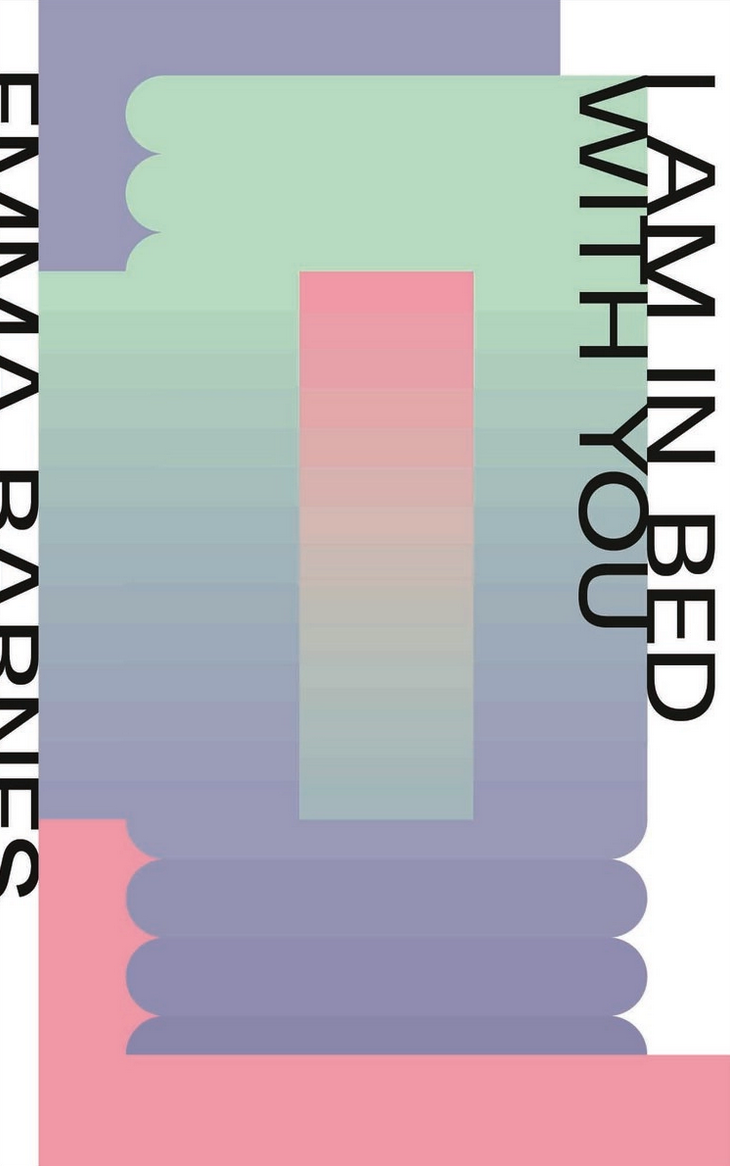
I Am in Bed with You, Emma Barnes, Auckland University Press, 2021
I am in bed with you. The room varies. But I’m always on the
left. I am pulling the pieces of myself into myself. In the winter
I left myself behind in the 90s. I’m coming back now. You
can see the light touching me. I can see layers of tissue finally
making a body. And once I have a body I have a head. And in
my head are these thoughts. I can’t tell you what it is like with
words. You can hold my hand and feel my pulse, but I was in
1994. I didn’t like
it there. When I am getting through days I don’t even know I
am making it. I am the legume in that story about royalty. And
then on the other side I open up like a lake into a river. I can
survey the lean fields of my insides as if I am owner of all
those glistening blades. In 1994 I was fourteen. I buried some-
thing back there. I buried it alive in a biscuit tin. This winter
makes choices I’d have made differently. Your mother cooked
a roast chicken every
Saturday unless a larger animal had died. (…)
from ‘I am in bed with you’
Emma Barnes’s debut collection I Am in Bed with You is a sublime read. Their poems hit such pitch-perfect notes any attempt to share my reading engagements will fall short. It’s like when someone asks why you like this painting or this song or this poem and all you can say I love it. Get the book. Find your own engagements.
And yet.
And yet this book haunts me to the degree I want to talk about it with you. There are three sections: ‘This is a creation myth’, ‘Sigourney Weaver in your dreams’ and ‘The Run-Around’.
There is a moving acknowledgements page. I love this page. In fact I am loving this choice in a number of recent publications – tributes paid to the communities and individuals that a book is in debt to. Emma begins by saying: ‘The most important thank you for any Pākehā writer is to mihi the mana whenua of Aotearoa for their generosity in the face of continued acts non-consent and disrespect by us, their Treaty partners. I am truly privileged to be a treaty partner, to have this place to stand and to receive repeated gifts and offerings of manaakitanga.’
Emma thanks a high-school teacher and her publisher Sam Elworthy (Auckland University Press) who prompted her ‘to transform reluctance into curiosity’. I love this too. A publisher who is nurturing all manner of vital poetry collections and connections into the world (think A Clear Dawn, AUP New Poets 8). And of course friends and family. Taking time to offer such a heartfelt mihi matters.
Emma’s collection refreshes a joy in sentences. This is a book where sentences are the exquisite building blocks of poetry. Crafted with an ear attuned to sound, rhythm and chords, and an eye for movement that may startle, dazzle, draw you in closer.
The opening poem in the opening section is akin to a creation myth; an original origin story: inventive funny fabulous. The poems that follow resemble creation episodes; the speaker is vulnerable and bold in their self exposures, in the creating and making of self, dismissed body, gendered self, self expectation. The mother is missing, longed for or discounted. Being woman being man being another is faced. The sentences are off-real surreal cloaked hyper-real skating and free-sliding from feeling to nothing to question to admission to nothing to strange detail to wounding edge to invisibility to laugh out loud. To being unbearably moved.
Sigourney Weaver tells me that desire has a hard edge. The end. The
limit it enforces by virtue of its own inevitability. She’s been reading
the internet again. Sigourney Weaver says that our bodies are wishes
made from DNA and that time and time again we defeat ourselves with
our limited thinking. Always imagining edges. The edge of desire
is only there because we out it there. And we put it there because we
can’t make sense of a world where we could desire and act in equal
measure. Trust Sigourney Weaver to get me tied up in knots without any
rope. Not even the tiniest string around my finger. I like a boundary,
Sigourney Weaver. I like clear statements. I like small words. (…)
from ‘Sigourney Weaver confronts the limits of desire’
The middle section of poems stars Sigourney Weaver. If you want to hang out with a famous film star you can do it in a sequence of poems and then you get to choose how things will pan out. The speaker is hanging out with Sigourney in Aro Valley. They rent movies, kiss, take ecstasy, kiss, have an android baby. It is wickedly funny, so so funny, with a twist of weird and strange and creepy. Sigourney buys a place, a van, becomes a citizen, and in all the curious surreal twists – exhilarating, hilarious, uplifting – your heart is consistently tugged. Look to the weird and you find the ordinary: house-moving cartons, dresses and pigtails, ballgowns, mint-flavoured life savers. This sweetly crafted sequence also finds sustenance in the joy of the sentence.
The final section’s refrain is love. Love poems that are like prismatic love songs with shifting chords and rhythms, the ‘you’ elusive and on the move. In the other sections poems are given breathing-space as they break apart into stanzas. Here the poems appear as dense paragraphs – framed by the white space of breath yes – but catching love’s intensity, love as unfathomable, physical, intimate, complicated, hard to say. Again there is a glorious sway between the weird and the surreal and a familiar heart-grasp of relationships, aloneness, closeness. You can’t breathe as you read, as you feel.
Emma has produced a collection unlike any other I know with its unifying addiction to the sentence, and motifs that go deeper than surface beacons: think age, body expectations, gender, the making of self, the lasting effects of childhood, experiences that bite, disappearing acts, love, desire, more love, more desire. You will meet dreams and demons and epiphanies. Writing is musing, reflecting back, side-drifting, inventing, confessing. You will revel in the joy (and pain) of writing, and yes writing becomes, and yes writing is a form of becoming. Extraordinary.
Emma Barnes studied at the University of Canterbury and lives in Aro Valley, Wellington. Their poetry has been widely published for more than a decade in journals including Landfall, Turbine | Kapohau, Cordite and Best New Zealand Poems. They are currently co-editing with Chris Tse an anthology of LGBTQIA+ and takatāpui writing from Aotearoa New Zealand for Auckland University Press.
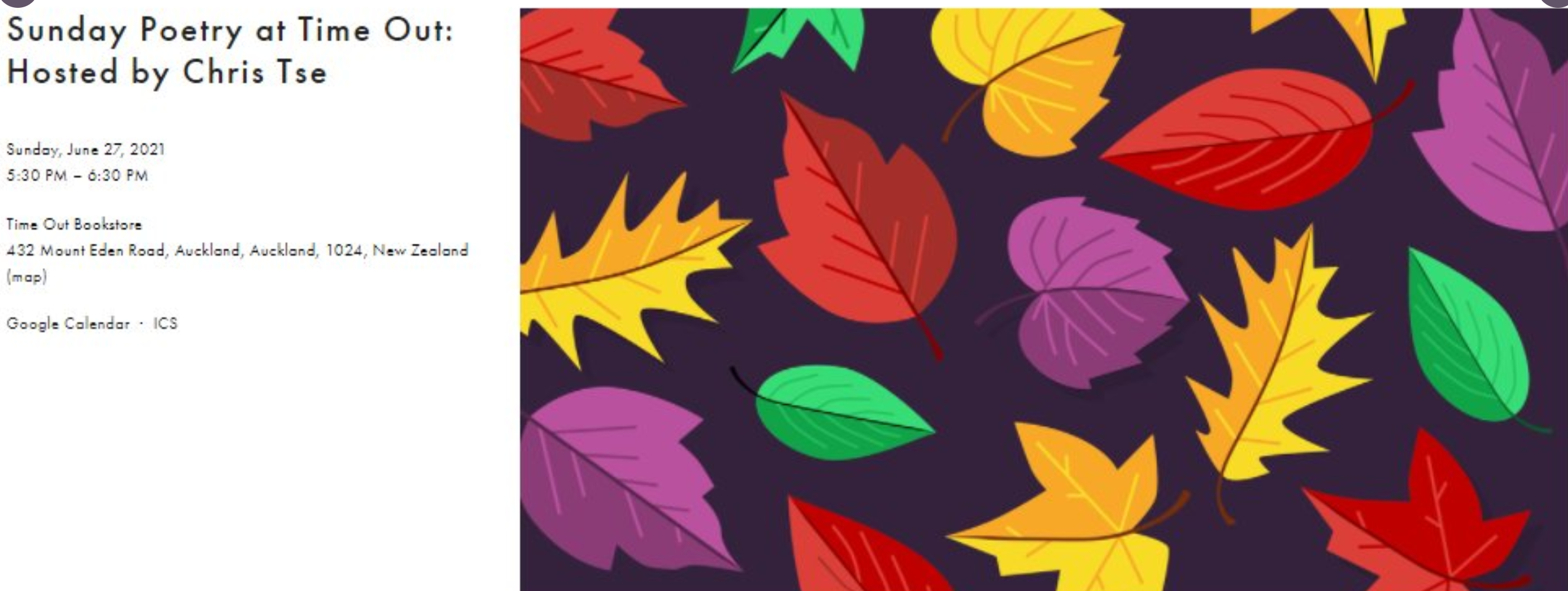
Wrap up your weekend with a poetry reading featuring an effervescent and refreshing six-pack of poets: Lily Holloway, Nathan Joe, Ria Masae, Samuel Te Kani, Chris Tse, and Angela Zhang




 NZ Poetry Shelf