Monthly Archives: March 2021

Poetry Shelf review: Catherine Bagnall & L. Jane Sayle’s ‘on we go’

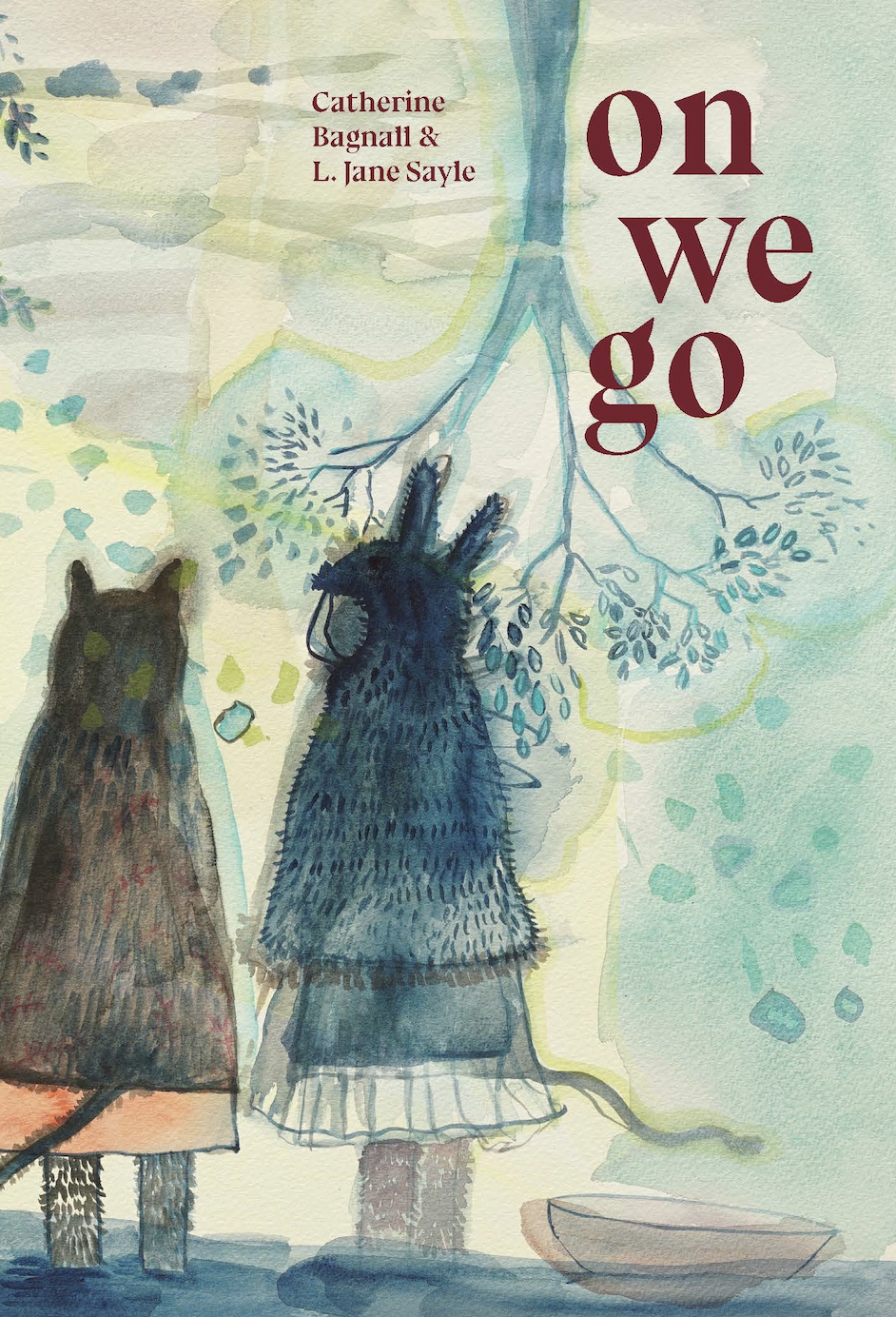
on we go, Catherine Bagnall and L. Jane Sayles, Massey University Press, 2021

On we go

Empty suitcase made of leaves

and a stomach light as air

just to walk up in the sky

talking with you

Artist Catherine Bagnall grew up between the bush and Wellington harbour’s eastern shore. She lectures at the College of Creative Arts Toi Rauwhārangi, Massey University. L. Jane Sayle was raised on Wellington’s south coast. She has lectured in art and design history, and collected and sold curios and ephemera. This is her debut poetry collection.

Jane was living in Munich and Catherine was in Wellington when they began on we go. It is an exquisite collaboration that matches watercolours with poetry. I had no idea about their working process when I first read the book. I read the images, then read the poetry and finally I read the conjunctions that simmered away between art and text. A magical and unique reading experience. In fact Catherine and Jane exchanged emails but produced the work independently with neither art nor poetry coming first.

Enter the collection and you enter a magical place that resembles a series of open windows and doors, thresholds that lead you to a world that is rendered ethereal, fable-inducing, childlike, dreamy, mysterious. The translucent layers in both the poetry and the images transport you to shadow and light, the familiar and the achingly strange.

I read the watercolours first, finding my way through a forested world peopled with costumed figures that seem part-child part-adult part-animal (rabbits, cats, butterflies). The trees adopt other-worldly shapes, there is a strong sense of playfulness, of acting out, of visual narratives that open wide for you to go meandering. Dream reading. Sometimes the characters are caught mid-movement while at other times they are transfixed in the scene, caught in the middle of reverie. I love the image of the two cats, one larger and one small, one black and one blue, on the doorstep staring out into the ambiguous colour-washed world. I am there on the threshold as reader and am part of the world-gazing. There is a tiny teapot next to the two cats, a miniature marker of the domestic, of curios and collectibles, of rituals that shape a day. On the other side of the page, two figures awkwardly climb into their cat costumes, one tall and one small, one black and one blue, with arms bent and askew, and one reaching out fingertips to touch the threshold, the tree branch, the great big magical wide open world.

The art work is mesmerising, a watery narrative that can never be pinned down to single meanings, dead-end stories. I didn’t discover the mode of working until the endnote. Catherine makes clothes resembling ‘other-ly creatures’ with tails, ears and fur, and wears them into the forest where she archives her experience / performances. These then are translated into the watercolours. I liked reading the images before discovering this, so I hope I haven’t spoiled the pathways for you.

What bird is that?

Between winds

soft sunshine

strands of lemon lichen

across a satin-grey rock bank

and the smell of blackberry

living for the moment

inside the quiet air

on the nameless day

Armed with this fascinating biographical snippet, I then read Jane’s poems wondering if a poet can also make her her own ‘other-ly’ dress-up clothes that she wears into the forest before archiving her performances (so to speak). The elegant poetry achieves the same layering of mystery, etherealness, economy. Enter the layered poems and you draw upon the metaphysical, the ambiguous, the translucent, the metaphorical. The poems are potent, allowing tiny narratives of your own making, with everything delighting in the present tense. We are directed to the small and we are sidetracked to the large. There is vital economy and there is vital plenitude. There are ideas and there are moods. The detail is lush, the sound effects are intricate.

When the poem, ‘On we go’, offers an empty suitcase that is made of leaves, the suitcase itself becomes the point of fascination rather than the contents. And then the whole notion of emptiness pulls you back, and the collection pivots on whatever is there and whatever is not. I see this collaboration as part fable, part fairytale, part response to the knotty world but, more than anything, it is a precious contemplation prompt. A gorgeously-produced handbook to keep in your pocket for times you need that moment of dream and drift and replenishment.

Though we were long gone

all our coats were hanging

on hooks in the hall

How things wait

for us to come back

how they mutely love us

as they fade

from ‘Going back’

Massey University Press page

Sample pages
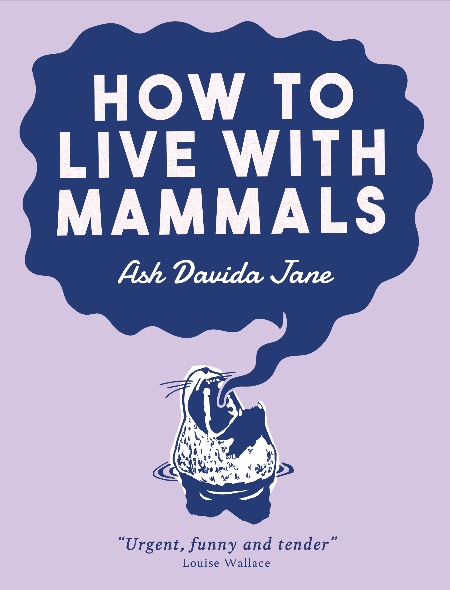
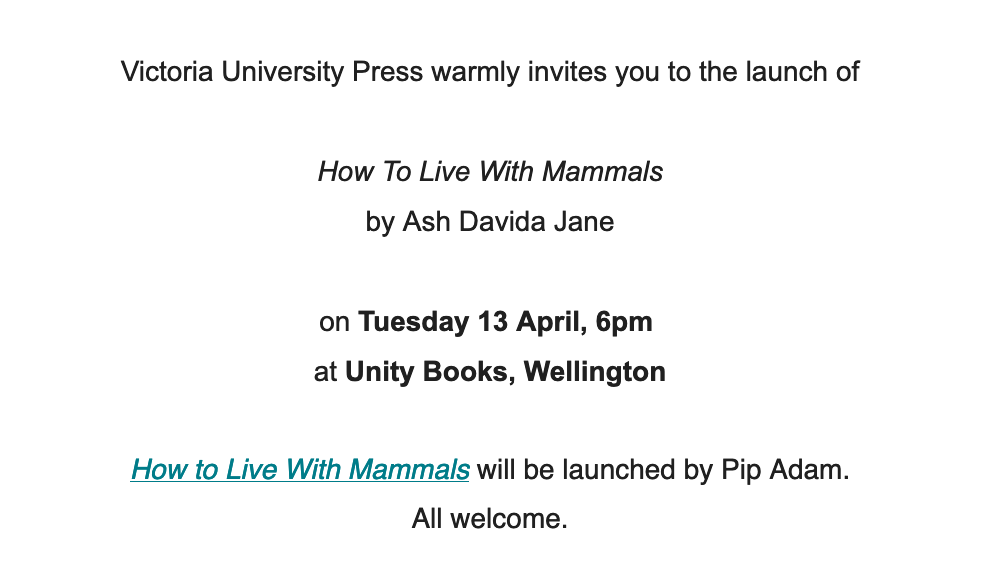
Poetry Shelf noticeboard: Launch of Ash Davida Jane’s How to Live with Mammals

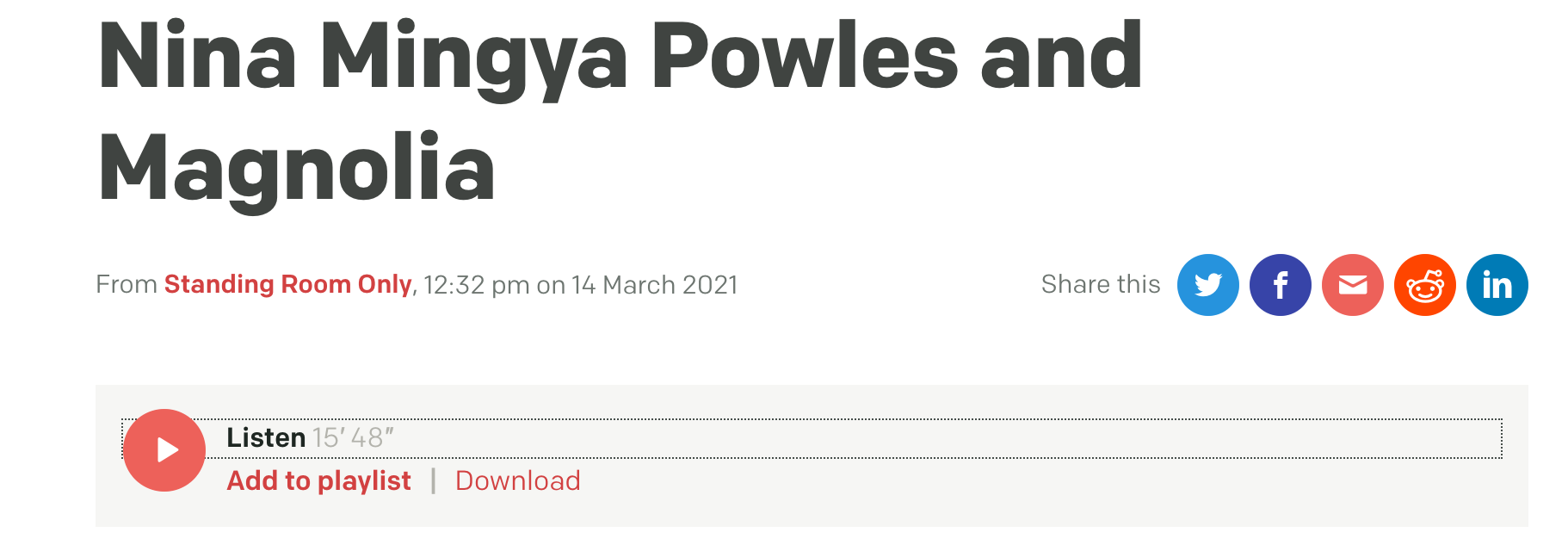
Poetry Shelf noticeboard: Nina Mingya Powles on the radio and live at Vic Uni

Listen here

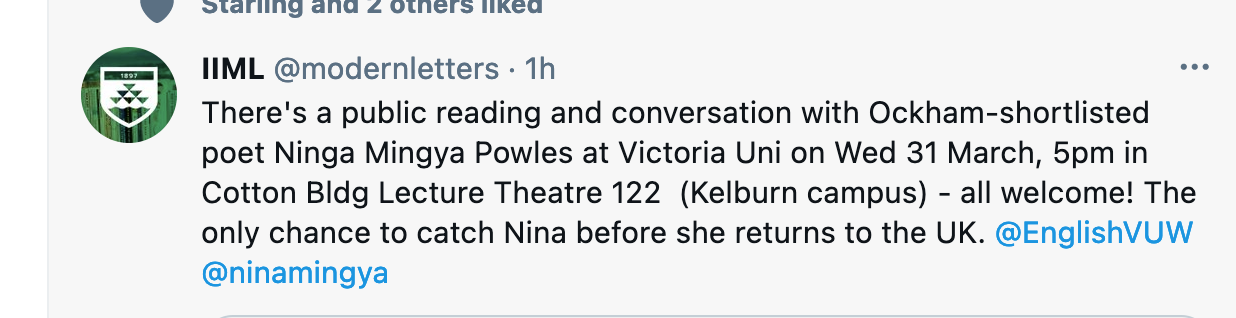
You can also hear Nina in person at Vic Uni:

Poetry Shelf noticeboard: Poems by Cleaners event

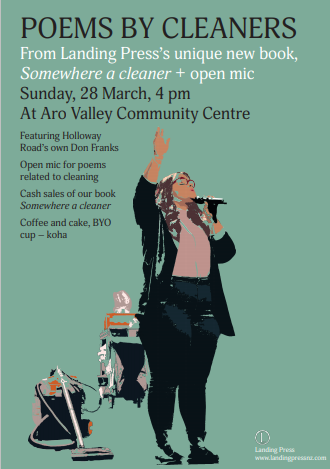
We’re in the Auckland Writers Festival! The amazing Mele Peaua will lead a team of four writers from Somewhere a cleaner, introduced by co-writer Janice Marriott. If you’re in Auckland, Saturday 15 May 5pm, join us.

You don’t need to go to Auckland! Several writers from the book join cleaner/musician Don Franks for an hour in the Aro Valley Community Centre. Sunday 28 March, 4.00pm.

Also an open mic for poems about cleaning/cleaners. Coffee and cake (bring your own cup), koha.

Poetry Shelf Review: Eamonn Marra’s 2000ft above Worry Level

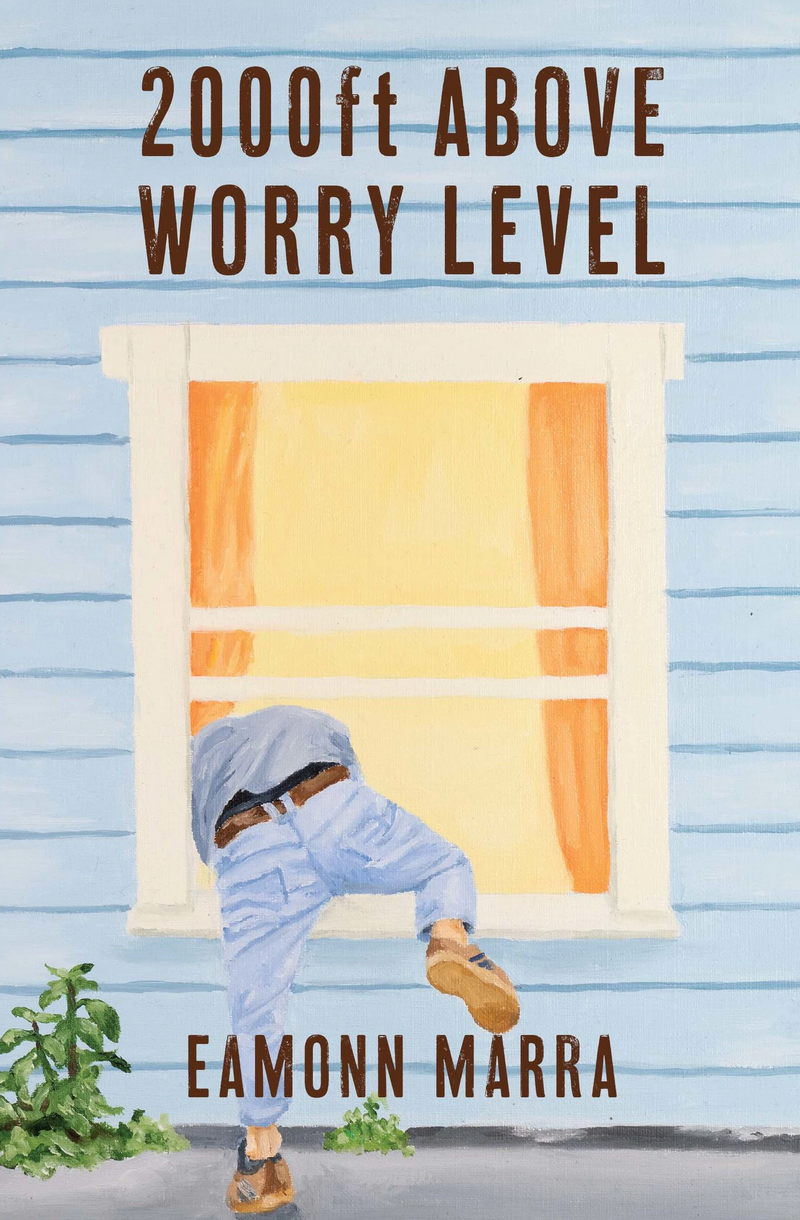
Eamonn Marra, 2000ft above Worry Level, Victoria University Press, 2020

Have you read Eamonn Marra’s 2000ft Above Worry Level yet? It is so good. It is so real it hurts, because there you are in the edginess of life that is seldom smooth sailing, that offers up edges and grime and spikes and unspeakable challenges and making do and doing the things you need to do to get through the day. I laughed out loud and I winced and I almost cried and then I laughed out loud again and I just didn’t want to put the book down. The sentences are freshly flowing, the dialogue pitch perfect. The voice of the main character feels so real I feel like I am intruding into the story. A gatecrashing eavesdropping reader who wants everything to go ok. The bloke is just out of university and is trying to find a job, trying to hold down a room in a flat, trying to keep his mind in balance with anti-depressants, keeping in touch with his ex-girlfriend who he likes more than any other subsequent date. painting his mother’s fence slower than a snail with the help of top tips from a well-meaning neighbour. He is trying to write fiction in between the daily demands, and when his ex-girlfriend complains his short story is based on her, he claims it as fiction. Who knows whether fiction draws on real life and real life collapses into fiction in this kaleidoscopic rollercoasting 3D realism!

The novel is episodic, collaging pieces of a life, scenes from childhood alongside university days and post university, and it comes together as glorious conjunctions with its adhesive threads. Think persistence, think daily detail, what gets eaten, what gets agonised over, what gets said and what doesn’t get said, think humour and everyday tedium and enduring family attachments. The writing is almost like stream of conscious, yet it is sweetly crafted in its poise, its delicious ease. And if you crash against the dark, especially a psychological dark and the awkwardness of fitting in and making ends meet, if you do feel affected by this, and I sure did, you also absorb hope and light and rejuvenation. I started reading the book when an incomprehensible and insulting tweet about two new zealand poets really pissed me off. Reading 2000ft above Worry Level got me back on track and I just thought yes! This sublime self-transcending reading experience is why books matter.

Eamonn Marra is a writer and comedian. He was born and raised in Christchurch and now lives in Wellington. He has a masters degree from the International Institute of Modern Letters. Eamonn’s shows include Man on the Verge of a Nervous Breakdown (2014), Respite (2014/2015), I, Will Jones (2016–18), and Dignity (2018). 2000ft Above Worry Level is his first book.

Victoria University Press page

Poetry Shelf Monday Poem: Emma Neale’s ‘Indicator’

Indicator

All through thin winter

a single yellow-lipped flower

hangs like honeydrip

from the tip of a twig

on the kowhai outside our window.

Now and then a wax-eye

or an eerily silent tūī slips by,

suckles there, each visit so swift

we soon guess the teat’s run dry:

no languid glug of nectar

like those summer-dusty kids,

canter-and-cartwheel parched

at the schoolyard drinking fountain,

when their every mouthful sounds

a grateful, gulping hum

like the rev of a warming engine.

Through ice, hail and fog

this blossom that grips the brink

seems bitter, withered emblem

of what is not; of tense lockdown;

of what cost; futures lost,

the tired earth’s toxin-clogged, wild demise

I even cuss some fossicking birds

as if they’re mad deniers —

boom-times are gone.

Can’t you just goddamn leave

that last poor scrap alone?

Then one cold but blueing morning

I lift the kitchen blind

wait for coffee to send its sun

through the hoar-frost of sleep

to see the whole tree

buckets with its own bright rain

a thousand beak-mouthed flowers

sing the aria of themselves

as if that one yellow blossom

in its winter death clench

was the stoic pilot light

that set the whole tree ablaze

a Kali-armed candelabra

peacocking with gold —

yet this silken dart and glitter

of unbidden happiness —

now grown so unfamiliar —

is it dangerous?

What have I turned my back on

for that moment

it takes a small child

to rush before a speeding van,

slip into an unfenced pool,

for some link in the web to fray

by the time night flows over the tree

as dark as the inside of a body?

Emma Neale

Emma Neale is a Dunedin based writer and editor. The author of 6 novels and 6 collections of poetry, Emma is the current editor of Landfall.

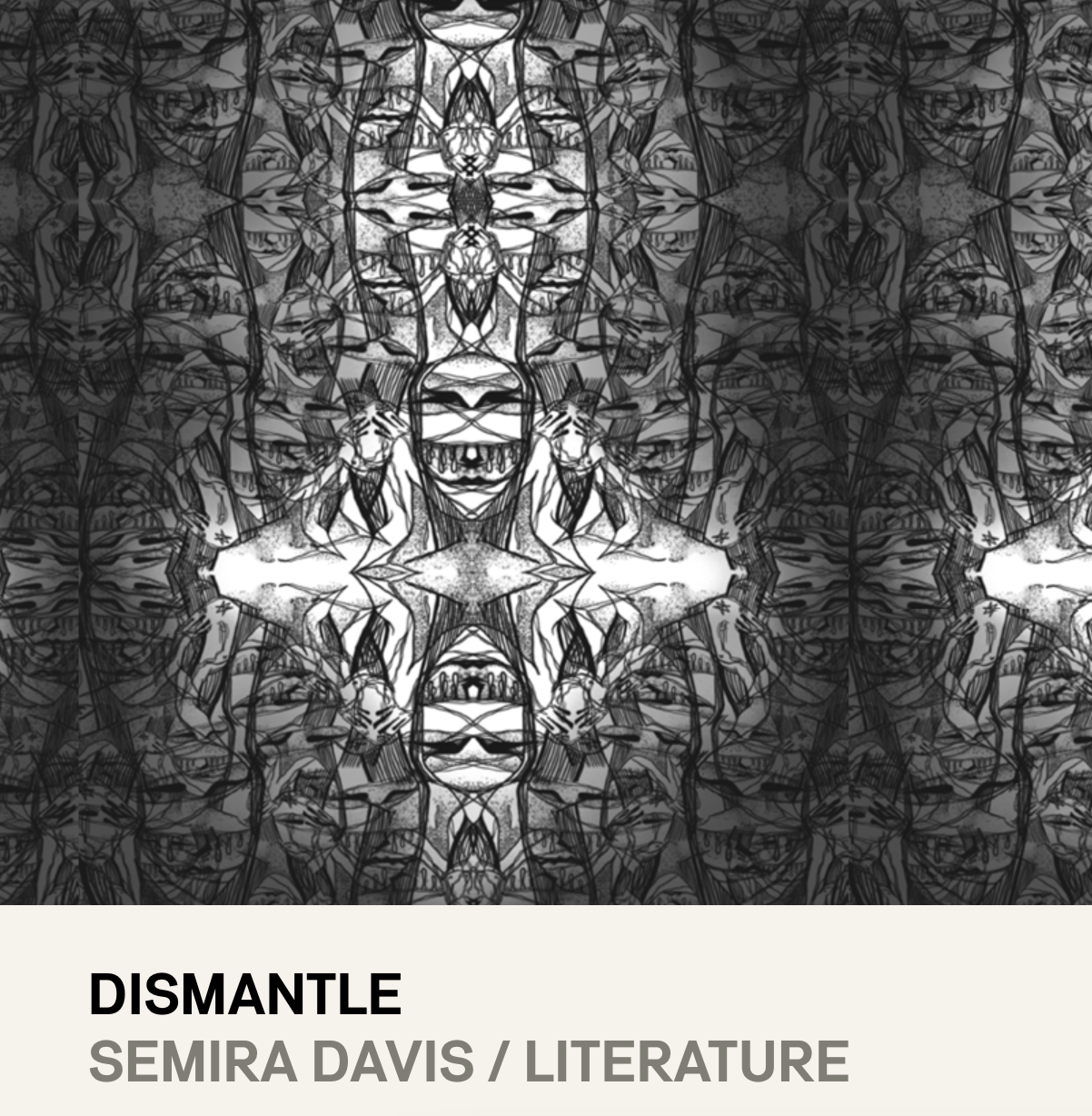
Poetry Shelf noticeboard: Semira Davis’s Boosted campaign

Semira Davis is currently running a Boosted campaign and looking to spread the word beyond her own social circle. 


The campaign is to publish a narrative sequence of poetry that was Runner-Up in the 2019 Kathleen Grattan Poetry Award. 


It’s a story about the grief of losing a sibling to incarceration. 
Here is a link to the project.

Poetry Shelf noticeboard: NFFD 2021 is open through 30 April


NFFD 2021 is open through 30 April!  

Submit your best 300-word stories! 

See an interview with the judges for the 2021 competition: Rachel Smith speaks with Diane Brown and Paula Morris.  

Coming soon: an interview with youth judge Kerry Lane

The youth competition moved in 2020 to an international competition with free entry – curated by the youth journal fingers comma toes.  All youth writers welcome!
 

Note that the youth comp, for ages up to 19, has no competition fee and is international! Please share the news!


Upates have been posted for the international 2021 MICRO MADNESS competition – opening in April! Judges this year are Alison Glennyand Grant Faulkner. Micro information, and last year’s winners, are here.  
 

NFFD events will take place 22 June 2021 in AucklandChristchurchDunedin, Northland, Waikato and Wellingtonwith international online events as well.