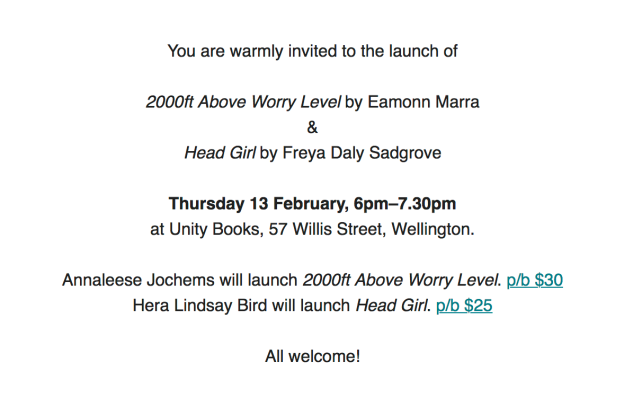
A double book launch from Victoria University Press


A double book launch from Victoria University Press
The Day
Cambrian Valley
The dog lies down in the shade of the table.
Knives lie down with pieces of lunch on them.
The mountains lie down across the valley
and the sunlight lies down across everything.
When we drive Neil says I love this:
the car and the music and the dog
and the sun and the spring and the lambs
and the light and the mountains and the sky.
The sky is so blue you can almost hear it skying.
Lynley Edmeades from Listening In, Otago University Press, 2019
Lynley Edmeades is a poet, essayist and scholar. Her debut collection As the Verb Tenses (2016) was longlisted for the Ockham New Zealand Book Award for Poetry and was a finalist in the UNESCO Bridges of Struga Best First Book of Poetry. She has a PhD in avant-garde poetics, and lives in Dunedin with her partner.
Otago University Press author page
Poetry Shelf review of Listening In
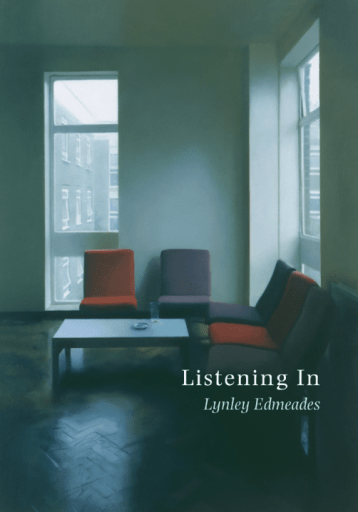
Listening In Lynley Edmeades, Otago University Press, 2019
Most of the time things slip
The seed on your plate slides
in the mess of leftover dressing
the hum of three street lights
making bright for no one
But every now and then
it feels as if things might hold
like here in this room
with its air and its airlight
from ‘Blue Planet Sky’
This is my summer holiday: reading gardening cooking walking on the wind-whipped beach. Trying to get better at sour dough. Most of all it is reading. Most of all it is reading novels. But some Aotearoa poetry books I dipped into in 2019 have been tugging at me, diverting me from the glorious satisfactions of fiction. I would hate to be a book-award judge this year as my shortlist of astonishing NZ poetry reads is Waikato-River long!
Here is another one is one to add to my list: Lynley Edmeades’s Listening In.
I adore this book. I adore the the extraordinary scope of writing.
The playful title evokes the reader bending into the frequencies of the poems but also underlines the attentiveness of the poet as she ‘listens in’ to her life, her preoccupations, the way words sing, misbehave, connect, disconnect, soothe, challenge. The linguistic play is breathtaking. You get different rhythms: from stammering staccato to sweet fluency, wayward full stops that introduce breathlessness, pause, discomfort, further pause. Verbs are signed posted (as is Lynley’s debut book As the Verb Tenses), as though each poem is a movement, as though each thing made visible is movement. A poem becomes a matter of being and doing in the now of the present tense.
The day unravels in the precarious throws of verb.
It’s everywhere we look: kitchen, bathroom, garden.
Even the floor waits in its doingness.
from ‘Things to Do With Verbs’
This is poetry as the flux of life where things are in place and out of place, where a great swell of language repeats and sidetracks and repeats again. You get to laugh and you get to feel. If we had all day, sitting together in a cafe or atop the dunes, I would tell you about the delights of each poem because there is such variation, such diverse impact as you read. ‘The Way’ is a knife-in-the-heart love poem and you have no idea the knife is coming and the love heat makes way for heartbreak. ‘Where Would You Like to Sit’ is an anxiety poem where questions pose as statements in a therapist’s chair.
You have to read the poems to see how they gather inside you. How the language gathers inside. How you can’t stop feeling the poems: the wit, the music, the originality.
Lynley takes three politicians as poem starting points. ‘Speetch’ is a transliteration of ex Prime Minister John Key’s valedictory speech in parliament. ‘Again America Great Make’ quantifies Donald Trump’s inauguration speech. ‘Ask a Woman’ juxtaposes Margaret Thatcher quotes that Lynley found online. All three poems are quite disconcerting!
(..) But long
before Wall Shtreet my political views hid been shaped by my Aushtrian Jewish
mutha Ruth, who single handedly raised me and my sisstas in now the infimiss
state house at nineteen Hollyfird Av Christchurch. My mutha wazza no nonsense
womin who refused to take no in answer. She wuddun accept fayure.
from ‘Speetch’
On other occasions a single word (stone, because) prompts a poem like an ode to a word that shadows an ode to experience. ‘Poem (Frank O’Hara Has Collapsed)’ spins on the word ‘collapse’ like a free wheeling stream of consciousness unsettling whirlpool. I adore these poems. ‘Islands of Stone’ leads from physical stones to language play. A quote from Viktor Shklovsky heads the poem and it is how I feel about the book: ‘Art exists that one may recover the sensation of life, it exists to make one feel things, to make the stone stony.’
Stone-sober stone
Getting-stoned stone
Stepping-stone stone
Sticks-and-stones stone
Leave-no-stone-unturned stone
Blood-from-a-stone stone
Two-birds-with-one-stone-stone
A-stone’s-throw stone
Then there are the poems that glow. That fill you with poetry warmth. I am thinking of ‘Constellations’, a in which Chloe tells us ‘we draw stars/ around the adjectives/ to identify them’. She is writing a story about friends and lunchtime at school and whether friends are kind or nice.
It has little shadows
of very and kinda
that reach out
towards the stars.
Perhaps another way to view Listening In is as translation. A small poem ‘The Order of Things’ makes multiple appearances (it originally appeared in As the Verb Tenses) as half-translations and iterations. I am thinking each book we write is enmeshed in the books that we wrote before, and the books we write foreshadow the books to come. Lynley is translating the world (life) with an exuberance of words, out-of-step syntax (a nod to Gertrude Stein), repeating motifs, word chords, word cunning and delicious humour. She tests what a poem can do by testing what words can do and the effect is awe-inspiring. It makes me want to write. It makes me want to put the book in your hand. Because. Because. Because. Life is here out in the open and hiding in the crevices. Because. Because. Because. Her words open up like little explosions inside you and you know poems can do anything. I have barely touched upon what this poetry does. I love love love this book.
Otago University Press author page
Lynley Edmeades is a poet, essayist and scholar. Her debut collection As the Verb Tenses (2016) was longlisted for the Ockham New Zealand Book Award for Poetry and was a finalist in the UNESCO Bridges of Struga Best First Book of Poetry. She has a PhD in avant-garde poetics, and lives in Dunedin with her partner.
Global
Search for counter-attack
Replace with hold
Search for attack
Replace with attach
Search for murdered
Replace with heard
Search for killed
Replace with serenaded
Search for ambushed
Replace with invited
Search for missile launchers
Replace with, oh, red silk fans
Search for front line
Replace with lamp-lit threshold
Search for grenades
Replace with iris bulbs
Search for smart bombs
Replace with crayoned paper folded into lilies, swans
Search for generals
Replace with farmers, orchardists, gardeners, mechanics, doctors, veterinarians, school-teachers, artists, painters, housekeepers, marine biologists, zoologists, nurses, musicians
Search for combatants
Replace with counsellors, conductors, bus drivers, ecologists, train drivers, sailors, fire-fighters, ambulance drivers, historians, solar engineers, designers, seamstresses, artesian well-drillers, builders
Search for profits
Replace with prophets
Save as
New World.doc
Emma Neale
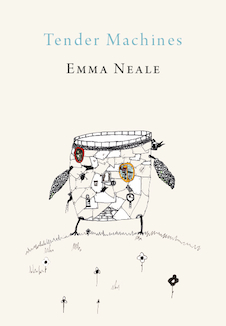
from Tender Machines (Dunedin: OUP, 2015)
Emma Neale is the author of 6 novels and 6 collections of poetry. She is the current editor of Landfall.
Otago University page

The Burning River Lawrence Patchett, Victoria University Press, 2019
Complete immersion in a novel is a wonderful thing. A precious thing. I have just spent the past few days inhabiting Lawrence Patchett’s The Burning River and it feels like I will carry this gripping book with me for a long time. It is exquisitely crafted, the sentences flow like honey, the rhythms are perfectly in tune with the subject matter. But it is the way this novel represents narrative as a form of listening that has affected me so much. It takes place in the unsettling and hazardous future of a re-imagined Aotearoa New Zealand. However, this strange and estranging future, with near dead rivers and herbs that heal, is dependent upon the author paying close and astute attention to our past. Especially to the past narratives of Māori and Pākehā, both entwined and in conflict. Different groups of people are connected by bloodlines, languages, cultural rituals and behaviours, and a fierce need to survive and protect family. The novel foreshadows the ominous state of the world, yet it offers hope, bridges, restorative moves. It maps the state of an individual heart. I am so affected as I read – reading is both despair and joy.
Let me say this again: I have never read a work of such acute listening, of attending to whānau language song trading nurturing nourishing planting remembering singing kõrero.
In his acknowledgements, Lawrence thanks Araon Randell for assistance in making ‘the altered “patchwork” world of this world deeper and richer.’ The Burning River is like a patchwork quilt, comprising many luminous and connected pieces, stitched together with such caution, feeling, integrity, vulnerability, aroha, enduring mahi, attentiveness. It becomes a narrative quilt that you hold about your shoulders as you face a world that is burning and flooding, that is wounding and maiming, that is hungry and overfed, that is tending and loving.
I adore the presence of te reo because it is part of the fabric of the storytelling – not as an exercise, not as an exotic frill – but as an essential and uplifting belonging.
This novel is a significant arrival. Find a stretch of time and immerse yourself in its extraordinary currents. If you only read one book this month make it The Burning River. I have written this very small tribute off the cuff of finishing the book, in that half-mourning state where the real world seems unreal, because I still occupy the burning river, because now I am longing even more for everything to be good and fair and humane.
Ngā mihi nui Lawrence
thank you, thank you, thank you
Victoria University Press author page
 NZ Poetry Shelf