THE KEROUAC EFFECT
annual celebration of all things beat
seven pairings of poets & musicians
When: Friday 13th March 7 00pm
Where: The Winchester, 24 St Benedicts St, Auck CBD
$10/$5; door sales only

THE KEROUAC EFFECT
annual celebration of all things beat
seven pairings of poets & musicians
When: Friday 13th March 7 00pm
Where: The Winchester, 24 St Benedicts St, Auck CBD
$10/$5; door sales only

Poetry NZ‘s 50th issue will be published later this year. Submissions are now open (closing 31st July). Please subscribe to our page for updates.
Poetry NZ is a print journal, established in 1951 by Louis Johnson, edited between 1993 and 2014 by Alistair Paterson, and now housed by Massey University. The current editor is Jack Ross.
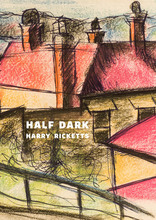
Harry Ricketts, Half Dark Victoria University Press, 2015
The title of Harry Ricketts’s new poetry collection, Half Dark, is apt as many of these poems are like little retrievals from the shade of the past. Poetry as retrieval. As excavation. As reflection. The half dark underlines (as does the blurb on the back) that this collection is dedicated to the gap, and that in these spaces, there is electric life. Poetic life. One poem, ‘Gap,’ makes reference to the haunting voice of the London Underground:
‘When I grow up, I want to be
the man who says “Mind the gap”.’
Down the years how your voice,
that phrase, have haunted me.
Yet ‘mind the gap’ is also like the surrogate, underground voice of the poetry that cautions us to stall in the gap for it is there poetic rewards will multiply. If you think of the poetic gap, you are lead in myriad directions from the silent beat at the end of the line, to the white space of the page, to the tension between what the poet holds back what the poet reveals. All these things are paramount in a collection that pays diligent attention to the pause at the end of the line, the form of the poem upon the page and what is revealed by choice. Yet what animates the poems beyond this is the gap of recollection, with so many examples stretching back in time to record and review. Now the gap is the faltering stutter of history where the past is only visible in pieces and can so easily be misremembered and even diverted to suit a cause. The London-Underground echo resonates on another level when you bear in mind the punning possibilities of the word ‘mind.’ Step beyond the warning (Watch out!) to the need to tend and care for and you reach the subterranean simmer that shows these poems come from the heart. The poet loved and the poet minded.
One striking example is a triloet dedicated to Jessie. The looping lines signal the circularity of families dividing and returning, of life itself though generations of fundamental behaviour and connections. Much is not said, yet the mood that permeates is infectious and moving:
(…)
Sometimes we find ourselves quite
overcome and can’t hold back the tears,
but still we walk, talk, laugh in soft November light;
a day to set against all the lost years.
In ‘Broken Song,’ the gap is replayed on the page in the syncopated words, the white space, the withholdings paramount.
Harry has often displayed a predilection for traditional forms; they become vessels for play, for the allure and comfort of repetition, for the challenge of innovation or depth within constraint, for a contemporary licence to laud, rattle and refresh. In his endnote, Harry addresses his current preoccupation with the triolet: ‘I soon found that, like the villanelle, the restrictions and repetitions of the triolet can lead to writing poems not merely playfully or self-consciously ingenious (nothing wrong with that of course) but poems embodying confinement and the inability to break out of particular cycles of thought, feeling and behaviour.’ There are ways in which his triolets do this, as in ‘Jessie,’ yet there is often a word or phrase that acts as splinter. In this poem, for me, it is the word ‘lost’ as it becomes a universal beacon. It breaks out from the individual story (the way you can’t go back as father and son in this case) and spikes your own disconnections and connection, your own missing pieces.
Poetry also sparks on poems as startling neighbours. In some poems, it almost feels as though this intrudes on that, and that intrudes on this, to offer different insights. in ‘The Frick comes to Lake Rotoma,’ it is as though the tracing-paper museum is laid over the tracing-paper lake and you understand that purity of location is perhaps a pipe dream. Something always tugs at you elsewhere and something always keeps you heartily rooted here.
These postcards before you are meant
to bring back the Frick, that sumptuous
room, Fragonard’s Four Stages
of Love: meeting, pursuit, lover
crowned, love letters—all those pink roses,
that jaunty parasol, No,
you’re still here, sweat trickling over
your ribs. They knew love wasn’t that easy.
Perhaps, the feature that I found most admirable was the way in which many of the poems bear witness to an instance. The gaps heighten this effect along with the detail, musical choices and tropes. There is a sense that the poem frames a moment, an incident, a scene, a person (friend or family in many cases). ‘Pewsey’ is a terrific example of this, as is ’10 to 3.’ The latter again catches the circularity of life with a perfect balance of economy (the gap) and detail. The central image comes alive with a trope that evokes vulnerability, tenderness, stillness: ‘your hands bunched like spiders/ the purple eiderdown.’ The poem haunts as it exposes a moment so intimate, in its familiarity, it becomes universal.
Harry’s new collection takes you from Te Mata Peak to Frankfurt to Rome. It traverses weather, old friends and family. What marks the measure of book, is the fact there is so much one could say about the connections that emerge from the spaces. The poems are the heartbeat of a backward look; at times mourning, often contemplative, they revel in humour as much as intimacy, in sumptuous detail as much as the well-tended gap. This is Harry at his poetic best.
Victoria University Press page here
Poetry Shelf interview with Harry here
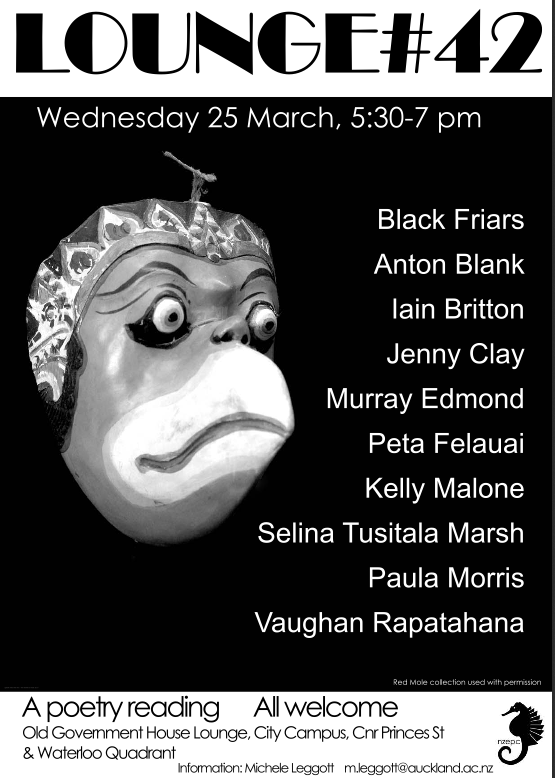
Free entry. Food and drinks for sale in the Buttery.
The LOUNGE readings are a continuing project of the New Zealand Electronic Poetry Centre (nzepc), Auckland University Press and Auckland University English, Drama and Writing Studies, in association with the Staff Common Room Club at Old Government House.
LOUNGE READINGS #42-44: 25 March, 29 April, 27 May 2014
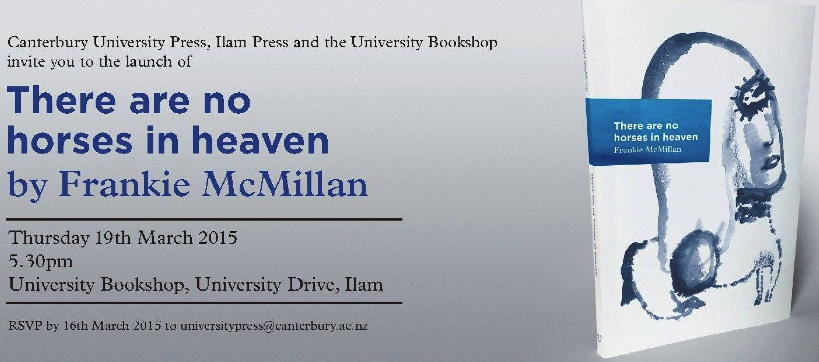
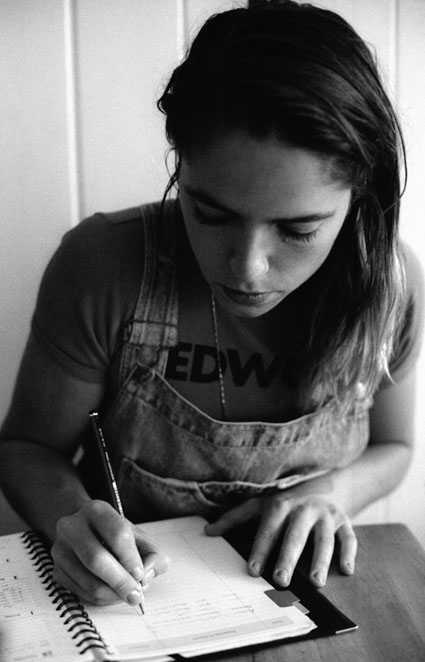
Jess Holly Bates is a Pākehā poet, particularly a spoken-word poet, and has studied English and Chemistry at The University of Auckland. Her Masters Thesis (she gained First Class Honours) is entitled ‘Revolting Others; Disgusted Bodies as a Function of Colonial Continuity in Aotearoa NZ and the Pacific.’ She did a Rising-Voices workshop which spurred her desire to write spoken word poetry. Her first piece, ‘P.I.P: Pakeha Identity Poetry’ was performed at the Rising Voices Slam in 2011. Since then she has performed in various places; most notably, REAL FAKE WHITE DIRT, which was performed at the Edinburgh Fringe Festival (with a four-star review).
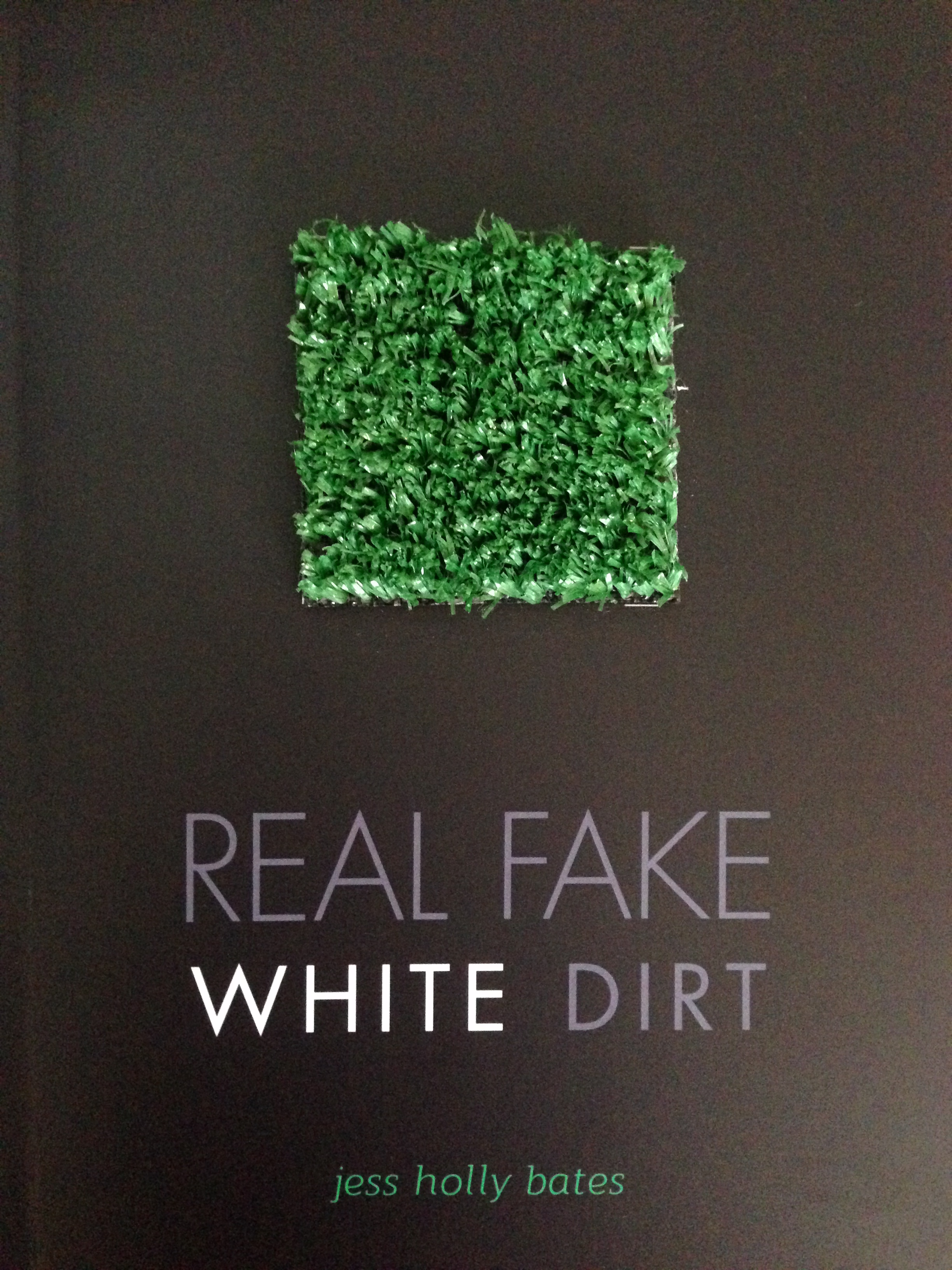
Anahera Press (publisher is Kiri Piahana Wong) published REAL FAKE WHITE DIRT in 2014 and it is a terrific debut. It is the first Pākehā poet that this press has published and I can see why Jessie was chosen. The poems overlap and interlace with a vibrant cutting bite. This is wide open, loud politics that navigates identity issues face on. Tough. Uncompromising. Edgy. I loved the urgent challenging punch of ideas but I also love the way the words on the page split and weave into poetry. There is glorious word play at work. On the page, phrases flit and float. You have to keep your eyes roving as this is not conventional poetic forms/form (although not exactly unconventional as you can trace back examples of this for decades). I see it as poetry misbehaviour. There is enviable rhyme (taxes/ masses, bleached/ keen, schtict/ poetic). There is leapfrogging assonance and the aural allure of repetition. Repeated things gain flesh in shifting contexts. Sound enacts political punctual marks. Everything comes back to the white-hot core that this is poetry from the heart and that vital ideas percolate above the surface. Wonderful!
PS: It is a gorgeous production with a striking black cover and a fake patch of grass that in the manner of poetry could equally be something else.
Anahera press page here
‘The conditions, in the wake of this reading, are ideal for beginning to cultivate my own barren planet, to write my new poem, and for that I am very grateful.’ Amy Brown 2015
Eleanor Catton on the grant she has established and to date funded (contributions are welcome!):
‘I established the Horoeka / Lancewood Reading Grant to give New Zealand writers the means and opportunity not to write, but to read, and to share what they have read with their colleagues in the arts.
I hope that this endeavour will challenge our tendency to measure the value of art in the proof of artistic production and productivity, and that it will restore value to the crucial but in many ways unquantifiable activity of reading. Most of all, however, I hope that the grant will encourage free and curious discussion about books.
Each grant is worth NZD$2000, with half awarded at the beginning of the reading period, and half at the end, whereupon the recipient submits a short essay that discusses what they have read and what they thought about it. These essays are then published on this site along with a bibliography.’
For the rest of her statement see here.
The inaugural recipient of this timely project is Amy Brown whose debut poetry collection, The Odour of Sanctity, was published in 2013. She teaches at the University of Melbourne where she was awarded a PhD in Creative Writing.
‘For the last year or so, I have been drawn to news items such as:
The Country Fire Authority implores residents in rural areas to make Fire Plans so that when it becomes imperative to leave their homes the temptation to stay may be over-ruled by a rational list of instructions.
Asylum seekers intercepted in Australian waters are being stripped of their personal effects — hearing aids, spectacles, prosthetic limbs and medication — on arrival at detention centres.
Hundreds of Mars One applicants are hoping to participate in a small Dutch not-for-profit organisation’s plan to send four civilians on a one-way mission to Mars in 2026.
These stories have struck me, I believe, because I’ve been interpreting them as extreme extensions of my own expatriate situation. In 2014, I applied for permanent residency in Australia, married an Australian, and so began legally relinquishing New Zealand as my home. My country of birth was not being consumed by fire tornadoes or bombed to pieces; I was not fleeing anything. Nor was I choosing to fly for seven months to a planet whose atmosphere could not support my life. However, these news stories gave me a new, oblique angle from which to question when and why I felt ‘at home’ in Australia, how that affected my connection to New Zealand, and, generally, what it means to belong to a place.’
You can read the rest of her essay here.
Current recipients include Craig Cliff, Alex Lodge, Rosabel Tan and Alex Mitcalf Wilson.
Calling all Wellington friends! Greg O’Brien is hosting a seminar next week entitled:
Geography and the Imagination: A conversation between two poets and two geographers
Date: Friday 20 March 2015
Time: 11.00am to 12.15pm
Venue: Stout Seminar Room, 12 Waiteata Road, Kelburn
All Welcome!
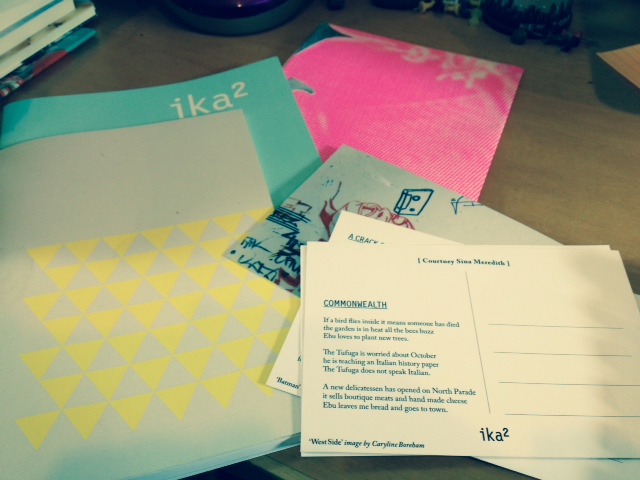
The second issue of Ika is out. This is a journal devoted to Literature and the Arts, is published by the Faculty of Creative Arts at Manukau Institute of Technology and is currently edited by Anne Kennedy.
This not your run-of-the-mill journal as it included a big book pasted inside a small book, a poster, a handful of postcards and a sticker. The postcards are terrific; they have a graffiti image sourced by Caryline Borerham and poems by Semira Davis, Courtney Sina Meredith, Alice Miller and Richard von Sturmer.
The look of the complete package is fresh. The line up of contributors on the literary front diverse and includes students at MIT and from Hawaii along with familiar poets. I am not sure what the submissions policy is but the guest poets include Emma Neale, Steven Toussaint, Helen Rickerby, Grace Taylor, Lee Posna, Daren Kamali, Jeffrey Paparoa Holma, David Eggleton, Michelle Elvy, Geoff Cochrane, Sue Fitchett, Johanna Emeney, Kirsti Whalen. That gives you an idea of the range of voices and styles.
A couple of personal favourites: I loved the curl and slide of Lee Posna’s ‘Island bay Blues,’ but two other poems really stood out for me. Steven Toussaint’s suite of ‘cradle’ poems are joy to read because the musical pitch is utterly rewarding. You follow the clash and link of vowels and consonants and fall upon tonal bridges, arcs and diversions. Wonderful. Emma Neale’s poem, ‘Pokpo,’ underlines how assured her writing has become. This poem reads in the ear so sweetly, yet it shocks and startles. It is risk taking not in terms of language that bends but in the degree of confession. And that confession is slipped in the cracks of the poem, subtly, surprisingly. It is a knock-out poem.
Long may this journal continue.
Subscription enquiries to: The Editor ikajournal@gmail.com
Painter, poet, curator and writer Gregory O’Brien discusses You Fit the Description: the Poetry of Peter Olds and a new collection by Geoff Cochrane, Wonky Optics.
Listen here

 NZ Poetry Shelf