Tag Archives: Te Herenga Waka University Press

Poetry Shelf Cafe Readings: Harry Ricketts

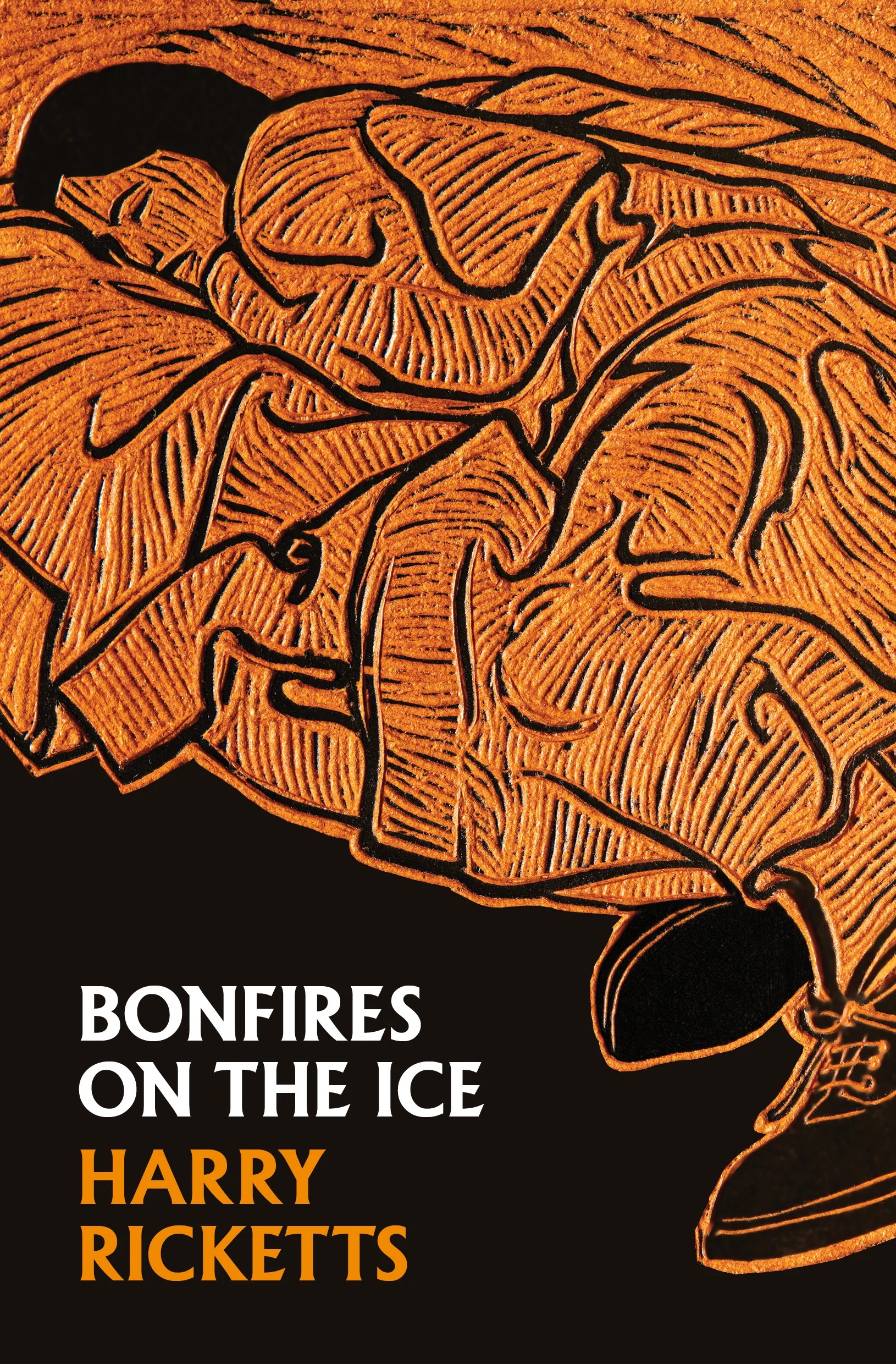
Harry reads from Bonfires on the Ice, along with earlier poems.

Harry Ricketts taught for many years in the English Programme at Te Herenga Waka Victoria University of Wellington. He has published around 30 books, including literary biographies, essays and twelve collections of poems (most recently, Selected Poems). First Things, published by Te Herenga Waka Press, is the first instalment of a two-volume memoir. He lives in Te Whanganui-a-Tara/Wellington and is mad about cricket and coffee. Persuasion is his favourite novel, Les Enfants du Paradis his favourite movie. Bonfires on the Ice has just appeared from Te Herenga Waka Press.

Te Herenga Waka University Press page

Poetry Shelf review and reading: Sick Power Trip by Erik Kennedy

Sick Power Trip, Erik Kennedy
Te Herenga Waka University Press, 2025

Mujaddara

I know. I know what’s happening elsewhere.
While I mess around with my kitchenware.from


‘Autumn Couplets’

Every time I review a new poetry collection, it feels like I am holding poetry itself to the light, discovering things about how poems might work, what they might deliver, what they might spark in a reader.

Erik Kennedy’s sublime new collection, Sick Power Trip, got me musing on how poetry might stand as a prism. A poem might be held to get a view, then swivelled to get a different view, and then another, and then again. Each time I turn a page in Sick Power Trip, it’s a prismatic surprise. Unexpected. Utterly fertile. I love it.

Erik’s collection has stuck with me for a number of reasons. I have never read a collection quite like it and I love that. It feels like there are two significant settings. Firstly, an extraordinary band of wit and humour, with unexpected scenarios, shifting angles and points of view. Secondly, the necessary and imperative knottiness of humanity, from exposed self to a wider global reach. Not an either or view, but an incredible shifting light on how to live and how to survive. A poetic prism on the contemporary world that might be sharp, jagged, wise, personal.

Even the pronouns, particularly the ‘I’ and the ‘you’ are multi-tendrilled. The voice speaking is prismatic, drawing us into a stretching field of possibilities, vulnerabilities, recognitions. Nothing is set concrete here. I love this.

Let me shift the prism again for you, in a collection that reveals both the positives and negatives of situations, poetry that is mindful of an impulse to decipher, to muse upon sides, to navigate the good and the bad and the inbetween. There’s involvement and not involvement. Darkness and lightness splintering, merging, resisting clear borders.

And always, let me underline this, there is always the ripple of surprise, in turning each page, within the poem itself. I love this. For example, going shopping after illness:

I thought about the things that are abut me.

And I went to look for the aisle where they keep the fully realised lives,
doubtless alongside the wax food wraps and the fancy vinegars.


from ‘Shop Floor Layout Algorithm’

Another stunning example, the notion (or experience) of consolation. Wit and wisdom again refracting. Self fragility and collective strength. The poet holds the prism poem along the degree to which one can understand what someone is going through. Here is the final stanza, it resonates so deeply:

That’s why I can picture it
but can’t imagine what it feels like
to be a phone,
delicately poised on the arm of a chair,
that gets one message too many
and vibrates onto the floor.


from ‘Consolations’ 73

I want to share so many of the poems in the book with you, so you too can experience the glorious settings. I like how a word or idea might pose like a mise en abyme – inside this thought (word) another thought (word), inside this light refracting, another light that surprises startles delights. Take the poem offering an analogy on thinking, poised on the moment in a fable when the thorn pulled from a lion’s paw turns out to be a little lion, and the whole progression and stability and expectation of thought or story is in jeopardy.

And then, most importantly, how to deliver and absorb the poem prism in a time when the world is so damn awry. I keep swearing I won’t mention this in a review, but it’s the monster in my kitchen. As I read, I pick up on how doing is in partnership with thinking, how in one poem protest might be deflating tyres of SVUs and in another poem caring might be hugging trees like a 70s hippy. Again the vital oscillation. I am thinking this. Writing poems might be a form of protesting, sharp insistent necessary protesting (listen to the three poems below), but it is also a form of caring. I love this. I love this so very much.

On multiple occasions, a single poem stalls (shadows?) me with its prismatic effects. Surprise turns alongside shards of wisdom alongside physical detail alongside acute global and local concern, with every effect housed within writing that is sublimely fluent. Read ‘How a Year Ends’ for example. This poem. This magnificent poem. Try this stanza:

A year is a road
that ends at the sea
in an afterthought of a town,
just a few weatherbeaten houses,
some indifferent trees,
a small picnic area,
and a one-eyed cat
wandering around proprietorially.
You drive here
because it is here.


from ‘How a Year Ends’

Maybe reading this collection is akin to a snow globe effect. Every time I hold a poem to the light and dark of my reading, and let the poetry shake and settle in my mind, I feel the sharp sweet delight of surprise and wonder. On the back of the book (always the last thing I read), it states “Kennedy reminds us that some things remain true and vital: self-care, empathy and solidarity”. And that is exactly why I love this collection so very much. Let us put these words in our pockets and carry them over close the coming months: self-care, empathy, solidarity.

I went out into the day with my symptoms. The sun made the swans look
like harps. I appreciated the silhouettes of buildings. I scrumped apples
from over a fence. My symptoms were still with me but also not with me.
I was loving them. I was setting them free.


from ‘Self-Affirming Mantra’ 

a reading

Erik reads: ‘Bildungsroman’, ‘I Like Rich People, but I Couldn’t Eat a Whole One Myself’ and ‘The $6 Pepper Song’

Erik Kennedy is the author of two previous books of poems, both with Te Herenga Waka University Press: the Ockham-shortlisted There’s No Place Like the Internet in Springtime (2018) and Another Beautiful Day Indoors (2022). Originally from New Jersey, he lives in Ōtautahi Christchurch.

Cover design: Todd Atticus
Te Herenga Waka University Press page

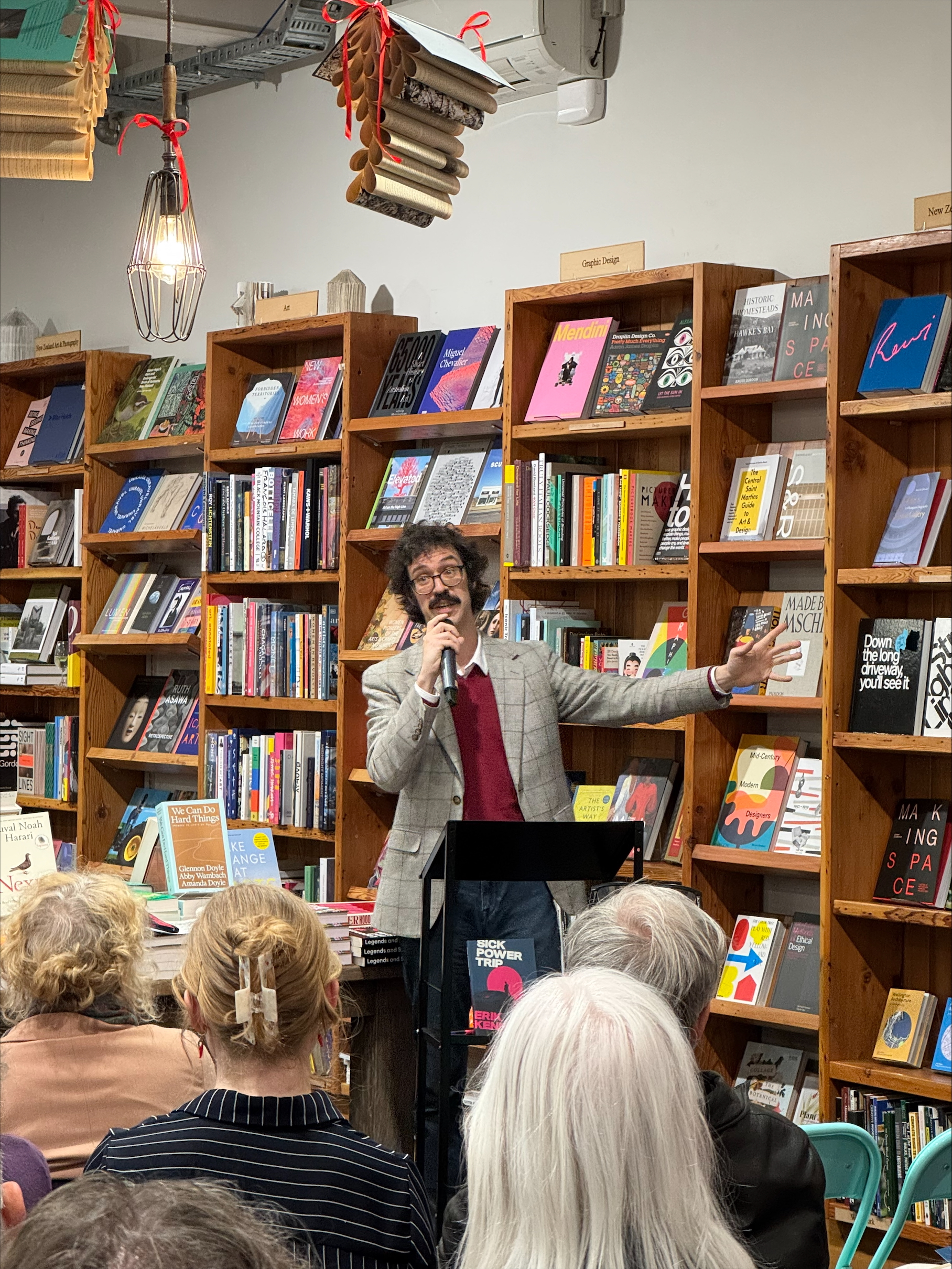
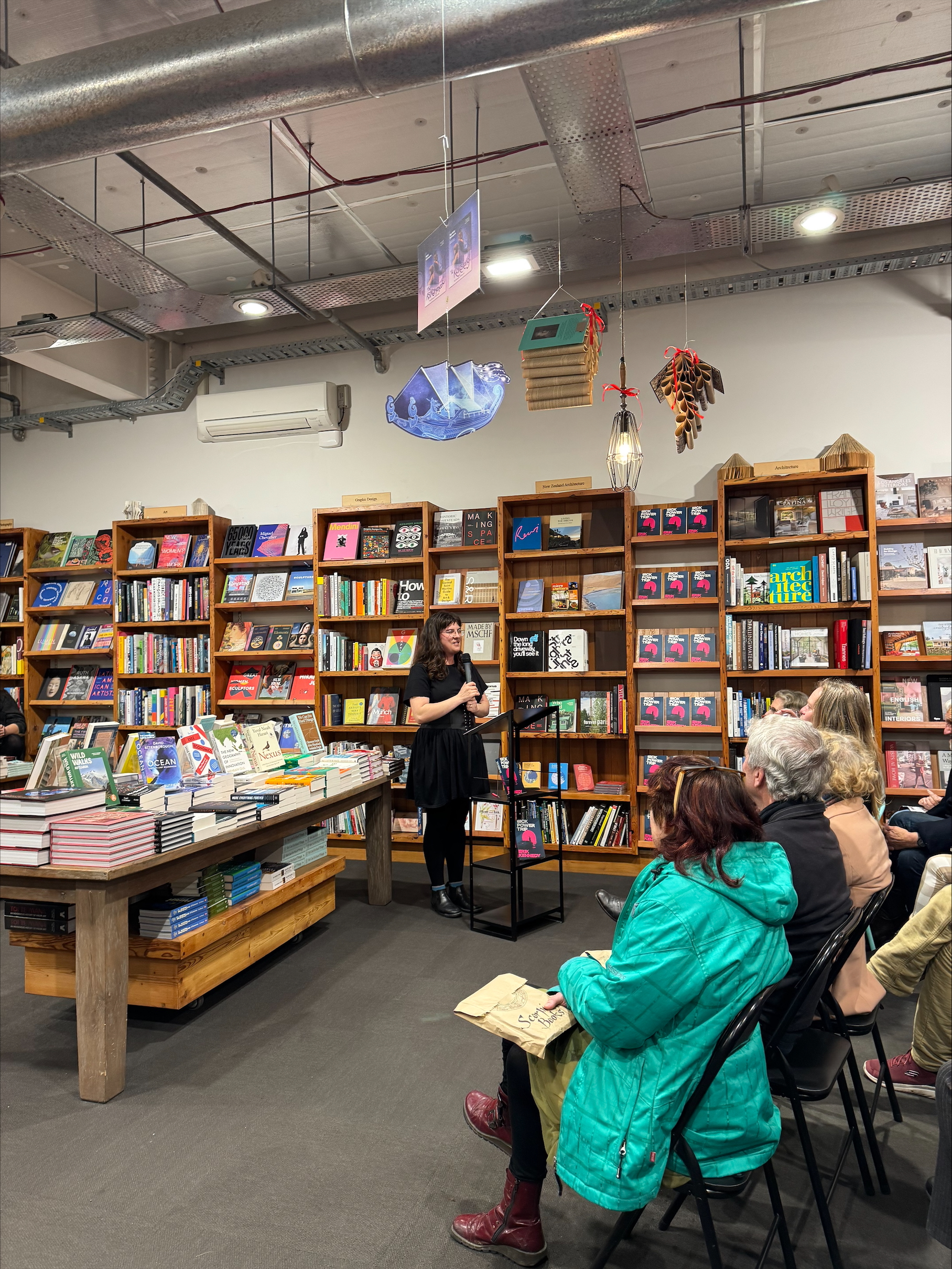
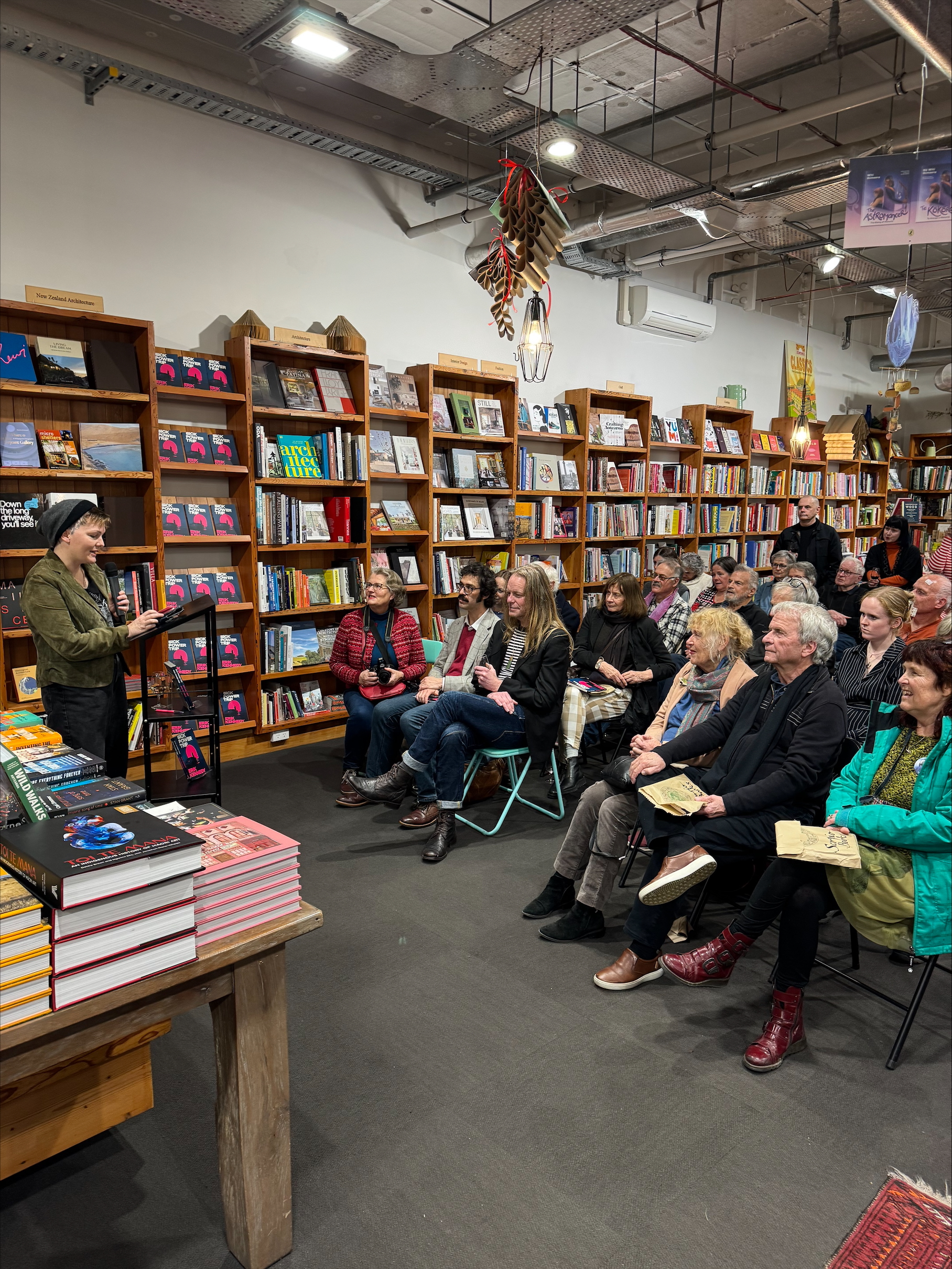
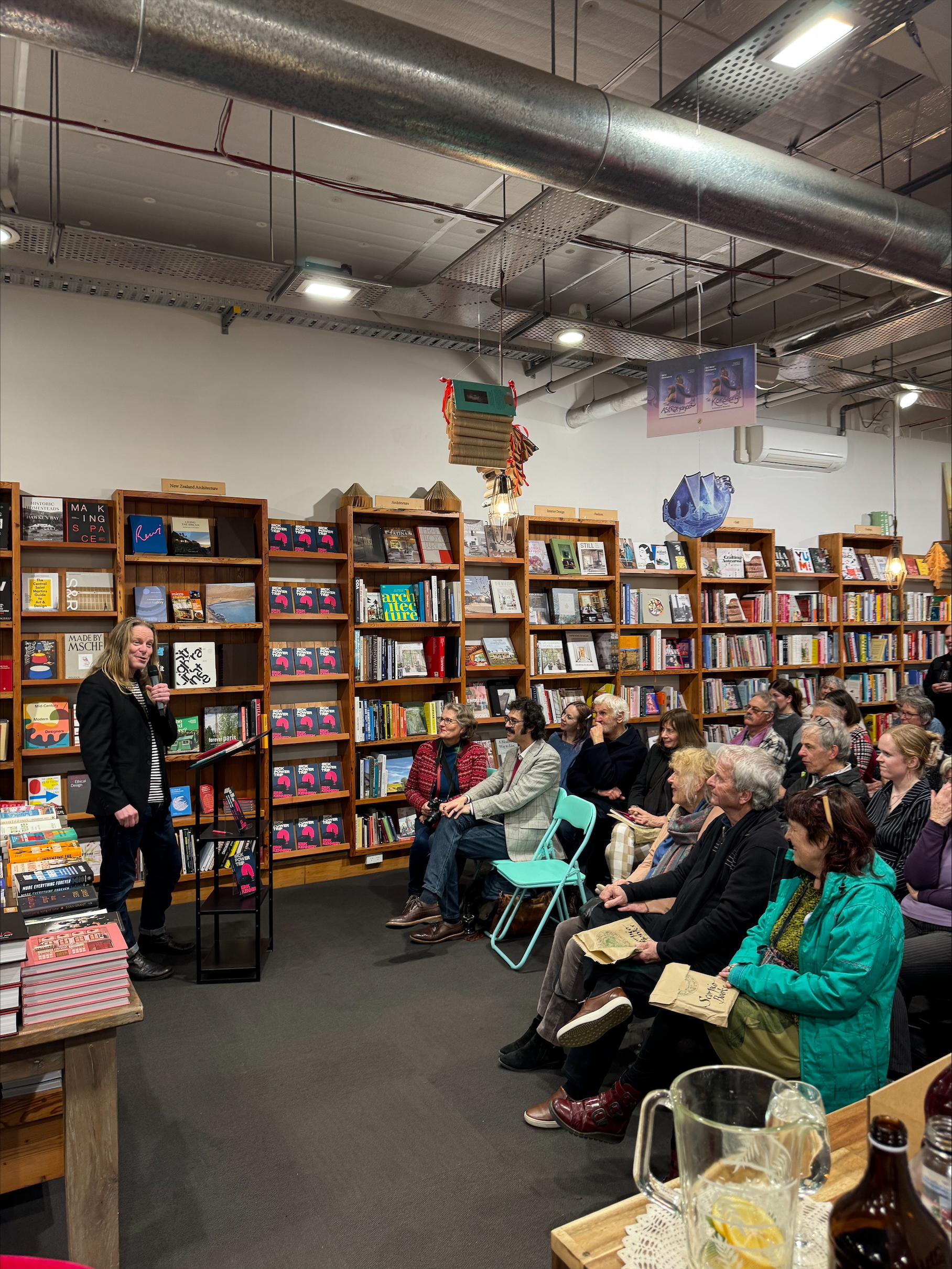
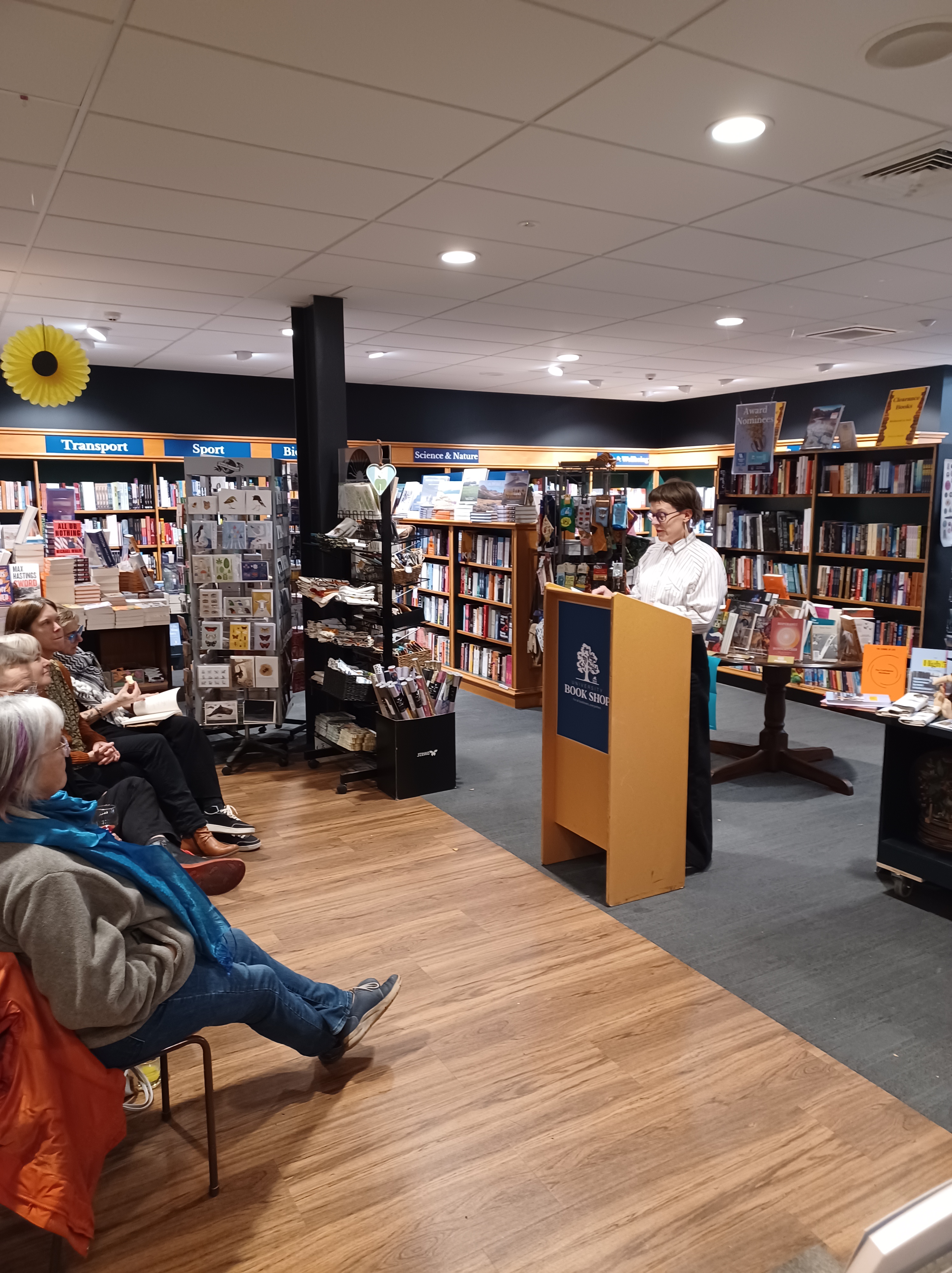
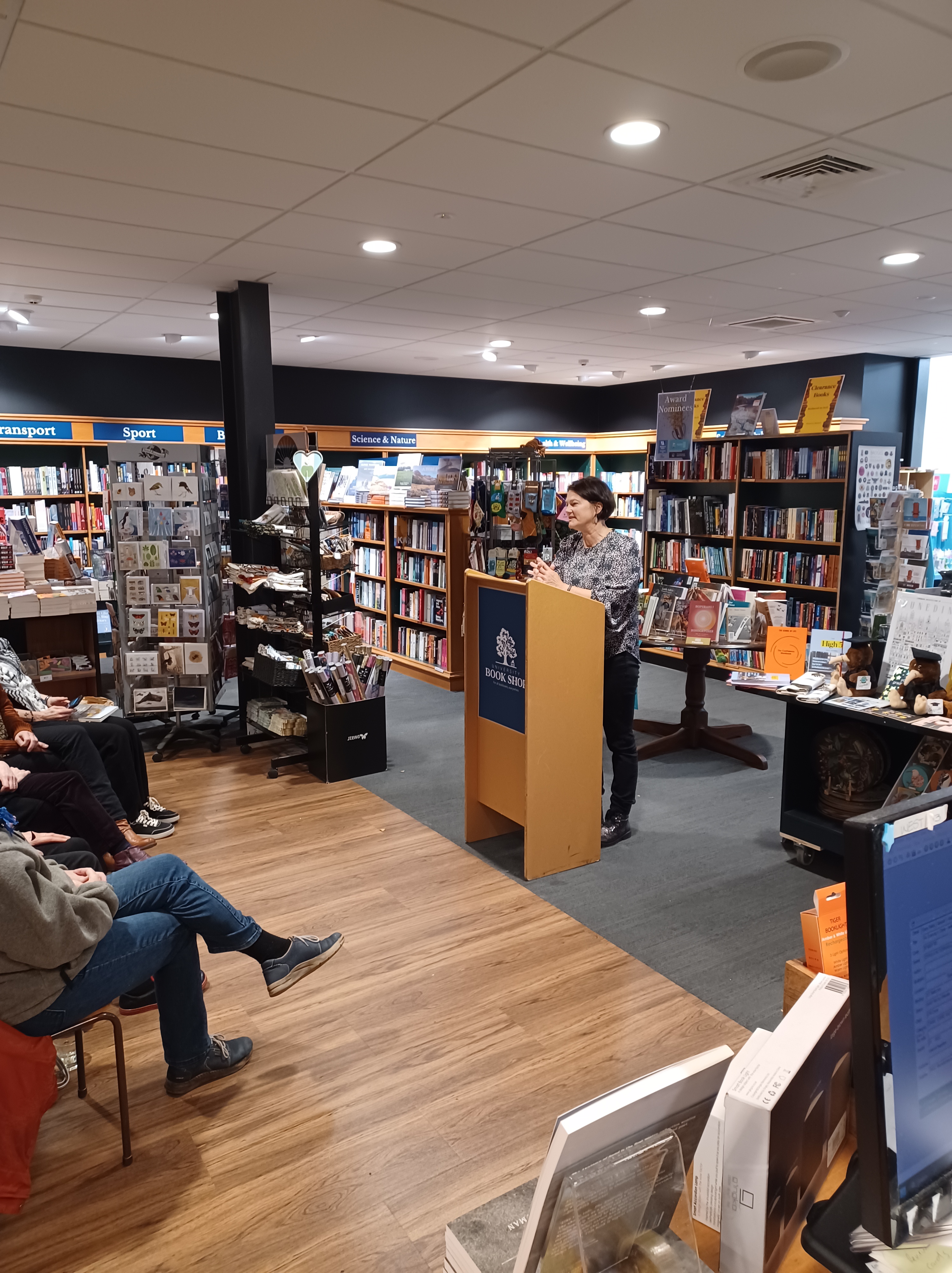
Poetry Shelf launch speech series: Claudia Herz Jardine launches Erik Kennedy’s ‘Sick Power Trip’

Sick Power Trip, Erik Kennedy, Te Herenga Waka University Press, 2025
(photos courtesy of Scorpio Books)

Tēnā koutou katoa.
Ki ngā mate, haere, haere, haere atu rā.
E mihi ana ki te iwi e tau nei, Ngāi Tūāhuriri, tēnā koutou.
Ki a tātou e tau nei, kia ora koutou.
Nō Mīere me Ingarangi ōku tīpuna.
Kei te noho au ki Ōtautahi.
Kei kaituhituhi ahau e mahi ana.
Ko Claudia Herz Jardine tōku ingoa.
Tēnā koutou katoa.

Hello, everyone. Thank you for coming. A caveat that these things aren’t expressed so gracefully in reo Pākehā; with my opening remarks I acknowledge the deceased, notably the poet John Allison; I recognise Ngāi Tūāhuriri, our local iwi and tangata whenua; I welcome you all here, in Scorpio Books, to this celebration of Erik Kennedy’s pukapuka Sick Power Trip.

My name is Claudia Herz Jardine. My ancestors, like Erik’s, came from far away- and, also like Erik, I call Ōtautahi Christchurch home and am prepared to defend it from further environmental assault with my life, my poems and my needle-nose pliers.

The first image of Sick Power Trip that wedged itself in my head was the “absolute possibility engine”- a ferret on a leash as observed in the poem ‘Animals On Leads’. At the time, my brother-in-law had his girlfriend’s dearly beloved and deceased pet ferret in his freezer as they waited for the cost of taxidermy to go down – this going down in price could be enabled by free market conditions, or the death of another ferret i.e. taxidermy at a quantity discount. All the ferrets in my life were distinctly lacking in possibilities, and then Erik came along to our critical writing group with his poem. I didn’t have much critical feedback for Erik- I only recall scrawling, “love ‘the energy of a ten-man brawl in a two-man toilet’.” A phrase that feels like it has the same amount of plosive consonants as a ferret should have claws.

Many months later Erik mentioned he had a manuscript ready. He emailed it to me. I made approximately five suggestions. My email sign-off was: “It’s a stacked deck! A pack of heavyweights! An all-star team!!” This ratio of suggestions to compliments bodes well for Erik. I read it all in one sitting, and by standing before you all tonight, I declare that me and my poetic sensibilities were wholeheartedly entertained and intrigued by this book.

To make some hazy, summative stabs at the book now, Sick Power Trip is a sort of wealth redistribution weathervane. The poems in this book, together, seem to say- if you have THIS much money, can you please do the decent thing and use it to make THESE lives better? Though the poems are stacked with ‘I’ statements, the ‘I’ is always asking; why aren’t we kinder to each other? Why do the people with the most get away with caring about others the least?

We live in an age in which any possible friction in our daily lives is viewed by Big Tech Companies as a money-maker. We have computers in our hands, a supermarket monopoly willing to visit us at home, and apps that write small talk and argumentative rebuttals for us. The narrator of ‘Individualistic Societies’ (page 11) states: “I fixed every problem I ever had until I couldn’t, at which point I became the problem.” For as long as we are encouraged to remove friction from our lives by paying money, the environment and its indigenous populations will be exploited. Skip ahead to page 93, ‘Someone Put an Ancient Burial Ground Right Where a Hotel Needs to Go,’ and an archaeological worker has a vision of excavated bones filling the city- “One day this project will be done and the building that even / its designer’s mother doesn’t love will spend its seasons here… What is allowed to endure is sometimes a second-choice thing / and the ones choosing are as likely to be thinking about the weather / as the future. Is it going to rain? Is the smart oven set?”

Yes, these poems are fringed with scathing, cynical Erik-ness. They also serve as an untraditional curriculum vitae for why, in the end times, Erik Kennedy will be on the shortlist for holding the newly-designed flag while jumping up and down on top of the bunkers as we sweep through Central Otago, shelling billionaires from their boltholes. This will be a pointy time, and unlike the narrator of ‘Notes Towards a Theory of Fun’ (page 50), no one will be getting arrested for kidnapping fossil fuel executives and shouting (quote) “Imma rubber-band this motherfucker up like a bunch of kale.”

Some notes on craft; Erik knows when to end a line, use an adverb, when to turn up the dial on the presence of the narrator and how to get out of the way. Erik and I share a love of whittling the pointy end of the poem first and then making the grip as comfortable as we see fit. So, watch as he casually wraps serious themes in humour to make the weight a little easier to bear- you could “die in a hail of 5-inch shells / or mild social disapproval,” you were either “raised by scorpions,” or you can care about the people of Gaza, you can be sad and lonely, or you can get involved in your local dogging group- just get out there and network!

Importantly, these are poems about thinking and caring. Erik cares about us. Erik cares about all animals. Erik cares about the planet. And Erik, in his day-to-day ways, turns up for other poets and throws his support behind our scene. When Erik had long Covid and stayed home, we missed him, and it was nice of him to invent the word “wonkening” while he was away.

Thank you all for listening to my speech. Congratulations, Erik, on another fantastic volume of poems. Can we all give him a big round of applause?

A warm thank you to Te Herenga Waka University Press and our speakers for this evening – and please join me again in congratulating Erik Kennedy.

Claudia Herz Jardine, 10/07/25

Te Herenga Waka University Press page

Poetry Shelf launch series: Lynley Edmeades launches Mikaela Nyman’s new book

In order to widen the reach of new poetry books, Poetry Shelf is posting a series of launch speeches and photographs. Do get in touch if you have had a launch you would like featured.

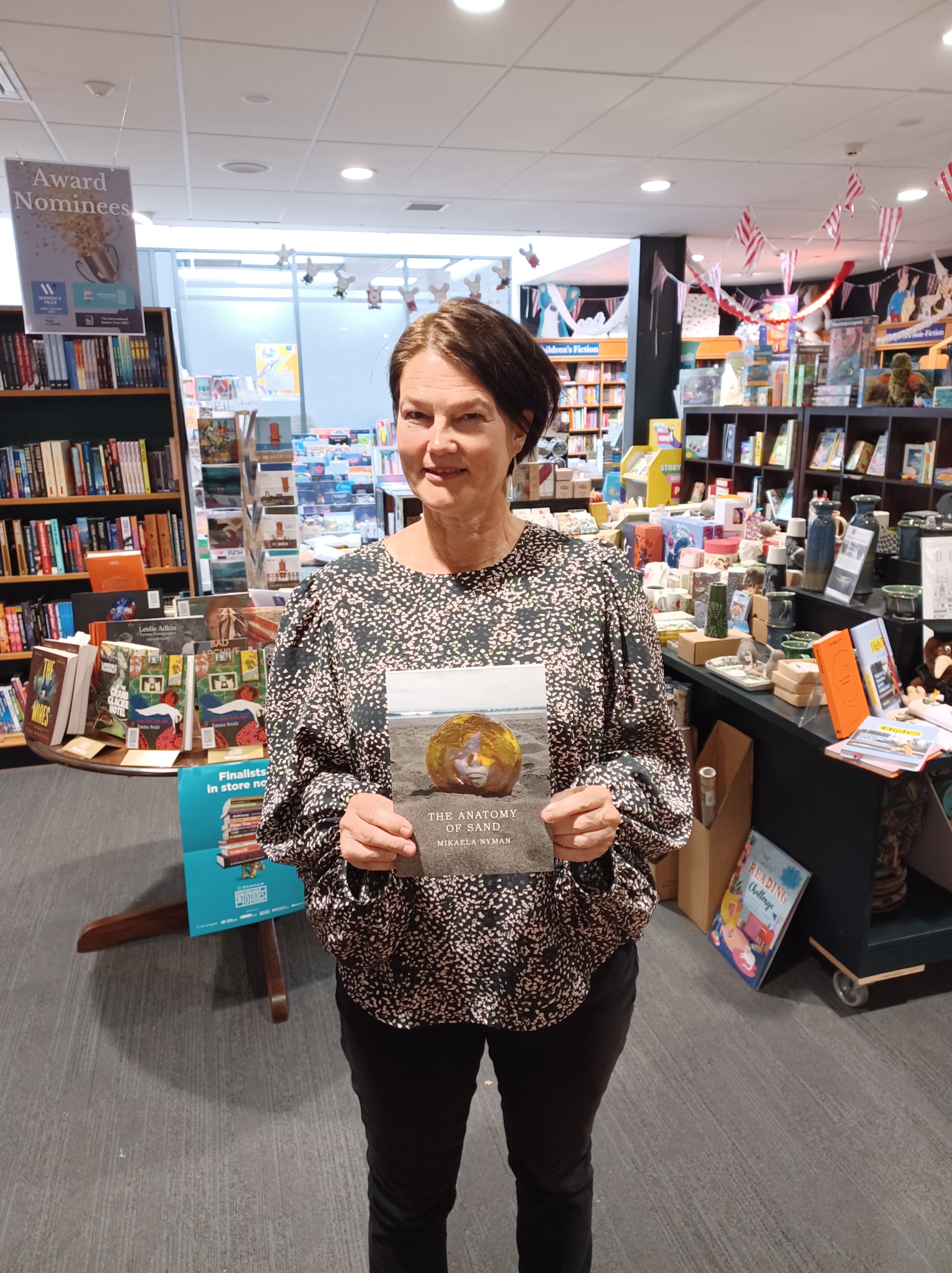
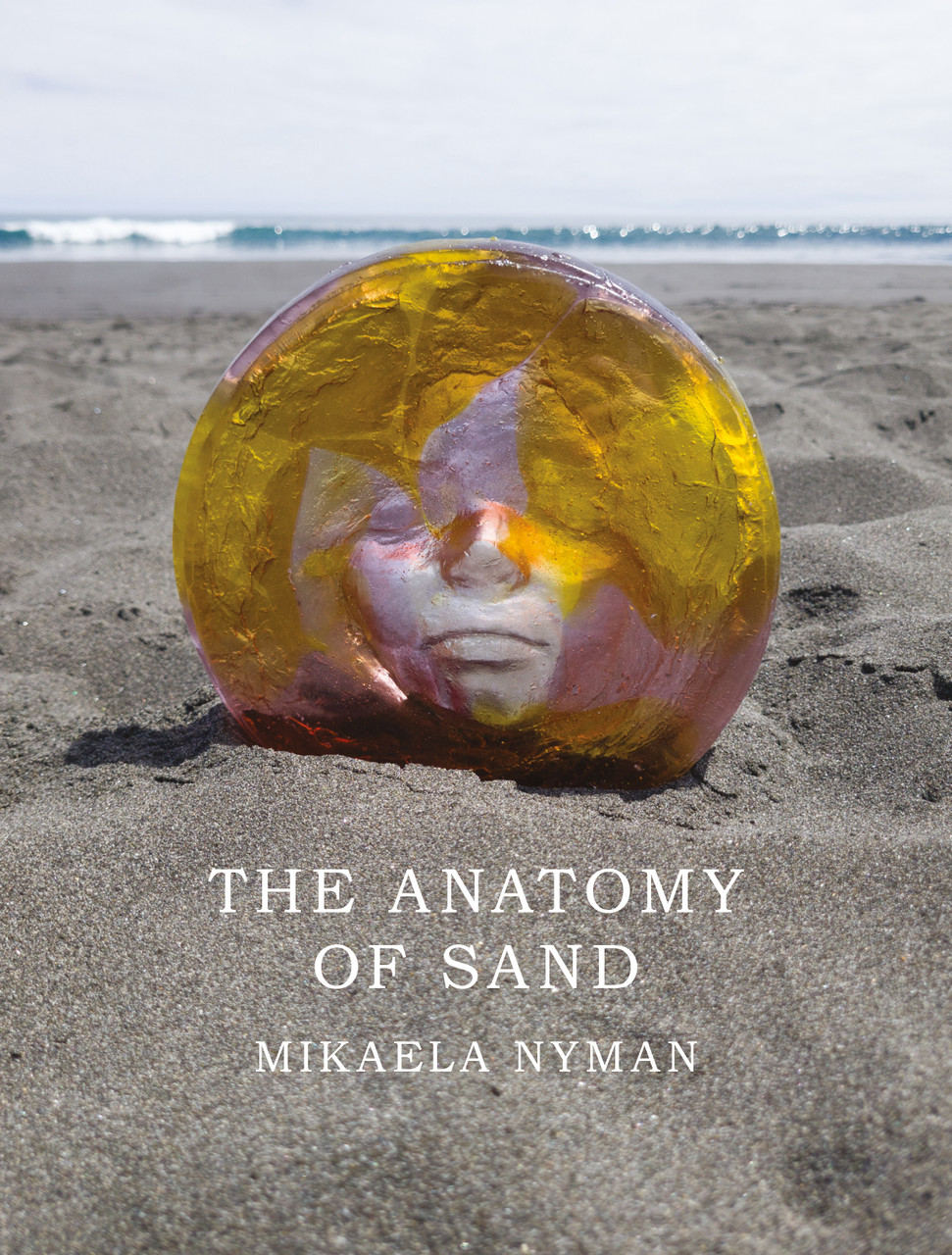
The Anatomy of Sand, Mikaela Nyman, Te Herenga Waka University Press,2025
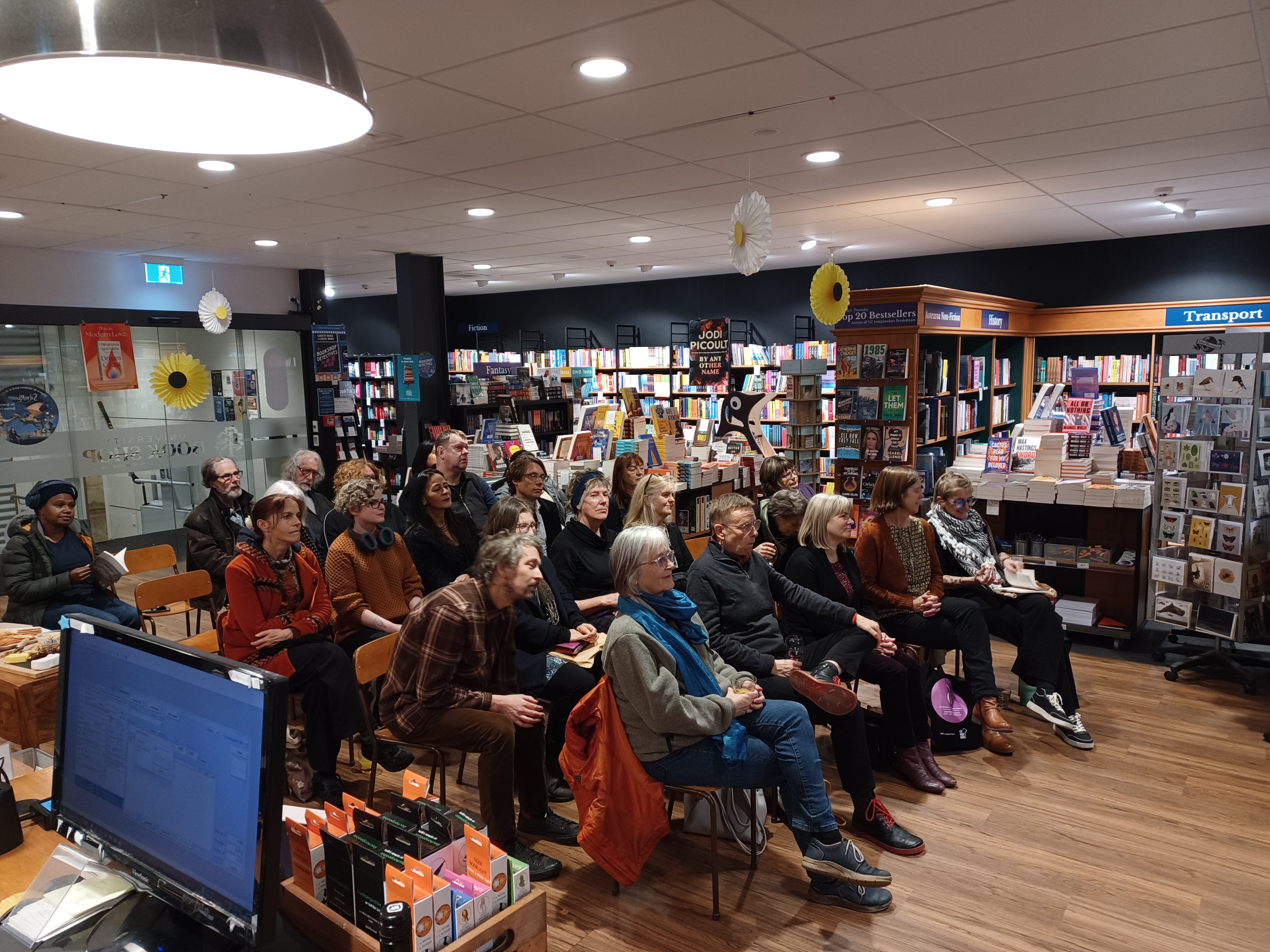
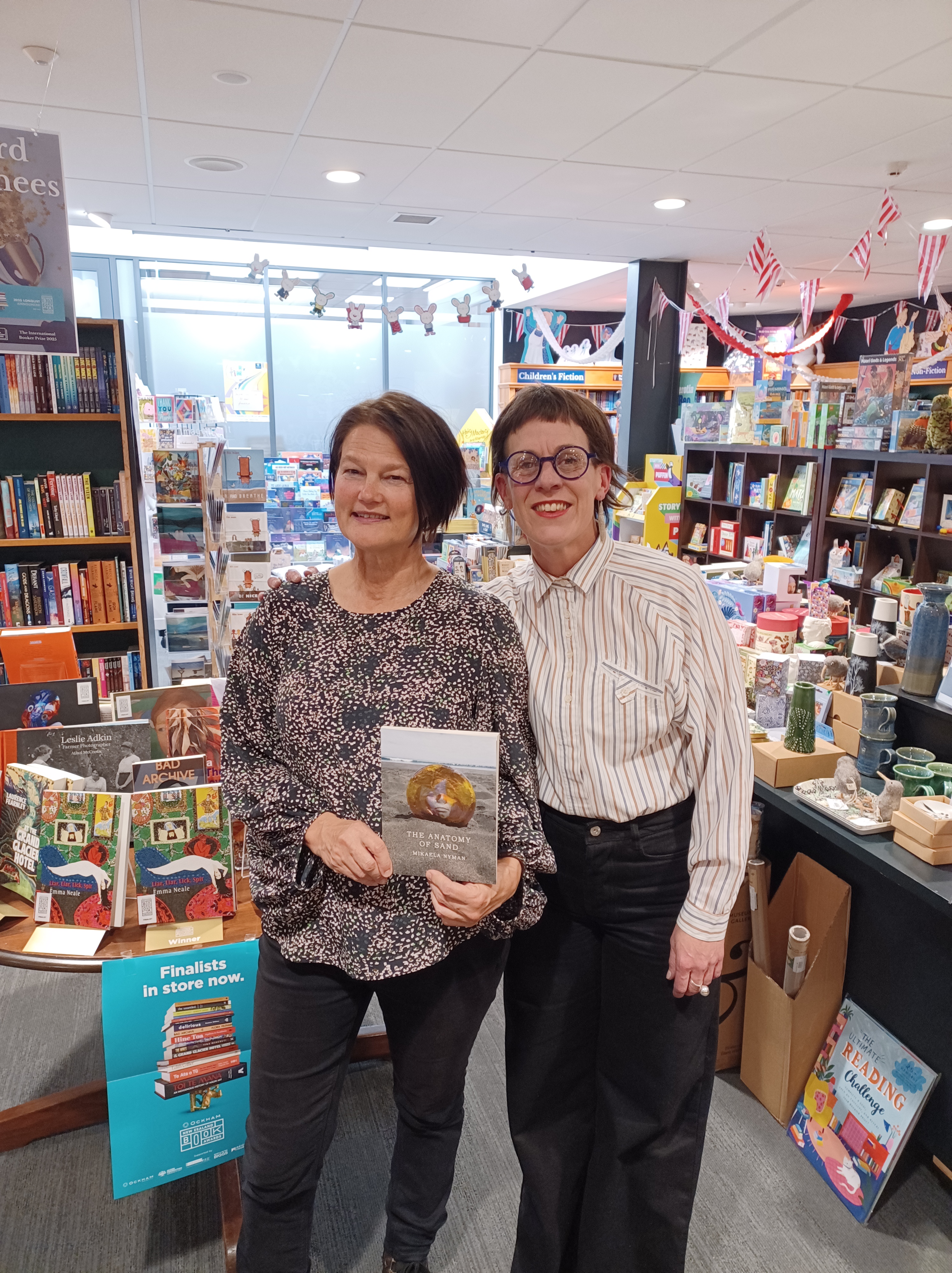
(the photos are by Ina Kinski at UBS Otago)

Launch speech for The Anatomy of Sand by Mikaela Nyman

Kia ora koutou

Thank you so much for this invitation, Mikaela, to launch this new book, The Anatomy of Sand. It’s an honour to be asked. My job, as book-launcher, is to tell you why you should buy and read this book. I’ve got plenty of reasons why you should.

I never tired of reading and rereading this book. It was a joy to read a full collection, to sit down and do that thing many people don’t often get to do these days without distraction, and read a book from cover to cover—to read it’s contours and shimmies, its tilts and turns, its rises and falls. The poet seems to say to us: Look at this, can’t you see how curious it is? And then she goes on to show us. The poet is curious to the world, sensitive to our missteps as humans, but also alive its wonders.

As cliche as it may sound, reading Anatomy of Sand felt like traversing the world with my slippers on. Mikaela takes us so many places, in time and space: as expected (and hoped), we travel to Norway, Finland, and Sweden. But we also visit Nigeria, Palau, and the United Arab Emirates, Western Australia, New Caledonia, Dubai and Cornwall, Jamaica, Nigeria, the Virgin Islands, Bamiyan, and London’s River Thames. But we also flit around Aotearoa, from her home in Taranaki and the surrounding regions of Ōpunaki, Parihaka, Mōkau, we also go to Tokoroa, Porirua, Lake Rotokare, Waiwhakaiho, Mangorei, Mimitangiatua Awa, Whakarewarewa, Ngahoro, and back down here to Ōtepoti where a little bit of Mikaela’s heart remains after having the Burns Fellowship in 2024 (more on that later). Mikaela’s sense of place is immense and the poet never takes her taking up space for granted.

The book is also in conversation with many and provides a very contemporary constellation of voices. Like a great navigator of place and time, of language and culture, Mikaela reaches out to writers and artists, great myths and minds from so many reaches of the globe and somehow, somehow, joins them all in conversation. We meet Lauris Edmond, Michael Smither, Bill Manhire, Ngāhina Hohaia, Ni Vanuatu poet Carol C. Aru, Mary Oliver, Mary Ruefle, Rilke, Gregory Kaan, Andreas Wannerstedt, Maggie Nelson, Paul Celan, Brett Grahame, Sisyphus, and Oppenheimer. But this is not a name-checking exercise—Anatomy of Sand is a tapestry of language, connected deeply with the layers and complexities of our time. One poem, for example, is called ‘Reading Maggie Nelson at Matariki,’ where the poet invites Nelson’s presence into a contemplation of our celebrated winter stars, Puanga and Tautoro, to collectively contemplate the idea that may be what connects all writers and artists across time and space: that we’re all searching for ways to articulate the world. As Mikaela says, so beautifully: ‘Focus on Puanga bright above Tautoru / know that the inexpressible / is contained within / the expressed // We feed our anxieties with that / which eludes us, what can be said / instead—galaxies sugared / and stripped—stuck on verbs that explode a constricted throat.’

This is a generous poetry, a poetics of openness, ‘whose verbs explode a constricted throat’. We’re constricted by our time, our inability to fight against the monoliths of industry that continue to plunder our resources and tip the delicate balance of our environment, the ecosystems that would allow us all to thrive if we just took what we needed to sustain ourselves and nothing more. Mikaela’s poetry is sensitive to these plunders and butcherings, always turning toward the problems—never away from them—as if to say, let’s look at it. Let’s address the absurdities that underly so much of our late-capitalist motivations, the immense madness that is a phenomenon like private property, or, as the poet calls it, the ‘cost of sand.’ In her poem ‘Iron throne, submerged’ the poet tells us about the mineral Vanadium-rich iron ore found off the coast of Taranaki that a company called Trans-Tasman Resources ‘had their eye on’, and that vanadium is used for treating various life-threatening ailments. And yes, that sounds ideal, but the mineral can also be found in ‘space vehicles, nuclear reactors, aircraft carriers, piston and axles, as girders in construction.’ The poem asks, ‘who does the sand belong to anyway,’ and finishes by suggesting that ‘next time you’re held at ransom, why not bargain for sand dollars.’ It’s not too far outside the realm of possibility—stranger things have happened…

Of course, sand is a central feature throughout the book. The poetry is attuned to mineral, geology and the ancient body of earth we call home. But not just the land that we can successfully ‘own’ but also the water, the bodies of oceans that are also the home to so much life. The poet is sensitive to sand as border, porous, sometimes solid, and almost mythical line between land and sea, particularly as she comes from a long line of islanders and nordic seafarers, and has spent much time in the Pacific, particularly in Vanuatu, and with the work she did with ni-Vanuatu poets as co-editor of the excellent book Sista Stanap Strong! The poet seems to at home on and in the sand, as the place of welcome and transition, a porousness and openness to the waves of what comes and what goes.

And perhaps, if we too could hover in that sand-space for longer, we might also come to notice the things the poet is alerting us to. To exist on sand, to examine the anatomy of sand, is to learn of both the sea and the land. It is made up of both, just like the poet now is made up of the Aland Islands of Finland and the islands of Aotearoa, of several languages and cultures. And as such, the poet and the poetry has so much to teach us: as fellow island dwellers, we could really learn a lot from the reach of this poetry, the way it respects the land it is borne of it but is constantly looking out from.

On a very practical level, although I don’t condone googling-while-reading, I would suggest keeping your phone nearby as there is so much to be gained by following Mikaela’s layers of interest to teach you about so many things you’ve heard of, let alone even thought of: we learn about the Global Seed Vault at Svalbard, a secure backup facility for the world’s crop diversity on the Norwegian island of Spitsbergen in the remote Arctic Svalbard archipelago; the epic Finish National creation story, the Kalevala, and how representations of Aino, a mythological character who was the victim of sexual advances of a male counterpart have been rethought in the wake of the #metoo movement; that in 1961, amateur Italian radio engineers recorded what appeared to be a female Russian cosmonaut burning up on re-entry to the Earth’s orbit. I was constantly stopping and looking out the window, thinking: fuck! There’s a wonder in these pages, both of the poet in wonder of the world, but also the wonderment of a poet with the skill to show us her own wonder and to make us, in turn, wonder. I felt myself wondering: how exactly is she doing this? There is a desire to share (not ‘tell’) ideas and information, a generosity that comes, I think, with the poets capacity to see what’s curious and to infectiously share this with us.

This openness is twofold, both in the poetry and the poet, as observed from her time in Ōtepoti as the Burns Fellow in 2024. Mikaela threw herself into our community, forged genuine and what I imagine to be life-long friendships with some of us in the room. Her desire for connection and community is immense and this is illustrated in the poetry too. It forges connections, leads you toward that ‘Aha’ moment, guides you the reader toward new knowledge. It’s a poetics of generosity—a sisterlyness, for people and for the environment.

It’s a generosity that is quite unrivalled in contemporary poetics, I would say. This is poetry that isn’t intersted in the the self, the personal. Yes, it views the world as any subject would, making it subjective, but the poet is so acutely aware of the bigger world, the one in which that subject lives. The beautiful poem ‘Beach Scrabble’, reads:

Drop your phone and concentrate
On this complex arrangement of stones and bones
for the sake of sanity, beauty
and all the things
that count yet cannot
be measured

Of course good intentions count—
but do they suffice?

What are we but petrified symbols
standing in for the real thing
lost to rising tides

Mikaela’s voice is unlike anything I’ve read in NZ before and we’re lucky to have her, writing about us, writing with us, writing amongst us. She comes from a civilisation eons older than our own and she’s chosen to make a life here, to share the wisdom from beyond, and Anatomy of Sand is a taonga in our literary ecosystem. The work in here offers threads where threads have not been, invisible ties to a world that is not our own, lands and sands beyond our shores, and yet shows us exactly how connected we all are, how undeniable these threads of connection are.

It’s a leap of faith, by the writer, to ask someone who hasn’t read the book yet to launch it and I also took a leap of faith when I agreed to launch Anatomy of Sand before I’d even read it. There’s always that slightly fretful moment of thinking, ‘what if I don’t like it?’ ‘What will I find to say about it?’ Well, I can assure you, I love it (and have obviously got a lot to say about it) and I absolutely know you will too. If you don’t buy this book, you’re missing out.

Dr Lynley Edmeades (she/her) 
Editor, Landfall Aotearoa Arts and Letters
Lecturer | Pūkenga, University of Otago – Ōtākou Whakaihu Waka


Te Herenga Waka University Press page


Poetry Shelf Cafe: Bill Nelson reads from Root Leaf Flower Fruit

Root Leaf Flower Fruit, Bill Nelson, Te Herenga Waka University Press, 2023

Excerpt from Root Leaf Flower

Bill Nelson is the author of Root Leaf Flower Fruit (2023) and Memorandum of Understanding (2016). His poems have appeared in Best New Zealand Poems, Sport, Landfall, Hue & Cry, Shenandoah, The Spinoff, Minarets and The 4th Floor, as well as in dance performances and art galleries and on billstickers. In 2009 he won the Biggs Family Prize in Poetry from the International Institute of Modern Letters, and he is a founding editor of Up Country: A Journal for the NZ Outdoors. He lives in Te Whanganui-a-tara Wellington with his partner, two children and his dog, Callimachus Bruce.

Te Herenga Waka University Press page

Poetry Shelf review: As the trees have grown by Stephanie de Montalk


As the trees have grown, Stephanie de Montalk
Te Herenga Waka University Press, 2023

We heard neither

gasps of admiration
nor ecstatic interpretations

of radiance that afternoon—
only the sighs

of wind-blown sand
awakening our

desert thirsts
to the marvellous

from ‘Trance’

Many of the poetry collections I read, reinvigorate the idea of writing, plural rather than singular, expanding and refreshing the scope of what poems can do. Stephanie de Montalk’s new collection, As the trees have grown, is no exception. Writing becomes memory, elevation, diversion, celebration, uplift, grounding. Writing becomes heart, and all heart’s embedded words resonate within the poems: art, ear, tear, hearth, health, earth.

Art vibrates on the cover in the form of Brendan O’Brien’s terrific artwork, a collage made using 19th-century engravings with pencil and ink additions, with its intricate detail of bloom and mysterious dark. He created it after revisiting her poetry, having created covers for her first two collections. Inside, the art of the poet laces plants and wildlife, weather and luminosity with subterranean pain. It’s heart. It’s the allure of a physical moment that is transcendental in its physicality. In ‘Allurement’, you move from cobalt skies and bright hills to lawn sleeping cats to:

and all day there was
a deep, white light

and everything
with an edge to it.

A significant current, a vital skein, is that of health, as the poet negotiates physical challenges, ‘limitations’ as it states in the blurb, the tear and pain in daily equilibrium. Critical illness is an undercurrent, understated, there in signposts whiffs and analogies, as much as it is admitted, referenced, factored in. The opening poem, ‘Heartfelt’, lays down the threshold admission, introduces the impaired heart and its skew whiff music. Everything proceeds from this point. The writing. The absorbing. The living.

The rolling slopes and groves
of my lissom, evergreen heart,

struck by the dysfunction of left
ventricular damage—were at risk

of fatal erosion.

A poem, ‘Amor fati’, features a brown trout that allegedly accompanied a Scottish steam train driver on his daily trips between London and Edinburgh. I am musing how this found narrative stands in for the love of fate, amor fati, an embrace of the cards dealt, whether good or bad. And I am drawn back to the exquisite ‘Allurement’, and its pulsing beauty of an outdoor scene. Elsewhere an ailing lemon tree is watered to offer relief, or in ‘Events’, under the threat of flood and storm and power lost, plans are made: ‘What to do but bake bread and brew tea / before the occurrences peak’. Ah, how the doing is reinforcing the being. The imperative of trees and butterflies, sunsets and sunrises, earth in all its marvel and magnificence, is so vital.

Now I come to ear, the arrival of music, the longer lines, the shorter lines, the propensity for melody. Some poems favour length, but many accumulate short phrasings, a puff-breath syncopation, white space to savour, the measured beat, an economy that builds image, physical presence, nourishment. In ‘Imperium’, the poet bends her ear to the music of the bush, the pitch of tree, the operatic score of a physical view, and it is opening and it is open, as is the whole collection:

Massed choir

or spot-lit
solo performance?

The grace of long
gliding strides

or a glissandi
of light, rapid steps?

Stephanie de Montalk’s As the trees have grown is a rejuvenating map of bush tracks through living and breathing, seeing and sensing, where hospital ward becomes garden and garden becomes hospital ward, where each poem holds out ‘space and weight’, where the joy of words becomes the joy of unpackaging each day. The poetry so resonant. The poetry heart a marvel. The reading a gift of ‘hope and possibility’. This is a book to savour.

Stephanie de Montalk is the award-winning author of four collections of poems, including Animals Indoors, which won the 2001 Best First Book Award, the novel The Fountain of Tears, the biography Unquiet World: The Life of Count Geoffrey Potocki de Montalk, and How Does It Hurt?, a memoir and study of chronic pain. Described by Damien Wilkins as ‘groundbreaking and riveting and beautiful’, How Does It Hurt? was published to critical and medical acclaim, and received a Nigel Cox Award at the 2015 Auckland Writers’ Festival. It was published as Communicating Pain: Exploring Suffering through Language, Literature and Creative Writing by Routledge in 2018. Stephanie was the 2005 Victoria University Writer in Residence, and she lives in Wellington.

Te Herenga Waka University Press page

Poetry Shelf review: This is a story about your mother by Louise Wallace

This is a story about your mother, Louise Wallace
Te Herenga Waka University Press, 2023

Think of something you know about me.
Something you know for sure.
Step on it with both feet.
Make sure it can hold your weight in water.
Make sure it can hold you for a long time.

from ‘Vessel’

I adore poetry books that exude a love of poetry and what words can do. I also adore poetry books that get me thinking. Poetry can generate so much as you read, whether you enter roadmaps of experience, imagination, or combinations of both. For decades I have been fascinated by how the ink in our pens (or pencils or keyboards) is infused with the personal, the recalled, the scavenged, the political, writing trends, writing regulations, societal trends, societal regulations, hierarchies, biases, ideology that circulates immunity, open challenges, open hearts and roving minds.

Louise Wallace’s new collection, This is a story about your mother, gets me thinking. I am in awe of what her poems can do, the way we might delight in a poem for the sake of its poemness. I am also personally stitched into the weave of poetry that places motherhood and pregnancy, the anticipation and the actuality, centre stage. It is to be back in the thick and thrill and fatigue, the endless questions and precious epiphanies, the physicality of both becoming and being a mother.

Some critics continue to denigrate writing that favours a domestic focus, yet I continue to argue it is an enduring and rewarding subject for poetry with its multiple rhythms and rhymes, its myriad melodies and repetitions. It might be personal, political, physical, nurturing, mood or idea-generating, fortifying.

Louise’s collection begins with the poem ‘fact’, a sequence of declarations that are rich in possibilities. Already I am hooked. Read the phrase, “life is not a bed”, and hit the pause button, savour the sweet gap on the line. I want to put of roses in the gap but I make the poem’s leap to “of white paper”. Then I spin and spiral on the “bed of white paper”, the reverberating rose. Ah. I keep reading the poem’s punctuated flow, leaping over the spaces on the line to the next fact, the next rose.

I am breaking up with difficult poetry using       a comprehensive guide
to my biggest childhood crushes      then & now          thanks people

life is not a bed      of white paper         don’t forget to stop and smell
a white piece of paper    by any other name

Begin with pregnancy, the mystery and miracle of birth and new babies, the how to put into words such experience. The larger section of the book is entitled ‘like a heart’, while the second slender section, ‘vessel’ contains a single poem, an epistolary poem, like a gift addressed to the baby, whether still in the womb or out in the world.

Questions permeate. How to be a mother? How to be mother lover writer woman? How to negotiate the bombardment of images and ideas that promote an ideal woman – the ideal body image, the ideal mother, partner, writer. Louise performs a resistance through her writing – there is no singular maternal rhythm or composition or thread or place to stand or sleep.

it’s hard to be completely yourself while being beaten around the ears with
leafy greens. you can see freedom swinging further away as you try to relax
daily and  not lift heavy things, blitzing vegetables and exposing your mood,
poking out your chin and the no-good nose, your hair constantly increasing
in volume so that everything feels like it might do you harm.

from ‘cumbersome repetitions with friends’

I hold this glorious book out to you as an example of poetry as hinge. Poems offer continuity and flow but they also create invent juxtapose. The richness of the poetic hinge establishes connection, the pause, the gap. Louise uses numerous “hinges” that affect visual and aural effects as you read. A poem might be fractured and conversely connected by the use of an x, a blank space, a comma, a full stop, or slash /.

The opening poem ‘fact’ compiles a series of ands. Writing becomes a way of measuring and marking a life, the time, the day, what we must to do, what we might do. There are echoes and there are repetitions, but each arrival is nuanced. A word might be a musical note, a gesture, a thought, a feeling – it might be different keys, a chord, a swelling, a gathering, a recognition. There might be connection and there might be disruption.

Ah. The title of the collection offers us entry points. A way into the comfort of lists. A way into joy and pain. Ah yes. The way mothers might be invisible. The way self-doubt is a plague and the burnt chop is mother’s choice.

this is the sound of waves / of no preference / of low-fuss mothering / or working
and staying reputable / the sound of being undercover / this is what it sounds
like to be secretly terrified / and this is the sound of washing / drying flatly / in
heat / the sound of a booster seat / being installed / this is sound of intent /
of planning / and preparation / for something for which you can’t prepare / this
is the sound of size / the sound of a guarantee / and of hope / this is the sound
/ found / in a library / this is the sound of a screen / in the dark / the sound of 

from ‘talk you your baby’

When I reach the final poem, the long gift letter to the baby, it feels as though I am trespassing on something utterly intimate, so exquisitely private. But how this poem resonates; the way motherhood is both familiar and unfamiliar, with recognitions and misrecognitions. It is the most breathtaking sequence I have read from a mother’s point of view in ages.

There are many different scales of pain.
Some are songs.
                                                                 Some linen

                                                    with white lace trim.

As you read, you enter a realm where poetry is “like a heart” and like “vessel”. Where poetry is a sublime rendition of what poems can be, where poetry pulsates, and poetry holds. Such is the glorious terrain of This is a story about your mother.

There are some things you cannot know.
There are some places I cannot go.

from ‘Vessel’

Louise Wallace is the author of three previous collections of poems. She is the founder and editor of Starling, an online journal publishing the work of young writers from Aotearoa, and the editor of Ōrongohau | Best New Zealand Poems 2022. She completed an MA in Creative Writing at the International Institute of Modern Letters in 2008, winning the Biggs Prize for Poetry, and was the Robert Burns Fellow at the University of Otago, Dunedin in 2015. She grew up in Gisborne and now lives on the Otago Peninsula in Ōtepoti with her husband and their young son.

Te Herenga Waka University Press page
Louise reads at Poetry Shelf
Chris Tse launch speech for Louise Wallace and Jane Arthur at Good Books

Poetry Shelf review: Leah Dodd’s Past Lives

Past Lives, Leah Dodd, Te Herenga Waka University Press, 2023

last night I locked eyes               with a possum
its gaze moon-dark      and gleaming
              through the bedroom window

it trying to get in
               me trying to get out

from “soulmates”   

I am writing this review with Pink Floyd’s Ummagumma on repeat. The last time I had the album on repeat was in the 1970s. Having an album on repeat is a habit I have never discarded and it is a habit I apply to poetry collections. I highly recommend it. Leah Dodd’s Past Lives is a collection to put on repeat, and yes, it is there in a poem, the impetus for me to play Pink Floyd: “one night seventeen / got high listened to Ummagumma on repeat / then fell in a pool and floated away” (from “masterclass”).

Reading Past Lives is exhilarating, the poetry moving between the supercharged and the intimate. I have made a music playlist, a first while reading a poetry book, because the music references are so enticing: Miles Davis, Leonard Cohen, Big Thief, Joni Mitchell, Schumann, Jim Morrison, Fleetwood Mac, Nick Shoulder covering Blondie’s “Heart of Glass”, Cristina Aguilera, Shocking Blue. Throw in a youth group singing gospel songs, piano lessons, and you are in the heart of a collection steeped in music, that lifts you out of the thickness of daily routine and sets you afloat on a pool of reading bliss. Kind of like a version of high.

As I read, I am pulled between the domestic (a new baby, staying in, doing the washing, “kitchen scissor haircuts”) and the beyond: a history of reading, viewing, listening, going out, falling in love. The physicality of writing is mouthwatering, whether food or baby, whether “stale curry” or “too-bright billboards”.

in poems, babies are like snacks –
doughy loaves, apple-cheeked,
sweet as pie, sausage-toed

victim to the metaphor,
I call my peach-fuzzed baby yummy
because he is so tasty
I could just toss him in olive oil
and roll him into a kebab

from “clucky”

Here I go setting controls for the heart of the sun and I am back in the weave of the book. I am laughing out loud and I am holding back the tears. I would love to hear Leah read “the things I would do for a Pizza Hut Classic Cheese right now” because it is fast paced, a rollercoaster pitch of pang and laugh: “I would strip down to my knickers & slither around / on a backyard Warehouse waterslide coated / with cheap detergent on the coldest day of the year”. OR: “I would forgive the person / who hurt me when I was thirteen”. Ah, what you would do for a Pizza Hut classic cheese pizza!

Turn the page and fall into the sweet humour of conversing with the snails who insist on eating letters left in the letterbox before “shitting [them] out in long ribbons” (from “snails”). The poet and the snails get to talk TV, to talk Twin Peaks and Special Agent Dale Cooper, and what creamed corn stands for, and to ask if Josie is ok.

Put the collection on replay and you can hear music simmering in the bones of its making. This from “tether”:

I am a moonscape of blood and kitchen grit
ultraviolet bone & blotted sleep     one day
we will be separate creatures
I will give kitchen scissor haircuts
tether balloons on a string to a wrist
wrap birthday presents in the witching hour
and become a different animal altogether

Sometimes I feel like I’m holding on with fingertips, legs outstretched, hair streaming behind, as the poem and I move along a blistering stream-of-consciousness trail and it is so darn thrilling. Take “this night’s a write-off” for example, a poem that riffs on the notion of ideas, on writing on the passion lip of inspiration where ideas get away on you. All I know is I yearn to hear Leah read this poem out loud too!

my ideas are full bunches of marigolds
they are like a flock of Polish-Jew ghosts all set to haunt
the local supermarket, spitting OY VEY
              on single-use plastic and individually wrapped
                          organic energy bars
they are like                   if canned meat was a person
they get all dressed up in Brokeback Mountain cosplay
just to sit around the house smoking and
               thinking about Linda Cardellini
they are strong teas
and dancing to Miles Davis in the kitchen

Fresh! So very fresh! That is what Past Lives is. Every poem and every line refreshes the page of what poetry can do – of how we move between what was and what is and what might be. It is bold and eclectic and full of verve. It is a single moment on the first page that sticks with you while it is your turn to hang the washing out or put an album on replay, say Lucinda Williams or Anoushka Shankar or Bach. Because there in the first poem is the way a particular moment can flip you up and over, and become poetry, and be physical and confessional and full of heart-yearn and self-awareness. The speaker in the opening poem, “soulmates”, is eyeballing a possum at the window and it as though she’s eyeballing herself. The poem is unexpected, visceral, with the unsaid as potent as the said.

Ah, gloriously happy poetry head zone! Set your sights on this book and let go. Let yourself go into the joy of reading poetry.

Leah Dodd lives in Pōneke. Her poetry has appeared in Starling, Stasis, Mayhem, Sweet Mammalian and The Spinoff. In 2021 she won the Biggs Family Poetry Prize from the International Institute of Modern Letters at Te Herenga Waka—Victoria University of Wellington.

Te Herenga waka University Press page

Poetry Shelf review: Jake Arthur’s A Lack of Good Sons

A Lack of Good Sons, Jake Arthur, Te Herenga Waka University Press, 2023

I cavorted through the Gobi Desert
I fell in love with a camel in Saudi
I poured pints in Kraków.

If anecdotes are a life, I have lived.
Otherwise, I’ve urgently wasted my time.

from “Peregrination”

The opening poem of Jake Arthur’s debut poetry collection, A Lack of Good Sons, is wow! A young boy witnesses a bizarre and startling sight through his bedroom window: the farmer who lives next door, stands naked in his gumboots, back to the window. Even more surprising is the mother who says the boy did that when he was younger. The poem is a perfect threshold into a collection that startles and twists, that is honey fluent, detail sharp, physically grounded and metaphysically sailing.

For me this is a travel collection – poetry as a means of travel through time, space, location, voice, perhaps memory. I could say “prismatic” which would make Nick Ascroft squirm with his abhorrence of the word “luminous” in reviews. But this is the collection’s effect on me. It is poetry that glints and hues variously, from dark to edge to light to edge to dark to softness to searing colour and more light. There is a fluidity of voice and representation, epitomised in an “I” that is on the move, third person pronouns that skate and shuffle, a symposium of characters that Luigi Pirandello might fall in love with, or Italo Calvino.

This is the kind of book you need to immerse yourself in without being dampened down by the expectations and limits a review might offer. I offer you a mini tasting platter of poem extracts. Some stanzas are so sticky you keep hold of them for ages. I love the weave and startle turns. In the multilayered “Confessional”, the poem navigates both an external world and internal consumption. The last verse is sublime:

On a pew I rest my head and look up,
the colonnade a forest to a stone ceiling;
in me, too, an awful lot of rock.

The speaking voice might be man woman son or daughter, but at other times it is object. I particularly loved the shifting perspective (a trademark of the book as a whole) of the tree that becomes boat mast in “Bare choirs”. Again I loved the final stanza:

The flap and licking
thrump of the sail is a beat,
the slapping waves an uneven melody,
but it is more dirge than music
and not a tune to sing too.

I ask myself whether I will locate a connective tissue across the collection as a whole, a link beyond recurring motifs and devices. I wondered, for example, if there is “sameness” embedded in all the difference, then I read this in “1588”:

Everything was animated.
It spun on a dime. It was umami.

Now I  know better.
There is a sameness in everything.

Physicality is a lure. It is there in the earth and soil that appear and reappear. In a deft subject sidestep in the poem “Encounter”, a gardener becomes springboard to a sci-fi anecdote, and is abducted by aliens.

                                                      (…) I’m used to getting soil out
of my clothes, being green-fingered, but first I looked up
in the hope of spotting their craft and
I did see a little black shape but
probably it was just a bird
oh well, I thought,
from a distance
everything’s
unidentified.

Reading this sublime book, I am reminded of the wit and humour, the economy and richness of a James Brown collection – and heck, there is James Brown, endorsing Jake’s book on the back cover. Jake takes us on a multi-dimensional, electrifying tour that holds human to the light and then keeps twisting and turning so can we absorb human from different vantage points. So satisfying as reader. I have barely scratched the surface of Jake’s fabulously haunting poetry. Read it!

Jake Arthur’s poetry has appeared in journals including Sport, Mimicry, Food Court, Turbine, Return Flight and Sweet Mammalian. He has a PhD in Renaissance literature and translation from Oxford University.

Te Herenga Waka University Press page

Poetry Shelf Occasional Reviews: James Brown’s The Tip Shop

The Tip Shop, James Brown, Te Herenga Waka University Press, 2022

Alex Grace writes on the back of The Tip Shop: “Funny, dark, insightful and nothing close to a chore to read. Poetry, but it doesn’t suck.” Ha! Some poetry must suck, even be a chore to read, like a school assignment! James Brown’s poetry is cool – ok a lazy-tag adjective children are often forbidden to use as what does it actually mean? It means James’s poetry is hip, electric, agile on its poem toes, lithe on its heart beat, and is immensely readable.

The opening poem, ‘A Calm Day with Undulations’, places visual waves on the page and sets you up for all manner of undulations as you read the collection: wit, heart, life. In the poem, James uses an ocean metaphor to write about cycling which is a way of writing about living. Think surf / swell / naval surface / roll up and down / wave length / lull / pool.

It’s a calm day with undulations.
My tyres flow freely
across the naval surface.

The Tip Shop appraises and pays attention to scenes, moments, events, potential memory, language. The detail ranges from measured to madcap. Questions percolate. Poetry rules are invented. Words are played with. Dialogue is found. Poems stretch and poems repeat. Herein lies the pleasure of poetry in general, and a James Brown collection in particular: there is no single restrictive model when it comes to writing a poem. Within the collection as a whole, and within the frame of an individual poem, James resists stasis.

A poem that epitomises intricate delights is ‘Schrödinger’s Wife’. It delivers a miniature story laced with wit and puzzle. Here is the first stanza:

Mary didn’t walk with us Sundays. She ran.
With earbuds, she could keep reading. Her shop,
Schrödinger’s Books, was a tough mistress.
‘Are you working today?’ we’d ask. ‘Yes and no,’
she’d reply. She just needed to ‘finish the books’.
Can the books ever be finished? They wink at us
as though there are uncertain things
they think we ought to know.

I am drawn to repetition, to a concatenation of detail, especially in list poems, overtly so or nuanced. Three examples in The Tip Shop, establish A to Z lists. Another poem juxtaposes ‘I must not’ and ‘I must’. A found poem, like a form of canine play, lists dog owner dialogue. And then the delight in repetition dissolves, and time concentrates on the washing and peeling of fruit. In ‘Lesson’, a single elongated moment becomes luminous when caught in the poem’s frame. We are implicated, and are returned to an (our) apple: “When was the last time you / washed a green apple”.

Three longer poems stretch into telling a yarn, spinning a story, as the repeated indents mark the intake of a storyteller’s breath. Glorious.

‘Waiheke’ pares back to an ocean moment, and I am imagining the scene imbued with love. So much going on beneath, on and above the surface of the poem, whether in the breaststroking, in the prolonged looking.

You yearn so much
you could be a yacht.
Your mind has already
set sail. It takes a few days
to arrive

at island pace,
but soon you are barefoot
on the sand,
the slim waves testing
your feet

The Tip Shop is piquant in its fleet of arrivals and departures. It is poetry as one-hundred-percent pleasure – it makes you laugh and it makes you feel. It encourages sidetracks and lets you rollercoast on language. What a poetry treat.

James Brown’s poems have been widely published in New Zealand and overseas. His Selected Poems were published in 2020. Previous books include The Year of the Bicycle (2006), which was a finalist in the Montana New Zealand Book Awards 2007, and Go Round Power Please (1996), which won the Best First Book Award for Poetry. His poems are widely anthologised and frequently appear in the annual online anthology Best New Zealand Poems. James has been the recipient of several writing fellowships and residencies, including the 1994 Louis Johnson New Writers Bursary, a share of the 2000 Buddle Findlay Sargeson Fellowship, the Canterbury University Writer in Residence, the Victoria University of Wellington Writer in Residence. James works as an editor and teaches the Poetry Workshop at the International Institute of Modern Letters at Victoria University of Wellington. 

Te Herenga Waka University Press page