
Vincent O’Sullivan: I can’t imagine moving further from the kind of poetry we tend to write in New Zealand, and the kind we probably mostly read ( allowing for the crass generalisation that of course implies!), than to what I’ve been so delighted by over the past couple of months in Ilan Stavans’ huge anthology, The FSG Book of Twentieth Century Latin American Poetry (Farrar Straus and Giroux, 2011). The Introduction is smart in the best sense, informative and challenging. Then seven hundred pages of poets from a dozen countries. There are the poets one can’t help but have come across, the marvellous so un-English figures like Neruda and Paz and Vallejo, but then so many others I didn’t know, and was bowled by – the Brazilian Carlos Drummond de Andrede, say, whose ‘The Elephant’ is probably the best animal poem I have read. A book to open at random, where you’re hardly ever likely not to be snared.
Of poets closer to home, I’ve especially admired Caoilinn Hughes’ Gathering Evidence (Victoria University Press, 2014). We don’t have many writers so at ease with either the long line’s six or seven stresses, or with so sustaining narrative as poetry ( I mean narrative with the same qualities as good narrative in prose, and then more as well.) And this, with the taut, vivid phrasing of fine lyric. A book you come out of, feeling the horizon is that touch further than you thought.
Vincent O’Sullivan is the current New Zealand Poet Laureate. Victoria University Press released a collection of his short stories, The Families, earlier this year. You can see my review of it here.
Sue Wootton: A collection I’ve been re-reading with great pleasure recently is The Overhaul by Scottish poet Kathleen Jamie (Picador, 2012), winner of the 2012 COSTA Poetry Prize and shortlisted for the 2012 TS Eliot Prize. It’s a book that gives you sharper eyesight, better hearing, that makes your body into compass and barometer. Jamie’s voice in these poems is clear and concise, managing to appear almost matter-of-fact while also being elegant and lyrical. She gives equal weight to everything she scrutinises – to spider, roe deer, stag, osprey, hawk, swift, blackbird, weather-beaten clinker, bluebells, roses. A collection that seems to me be part rapture, part lament, it’s full of questions, like this from The Spider: “Who tore the night?/ Who caused this rupture?/ You, staring in horror/ – had you never considered/how the world sustains?”
My Poetry Book of the Winter this year is The 20th Century in Poetry, edited by Michael Hulse and Simon Rae (Pegasus, 2013). This rich anthology opens in 1900 with Thomas Hardy and ends in 2000 with Jeffrey Harrison. In between it takes in a broad sweep of English language poets from a variety of countries. New Zealanders include Vincent O’Sullivan, Elizabeth Smither, A.R.D. Fairburn, Bill Manhire, James K Baxter and Katherine Mansfield. With almost 800 pages of poems, it’s a joy to open at random. Just now I picked it up to write about it and it fell open at Gwen Harwood. I read ‘Prize-Giving’ and closed the book. I picked it up again: Tony Harrison (‘The Mother of the Muses’). The third time, it gave me ‘The Steeple-Jack’ by Marianne Moore. You can’t really go wrong.
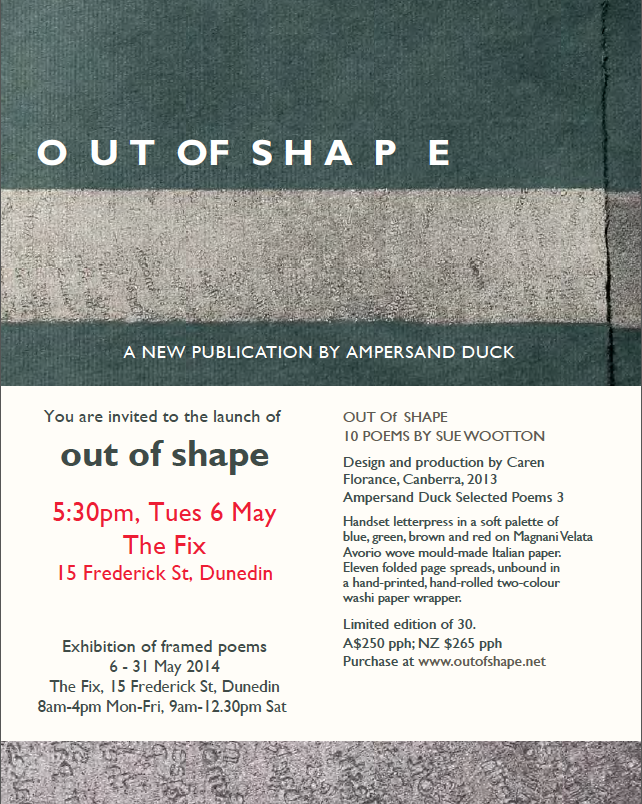
Sue Wootton is a Dunedin poet. Her latest venture is Out of Shape, a letterpress collaboration with Caren Florance of Ampersand Duck (Canberra). The exhibition of framed poems from this unbound book is on until July 4th at The Fix cafe in Frederick Street, Dunedin. See website for details.
Ros Ali: It’s too hard to choose favourite books of poetry. Like trying to rank best friends. So I’ll cheat a little and tell you about two books I’ve dipped into the most over the last few months, to help inspire my students to enter ‘imaginary gardens with real toads in them.’
Essential Poems from the Staying Alive Trilogy, edited by Neil Astley (Bloodaxe Books, 2012) is a ‘portable travel companion’ housing numbers of my favourite poems from the popular UK Staying Alive, Being Alive and Being Human anthologies
Take Naomi Shihab Nye’s, “Kindness”, for example. I give this poem to all my students at the beginning of the year, hoping they, too, will look to it in difficult times and find:
… it is only kindness that makes sense anymore,
only kindness that ties your shoes
and sends you out into the day to mail letters and purchase bread,
only kindness that raises its head
from the crowd of the world to say
it is I you have been looking for,
and then goes with you everywhere
like a shadow or a friend.
Another small and important book, an essential reader in the classroom, is Why Poetry Matters by Jay Parini (Yale University Press, 2008).
Here, we are eased backwards and forwards in ‘conversation with the traditions,’ as Parini discusses the craft and experience of poets from Ancient Greece to modernist America. Of most significance, perhaps, for young people finding their identity in the world and on the page, Parini deals with poetic voice, which he perceives as ‘offer[ing] an antidote to the bludgeoning loud voices of mass culture … thus staking a claim for what used to be called the individual soul.’
Parini observes that poetry’s power and transcendence are internal. Poetry ‘doesn’t usually send masses into the streets to protest a war or petition for economic justice. It works in quieter ways, shaping the interior space of readers, adding a range of subtlety to their thoughts, complicating the world for them.’
I love that Parini gently nudges us to conclude that yes, poetry matters. It matters profoundly. Poetry allows, among other things, insight into the ‘substance of our lives…to see ourselves freshly and keenly.’
Ros Ali teaches English and runs a Writing Programme at St Cuthbert’s College. She also works with Jo Emeney in the Young Writers’ Programme, of the Michael King Writers Centre, offering writing workshops for senior secondary students. Recently Ros and Jo ran series of student workshops for New Kiwi Voices, sponsored by the Albert-Eden Local Board.
Sam Sampson:
Stunning debut of the repairing of a life, Leigh Davis (Otago University Press, 2010)
‘The only joy of poetry is the trance of language. All the rest is sentiment’
(Leigh Davis, Sunday Star Times, July 25, 2010)
The late Leigh Davis wrote this book after a major operation to remove a brain tumour. It charts not just the resurrection of language, but also the metamorphosis of language. Emerging from the chaos of trauma, the book takes us on a journey, the mapping of a new voice…the re-emergence of an old voice…the distillation of a polyphonic voice. Visually the introductory notebook pages ( Simple / Broken / Beautiful) preserve (collect, if you will) a sense of origins, contexts, which the new composition will never quite obscure.
As a composition it is authentic in its format of fourteen-line semi-autobiographical utterances. The body will die, but the language is an embodied presence. To progress we must surrender to such a presence and be comforted by incoherence. Delivered in almost meditative flashbacks we feel the bumps and joins (of Davis’s favourite texts) trace the surface of the poem, and feel where one piece of language meets another – where texture and temperature change.
The proem, or ars poetica that begins the book is both elusive and revelatory: I want to reflect what I live with, to extract representation’s / subtle body in even the most intimate moments.
By the Bias of Sound Selected Poems: 1974 – 1994, Gustaf Sobin (Talisman House, 1995)
When I first encountered Gustaf Sobin on the Shearsman Press website, I was so moved by his clarity of vision that I used a fragment as an epigraph for my first book (wanting to say / wanting to / hear/ what it is that / I wanted to say), and when he died in 2005, dedicated a poem to him in my new book. Sobin was an expatriate American poet who spent most of his adult life in France, moving to a small hillside village in Provence, near the home of Rene´Char, whom he admired greatly. His syntax is to break the line, the word, and embody language, such that it is never inert. Nouns become verbs, the inanimate becomes animate with each unit of breath. As Heidegger’s investigation into ‘Being’ (Dasein), Sobin’s poetry attempts to strip away artifice and provide a musical scaffolding for the thought-speech continuum. One of my all time favourite poems is Sobin’s ars poetica: ‘The Earth As Air: An Ars Poetica’.
An Elemental Thing, Eliot Weinberger (New Directions, 2007)
Reading Weinberger was like turning a multifarious kaleidoscope that throws up new angles with each viewing. Thirty-five prose fragments / essays (including the Preface) where the only rule is that the information is verifiable. It reminded me of my early studies in ethnomusicology and the discoveries of ethnomusicologist William P. Malm’s – Music Cultures of the Pacific. The Near East and Asia – I returned to as an attentive explorer. As with Malm’s investigations, Weinberger’s poetic essays both narrate and articulate liminality inside and outside the frame of reference. Where does the text / key take us? Is the music even dictated by a key? As a form, does the prose element restrain the voice or accelerate the vision?
Century Swept Brutal, Zach Savich (Black Ocean, 2013) and The Self Unstable, Elisa Gabbert (Black Ocean, 2013)
I’ve just received two volumes from the small U.S. press Black Ocean.
The first by Zach Savich stakes out a fractured quality of mind; unsettling, and responsive, it is at once being consciousof its own consciousness.
He writes: …Beauty being cause / not effect; not perceived / perceived with / Century-swept brutal, the new flags / dry on wires.
He sings: Asters in the sill / hat brim thin. / Willow’s the only green for a time. / I place in a small envelope. / I gauge the season by what is in my hands…
Elisa Gabbert’s prose blocks, build a frame for the self, the body framed, the language re-framed. An alphabetically arranged index at the end of the book throws the reader toward a referable lexicon of subject matter: If information has replaced the story, what will replay information?
From ‘Enjoyment Of Adversity: Love & Sex’:
Girls want to be beautiful. Boys want to be powerful. In other words, everyone wants to be powerful. The appeal of Houdini and lingerie is the same: The more straps you wear, the nakeder you look. The only natural responses to vulnerability are love and violence.
Sam Sampson‘s latest poetry collection, Halcyon Ghosts, was recently published by Auckland University Press. I will post an interview with Sam this week and review his collection shortly.


 NZ Poetry Shelf