Jillian Sullivan has just started walking the South Island section of the Te Araroa trail. I invited her to send poems whenever she felt inspired to do so, internet access permitting.
Friends are why we come home
Friends around the table and all the glorious food and laughter. Sometimes I yearned to run away from here, I told Graeme. But I didn’t
want to leave this. He guessed the weight of my pack closest, at 14 kilos. Some said 17. It was 13. Achievable, then.
The gifts they gave me of their eyes. The gifts they gave me of their selves, who know me. And so we said goodbye. And so it is true
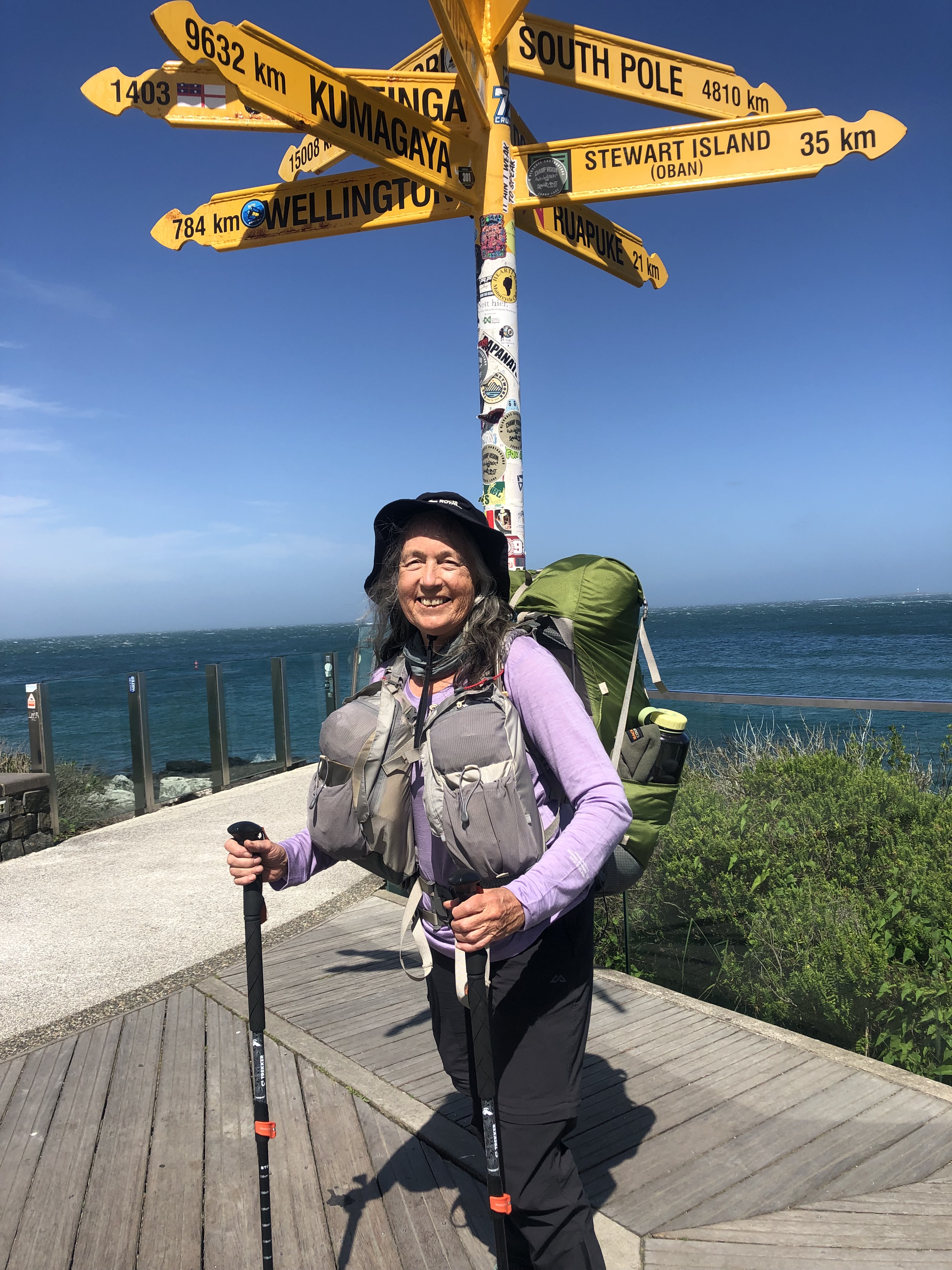
I am going. Margaret took a photo, as pack on back I walked down the white line of the empty road running through our village. A metaphorical photo.
Now it is a thrush singing outside my window. Bach, Ave Maria, black coffee. The gentle easing into leaving this life, for when I come
back, who will I be? Someone dissolved into trees and rocks and sky?
extra shirt, my darling’s hat, also, his book of poems. I will have to cleave
them closer. My daughter laughs when I say I packed a nighty for the huts. Now
I know I am a grandmother. Ok, gone the nighty, the togs, the jar of magnesium pills,
also, the merino jersey. The wind held me down and I was hardly a leaf. The photo
at the yellow signpost of Bluff – I’m not staunch. My legs aren’t even
straight. My body saying, “You’re going to do what?”
No regrets
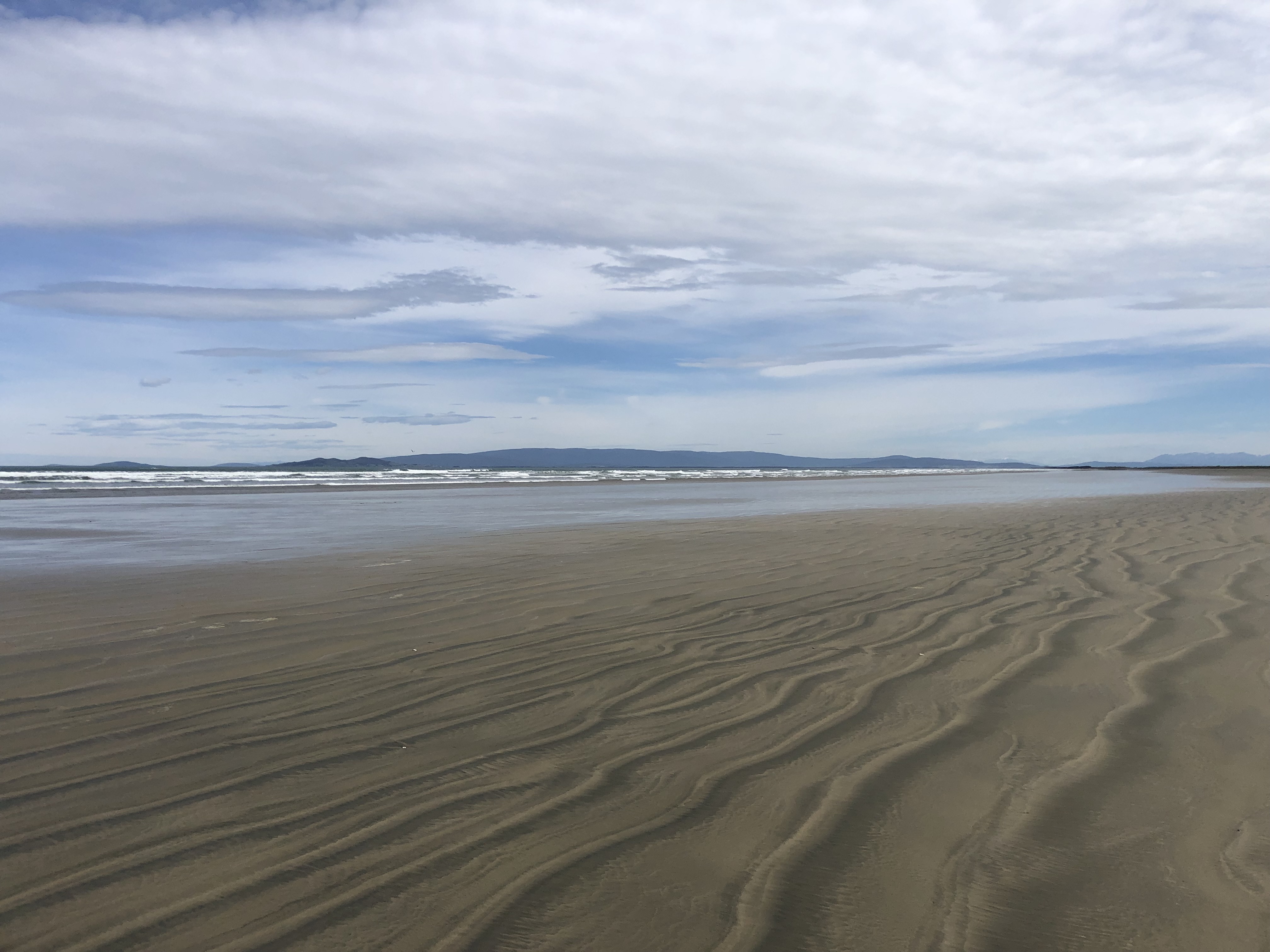
The beach is a long wing, of course you like it; the waves blue, white crests blown apart by wind, the sand tawny and firm. But now you have to walk it as if this is a sentence, for seven hours, actually, until you turn from the jauntiness of one step after another, like hope in the future, which is possibly why you’re doing this, until about the| six hour point it all becomes pain. The thigh bone connected to the| knee bone, intimately. There is nothing to be done about the future now, except keep walking. No-one will save you. Only the memory at five hours when the young tattooed builder from Western Australia, who has caught up to your stride, stops to swim in the lolloping waves. You are longing, you are longing to, also. You won’t regret it, he says. You take off your clothes on a public beach. You don’t regret it.
Jillian Sullivan
Oreti Beach
Jillian Sullivan lives and writes in Central Otago, New Zealand. She is published in a wide variety of genres and teaches workshops on creative non-fiction and fiction in New Zealand and America. Once the drummer in a woman’s originals band, and now grandmother of eleven, her passion is natural building. She finished a Masters degree in Creative writing in her 50s, and became builder’s labourer and earth plasterer nearing 60. Now home is the tussock lands, the tor-serrated dry hills and the white flanked mountains of the Ida Valley, where she has 20 acres bordering the Ida Burn, and plenty of room to store clay and sand for future earth projects. Her books include the creative non-fiction book, Map for the Heart – Ida Valley Essays (Otago University Press 2020).
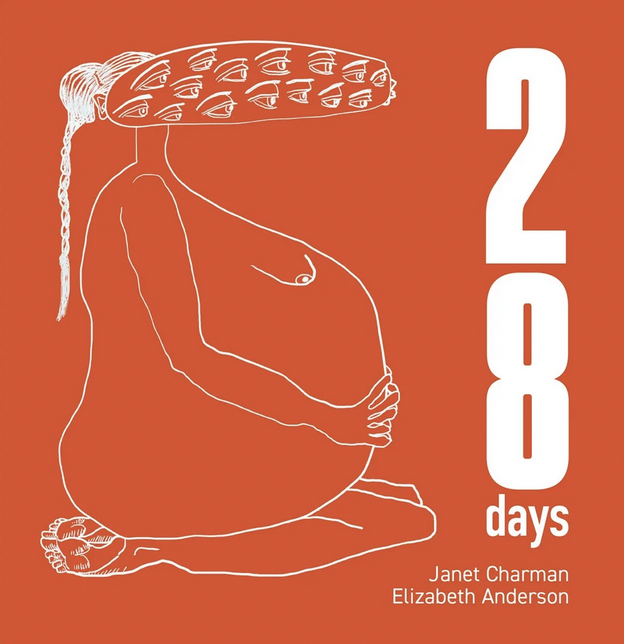
28 days, Janet Charman and Elizabeth Anderson Skinship Press, 2025
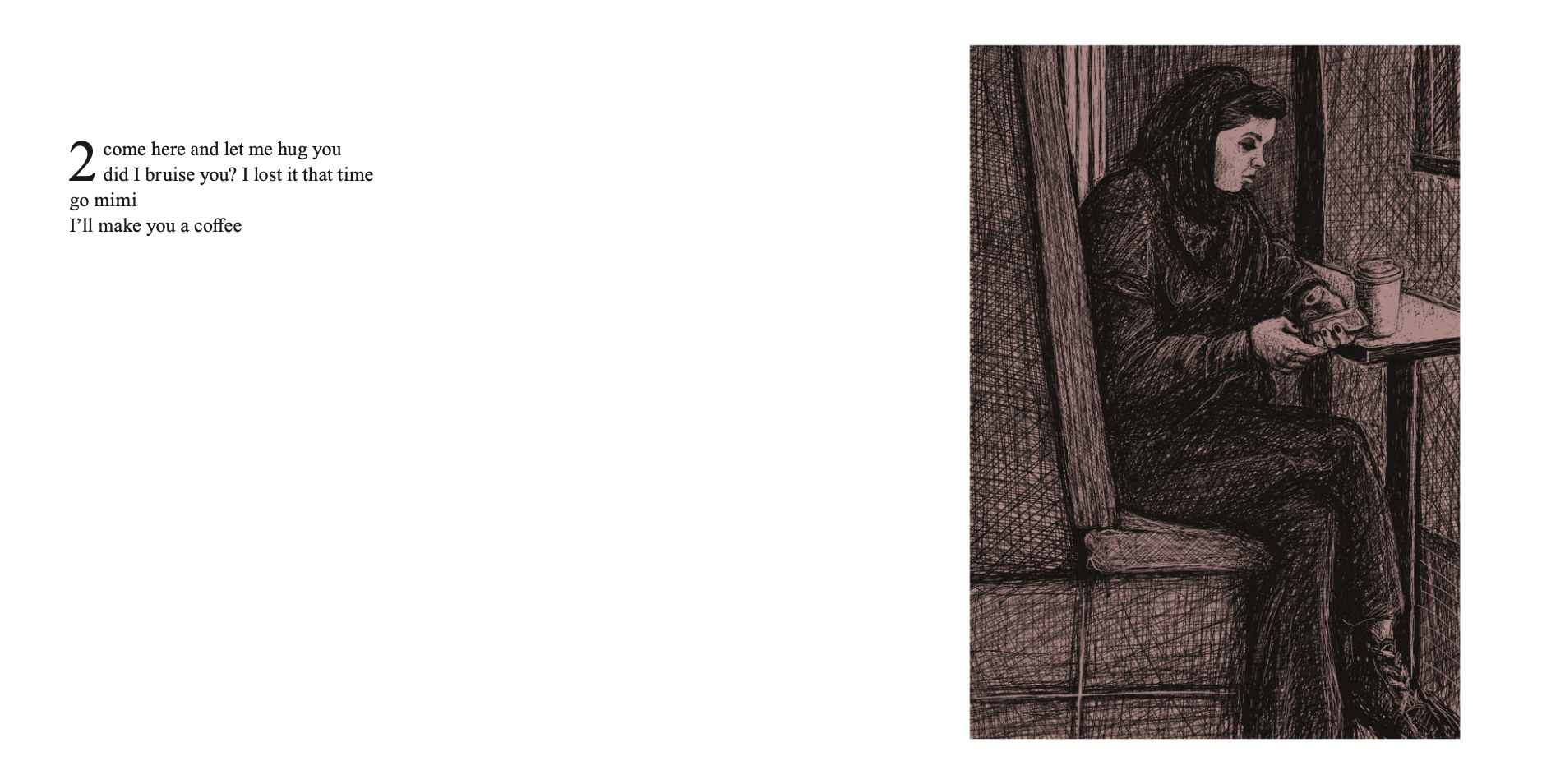
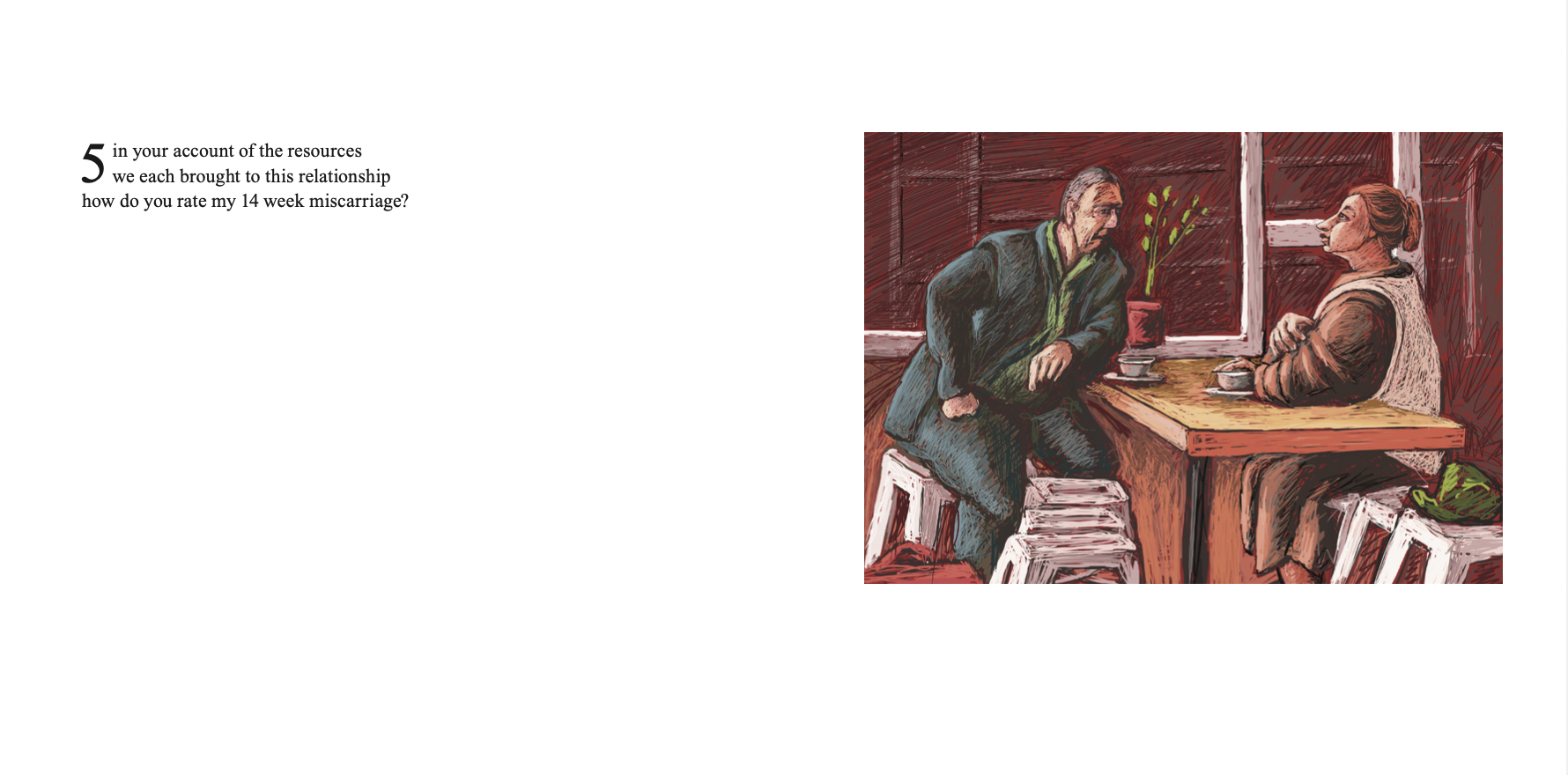
I am sitting at the kitchen table, the doors wide open, feeling the wind rustling in from the Waitākere ranges, the bird song racketing after all that rain, my flat white growing cold, and I slowly reflect upon 28 days. The book fits in the palm of my hand but expands in prismatic ways in both heart and mind. I have never experienced anything like it. It is pitched as a creative memoir. Elizabeth Anderson has produced 28 artworks, Janet Charman 28 texts. The artwork focuses on cafe scenes, drawing upon multi media, echoing Japanese ukiyo-e woodblock prints and Henri de Toulouse-Lautrec’s Parisian café paintings. The little texts – dialogue or poems or anecdotes – are like word kisses on the page.
The memoir is a collaboration, a contiguous relationship between word and image, between artist and writer, and this brushing close, this besidedness as the blurb says, is utterly fertile, utterly heart expansive in its reach. I am stretching for words, and they slip away. So I sit here on the rim of weeping, weeping at the way I’m brought cheek to cheek with the sharp edges of humanity. The shadows. My shadows. The unspoken. My unspoken. There in the cafe settings. There where dark brushes against light, where isolation and loneliness are rife. There where stories are shared, and equally stories are held back. Darkness and light.
Probably against the grain of reading a sequence of images and text, I look at Elizabeth’s images first. She produces all the drawings on her iPad using the Procreate drawing app, recording her observations in cafes or buses. I am absorbing the people frozen in a cafe moment, those on phones, those alone, those in groups, those with son or daughter, and each scene amplifies an intensity of mood. I can’t think when I have last felt portraits to such a degree. I feel the gaze of the eyes, the expression on the face. I feel the unspoken, and more than anything, the way we become a catalogue of memory, experience, pain, aroha, longing, recognitions.
In these tough times that can be so overwhelming, this book, I am feeling to its raw mood edges.
Now I return to the beginning and read Janet’s texts, these little patches of dialogue or poetry or anecdote, and again I am shaken to my core. It’s dark and light, its jarring and surprising. It’s gender relations and damage and patriarchy and femen and abuse and dressing wounds and how do we become and how do we be. Interior monologues, intimate revelations. Again I am feeling this book, feeling poetry to a skin tingling degree.
I am reading through the book for a third time, text alongside image, image alongside text, and the besidedness is extraordinary. It takes me deep into grief, into how we live, how vital our stories and conversations are, how connectedness matters, how listening to the person beside us matters. How important it is to nourish our children and ourselves in multiple self-care ways. And my words are a knot. How to re-view? How to speak? How to write?
Janet and Elizabeth’s collaboration began during the Canal Road Arboretum protest in Avondale, where the two artists first met. The book is in some ways a form of protest, in another ways a memory theatre, an intimate album. I haven’t felt a book this deep in a long time. This book is a gift. And I have ordered a copy to gift to a friend. Thank you.
Janet Charman is an award-winning poet, recipient of the Best Book of Poetry at the 2008 Montana New Zealand Book Awards. Her 2022 collection The Pistils was longlisted at the 2023 NZ Book Awards, and her 11th collection The Intimacy Bus was released in 2025.
Elizabeth Anderson is an artist and educator with an MFA from Elam. She has worked across design and television in Aotearoa and the UK, and now focuses on observational drawing and community-based creative work.
Ethan Christensen is a writer from parents, grandparents, and tīpuna based in Coromandel Town. His work features in publications across Aotearoa and Australia, and he co-edited the penultimate issue of Overcom Magazine in 2024. In 2025, he won the Peter Wells Short Fiction Most Promising Young Writer award, presented by Samesame but different. In the breaths of community and belonging, he hopes others can see themselves in the experiences he puts to page, whatever they may be. You can find more of his published mahi on Instagram, @eth_christ.
I get up at 4.00pm & buy a cheese 3 tomatoes, an orange, & a tin of fruit juice as usual; also a paper. I return to the kitchen & put 2 tomatoes in the fridge for midnight, cut off a piece of cheese & put the rest in the fridge, also for midnight; then I open the tin of fruit juice, two triangular holes neatly opposite each other; I wish I had had time to put it too in the fridge to cool. When I come to sit down at the table I find Kathryn is reading my newspaper. I eat the tomato, the piece of cheese & the orange; also I drink the tin of fruit juice. I feel I need some exercise, So I go for a walk as the sun goes down.
Murray Edmond from Entering the Eye, Caveman Press, 1973 First publication of this poem was in Landfall 98, June 1971, pp.122-123 (lovely cover by Pat Hanly – please note, Landfall then cost $1.00!).
Interviewer: Today we are speaking with a poem, which hasn’t been seen for many years, but has been reprinted here today. I began by asking the poem how it persuaded the poet to get re-printed:
Poem: Truth to tell, I didn’t even recognize the old bugger, it’s been so long.
Interviewer: So, did you get in contact . . . I mean, was it you who approached him?
Poem: Pure coincidence. I was on my way down to the mall. I work down there, back of the supermarket. Opening boxes all night. It’s a job. I usually stop off at the local – have a beer and a falafel. I took a short cut down a street I’d never been before. I’ve completely lost contact over the years. Once you’re written, that’s it. Most of them don’t give a monkey’s after that. They go off and they write different kinds of poems. But we’re pretty stuck as we are. As we were, so to speak.
Interviewer: So, what happened?
Poem: This old guy was mowing the berm. Pushing an old hand mower. I walked right past him. He’d looked up and caught my eye. I thought: why is he looking at me like that? I’d gone about twenty paces further on, and I stopped. It was him.
Interviewer: So, did you say hullo?
Poem: I turned back and had a second look. It was him all right. We were staring at each other. Just staring like. Then we both pretended not to know. He was the first to break. He put his head down and started pushing the mower like fury.
Interviewer: So, nothing happened.
Poem: It had been too long. Like seeing an old lover across the street.
Interviewer: When I read you, I don’t see much love in you.
Poem: I like to think I’m a love poem.
Interviewer: Really?
Poem: True.
Interviewer: How do you work that out?
Poem: I don’t. It’s what I am.
Interviewer: I don’t see it. Who’s the lucky . . . whoever?
Poem: Not that kind of love. All youse interview bods are the same. Love! For the fucking world. And all its shit. The sun, the cheese, the fridge, the tin of juice, the fucking orange, bro!
Interviewer: Do you call that love?
Poem: I call it love. What do you call it? Sorry! “We ask the questions”. Mind you, maybe you’re a bit right. Turned out we had the same girlfriend once. That was a bit odd. I’d forgotten all about her. I wanted to ask him ask: Where is she now? But I didn’t.
Interviewer: Was that Kathryn?
Poem: Kathryn?
Interviewer: In the poem. You should know: “I find Kathryn is reading my newspaper.”
Poem: Oh, Kathryn! No, no.
Interviewer: So, who was Kathryn?
Poem: She’s still there. She’s in the poem. She’s reading the newspaper.
Interviewer: Are you just making this up?
Poem: No, no. Cross my heart. Well, yeah. I guess. I’m aware that I’m just made up. “Every time I wake up, I’m putting on my make-up . . . “ Don’t look so worried, bro. Aretha Franklin! I’m not ‘making up’ to you. Swear. One thing I am proud of is my semi-colons. Did you notice? Didn’t think so. And did you notice the lack of pull-tabs back then? Do your homework. Thing is I’ve worked night shift for years. They say it stuffs your health. Stuffs your . . . what’s it called? Psyche? Is that the word?
Interviewer: You’re the poem. You should know.
Poem: Tell me: how do you get a job like yours?
Murray Edmond: born Kirikiriroa 1949; lives in Glen Eden, Tāmaki-makau-rau. Recent publications: Time to Make a Song and Dance: Cultural Revolt in Auckland in the 1960s (Atuanui Press, 2021) – cultural history; FARCE and Sandbank Sonnets: A Memoir, (Compound Press, 2022) – 2 books of poems; Aucklanders (Lasavia, 2023), a book of 15 short stories.
No Good, Sophie van Waardenberg Auckland University Press, 2025
What initially hooks us into a poem? For me, there is no singular response. Indeed if there were, it might limit what poetry can be and do. When I first started reading Sophie van Waardenberg’s new collection, No Good, I jotted down two words in my notebook: rhythm and voice. I was hooked. I was drawn into the musical cadence of a speaker speaking, drawn into the under and over currents of spiky, thistle, bloom. And as I read the collection, on a number of occasions over the past few months, crucial questions arrived. I was especially musing on the way a poem might become both self and other.
The title is the perfect welcome mat into the collection, particularly coupled with the cover illustration, where ‘good’ wavers, and I gaze at the beetle on the apple that is both good and not good. Pausing on the welcome mat, a cascade of (centuries) of good girl propaganda spins in my mind, and I am peering into the no good to see the next apple in the bowl, a portal of good in the pillowcase of no good.
And then, there on the first page, the ‘Poem in Which I am Good’, and the welcome mat widens, and still I am musing on the good girl, the no good girl, and the lyrical voice is blisteringly affecting.
Everything will be good, and the trousers I left to blow in the wind and the rain and lemon leaves,
them too. The linen will keep its soft thatching.
Who is she? How is she? The speaking voice gently draws me into both flawed and happy, and as much as I am on the edge of weeping, I hold tight to the coat-tails of joy. These words. These lines. These poems. I read : ‘A girl is born out of comparison.’ Read the glorious poem, ‘Sticky’, and feel the possibility of girl stretch oh so wide, even in the complicated history of her making, whether personal, or across centuries, or as negotiable and contested ideas.
A girl is filth and bright. A girl is born out of comparison. A girl can sing or can’t. A girl is held inside a duck’s bill, weighed against a slice of bread for softness. What flour is a girl made of? Wheat or corn? How can a girl get clean again?
The middle section of the book, ‘Cremation sonnets’ resembles a grief casket, where the poems lead in multiple directions, carrying us between presence and absence, letting go, and unable to let go. This lost love. This elegiac memory.
The final sequence of poems, so utterly moving, are written with the ink of love. The poems are addressed to ‘you’, written across a distance between here and there, between hunger and satisfaction, dream and reality, turning away and moving close. This is love. This loved and loving woman. This is ache and this is a yearning to love and be loved. Such gentleness, such a slow perfect unfolding of what is special, with only so much revealed and gently placed in the pockets of the poems. And if this is a love that is over, such deep sadness, it seems to me, that love finds a way to linger in residues, traces, scents.
The word I write in my notebook in my latest reading is bridge, the way poems become a bridge, establish vital bridges. Think sweet and sour crossings, fluid and awkward, here and there, good and not good. Not as a restrictive dichotomy but as a series of movements, like music, like the way personal experience resists pigeon holes. Traversing the myriad bridges in Sophie’s sublime collection makes me both think and feel the world. Yes I am thinking and feeling a version of her world, but also a version of my world. And this moves me.
Rhythm, voice, bridges. I hold this book out to you so you may find your own self-affecting crossings.
A stagger of lemons and a goneness I can’t swallow. Hello the same feeling,
didn’t I wash you off, you get everywhere, sog up my arms
and droop me. It’s something alien in my gut that knows you so well.
I say it again: I am not a creature of sorrow. But I could be proper sad if I put my mind to it,
if someone dropped me from a height.
from ‘The Getting Away’
Sophie van Waardenberg is a writer from Tāmaki Makaurau. She holds an MFA from Syracuse University where she was editor-in-chief of Salt Hill Journal. Her first chapbook, ‘does a potato have a heart?’, was published in AUP New Poets 5 (2019). Her poems about eating carbohydrates and kissing girls can be found in Cordite, Sweet Mammalian, The Spinoff and Best New Zealand Poems.
Listen to Sophie read two poems on Poetry Shelf: ‘Self-Portrait as Adolescent Covered in Flour’, ‘Hymn to the Insomniac in Fool’s Spring’
Alexandra Cherian (she/they) is a filmmaker, writer, and girltwink extraordinaire from Te Whanganui-a-Tara. She has been published in bad apple, Takahē, Starling and Overcom among others, and is a founding member of queer filmmaking collective The New New. In 2025, she completed her Masters in Creative Writing at the International Institute of Modern Letters.
My recent book, Slender Volumes, is made of 300 seven-line poems. Really they are 300 stories, told in different modes: the realistic, the autobiographical, the historical and the surreal. One, popular with audiences when read aloud, is number 216, which concerns Mr Moth and his dairy:
There was a dairy at the end of the road owned by Mr Moth. Everybody knew it as Moth’s dairy. He sold ice blocks made in a special mould – the stem being a popsicle with a large wing on each side. The ice blocks came in different colours and were named Emerald Surprise, Ruby Splendour and, best of all, the Tiger Moth. The dairy always shut its door at dusk. No fluorescent lights were switched on. Mr Moth liked the darkness.
What seems to be a figment of my imagination, in the surreal mode, in fact came from a walk around Onehunga Bay Lagoon. On this particular walk my wife Amala and I encountered an old-time resident who told us that many years ago there used to be a dairy opposite our house on Normans Hill Road. The dairy was owned by a Mr Moss. I misheard him, and thought he said “Mr Moth”. This led to a reverie about Mr Moth and his dairy, which I wrote down when I got home.
Richard von Sturmer is a New Zealand writer. He was born on Auckland’s North Shore in 1957. His recent works are the acclaimed memoir, This Explains Everything (Atuanui Press, 2016), Postcard Stories (Titus Books, 2019), and Resonating Distances (Titus Books, 2022).
In 2020 he was the University of Waikato’s writer-in-residence. His book Walking with Rocks, Dreaming with Rivers: My Year in the Waikato (Titus Books, 2023) was written during his residency.
In 2025 his new collection of poetry, Slender Volumes (Spoor Books, 2024), was shortlisted for the Mary and Peter Biggs Award for Poetry at the 2025 Ockham Book Awards.
The body you gave me’s wearing thin: I won’t patch a scarecrow’s coat. The plains of the east I tilled are stippled with wheat; magpies nest
in the hair of my head, my heart is all marching feet. This night I lie beside my wife; the moon creaks over
the sill: I breathe, “You’re a tinny sod!” and tilt in the coffin of sleep. I dream of what’s left in this sliver of life, the reins my hands can’t reach.
Jeffrey Paparoa Holman London 1993
This poem was written in London in the mid-1990s, at a time when I was working in a central city bookshop – Waterstones – and devoting myself to writing. Short stories and poetry, going along to writing programmes at City Lit adult education centre in WC2H, and making friends with Dylan Horrocks, also at the same Charing Cross Road branch, doing his drawings and cartoon strips in lunch breaks, evenings and weekends. We all now know the result of his apprenticeship to the art. Quite when or why this poem emerged, it’s too far gone to remember, but it’s fair to say, is part of a self-appointed midlife apprenticeship to my lifelong writing urges. It was time to get serious and ‘Wheat in the East’ belongs there. 1997, I was back in New Zealand for good – in both senses – returning to university to finish a rusty, abandoned 1970s BA. I decided the following year, to put together a self-published 36 pp chapbook, with Johnathan of Molten Media as my guide. In 1998, we produced Flood Damage, where this poem, with many other London-birthed works appear. I was away. There was no stopping now. I couldn’t know it, but I was on my way to publishing what became As Big As A Father, with Steele Roberts, in 2002. The title poem here had also been written in our London council flat. This poem was part of that journey, so resides in my heart, with affection.
Jeffrey Paparoa Holman writes poetry, short fiction, history and memoir. He has published seven volumes of poetry; Best of Both Worlds (history, 2010); The Lost Pilot (memoir, 2013); Now When it Rains (memoir, 2017). As Big As A Father (Steele Roberts, 2002) was shortlisted in the Montana Book Awards, Poetry, 2003. Best of Both Worlds: the story of Elsdon Best and Tutakangahau (2010) was shortlisted in the Ernest Scott Prize, History (2011, Australia). His most recent work, a family history, Lily, Oh Lily – Searching for a Nazi ghost, is published by Canterbury University Press.
Slowly it dawns, the need to listen to the faint grief of a mourning cello, the sky’s blue jug pouring out a second helping of custard sun, this music that vies with a lost bee and a kereru’s three-note flight path beyond our open door. Nick Tipping’s low voice, sounding like a pilot’s announcement: Enjoy this shadow of trees, this laughter of water. From among a shock of leaves, a tūī’s semi-colon, a piano note, a caught dragonfly cupped in the soft sweat of a child’s hand. The lowest black key repeating—a lawnmower four houses down. Nick corrects himself, ‘Rachmaninoff,’ he says. My grandson comes down to visit from upstairs, says, ‘I thought you were still in bed.’ No. I’m here just awake and no more even though it’s now past noon. I’m here taking it all in. The Concert Programme in summer, volume turned down to 7, the fret of a pīwakawaka. No. I stand corrected. Vaughan Williams’ Lark Ascending.
Kay McKenzie Cooke
Although Kay McKenzie Cooke (Waitaha, Kāti Māmoe, Kāi Tahu) lives in Ōtepoti Dunedin, she continues to hold a deep connection to Murihiku Southland, the province where she was born. She is the author of four poetry collections and three novels.
Poetry Shelf offers a bouquet of warm congratulations!
To celebrate Dinah Hawken as the 2025 recipient of the Prime Minister’s Award for Poetry, I am reposting a poem she picked from Small Stories of Devotion (Victoria University Press,1991) with her comment (Playing Favourites), an audio of her reading from Sea-light (Victoria University Press, 2021), and an extract from Wild Honey: Reading NZ Women’s Poets (Massey University Press, 2019).
Dinah Hawken is one of New Zealand’s most celebrated poets. She was born in Hāwera in 1943 and trained as a physiotherapist, psychotherapist and social worker in New Zealand and the United States and has worked as a student counsellor and writing teacher at Te Herenga Waka—Victoria University of Wellington. Of her ten collections of poetry, four have been finalists for the New Zealand Book Awards. Her first book, It Has No Sound and Is Blue (1987), won the Commonwealth Poetry Prize for Best First Time Published Poet. Her latest poetry collection is Faces and Flowers: Poems to Patricia France (2024), and other recent collections are Sea-light (2021), longlisted for the Ockham New Zealand Book Awards, There Is No Harbour (2019), and Ocean and Stone (2015). In 2007, Hawken received the Lauris Edmond Award for Distinguished Contribution to Poetry; and her new book of poems, Peace and Quiet, is to be published in 2026. Dinah lives in Paekākāriki.
The harbour is hallucinating. It is rising above itself, halfway up the great blue hills. Every leaf of the kohuhu is shining. Cicadas, this must be the day of all days, the one around which all the others are bound to gather.
The blue agapanthus, the yellow fennel, the white butterfly, the blue harbour, the golden grass, the white verandah post, the blue hills, the yellow leaves, the white clouds, the blue book, the yellow envelope, the white paper. Here is the green verb, releasing everything.
Imagine behind these lines dozens and dozens of tiny seed-heads whispering. They are a field of mauve flowers. What they say is inexplicable to us because they speak another language, not this one written from left to right across them, made up of distinct and very subtle, ready-to-burgeon sounds.
Dinah Hawken from Small Stories of Devotion (Victoria University Press,1991)
Note on Poem
‘The harbour poems’ come from my second book of poetry, Small Stories of Devotion. It’s a book I’m very fond of, not least because the book itself is a beautiful shape, on beautiful paper and with unique images by the New Zealand artist Julia Morison. It is also a unique book in my poetry backlist since it is a narrative made up of mostly prose poems, and prose poetry in 1991 was unusual on our shelves. Looking back 30 years I see it is the book amongst my collections with the most faith in the imagery of dreams, and with my preoccupation with the Sumerian myth of Inanna, one of the earliest stories ever written. The epilogue of the book contains 36 6-line poems and it is the first three, written above Wellington harbour, I have included here.
Dinah Hawken
Dinah reads from Sea-light
Dinah Hawken reads ‘Haze’, ‘The sea’ and ‘Faith’ from Sea-light, Victoria University Press, 2021
In my review of Dinah’s collection, Sea-light I wrote: “reading her deftly crafted poems is akin to standing in an outside clearing and reconnecting with sky, earth, water, trees, birds, stones. It is personal, it can be political, and it is people rich”.
Extract from Wild Honey
I fell in love with the poetry of Dinah Hawken, particularly her collection Small Stories of Devotion, published in 1991, when I was writing my Master’s thesis on the Italian novelist Francesca Duranti and her myriad narrative movements.
As much as I was enjoying stepping into another language at that time, Hawken offered a different direction: she inspired me to write poetry. I have always thought of Hawken as a sky poet because she leads me to a state of contemplation; to see beauty, strangeness and disquiet.
Hawken’s collection It Has No Sound and Is Blue won the 1987 Commonwealth Poetry Prize for a debut book of poems.13 Mostly written in New York, the poems record Hawken’s intricate relationships with the city — the homeless, the leafless trees, the fierce cold, the lack of balance, the unwarranted deaths, the points of neglect — as well as reflections on New Zealand.
In these poems, Hawken zooms in on the way miniature details can lead to larger ideas, and the way she could find connections to stillness and quiet amid the clatter of a major city. The poems both delay and promote movement; she deliberates on things, branching out in a range of directions with physical attachments and floating ideas. In ‘Writing Home’, a long sequence of sonnets in couplets, a slow contemplation of the city is important to Hawken:
Since you left the trees have been standing against the snow making those small inexplicable gestures
children make in their sleep. Today they were strictly still. They gave nothing away, as if
they themselves were the dead of winter.
from ‘Writing Home’ (It Has No Sound and Is Blue, VUP, 1987)
Hawken is ‘acutely aware of [her] human breathing’ as she stands next to trees that are barely alive. This description of such a sensation is a hallmark of her poetry: keen to absorb intricate patterns, especially from nature, she produces poetry that abounds with life.
Hawken’s poetry favours space as though she wants room for her poems to breathe: on the white page, in the pause at the end of the line, and in the way both poet and reader have room to move in the poem. But the physical world is equally important. She is fascinated by surfaces and depths, and the way the physical world ignites all senses: ‘Stay in the physical world you say. / Take your boots and socks off.’15 The poem ‘Stone’, for example, delights in a stone’s physicality as well as in attributes that are much harder to discern:
Plain the call of a noun
of balance and beauty.
Stone.
from ‘Stone’ (Ocean and Stone, VUP, 2015)
Hawken conveys the plainness of objects with a plainness of words, and she often returns to the same object to uncover new revelations. If you hold a stone in your mind as a poet surprising connections rise to the surface:
Stony this, stony that. They are cold today, these stones on the desk. Stone cold. Stone blind. Stone deaf. Heart, reception, stare, silence. They remember the slingshot.
from ‘Stone’ (Ocean and Stone)
For Hawken, ‘[w]riting, at least, is going somewhere’; to write is to take risks, to ponder and to feel:
To write is to live on a balcony: the outlook is great, the air is still, roads are not yet taken.
The air is unpredictable. The elements are downright dangerous.
from ‘How far’ (The leaf-ride, VUP, 2011)
Hawken’s movement between the physical world and drifting thought might be a way of travelling through time and across the land, among people and within herself: ‘We try reading between the pages, the stars. / We’re attached to a planet of ocean and stone.’ Her poetry is people-dependent, and she is as attentive to strangers as she is to people she knows. Sometimes her pronouns are personal. In ‘Welcome’, the grandfather, for example, holds his smiling granddaughter in his arms; in ‘Sixteen months, co-creation’, ‘[s]he is the question and / the answer and the question again’. At other times, her pronouns move beyond the personal to belong to anyone. Humanity is always under scrutiny. It bothers her that we live surrounded by digital screens, for example; they limit life and induce loneliness. When she considers a tree, she confronts another concern that we must face:
[. . .] It reminded me I had a family and the company of friends. It reminded me I had a home by a heavy and beautiful sea. It told me that we live in a world of treeless, make-shift cities, cities that are flickering and maybe drowning.
from ‘A screen is a screen’ (Ocean and Stone)
If Hawken’s poetry is entrancing in its musicality, mystery, physicality and space, speaking out about the state of the world is equally significant to her:
If we live in the light or the dark too long, being human, we go blind. We are suspects, all of us, in a cruel climate. Is it ok to speak out in this world-wide room?
from ‘The question of cruelty’ (The leaf-ride)
Small Stories of Devotion features the meandering, looping threads of a woman writing, dreaming and loving. The poems keep repeating: ‘she wants me to talk simply and to reach you’. Feminine motifs flourish in a sequence that is divided into the four quarters of the moon, and feed a narrative that explores women’s friendships, rape, death, birth, cancer, Sumerian goddesses, muted woman, the outspoken woman, academic thinking, history, love, subtle politics, blatant politics, gardening, mourning, this language, another language, stones, the ocean, flowers, a hallucinating harbour, low clouds, small ponds, the struggles between men and women, hands, bodies, hearts.
After twenty-five years of reading Dinah Hawken, I am still finding fresh reading tracks in her work. Phrases that blaze in multiple directions still catch my eye:
‘Oh let’s recognise the silence so composing her’
from ‘Memory’ (Small Stories of Devotion, VUP, 1991)
Hawken’s ‘her’ might reference the silence of ‘the friend who has died’ or the recurring refrain of women who have been misheard, ignored, shut down, mistranslated, spoken over. Across a lifetime of writing Hawken has given ‘her’ a kaleidoscopic voice:
Who is she? She is trimming the smallest fingernails, she is threading honeysuckle through trellis. She is the context, the swell, the breathable air. She is singing, she is swinging the boy on the swing in the park. She is fluent and steady and unpaid.
from ‘She is Kissed Three Times’ (Small Stories of Devotion)