It’s time to register for Phantom Billstickers National Poetry Day 2024!
Mark your calendars! The date for this year’s nationwide celebration of poetry is scheduled for Friday 23 August. Registrations and seed funding applications are now open, and event organisers across the motu are encouraged to get involved and celebrate Aotearoa’s growing and vibrant poetry scene.
In its 27th year, Phantom Billstickers National Poetry Day has established itself as a prominent and popular event in the literary calendar that promises an explosion of poetry countrywide in late August.
Poetry has made its mark everywhere during previous events, from bricks to buses, sidewalks to sand, resonating through national parks, churches, hospitals, museums and city streets. “The possibilities are endless,” emphasizes NPD’s new national coordinator, Gill Hughes. “We invite organisers to don their creative hats and come up with unique and wonderful ways to celebrate poetry in all its forms”.
Phantom Billstickers CEO Robin McDonnell says, “Poetry is the beating heart of unity, inspiration, and endless imagination. From poem posters on the streets of Aotearoa to a verse that hits you right in the heart, it crosses every boundary. At Phantom Billstickers, sponsoring National Poetry Day for nine years, we’re still in awe of how it brings us all together.”
Gill urges interested organisers to register early for seed funding and to take advantage of the heavily promoted official schedule of Phantom Billstickers National Poetry Day 2024 events.
Registration forms, templates, planning and marketing resources are all available on the NPD website. Don’t miss out on the opportunity to showcase your love for poetry and engage with your community in a meaningful way. Join us in making Phantom Billstickers National Poetry Day 2024 a memorable and successful celebration of creativity and expression.
Applications for seed funding close at 5pm on 4 June 2024. The official Phantom Billstickers National Poetry Day 2024 calendar will be announced on 1 August.
For further information contact NPD national coordinator Gill Hughes at poetryday@nzbookawards.org.nz and to keep up with plans for NPD 2024, follow NZPoetryDay on Facebook, Instagram and X (formerly Twitter).
Ōrongohau | Best New Zealand Poems 2023 captures the spirit of the times
The latest edition of the online anthology Ōrongohau |Best New Zealand Poems is now live, featuring 25 poems chosen by Poet Laureate Chris Tse from nearly 4000 published in 2023.
“These are the poems that surprised and delighted me the most, that made me pause to sit in my own discomfort or revel in another poet’s joy. Above all, they’re the poems I thought other people need to read.”
His chosen selections, he says, are the “poems that stood out to me for the way in which they navigated inner and outer worlds, or gave life to the poets’ hopes for themselves and their communities.”
The fiery public debate around Tusiata Avia’s poem ‘The 250th Anniversary of James Cook’s Arrival in New Zealand’ that was unfolding when Chris Tse was editing the anthology speaks to the continuing power of poetry to provoke and challenge.
“Here and around the world, we are seeing creatives caught in campaigns of misinformation and bigotry, sometimes driven by those in power,” says Tse in his introduction. “The effects of this are concerning: for example, cultural institutions have cancelled events featuring writers who are outspoken against genocide, and tired anti-queer and racist rhetoric is being used to threaten writers and performers, and fuel the surge in book bans.”
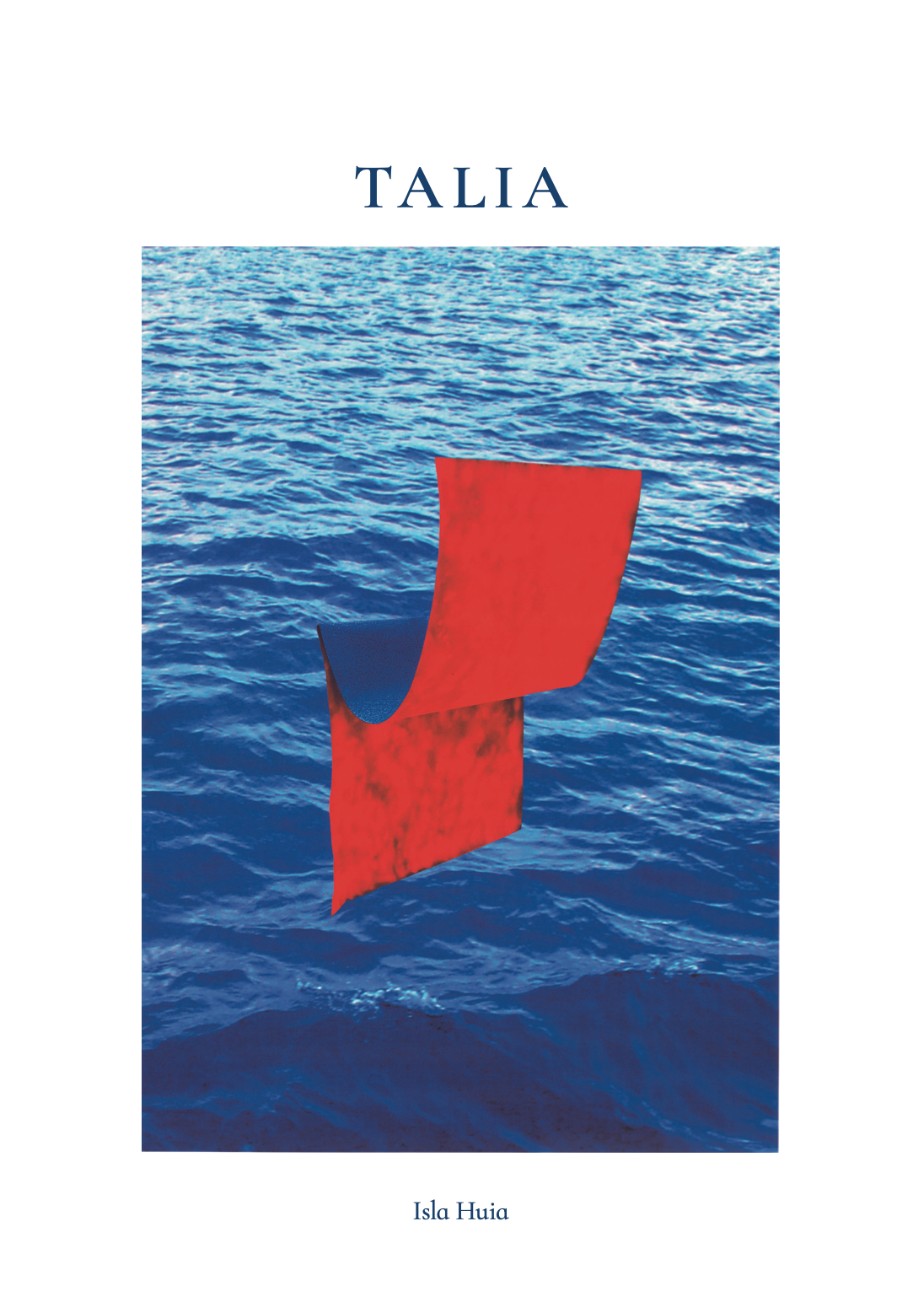
The 2023 edition showcases established figures such as Michele Leggott, Sam Duckor-Jones, John Allison, and Tracey Slaughter alongside 2024 Ockham New Zealand Book Award Poetry finalist Isla Huia, and introduces newer poets such as Ruben Mita, Jessica Hinerangi, Geena Slow, and Loretta Riach, who are making their first appearance in Ōrongohau | Best New Zealand Poems.
The voices in this anthology engage with times past as well as looking to the future. They contain multitudes of experience and perspective, delight in moments of love and desire, confront the ongoing impacts of colonisation, show us the many ways in which the political is deeply personal, and in the process offer a mirror on the world as it is, along with tantalising glimpses of where we might be heading.
These are poets writing from the range and depth of human experience. Hannah Mettner offers a youthful experience of that infamous measure of fitness, the ‘Beep Test’, as a lens through which to view the adult world. Emma Shi considers the distances of immigration, what remains and what is lost, while Rushi Vyas uses a memory of a father’s Rolex to explore the work of facing our cultural inheritances, of choosing what we want to keep alive, and what we are prepared to relinquish. Hana Pera Aoake gives us a meditation on the anxieties she holds for her newborn daughter’s future, while harold coutts offers an exploration of passion, intimacy and lust. Dan Goodwin’s boy in Wyoming meets his dream man in a bar, while Stacey Teague unpacks the way pop culture, specifically Kylie Minogue’s gold hot pants, alters the chemistry of your brain.
Series editor and International Institute of Modern Letters (IIML) senior lecturer Chris Price says, “The poet laureate has given us a gathering of poems that are very much of this moment, recording the crises we are facing, reflecting the diversity of our culture, and celebrating the way human dreams and desires persist in the face of all obstacles.”
The International Institute of Modern Letters at Te Herenga Waka—Victoria University of Wellington has published the anthology annually since 2001, with support from Creative New Zealand. Every issue has a different editor, selected from Aotearoa’s literary world.
Ōrongohau | Best New Zealand Poems 2023 can be viewed online
Today there is the real wolf and the imagined wolf mixing up with an Airini Beautrais short story and missiles are dropping and children are starving and I can only do one day at a time, and The National is singing and there’s a midnight moon in the dead of the night with the window wide open
Paula Green from The Venetian Blind Poems (2023-2024)
After a fourth month hiatus to restock my small energy jar, I am keen to refurnish Poetry Shelf. In such planet-and-self-depleting times, it feels even more important to foster a connecting hub for readers and writers, booksellers and librarians, festival organisers and book reviewers. My aim is to host a shelter, a haven, a meeting space for poetry. It is a place for music, stories, ideas, relationships, beauty, conversation, heart and aroha. It is a place for celebration but it is also a place for the growing concern and protest we feel at global and local inequity, prejudice, conflict.
I aim to post something each day: Monday new poems Tuesday audio and videos Wednesday my reviews Thursday poets on other poems Friday various features and musings by and on other poets, interviews, thematic poem clusters PLUS an ongoing noticeboard.
I spotlight poetry but I may review fiction and nonfiction that catches my attention. In April I am posting features on each of the shortlisted poets for the Ockham NZ Book Awards.
I cannot promise to post every day as I am still on my recovery road and have daily patches when it is hard to function. Ironically the past week is the most challenging I have had for a long time. But I strongly believe in the power of doing things that build joy and wonder, focus on what we can do, make nourishing connections. In order to protect my small energy jar, I do not accept unsolicited poems and I cannot promise to review every book I get sent.
I am so grateful for the support you have given me over the past 18 months. Your kind emails. Your magnificent writing. And for the heart-boosting response to my recent invitations.
On Monday I am launching Monday Poems with a poem by John Allison (1950 – 2024), selected by James Norcliffe. This series usually hosts new work, but it felt fitting to pay tribute to a much loved poet. Poetry Shelf will also post a tribute feature.
Try to remember how the year began. Were you under a sky of your own choosing or one stripped from photographs you’ve only ever seen on social media? At what point did you realise you had lost the language to describe even the most simple of joys?
/
The party had been raging for months by the time I arrived in my silver. Cans and bottles blanketed the lawn while neighbours peeked through their curtains to sneer silently and mouth curses. I entered with a resolution and left with a mouth full of blood and extra teeth.
\
The history-makers abuse their well-worn templates, framing each year as business as usual. The media play along until business becomes personal. The storytellers sift through ash to find something to celebrate but all they find is another word fashioned into a weapon.
/
I have known this year and its versions, all measured in past lives and misdirections. Joy becomes a distraction. Sometimes the only escape I long for is a dancefloor— where I can keep my body moving under flashing lights and not worry about being ushered out into the cold.
\
The machines are programmed to show us how it ends. Blossoms bloom into fists. Sugar on the tongue sours. The radios talk back, the televisions stream and another old song goes viral as bodies become a spectacle on our screens. Erasure makes a deathly noise, floods our blood.
/
I want to believe the heart is more than a muscle— more than a faded metaphor for a contract that binds us, flaws and all. I press my ear against the year and hear a song with a lyric repeated until the music fades, leaving a ghostly chant in my head imploring: do not look away.
\
This year proves that borders are imaginary and they do more harm than good. Nothing can contain what little remains after devastation has swept through a city. The impulse to read the earth’s lines in the past tense even though those on the ground attest: is, now, forever.
/
A niece’s embrace. A pool in swampy heat. The gift of Knowledge. German brass band techno. Ponies prancing under mirrorballs. Cruel summers bring the sweetest stings. The Poet Laureate’s port. Northern storms and southern rainbows. My love’s love. Padam? Padam.
\
My hopeful poems wait in the wings—my highlights and golden hours are no match for our collective whiplash. Make a wish before we knot this year and let it slip out of our hands as another lesson we will never learn. Is it enough to summon the star that once called us home?
/
Somewhere there is a sky that rages in psychedelia— the shapeshifting breath of a benevolent god looking down at the legacy we have scorched into the earth. If the hand no longer feeds, bite. If kings and queens try to take our tongues from us, bite—and don’t let go.
Chris Tse
Chris Tse is New Zealand’s Poet Laureate for 2022-24. He is the author of three poetry collections published by Auckland University Press: How to be Dead in a Year of Snakes, HE’S SO MASC, and Super Model Minority. He and Emma Barnes edited Out Here: An Anthology of Takatāpui and LGBTQIA+ Writers from Aotearoa. He is the editor of The Spinoff’s Friday Poem and Ōrongohau | Best New Zealand Poems 2023.
What does it mean to continue? Grandmother says that now is the time to ask ourselves what we are, other than ourselves. A piece. This is a moment mad for understanding. The body is a fence but it is also a wave and a thread in a fabric.
Joan Fleming from ‘Yana’, Song of Less, Cordite Books
2023 has served a dazzling array of books, across genres, from across the globe, and in particular, books published in Aotearoa. Local poetry books have stoked my heart, offered kaleidoscopic directions, hauntings, subject matter, challenges. Lifted me out of the mundane, and at times the weight of the world, for yes, this is a year of weight, a year of unbearable inhumanity in Gaza, climate change, and now an incoming coalition government that has, for me, intolerable values. Poetry can be a connecting force, whether deeply personal or acutely political. It feels necessary.
Poetry thrives in many places: from Bill Manhire’s much-loved presence on X / Twitter / Blue*** to dynamic poetry performances in cafes, inspired zines, new collections, stunning anthologies. For me, posting book reviews, the Monday poems and poetry readings has been a lifeline this year.
Importantly, poets in Aotearoa have called hard for a ceasefire in Gaza. Hana Pera Aoke and Khadra Mohamed organised a petition to send to political leaders and the Government. Kiri Piahana-Wong has been posting Palestinian poets on her Facebook page and selected five poems for Poetry Shelf. Anne-Marie Te Whiu selected a poem by Sarah M Salehs.
I invited poets to write a 2023 postcard, poets who have inspired and solaced me with stunning new books (some I have already read and reviewed, some I have read but still to review) and various other writings, blogs and audios. I suggested the poets could celebrate or bemoan anything – the space was theirs to fill.
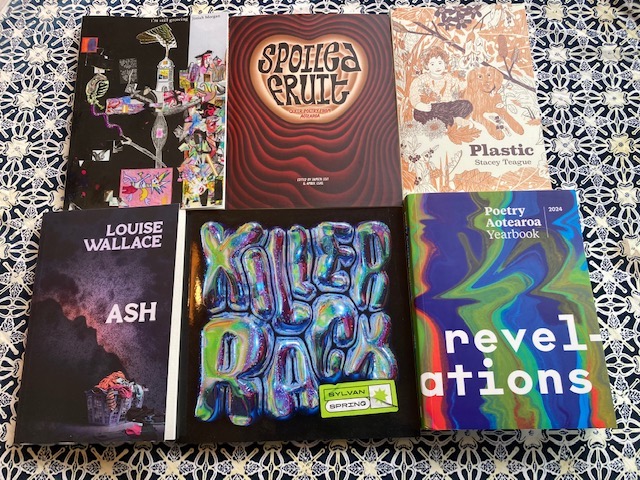
My final review of 2023 was the extraordinary Big Fat Brown Bitch by Tusiata Avia, a book that affected me so very much. I did not manage to read all the poetry books I wanted to read – it just wasn’t possible at my snail’s, 8 tablespoons-of-energy pace – but I will read them. I am thinking of Ruby Solly, Dani Yourukova, Rushi Vyas, Dominic Hoey, Geoff Cochrane, Gail Ingram, Robyn Maree Pickens, Amber Esau and Damien Levi’sSpoiled Fruit: queer poetry from Aotearoa, Iona Winter’s grief anthology a liminal gathering, a Catherine Bagnall and Jane Sayle collaboration, and Landfall 246 and the new online Takahe presence.
2023 was a stellar year of anthologies: readings from Rapture: An anthology of performance poetry in Aotearoa, eds Carrie Rudszinski and Grace Iwashita-Taylor, (AUP), Remember Me: Poems to Learn by Heart, ed Anne Kennedy (AUP) review , readings from Te Awa o Kupu, eds Vaughan Rapatahana and Kiri Piahana-Wong (Penguin) and readings from A Kind of Shelter Whakaruru-taha: an anthology of new writing for a changed world eds Witi Ihimaera and Michelle Elvy.
I got to have conversations with a few poets; Michele Leggott’sFace to the Sky (AUP) offered such vital connections. I invented my own Poetry Shelf Cafe so I could hear exquisite readings such as Audrey-Brown Pereira read from a-wake-(e)nd (Saufo’i Press), Stephanie Montalkread from As the Trees Have Grown (THWUP), Hannah Mettnerread from Saga (THWUP), Gail Ingramread from Some Bird (Sudden Valley Press), Claudia Jardine read from Biter (AUP), Diana Bridgeread from Deep Colour (OUP), Jen Curtisread from Stone Men (Sudden Valley Press), Claire Orchardread from Liveability (THWUP), Leah Dodd read from Past Lives (THWUP), Arielle Walker and harold couttsread from AUP New Poets 9 (AUP),, readings from A Kind of Shelter (MUP) and readings from Takahē 107. Other cafe audio links below.
And it is a big shout out to Starling, an online journal that continues to shine a light on poets under 25.
Our local publishers, from the universities to the boutique presses, have excelled in poetry publications this year. They care about poetry! They nurture both new and established voices, across styles and subject matter. They produce books with aroha and it shows. Thank you!
Poetry Shelf is taking an extended summer vacation but I look forward to celebrating poetry and furnishing this poetry hub at some point in 2024 all going well. I am so grateful for your participation, support and kind emails. Small gestures matter on my long challenging recovery road.
On Monday, to wrap up my blog, I am posting a terrific poem by Chris Tse, our current Poet Laureate, a poem that speaks to being a poet and indeed a human being in the ache of now.
Postcards 2023
Arihia Latham
Postcard from Arihia
The thing that has been consuming many of us in the last two months is the brutal genocide of Palestinian people despite many war crimes called out and the UN demanding a ceasefire. The economy of poetry has meant that we are able to receive words of excruciating beauty in moments of despair and chaos. It feels in light of what Palestinians are experiencing, it is hard to form words in return. Sometimes it is in the sharing of kai and kupu that we find pathways forward. I was lucky to be asked to read at Justice the Seed, Peace the Flower, a poetry event organised by Hala at Enjoy Gallery by Tehani Buchanan and Khadro Mohammad. I felt very aware of my place as tangata whenua holding the grief palpable in a room of many Palestinian, Middle Eastern and Muslim people gently showing up to share our words and perhaps the most expensive and delicious watermelon we had ever eaten. Poetry is a way of writing through languages, of plaiting together the metaphors of indigenous connection to land. Poetry is portable in times of difficulty and displacement as we can pass it on with our voices, with our phones and write it in the dust of our whenua.
Poetry is expansive in its ability to give voice to the spaces between us, it speaks to the unseen and to those taken too soon. It is the language of aroha and tino rangatiratanga that connects us.
Arihia Latham (Kāi Tahu, Kāti Māmoe, Waitaha) is a writer, rongoā practitioner and cultural advisor. Her work has been widely published and anthologised. She lives with her whānau in Te Whanganui a Tara.
Dear Paula, Thank you for asking me to write a virtual postcard about reading in 2023. (I remember exchanging actual postcards with you about reading [and life], in another life.) Since 6 October, nothing has made sense apart from a kind of helpless empathy. But I don’t want to not talk about my phenomenal reading experience before that point. It was, this year, Annie Ernaux, translated from the French (with an erchh on the r) who is in her 80s now. I don’t know why I’d never heard of her before. She has mostly written about her own life: about domestic moments, like Proust except she came from a working family so most of those moments were filled with work; about love and relationships, like Knausgaard except it included an illegal abortion as a young woman; about class shame, exuberance, about the history and politics that formed her. In the end: “There is no ‘I’… there is only ‘one’ or ‘we’…” (The Years). On my postcard I’m at the point where I’ll need to overwrite sideways like the Brontës so will finish here. To write about or talk about our lives there needs to be the first resource, life. Love, Anne
Recipient of a Prime Minister’s Award for Literary Achievement, Anne Kennedy is the author of four novels, a novella, anthologised short stories and five collections of poetry. She is the two-time winner of the New Zealand Book Award for Poetry, for her poetry collections Sing-Song and The Darling North. Her latest collection, The Sea Walks into the Wall, was shortlisted for the 2022 Ockham New Zealand Book Awards. In 2023 she
My review of Remember Me: Poems to Learn by Heart from Aotearoa New Zealand edited by Anne (AUP) with readings by Bill Manhire and Mohamed Hassan
Medb Charleton
Postcard from Light from Tate: 1700’s to Now at Auckland Art Gallery Toi o Tāmaki, Aotearoa New Zealand
On the 21st of June this year I went to Auckland to see J.M. Turner’s Shade and Darkness – the Evening of the Deluge, on loan from Tate Britain. When I stood before it, expecting to be overcome by the furious fervour of one of the most famous painters of the Sublime, I found instead the usual impenetrability of something familiar. It was keeping close the secrets hard won by so passionate an artist. But I kept standing there, not wanting to give up, until its familiarity became strange again and the portentous arrow of birds in calligraphic flight took me into its vast disturbance of light. They seared the canvas like the mark of a branding iron wielded by a life-intoxicated prophet. Turner had braved an evening – and a subject – most take shelter from, maybe catch a wild glimpse of through the kitchen window and move on or cower in the bedroom or office until the storm passes. By venturing out into this painting, I gave it permission to illuminate the memory of a memory: a walk around the byways of my childhood home, steel light from all the sun’s compass points piercing the dark afternoon, making mirrors of wet roads, shirking off clouds in their indigos and violets to fall on half-clad trees while crows and ravens battled the wind like black kites. Jon Fosse, who won the Nobel Prize for Literature this year, once spoke about “writing into the unknown”. Seeing this painting by Turner reminded me that you have to take fear with you, nurture it, console it and let it be your guide rather than a weight to drag about because darkness and light go hand in hand and any time you have momentary license to flare in the dark for a while with your own borrowed light, you’ll be ready to face what’s there and receive it kanohi ki te kanohi.
Medb Charleton is originally from Ireland. She has published poetry in Landfall, Sport, Poetry New Zealand and online in Turbine | Kapohau.
I’ve been thinking a lot about digital spaces in my reading, writing and music this year—especially of the simultaneous intimacy and alienation of these spaces. I wrote an essay and a composition both titled Think an empty room, moonly with phoneglow. Living alone in Naarm, my main contact with my family is online. Though I almost exclusively speak to my mother in Mandarin, I am unable to read Chinese characters, so she texts me through Wechat in broken English which I mirror. Her peculiar way of texting has been a constant source of humour and poetry throughout the year. Once, I couldn’t stop laughing at the way she described administering flea medicine to our two family cats in Aotearoa with unintentional bluntness:
Kill fleas today.
Hope all die.
Another time, she texted me a cryptically poetic line in response to a composition I shared with her. I assume it was the consequence of a typo, but I copied it into my journal for safekeeping:
This year, the book I can’t stop telling people about is Middle Youth by Morgan Bach. It’s so good and everyone should read it. It has a kind of flame to the blade truth that great poetry collections often have. There’s no artifice or forced messages, just intelligence and intensity with splashes of anger, wit and dark magic. I read it while I was on holiday in Fiji which was possibly a strange choice, although it was a nice break from the frangipani and pinã coladas. I’m going to struggle to describe the book further without sounding like a bad Christmas card, so here’s a few lines I like.
‘…To explain the hesitance / I’ve tangled myself in, dehydrating in a trap / of distorted electrical impulses. It always goes wrong, / the explanation goes off course like a river bursting its banks, / the vulnerability I held back too long.’
‘You walk through churches you don’t believe in / with your body / you don’t believe in.’
‘To eat the sprouts / of plants is to eat potential / energy, the life force / of babies. Fill me / with the earth’s iron.’
Go get it before it wins a big important award.
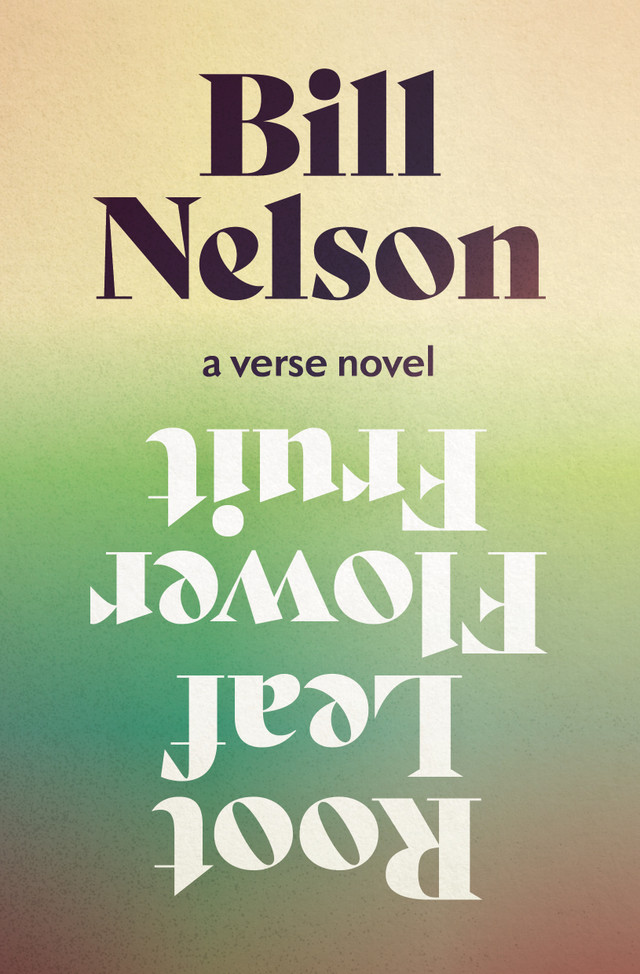
Bill Nelson is the author of Root Leaf Flower Fruit and Memorandum of Understanding (both published by Te Herenga Waka University Press). He lives in Te Whanganui-a-tara Wellington with his partner, two children and his dog, Callimachus Bruce.
My review of Root Leaf Flower Fruit (THWUP) Bill reads from collection
Kerrin P Sharpe
Who hasn’t returned to a poem or collection they’ve written to find it reads like someone else’s work? To find it exists because of you but in spite of you. To find it strangely aloof and self-contained. I have often felt like this so it was reassuring to read the late Louise Glück a wonderful writer, felt like this too. An article in The Guardian summed up her experience: When she did write, she had little sense it was hers. This is very familiar to me. Just as the world seems to vanish when I write, maybe the poem born of silence returns there and only wakes when it is read by someone. Perhaps that is why there are so many interpretations of a single poem. For me it also raises a second question especially after a collection of poetry has just been published and the flames of a launch die down. Can I still write? I guess the only solution is to grow that silence and begin again.
Kerrin P Sharpe has published five collections of poetry (all with Te Herenga Waka University Press, Wellington, NZ) the latest Hoof, published October 2023. She has also had poems published in a wide range of journals both in NZ and overseas including Oxford Poets 13 (Carcanet Press), Blackbox Manifold, Poetry (USA), berlin lit (Germany), PN Review and Stand (UK). She has also appeared in Best New Zealand Poemssix times, Best of Best New Zealand Poems and The Best of Sport 2005-2019. In 2021 she was awarded a Michael King Writers Centre Summer Residency.
It’s cheating I know, but one of the most impactful gigs of the year for me was Big Thief last December at the MFC in Wellington. December is a month that can belong to either year, I feel (it being my birthday month I’m going to make bold claims for its temporal fluidity!). This was a gig where the band to audience to band energy was palpable – I talked about this with my old teachers Damien Wilkens and Greg O’Brien at a launch early this year, and we agreed it was spectacular. The band seemed to love being there, and everyone in the audience was standing by the end of the gig. It felt exemplary of the give/take circle of energy that creative acts can be. My other favourite gigs of the year were Kevin Morby (I have dried the rose I caught!) and Ebony Lamb (both at Meow) – again the energy of both gigs was enlivening, and the musicians were on form and also seemed like thoroughly good people. Film-wise, try as I might I could not escape the Barbenheimer phenomenon – but its impact was only that it offered an accidental visual aesthetic parallel for my and Hannah Mettner’s double book launch. Launching with my dear friend was obviously a highlight of my year! Less happily, recent events have had me revisiting Emily Berry’s poem, ‘’Bad New Government’’, and James Brown’s ‘’The Wicked’’. I re-read these, as well as the poems of Tusiata Avia, Chris Tse, and many others in preparation for the ‘’poetics of rage’’ workshop at Verb (another highlight). To end on a high note, the poetry books by NZers that I’ve loved this year are too many to name, but some top picks are Leah Dodd’s Past Lives and Arihia Latham’s Birdspeak, I’m looking forward to and dreading the Ockham long list cos there are more books I wish would win than can be on that list. What an impossible task! Here’s to a 2024 of better news, and plenty of poetry.
Morgan Bachis from Te Whanganui-a-Tara. Her first book, Some of Us Eat the Seeds, was published by Te Herenga Waka University Press in 2015. With Hannah Mettner and Sugar Magnolia Wilson, she was an original editor and co-founder of the literary magazine Sweet Mammalian. Morgan had the privilege of judging the National Schools Poetry Award this year, and her second book, Middle Youth, was published in August 2023.
My review of Middle Youth (THWUP) Morgan reads from collection
DaniYourukova
I’ve read statistically fewer books than usual this year, but, in fairness, it takes longer to read thousand page alternate-historical wizard books than it does to read poetry, or highbrow erotic thrillers about lesbians poisoning each other. Anyway! I’ve recently been enjoying Damien Levi and Amber Esau’s Spoiled Fruit anthology, which contains an absolute feast of sticky-sweet, fresh queer poetry. I was lucky enough to be at the Wellington launch, which was such a gorgeous cacophony of queer joy. And! The proceedings opened with a suite of music from Cadence Chung as composer and fellow contributor Jackson McCarthy’s poetry as the lyrics, in a showcase of outrageous, multi-disciplinary talent.
Now that I think about it, a great deal of the poetry I’ve loved this year has had a particular relationship with music. It sings through The Artist by Ruby Solly, which really hollowed out a space in my chest cavity and built a house there, and also in Leah Dodd’s Past Lives, which takes the mundane specifics of the Wellington experiential landscape, and fills them with wonder, humour, tenderness and barely suppressed rage. Madison Godfrey’s Dress Rehearsals spans a personal history of mosh pits, pop hits and karaoke rooms, absolutely screaming with the sharp edges of queer desire. It also made me cry on a bus.
Claudia Jardine’s Biter has a music of its own, the music of translation, spaces, raspberries, silences and unopened blocks of cheese, and Selima Hill’s I May be Stupid but I’m Not That Stupid had me lying on the floor for about a week, with those perfect, sparse little jewels of poems. The Elective Mute sequence in particular kicked down the door to my childhood and set my Pokemon cards on fire. I also loved Shastra Deo’s The Exclusion Zone, for its haunted spaceship containment of post-apocalyptic video game trivia, and Alejandro Zambra’s absurd, playful and politically devastating Multiple Choice. I’ve probably already talked too much, but when thinking about texts that have moved me this year, I do also need to mention a video game called Book of Hours. If you’ve ever wanted to relocate to a remote Welsh island, befriend the local midwife, and spend the rest of your life cataloguing arcane texts which may or may not be cursed while hand-feeding feral creatures from the moors, we should probably be friends. It also probably helps if you enjoy making excel spreadsheets.
Dani Yourukova is a queer Wellington writer who completed their MA in creative writing at The International Institute of Modern Letters. Their poetry and essays have been published in places such as Starling, Sweet Mammalian, Bad Apple, takahē, Stasis, Turbine | Kapohau and The Spinoff. Their debut collection, Transposium, was published by Auckland University Press in October 2023.
I want to cram a paragraph full of books I loved this year, though it won’t be enough: Below by David Hill is an almost literally unputdownable novel for early teens; Audition by Pip Adam is like an avant garde symphony built from anger and kindness, it changed my brain, and has no shit inspired me as a writer; I can’t talk about Barbara Else’s memoir Laughing at the Dark without yelling (in a good way) because I loved it so much; The Observologist by Giselle Clarkson is wise, gentle and very funny and will make people of all ages care about nature; The Artist by Ruby Solly is like some kind of poetic gift from another plane, I felt honoured to be able to read it (I love her); The Hero of this Book by Elizabeth McCracken is the international novel that took the cake for me this year – if you like Elizabeth Strout but jokes as well, read this (it’s funnysad). I could go on. What a year. What a bloody year. Thank god for books.
Jane Arthur is a Pōneke-based writer and manager/co-owner of the country’s only Living Wage bookshop, GOOD BOOKS. Her first poetry collection, Craven (VUP), won the Jessie Mackay Prize for best first book at the 2020 Ockham NZ Book Awards. Her second collection, Calamities! (Te Herenga Waka University Press) was published in May 2023. She has a debut children’s novel, Brown Bird, due for publication in May 2024 with Puffin/Penguin Random House NZ.
My review of Calamiities! (THWUP) Jane reads from collection
Sue Wootton
Here, literally, is my postcard. It’s from Menton in the south of France. Because, how lucky I’ve been this year, finally able to take up the Katherine Mansfield Menton Fellowship as I was originally scheduled to do in 2020. And on the back of the postcard, here’s my scrawl:
Bonjour à toutes et à tous! Menton really is as pretty and colourful as this. The sky is cornflower blue and it only rains oranges and lemons. Swim, write, siesta, write, eat, drink, write. C’est la vie, mes amis ! Wish you were here ! À bientôt. Sue
Sue Wootton is currently in Menton, France, as the fiftieth New Zealand writer to hold the Katherine Mansfield Menton Fellowship. Sue is a poet, novelist, short story writer and essayist, and in her usual day job is the publisher at Otago University Press.
So many books that made my heart sing this year. Just when you think that nobody could write another book that engages every sense, along comes another. I’m not lighting on poems this Christmas, rather a poet’s novel. Fiona Farrell has written The Deck, (Vintage) and it’s not just so much my best novel from Aotearoa New Zealand this year, but the best I’ve read in an age.
A plague threatens the country, and a group of friends retreat to the countryside, seeking safety. There they tell stories, revisit their past lives, reveal old secrets. The style draws on that of Giovanni Boccacio’s 14th century The Decameron, and the form gives the characters (and Farrell, as their creator) the opportunity to consider the role of the storyteller.
Fiona Farrell and I often get confused for each other. People tell me they love my new book and start telling me all about it. Well, I say, I wish I had written that, but it wasn’t me, if was eff eff, which is what I call her in private correspondence . And I, of course, am eff to her. I think the extra eff makes a difference, a whole other bag of tricks that I’d love to get my hands on. But writing this about Fiona and her work has taken me back to her Selected poems, the beautifully produced Nouns, Verbsetc. (Otago University Press 2020). I hear echoes of Seamus Heaney, no surprise that she is one of a band of New Zealand writers descended from the Irish. Try this, it’s part of a poem called “Julia at Tai Tapu”:
The paddock too is clad in silk. Fine-grained, it falls as white as milk, Like rain it shimmers, falling over ryegrass, cocksfoot, sweet white clover. Swamp and rivers we’d thought dead rise, torchlit, clad in glittering thread. And, sibilant, high fountains play where Holsteins browse in naked day. Thanks eff eff
From ‘eff aka Fiona Kidman’
Fiona Kidman has been writing novels, poetry, fiction and essays for the past 60 years and the urge never really leaves her. Her last novel This Mortal Boy was awarded the Jann Medlicott Ockham Prize for Fiction, and other awards, including the Ngaio Marsh prize for best crime novel of 2019. Her work is published internationally. She lives in Wellington.
One book that utterly transported me this year was Thomas Halliday’s Otherlands. It’s a reverse history of the earth jumping back from 20,000 to 550 million years ago. Each chapter tours a complex, bristling and often bizarre ecosystem. I felt like a nineteenth-century reader encountering one of the blockbusters of early paleontology. Luckily, as this book revealed to me, the deep past is now much more than cabinet fossils and dinosaur bones. Otherlands is nature writing for places it’s only possible to visit ‘rockwise.’ Or science fiction where all the other planets are our own. Halliday writes so immersively and dynamically about even the smallest sponges or primitive trees, with real love and respect for their lifeworlds. He also throws in lovely Scottish words like ‘outwith’ (which I promptly stole for a poem). Apparently, I’m not the only one finding escapist fascination in the extinctions of the past, as we live through our own slow extinguishing. It’s a strange comfort to be reminded that life on this planet has been almost entirely wiped out, time and time again. Yet, somehow, it springs back.
Megan Kitching was born in Tāmaki Makarau Auckland and now lives in Ōtepoti Dunedin. She holds a PhD in English Literature from Queen Mary University, London, looking at the influence of the natural sciences on eighteenth-century poetry. Her poetry has appeared in many publications including The Frogmore Papers(UK), takahē, Poetry Aotearoa Yearbook, and Landfall. In 2021, she was the inaugural Caselberg Trust Elizabeth Brooke-Carr Emerging Writer Resident, and in 2023 she was runner up in the Caselberg International Poetry Prize. Her debut collection is At the Point of Seeing (Otago University Press, 2023).
My review of At the Point of Seeing (Otago University Press) Megan reads from collection
Louise Wallace
Photo of Poet Laureate Chris Tse, credit the Hawkes Bay Readers & Writers Trust
With a new book of my own poems out this year, it’s been really invigorating to get back into the live reading and festival scene (acknowledging my privilege to do so around health risks). Launching my book alongside Jane Arthur’s Calamities, at her very good bookshop Good Books in Wellington and the University Book Shop in Dunedin (for all your Christmas shopping needs), was super special. It was almost overwhelming seeing my pal Chris Tse officially take on the laureate mantle, bringing his trademark energy to events around the country, along with meeting and performing with so many talented creatives including Rushi Vyas and Nafanua Kersel. It was a privilege to host Jackson McCarthy and Xiaole Zhan in Ōtepoti | Dunedin as the Starling micro-residents for the New Zealand Young Writers Festival. And I loved the vibrant energy of this year’s Dunedin Writers & Readers Festival – Witi Ihimaera, Linda Tuhiwai Smith and Monty Soutar in conversation at Ōtākou Marae, as well as seeing my son’s creativity bubble over at a children’s session with Michaela Keeble and Tokerau Brown, based on their book Paku Manu Ariki Whakatakapōkai. Great news that DWRF have just released a podcast series of festival sessions, which you can listen to here. Ngā mihi!
Louise Wallace is the author of four poetry collections with Te Herenga Waka University Press, the most recent being This Is A Story About Your Mother, published earlier this year. She was the guest editor for Ōrongohau | Best New Zealand Poems 2022, and is the founder and editor of Starling, an online journal for young New Zealand writers.
My review of This Is a Story About Your Mother (THWUP) Louise reads from collection
Joan Fleming
Dear Pōneke,
I came back to you this year, and you seemed to be okay with it. I landed in February, right after Cyclone Gabrielle, and the air in Wellington was eerie and still. I couldn’t recognise the city without the wind. That was temporary. You gave me a job (temporary). You gave me the most pressurised teaching semester of my life (temporary). By April, you had coated my stored-away sandals in white aspergillis mould (temporary). I planted shade-tolerant wildflower seeds in August, and up they came by October (temporary). Some days I felt young (temporary). Some days I felt older.
In the book I’m writing, there’s a young woman who is trying to work out, among other things, just how much of her womanhood she should feel bad about. Since adolescence, she has been addicted to visiting the mirror, and every time the mirror reassures her of her distance from perfection. It is always telling her, Yes you are older, which is to say, that much closer to the world’s universal No. One night she dreams she is looking down at her belly and thighs, and she sees the flesh there terraced into geometric lines and curves. She feels herself being excavated and moved by machines, being recessed and recessing. And yet, she knows in the dream that there is far more of herself than the machines can excavate. They can never eat her up anything close to completely, because she is far, far older than them.
When she wakes up and tries to explain this feeling to her fiancé, he is confused. ‘And that felt good?’ he says, discomposed. ‘It felt good to be old?’
Pōneke, the best night of the year was the Peaches gig you hosted for us back at the end of summer. Peaches wobbled onto the stage at Meow on a zimmer frame, wearing nana glasses, fleshy nipple-stickers, fleshy nana undies, and a crown made of fleshy pantyhose fashioned into the shape of a vulva. Then, for the next two solid hours – the gig felt exquisitely, impossibly, fantastically long – she and her outfit set us on fire. She robed and disrobed. She thrashed, she rocked, she sweated, she jiggled and rippled and sang. She was unapologetic, brilliant, hilarious, and hot. At one point, she said, “I’m going to walk on you now,” then stepped out onto our hands and walked in the air.
A night like that gives one a certain profound kind of permission. In the book I’m writing, there’s a young woman who is trying to work out, among other things, just how much of womanhood she ought to set on fire.
Love always, Joan December, 2023
My review of Joan Fleming’s Song of Less (Cordite Books)
Speak the Mountain
for dear Banu
There is a mountain There is a river There is a lake
Hold the weeping child to heart Hold the thirsty and the wounded to heart Hold the dead and the fearful also to heart Hold the rubble home and the broken bones
We speak the mountain We speak the blood river We speak the grief lake
Marching peace Marching heart Marching out
There is a mountain There is a river There is a lake
Big Fat Brown Bitch, Tusiata Avia, Te Herenga Waka University Press, 2023
My niece and I are lost travellers
We have to find our way, we have to search our symbols
and pray to the marrow in our bones for our stories,
for our whakapapa. This is what I tell my niece.
from ‘Tualima’
Tusiata Avia’s new poetry collection, Big Fat Brown Bitch, steps off from a bonfire blaze of racism, hatred, ignorance, intolerance, the inability to cross and build bridges, to understand what it is like to be colonised, to be judged by the colour of your skin, the sound of your name.
The book begins with a news clipping outlining the ACT Party’s outrageous response to Tusiata’s play and poetry collection, The Savage Coloniser. The ensuing furore played out on social media, the radio, in print media, and generated a whiplash of toxicity, including death threats towards her, and importantly, a significant groundswell of loving support from our writing and reading communities.
Tusiata stands up in her poems, she stands up and speaks, speaking out from the scars and the wounds and the rage and her brown skin. Speaking out. Echoing out. Writing out of skin, blood, bones and heart of anger, hurt, resolve.
This is poetry of now. This is poetry so essentially, imperatively and heartbreakingly for NOW, at a time when the ACT Party and its picklehead leader are stoking racism, division, inequity, injustice, ignorance, intolerance through its abominable choices, goals and speeches – in collaboration with its Government coalition partners.
This is poetry for NOW.
Tusiata is a “sharp like an arrow” poet. She is a beloved poet, much lauded, multi-medalled, award-winning “Arts Laureate ,Distinguished Alumni” who “got a Fulbright, got off-Broadway, got that Ockham”. Take that Peters. Take that David. Take this write/right/rite of reply. Read this book and reSEE what freedom means. A word I can barely hold on my tongue it has become so stained with ignorance, so hijacked.
This is poetry searing in its music and its heat. Its heart and its strength. Its complexity, intricate layers, ranging subject matter, overlaps and undercurrents. This is NOW.
I am the Pākehā woman holding my pen and ink rendered mute in despairing at the Government and its resistance to the wellbeing of our planet, land and people, grieving at the insane inhumane catastrophic tragedy in Gaza. This is emptiness.
But Tusiata’s sublime poems are reminding me that poetry is both balm and resistance, both threaded needle and sharpened sword, both anchor and open fight/flight. It is personal and it is political. It is necessary for both reader and writer.
Here, hold my hand, bae, it’s OK cos poems: sometimes they like to make us feel
sometimes they like to flip the script and make us wonder: What would it be like if things were different? And some poems, they can make us ask: Why?
from ‘Hey, David’
The poems draw upon family whether grandmother, father, mother, daughter, sister, niece. It challenges colonialist dogma with wit and barb and necessity. The poems face, let’s say eyeball, the tough challenges of ongoing illness – headaches, epilepsy, osteoarthritis, crutches, wheelchair – and again, yes, this is NOW. This is the tilted health system, the inequity of yardsticks measurements treatment.
Here, too, is poetry that grieves and honours. A poem visits Al Noor, the poet-speaker, ‘part coloniser, part colonised’, enters with respect:
I went to Al Noor to remember. To say sorry with lilies, the flowers of death, white for peace, pink for the hearts stopped beating.
from ‘Diary of a death threat, 15 March 2023 (Anniversary)’
This is poetry that digs deep into self, self awareness, into the complicated constellations of self existence, wound, history, experience, that is knowable, unreachable, reachable, werewolf, heart-rattling, alive. Oh so alive. That is savage and soothing.
Throw me like a colour against a canvas or the footpath or an made bed or the eyes of a classroom or a New Zealand literary festival or a lunchtime crowd in a Wellington bookshop, throw me like a colour and see what happens.
from ‘Big Fat Brown Bitch 87: She feels most Samoan in a room full of white people’
Tusiata holds out her poetry as an offering and the poems are whispering and hollering, wailing and insisting: see me, name me, call me, feel me. And yes, this is poetry as big extraordinary embrace, as big warm fierce embrace from you Tusiata, from you, gorgeous woman, gorgeous big brown woman, whose pen is aroha, who is pen is resistance, whose pen is offering. This is poetry for NOW. I am breathing it in, listening to the storm outside, feeling the breath and tang and edge of words, feeling revived. And this matters. For many of us this matters. Thank you.
Tusiata Avia’s previous poetry collections are Wild Dogs Under My Skirt (2004; also staged as a theatre show), Bloodclot (2009), the Ockham-shortlisted Fale Aitu | Spirit House (2016), and the Ockham-award-winning The Savage Coloniser Book (2020). Tusiata has held the Fulbright Pacific Writer’s Fellowship at the University of Hawai‘i in 2005 and the Ursula Bethell Writer in Residence at University of Canterbury in 2010. She was the 2013 recipient of the Janet Frame Literary Trust Award, and in 2020 was appointed a Member of the New Zealand Order of Merit for services to poetry and the arts. In 2023 she was honoured with a Distinguished Alumni Award at Te Herenga Waka—Victoria University of Wellington.
Cover artwork: Tui Emma Gillies, tapa cloth with Woman on the Cross 2022AD. Website, Instagram
Luckily the wolf is inside when the bird comes to splash about in what has become a birdbath.
‘Peter and the Wolf’ was childhood. A bird, a boy, a wolf. Somewhere from deep in the forest the horns sounded warning.
Just like the song, the kookaburra sits in the old oak tree. Each morning begins with its long, wild laugh.
Jenny Bornholdt
Jenny Bornholdt has published 12 books of poems including two Selected Poems. Her most recent book is A Garden is a Long Time, a collaboration with photographic artist Annemarie Hopecross, published in 2023 by Te Herenga Waka University Press.
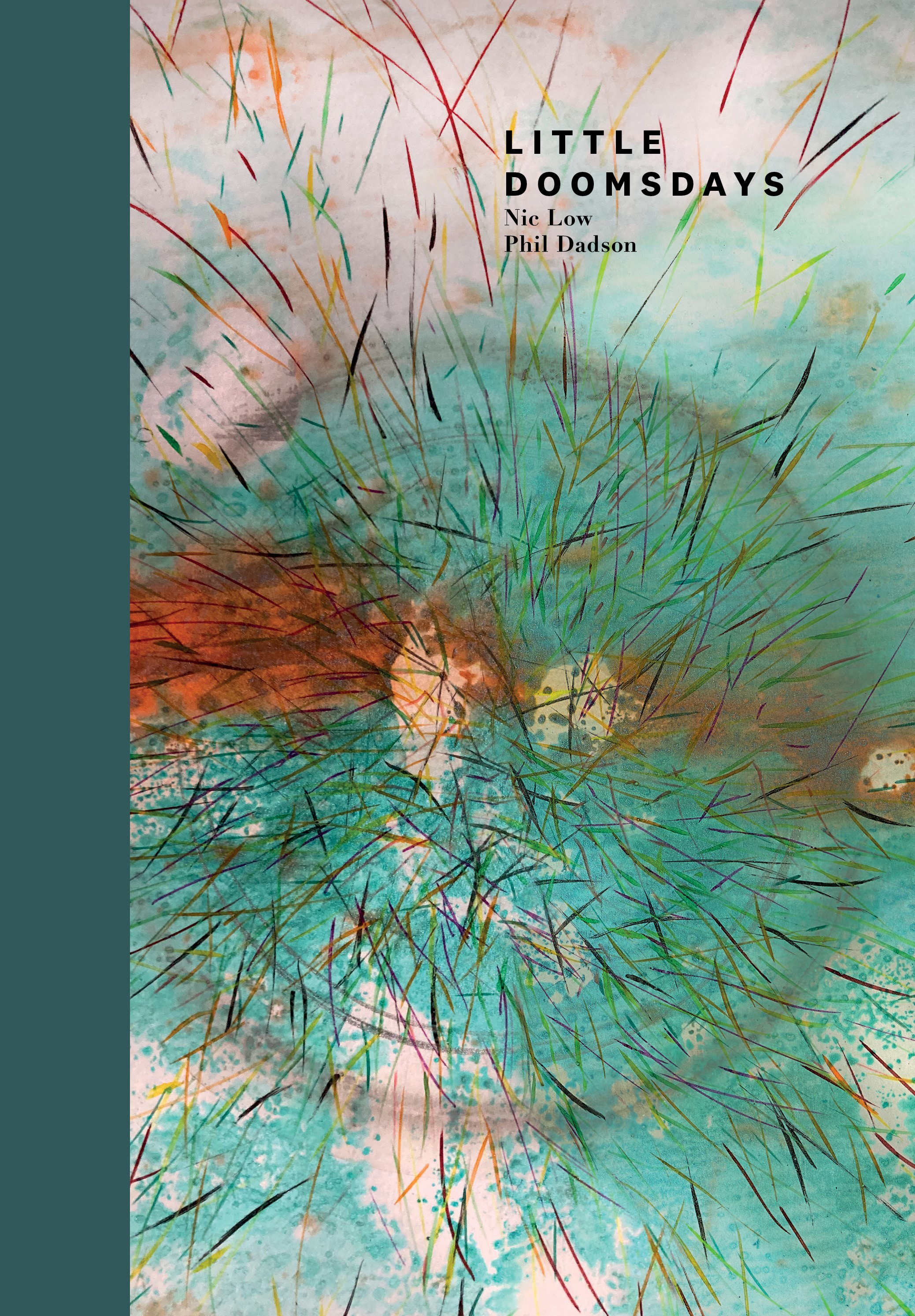
Little Doomsdays, Nic Lowe and Phil Dadson Massey University Press, 2023
We say they unloaded all conversations, all laughter, all debate, all questions, all ways of loving, all whakapapa, all jokes, all schools of thought, all kūmara and kūmara rites, all animosity, all arts, all star paths, all curiosity, all gods, all feuds, all karakia, all seeds, all tools, all methods of war, all rites of birth, all knowledges pertaining to thriving in an unknown land.
from ‘Entry DFLKJ0022110: First arrivals I, 11 –CE’
Little Doomsdays is a collaboration between Ngāi Tahu writer Nic Low and musician and painter Phil Dadson. These are the opening words:
It’s said — in the quiet between buses, down the back of the pub, in the hushed elevator rising to the penthouse — that in the late twentieth century an unstable grouping of scholars, writers and fanatics from several Ngāi Tahu hapū in Murihiku created what has come to be known as the Ark of Arks.
It’s said that this project aimed to catalogue all known arks from the last five millennia. It was a failed attempt to capture previous civilisations’ failed attempts to preserve whatever was valuable to them: waka huia, time capsules, caches, burial ships, seed banks.
This becomes threshold into what feels like a conference of arks, inside this ark that ark, inside that ark another, and as Nic suggests, the very book we hold becomes ark. I am holding a storehouse, an instruction manual, a travel guide. We are invited to examine, admire, lay our hands, not to believe everything people say. We might “dig down into the sediment of memory that is a city”.
We are in the vessel of preservation and it is a neighbourhood of truth, fragmentation, missing bits, disappearance, change. Across time and place. In this vessel, we will find seeds, things, knowledge, aroha, museums, hapu time capsules, seeds of language, cave paintings. We will hear “time is running out”. We will fall upon the possibility of germination.
Te ao Māori is the pulse, the vein, the energy force, the lifeline.
Little Doomsdays is the fifth collaboration between artist and writer in Lloyd Jones’ ongoing kōrero series, which again invites the reader to consider the sparking links between image and text. Both prompt a curiosity that is fuelled by enigma, movement, little explosions of metaphor, depth and distance. Ideas reverberate, along with a transcendence beyond ideas to a meditative state. I look at image, I read the text, I track the arcs between one and the other, and become entranced. Ark becomes arc with its sweet curve, electric or static, and arc becomes ark wherein preservation is as much a sequence of openings as it exists in the brine of making.
Phil’s artwork springs with textured possibilities: the earth veins that might be river tributaries that might be blood vessels that might be skeletal leaf that might be umbilical cord or relief map.
Nic’s writing is fluent and fluid, it is poetic and philosophical, mysterious and multilayered. You are pulled into alcoves of thought, deposited in archival pockets, gently placed in slip sleeves of imaginings.
And what of the title with it’s ominous “doomsday” reference? How to proceed from the threat of endings, of time running out, of mayhem and annihilation – just as we are witnessing doomsday-ish manifestations on our screens. Ah we keep travelling through the book. We reach the warmth of te pō. We are not alone. We reach the possibility of germination. We reach the exquisite explosion of tiny line and vibrant colour, hard to pin down semantics, below the skin pinpricks of feeling, we are feeling the world, with finger touch, within eye sight, within hearing. It is both dark and light, heat and chill. It is the impulse to move forward. This is what I feel.
Nic and Phil produced Little Doomsdays during the difficult and uncertain constraints in the time of Covid and were unable to meet in person. I have lingered over the book at a time when the inhumanity of Gaza is breaking our hearts and the societal and cultural debasements of the new Government cuts to the bone. The book has been a much needed retreat, a meditation aid, where to dream and drift, to grieve and to construct, is a salve. Beautifully produced, rich in connections, Little Doomsdays is a fine addition to a fine series.
Nic Low (Ngāi Tahu) is the partnerships editor at NZ Geographic magazine and the former programme director of WORD Christchurch.
Phil Dadson ONZM is a transdisciplinary artist, musician/composer and improviser, whose practice spans some 50 years.
In November I decided I would do my tiny bit towards the #ceasefirenow protest movement for Gaza by posting one poem by a Palestinian poet a day on my public Facebook wall. I’m introverted so I’m not a natural placard-waving protestor (although I admire those who do protest). Bearing daily witness, and inviting others to do so if they wished to, seemed like something I could do. Thank you to Paula Green for inviting me to choose five poems to repost here on NZ Poetry Shelf, meaning that the important things these poets have to say can reach a wider audience.
Kiri Piahana-Wong
The Poets
Khaled Juma
Khaled Juma is a Palestinian poet and writer of children’s books. He is a long-term resident of Gaza city and was born in Rafah.
Oh rascal children of Gaza. You who constantly disturbed me with your screams under my window. You who filled every morning with rush and chaos. You who broke my vase and stole the lonely flower on my balcony. Come back, and scream as you want and break all the vases. Steal all the flowers. Come back … just come back …
Mahmoud Darwish
Revered writer Mahmoud Darwish is regarded as Palestine’s national poet. He wrote of the anguish of dispossession and exile, and has been described as ‘an utterly necessary and unforgettable voice.’
From ‘Under Siege’ [extract] Translated by Marjolijn De Jager
***
You who stand in the doorway, come in, Drink Arabic coffee with us And you will sense that you are men like us You who stand in the doorways of houses Come out of our morningtimes, We shall feel reassured to be Men like you!
***
A woman told the cloud: cover my beloved For my clothing is drenched with his blood.
***
When the planes disappear, the white, white doves Fly off and wash the cheeks of heaven With unbound wings taking radiance back again, taking possession Of the ether and of play. Higher, higher still, the white, white doves Fly off. Ah, if only the sky Were real [a man passing between two bombs said to me].
***
Cypresses behind the soldiers, minarets protecting The sky from collapse. Behind the hedge of steel Soldiers piss — under the watchful eye of a tank — And the autumnal day ends its golden wandering in A street as wide as a church after Sunday mass…
***
If you are not rain, my love Be tree Sated with fertility, be tree If you are not tree, my love Be stone Saturated with humidity, be stone If you are not stone, my love Be moon In the dream of the beloved woman, be moon [So spoke a woman to her son at his funeral]
***
My friends are always preparing a farewell feast for me, A soothing grave in the shade of oak trees A marble epitaph of time And always I anticipate them at the funeral: Who then has died…who?
***
Writing is a puppy biting nothingness Writing wounds without a trace of blood.
***
Our cups of coffee. Birds green trees In the blue shade, the sun gambols from one wall To another like a gazelle The water in the clouds has the unlimited shape of what is left to us Of the sky. And other things of suspended memories Reveal that this morning is powerful and splendid, And that we are the guests of eternity.
Hiba Abu Nada
Hiba Abu Nada was a poet and novelist. Her novel ‘Oxygen is not for the dead’ won second place in the Sharjah Award for Arab Creativity in 2017. Hiba died on October 20th in an airstrike that hit her home in Khan Yunis in southern Gaza. She was 32 years old.
These are her last words posted online on 8th October:
Gaza’s night is dark apart from the glow of missiles, quiet apart from the sound of explosions, terrifying apart from the comfort of prayer, black apart from the light of the martyrs. Good night, Gaza.
Basma Al-Mashrawi
Basma Al-Mashrawi is a young poet and novelist.
Where to walk? All roads are paved with glass. Where to cry? all hearts are made of stone. where to go? All of the land is a ruin.
Sara Abou Rashed
Sara Abou Rashed is a Palestinian American poet and storyteller.
I’m Told I Have a Clear Sense of Purpose (Translation by the author)
There is no room in my house for uselessness. I have lost. Years ago, in ceramics class,
my friends shaped mud into asymmetrical statues, called them pure art, abstract decor.
I made dishes, a toothbrush holder, a jewellery box and its lid. Don’t blame me, even the screws
in my walls carry more weight than intended. On the internet, I found videos of my house
turned museum for what isn’t there. My old kitchen now a skeleton, bones stripped naked
of cement and copper wires. Still, I don’t curse the revolution, the war, the thieves or the regime; I curse only
myself—all these cracked tiles and the probable risk of death by electrocution for a day’s worth of bread.
Hoof, Kerrin P Sharpe, Te Herenga Waka University Press, 2023
the blackbird mistakes
the blackbird mistakes my blank page for snow his wings shadow my pencil
my hand becomes a beak my spine hollow bones and feathers of a blackbird’s hump
he peck-pecks the paper like rain sleet hail
I write tree he’s in the branches I write house he’s on the roof I write garden he’s found a worm
now the poem’s a blackbird’s watch-tower a waiting room so cold
his gizzard rattles the oldest song it should be snowing
when I write sky as quick as a full-stop he’s back in the world
his eyes white blades on the horizon
Kerrin P.Sharpe, from Hoof
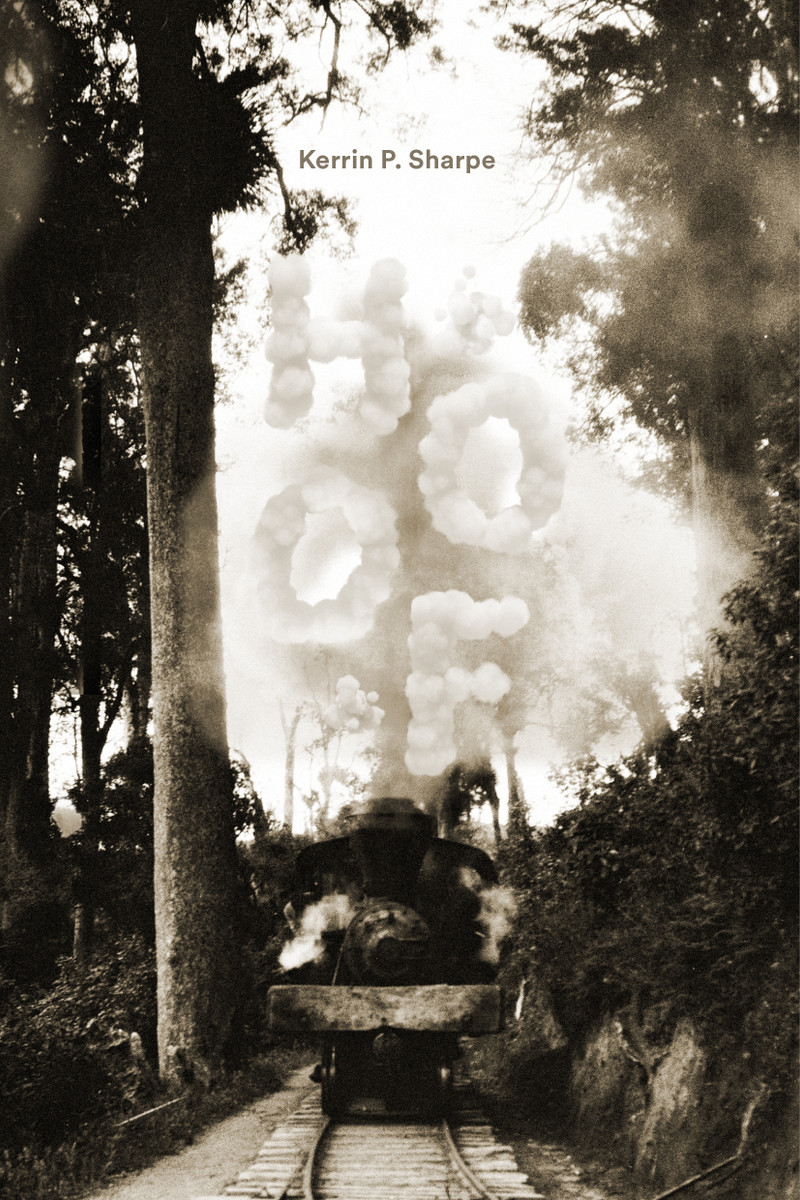
Kerrin P. Sharpe’s new collection, Hoof, is “an invitation to travel by train through the poet’s world”. What an appealing idea. There are three sections, like three legs of a journey, with each stage beginning with a dedicated train poem. These poems establish the rhythm of travel, the musicality of movement, the way a poem is a sequence of windows offering shifting views. Rhyme compounds like the sound of wheels on track. We are moving through place, memory, experience, and it is immensely satisfying.
I write the word “original” on my notepad. “Original”, a word that went out of fashion for awhile, a fugitive idea where everything we write resists what precedes, but I am embracing this notion, this sense of “original”. Embracing the multiple possibilities of the word, let’s say the meeting place of not-replica, free spirit, individual, authentic, fresh, origin-al. I am holding Kerrin’s collection of poetry and it is like seeing things for the first time. I was delighted to read the Lynley Edmeades endorsement on the back of the book: “One of the most original and idiosyncratic voices currently writing in New Zealand.”
Take the poem, ‘the blackbird mistakes’, such an original take on writing poetry, it makes my skin prick, my heart beat faster, there on the poetry tracks of travel. I got permission to include the whole poem so you can read it for yourself.
If I muse on the resonance of train journeys, I muse on the connecting beat, the sense of concatenation where an image taps gently against the next image, a rebounding echo that sustains, that might be motif or object or image or sound. In a cluster of poems, my eye moves from branch to forest to trunk to trees. Through the window, through the window, the rhythm pulling me along the poetry tracks.
What we see through Kerrin’s windows of travel is eclectic: Antarctica, the parent’s head stone, hospitals, brides, horses, ice, a penguin, sunlight, Ted Hughes, Rita Angus, Benedict Cumberbatch. Startling images, stillness, activity, presence, absence. What we fall upon, as happens for many travellers, is the fertility of the gap alongside the reward of the connection.
The mesmerising cover, designed by Spencer Levine, comprises photos by Roland Searle that are housed at Te Papa: North Island steam train, 1920s–1930s, North Island lake, 1920s–1930s, Wanganui River, 1920s to 1930s. Another rewarding way to approach the poetry.
Hoof is sublime; it is waking up in the lifting light of poetry, seeing through the windows, enhancing energy, advancing heart. I love this original collection so much.
Kerrin P. Sharpe is the author of four previous poetry collections, most recently Louder. Her poems have appeared in local and international literary journals including Landfall, Turbine | Kapohau, Poetry Aotearoa Yearbook, POETRY (US), Blackbox Manifold, PN Review and Stand. Her work has been anthologised in Best New Zealand Poems six times, Best of Best New Zealand Poems, Oxford Poets 2013, 150 Essential New Zealand Poems and A Game of Two Halves: The Best of Sport 2005–2019. In 2021 she held a writing residency at the Michael King Writers Centre.






 NZ Poetry Shelf