
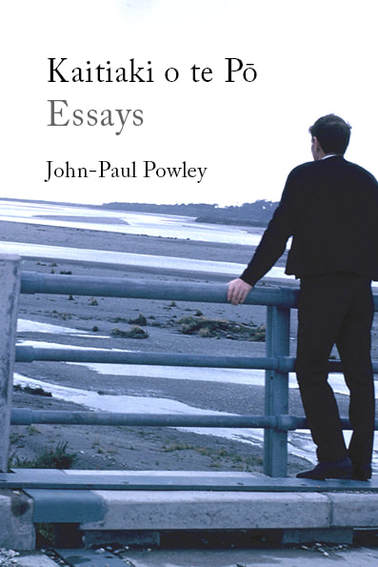
John-Paul Powley, Kaitiaki o te Pō: Essays, Seraph Press, 2018
John-Paul Powley writes with ease and grace in essays that present entwined threads. Simplicity and richness coexist as he reaches down into the truth (his truth) of his experience. This is what draws me into his collection: the need to explore the personal truth of both past and present. It feels utterly explorative, vulnerable, testing, mobile. It feels humble.
The opening essay resembles a reflective walk, a sequence of interconnected musings, particularly on grief. John-Paul is watching Brideshead Revisited, he is walking through the grounds of Victoria University on his way to a History Conference that starts off tediously with an Education Minister who speaks of herself rather than from an accumulation of listening and then, when Justice Joe Williams suggests the role of the historian is as kaitiaki o te pō (caretaker of the night), includes moments of epiphany. John-Paul is walking through the past as he walks to the conference, retrieving his younger self and more importantly a university friend who had recently died in London. The essay is a deft weave of experience, ideas and feelings: of moving with the past into the future, of processing loss and carrying that loss forward, of shifting the way he carries the dead within him. Reading the essay is akin to taking a walk. I stop by certain vistas and objects and let the embedded ideas reverberate. A plaque, for example, unnoticed by the young John-Paul, now resonates. An old oak tree had been axed by bureaucracy to make room for a single car park.
The second essay also drew me in to close attention as John-Paul navigated his masculinity, his femininity, his gender identity – however we might define such concepts and ways of being. The fact others thought he was gay when he was not gay challenged him as both child and adult. We travel through his school-boy choices that threaten to put him at the bottom of the social ladder. He loathed the misogynistic lyrics of Guns N Roses, he picked leg warmers as his favourite item of clothing and pictured a leg-warmer dance scene when the class sniggered at him, he fell in love with Marlon Brando and cried when Marlon died. He got to shave before his Y8 peers did and it felt like a badge of masculinity. He wondered when he would ever be at the arrival point of himself. When as an adult he became Dean, at the high school where he taught, he wanted to protect the bullied and ended up being called a ‘faggot’. The layerings of confession and experience are deeply affecting. John-Paul asserts this is not a coming-out essay – I see the essay as an opening up of gender experience that resists location within either/or.
If the essays are deeply personal they are also political. One essay considers why Anzac Day irks him: he pinpoints our blind spots (indifference? ignorance? need to ignore? to privilege white narratives?): the New Zealand wars and the Boer war in the claim ‘we’ lost our innocence in Gallipoli. The notion of noble sacrifice. The whole business of remembering ‘them’ when who exactly was ‘them’. The way remembering begins at WWI.
John-Paul teaches (or has taught) history and social studies and that occupation strongly influences the weave of writing. When he visits a beach and the adjacent town with his children, he reflects upon the grave of Parnell but he also reflects upon the graves of Te Puni and his family. The dampened down stories, in the master narratives, are drawn to the light. It feels so important to be reading these essays, to be acknowledging the unspeakable violence and theft and wrongs done to Māori, to be widening our view of history. It feels so right that his students will not be limited to a Pākehā-centric view of the past.
This book feels like part of our coming together; of the contemporary call to reconsider who and how we are at both a personal level and within our communities, both past and present. It is essential reading.
Seraph Press author page
Poets at ONEONESIX 116 Bank Street Whangārei Thursday 18 April, 5pm

Renowned Professor to judge $1000 poetry prize
International Writers’ Workshop NZ Inc (IWW) is delighted to announce that Professor Bryan Walpert, who teaches English and Creative Writing at Massey University in Auckland and was a co-judge of the 2019 Ockham New Zealand Book Awards Poetry Award, will judge The Kathleen Grattan Prize for a Sequence of Poems later this year.
The prize of $1000, which is made possible due to an ongoing bequest from the Jocelyn Grattan Charitable Trust, is for a cycle or sequence of unpublished poems that has a common link or theme.
This is the eleventh year IWW has had the honour of organising the Prize.
Previous winners are Heather Bauchop (2018), Janet Newman (2017), Michael Giacon (2016) Maris O’Rourke (2015), Julie Ryan (2014), Belinda Diepenheim (2013), James Norcliffe (2012), Jillian Sullivan (2011) Janet Charman and Rosetta Allan (joint winners 2010) and Alice Hooton (2009).
The Kathleen Grattan Prize for a Sequence of Poems is sometimes referred to as the ‘Little Grattan’ as the Jocelyn Grattan Charitable Trust also funds the biennial Kathleen Grattan Award, run by Landfall / Otago University Press.
The competition is free for IWW members to enter but it is very easy for aspiring poets and writers to join IWW to be eligible to enter their poetry into the Prize.
About the Judge
Professor Walpert is the author of three collections of poetry, Etymology (Cinnamon Press), A History of Glass (Stephen F. Austin State UP), and most recently Native Bird (Makaro Press); a collection of short fiction, Ephraim’s Eyes; and two scholarly books: Poetry and Mindfulness: Interruption to a Journey (Palgrave 2017) and Resistance to Science in Contemporary American Poetry (Routledge 2011).
His work has appeared in many countries and has been recognised by the Montreal International Poetry Award, the New Zealand International Poetry Competition and the James Wright Poetry Award (U.S.).
His website
Preparatory Workshop
Professor Walpert will conduct a workshop on Writing Poetry Sequences at IWW’s meeting venue, the Lindisfarne Room under St Aidans Church, 97 Onewa Road, Northcote, Auckland on Tuesday 21 May. Doors open at 10 am and the workshop runs from 10.30 am to 12.30 pm.
While the competition is restricted to IWW members, visitors are welcome to attend the workshop for a $10 visitor fee. Any visitor who attends the workshop and joins IWW by the third Tuesday in June will be eligible to enter The Kathleen Grattan Prize for a Sequence of Poems and will have the visitor fee deducted from their joining fee.
About the Competition and about IWW
The rules for the competition, details of how to join IWW, meeting times and other activities of the workshop, which meets on the first and third Tuesdays of the month from February to November and runs several competitions a year, are available from the IWW website: iww.co.nz.
Key Dates for The Kathleen Grattan Prize for a Sequence of Poems in 2019
21 May: Workshop with Professor Bryan Walpert on writing poetry sequences.
18 June: Last day for new members to join IWW to be eligible to enter this year’s Prize.
1 October: Closing date for entries.
19 November: Announcement of the 2019 winner of The Kathleen Grattan Prize for a Sequence of Poems.
Contact
For further information about the Prize or about IWW in general, contact Sue Courtney, email iww-writers@outlook.com or check out our website
The Capital of My Mother
My mother is born in the capital of Malaysia
her own umbilical cord tied to a deflating sun
In her country, the heat is wet
the air is heady
the sweat on my back is hereditary
I know no kin except blood tied to bone
my water body leaks red and diaspora yellow
my eyes are globes
Karl, my brother, is turning seven.
We sit in the muggy backyard of our grandparents
house in Kuala Lumpur
Kuala Lumpur means muddy confluence
The city is born from the place two rivers
merge then flow
I am the point two paths cross just to separate
byproduct of my parents’ relations
divorce impeding
my mother’s birthplace
They say all rivers flow to sea
I cannot find home except the sense
of somewhere I can’t reach
I am a migrant’s remembrance
I am a welcome party.
The kettle is boiling and it is time in slow motion
It is the noise of my grandma learning English
off my five years old cousin
Her R’s are a dysfunctional lawnmower
explaining wet season, sticky rice, banana leaf
Across the phone
in my privileged NZ accent
I talk about burgers, flat whites, fries with aioli.
We don’t speak the same language
but we do share the same ocean
when I say noodles she knows exactly what I mean.
Potluck is God doing dishes
Migration is the earth stirring flavour
Clepsydra is a clock that runs from dripping liquid
Its name means water thief
Across boats, migrants tell time by the second
and we call them thieves for different reasons
The first house I live in is a transported container
stolen body, claimed land, white heartbeat
Decades are tides that rock us to sleep
except landlocked I cannot dream
except I’ve a fear of the open sea
accept that you are dry land
still amniotic
barren
bleeding
I’ve worn ships not shoes since the minute
I was aware of my own unbound feet
Only a daughter’s daughter’s body
arriving to this space every century
The harbour is a welcome mat
for a new placenta
I spit in it
and let the land claim my whole front teeth
Vanessa Crofskey
Vanessa Crofskey is a poet and artist based in Tāmaki Makaurau. She was the Auckland Regional Slam Champion for 2017 and won Best Spoken Word / Storytelling at Auckland Fringe Festival that same year. Vanessa has written for multiple publications including Turbine | Kapohau, The Pantograph Punch, Starling, Hamster Mag, Hainamana, East Lit, SCUM Mag and Dear Journal. She tends to write about water, intimacy and violence.
This year Kraków will host four exceptional writers. The artists from Great Britain, Australia, and New Zealand will come to Kraków for monthly or two-month residences!
In May Kraków will welcome Georgina Wilding from Nottigham, Creative Director of Nottingham Poetry Festival, as well as being the Founding Editor of Mud Press, and Nottingham’s first young poet laureate. She has performed her poetry both nationally and internationally, and writes to commission for organisations such as BBC Radio Nottingham and the Royal Shakespeare Society. She has been published in journals such as “The Rialto”, and teaches poetry and performance across the midlands. Georgina will stay in Kraków until the end of June.
Koraly Dimitriadis form Melbourne will join us in June. Koraly is a Cypriot-Australian writer, actor, and the author of the poetry books Just Give Me The Pills and Love and F—k Poems. The latter is a bestseller for the poetry genre in Australia, and has had rights sold into Europe. Her two books form the basis of her poetic play “I say the wrong things all the time” which premiered in Melbourne’s renowned La Mama Theatre. Koraly is currently developing her debut novel, Divided Island, a love story set in Melbourne and Cyprus that explores how our upbringing effects who we love and how we love. She writes opinion for the Australian media and has been published in The Independent(UK) and The Washington Post internationally. Much of Koraly’s work is to do with cultural and religious repression. She is also working on a non-fiction book called Not Till You’re Married
In autumn, we will welcome two more residents. Liz Breslin and Nadia Bailey will spend two months (September and October) in our city of literature.
Living in Dunedin Liz Breslin writes plays, poems, stories and a fortnightly column, Thinking Allowed, for the “Otago Daily Times”. Her poetry collection, Alzheimer’s and a spoon (Otago University Press), was listed as one of The NZ Listener’s Top 100 Books of 2017. At home on the page and on the stage, Liz’s recent performances include ‘Love in a time of netball’ at the sold-out Wanaka season of Tall Tales and True, and the back end of Jill the Cow for her 2018 pantomime, Jac and the Beansprouts.
Nadia Bailey is an author, journalist and critic. She has published three non-fiction books on popular culture with Smith Street Books, and her short fiction, poetry and creative non-fiction has been widely represented in journals and independent presses. She was awarded highly commended in the 2017 OutStanding Queer Short Story Award, first place in the 2014 Adrien Abbott Poetry Prize among others. Her work has appeared in “The Lifted Brow”, “Cordite”, “The Australian and The Age/SMH”. She holds a Masters Degree in Creative Writing. She lives in Melbourne, Australia.
The residents will stay in the guest rooms of Villa Decius, project co-organizer. During their stays, you will have a chance to get to know them better at festivals, author’s meetings and other literary events.
The Krakow UNESCO City of Literature Residency Program is dedicated to writers from the Cities of Literature of the UNESCO Creative Cities Network. It aims to provide writers with a platform to showcase their work and talent to a Central European audience, support greater diversity of voices and literatures on the Polish and Central European book market and offer local writers the chance to create links with international writers as well.
I am excited right now about the collectivity of writing poetry; how poems draw from poems. In 2016, soon after arriving in Edinburgh, I was invited to join a collective of women writers who had come together at the request of the Cooper Gallery in Dundee to respond to their exhibition about a 70s collective art movement called the Feministo Postal Art Event. The Postal Art Event began with two artists – Sally Gollop and Kate Walker. When Sally moved away from South London where she and Kate were neighbours to another part of the UK, both women missed sharing their art so began posting small artworks to each other. Other women artists heard of and picked up this idea and in homes across cities, towns and villages in the UK women made, posted and received art and generated a community of artists. We echoed the Feministo Postal Art Event’s process in a 21st Century way, by writing and responding to each other’s work via a shared Google document.
Our collective is called 12. There are twelve of us, we are Edinburgh-based, and we have continued to write and respond to each other’s poems via a shared Google document for more than two years. We sometimes perform our work, and have been asked to respond to several art exhibitions, most recently to Emma Hart’s Banger at the Fruitmarket Gallery in Edinburgh. We are finding that the poems we write for 12 are a bit different to the poems we write outside of that particular circle of response. Why? I’m not sure, but there’s something about being honest about writing from community. About calling our lone selves in from the hills. The collectivity of making is front and centre; no one is pretending otherwise.
Lynn Davidson
Lynn Davidson is a New Zealand writer living in Edinburgh. Her latest poetry collection Islander is published by Shearsman Books and Victoria University Press (out this month). Lynn teaches creative writing, works in Edinburgh libraries and is a member of 12, a feminist poetry collective.

Helen Rickerby ‘How to live through this’ from How to Live (Auckland University Press, due August 2019)
Helen Rickerby has published four books of poetry, most recently Cinema (Mākaro 2014), and her next one, How to Live, will be published by Auckland University Press in August. She’s interested the elastic boundaries of what poetry can encompass, and has become especially obsessed with what happens when poetry and the essay meet and merge. She lives in Wellington, runs boutique publishing company Seraph Press, and works a day job as an editor.
This looks amazing – some great writers as tutors – and I bet some great food! You can register here.


Sound Check
you sound just like that woman, what’s her name
she sings that one about the train
check one two one two check check
ka tangi te tītī tieke one two
she sings that one about the train
can I get another tui over here
ka tangi te tītī tieke one two
my secret love’s no secret any more
can I get another tui over here
at last my heart’s an open door
my secret love’s no secret any more
that sounds choice love what a voice
at last my heart’s an open door
you got a voice on you alright
that sounds choice love what a voice
you know the crowd’s gunna soak up the highs
you got a voice on you alright
had a bit of a band myself back in the day
you know the crowd’s gunna soak up the highs
i’d up the tops if I was you ay
had a bit of a band myself back in the day
check one two one two check check
i’d up the tops if I was you ay
you sound just like that woman, what’s her name
Hinemoana Baker from mātuhi / needle (Victoria University Press, 2004)
From Bill Nelson: Sometime in 2009 I heard Hinemoana Baker read ‘Sound Check’ and it has stuck in my mind ever since. I think the reading might even have taken place on a mid-range PA system in a dingy carpeted room, some people laughing in the next room. Although I could be retrofitting that memory and it was in Unity Books or something. Anyway, at the time I noticed the outstanding music in the poem, and then wit and humour, and finally, the way the drama escalated as it continued.
Unusually, the poem is entirely in dialogue. A man is speaking to a woman who is trying to do a soundcheck and sings bits and pieces into a microphone. There’s no other description of the room, or the man, or the woman, or any other sounds. And yet through the poem’s pitch perfect choice of dialogue, the man is conjured up before us. A man we’ve probably all met. A pissed bloke in a pub, who likes to talk shit, knows a little bit about everything, probably from some other generation. He leans with his elbow propped on a tall felt-covered loudspeaker at one side of the stage, a beer in other hand, maybe a cigarette too. By contrast, the woman in the poem is a collection of song fragments and meaningless numbers, and it’s harder to picture her clearly. We know little about her, other than she seems like an incredibly professional musician, with a grasp of te reo Māori and a penchant for love songs.
You don’t have to try very hard to hear the music. It’s a pantoum, so there’s the repetition of course, but also the rhymes are particularly great and bang home like a drum, and there are bits of song lyrics that are italicized like they are meant to be sung. The complexity of the staccato sound check syllables juxtaposed with the rambley-bloke language of the man speaking is also really interesting and ramps up the conflict. Different people and different rhythms, looping in and out and over each other. It’s the kind of poem that is always going to be read out loud.
Pantoums are great at showing how context is important for language, how one line put against another can change it’s meaning entirely, or more accurately, provide two equally true meanings. The poem starts and ends on the same line said by the man, ‘you sound like that woman, what’s her name.’ And what seemed like an innocent enough question at the beginning, a bit idiotic perhaps but friendly enough, becomes patronising and infuriating by the time we get to the end. We cringe as he says it a final time, after a string of condescending comments and feeble compliments. He’s sounding more drunk, unable to remember what he already said two minutes ago, and I imagine him wandering off to the urinal, a poster of the gig that night right in front of his face. And he stands there with one hand propped against the wall, squinting his eyes, still unable to remember her name.
Bill Nelson’s first book of poetry, Memorandum of Understanding, was published by VUP. He is a co-editor at Up Country: A Journal for the NZ Outdoors and his work has appeared in journals, dance performances and on billboards. He is currently living in France. You can find more about him here at billmainlandnelson.com.
Hinemoana Baker of Ngāti Tahu, Ngāti Raukawa, Ngāti Toa and Te Āti Awa along with English and Bavarian heritage, is a poet, musician and playwright currently living in Berlin. She was the 2009 Arts Queensland Poet in Residence, a writer in residence at the University of Iowa International Writing Programme (2010), Victoria University Writer in Residence (2014) and held the Creative New Zealand Berlin Writer’s Residency (2015–16). She has published three poetry collections and several CDs of sonic poems. Hinemoana’s website.
 NZ Poetry Shelf