Poetry Shelf noticeboard: Faith Wilson reviews Tayi Tibble at The Spin Off

This is brilliant! Check out Faith Wilson’s review here.

‘As I drank every word of Rangikura, then back to Poūkangatus then back to Rangikura again, I felt myself defrost. Yes, poetry can be fucking good, can be genius even. That this enigmatic kid from Porirua, this Māori Mona Lisa, was out here, walking over the words of the dead white poets in stiletto heels and dripping gold, was doing her own kanikani, the one only she knows, evolved from ancestral blessedness, showing the world, showing me, showing you, how it’s done.’


Poetry Shelf noticeboard: NZSA Peter & Dianne Beatson Fellowship

Annual award of $10,000 – open now with deadline of 20 August 2021

Open to writers of fiction, non-fiction, poetry and drama who are currently working on a new project.

pohutukawa

Opens for applications between June and August in any given year 

Applicants must be members of the NZ Society of Authors. More information below, or email the national office.

Peter & Dianne Beatson Fellowship information

Peter & Dianne Beatson Fellowship 2021 Application form

Poetry Shelf celebrates new books: Iona Winters reads from Gaps in the Light

Gaps in the Light, Iona Winter, Ad Hoc Fiction, 2021

Iona Winter reads ‘Gregorian’

Iona Winter (Waitaha/Kāi Tahu) lives in Ōtepoti Dunedin. Her hybrid work is widely published and anthologised in literary journals internationally. Iona creates work to be performed, relishing cross-modality collaboration, and holds a Master of Creative Writing. She has authored three collections, Gaps in the Light (2021), Te Hau Kāika (2019), and then the wind came (2018). Skilled at giving voice to difficult topics, she often draws on her deep connection to land, place and whenua.

Ad Hoc Fiction page

Poetry Shelf noticeboard: 2021Kathleen Grattan Prize announcement

2021 Kathleen Grattan Prize announcement

International Writers’ Workshop NZ Inc (IWW) is delighted to announce that renowned New Zealand poet Vana Manasiadis, will judge The Kathleen Grattan Prize for a Sequence of Poems later this year. The official announcement was made at IWW’s annual Mid-Winter lunch in Northcote yesterday.

Vana Manasiadis is a New Zealand-Greek writer, translator and creative writing teacher whose collection of poetry The Grief Almanac: A Sequel was launched in May 2019. Along with Behrouz Boochani Vana is a 2021 Ursula Bethell Writer-in-Residence at Te Whare Wānaga o Waitaha Canterbury University.

The prize of $1,000 – which is made possible due to an ongoing bequest from the Jocelyn Grattan Charitable Trust – is for a cycle or sequence of unpublished poems that has a common link or theme. This is the thirteenth year IWW has had the honour of organising the Prize.

In 2020, the prize was won by Wanaka poet Liz Breslin for her sequence titled: In Bed with the Feminists.  

The competition is free for IWW members to enter.  It is very easy for aspiring poets and writers to join IWW to be eligible to enter their poetry in the competition.

Previous winners over the past few years include: Liz Breslin (2020) Siobhan Harvey (2019) Heather Bauchop (2018), Janet Newman (2017), Michael Giacon (2016) Maris O’Rourke (2015) and Julie Ryan (2014.)

Manasiadis said: “The prize is so important to the country’s literary landscape, and I am very honoured to be judging this year’s competition. I can’t wait to spend time with the talents of the 2021 entries – and I hope there will be many of them!”

President of IWW, Duncan Perkinson said: “As a writing group, we are proud to organise The Kathleen Grattan Prize for a Sequence of Poems and we are thrilled to have Vana judge this year’s competition. Both of the two previous winners (Liz Breslin in 2020 and Siobhan Harvey in 2019) have used the prize as a springboard to launch their books – In Bed with the Feminists and Ghosts – with both having been released in the past couple of months.”

About the Judge

Born in Te Whanganui-a-Tara Wellington, Vana Manasiadis has been moving between Aotearoa New Zealand and Europe the last 25 years. Her poetry experiments with hybridity and code-switching and has been translated into Greek and Italian, and she has edited and translated from the Greek for Shipwrecks/Shelters, a selection of contemporary Greek poetry. In 2018 she co-edited Tātai Whetū: Seven Māori Women Poets in Translation with Maraea Rakuraku.


Preparatory Workshop

As well as judging the competition, Manasiadis will conduct a workshop on Writing Poetry at IWW’s meeting venue, the Lindisfarne Room at St Aidan’s Church, 97 Onewa Road, Northcote, Auckland on Tuesday August 17th. Doors open at 10 am and the workshop runs from 10.30 am to 12.30 pm. While visitors are welcome to attend the workshop for a $10 visitor fee, potential entrants must have joined IWW before July 20th in order to enter the competition.

About the Competition and about IWW

The rules for the competition, details of how to join IWW, meeting times and other activities of the workshop, which meets on the first and third Tuesdays of the month from February to November and runs several competitions a year, are available from the IWW website: iww.co.nz.

Key Dates for The Kathleen Grattan Prize for a Sequence of Poems in 2021

20 July: Last day for new members to join IWW to be eligible to enter this year’s Prize.

17 August: Workshop with Vana Manasiadis on writing poetry.

5 October: Closing date for entries.

16 November: Announcement of the 2021 winner of The Kathleen Grattan Prize for a Sequence of Poems.

Contact

For further information about the Prize or about IWW, contact Duncan Perkinson, email iww-writers@outlook.com or check out the website

Poetry Shelf review: Shari Kocher’s Foxstruck and Other Collisions

Foxstruck and Other Collisions, Shari Kocher, Puncher & Wattman, 2020

The cover of Foxstruck and Other Collisions reminded me of an astral vista (my partner said a Rothko painting not knowing there’s a Rothko poem inside!), but the image is in fact Kate van der Drift’s artwork, a camera-less photograph. She buried large format sheet film in the Piako river between the ebb and flow of low and high tides. What looks like a stellar view is the alchemy of pollution and nutrient by-products of intensive farming. Enter a poetry book and already nothing can be taken for granted. The title Foxstruck and other Collisions is equally fascinating. Enigmatic but rich in possibility.

Shari Kocher’s collection is a sumptuous read. It is structured in seven sections moving from the weight of lead, through the practicality of tin and iron, and the preciousness of gold, copper and silver, to the liquid toxicity of mercury. I am no alchemist but each element feels prismatic with poetic connections, shifting perceptions, uses, misuses. What bridges will form between one element and the other? Would I gain more from reading, if I were an elemental whizz? How will the elements interact with the properties of a poem? The properties of an element with a poem’s movement? All this musing and I am on full alert.

Here I am entering an alchemy maze and all I can think about is fabric as I read. I am always suspicious of academic criticism that stretches a poem to fit a premise or theory, but I am (no way an academic critic) falling upon words, phrases, ideas, details, motifs that give my approach zing. Let me be clear: a poetry book will always offer myriad pathways, frames, devices that refract, reflect, dissolve, connect. I guess I always want to put my finger upon a poem and discover its pulse.

Why fabric? Shari’s poems resemble brocade (full of sheen and intricacy), the rustling texture of silk, hard-wearing everyday denim and the coolness of cotton against skin. Glorious! There are weaves and tucks and fasteners and stitching. I am thinking of the loom behind the line, the handwork and the handiwork, and never forgetting the heartwork. I am thinking of threads and buttons and agile sewing needles. Because this poetry is rich in craft and artistry. The visual matters as much as the aural. Motifs glint. Story is intricate thread.

The collection has been slow in the making, composed over five years, and walked into being as much as written. In her endnote, Shari shares the question that might well have been there from the start: ‘In light of this task set before me, which I take as the task to love, how am I to live?’ Each poem came to life on foot, a rule set by the poet, with the walking rhythms nurturing first seeds through the many drafts.

Take any poem and the rewards are numerous. I particularly love ‘Fritter the Fat Then Fry It’. The fabric of the poem is intricate with sound and image. The poem brings to mind a feminist folktale that will bite your ankles as you walk. Corpse, Narrator and Belovèd speak, with overlapping voices, sharp stitching. Here is the opening of the poem, the Narrator speaks:

Once upon a time a house

all the modcons, etcetera but she flits

vagrant as a dandelion’s flimsy puff

blowing about in a yard

empty of air and light a hole

shucked to the floor like a skin

all that space shut-up

the chimney sealed

against birds

smoke and one

homeless soul

chewing her finger

nail outside the door slipped

sideways into maternity

ward of the state where she once laboured

abandoned to her fate under the weight

of sixteen generations of women

who lived to be fed to the dogs

day after day without complaint.

The soundtrack of the collection is sublime: words loop and repeat, with rhyme, with connecting vowels and consonants heightening the music. Such rich delight in the ear. This from ‘Girl in the Mirror’, a poem dedicated to poet Joan Fleming:

sound of her gentling

mind on me each plate

washed as if to placate

the place I’d become (from)

the shower wiped free

just sketch she said just

sketch what you see

the grain of the wood

on the windy deck the scab

on the knob of your knee

Expect restraint and exuberance. Expect rawness and polish. Expect lutes and ladders, saltspray and violins. Expect rose oil and valleys, kitchens and throats. Cosmic glitter. Questions. Breath. An alphabet unskinned. A grounding in land. The natural world with all its challenges and beauty. As Joan Flemming says on the back of the book, ‘This is dazzling poetry.’

I am just hoping my little piece will connect with readers who want to track the book down and read it for themselves, because yes this book dazzles in its love of language, its love of life, its joy in discovery.

Shari Kocher is a poet, creative writer, thinker and therapist. Foxstruck and Other Collisions (Puncher & Wattmann, 2021) is her second poetry collection, following The Non-Sequitur of Snow (Puncher & Wattmann 2015), which was shortlisted for the Anne Elder Award. Recent accolades include The Peter Steele Poetry Prize (2020), The Venie Holmgren Environmental Poetry Award (2018), and The University of Canberra Health Poetry Prize (2016). Shari holds MA and Doctorate degrees from Melbourne University, and works in a supervisory and remedial capacity.

Puncher & Wattman page

Shari Kocher’s website

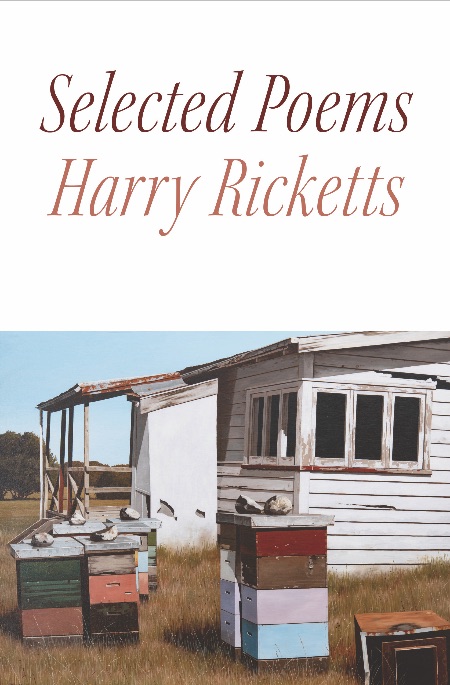
Poetry Shelf noticeboard: Harry Ricketts launches Selected Poems

You are warmly invited to the launch of 

Selected Poems
by Harry Ricketts

at Unity Books, Wellington
on Wednesday 23 June, 6pm

Harry will be joined by special guests for poetry readings

All welcome.

Poetry Shelf Monday Poem: James Brown’s ‘Their Feelings’

Their Feelings


Their feelings are like a mosquito sliding
its proboscis into a freckle. Their feelings are like
light through blinds in an 80s music video.
Their feelings are like techno under aurora in Norway.
Their feelings are like swimming in sunlit sea and
seeing a shadow. Their feelings are like when they’ve
taken bath salts that turn out to be bath salts, and they
end up in A&E and their mothers have flown in from
Hamilton and are holding their hands and crying, but
all they can think about is how their lives have become a
TV hospital soap which they could have been written out of
or out of which they could have been written.
Their feelings are like a Mindful Self Compassion course
when someone asks where the hyphen goes in the title
and the convenor says ‘Anywhere’ and the person says
‘I don’t think this is what I am looking for.’

James Brown

James Brown’s Selected Poems was published by VUP in 2020. He is working on a new book.

Poetry Shelf noticeboard: Alison Glenny and Liz Breslin Wellington poetry launch

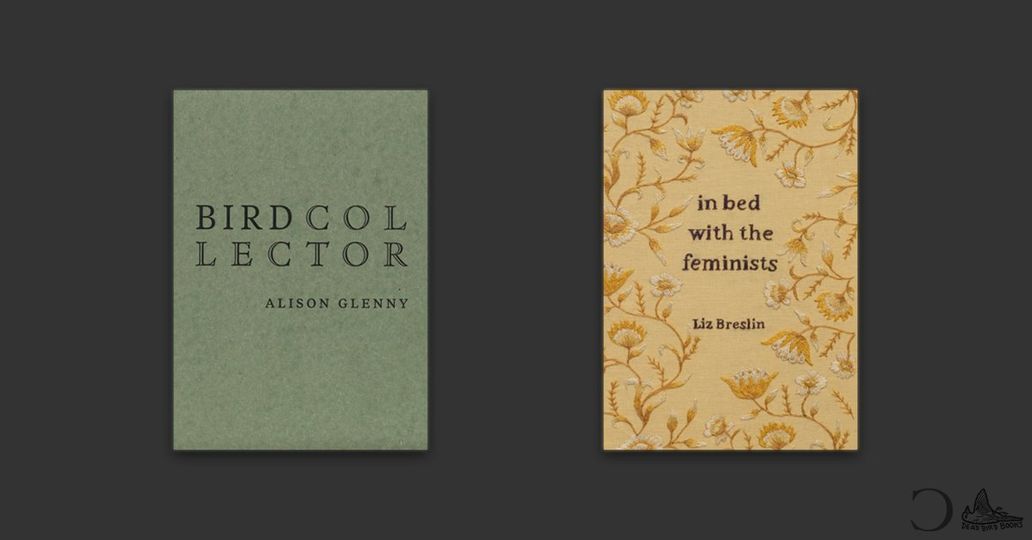
Compound Press and Dead Bird Books present: Alison Glenny – Bird Collector
Liz Breslin – In Bed with the Feminists. A double book launch for two very different works by comrades in writing. Please join us for some refreshing words and wordy refreshments.