Category Archives: Uncategorized

Friday Poem: Anna Jackson’s ‘To my hen-flock’ –the hen is a transcendental stepping stone

SAM_0467 (2)


To my hen-flock

Blithe they are, but spirits?

Birds they hardly are,

calling not in lyrics,

but with prosaic care

to put on record every moment’s find or fear,


grounded throughout, perching

awkwardly at evening

on their roosts, and lurching

squawking, wings wild-beating,

as soon as morning breaks, back to the earth’s receiving.


Far from here, the sky is

no threat, not forbidding

but no temptation either;

like the softest wing

of a mother hen it holds itself above them, brooding,


keeping all below it

close.   Not for my birds

the rapture of a poet

by the sublime stirred

to reach beyond the mundane to put into words


thoughts beyond his thoughts,

song beyond his song;

sweetly from their throats

my hens cluck all day long

about the smaller pleasures that to them belong.


Should the world not listen

nothing would be lost,

still the earthworm glistens,

still flies by the moth,

and to the hen beside her each hen murmurs as they roost;


should the world not listen

I will still be soothed,

learning some small lesson

best put into prose,

that beauty’s not the only thing that counts as truth.


Author bio: Anna Jackson is a poet, essayist, and fiction and academic writer. She teaches in the English Department at Victoria University. Author of five collections, her most recent volume of poetry, Thicket (Auckland University Press), was shortlisted for the New Zealand Post Book Awards in 2012.

Note from Anna: This ode to a hen-flock is a response to Shelley’s ode, “To a Sky-lark,” which begins

Hail to thee, blithe Spirit!

Bird though never wert –

That from Heaven or near it

Pourest thy full heart

In profuse strains of unpremeditated art.

It is a poem that again and again seems to me poised on the brink of silliness – “bird thou never wert”? – and yet every stanza lifts and falls its way towards the wonderful out-pouring of its last, long, alexandrine line in a way that I find beautiful. So when my friend Sonia Johnson, whose year-long project “A Formal Year” involves writing a poem in a different form every week, took on the challenge to write a poem using the alexandrine, I thought I would try writing in Shelley’s metre.

I have four hens I am very fond of, and I thought it would be funny to see what happened if Shelley’s beautiful verse form were used to write about hens rather than a skylark. The skylark becomes, in Shelley’s poem, a symbol for the poetic ambition to transcend the self in song, to give the self over to the creation of beauty, and yet, paradoxically, through doing so, to make a name for oneself forever, so that “the world should listen then, as I should listen now.” In contrast, an ode to hens can only celebrate more mundane, more humble pleasures – prose not poetry, ordinary conversation (or clucking) not elevated song, a grounded aesthetic not the soaring transcendence of the lark.

Here is a link to Shelley’s poem: http://www.poetryfoundation.org/poem/174413

And here is a link to Sonia Johnson’s project blog: http://aformalyear.wordpress.com/


Note from Paula: My eye first took in the visual flitter of lines on the page, scanning to and fro, before settling in to the words themselves. Shelley’s alexandrine form gives an other-worldly pitch for the ear, syntactical choices that mark a time elsewhere. That is one lure. Then there is the way you are drawn into an intimate space (the poem itself, and that of the hens in the backyard). The form’s regularity, that delicious metrical pattern, sings the regularity of day in day out, of the routine of hens. On the one hand, this is a celebration (the joy) of the mundane, of daily business but the hen is also a transcendental stepping stone to poetic musings. And then. And then it is the hen in all its beauty (a hen is a hen is a hen). The poem is replete with aural lures (moth/lost; birds/ stirred) and the lure of tropes (the sky likened to the wing of a mother hen). Above all, it is a poem of terrific movement– aurally, visually, linguistically, philosophically and temporally (pulling Shelley into a contemporary backyard). The poem is a work of beauty.


NZ Book Council author page

AUP page

Poetry Archive page

Arts on Sunday interview
The Book Show is 97 per cent there in its hunt for funding via Boosted!

The Book Show is 97 per cent there in its hunt for funding via Boosted!  This is wonderful news for Graham Beattie and Carole Beu, but they still need that 3 per cent to make it.

From Boosted:

Calling all book lovers!

Face TV, working with two of this country’s most well-known book people, wants to respond to audience demand; and produce & screen a weekly TV show.  Called simply THE BOOK SHOW, it will be written and presented by Graham Beattie and Carole Beu.

Graham Beattie has the most widely read book blog in NZ and beyond; and Carole Beu runs the highly successful Women’s Bookshop in Ponsonby – and also beyond!

Both of them are chatty and charming and amazingly informed about the written word – whether it’s in print or on your Kindle or Kobo.

Each week the programme will feature author interviews, reviews and great reads from both NZ contributors and visiting international book people.

Face Television (formerly Triangle TV) is Sky’s non-profit public media contribution and started broadcasting early this year – filling a gap in the media landscape and allowing independent programme makers and communities the opportunity to create and broadcast content nationwide.

THE BOOK SHOW will be screened weekly on Face TV – prime time with a daytime repeat; as well as being made available online.

Because Face TV is a non-profit television service we are able to produce a 12 part series for $6,000 and we’re looking for donations to fund this.

a school library that enchanted me

?????????????????????????????

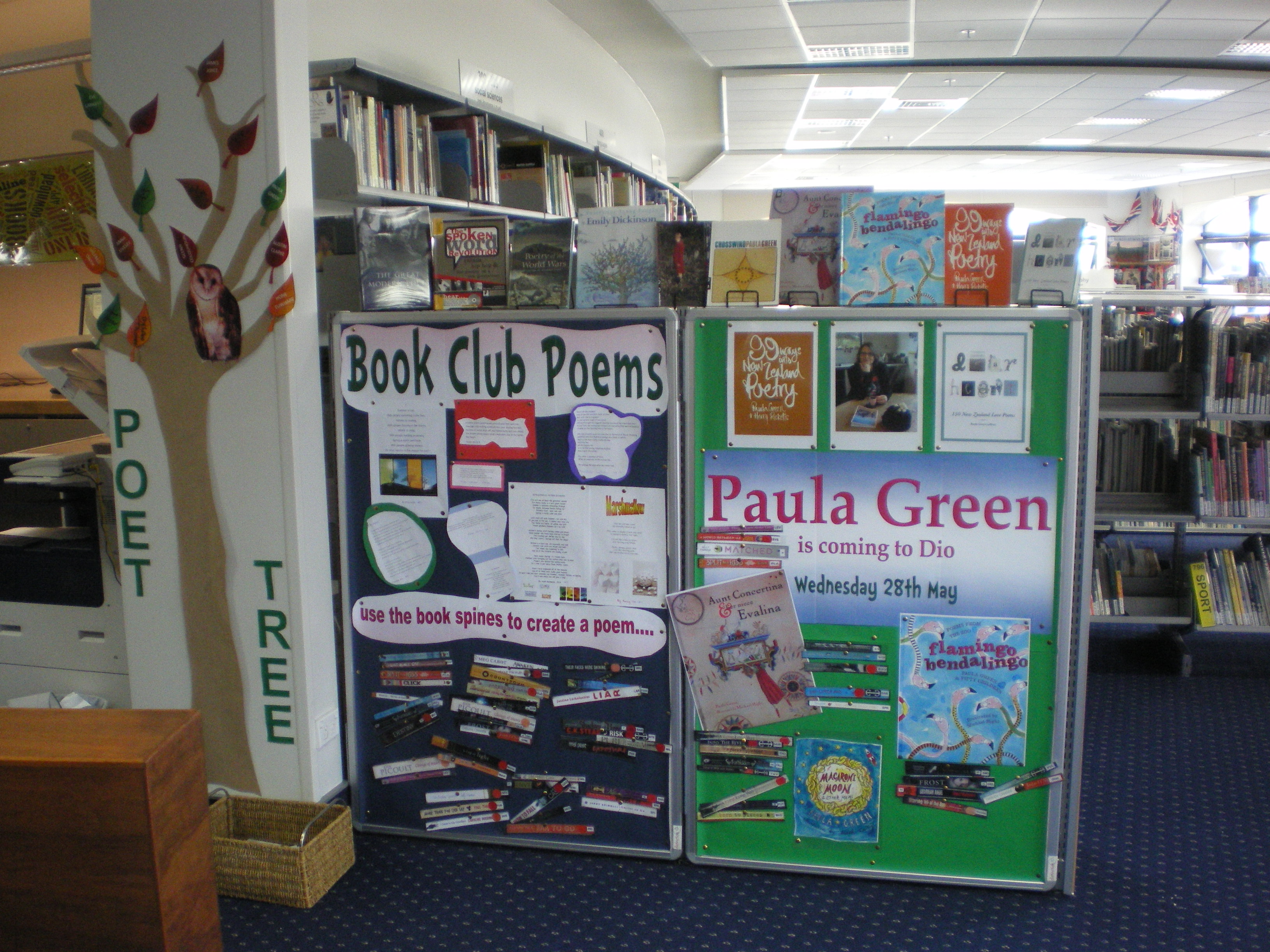
As an author it is especially rewarding to visit a school that displays your work! I visited Auckland’s Dio recently and was thrilled to bits with this display and the book-spine poems. The library hosted a lunch of sandwiches and cakes for the students librarians, the English teachers and members of the School Book Club after my morning visit. It was a terrific idea as I got a chance to talk to some enthusiastic, young writers in an informal setting. Thank you!

Two Poetry Competitions for Secondary School Students

2014 NZATE Senior Poetry Competition

This new competition is available to any Year 11-13 students in schools that are members of NZATE
Prizes:
The winner receives $150 and their poem will be published in the October issue of
English in Aotearoa
The two runners-up each win $50.

Rules:
1. Entries must be sent as attachments in a teacher’s school email, by a teacher who is a
member of NZATE or whose school is a member.
2. The email must list the attached entries, with name, year level and title for each entry.
3. Each entry (attachment) must have name, year level, school name and title.
4. Email entries to HCE@stac.school.nz by Friday 15 August

Instructions:
Write a poem
Have fun.

2014 NZATE Junior Poetry Competition

Prizes:
The winner at each Year level (Yr 9 and 10) wins $100 and their poems will be published
in the October issue of English in Aotearoa
The two runners-up at each level win $50 each.
Rules:
1. Entries must be sent as attachments in a teacher’s school email, by a teacher who is a
member of NZATE or whose school is a member.
2. The email must list the attached entries, with name, year level and title for each entry.
3. Each entry (attachment) must have name, year level, school name and title.
4. Email entries to cl@rangiorahigh.school.nz by Friday 15 August

Instructions:
Write a short poem containing the phrase
‘eating the plan’

Have fun.


Farewelling Christine O’Brien- AUP Publicity Manager

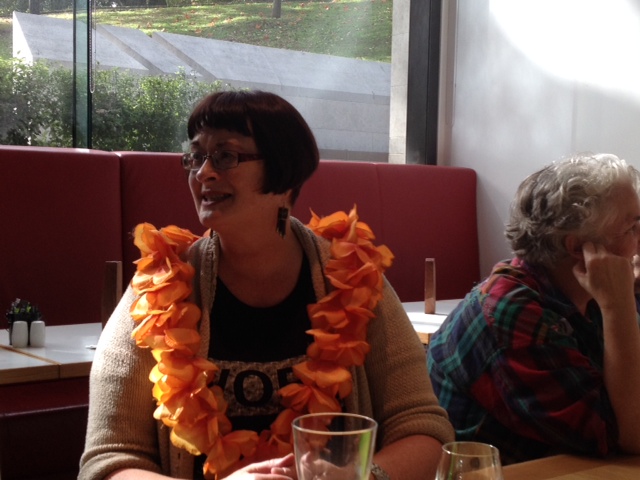
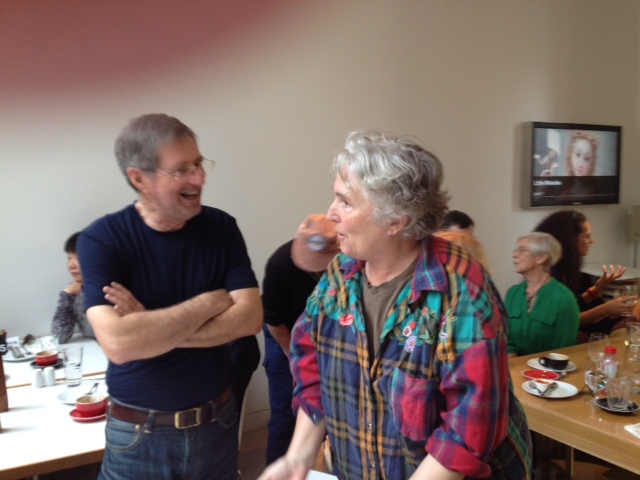
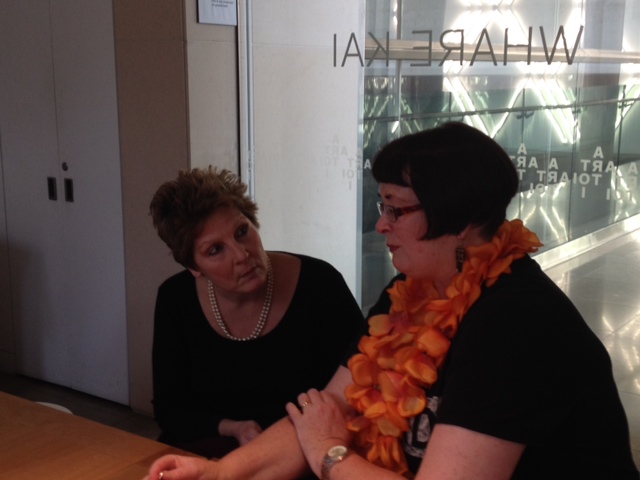
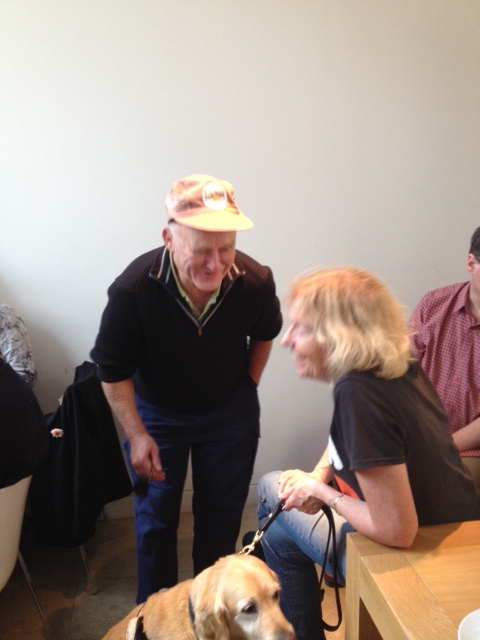
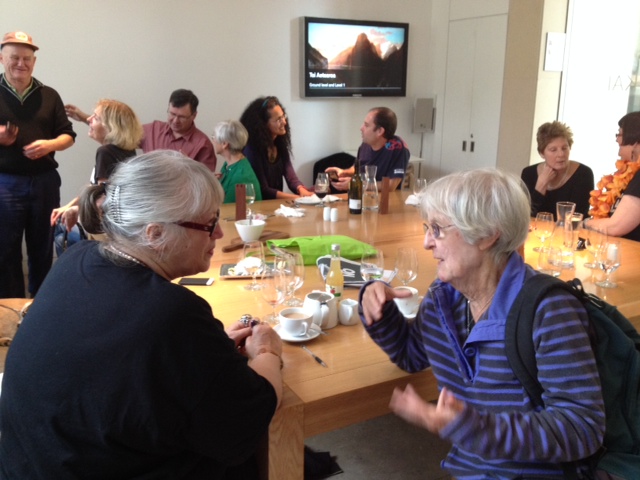
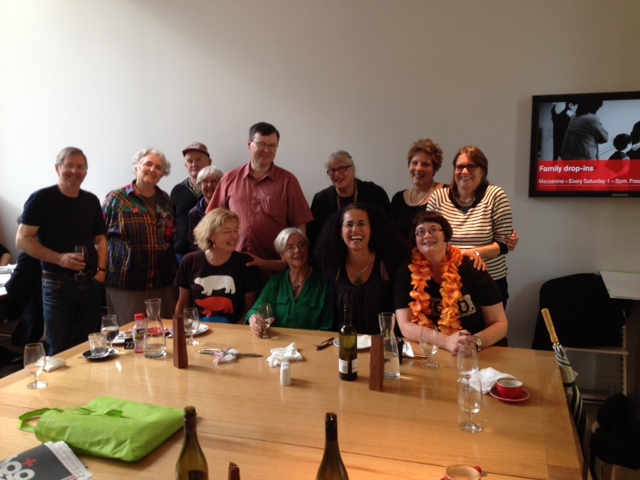
Today we had a poets’ lunch at Auckland Art Gallery Cafe to farewell Christine O’Brien. It was wonderful to all come together as the AUP poetry family and pay tribute to someone who is a storehouse of knowledge and experience. The weather outside was a mix (typical Auckland!) of sun and showers and I guess that was how we all felt. Christine has been a dedicated supporter of NZ poetry, has been at so many of our launches, and distributed vital poetry news for a number of years in her poetry newsletter. We will most definitely miss her, but we wish all the best in her next choices. Selina got us all singing a waiata which was just wonderful. Arohanui, Christine. xxx

I have posted this so out-of down poets and poetry fans can add a comment for Christine.

photo

photo photo  photo photo photo

New Voices: Emerging Poets Competition

New Voices comp

Divine Muses

NEW VOICES – Emerging Poets Competition

The 2014 competition is NOW OPEN

This is the third year of the competition and the winners will be announced at
The Divine Muses X : an evening of poetry
which will be held
at the Gus Fisher Gallery as part of National Poetry Day.

For information and entry form see here


The competition will be judged by Auckland poet, Bob Orr.

For an interview with Bob and Peter Calder in The NZ Herald see here.

For Bob’s NZ Book Council page see here.

Kirsti Whalen makes a moving tribute to Sarah Broom

Kirsti has just posted this on her blog. She has the writing life within her, her mother would be proud, and as she took to the stage on Sunday, it shone out for us all.

In Memory of Sarah Broom

It was with a mild hangover and a brimming heart that I greeted the day following my first writers festival reading. I attended a great many luminous events, but read as part of the celebration of the inaugural Sarah Broom Poetry Prize.

I feel incredibly honoured to have been shortlisted for this very special award, especially alongside such distinguished poets as Emma Neale and C.K. Stead, the winner, to whom I offer my utmost, and sincere, congratulations.

This event held a special significance for me, in so many ways. Before I went on stage, my dad told me to do it for my mum, and to imagine her at the back of the room.

I lost my mum to cancer six years ago. Knowing how short these years feel only makes me more amazed at the courage of Sarah’s family and friends, creating this tribute to her life such a short time after she left it.

My mother was a staunch supporter of my writing, and in the diary I inherited after her death she stressed that she hoped I could find a life in which I wrote, above anything else. When I was informed that I had won the Katherine Mansfield Young Writers Award back in 2006, I remember clutching her hands and jumping up and down in the entrance of our old home, with shared excitement.

The submission that I sent for the Sarah Broom Poetry Prize was titled ‘i’m only here because she isn’t,’ a line from one of my poems. This statement is applicable to my both my mother and Sarah, two women who fought their cancer with incredible bravery, and both, in different ways, left a legacy of language.

See the rest of her blog here.

Eleanor Catton, John Marsden, Grace Taylor at the Auckland Writers Festival

Yesterday I was on stage in the ASB Theatre at the Auckland Writers Festival — today I was in the audience for a couple of the school sessions.

photo

First up Eleanor Catton (now one of most famous authors after winning the Man Booker Prize last year for her novel, The Luminaries) and she was inspirational. I love the way she connected with the audience and wasn’t afraid to show herself, to laugh, to take risks, to talk about things that matter.

She began by telling a story that turned out to be boring and it turned out to be boring because nothing changed in it. Elie said that change is one of the most important things to explore when you write fiction. She said the greatest stories involve the greatest change.

She then drew a cross on a white board (good tip for me if I ever stand on stage again in front of 2,000 students!) and got the students to tell her the four types of action that drive a story: accidents, deeds, discoveries, decisions. She then talked about the way some were inside you and some where outside you; and some were controlled by you and some were outside your control.

Next she wrote down three questions that matter very much to the writer and reader of fiction: How? Why? What next?

The four actions and the three questions need to be balanced. If you miss some out, your story might fall over. It might not matter so much to the reader.

Then she got the audience to help her write a story. It was surprising! She used the questions to help make the story more interesting. If all the audience voted for what next? she used why?

The first sentence someone came up with was: A rock fell on the cave-dweller.

Then after some sentences in between, a student suggested the last sentence: She got super strength from berries.

You had to be there to experience the movement from first to last sentence! It was surprising.

It was a wonderful session that inspired students to think about their writing and reading and gain solid tips on how to make writing interesting and how to give your reader a good time!

photo

Next up was legendary Australian author John Marsden (he is also a school Principal). He started off by telling a story abut the word ‘um.’ It was the sort of story that makes you laugh and makes you think. It was about a boy and a father at the rugby and the father kept getting cross with his son for saying ‘um’ all the time—so many times the boy could no longer talk!

I loved what John said about writing because it is my philosophy too. Language, he said, is infinitely flexible. It’s like play dough, plasticine, triple somersaults, pouring on petrol and setting words alight.

He said it is really important to learn the conventions as you go through school  (like how to punctuate, grammar and so on), but in the end you don’t have to do things if they don’t help your writing. I agree totally.

John told a story about Poetic Licence. When he was at primary school his teacher told him about Poetic Licence and he thought it was a laminated card he could get somewhere that meant he could do what he liked with words. Poetic Licence is the freedom to do what you like when you write a poem (for example). Now John wants to print of millions of Poetic-Licence cards to give people permission to use language creatively.

Language, he said, is all about play (Yes! that’s exactly what I said yesterday!). Language is yours to do what you want with! he said.

He then went on to talk about status—high and low—and what kind of person that makes you and how that can steer your writing. We can find ourselves in all kinds of situations in life and part of it is how we respond, How we react. Are we looking down on everyone around us? Are we respecting people? Are we acting all down trodden? It seems to me he was saying we need a bit of both. We need to be confident about who we are but not ashamed to make mistakes.

I caught the last part of Spoken Word poet, Grace Taylor’s, session. At question time she said she started out as a closet writer until she discovered Def Poetry Jam and was then inspired by the Spoken Word Poets. She loved being asked who inspired her and reluctantly picked out just a few: Selina Tusitala Marsh, Tusiata Avia, Karlo Mila, Albert Wendt, Lemon Anderson, Sonny Paterson (I missed a few I think). Def Jam Poetry presented her with a bunch of ways of delivering poetry, she said, and then she went on to discover her own. She said rhyme wasn’t important but storytelling was. Spoken Word Poetry is all about storytelling. She said she would love to see part of the news delivered in Spoken Word Poetry! She said her strength as a poet is vulnerability. She is not afraid to be vulnerable.