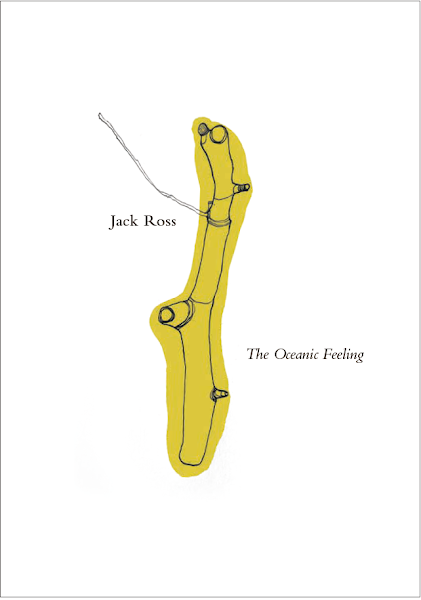
The Oceanic Feeling, Jack Ross, Salt and Greyboy Press, 2021
Here I go reviewing a book again with the subterranean feeling I experienced last March, barely articulated, drenched in uncertainty, fearing for the well being of Aotearoa, fearing for the well being of our frontline workers, fearing for our understaffed hospitals, fearing that supermarkets will deal with aggressive behaviour from some shoppers, yet full of gratitude for our Government’s swift response, for everyone choosing to stay at home and wear a mask. The subterranean Covid effect saw me drifting around the house yesterday with Jack Ross’s new poetry collection, The Oceanic Feeling, in my hand. Not writing a word. Word-drifitng in and out of countless books. Worrying about Afghanistan. Listening to Reb Fountain. Worrying about Haiti. Sydney. All the people living alone. The homeless.
The title is so fitting. The oceanic feeling.
Layer it up. Stand by the ocean and get an intake of ocean beauty. Sit at my kitchen table looking onto the tail end of the Waitākere ranges and my potential for worry is oceanic. Below the surface in my blood and bones. Above the surface in those intruding thoughts that I try not to let settle at the station.
I love this title. This beautifully produced book with its white cover and striking image holds an ocean of feeling. Add in the white space, the unsaid. Add in the physical, the images that glint and hold your attention.
The cover drawing is by Swiss-New Zealand artist Katharina Jaeger, and is part of the suite of images included in the collection. Bronwyn Lloyd’s afterword explores the connections between the drawings and the poetry. Katharina was inspired by her father’s manic pruning, and rather than use the the pile of clippings as prunings, drew them instead. Bronwyn makes a vital link between prunings and the skeletons in the artist’s closets, in the poet’s closet, and by extension in our closets.
Poetry is both pruning and planting and, at times, opening the closet door is to shine a light on the tough, the difficult, the surprising.
Jack’s terrific new collection does just this. The poetry seeks perspective in the corrugations and felicities of the everyday. In the little and larger events that shape and have shaped life. That nurture love, that spark a sense of humour, that trigger contemplation. The poems occupy the present but they also recuperate the past. I am moved by this.
The book is essentially in two sections, like two halves of a heart, with ‘Family Plot’ alongside ‘Ice Road Trucker’. Family poems alongside poems that consider the academy, poetry journals, travel, public art, reading, thinking. There is also a tiny cluster of small poems and of translations.
The poetry peers into the mist, and swivels to embrace the clearly sighted.
A sublime example is ‘What to do till the sentinels come’. The poet’s mother (I am making this assumption) has forgotten to feed Zero the cat when they are away. The cat hides in the garden shed, unfed. Here is the mist and the close at hand. The poem as the pruned twig.
it’s not that my mother
neglected her task
on purpose
she’d written in her diary
FEED THE CAT!
it’s just that her mind
now fills in blanks
with certainties
not doubts
there was a slight pause
before that “fine”
all I know is our cat
left alone
in the storm
my mother alone
in the fog of her brain
In the opening poem, ‘Lone Pine’, a tree crew are pruning the pines. The physical scene unfolds, and in reaching the visual impact of the tallest tree with its branches stripped bare, the loss doubles back. This is the pruned branch laid on the page: ‘standing bare / just like my father at the end’.
2021 is the season of memoirs. Long form and all revealing.
And yes, The Oceanic Feeling is a form of memoir. Fragmented. Selective. Revealing. It is also a form of engagement with both ideas and feelings. Poetry as a way of discovering chords between here and there, this and that, now and then. So many layers. So many connections. ‘Family skeletons’ does this. The sister with her suicidal thoughts, witnessed throwing a rope over a tree, who later succeeds with pills, is both presence and absence. Again I am picking up a branch laid upon the page and I am feeling it deeply.
Ah, I am moving in so many directions, as I read Jack’s collection, from the cars loved and then replaced, to bookshelves and superstitions, to wrangling over the colours of a graduation hood, to a university department lovingly built up over time, to be faced with cutbacks.
What makes this book resonate so deeply with me is movement. Physical and emotional movement. Not on a grand over-the-top flare of sentimentality but in small measured steps that favour contiguity. I relish the shift between what is easily witnessed in the everyday and what is much harder to fathom, what is retrieved in glimmers and shards across time. it is a collection that warrants a prolonged sojourn. Glorious.
I am going to leave you with ‘What do you want?’. The poet is in a Feilding library, having driven down for a function. The poem swerves and I am utterly affected.
What do you want?
said the librarian
in Friendly Feilding
to come in from the cold
was my reply
we’re closing an hour early
for a function
the function I’d driven down for
I walked away
he’s crying
but he doesn’t know
why he’s crying
said my sister
to the primer one teacher
who wanted to know why
I guess I do too
I guess I do
I was small and afraid
of a brand-new place
so many people
but what remains
is kindness
my sister
trying to help
unavailingly
Jack Ross
Jack Ross works as a senior lecturer in creative writing at Massey University. He is the author of five poetry collections and eight works of fiction, most recently Ghost Stories (Lasavia Publishing, 2019) and The Oceanic Feeling (Salt & Greyboy Press, 2021). He blogs here
Jack reads from The Oceanic Feeling
Notes to The Oceanic Feeling
Jack reads and comments on ‘1942’