Category Archives: Poetry

Sarah Jane Barnett: Three tips for beginning poets


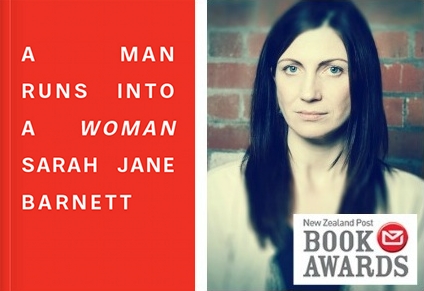
Sarah Jane Barnett’s fabulous, debut poetry collection was short-listed in the Poetry Category at this year’s New Zealand Post Book Awards. She has contributed a piece to the ongoing series On Poetry that  NZ Poetry Shelf is hosting. I totally agree with her tip that reading makes a writer (and I would add writing). Read read read write write write (a simple but time-tested formula. There was an excellent interview in the Listener but you need to subscribe in order to follow link.
bookawards

Sarah Jane Barnett  A Man Runs Into a Woman Hue & Cry 2012 This is what I wrote about this book last year (part of it ended up on the blurb at the back of the book): Sarah Jane Barnett’s debut collection is a gift for the ear. The words are poised, graceful, musical; verbs and adjectives soar and vault and balance. Within her glorious word gymnasium, Barnett is a poetic trapeze artist with feet on the ground and magical arcs and sidesteps in the air. As the cartographer of human experience, she steps boldly into the shoes and lives of others – a cable television engineer, a geographer, a pipeline worker. Her alert mind and canny eye for detail translate and transform what we may have missed in the world into poetic vignettes that are both light-footed and fresh.

the red room Sarah’s blog

Hue & Cry

And now from Sarah:

Three Tips for Beginning Poets

 Even though I’ve been writing poetry for the last ten years, I still feel like a beginner. I can’t imagine this will ever change. Every time I read a new collection of poetry I learn something new. There is always somewhere else to go; some new poems to write. So, while these tips are aimed at writers who are just starting out, I think they are useful for any writer.


1. Read poetry


A few years ago at a writers festival I met one of my idols, Canadian poet Christian Bök. After he signed his book for me I asked him what advice he had for poets just starting out. His one word reply: “Read.”

It seems an incredibly obvious statement to make, but I’ve been given the same piece of advice by many other poets, and it’s now the piece of advice I give to other people. I think that sometimes poets become so focussed on writing new work that they forget the best poetry is part of a wider dialogue with other poems and art forms. It’s not just about reading, though, but reading with a critical eye. Poets are notorious magpies. By reading other poets you can look at the mechanics of their poems. What tricks do they use? How do they use form, language, sound, and imagery? What poems make you excited and why? Once you figure out these things, you can try them out in your own poems. This tends to result in poems that sound like the poet that’s inspired you, but in the process you learn how poems work.

A great exercise related to this idea is to take the first line of a poem you like, and then use that line to write your own poem. At the end, take away the first line.


2. Experiment with form


After I finished my MA in creative writing I had writers block for about six months. No matter what I tried, I could not write a poem. To feel like I was doing something useful with my time I started to write short stories. These came easily and I enjoyed playing with dialogue, narrative, and place, which poets don’t usually get to do. In the end the stories weren’t very good, but after I finished writing them I started to write long narrative poems, and now these are my favourite poems to write.

What I am trying to say is that no time writing is wasted. If you’re a poet there is a lot to learn from writing stories, creative non-fiction, and essays. I think that every fiction writer should write some poems as a way to learn about how to apply pressure to language.

3. Never give up on a poem


I started to seriously write poetry in 2002 after attending a workshop run by Christchurch poet, James Norcliffe. James was the first person to encourage me to send poems out for publication, so I own him a lot. The best piece of advice he gave during that workshop was to never give up on a poem. Sometimes it takes a long time for a poem to reveal itself. It’s a bit like an archeological dig: you’re not sure what the final find will look like.

Take a recent poem of mine. I wrote this poem at the beginning of my PhD and it never really worked. The form was wrong, and the last few lines were rubbish. I’d take it out every three or four months and push the words around the page. A few weeks ago – four years since I first wrote that poem – the poem finally revealed itself.

Sarah Jane Barnett is a writer, reviewer, and tutor who lives in Wellington. Her debut collection, A Man Runs into a Woman (Hue & Cry Press) was selected as a finalist in the 2013 New Zealand Post Book Awards. She blogs at http://theredroom.org.
Vision of Escape — a poem by Lorna Staveley Anker

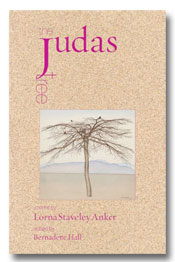
I posted a little feature on the recently published, selected poems of Lorna Staveley Anker. I am now able to post a poem from her collection, one which I made reference to in my review of her book. I have a spare copy of the book to give away to a random follower of the blog or someone who likes this post (on Friday).


‘There are numerous poems that stand out in The Judas Tree, (I love the compounding detail in ‘Recipe for Writing a Poem in the Dark’), but I want to finish with a peek at ‘Vision of Escape.’ In this poem a city is being traversed and the driver asks, ‘what is poetry?’ The poem then travels from ornate metaphor to gloomy night to stationary moment to ornate-but-cooler metaphor to stalled car. Ingenuous. The poet deftly moves in and out of reality and ‘the moment’ — and as the title suggests that is exactly what the pen does. Poems are as much the stalled car as they are the “green/ Aegean sea.”’ Then there is rippling tension between the title and the movement in the poem.


Vision of Escape


At the city crossing

you ask,

what is poetry?

and I reply,

us                     here

snug in this       warm

ruby-red    gold-encrusted

Venetian    glass     goblet.


Fool – you say,

we are sitting

in our saloon car.

It’s a wet winter night

and we’re waiting for

the red lights to change

to green.


No matter

I retort,

when that happens,

we switch time and

place   to    a

gold-spangled-fish bowl

at the bottom of some

faraway cool green

green Aegean

sea.


Suddenly

you stall the engine.


© Lorna Staveley Anker The Judas Tree  Ed Bernadette Hall Canterbury University Press 2013

I have a copy of The Judas Tree to give away to a Poetry Shelf follower

I just realised I have two copies of The Judas Tree by Lorna Staveley Anker (see my post here).

I bought a copy and then got sent a review copy.

Next Friday I will pick a follower of Poetry Shelf to send to the spare copy to.

judas_tree    judas_tree

Lorna Staveley Anker: As much the stalled car as the cool, Agean sea

Lorna Staveley Ankar The Judas Tree (Canterbury University Press, 2013)

judas_tree   judas_tree

Bernadette Hall has edited The Judas Tree, a selection of poems by Lorna Staveley Anker (1914 – 2000). The book also contains a detailed bibliography of publications, chronological autobiographical notes and an introduction by the editor.

This poet was unknown to me and I was grateful that she was not only brought to my attention, but that I was able to place her poems within the context of her life and times. Having just reviewed a novel for The NZ Herald by an Italian author (Elena Ferrante) who insists on absolute anonymity, I have been musing on the usefulness of authorial contexts. Since Roland Barthes’ provocative ‘Death of the Author’ essay decades ago — and truckloads of theory on the role of the reader and the performance of ‘texts’ — I think it is very clear the author is not the sole authority on what is written/published. If we remove ‘authority’ from the cult of the author, then we might be left with authorial context (autobiography, social and cultural times, opinions and so on).  Thus, I welcome with open arms access to such details — along with a vital conversation on the practice of writing and reading fiction and poetry.

So a brief author context: Lorna was born in Christchurch. When she was two, her father died from throat cancer and her mother took in boarders to support the family. The mother’s grief was amplified by the death of her three brothers in 1918. Her mental state affected Lorna. Lorna married a fellow teacher, had five children and began writing and publishing in the 1960s. After the death of her husband, she became more public as a writer, with poems appearing in numerous journals and magazines. Her debut collection appeared in 1986, My Streetlamp Dances, with two more to follow. Lorna writes in an essay on women in wartime, ‘I am a war casualty.’ She suffered from night terror, agoraphobia, anxiety, panic attacks, and in her final years, Parkinson’s Disease.

Bernadette concludes the book with a moving set of acknowledgements — above all, to Lorna herself: ‘if she hadn’t been such a beautiful presence; if I hadn’t been invited to speak at her funeral; if I hadn’t suspected that the subversiveness of her conversation might be reflected in some hidden-away manuscripts; if she hadn’t brought up her daughter to be as fearless as she herself was, this book might never have come into existence’ (106).

Lorna’s poems reflect a mind that engaged with the world acutely, wittily, compassionately. There is a plainness to the language in that similes and metaphors are sidestepped for nouns and verbs. These are poems of observation, attention, reaction, opinion, experience. The starting point might be the most slender of moments — and the poetry opens out from there, surprisingly, wonderfully.

In the first section (and indeed the largest section), war makes its presence felt; from the pain of departures, to the pain of the wounded, to the ache of loss. At times Lorna filters a poem through the eyes of her young self (for example, trying to make sense of Armistice Day). At times a concrete detail makes the poem more poignant (‘her spade searching/ her garden for/ her three lost sons’). In ‘Arie’s Tale’ the detail that renders the pain sharper is the ‘tyreless rims.’ In this poem the dead are carried away on a bicycle that makes such a clatter it is the hardest thing to bear (‘He felt it wasn’t respectful/ to his customers’). Lorna’s war poems stretch in all directions — they never forget the life that goes on and they never forget the heartbreak and loss that are etched indelibly. One of my favourite poems, ‘V.E.Day … and Neenish Tarts,’ moves beautifully between these two opposing but entwined forces. From the darkness of battle (now over), the poem moves to the grandmother dancing on the bed (as warm flesh weaves/ pink circles/ under a nightgown’; and from there to ‘Let’s have Neenish tarts for tea’ (this is cause for celebration). This first section of the book is a terrific addition to New Zealand war poetry because it casts a light on women at war (even when they remain in the kitchen).

The remainder of the book shows that Lorna is more than a war poet. Her sense of humour is there in the dance with a tea-cosy upon her friend’s head. There is the recurrent political edge that marks a mind roving in the world (‘Every headline is grit in the eye’). There is the slight surrealness of the the house in Lyttleton that swells every night, ‘Since they widened the road.’ There is the stepping around poetic corners to re-view the facts or first impressions (The company agent (her father) collected all the statistics in his diary but would you guess ‘the uplands and plains/ of early Canterbury ever/ yielded beauty, colour, form’).

There are numerous poems that stand out (I love the compounding detail in ‘Recipe for Writing a Poem in the Dark’), but I want to finish with a peek at ‘Vision of Escape.’ In this poem a city is being traversed and the driver asks, ‘what is poetry?’ The poem then travels from ornate metaphor to gloomy night to stationary moment to ornate-but-cooler metaphor to stalled car. Ingenuous. The poet deftly moves in and out of reality and ‘the moment’ — and as the title suggests that is exactly what the pen does. Poems are as much the stalled car as they are the ‘green/ Aegean sea.’

Lorna’s collection is a delightful discovery. Her poems never sit still (do any?). They take you to grief and yet to laughter. Their linguistic simplicity is a gateway to a rich, reading experience. I am very grateful.

Canterbury University Press

Mary McPherson on Lorna Staveley Ankar

Mary’s review in Landfall

The editor Bernadette Hall is to be congratulated on bringing these poems to a wider audience. Bernadette lives at Amberley Beach in North Canterbury. She has published numerous collections of poetry including The Lustre Jug, and edited Joanna Margaret Paul’s Like Love Poems: Selected Poems. She was a judge for this year’s New Zealand Post Book Awards and co-founded the Hagley Writer’s Institute in Christchurch.

Bernadette Hall New Zealand Book Council

Bernadette Hall Victoria University Press

Bernadette Hall nzepc


Poetry as Social Action: A free symposium at the University of Auckland

POETRY AS SOCIAL ACTION 

A Symposium at the University of Auckland, 27 September 2013

How do contemporary poets engage their multiple audiences? What is the function of experiment in writing as a social act? How should we map the cultural dimensions of eco-poetics, identity politics or non-normative behaviours? Seven speakers address these and other questions in a series of interactive panels and a public reading hosted by the NZ Electronic Poetry Centre (nzepc) in conjunction with Australian poet Pam Brown’s Distinguished Visitor Award at the University of Auckland.

Our speakers are Adam Aitken (Sydney), Ali Alizadeh (Melbourne), Pam Brown (Sydney), Jen Crawford (Singapore), Ya-Wen Ho (Wellington), David Howard (Dunedin), Susan Schultz (Honolulu) and Ann Vickery (Melbourne).

We welcome students, staff and interested individuals to this free event at the Pat Hanan Room in Arts 2, 9 am-4.30 pm. Then join us at Auckland Central City Library and hear symposium poets read their work at WORD AND WORLD, 5.30-7 pm.          .

Programme: http://www.nzepc.auckland.ac.nz/features/social-action/index.asp
Information: Michele Leggott (m.leggott@auckland.ac.nz)

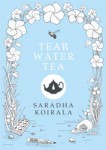
Saradha Koirala’s Tear Water Tea arrives wrapped in blue tissue

978-1-927242-04-9 978-1-877448-42-3

Saradha Koirala  Tear Water Tea  (Steele Roberts, 2013)

Saradha Koirala’s second collection, Tear Water Tea, arrived in my post-box in style this week. It was wrapped in blue tissue, with a tracing-paper tag embossed with with a bee. Imagine if all poetry books were delivered to us like this. The book, itself, is beautiful to both hold and behold.   Delicate black & white drawings of flowers scroll about the powder blue — and then you shift from skull to lego block to bee to teapot (or whatever route your eye might take). David Randall Peters, the artist, also did the faint, vein-like, pool-like drawings scattered inside.

Saradha’s new book flutters between the physical world (a land-locked bird, an escaping dog, a sheetless bed) and a more ephemeral world (blown kisses, things in the air, melting photographs, smoke, ink tears, vapour). What emerges in this poetic movement between what is observed physically, intuitively and at times unfathomably are the strong and lyrical threads of love, home, and place that glue the collection together. It is as though the poet is inviting us into her family album, a poetry diary of sorts, and each poetic entry is lovingly crafted.

While much of the collection adopts a quiet, almost conversational tone (back to Andrew Johnston’s notion that much of New Zealand poetry is talky), the collection as a whole offers the variations of a musical piece. Certain phrases ring deliciously in your ear (‘colourless in corners and stiff’ ‘I pull my temper’). Analogies surprise (‘and yet months pass like clouds’). In some poems, the words accumulate in lush patches of alliteration and assonance (‘Arat’). Then there is the way everything comes together in the one shimmering line (‘no need to read the residue/ of forests strewn like tea-leaves on the lawn’).

The opening (and title) poem is a delight (‘Tear Water Tea’). It lays down three slender strands within its slender form, and you cannot help but swim through the gaps. Poetry so often comes alive out of juxtaposition. Here, storytelling is placed next to grief which is placed next to daily routine. There is accruing mystery about the boy and his imagined wolf, a story that gets repeated in order perhaps to dislodge grief. There is the rip that is also sorrow,  that a cup of tea might wash away (there, there). There is the kettle put on — oh, the salty tears that masquerade for water — as you speak and as you listen. There is this strand collapsing into that strand, and so on and so forth. Poetry can take many forms and employ language in a thousand ways, but there is something immeasurably satisfying about small poems that are economical, graceful, mysterious (Bill Manhire is a whizz at this!). Thanks to the publisher and the poet I have reproduced the poem below.

Saradha’s second collection is a larger version of the small poem that introduces it: pleasurable, contoured, refined. A little gift, indeed.

Tear Water Tea

Over and over they told me the story:

a boy, an imagined wolf.


As if sorrow can be likened to mischief.


I hold the teapot in both hands

another satisfying, salty brew.

©Saradha Koirala Tear Water Tea (Steele Roberts, 2013)


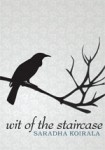
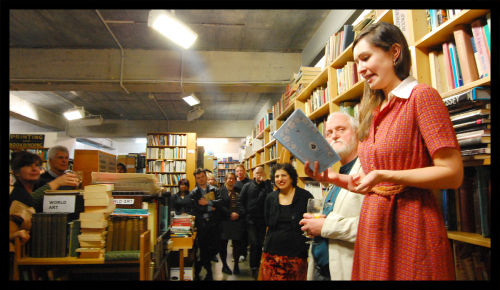
Saradha resides in Wellington and has taught English in secondary schools since 2005. She is of Pakeha and Nepali descent, and holds a Masters in Creative Writing from the International Institute of Modern Letters at Victoria University. Her new book was recently launched at the fabulous Quilters Bookshop in Wellington. Her debut collection was entitled Wit of the Staircase. See below for further links.

005-1

Saradha Koirala website

Steele Roberts

Winged Ink Tuesday Poem

An interview with Tim Jones

New Zealand Poetry Society on Wit of the Staircase


My tribute to Sarah Broom

images-2

Sarah Broom (1972-2013) is to be honoured in a new poetry award thanks to her husband Michael Gleissner (Sarah Broom Poetry Prize). The award is a way of acknowledging the strength, imagination, craft, commitment and love that guided Sarah in both living and writing. The prize will enable a New Zealand poet to work towards the completion of a poetry manuscript. The entry will consist of 6-8 poems of which at least 5 must be unpublished. Entries will be accepted from 3 February 2014 and close on 28 March 2014. The winner will be announced May 2014. Sam Hunt is the inaugural judge and I am delighted to be a member of the judging panel. For further details see here.

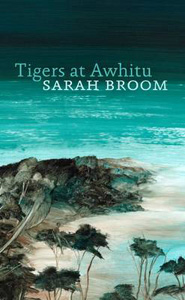
Sarah undertook academic studies at Leeds and Oxford which resulted in her publication, Contemporary British and Irish Poetry (Macmillan, 2006). She returned to New Zealand where she held a post-doctoral fellowship at Massey University in Albany. An academic life, however, gave way to time dedicated to poetry, motherhood (three young children) and managing lung cancer. These three factors understandably became entwined — and her poetry is testimony to a woman who nourished the word along with her family and her self. Her first collection, the astonishing Tigers at Awhitu (Auckland University Press, 2010), is a book of two parts. The first part was written before her diagnosis, while the second part was written afterwards. Poetry is at work in both. As you move through the poems your ear is lit by the musical notes, you are drawn into the detail that enlivens a view of the physical world, and captivated by miniature renditions of life and experience (‘The beach is heaped and hilled with bleached branches/ as if whole forests have been rolled over the ocean/ and dumped.’) (And: ‘It was as the snow started falling again/ that she blurted it out, so they were all/ just standing there gazing up, knee deep/ in snow’).

The second half of the book represents poetry trying to absorb a terrific blow to the gut and heart. The titles themselves track the path of searching for a new way to be: ‘NO’ ‘Hospital Property’ ‘Ward’ ‘Three Exercises for Oncologists’ ‘Hold it there’ ‘A Terribly Unfair Question’ ‘Not yet, not now’ ‘because the world can do that to you.’ These poems still have the beauty of musical notes, the attentiveness to the details of the world and the little windows that invite you to stand within the experience of the poem. But these poems now navigate pain and unfathomable questions. Sarah hasn’t poured a deluge of bitterness and despair within the form of the poem, but you can feel the ache along with the determination and ability to take hold of the light. In my review for The New Zealand Herald I wrote:

‘The poems, that may in part be therapeutic, stand as an aid to life. Things outside the clinical procedures and walls wrap about her as windows, anchors and safety nets. Reading these poems, the real world fades to a distance, and beyond the tender craft of each line, the intense luminosity of each word choice is poetry of absolute love.’ For the rest of the review see here.

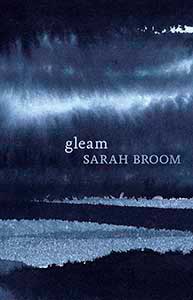
cp-tigers-at-awhitu cp-gleam

Sarah’s second poetry collection, Gleam (Auckland University Press, 2013), was launched posthumously. In my review in The New Zealand Herald, I wrote that: ‘Broom uses big things such as the stars (“I am so thin/the stars can see right through me”) and the ocean to navigate lines that shimmer with little explosions of loveliness.’ These poems come from a tremendous love of writing and of family. The poems uphold the musicality and the attentiveness that marked her debut collection (‘So I lay there every night/ and every night the fat white/ moon crept out of the bush/ and came to talk to me’). They are poems that signal the way craft can produce joy, yet upon each occasion there is the fragility of life, the preservation of all that matters, the ability to shine beyond pain and bitterness (‘you are both held/ and not held’). Such poetry becomes a gift to the reader – a place to enter and re-emerge subtly changed. Reading this book strengthened me. Two of the love poems here were published in Dear Heart; love poems that stretch beyond petty squabbles to those bonds that forge immeasurable intimacy. I could never read these out at a reading, but readers have commented on how these poems stick with them.

I love writing about poetry but I want Sarah’s poems to resist my dissection. I want these poems to stand and endure, each and every one, as little homages to love, life, difficulty, family and the insistent desire to write. Each poem holds the world at arm’s length as you read —  and then draws it in closer. Perhaps writing and reading under the threat of death does this. Ever since my theoretical explorations for my doctoral thesis I have wondered if writing is a way of postponing death. If you write your way into life. I don’t know. Sarah’s Gleam is a gift for those of us who are well, and those of us who are not; for those of us who write poems and for those of us who love to read them.


Sarah Broom website

Auckland University Press Sarah Broom

Landfall review Tigers at Awhitu

Sarah Laing’s comic

Review of Gleam in ODT

Review of Gleam in Nelson Mail

Michael Gleissner on National Radio

Hamilton goes to town for National Poetry Day

Hamilton Poetry Day Committee came up with all sorts of events to celebrate National Poetry Day. Bookmarks were given out in shopping malls and at Garden Place. There was a roving poet. There was an open-mic night and a Wintec Poetry Competition open to all residents (results on the Wintec and Hamilton Library sites). Carrie Barber came first and second. Hard work for all of those behind the scenes, but great to see a flourish of poetry in a range of ways.

Bookmark Jpeg 3 National poetry day bookmarks 2

group shot open mic night

National poetry day bookmarks

I am full of admiration for Grace Taylor

images-11185137_10153133266500224_560408671_a 1185137_10153133266500224_560408671_a 1185137_10153133266500224_560408671_a

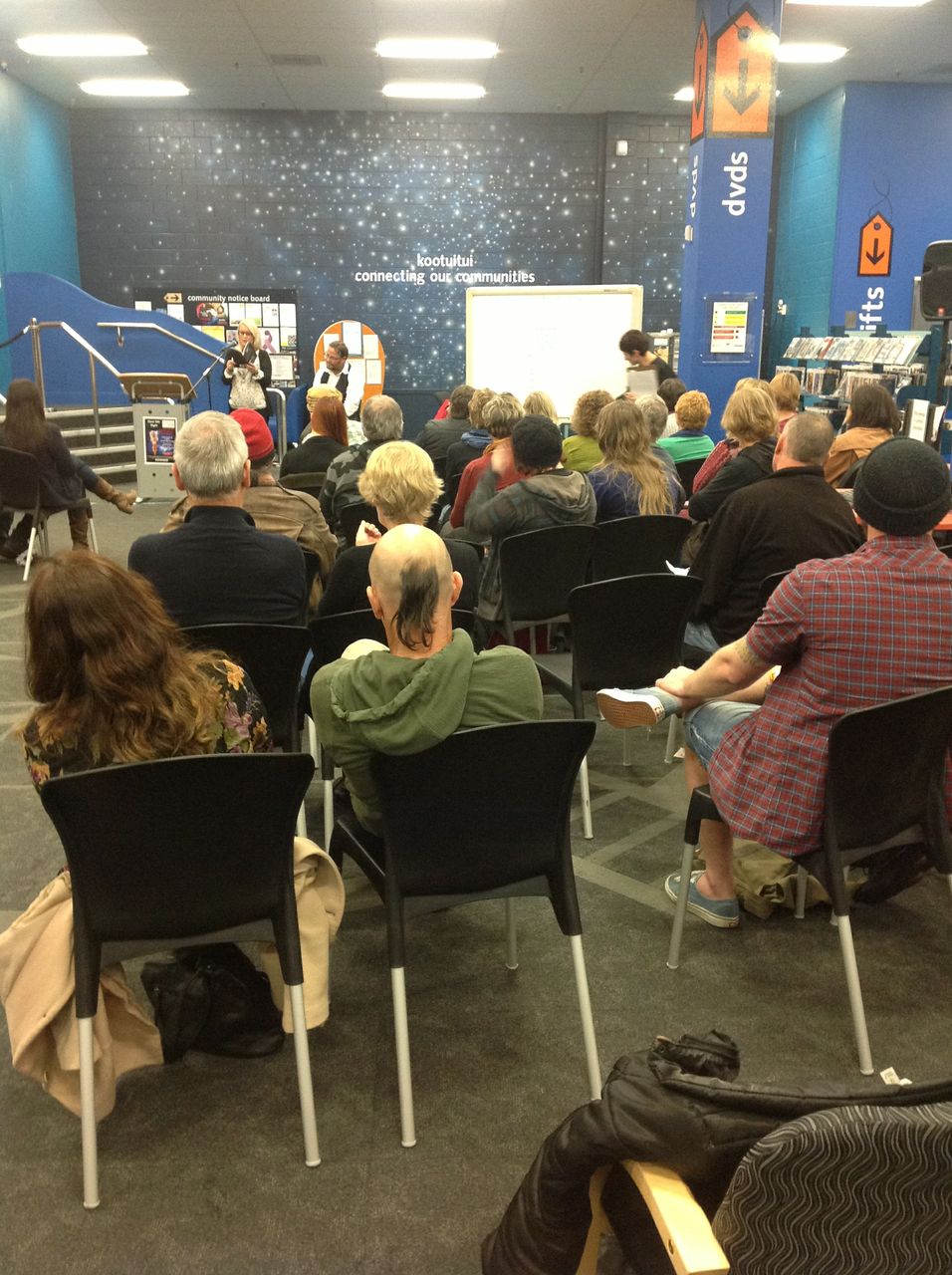
Grace Taylor is a spoken word poet, teacher and youth development worker. She is a co-founder of the South Auckland Poets Collective and The Rising Voices Youth Poetry Movement. She works tirelessly, creatively, insistently to promote poetry in South Auckland.

Marc Smith founded the Poetry Slam movement in The States in 1986 and it has spread like wild fire throughout the world. The movement has created ‘families’ of poets  that are drawn together by slam events, new bohemia or hip hop. Spoken-word poetry has taken poems into different corners. It has ignited a love of words with generations of youth. It has energised the way poetry can be delivered, liberated the word from the page and given poets freedom to speak with renewed political bite.

Grace is one of a number of New Zealand poets who are not only producing vital examples of spoken-word poems (along with poets such as Tusiata Avia, Doug Poole, Selina Tusitala Marsh, Serie Barford) but are igniting a love of words in communities such as South Auckland. This is cause for celebration and admiration.

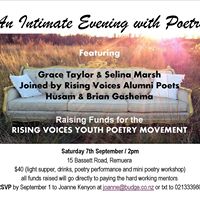
Grace and the team have a fund-raising event coming up for the Rising Voices Youth Poetry Movement.

It is on Saturday September 7th at 15 Bassett Road, Remuera at 2pm. Light supper and refreshments. Tickets $45

1157567_10151885159321018_607988923_n

Tonight, there is this event at 7pm at the foyer of the Mangere Arts Centre. This year, Stand Up Poetry has been at MIT Creative Arts School, Te Matariki Clendon Community Library, the Cafe at Youthline Manukau. Packed houses for the open mic. Special guest tonight: Jahra Rager.

971062_10151868530466018_1416843078_n

Ten minutes with Grace Taylor

Listen to Being Afakasi

South Auckland Poets Collective Blog

Niu Navigations

Stand Up Poetry

On Grace Taylor