Category Archives: Poetry

Best NZ Poems 2013 is now live and the list is a cracker!

Here is a list of the poets in the latest edition of Best NZ Poems edited by Jane Stafford and Mark Williams. Poetry Shelf has featured many of these poets to date and I can’t wait to work my way through the poems. This is a terrific line up — imagine it as a poetry reading!

Fleur Adcock Hinemoana Baker Amy Brown Sarah Broom Kate Camp Mary Jane Duffy Murray Edmond Johanna Emeney Cliff Fell Bernadette Hall Dinah Hawken Caoilinn Hughes Anna Jackson Anne Kennedy Michele Leggott Therese Lloyd Selina Tusitala Marsh John Newton Gregory O’Brien Rachel O’Neill Vincent O’Sullivan Elizabeth Smither Chris Tse Ian Wedde Ashleigh Young

Check out the 2013 page here

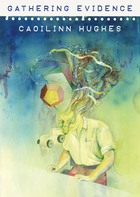
The giveaway copy of Gathering Evidence by Caoilinn Hughes

gathering_evidence_front__66501.1385936635.140.215   gathering_evidence_front__66501.1385936635.140.215   gathering_evidence_front__66501.1385936635.140.215

Sarah Jane Barnett’s name  was picked out of the hat and will receive a copy of Gathering Evidence by Caoilinn Hughes thanks to Victoria University Press.

My review here.

Caoilinn’s picks for April’s On the Shelf here.


Caoilinn Hughes’ Gathering Evidence: To read this book is to step out of an itinerary of expectation

caoilinn-hughesweb-2

gathering_evidence_front__66501.1385936635.140.215gathering_evidence_front__66501.1385936635.140.215

Caoilinn Hughes, Gathering Evidence, Victoria University Press, 2014


Victoria University Press recently launched Gathering Evidence, the debut collection of Caoilinn Hughes (it is also being published by Carcanet Press in the UK). It is a debut collection, but Caoilinn has a significant track record to date. She graduated from Queen’s University in Belfast with a BA and a MA, and after doing various things (including writing novels at the weekends and working for Google), she enrolled in a PhD at Victoria University. The poems, too, have a fine pedigree—some won the 2012 Patrick Kavanagh Award and others the 2013 Cúirt New Writing Prize. She then won the 2012 STA Travel Writing Prize and the 2013 Trócaire/Poetry Ireland Competition. The book itself comes with a terrific endorsement by Bill Manhire on the back.


Caoilinn’s collection draws upon the richness of the world—her poetic tentacles reaching out in all directions to take hold of snippets of information, dialogue, recollection, facts, insight. Her lexicon is vibrant, challenging, eclectic as she shifts from scientific jargon to Spanish to Italian to plain language to language that sings and shines. There is a density on the page in terms of both meaning and accumulating detail and phrases—and it is as though you are within a sumptuous painting on the cusp of the Baroque and of the Renaissance. Not that this writing belongs in another time, it is most definitely, most gloriously, of our times.


The collection, more than anything, delights in the scientific. Caoilinn exhibits a penchant for scientific thought (how to translate and inscribe within poetic form); the alchemical link, the chemical reaction, the physical dance, the scientific anecdote. At times she stands in the shoes of other scientists not only to explore science itself, but also to invent and reproduce miniature, historical narratives. In ‘Rational Dress,’ Marie Curie is seen as much in the light of her clothing as she is in view of her prize-winning discoveries:

She wore her dark blue wedding dress for years on end

in the shed laboratory – once medical dissecting room –

at l’École Supérieure, filling its pockets with painstaking findings.


[and a little later in the poem]


On this, society would insist. Pierre had to speak on her behalf

at the Royal Institution, as she sat, hands knotted in the encumbrance

of her skirt. So off the record was she that the Nobel Committee

needed reminding of her work. Was it physics, chemistry or both?


Such a focus upon attire, makes the poem even more poignant.


In ‘Pacific Rim,’ the poet has her ear to the earth’s tremors, and again she renders a scene vivid through her concatenation of phrasing and detail (this is a poet of fertility rather than economy). The final verse resonates in the aching juxtaposition of children, cathedrals and split earth:


Children lose their footing, crying: ‘Pop goes the ceiling’,

cathedrals spill their bricks of hymn upon their neighbours;

flags drop to their knees; gardens split like freshly baked loaves.

The thundering ground, fissuring walls, the sound of history’s footfalls.


So many poems stand out, but unlike many collections I read, every last line sent me back to the first (without exception), to read the poem again in order to absorb and relish the layers of sound and thought, revelation and curvature. Even pocket narratives, such as ‘Catechism,’ dazzle with each next detail, connection or trope:


My aunt cried ‘Up the Reds!’ between Hail Marys

and was sent to bed. It might have been half-deliberate


when she snagged the sacrament, launching Glory Bes

into the gluey hives and trenches of her head


What I loved about the book is the contoured reading experience—these poems take you from Bolivia to Peru to Ireland to New Zealand. They take you from the cusp of womanhood in the terrific ‘Dublin Can Be Heaven’ (the mother sneaking her daughters on an illicit train ride instead of school) to electric connections between time and love in two Roundelets. There is the inventive exploration of ‘The sound that precedes the writing of poems’ in ‘Is It A Kind Of Bell Toll.’ There is the reading of Waiting for Godot (it can’t be reduced to the gist!) with dressing gown, goosebumps and love:


You point to the window, where the curtain is parted like a sideways eyelid,

pretending to be asleep. Our neighbour is watching us: the meaning of life laid bare.

The gown has come undone and goosepimples are everywhere. I curtsey.


Caoilinn bucks the trend and offers no endnotes, copious or otherwise (and there are plenty of occasions to expand upon the context and scientific references), but these poems get to stand on their own feet and I rather like that.


To read this book is to step out of an itinerary of expectation and take flight within the imagination and intellect, the warmth and the gut feelings, the precision and the clarity, of a mind that roves in startling directions. It is a voyage you want to reserve and rebook. Wonderful!


Thanks to Victoria University Press, I have a copy of the book for someone who likes or comments on this post.

Twitter Poetry Night NZ is a way of happening, a mouth

This is from Ashleigh Young:

Twitter Poetry Night NZ

People read poems and other people listen to them

A way of happening, a mouth.

Poetry Night doesn’t happen that often, but sometimes it does happen. Winter is on the horizon, deadlines are clamouring, the wind wand sculpture on the waterfront keeps gyrating suggestively, the future keeps leering at us from its speeding vehicle. One thing to do under these circumstances is read some poems and listen to other people reading poems. A man with some opinions called Karl du Fresne recently quoted that famous line by Auden: ‘Poetry makes nothing happen’, but du Fresne didn’t quote the next lines, in which poetry:

flows on south
     From ranches of isolation and the busy griefs,
     Raw towns that we believe and die in; it survives,
     A way of happening, a mouth.

He forgot to mention that it flows, it survives. That it’s a way of happening. It’s a mouth, Karl, a mouth.

I think also that du Fresne forgot that in the wider context of the poem, ‘nothing’ is a value in itself (Auden wrote those lines in a poem, after all, and to eulogize Yeats). I think he (and everyone) should read this great essay about isolation, communion, and poetry, by A. F. Moritz. I like these lines from the essay very much:

When we turn isolation into solitude by being creative and seeking ways to make this the basis of social life, we are poets.

The next Poetry Night will be on Sunday 20 April at 8pm on Twitter. If you’d like to record a poem or listen in, see here. Please note that the request to join me in an effort to get celebrities to read poems still stands.

Let’s make nothing happen, together.

@PoetryNightNZ (@ashleigh_young)

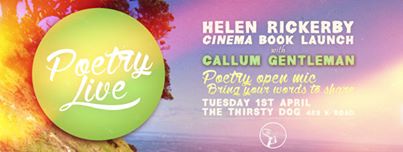
Helen Rickerby’s Auckland launch of Cinema

1932310_10151901349171734_839030285_n

Tuesday, April 1 at 8:00pm

Thirsty Dog 469 Karangahape Road Auckland

Music by Callum Gentleman, open mic, Cinema will be launched by Anne Kennedy. Helen Rickerby will read some poems. Cinema, and the other Hoopla books (Bird Murder by Stefanie Lash and Heart Absolutely I Can by Michael Harlow) will be available for $25 (cash or cheque only).

1932310_10151901349171734_839030285_n

Lest We Forget Poetry Competition

Lest We Forget Poetry Competition

Lydia Whyte, 2013 winner of the 12 - 17 years category, reads her poem.

As part of the lead up to the First World War Centenary commemorations, the Lest We Forget Poetry Competition provides an opportunity to articulate responses to war, in poetry or prose.

Using an historical or a contemporary lens, you choose the focus and content, around this year’s theme: Duty and Adventure. Whether focusing on those who went off to fight or those who were left behind, you can express thoughts and feelings, thus adding your voice in a very real way, to our Anzac Day commemorations.

The competition is open to families, adults and school students. There are three age categories: 11 years and under, 12 – 17 years, and 18 years and over.

Six finalists will be invited to read their poems in the Hall of Memories during the ANZAC Day Commemorations on Friday 25 April, 2014. If a finalist would rather not read out their poem, they may assign a substitute to read on their behalf or the poetry competition host can read for them.

How to enter

To enter, you can email your poem to competitions@aucklandmuseum.com including your name, address, age, telephone number and the title of the poem. You can also send your poem along with the submission form to:

Lest We Forget Poetry Competition
Auckland Museum,
Private Bag 92018,
Victoria Street West,
Auckland 1142

Please ensure that your poem arrives no later than Thursday 17 April. Submissions will be read by a museum panel of judges, and finalists informed by telephone on Friday 18 April.

Zarah Butcher-McGunnigle’s debut poetry collection, Autobiography of a Marguerite, needs support

Image1
Hue & Cry Press is excited to announce the upcoming release of Zarah Butcher-McGunnigle’s debut poetry collection, Autobiography of a Marguerite.

Autobiography of a Marguerite is scheduled for publication at the end of May, but we need your help to get the book printed. PledgeMe is providing a platform for you to get your hands on some excellent paraphernalia, including signed copies of Autobiography of a Marguerite, so we can afford to give the book the treatment and send off it deserves.

Every little bit will count, so please spread the word on our behalf. See the Autobiography of a Marguerite PledgeMe page for more details and to pledge.

Autobiography of a Marguerite is an innovative autobiography about illness, family dysfunction, and identity, and how they can shape one another. The narrator struggles with the effects of her auto-immune illness, and struggles to separate herself from her troubled mother. The narrative that emerges from the connected prose poems is both revealing and mysterious. Fragmentation, non-linearity and the use of footnotes reflect the disruptive nature of illness and the nature of recalling memories and family patterns.

Zarah Butcher-McGunnigle’s work has appeared in a wide range of publications. Along with Hue & Cry these include Sport and Landfall, and her poems have been selected for Best New Zealand Poems in 2011 and 2012. She has a Masters in Creative Writing from the International Institute of Modern letters, where was awarded the Biggs Poetry Prize for her manuscript, the first rendition of Autobiography of a Marguerite.

Owen Marshall’s The White Clock provides a frame for shimmering contemplation

otago065671   3378992_orig

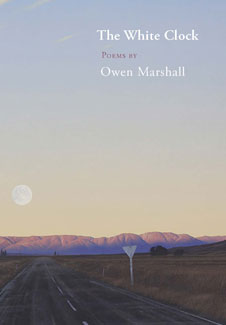
Owen Marshall, The White Clock, Otago University Press, 2014

In Owen Marshall’s third poetry collection, The White Clock, poems provide a frame for contemplation—for reflecting back into the hills and dales of memory and for musing upon the physical and metaphysical currents of the world and of living. The adept fiction writer is at work here, with his trademark economy and grace, but so too is the roving mind of a philosopher. There is also the bird watcher (I should say life watcher) as Owen trains his figurative binoculars upon detail that renders his lines lucid and vital. Not all poems work for me, but those that do (the majority), dig and delve into the essence of humanness. There is humour (wry and infectious) and there is tenderness. As a whole the collection provides lovely contours of thought and feeling.

The title poem takes us in all directions—from the ‘multi-limbed Leonardo man’ to the idea that ‘Time writ this large is discomforting.’ This sway between the transient and the concrete, the hard to pin down and the readily held, is a terrific vein throughout the book. Thus ‘Freeze Frame’ observes the fleetingness of time. The opening line, ‘In the spool that is my life,’ makes a nice link to the way photographs also share ‘the stabbing sadness/ of glimpsed transience.’

Owen embraces playfulness. ‘Dog Winds’ does just that. He links a season to a wind and that season to a dog.

Winter wind is the starving bitch

heeding no one’s whistle, baring

cold, white teeth if faced, with ribs

of adversity and a muzzle-up howl.


Or he returns to the fable of the tortoise and the hare and resists favouring the tortoise that is ‘commensurately wise’ and endures ‘an eternity of slow vegetative mastication.’ Instead:

Better a mad March dance before

a lover, the sprint with wind in

your hair, the ultimate exhilaration

within the headlights’ glorious flare.


In ‘Watcher on the Shore,’ Owen (or narrating voice) confesses he prefers ‘Brueghel’s/ trivial and persistent cruelties’ to ‘transcendent, uplifting paintings.’ Is the last line then a cue for us to see the darker line of thought in the collection?

Like old Jacques I find more sustenance

in melancholy than any other humour.


Sometimes the humour, though, is laugh out loud. When the poet-narrator is about to talk about ‘narrative point of view/ and psychic distance’ he looks into the crowd and spots a woman asleep. Disconcerting, hilarious:

[  ] Golf balls could

have been dropped into her mouth

and there was nothing I could say

that would add to her contentment.


What I particularly love about this collection is the way the poet opens himself up for inspection—through what he observes, experiences and thinks. It imbues the poems with an acute truthfulness (which goes against the grain of poetic game play and irony). One black coat (now a little shabby) was purchased in Menton and conjures up past memories in ‘Habit.’ It is the last verse that shows Owen at his perceptive best:

[   ] We

are a fit, and I cannot bear its

replacement with any companion

less familiar with my life and form.


The White Clock, like the Graeme Sydney image on the cover, provides a frame for shimmering contemplation.


Otago University Press page

New Zealand Book Council page

Owen Marshall web page

Christchurch City Library interview

Random House author page

Emma Neale’s poetry reading was witty, warm, sharp and utterly musical

IMG_4503 IMG_4504

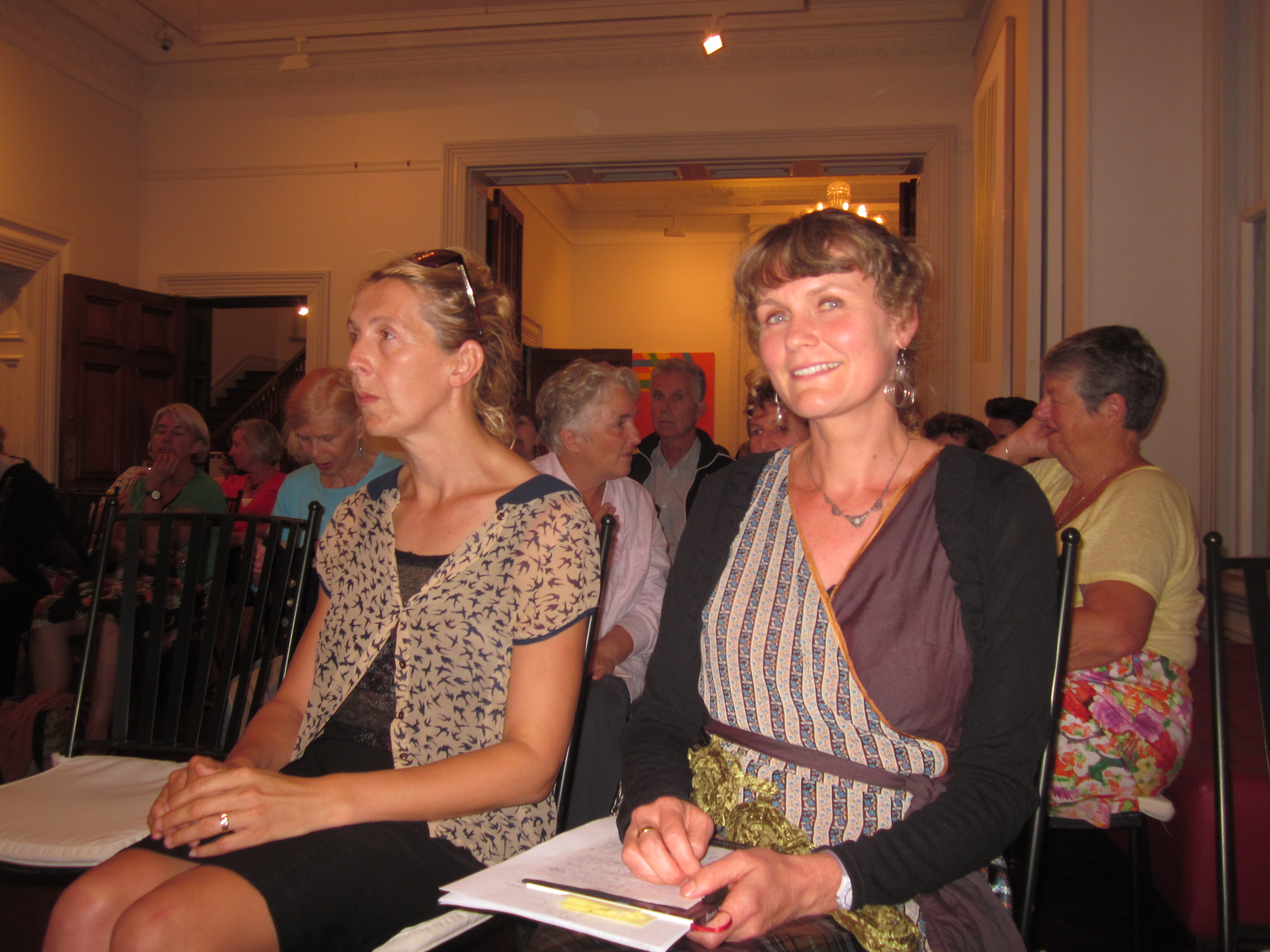
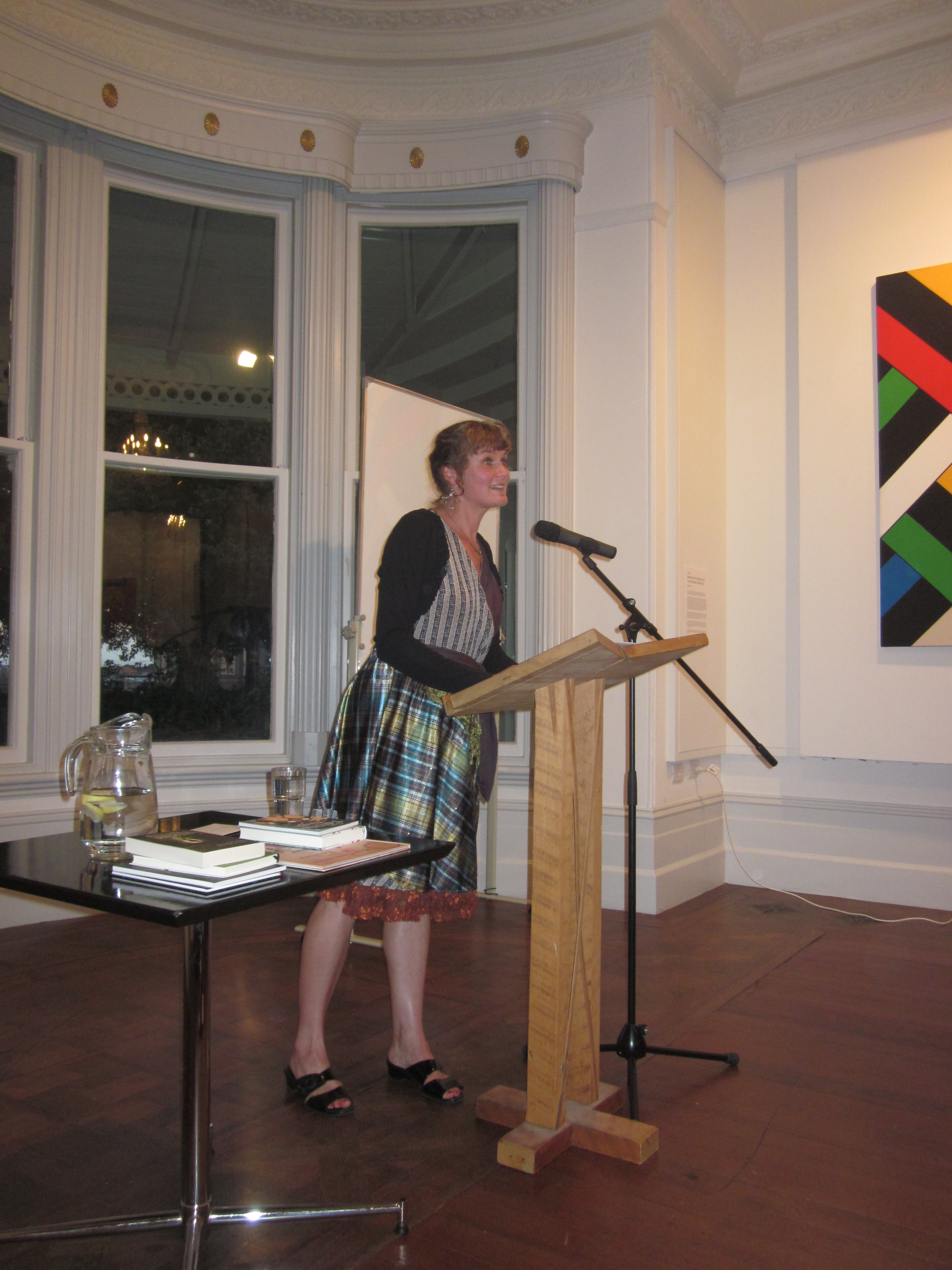
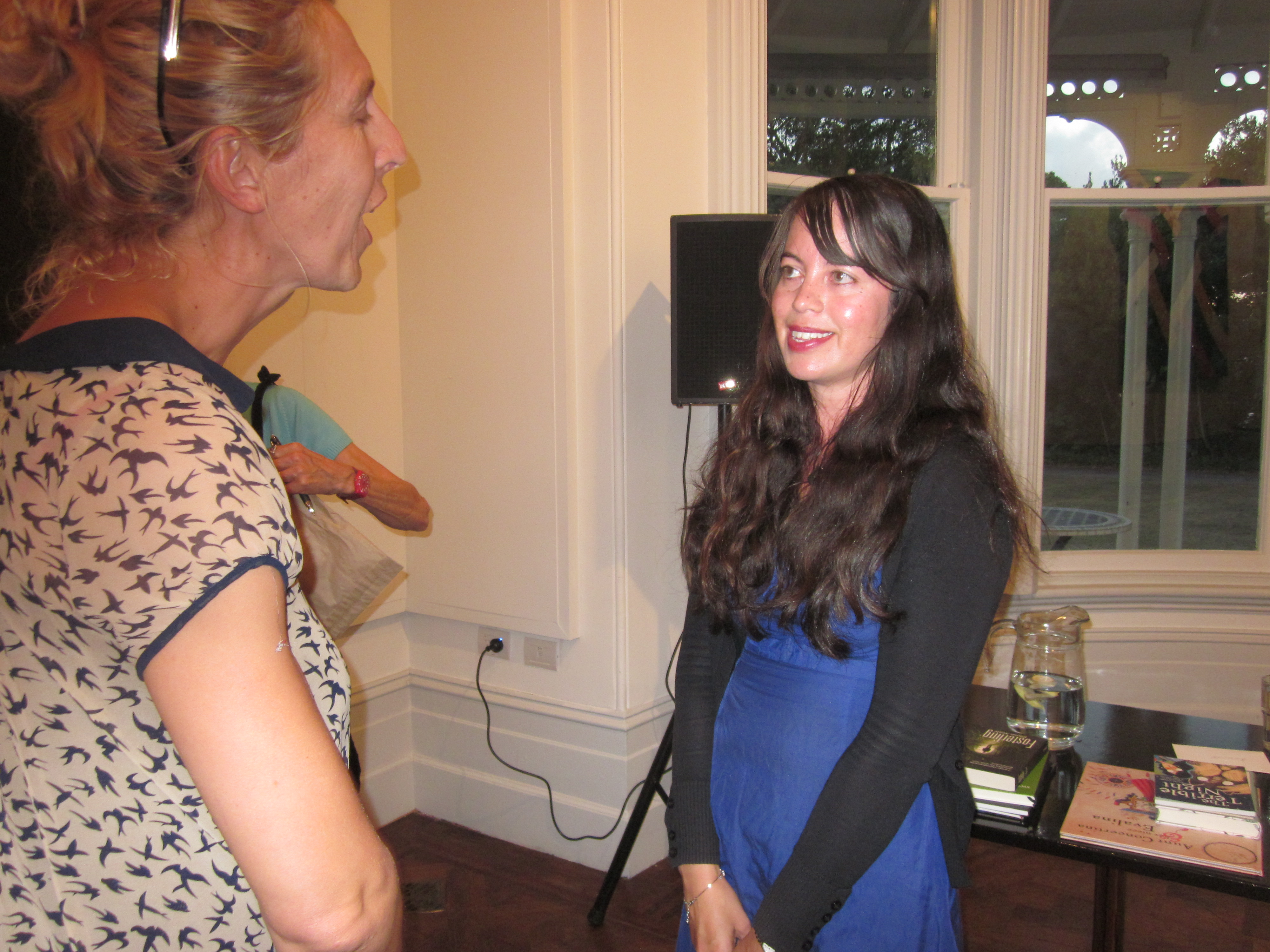
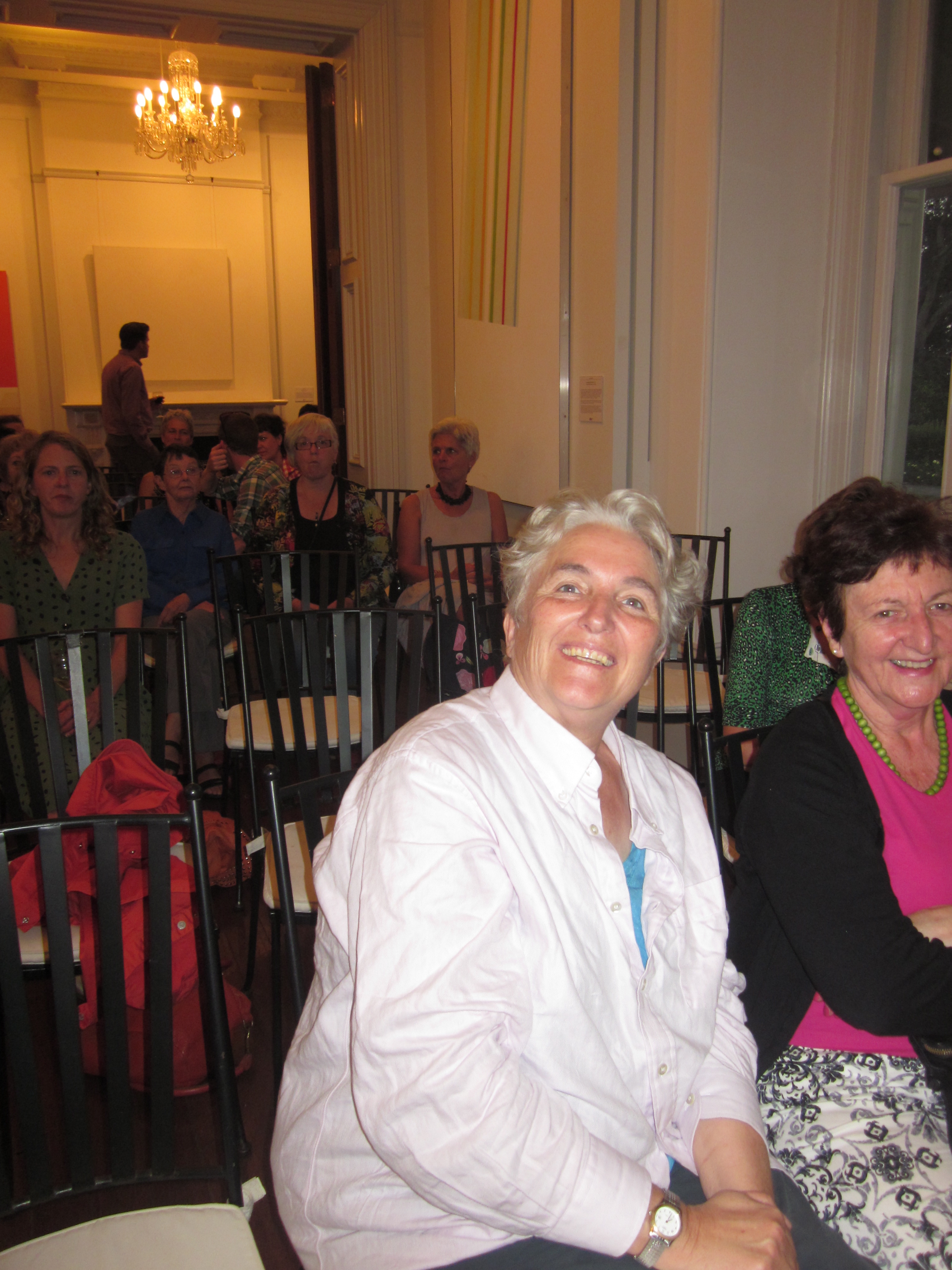
Last night Siobhan Harvey and I were the support acts for Emma Neale who is the current Literary Resident at The Pah Homestead in Auckland. There was an impressive audience made up of poetry fans, local poets, friends and family.

What a treat to hear our guest from Dunedin read. At question time, someone asked Emma to discuss the difference between writing poetry and fiction (she does both!). For her, poetry originates in a musical phrase, a musical fragment, the music of language (Interestingly she shows drafts of her novels to people for feedback but not drafts of her poems). When I sat back into the pleasure of her poems, it was my ears that pricked to attention — to a state of utter attentiveness. I have read the poems in The Truth Garden a number of times and admired their musicality, but to hear them in Emma’s voice adds extra musical zest. Words chime and words tremble. I particularly loved hearing ‘An Inward Sun,’ a poem written after Janet Frame. Emma gave us humour, intimacy, self revelation.

Two new poems particularly stuck me. The prose poem, ‘Stoic,’ that looped and curled on itself, drawing upon a mother-in-law along with the poet herself. It was witty, sharp, wry, pungent and densely packed with musical notes and observation. Then, in a completely different tone, but equally transporting, ‘PokPo’ used a  work of art as a starting point (a large white mouse). This poem was as much about mother and son, and maternal relations, as it was about art. There was poignancy and daring in its musical phrasing.

Interestingly Emma’s The Truth Garden was published as a result of The Kathleen Grattan Award — and Siobhan Harvey read from her manuscript that won the same award last year. Her reading of excerpts from the long narrative poem moved the audience profoundly (it will appear in book form later this year courtesy of Otago University Press!).

As for me I came away feeling I had put my foot in my mouth after responding to a question: Is there such a thing as women’s poems? Or some such wording. I spent seven years writing a doctorate where my central thesis/question was: Does it make a difference if the writer’s pen is held by a woman? This was explored in an Italian context (my Doctorate is in Italian). However, I read theory from all round the world as well as navigating Italy’s social, cultural, legal, political, historical and literary contexts. Such a question cannot be reduced to a black and white answer. There are smudges and blurs whichever way you look. But I strongly feel we haven’t yet told the story of women poets in New Zealand. And for all kinds of reasons I do think it makes a difference when the pen is held by a woman. Does this mean there is such a thing as men’s poetry and women’s poetry? I don’t know. Reviews of women’s poetry still denigrate it with a gender bias. You have to go back to Ursula Bethell and Eileen Duggan (and then further back still) and follow in the footsteps of our pioneering women writers to see how style, tropes and content (they can be in a symbiotic relationship) create writing that some people dismiss (particularly if it is domestic). Gosh the whole feminine-masculine  debate is a minefield. Ahh! Mmm. Ah well.

But tricky questions aside, it was terrific night. Just wonderful. So grateful thanks to The James Wallace Trust and The Pah Homestead crew.IMG_4500 IMG_4502

Marty Smith’s Horse with a Hat– you get grit and you get open views

good one 7 cat

Marty Smith, Horse with a Hat, Victoria University Press, 2014

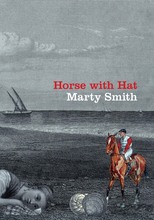
Marty Smith’s debut collection, Horse with a Hat, is a gorgeous book. The lush and evocative collages by Bendan O’Brien draw you in close, in a way that is both haunting and intimate. His cover collage replicates the way a poem can lead you to a wider picture (the ocean and its lure of voyage) and the catching detail (the pattern on a shell, the way a horse holds its head in anticipation). Heavenly!

The book itself is equally captivating. Horse with a Hat revels in poetry as a way of tracking a life, of harnessing an anecdote. The poems delve into relationships, previous generations, magical moments, pockets of history and, while they exude warmth and joy, Marty is unafraid of darker things, earthier things (violence, the threat of violence, grease and oil, bad tempers, men at war).

Marty was raised on a remote hill country farm between Pahiatua and the ocean so ‘bands of wild horses moving like wind patterns’ is as familiar to her as putting ‘the bloody thing [the lamb] out of its misery.’ Having learnt to ride, read and love horses from an early age, the animal is lovingly tended in the poems. Early on, the autobiographical and poetic motif is set when the father teaches the daughter how to ride bareback (‘Dad’s horses’). The emotional ripples—of a young girl trying to hold on tight with knees or keep up with the distant dot of her father—are poignant. So too is the poem’s lyrical beginning:

Dad’s horses

darken out the sun

I am at their knees looking up

at the lode star of the stirrup

and my four-storey father.

Horses are a nostalgic and potent link back to the author’s past, but they also connect the reader to the exhilarating movement of the poems (as though you are riding them bareback, wind in your hair so to speak). Poems are both reined in (diligently crafted) and set free (open to intuitive turns).

There is a sweet lyricism at work in these poems—from exquisite musical phrasing to biblical overtones to the pleasure of plain language in the service of narrative to gutsy dialogue. Here are some of my favourites:

‘I hide in the chook shed/ under a tin cold sky, thin bitter wind.’

‘It’s a demon—no it’s Dad, down in the dark/ sparks arcing off the grinder’

‘who flatten, who scatter’

‘I lived in the library. I was a child outside/ and I did not look up.’

‘He stays home with the slow slouch of cows’


There is terrific detail that adds vibrant life (yes, these poems are lived in!):

‘There are wasps all over the jam/ in the kitchen.’

‘the radio static fizzy, and raspberry biscuits.’

‘a heavy blur of rice’


And finally there are tropes that catch your eye:

‘My grandmother wore God like a glove/ to church’

‘the planes of light in the room’

‘bright flowers surprised to a standstill’


Marty’s collection takes you back to the child, to mother and father, and to country life, and in doing so you travel through sumptuous lines and layers. This is no rose-tinted memoir—you get grit and you get open views, you get life’s awkwardness and you get empathy. It is a fine debut.

Marty Smith teaches at Taradale High School, but she has also worked as a track-work rider in New Zealand and in England.

Horse_with_Hat_front_cover__77059.1385936731.220.220  Horse_with_Hat_front_cover__77059.1385936731.220.220  Horse_with_Hat_front_cover__77059.1385936731.220.220

Thanks to Victoria University Press, I have a copy of Horse and Hat for someone who likes or comments on this post.
 

Marty Smith’s website

Victoria University Press page

Blackmail Press multimedia performance and the stunning poem ‘Radar’

Marty Smith on Modern Lettuce