Category Archives: Poetry

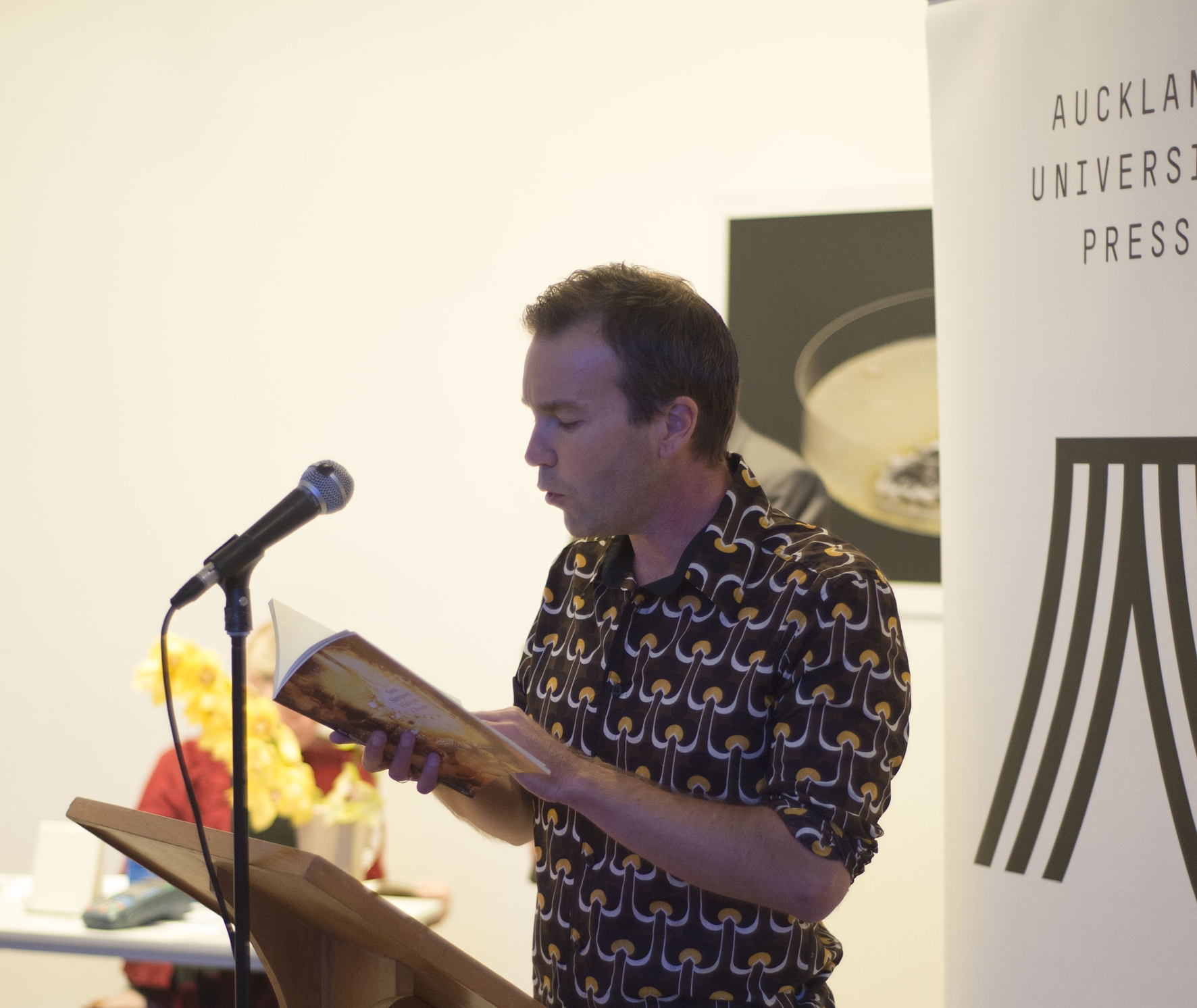
MEGA-READING AT OGH LOUNGE 6 August, 5.30-7 PM ALL WELCOME!

MEGA-READING AT OGH LOUNGE 6 August, 5.30-7 PM
ALL WELCOME!

LOUNGE #39 WEDNESDAY 6 August
Old Government House Lounge, UoA City Campus, Princes St and Waterloo Quadrant, 5.30-7 pm

Featuring  performances by:
Colin Basterfield
Amanda Eason
Murray Edmond
Sisilia Eteuati
Brian Flaherty
Gregory Kan
Fiona Melrose
Alice Miller
Peter Simpson & Jonathan Besser
Penny Somervaile
Free entry. Food and drinks for sale in the Buttery. Information Michele Leggott  m.leggott@auckland.ac.nz  or 09 373 7599 ext. 87342. Poster: http://www.nzepc.auckland.ac.nz/events/lounge39_poster.pdf

The LOUNGE readings are a continuing project of the New Zealand Electronic Poetry Centre (nzepc), Auckland University Press and Auckland University English, Drama and Writing Studies,  in association with the Staff Common Room Club at Old Government House.

LOUNGE READINGS #39-41: 6 August, 17 September, 22 October 2014

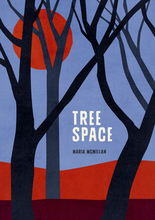
Maria McMillan’s Tree Space: a treasure trove of poetic connections—combinations that continually jumpstart the reader

Maria McMillan     TREE_SPACE__40939.1398819236.220.220    TREE_SPACE__40939.1398819236.220.220

Maria McMillan, Tree Space, Victoria University Press, 2014

(Thanks to VUP I have a copy of the book for someone who likes or comments on this post)

Maria McMillan’s biography tag on the back of her new book, Tree Space, fascinates me: ‘Maria McMillan is a writer, activist and information architect who lives on Kapiti Coast.’ Fascinating in the way these four key elements rub against each other.

Maria’s debut poetry book, The Rope Walk, was published by Helen Rickerby’s Seraph Press in 2013. It was a terrific arrival, and the sorts of joys that I fell upon there have been carried through into her new collection. As I wrote in my review for Poetry Shelf:

‘The poems are observant, musical, reflective and measured. The collection signals the craft and joy of small poems, words that are gathered together in a minor key where time stalls and you relish a moment. Maria knows how to write with the perfect degree of emotional seasoning and revelation (I will tell you this, but I will not tell you that). There was a sense of hide and seek for me as I read (and indeed there is a poem called ‘Hide and seek’).’

Tree Space is Maria’s first full poetry collection, and the poems have been written over more than a decade. Yes, there is a range of subject matter, style and inclinations, yet there is also a satisfying degree of cohesiveness. The poems step out from diverse starting points, yet frequently that starting point is a pivot for meditation. To me the poem provides an opportunity to delve deeper, to sidetrack and to offer slithers of anecdote.

What binds this book more than anything (although the deft ear comes close) is the way these poems, as poetic space, host relations. One of the delights of poetry is the way a poem reproduces and produces a series (‘set’ is too limiting a word here) of relations—whether aural, semantic or via tropes. There are relations amongst sounds, images, ideas and feelings. Some poets want to activate movement amongst all, others less so. You might fall upon relations between the real, the cerebral and the imagined. Relations between people, places and things. In my view, Tree Space is a treasure trove of poetic connections—combinations that continually jumpstart the reader.

The collection opens with ‘Song.’ An opening that is punctured, punctuated, startling. An opening that links sparrow to poet, the voice box to breath, the voice box to concealment (‘a parcel’) and revelation (anatomic). Pronouns tremble with ambiguity. Whose heaving chest? Hidden in the crevices is the ability to sing, the yearning to sing and the doubt ‘she’ can sing. And thus we enter the collection that sings.

The starting point as a pivot for poetic excursions is beautifully realised in the poem ‘salt marsh and tidal inlet.’ These words caught the poet-reader’s eye while ‘The other words get/ sucked back into the paper.’ It is as though the poet daydreams and we are caught up in her reverie, the words folding back upon each other, the nostalgic trip wires, the little spotlights on where you are and where you’ve been. Glorious!

In ‘Hairy Star,’ it is the breathless wonder at seeing the comet that the poet wants to preserve and remember for her sleeping child that hooks me, and the stepping stone between that sleeping form and the poet’s own little self. The own self: ‘Or my own self, carried to the steps by the back door/ to see a hedgehog. Milk in the saucer. Small noises.’ The sleeping child: ‘You were. In bed covered in pen marks and plum./ Sleeping. Outside your closed curtain/ half-painted trellis.’

I love the way the teapot in the poem, ‘In the very middle,’ transports you to all things strange, and the way ‘a polished cake spoon’ can show you yourself as ‘monsterish and wary.’ Again the pivot, the relations and the meditations.

There are so many poems that stand out for me (perhaps a tiny cluster at the back that don’t)—poems that generate myriad notes in my notebook. Maria is able to capture the luminous instance, a moment in time that becomes imbued with heat or longing or youthfulness. A moment that might be autobiographical or on the other hand invented. She steps into the shoes of others as adroitly as into her own.

‘Paradox’ finds  truth in the way sunflower seeds are both fast and slow growers and the way pumpkins are both heavy and light (and more examples). Maria’s poems are like that paradoxical pumpkin—exuding a tantalising simplicity of form and line yet embracing space that is sweetly fertile. Her poems are quick to the ear and a slow release to the mind. You save the room to move and the detail that sticks. These poems take exquisite flight whilst keeping toes in the soil. I loved this collection.

Victoria University Press page

Seraph Press page

VUP interview

Maria’s blog

Poetry Shelf interview with Maria

Interview with Janis Freegard

Poem Friday: Jessica Le Bas’ ‘Aroa Beach’ Its opening lines are effervescent with possibilities

Photo 21


AROA BEACH


            dealing sheep

            the ace of moon


The first night the tiny ants came

like a weak shadow. They drew lines on the wall

In the light that visited with part of a moon

you read their stories


The sun crept in during the night

Had its eyes closed tight, but it was there

never letting the day go. Simmering heat, a chorus of bugs

By dawn the sheets were abandoned


The second night was naked

Limbs cast off from your wet body, sailed ashore

in search of a cool zone. The morning light

came without land


The third night was opened under dusk

And inside, wrapped raw and true was the lightweight relief

of new dreams, and a ‘see through blue’ ocean

as soft as a song.


Bio Note: Jessica Le Bas’s first collection of poetry, incognito (AUP) won the Jessie MacKay Award. Walking to Africa, about mental health in adolescence, was a finalist in the Ashton Wylie Book Awards. She also writes children’s fiction, Staying Home (Penguin), and lives in Nelson

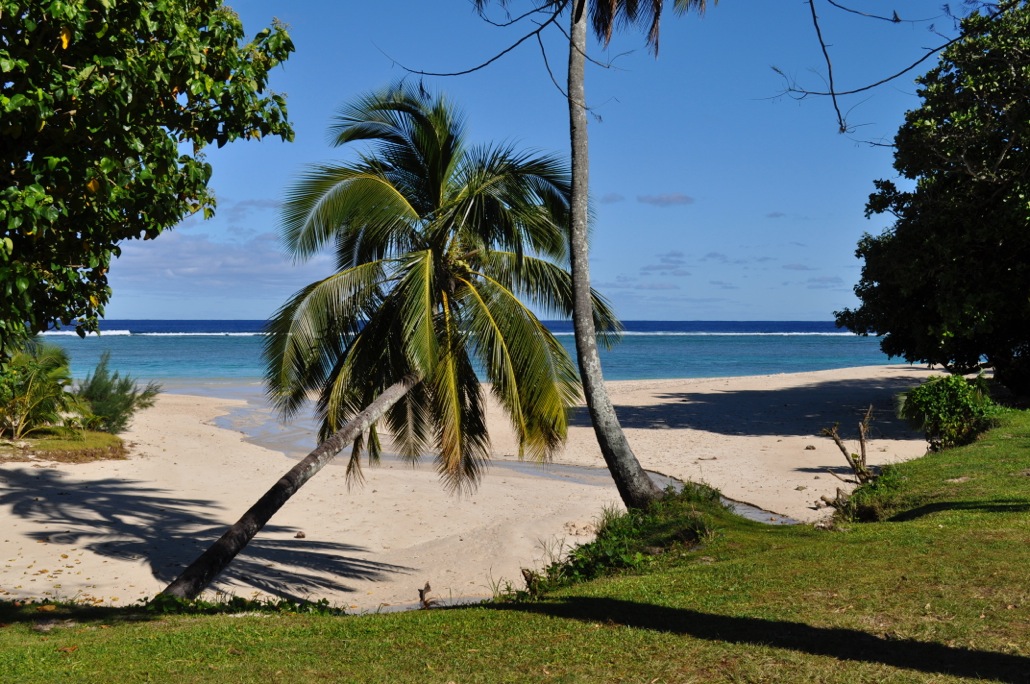
Author’s Note: I recently lived and worked in the beautiful Rarotonga for a year. The week I arrived the temperatures were in the high thirties, with little reprieve at night. I couldn’t sleep, as much from the heat and excitement, as from a fascination with new light and shadows, new sounds, and an army of ants that came nightly to watch over me. It took a while to find the ebb of my new life, at which point it felt like I had been dealt the ace, the top card!

Paula’s Note: Jessica’s poetry has always caught me, whether in terms of lithe sounds or missing pieces or shimmering images. This poem is no exception. There is a delicious movement between a facade of simplicity and a billowing knot of complexity. There is equally delicious restraint. The luminous details represent a world at a slight tilt where everything seems marvellous, strange, significant, legible, illegible. The poem is like a pocket narrative that gains life through its startling images. Its opening lines are effervescent with possibilities—as is the poem. You could move in any direction. That is the joy of poetry. You are led into the blurred edges of night, of a dream state where topsy turvyness (the sun in the night) underlines the relentless grip of heat. Or where dreams, against all odds, lay down (‘the lightweight relief’) the tracks to epiphany. Wonderful!

Auckland University Press page

Blackmail Press poem

Radio NZ interview

Jessica on rhythm for The Nelson Mail

NZETC page


DSC_5977

The website of New Zealand’s Poet Laureate has moved.

Website can be found here.

Here is a taste of Poet Laureate, Vincent O’Sullivan’s latest post:

Until a few months ago, all I knew of Mexican poetry was from a few international names like Octavio Paz, a selection of translations by Samuel Beckett, and a number of fine poets from anthologies. Then my discovery that in fact Spanish American poetry was being written a few kilometres from where I live. Rogelio Guedea has been in Dunedin for almost a decade. He teaches at the university, an intellectual who contributes regular political columns to papers in Mexico, a former legal prosecutor, a writer of crime novels, and a prolific poet. El crimen de los Tepames, the final volume of a fiction trilogy, last year was a best seller in Mexico, and his poetry has won Spain’s Premio Adonais. The enterprising Roger Hickin, whose Cold Hub Press is the only New Zealand imprint that brings out collections in foreign languages, is about to publish Si no te hubieras ido/If only you hadn’t gone, with his own finely pitched translations. The set of thirty four poems was written while the writer’s wife and family was temporarily back in Mexico. As I’ve noted in an Introduction to the volume,

‘Ordinary,’ I expect, is the first word that may come to you, should you ask, what kind of world is this, that these poems are part of? For that is the ultimate grace, you might say, that the poet’s wife bestows on a house and a suburb while she is there, and that seems so distant, so unlikely, when she is not. (…)

Visit site to read the rest of the piece.


The Emma Press (UK) Seeks Poems about Myths and Legends for Children (and more!)


The Emma Press Seeks Poems about
Myths and Legends for Children

The Emma Press has launched an open call for poems about myths and legends for an anthology aimed at children, publishing in spring 2015. The independent publisher is looking for poems which ‘tell myths and legends in fresh, engaging ways, and which give new spins to old stories and characters.’

The book will be edited by Rachel Piercey (Newdigate Prize, 2008) and Emma Wright, who have collaborated previously on The Emma Press Anthology of Mildly Erotic Verse, A Poetic Primer for Love and Seduction and The Emma Press Anthology of Motherhood and Fatherhood.

Publisher Emma Wright said: ‘This will be our first children’s book, and we’re very excited about reaching a new audience of writers as well as readers. I’ll be interested to see which stories poets choose and how they approach writing for children. I grew up reading stacks of treasuries of fairytales and myths, so I’m looking forward to producing my own fun, subversive and sumptuously illustrated book.’

The Emma Press was founded in 2012 and has since published three themed poetry anthologies, including The Emma Press Anthology of Fatherhood in May of this year. Anthologies about homesickness and exile and female friendship are scheduled for autumn 2014, and the publisher has just launched a further call for poems about age and ageing, as well as proposals for poetry pamphlets.

Poets are invited to submit up to three poems to myths@theemmapress.com. Entry is free, but all poets must be members of The Emma Press Club, whereby the purchase of a book from the publishers’ website allows entry to all calls for anthology submissions within the calendar year. the deadline for submissions is 3rd August 2014. For more details, visit the publisher’s website at http://theemmapress.com/about/submissions/

About the Emma Press

The Emma Press is an independent publisher dedicated to producing books which are sweet, funny and beautiful. It was founded in 2012 in Winnersh, UK, by Emma Wright and the first Emma Press book, The Flower and the Plough, by Rachel Piercey, was published in January 2013. The Emma Press was awarded funding from the National Lottery through Arts Council England to run the 10-date Mildly Erotic Poetry Tour around the UK in Autumn 2013, to coincide with the publication of The Emma Press Anthology of Mildly Erotic Verse. For more information about The Emma Press, please contact Emma Wright at editor@theemmapress.com


Best First Book – Poetry winner has been announced

good one 7 cat     Horse_with_Hat_front_cover__77059.1385936731.220.220

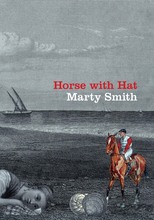
The Best First Book Award for Poetry at The New Zealand Post book Awards goes to Marty Smith and her stunning debut, Horse with a Hat.  The book has beautiful illustrations by Bendan O’Brien and is published by Victoria University Press.

Warm congratulations to Marty and all involved. Well deserved accolades.

Earlier on Poetry Shelf I reviewed the book:

Marty Smith’s debut collection, Horse with a Hat, is a gorgeous book. The lush and evocative collages by Bendan O’Brien draw you in close, in a way that is both haunting and intimate. His cover collage replicates the way a poem can lead you to a wider picture (the ocean and its lure of voyage) and the catching detail (the pattern on a shell, the way a horse holds its head in anticipation). Heavenly!

The book itself is equally captivating. Horse with a Hat revels in poetry as a way of tracking a life, of harnessing an anecdote. The poems delve into relationships, previous generations, magical moments, pockets of history and, while they exude warmth and joy, Marty is unafraid of darker things, earthier things (violence, the threat of violence, grease and oil, bad tempers, men at war).

For my full review see here.

Best First Book -Fiction: Tough by Amy Head  (VUP)

Best First Book Non-fiction: Tragedy at Pike River Mine by Rebecca Macfie (Awa Press)

Poem Friday: Frankie McMillan’s ‘My father, the oceanographer’ — its poetic co-ordinates set for some form of truth

2012-10-11_16-06-33_689 (6)

My father, the oceanographer


knew the language of whales

yet tripped over the sound

of his own name


They say the cure for death

is drowning and for a lisp

a bucket of salt water


*

In white gumboots he entered

the stomach of a whale

sat brooding under the great arched bones

of a church


invoking the mantra of LFA sonar

whale fall

and echolation


stripped to his underwear,

so great was the heat, and

blubber he said


now there was a word to make you weep


Author’s note: I’m never sure how a poem is ‘made’ but once I have a good opening line it gives me the courage to explore the possibilities. It’s a hit and miss method and out of the many poems I attempt only a few survive. I think this poem may have echoes of the biblical story, Jonah and the whale. The fact my father hardly talked to me as a child may also have informed the poem. Or then again, I’d seen the film, ‘The King’s Speech’ which might have worked its way in with whales. I imagine a lot of poets work in this subconscious fashion.

Author’s bio:Frankie McMillan is the author of The Bag Lady’s Picnic and other stories, and a poetry collection, Dressing for the Cannibals. In 2005 she was awarded the Creative NZ Todd Bursary. In 2008 and 2009 her work was selected for the Best NZ Fiction anthologies. Other awards include winner of the New Zealand Poetry Society International Competition (2009) and the NZ National Flash Fiction award (2013). This year she is a co – recipient of the Ursula Bethell writing residency at Canterbury University. Her next book of poetry, There Are No Horses in Heaven is to be published by CUP in early 2015.

Paula’s note: I loved the way the words looped and slipped over each other in this poem as though embarking on little ventures into echolocation. Each shifting phrase becomes a way of locating yourself in the poem — in its mysterious seams and lyrical folds. In the first verse, we get a magnificent yet miniature portrait of a father, of a man who is adept on one level, yet not on another. That delicious irony sets off the first ripple through the poem. The second ripple extends from the width of water to drown in to the single word that induces tears. This poem is like an ode, a sweet tribute to a father, but it is also like a tribute to the power of language to skid and skate, to conceal and spotlight. I loved it for its tenderness, its humbleness and its poetic co-ordinates set for some form of truth.

Poem Friday: Kiri Piahana-Wong’s ‘Kahukeke’ flows down the page like water, honeyed in its fluency

night swimming author pic


Kahukeke

Here at Hikurangi,

the waters pour

down Waitekahu

and into the sea.

On the threshold,

the surf surges up

against the river.

Quietly the water

is absorbed.

Even in flood, the

river is never as

strong as the ocean

it returns to.

Kahukeke used to

kneel here, washing

in the river.


Kiri’s note on the poem: At the moment I am working on my second poetry collection, which has the working title ‘Tidelines.’ The collection is based around the history of the Te Kawerau a Maki people, kaitiaki of the Waitakere Ranges region in West Auckland where I currently live. Other iwi also traversed this area, amongst them Kahukeke, who was the wife of the senior tohunga of the Tainui canoe, Rakataura. In this poem, and others in the collection, I am attempting to inhabit the lives and voices of these early tūpuna.

Author bio: Kiri Piahana-Wong is a New Zealander of Māori (Ngāti Ranginui), Chinese and Pākehā (English) ancestry. She is a poet, editor and publisher. Her first poetry collection, night swimming (Anahera Press), was published in 2013.

Paula’s note: Kiri’s poem flows down the page like water, honeyed in its fluency. Such fluency is addictive; you keep returning to the beginning to fall again into the watery flow. Then, the final image arrests you–the way, in the midst of riveting scenery, and the cyclic and never-ending movement of nature, there is the precise and vital instance of human activity. This image of a figure kneeing is poignant, potent. In such ways, the poem is utterly absorbing.

Poetry Shelf Interviews Sam Sampson–I try to forget that I’m writing a poem and hopefully an intuitive intelligence takes over


Sam Sampson June 2014

Photo Credit: Roland Vink

Auckland University Press recently published Sam Sampson’s second poetry collection, Halcyon Ghosts. To celebrate this, Sam agreed to answer some questions for Poetry Shelf. I will post a review shortly.


Did your childhood shape you as a poet? What did you like to read? What else did you like to do?

I’m not sure my childhood shaped me as a poet. I had a pretty ordinary white middle-class NZ upbringing, living out in the wops (as the Waitakeres were called in those days). But now, looking back at the books, plus audio and visual stimulus, maybe there is a correlation to what I’m up to now.

Early on I was introduced to nursery rhymes from both grandmothers, and from books that survive, a combination of traditional fairy tales and fables. I also remember being an avid listener of the radio (1ZB stories) on a Sunday morning.

My paternal grandmother (Nana) lived in Mt Albert and had retained all of my father’s exercise books, school prizes, and books, and these were stored in my father’s childhood bedroom. This is were I started my extramural reading, primarily the standard Anglo-fare of children of my father’s generation: Enid Blyton’s The Famous Five, The Secret Seven, and J.M. Barrie’s Peter Pan In Kensington Gardens (with pictures by Arthur Rackham), Daniel Defoe’s Robinson Crusoe

As much as these stories peppered my imagination there was the environment I grew up in at the bottom of South Titirangi Rd in West Auckland. There were the kauri, the tea-tree, the wood pigeons, tui…the Manukau (Jenkins Bay) on one side, and Little Muddy Creek on the other. As a child I had a magical upbringing. I swam in Little Muddy Creek, kayaked over to the dairy at Laingholm to buy ice cream, climbed trees, went fishing with uncles and friends…swam, surfed at Karekare, Piha, Anawhata, Whites, Whatipu, Bethells….


When you started writing poems as a young adult, were there any poets in particular that you were drawn to (poems / poets as surrogate mentors)?

I didn’t start out writing poems but song lyrics, which I suppose were early poems of a sort. A number of the songwriters I admired had either published prose, or poems, so I started to search out poets and thinkers they referenced.

In my late twenties I started sending poems out to poets and magazines. I flatted in a house where the owners had gone overseas and left an extensive library at our disposal. I remember reading Wallace Stevens (being transfixed by ‘The Man with the Blue Guitar’), William Carlos Williams, Hans Magnus Enzensberger, Walt Whitman, James K. Baxter, Stephen Spender, Michael Ondaatje, and The Penguin Book of New Zealand Verse (edited by Ian Wedde and Harvey McQueen). It was here I discovered the poems of Allen Curnow and started to seek out his work, partly I think because of the discursive line he wrote, but also because of his distinctive and recognisable images of Karekare on Auckland’s West Coast, which had been familiar to me right through childhood. Later, after discovering my great-uncles were early members of the Karekare Surf Patrol, and my grandfather (a mechanic) repaired the surf club trucks, this gave a gravitas of sorts to the environs I grew up in and anchored the familial with Curnow’s type of philosophical topography.

In 1999 I sent an early batch of poems to Allen Curnow and received back a reply, where he wrote, amongst other things, that I’d sent him quite a remarkable variety of ‘contruptions’ (Auden’s word). Now, for me I was overwhelmed that Allen Curnow had taken the time to read my work and respond, but I couldn’t work out this mysterious word of Auden’s: ‘contruptions’ – was it like an interruption contrariwise, a continuing interruption, or disruption – or some other fantastical Auden word? At the Auckland Readers and Writers Festival in May of 2001 I went to hear Allen Curnow read, and afterwards, queued to get my copy of Early Days Yet signed. When I reached the signing table I introduced myself, and as he was a little hard of hearing, repeated loudly and a number of times that he’d said my poetry was a series of contruptions (Auden’s word). He looked at me quizzically, and said, you mean ‘contraptions’…. it was then I realised his spidery, looping handwriting had turned the ‘a’ to a ‘u’. For two years I’d imbedded the notion of my poetry as being christened by Allen Curnow as a series of contruptions. Today it seems appropriate; maybe my work is a series of ‘contruptions’, somewhere in between a contraption, a disruption, an inter-ruption.


That is wonderful! Like a mishearing. Did university life (as a student) transform your poetry writing?

Yes, it was an immersive shock to the system. Not so much in the area of poetry writing but more the eclectic mix and match of subject matter. At the time I did my BA, and MA (I combined both papers in Philosophy and Ethnomusicology) I was lucky enough to have full year papers and this left enough time to explore a subject, to read books associated with the syllabus. This journey of discovery was the reason I found my way to literature, and especially to philosophers and poets.

While studying, I took a part-time job as a roadie and stage assistant for the local orchestra (The Auckland Philharmonia). For eight years I had access to a wonderful roster of orchestral rehearsals and performances. I couldn’t tell you exactly how it influenced my work, but talking and listening to musicians, conductors, and composers gave me a sense of how music could lift the notes off the page. I felt that as poetry is built around shifts of tempo and modulations of pitch, every gesture was connected to meaning and is an intuitive way of sound sculpting. This is not to say I felt poetry (my poetry especially) should ever purely be of the sound poetry tradition. I felt meaning inherently tied at the initial compositional stage, but this structure could be extended, until in some cases only a shimmer of the original meaning was left behind.


You have an MA in Philosophy and I do see philosophical undercurrents in your poetry — you are unafraid of embedded ideas. How do you view the relationship between philosophy and poetry in your own writing?

I started writing poetry in the last couple of years at university. I was more interested in Philosophy than taking papers in the English department (my degree has no papers from that department) although saying this, I was interested in philosophers who also wrote poetry and prose – especially the Continental Philosophy tradition, which articulated different formulations of the phenomenal and noumenal world…of empirical and non-empirical knowledge…


I love the way your poems exude joyfulness. In the power of words to delight and astound. To take us to unexpected places, poetry as an archaeological dig. What are key things for you when you write a poem?

I’ve always been interested in writing a poetry that evokes the joy of being found. But maybe joy could be extended to light…the refracted light in language that is unearthed. Sound is important for me in a poem, as is meaning and the shape of the text. I think as children we delight in this full range of possibilities and somewhere along the educational spectrum are conditioned toward a certain code of intelligence. I try to forget that I’m writing a poem and hopefully an intuitive intelligence takes over, and to use that wonderful John Ashbery analogy, a bucket is lowered down into a kind of underground stream flowing through the mind and is brought back to the surface. I try to let the language propel itself, not to worry initially about specific meaning, and when re-writing, to delight in unexpected slippage. As James Joyce said, when asked: ‘Aren’t there enough words for you in English?’ he replied: ‘Yes, there are enough, but they aren’t the right ones.’


Do you think your writing has changed since your debut collection?

Yes, definitely the writing has changed but carries over frames and referents from the last collection…my flow is going with time…as Leigh Davis wrote. I see myself as writing one book of poetry, with of course variations within the body of work.

Looking at this book I see a synchronicity, what others have called an analytic lyricism. I can join more dots when looking at the book as a whole, but saying that, I’m not sure how to describe the poems. It seems reasonable primary facts have been lost, other facticities I have created to replace forgotton fact, certain memories I have erased, or chosen to omit. When trying to chart poems, frames of reference will only take me so far, and images make me believe there was an event connected to each and every poem. I hope in this body of language I’ve let the subjects find themselves and inadvertently resurrected the dead. The dead here, I take to mean, not just those that have passed away during the writing of this book, but also the language that has been unearthed, the unearthed vestiges.

In coaxing this book into existence my maternal grandmother died, my daughter was born, and at the end of January, I took my father home to die. This book means something, but at the moment I’m too close to it, and I’m just not sure what, or even if it will ever be accessible to me.

People have told me my poetry will alter, not by any act of will, but because of a process, a process whereby living inevitably reconfigures one’s relationship to the world and to one’s sense of mortality and life. This book is a type of reel, a reel of life… in my beginning is my end… and the halcyon ghosts that manifest in this circuitry of life, live beyond their deaths – where names displaced by light / are dark but not lost….


Michael Hulse recently queried the status of certain poems in a review he did for New Zealand Books. In his mind, some poems weren’t in fact poems. How would you define poetry?

I’m not sure, as I haven’t seen that particular review. I know Michael and he is a very good poet and critic. I know from my perspective everything I set up to write as a poem, is a poem. I’m thinking here in the area of the conceptual arts, where Duchamp’s Fountain (porcelain urinal) is in fact an artwork when placed in the context of the gallery. I admire the work Kenny Goldsmith is doing with his ‘Uncreative Writing’ model, although I find it hard to produce pure conceptual work along those lines (I wrote a little more about this if anyone is interested: A Response). So to answer your question, I think it depends on the framework you set-up for ‘poetry’, and to my mind anything is possible.

Alternatively, I was reminded of what Allen Curnow said in an interview in the collection, Look Back Harder (1987):

…when one thinks or hopes one had brought off a poem of one’s own uncontaminated, it looks, at first, so utterly unlike anything one has ever read that one is worried about it – this can’t be poetry at all, it’s a curious sort of uncouth gangling kind of thing, and yet this is how it turned out. What has usually happened is that poem is definitely one’s own. This doesn’t necessarily mean it’s good, only it’s one’s own.


At times dislocating in the sway between deeply familiar and disconcertinly not so. You have turned to the shape poem in your new collection. When I first opened your book, it felt like I was entering a field of beauty — in the formation of the poems on the page and the phrases snared in the corner of my eye. What fascinated you about shape poems?

As I see and hear the world through poetry, I let it take shape – so to me all poems are shape poems. The shapeliest in the book is the title poem ‘Halcyon Ghosts’, which is in counterpoint to photographer Harvey Benge’s Birds. Harvey’s bird series seemed to open up the possibilities of a type of presentational immediacy, and more generally, a formation, or frame for language. In this instance the words articulate, and are mimetic in loosely following the flight path of migrating birds (the bird’s the word) but in my work I hoped to disrupt the reader by starting the poem on the recto (right) page, then moving the poem to a more traditional left-right reading pattern. The words loosely follow nature (birds), until the last frame, where my stanza becomes nature: the words and birds are both committed and identically. (I was reminded here of the wonderful Ed Harris Pollock movie, when Jackson Pollock asked by his partner Lee Krasner on why he didn’t paint, or imitate nature, his response: ‘I am nature’.)


I love the phrase on the back of your book, ‘thirteen shapes of knowing.’ Can you expand upon this?

Thirteen, consciously, and unconsciously, became an important touchstone throughout the book. There are thirteen poems in the book, the cover still La lampada della nonna (Grandmother’s Lamp) was produced in 1913, there are references to thirteen lunar cycles, thirteen ways of looking at a blackbird, the sun travelling thirteen degrees across the sky, McCahon’s number poems, Rothko’s number titled poems, plus many of the stanzas add up to thirteen; for example: ‘The Tombstone Epitaph’ is written in XIII stanzas…thirteen ways, or cinematic vignettes of looking at the famous gunfight at O.K. Corral, and the subsequent pursuit of the Earp gang.

Throughout Halcyon Ghosts, I also looked to number thirteen as a graphical representation, which I hoped may move the reader to see the poem as more than just a semantic meandering, and as much, a symbolic, or figurative representation of this numerical value.

Just to continue with the numerological, or repetitive arrangement of the book; this book is dedicated to my maternal grandmother, and my daughter. My daughter Lucia, was born on Friday 13th, at 1:13 in the morning, in Room 13 at Auckland Hospital; my grandmother was born in London, on March 13th, 1920, and died in Auckland, on December 13th, 2009. The idea of repetition, of a loosely constructed numerical frame is part of the circuitry that makes up this book. I hoped the poems were both spontaneous and exacting – a reel of real…a dancing in chains.

Coincidentally, Halcyon Ghosts was launched on Friday 13 June and my last book Everything Talks, was also launched on Friday 13 June, six years earlier.


What NZ and international poets have mattered to you over the past year?

Much of my reading is grazing online journals and blogs, reading what’s there in front of me. The books on a small shelf next to my desk are books I revisit, or recent purchases…(on the shelf at this moment): Barbara Guest; Paul Muldoon; Wallace Stevens; John Ashbery; Gustaf Sobin; Geoffrey Hill; Peter Cole; John Cage; C.K.Stead; Michael Palmer; Murray Edmond; Anne Kennedy; Ian Wedde; T.S.Eliot; John Keats; Alice Miller; Samuel Beckett; Eliot Weinberger; Keith Waldrop; Leigh Davis; Zach Savich; Elisa Gabbert.


The constant mantra to be a better writer, is to write, write, write and read, read, read. You also need to live! What activities enrich your writing life?

At the moment it’s a busy bustling lifestyle, looking after my nearly four-year-old girl (who now insists the next book must contain at least one ‘dinosaur’ poem!). The beginning of this year was particularly demanding, working towards this publication and caring for my father who died in January.

In the summer months I try to spend as much time at the West Coast beaches and Waitakere Ranges. I love swimming in the ocean, and through November–April, I swim with a couple of friends at Cornwallis Beach at the Manukau Harbour entrance. There’s something invigorating about bobbing about in the ocean five hundred or so metres offshore and looking back. I’m also a keen sea kayaker and in March was lucky enough to spend four days kayaking in the Coromandel, in and around Cathedral Cove, and then in late April, four nights kayaking the magical Tutukaka coastline…Rocky Bay…Matapouri Bay…Whale Bay….


Yes, do try a dinosaur poem for her! Finally if you were to be trapped for hours (in a waiting room, on a mountain, inside on a rainy day) what poetry book would you read?

I was trapped in a hospital waiting room waiting for my mother who had an appointment. I think I was there for about five hours and luckily had just received in the mail the second volume of Robert Creeley’s Collected Poems 1975–2005 that starts with the poem, ‘Wellington, New Zealand’. It was a great read, but I prefer his first Collected (1945–1975) more for the radical and influential shifts in register.

But if trapped for hours anywhere, I would have to say the magnificent Collected Poems of Barbara Guest. In the introductory essay by Peter Gizzi, he quotes Barbara Guest:

The most important act of a poem is to reach further than the page so that we are aware of another aspect of art…. what we are setting out to do is delimit the work of art so that it appears to have no beginning and no end, so that it overruns the boundaries of the poem on the page.


Thanks for such generosity of response Sam.

Auckland University Press page

Sam’s website