Category Archives: NZ Poets

Celebrating a year on Poetry Shelf: Four short poems by Bill Manhire


Top Dance Moves

You stand around not knowing what to do.

Then music comes and puts

its foot inside your shoe.


The E-mail Lover

Such clumsy roads keep us apart!

If I could find

the old, hand-written heart.


Beyond the screen but not completely out of reach

I can just make out the blackboard

where the first of my teachers first wrote speech.


My World War I Poem

Inside each trench, the sound of prayer.

Inside each prayer, the sound of digging.


© Bill Manhire 2014


These couplets are from Top Dance Moves & other poems, a slim chapbook published by Marinera Press, Wellington 2014. Some you may recognise as Bill tweeted a few of the short poems in the book from @pacificraft. This glorious wee collection filled me with the joy of poetry — the way slender lines send tendrils into a past that jumpstarts, or a heart that pulls, or a melody that swings, or a present that makes believe. One of my favourite reads of the year.

Thanks to everyone who read, shared or contributed to my posts in 2014.

Warm regards for the summer break,

Paula Green


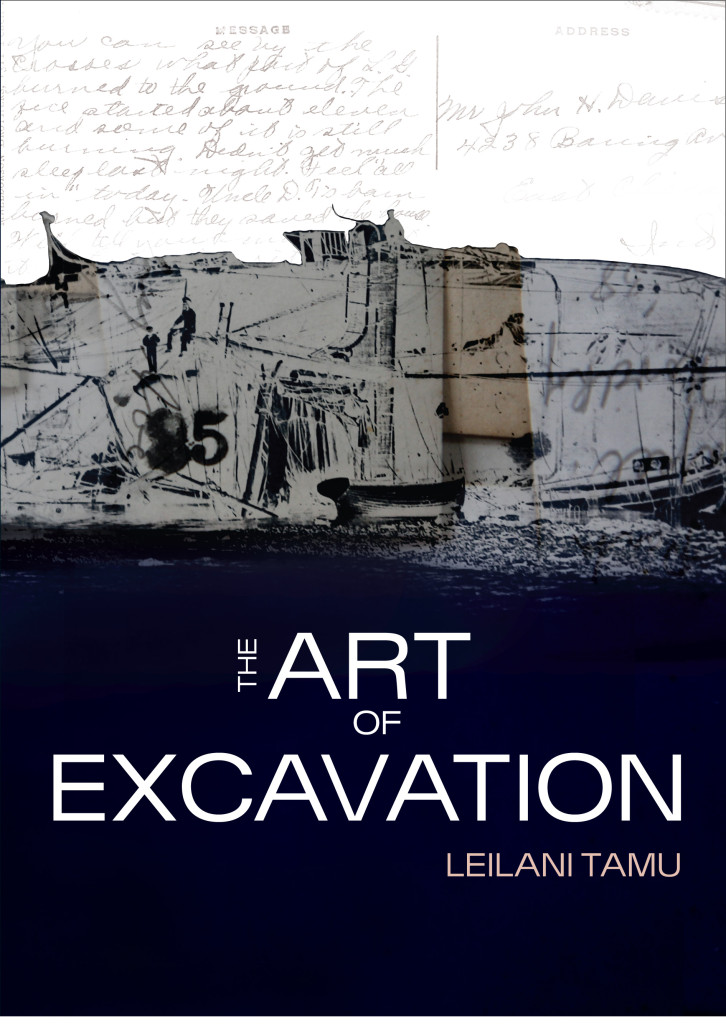
Leilani Tamu’s The Art of Excavation — This is an impressive debut that lays poetic roots in the present in order to nourish the past.

Art_of_Excavation_cover-726x1024

Leilani Tamu The Art of Excavation Anahera Press, 2014

Leilani Tamu graduated with an MA in Pacific History at the University of Auckland. She is also a  poet, social commentator and has worked as a New Zealand Diplomat. She was the 2013 Fulbright -Creative New Zealand Pacific Writer in Residence at the University of Hawai’i. Her poetry has appeared in numerous collections.

Leilani’s debut collection is in debt to the ‘concepts, ideas and philosophy’ underpinning her Masters thesis: Re-defining ‘the beach’: the Municipality of Apia, 1879 -1900. This poetry is the work of a poet who is Pacific archaeologist, word alchemist, hot-air balloonist (sees the world from new perspectives), scholar, musician, navigator, storyteller. The poems forge vibrant links with people and place, and with both economy and flair, they frame scenes and anecdotes. I was struck by the way the weighty package of a thesis is reduced to the slender frame and form of a poem yet billows with scholarly insight. A single phrase can open the poem out for the reader (‘layers of decaying colonial matter’ ‘but the missionaries/ caught the message/ on the wind/ and ate the bat’ ‘hijacked history remains supreme/ over dusty archives’).

Yes, these poems take you into history, a Pacific history that is forward facing as much as it includes  travels into the past. Yes, these poems are fueled by a genealogy of Pacific writers (there is a wonderful tribute to Albert Wendt’s ‘Inside Us the Dead’). Yes, these poems are lifted by a familial genealogy. The extensive endnotes and glossary add to the reading experience as they shine light on the genesis of a poem or linguistic options. What I particularly admired were the poetic choices that sung the Pacific as much as they commented on the Pacific. The line breaks augment the economy of words, together establishing the silent beats that evoke that which cannot be spoken, that which is spoken, that which is cradled and shared within  overlapping traditions of the Pacific. Or the aural chords and suspended alliteration that enacts the chords that link this person with that person, this place with that place, this event with that event. In ‘Midden Secrets’: you move from’ gut’ to ‘while at road juncture/ a collarbone juts  out’. In ‘A Tribute to the Black Ghost’: ‘like a black ghost the Sun’s ray glides/ on the surface of the lake-like lagoon’ and ‘with a flick of a wing/ her long sting trails behind.’

This is an impressive debut that lays poetic roots in the present in order to nourish the past.


Anahera Press page here

These Rough Notes: Bill Manhire, Norman Meehan, Hannah Griffin on RADIO CONCERT on Friday

A must-listen!

8:00 pm on Friday (12 Dec 2014)

Hannah Griffin (vocalist), Norman Meehan (pno), Colin Hemmingsen (cl/bass cl), Martin Riseley (vln), Stephen Gibbs (cello), Victoria Jones (dbass), Lance Philip, Bruce McNaught (percussion), George Mason (piper), Sue Prescott (whistle)

MEEHAN: These Rough Notes, An Evocation of Antarctica

Had we lived I should have had a tale to tell of the hardihood, endurance and courage of my companions which would have stirred the heart of every Englishman. These rough notes and our dead bodies must tell the tale (Robert Falcon Scott)

Drawing its title from one of the last pages of Scott’s journal, this collaboration between the poet Bill Manhire, composer Norman Meehan and singer Hannah Griffin remembers the tragedies of Scott’s polar expedition in 1912 and the crash of NZ901 into Mt Erebus in 1979. The collaboration also included images of Antarctica by Anne Noble, drawn from the series of Antarctic work she has been making since 2001 (recorded in Soundings Theatre, Te Papa, Wellington by RNZ)

More details here

Chris Tse’s How to Be Dead in a Year of Snakes — At times it feels like the intake of breath associated with the silence you grant the dead

1411440756602

How to Be Dead in a Year of Snakes Chris Tse, Auckland University Press

Chris Tse is a writer, musician and actor whose poetry first appeared in AUP New Posts 4 (Auckland University Press, 2011). He resides in Wellington, his home town.

Chris’s debut collection, How to Be Dead in a Year of Snakes, responds to a moment in history not so much by narrating that history but by installing a chorus of voices. He takes an event from 1905 when Lionel Terry went hunting for a Chinaman in Haining Street, Wellington and ended up murdering Joe Kum Yung. Within the opening pages, the chilling event is situated in a wider context where laws proscribe the alienness that situates  Chinese as outsiders. This is what gets under your skin as you read.

The poems draw upon and draw in notions of distance, defeat, guilt and forgiveness. There are the unsettled imaginings of what it is to be home, to be at home and to be out of home to the extent that home becomes difficult and different. Mostly it is a matter of death (and casting back into life) whereby phantoms stalk and cry about what might have been and what is: ‘You spend your thoughts drowning in your family-/ missing from this vista- and contemplate a return with nothing to show/ for your absence.’

The collection harvests shifting forms, voices and tones that promote poetry as mood, state of mind, emotional residue. Yes, there is detailed evidence of history but this is not a realist account, a story told in such a way. Instead the poetic spareness, the drifting phantom voices give stronger presence to things that are much harder to put into words. How to be dead, for example. How to find the co-ordinates of estrangement, of that which is unbearably lost and is hard to tally (family, home, what matters in life). On page four you move from a matter-of-fact representation of the law to page five and the wife in Canton (‘you carry her bones in your body’). Two disparate but equally potent aches.

At times the poems are syncopated, with words stretched over little bridges of silence or white space. It adds an accumulating breathlessness. At times it feels like the intake of breath associated with the silence you grant the dead. When you stop and remember. Thus (as it appears in one poem), it also becomes static: ‘Listen: there’s a hunger in the air. It’s reciting prophecies./ It’s doubled up.’

Many lines sing out and stick as they haunt:

‘to kill a man is to marry a shadow’

‘We must divide the world around us into safety sets or else it splinters/ of its own accord into anarchy.’

‘The world is full of murder and words are usually the first to go’

‘Peace is a loose ideal for the abandoned/ left to sing their songs/ to themselves’

‘there will be voices to say your name/ to clear the way. The rest is up to you.’

There are many vessels of emptiness (the body, the head, the memory, the thing) and in a way each poem is a version of a vessel that becomes provisionally and movingly full. Just for a moment: ‘Now your onus is to surround/ yourself in objects    of your former permanence// a bone flute that stores folk songs and lullabies within,/ chopsticks that remember the taste of every meal.’

This collection shows so beautifully, so movingly, the power of poetry to give renewed presence to history; so that the silent bridges billow with a new awareness of how we get to this point.

Thanks to AUP I have a copy of the book for someone who likes or comments on this post.

Hear Chris read from the book

AUP author page

Congratulations to Elizabeth Smither – Winner of the NZSA Janet Frame Memorial Award for Literature 2014

IMG_6152 9780473268305 cover

Congratulations to Elizabeth Smither

Winner of the NZSA Janet Frame Memorial Award for Literature 2014

New Plymouth-based poet Elizabeth Smither emerged as the winner from a competitive shortlist to be awarded the 2014 Janet Frame Memorial Award for Literature. This biennial award for $3,000 is offered by the NZSA to support a mid-career writer of literary or imaginative fiction, or poetry. This money comes from a gift generously provided by The Janet Frame Literary Trust.
The judging panel stated that they were ‘impressed by the calibre of the applicants and most gratified with their overall quality, feeling it important that the award bearing Janet Frame’s name should continue to gather prestige, with many of New Zealand’s more distinguished writers vying for this accolade.’


Highly Commended places go to: Cilla McQueen, Laurence Fearnley, Vivienne Plumb, Tina Shaw, and Siobhan Harvey

Poetry Shelf Interviews Anna Jackson: ‘writing a poem out of nothing, it can feel like a small miracle’

SAM_0467 (2)

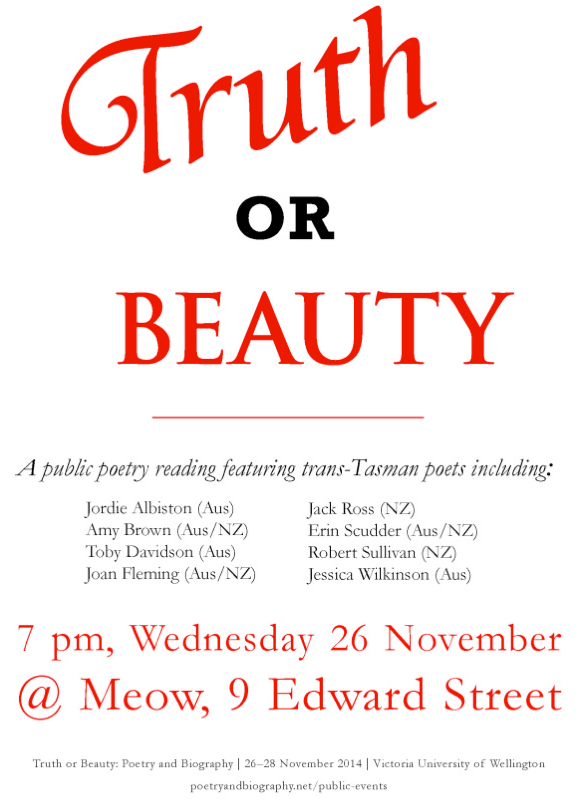
Anna Jackson teaches English Literature at Victoria University and has published five collections of poetry. Thicket was shortlisted for the New Zealand Post Book Awards, and Auckland University Press has just released her new collection, I Clodia, and Other Portraits.  To celebrate the arrival of this terrific new collection, Anna agreed to be interviewed by me. With poet and publisher, Helen Rickerby, Anna has organised, Truth or Beauty: Poetry and Biography, a conference currently running at Victoria University (26th to 28th November).


Did your childhood shape you as a poet? What did you like to read? Did you write as a child? What else did you like to do?

Reading and writing and making up long extended stories in my head were almost all I ever did, that and keeping pets, pretty much the same as now. Everything else was an interruption – children are always being interrupted from their purposes.


When you started writing poems as a young adult, were there any poets in particular that you were drawn to (poems/poets as surrogate mentors)?

To begin with the more musical poets, like Yeats, and my own poetry rhymed and was metred, I often wrote in a ballad metre. I wrote a wonderful long verse poem and then later found whole lines from it were lifted straight from Yeats – I’d remembered them but thought I’d made them up. The Romantics too – Keats and Shelley. But I was also reading Beckett, the novels, for the prose rhythms, which I found breathtakingly funny, and Pinter, again, for the rhythm.


Did university life transform your poetry writing? Discoveries, sidetracks, peers?

Murray Edmond was my tutor in twentieth-century literature and when I showed him some of my own poetry he told me I had to stop writing in metre and rhyme. The next year in modern poetry taught by Don Smith we learned about Ezra Pound modernising Yeats and about the rigorous line breaks of William Carlos Williams, and then the next year I took American poetry with Wystan Curnow and Roger Horrocks and that was revelatory, and challenging because the experimental L=A=N=G=U=A=G=E poets disturbed and disappointed me as much as they excited and inspired me, and I had to try and make sense of my conflicting responses. There was also always the pleasure of listening to Wystan talk – just like reading Beckett, it wasn’t what he said so much as the rhythms of the sentences – and Roger’s extraordinary generosity as a teacher responding to every student’s individual interests.


Does your academic writing ever carry poetic inflections?

No.

Are there any theoretical or critical books on poetry that have sustained your or shifting your approach to writing a poem?

I like this question and I teach a class on poetry and poetics which is founded on the idea that writing poetry and thinking about poetics, and reading poetry theory, ought to go together. But I can’t think of any poetry criticism or theory that has made any direct difference to anything I’ve done. Poetry criticism I have liked includes James Fenton’s The Strength of Poetry, Helen Vendler, especially The Making of a Poet, and James Longenbach, The Virtues of Poetry. Virginia Woolf is wonderful writing about poetry, although she hardly ever does – she chooses to write about Dorothy rather than William Wordsworth for instance. But her essay on Donne is brilliant. I used to find Ezra Pound an essential guide to poetry though reading The ABC of Reading now I can’t imagine how it could have helped; still, as Pound writes on page 86, “There is no reason why the same man should like the same books at eighteen and at forty-eight.”


Indeed! What poets have mattered to you over the past year? Some may have mattered as a reader and others may have affected you as a writer.

Can I go back further? The only poetry I think I’ve ever read that actually gave me the physical reaction that Robert Graves claims is the test of poetry, the hairs standing up, the shiver down the spine, the reaction that Emily Dickinson describes as feeling as if the top of your head has come off, is the sequence JUMP, from C K Stead’s The Black River, published in 2008. This is a sequence he wrote after a stroke in a state of semi-dyslexia. Some of the images – death as a Picasso, with a hole in the head – are terrifically, strangely vivid and funny. Some of the puns would seem banal in another context – the mine of the mind – and the wordplay on old rhymes and quotations is often simple enough in itself. But altogether, the effect is extraordinary. It really does somehow feel like he is mining the mine of the mind. It seems to reveal something about the way we think in language, something about the way language works, and there is an almost frightening spirituality about it. The capitalized word JUMP provides section breaks through the sequence, and by the end, the announcement can be made “faith hope the JUMP/ these three abide/ and the greatest of these/ is the JUMP.” This seems true, because we have experienced the way God, or religion, or some sense of an enormous and frightening significance can work through the gaps in language, through the jumps offered by dyslexia, a stroke, poetry.

More recently, in the last year or so, collections that have been very important to me include Helen Rickerby’s Cinema, a witty, perceptive collection of poems about the role of cinema in our lives; Ashleigh Young’s Magnificent Moon, a peculiar and wonderful blend of the surreal and the personal, the lyrical and the essayistic; and your own (Paula’s) The Baker’s Thumbprint, with its kaleidoscopic cast of characters, its richly rendered West Coast setting, the light of it, the weight of memory, the lift of imagination.

And then perhaps the most amazing publishing event of the last year was the publication of the newly discovered Sappho poem, “The Brothers,” with the TLS offering a spread of different translations of it – including a hilarious one by Anne Carson, wonderfully freewheeling and playful with its contemporary (and not so contemporary) references, while seeming at the same time to go straight to the psychological core of the poem. Even more moving to me though was the translation by Alistair Elliot – I was just so profoundly moved by the technical brilliance of it, as he apparently effortlessly translated the Greek metre into a perfect English equivalent, while – it seems, comparing only the different versions other poets offered – capturing most closely the sense of the original, the significance, in relation to the logic of the poem, of the details.

And that reminds me of one more translation event I found terrifically exciting which was the debate between Tom Bishop and Steve Willet in the journal Ka Mate Ka Ora over the translation of a Tibullus poem. I thought Tom Bishop won in terms of debating points, and loved his translation, but it was the level of debate and the skill of both translators that made it such a brilliant and absorbing conversation to follow.

(a link: http://www.nzepc.auckland.ac.nz/kmko/11/ka_mate11_bishop.asp)


What New Zealand poets have you been drawn to over time?

I expect I’m going to leave out some names that afterwards I’ll think of with amazement and regret, but among the poets whose work I return to again and again are Bill Manhire, of course, for the rhythms, the lift of the writing (I always hope to catch it a bit), and Jenny Bornholdt again for how rhythmic her poetry is, the way she plays with the rhythms of ordinary speech. Maybe this emphasis on rhythm is surprising, since I think my own poetry is quite prosaic. Though her rhythms are also quite prosaic – I like prosaic. Jenny Bornholdt and Bill Manhire are the poets I’ll read with the feeling that I can sort of catch poetry from them. A new Ian Wedde collection is always an event, and I loved The Lifeguard which came out last year, but I also return often to his earlier collections. I love the experiments with the sonnet in the Carlos sonnets, the intricacy of them and the ease, and I return again and again to the Commonplace Odes, again, the ease, the scope of them. Ease is the word I think of with Robert Sullivan’s poetry too and again that combination of ease and scope – the ease seems to allow the scope. But then again, the nervy tautness of Anne Kennedy’s poetry is tremendously exciting, and though scope isn’t the word that comes to mind in the same way, I like how her collections are always about so much, how she tells stories. James K Baxter, another story-teller, and a poet like Wedde and Sullivan with that combination of ease and scope – I return again and again to the sonnets, that relaxed sonnet he invented. C K Stead got closest to describing how it works, how it depends on a determined and consistent evenness of emphasis, a turning away from metre that is almost a metre in itself.


Your poems always offer surprise, a fresh and vital view of things and idiosyncratic musicality (an Anna Jackson pitch and key). What are key things for you when you write a poem?

Tautness? And that the poem has enough in it?


1415925155755    1415925155755   1415925155755

Your new collection, I Clodia, reflects a return to sequences that are thematically linked as opposed to discrete poems with more accidental connections. What drew you to this choice?

I far prefer writing sequences, I find building a sequence tremendously satisfying, and at the same time, it is far easier writing from within a sequence that is already underway than it is to generate new poems out of nothing. But not everything will fit into a sequence, so you have the discrete poems as well, and it can be very pleasing just writing a poem out of nothing, it can feel like a small miracle. And a single poem can be written in a very small space of time. It can rescue a day or a week that wouldn’t have had any poetry in it. I always wanted to write the Clodia sequence, but I wanted to so much, I put it off, till I had enough time to make the most of it. The photographer sequence started out just as a single poem about a photographer, which I wasn’t really sure was even a poem at first. But then after that, whenever I started another poem and didn’t know quite what to do with the material, the image or the idea, all it seemed to take was to attribute the experience to the photographer and it seemed to turn into a poem – it gave the material a dramatic element, a fictional element, that made it do just enough more to suffice for a poem. So then I started adding names to the titles of some other poems and found it gave them the same lift, and got interested in the idea of portraiture so wrote more portraits. I don’t think of that half of the book as a sequence so much as a collection of portrait poems – some of which I converted into portraits afterwards. But the Clodia sequence is very much a narrative with a three act structure, a cast of characters, a problem, a low point, a decisive action, and a resolution. I don’t think anything has ever been more fun to write.


And what of Catallus? Why does this subject matter resonate with you so strongly?

There’s a terrific essay by a classicist Maxine Lewis that discusses the reasons why writers and scholars are drawn to make narratives out of the Catullus poems (“Narrativising Catullus: A Never-ending Story,” in the Melbourne Historical Journal Volume 441:2, 2013). There are characters that recur in poem after poem, situations that seem to unfold, changing feelings, a developing relationship, and a complicated chronology that the order of the poems seems to defy. It is impossible to read the poems without trying to construct some sort of narrative – and as you do this, you begin to make the narrative your own, to act as a writer as well as a reader. And then, the poems are so funny, often, so passionate, and often so angry. They are also poems about writing poetry, or about the kinds of relationships that can be built around the exchange of poetry, and exchanges of wit. And love, and all the tumultuous feelings it evokes, has always been the best of themes for poetry.


And what of the point of view of women rather than the dead white men?

I write as Clodia because I love the poetry of Catullus, and I love him no less for being dead. But the point of view of Clodia is everywhere suggested, implied, presented or argued against in the Catullus poems – she is not just a character described by the poetry, but an implied reader teased, provoked, and responded to. The poetry invites an active engagement – I just couldn’t resist.


You gained a grant to undertake substantial research for this poetry project. Did you make serendipitous discoveries that flipped or fine-tuned what and how you wrote?

I made discoveries I really didn’t want to make. I had to give up on the first poem I wrote for the sequence, because it wouldn’t work with the chronology I developed. I had seasons in the wrong places, I had events happening simultaneously that had to happen two years apart. But I was able to work out a chronology that didn’t contradict any of the known dates or facts and allowed for a coherent story to take shape. The most important narrative breakthrough came in Rome, when I was doing nothing but work on the sequence and so could think always in terms of the narrative with an overview of the whole sequence, not just thinking one poem at a time. I had reached an impasse, and decided to go on a long walk along the river. I’d only taken a few steps out the door when I realised the solution that would make the whole story work. I kept walking for two hours, and then came back and wrote what I would have written if I’d turned back after five minutes. But I wouldn’t have had that five minute breakthrough without the weeks of sustained thinking and writing that led up to it.


The second part of the book is like a parade of characters, startling and askew with life, that may have strayed from a Fellini film. They glisten and glow on the page. There seems to be more invention and less autobiography that has marked many of your earlier poems (although not all!). Why this predilection to step into the shoes of others?

I love this description of the photographer section! I think photography has a glamour about it I have borrowed for the poetry. I am not sure how much less autobiographical the poetry really is. Even when I put my own children in to poems, as in “Tea-time with the Timorese”, often I made up the events. In Thicket, my previous collection, I might write as “I” but the “I” is as invented as a character like Saoirshe or Roland in the photographer sequence. And, conversely, I could have written the Saoirshe poem or the Roland poem as “I” – both are stories about my own life, in a way, in the same way the Thicket poems are. Perhaps it is a trick on the reader, perhaps the reader brings more to the poems when given a range of character names to lend the imagination to, perhaps the reader is able to read the poems more as stills from a film?


The constant mantra to be a better writer is to write, write, write and read read read. You also need to live! What activities enrich your writing life?

I completely agree and think the best poetry is, as Leonard Cohen said, the ash from a life burning well. I don’t like poetry about writing poetry, and the song that most embarrasses me is Gillian Welch’s song about not being able to make up a song – I don’t want to know! If you can’t think up a song, don’t sing one. But the truth is, I am unusually lazy and do less than just about anyone I know – almost nothing other than read and write, and have long baths. I have written a few poems about my hens, hen-keeping being my one hobby, if you can call it a hobby, but there are only so many poems you can write about hens and I think I’ve already reached my limit. So, I can’t think of an honest answer. Talking to my friend Phoebe, maybe? I quite often end up writing down bits of things we’ve said. Some of my best poems are probably actually just things Phoebe thought of.


Finally if you were to be trapped for hours (in a waiting room, on a mountain, inside on a rainy day) what poetry book would you read?

I’d want to read the collected Wislawa Symborska or the collected Bill Manhire, but I’d want to not have read them before, I’d want them to be a discovery. A new collection by either of them, I suppose, but I’d want it to be hundreds of pages long.


Auckland University page
 

Screen shot 2014-11-20 at 9.45.37 AM

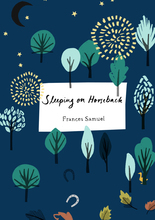
Frances Samuel’s Sleeping on Horseback — a symphony in shifting tones, silences, achingly beautiful chords

Frances Samuel (Grant Ma#B8     Sleeping_on_Horseback_300dpi__61176.1407673529.220.220   Sleeping_on_Horseback_300dpi__61176.1407673529.220.220

Photo credit: Grant Maiden

Frances Samuel, Sleeping on Horseback, Victoria University Press, 2014

Frances Samuel was a graduate of Bill Manhire’s Creative Writing programme in 2003. Sleeping on Horseback is her debut poetry collection and it is utterly marvellous. In all my years reviewing books, I have never made this link before, but reading the poems brought to mind the strength and beauty of Bill’s poetry. It’s not like I stumbled across a Bill clone, far from it, but I entered a similar effect of economy, musicality, eclectic detail, roving wit and an ability to surprise or catch a moment in brightness (or darkness). This is a tremendous debut.

An early poem, ‘How to draw spires,’ has taken its title from the contents page of How to Draw Churches and Cathedrals. One bit advice from the poet: ‘When you feel yourself distracted/ pretend you are a horse in blinkers.’ This is a bit like poetry — the way the whole world dissolves when you are caught in the moment of the poem. That is what happened as I read this book. Yet poetry also comes out of distraction as you are lifted outside the Be-Here-Now moment to the puzzling, surprising enervation of elsewhere.

So many stand-out poems. I love the fablesqueness of some.  One poem begins like this:

in the very earliest time

autumn leaves stretched to the sky

raking the reds and pinks

of the sunset.

Frances borrowed these lines from an Inuit poem and rebuilds a poem that tells a fable-like story as well as signalling a painting viewed. You move from ‘The grass was an extended family’ to ‘ before the human knew it/ thy had grown like the trees to the sky.’ The poem is rich in movement: aurally, visually, semantically.  Another poem that embodies such exquisite motion (and thus poetic life) does so to an even greater degree perhaps. ‘Vending machine’ is a poem that veers from fable to the surreal to real life and back, and is like a meditation on loneliness or desire or dreaming or dislocation-that-transmutes-to-selflocation by way of the catalyst machine. I adore this poem. The machine gives her ‘a walnut shell/ a rectangle of paper/ and four grains of rice.’ Thrown over her shoulder, because they are no antidote or balm for loneliness, they become boat:

They didn’t fall far:

the paper curved into a sail

the rice grains unravelled into long strings from its corners

and the walnut shell was big enough

for the girl to step inside.

Wry humour is an appealing feature of a number of poems. There is the amusing wit as Leo Tolstoy talks to a pigeon in ‘Leo Tolstory talks imperialism.’ Or the nostalgic flips as we meet (again) the very hunger caterpillar (‘I see the hungry caterpillar’).

Sometimes it is the visual potency and startling connections that arrest you. ‘Ice on cobblestones’ showcases the power of cold to infect and penetrate all detail, to be hyperreal like a strange and contagious dream, and the poem becomes a glorious rendition of snow and white that prompts melody as much as it does a semantic feast:

cheese and butter are snow

milk and skin are snow, shortbread

yes is snow and no is snow

wool is snow and socks are snow

pasta and rice are snow, paper

blond hair is snow, teeth are snow, fingernails

France’s debut book offers a symphony in shifting tones, silences, achingly beautiful chords across pages. There are hinges between one poem and the next whereby stone here becomes  stone there, or autumn, or snow. You travel through seasons and places and people, and by the end of the book you reach the intimacy of the domestic, of the baby, the tiny person where love and wonder lock fingers. I loved this book.

Thanks to VUP I have a copy to give to someone who likes or comments on this post.

VUP page

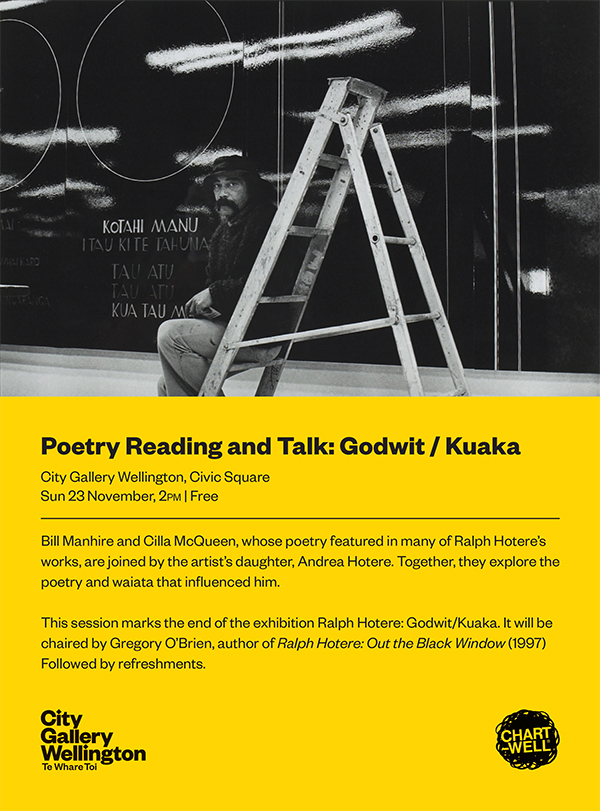
Poetry Reading and talk with Gregory O’Brien, Bill Manhire, Andrea Hotere and Cilla McQueen at City Gallery: Celebration of Ralph Hotere

1114-Poetry Godwit Kuaka-Flyer

Friday Poem: Sarah Jane Barnett’s ‘Blue Heart’: The poem enacts the mystery of writing a poem

SJB_small

Photo Credit: Matt Bialostocki


Blue Heart

Full size model of a Blue Whale heart, Te Papa Museum

The boy enters the whale heart. He finds his way.

His hands slide down the peachy aorta, his body

swallowed into the central chamber. My face pushes

after him because it’s just fibre and glass, and he’s

my first child, on his knees, his back to me. His hands

perform their work of play along a smooth ridge of cartilage

like a cardiac surgeon. Interpretations of the ‘whale’ fall

into three categories: The whale is real and my son

lives in her heart. Or the whale is the dream

I have for my son. Or the whale is an allegory

that should not be taken to heart. Some things take time

to understand. Last time we visited my grandmother

I knew she would die before I saw her again.

She’d been having regular blood transfusions—

pulsing circles of bright red tubing—which helped

for a few weeks before another fall, after which she’d rest

one cheek on the carpet. My son sat on her lap and she played

at biting his fingers, her grey dentures clacking together,

and he squealed and pointed, and then pointed to the fireplace,

and then pointed to the window where a dried floral arrangement had sat

for twenty years. Everything was there for him.

She took his pointing finger between the soft pads of her lips.

How do you enter the biggest heart? Do you say

that it weighs up to fifteen hundred pounds? The largest heart

is like a compacted Volvo! Maybe you must imagine it beating

inside you? Maybe you find it one quiet morning,

your son asleep, his cheeks flaring the colour of summer plums.


Author’s bio: Sarah Jane Barnett is a writer, tutor, and book reviewer who lives in Wellington. Her first collection of poems, A Man Runs into a Woman, was published by Hue & Cry Press in 2012, and was a finalist in the 2013 New Zealand Post Book Awards. Her work has appeared in various publications including Sport, Landfall, Best New Zealand Poems, and Southerly. Sarah has a PhD in creative writing from Massey University in the field of ecopoetics. She blogs at: theredroom.org.

Author’s note: ‘I wrote this poem as part of my PhD thesis which, in part, looked at the different ways poets write about the nonhuman world. While writing my thesis I had my son and my grandmother died. Both of these events felt huge and brittle and surreal. Both were difficult to write about. One afternoon I took my son, Sam, to Te Papa and he played for ages in their scale model of a blue whale heart. It made me think about the way poets often resort to using the natural world as a metaphor when trying to describe love, grief, or the sublime. That’s when I wrote this poem.’

Paula’s note: The opening line of Sarah’s poem, so exquisitely simple stalled me with myriad, potential directions: fable, fairytale, the slippery slopes of surrealism, metaphor and real-life anecdote (as the epigraph in fact signals). This heavenly poem celebrates the child — the mother-son relationship is clasped in its tender embrace. Poignantly, the life of the son is countered by the death of the grandmother, not as a set of scales but as a largeness of love and loss that finds its potency in the smallest of detail. The poem enacts the mystery of writing a poem — the way stream-of-consciousness or random thoughts that accumulate like stepping stones can drive the poet’s pen and make magic out of metonymy and juxtaposition. The son points out the luminous detail so that place becomes vibrant and beloved. The life blood of this poem is heart: the whale’s heart, the son’s heart, the grandmother’s heart. But more than than anything, it is the internal love heart that renders the grace,  economy,  attentiveness,  poetic craft, the words that shine out, the story that unfolds and the images that startle (‘cheeks flaring the colour of summer plums’) in maternal ink. This is why I love poetry.

Sweet Mammalian is a new literary journal edited by 3 Wellington poets. The journal was created out of a wish to see more good, new writing out in the world. The editors of Sweet Mammalian aim to provide a fresh space for poetry that comes out of the complex, the absurd, the warm-blooded. They aim to provide a space for all kinds of writing. The inaugural issue of Sweet Mammalian is launched today, Friday 10 October, with a launch party and reading in Wellington.

The link to Sarah’s poem in the inaugural issue is here.

Hinemoana Baker’s waha | mouth: This exquisite collection is not so much a symphony but a set of partitas for solo violin

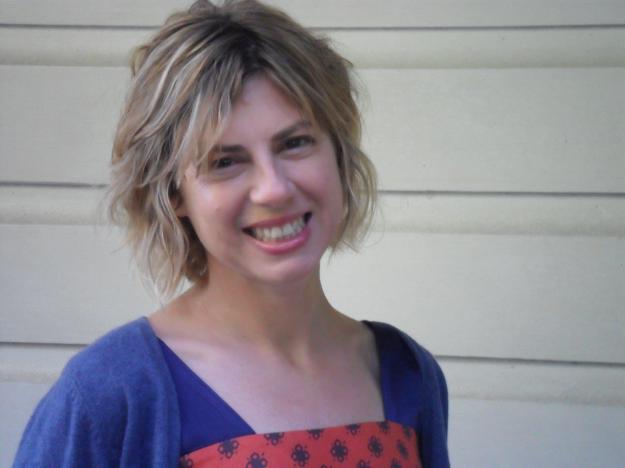
Hinemoana Baker

Photo Credit: Robert Cross

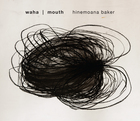
Hinemoana Baker, waha | mouth, Victoria University Press, 2014

(Thanks to VUP I have a copy of the book for someone who likes or comments on this post)

This is the self-penned blurb on the back of Hinemoana Baker’s new poetry collection and it resonated with me far more than the usual blurb content: ‘I’d like to think that opening this book to read is like standing at the mouth of a cave, or a river, or a grave, with a candle in your hand.’

waha_front__71664.1407673414.140.215   waha_front__71664.1407673414.140.215   waha_front__71664.1407673414.140.215   waha_front__71664.1407673414.140.215

This window into reading suggests you might enter the mysterious, dark depths of the cave with its labyrinth of passages, or the pull of a river’s current whether quiet or wild, or the private return to those who have left us. I adore the comparison of the act of reading to holding the light of candle to a poem where something will always remain in the dim shadows, barely sighted, inaudible.

In many ways this book is about the power of words to take hold of us, to connect us in myriad relations, to reproduce us. The first poem, with its mysterious ache and force of a single word, is followed by a family poem. In Nanna’s game, the missing words are adjectives that must be randomly supplied by the players to the gut-wrenching hilarity of all. Word in place — words out of place. In another poem, ‘rope,’ Hinemoana has used a clutch of words from the penultimate sentence of a James Welch novel as a prompt for her poem. It is as though her poem becomes a secret hyperlink that expands a word (or two) — like when you click on a word on a poem online and it opens out. In ‘eclipse,’ where she contemplates ‘his warm, dead right hand,’ individual words are intensified, made special by placing italics. They twitch and vibrate on the line as little memory beacons.

Two poems (‘part 1’ and ‘part 2’) are distorted mirror images of each other. in the splintered glass you enter the family occasion, where things shift and change in the way things shift and change over time, in the mind of this person alongside that person, in this mood alongside that mood. You move from ‘The apricot moon, and a statue, for Valour‘ to ‘The mackerel sky and a steam train.’ I love the way the two parts send a translucent bridge (an arc) over the short prose-like poems that they bookend. These latter poems follow the thematic curvature of the book as they slip from what is familiar to what is not, from being grounded at home to being grounded off shore, from anecdote to striking image. Detail matters.

This exquisite collection is not so much a symphony but a set of partitas for solo violin. Individual notes (words) resonate and linger in the ear as if to make aural chords (connections): ‘a parliament of owls, all palms but mine — bone dry, mouth full of sky and counting.’ In this example, the linking consonants, assonance and near rhyme make chords that register in a subterranean way (sky-mine, mouth-owls, owl-full, parliament-palms, but-bone). Hinemoana’s musicianship extends to the composition as a whole with its shifting tones and pitches.

Many poems stood out for me. I loved ‘there are almost no risks associated’ where the lines are borrowed from a fertility document. The poetic riff heightens the emptiness of repeated medical jargon and narratives, and the way they so often eclipse individual situations, fear and longing. I also loved the final longer poem, ‘magnet bay farm,’ which exemplifies the way Hinemoana’s collection brings together story, acute detail, and divine melody. The poem I have printed off to pin to my wall though is ‘manifesto.’ It reminded me a little of Bernadette Hall’s ‘lacework’ in the way poetry has its roots in mud and muck as much as the moon and stars (a bit like Hone Tuwhare writing poetry from and for the pub and the heavens). It is a poem about poetry with wit and humour where cats get fed and Poetry ‘sniffs at the moon/ and urinates on our suburban garden.’ This I love: ‘In public people stop to say how handsome my poem is, how playful and well-behaved./ ‘Hell that poem’s in good nick,’ they say. ‘What do you feed it?’

Hinemoana’s poems are anchored in the real world yet her poetic melodies remind you that there are other layers of reality embedded here, layers that sing and tremble in the candle light — joy, pain, recognition, trust, narratives that we inherit and carry with us. Tremendous.