There’s one week left to submit for the winter issue of Starling! New Zealand writers under 25, send us your new work by 20 April 2022 to be considered – full submission guidelines can be found here.

There’s one week left to submit for the winter issue of Starling! New Zealand writers under 25, send us your new work by 20 April 2022 to be considered – full submission guidelines can be found here.
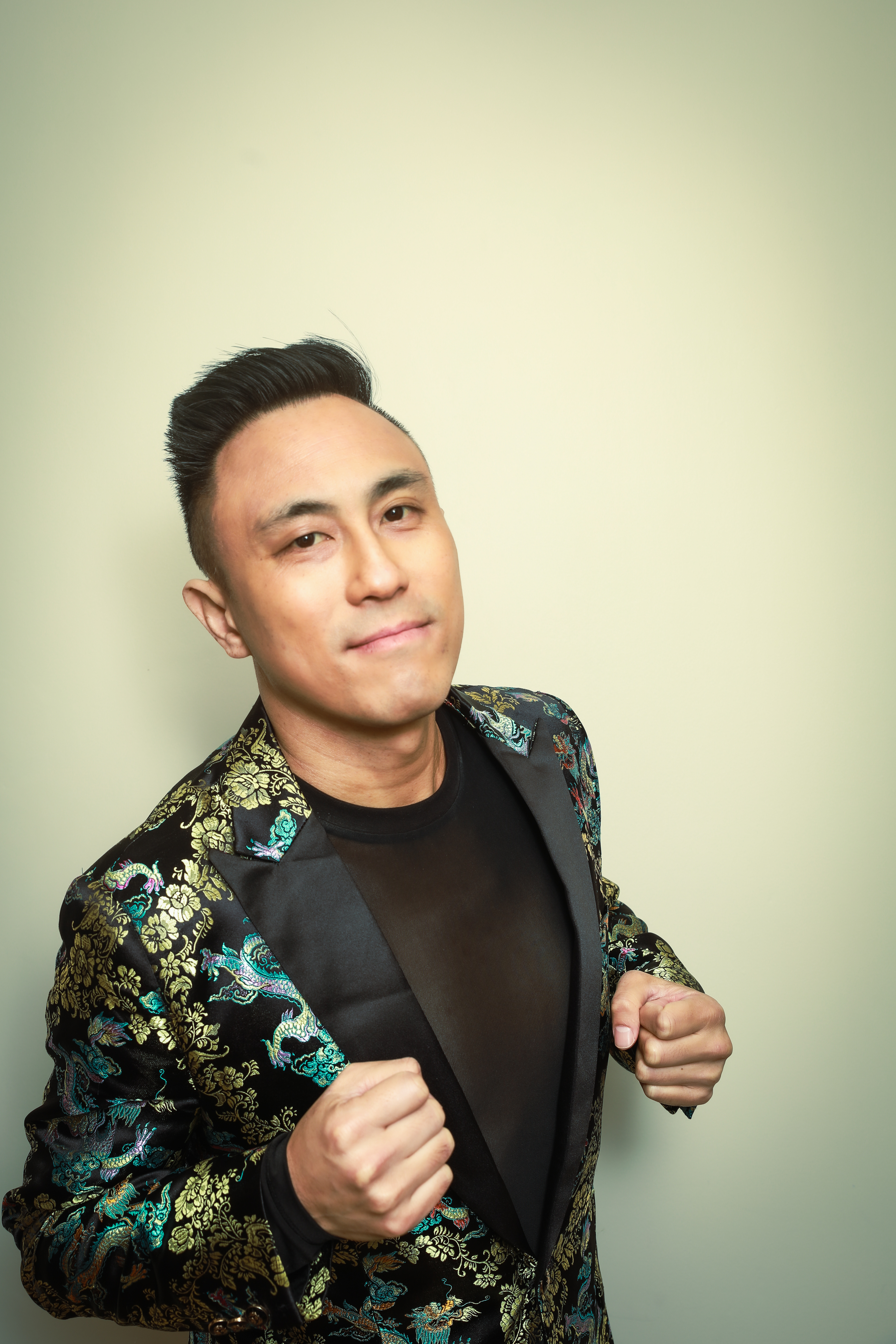
The arrival of a new Chris Tse poetry collection is always a moment to celebrate.
Paula: In 2022 I am running a few email conversations with poets whose work has affected me over time. I have loved your poetry since your appearance in AUP New Poets 4 (2004). Your new book, Super Model Minority, strengthens my enduring relationship with your writing. The collection is an explosion inside me, but first I want to touch upon the spiky times we live in. What helps you? I am finding books keep repairing me, sending me on extraordinary package holidays, depositing me in the sky to drift and dream, to think. All genres. What are books doing for you at the moment?
Chris: Books have been such a comfort for me these past few years. Emma Barnes and I were still up to our necks in reading for Out Here when we went into lockdown in March 2020, so there was plenty to keep me busy and distracted. Things did get a bit more difficult when we couldn’t access some older and out-of-print books, but we made it work. I’m not a very fast reader so I do tend to take my time with several books on the go at any given time. Books have always made me happy – I was always happiest hunched over a book while my family watched rugby or played mahjong in the background. These days a big part of that happiness is the thrill I get seeing friends getting published and receiving well-earned praise for their amazing work. It’s such an exciting time to be a reader and a writer – to be able to experience the world through the poetry of essa may ranapiri and Rebecca Hawkes, or to have your brain recharged by the essays of Megan Dunn and Lana Lopesi. Aside from a few small projects I have no plans to start writing a new book, so I’m just hungry for stories and ideas right now to see where that might take me next. I want to read as much as I can for pleasure while I can.
Paula: Out Here gripped me on every human level imaginable, yet I never considered how Covid might prevent access to the archives. That was such a joy for me researching for Wild Honey. With Emma, you have gathered something special. Wide ranging and vital. It is how I feel about the younger generation of poets. I fall upon brittle, vulnerable, edgy, risky, exposed heart, potent – and I am grateful to Starling and The Spinoff’s Friday Poems for representing these wide-ranging voices. I am decades older than you, but how is the new generation affecting you?
Chris: For me, it’s such an exciting time to be a poetry reader right now with so many young poets producing ground-breaking and challenging work. Also, they’re voices and perspectives that we’ve been sorely lacking for such a long time – poets like Cadence Chung, Khadro Mohamed, Lily Holloway and Ruby Solly are all redefining what ‘New Zealand poetry’ means in their own ways. If I look back at what it was like to be a poet at their age, the playing field has shifted a lot because of journals like Starling and Stasis, and publishers like We Are Babies Press. I find their energy so infectious and inspiring – it certainly makes me want to keep pushing myself as a writer.
Paula: Exactly how I feel! But I also have poets I have carried across the decades since my debut collection in the 1990s. Bill Manhire, Michele Leggot, Bernadette Hall, Dinah Hawken, JC Sturm, Hone Tuwhare. Poets that helped me become a writer in so many ways. Particularly as I didn’t do any creative writing courses. Were there poets from the past or the present that were writing aides for you? In person or on paper?
Chris: My exposure to New Zealand poetry was sorely lacking as a high school student, so I’m really grateful that the papers and creative writing workshops I did at university introduced me to the canon and more contemporary writers. Jenny Bornholdt, Stephanie de Montalk, Bill Manhire and Alison Wong are poets whose work played a huge role in shaping my fumblings as a young poet. My poetry world was further expanded when I started to stumble across contemporary US poets like D.A. Powell, Frank Bidart, Cole Swensen and Richard Siken, whose first collection Crush I have written and spoken a lot about. It really is one of those life-changing books that set me on my current path. For Super Model Minority specifically, I turned to Chen Chen, Ocean Vuong, Danez Smith, Tusiata Avia, Nina Mingya Powles and Sam Duckor-Jones for comfort and inspiration. Their work feels so vital during these times of change and uncertainty.
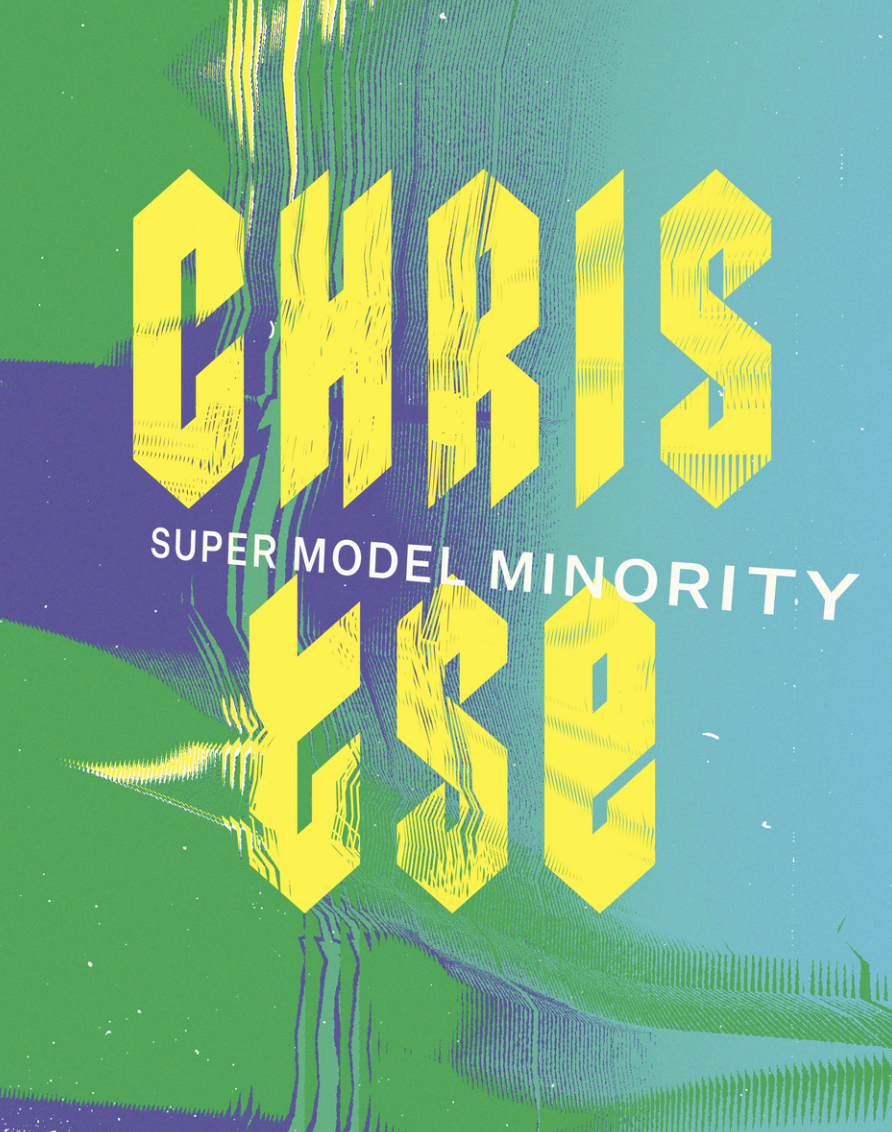
Super Model Minority, Chris Tse, Auckland University Press, 2022
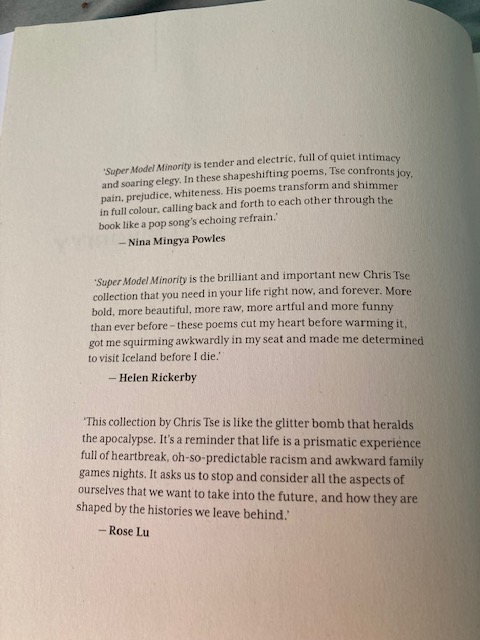
Paula: Inspired and comforted seem crucial for both readers and writers. Your new collection is body shattering and heart repairing. And yes, both inspiring and of comfort. The book includes the best endorsements ever (Nina Mingya Powles, Helen Rickerby, Rose Lu). They catch how the reading experience affected me perfectly. Would you couch the writing experience in similar terms?
Chris: Writing this book caught me off-guard, in a number of ways. First, I didn’t think I’d have a manuscript ready so soon after HE’S SO MASC – I was happy to take my time with the next book. Then a few things happened that set off something in me – an urgency to write and respond: the pro-democracy protests in Hong Kong, the aftermath of the Christchurch mosque attacks, and the rise of anti-Asian sentiment as a result of the Covid-19 pandemic. These events all triggered powerful emotions, but the overriding frustration I felt was that things seem to stay the same no matter how much we push for societal change and equality. I was overcome by anger, sadness, and helplessness, so I decided to write myself out of that state and turn it into energy. The poems kept coming and I found myself confronting a lot that I’ve left unspoken for so long – some of it out of guilt, some of it out of fear. Overall, the writing process taught me a lot about myself because of these responses and the realisation that it’s important to hold on to hope throughout the dark times – I’m not as nihilistic as I thought I once was, even if that’s how it may come across in the book!
Paula: I am coming across a number of poets who are re-examining a drive to write poetry in a world that is overwhelming, disheartening. Gregory O’Brien muses on poetry expectations: ‘If the times are dark, oppressive, tunnel-like – as they seem presently – maybe poetry can be a lantern?’ For me it’s Covid and impinging greedy powers. Shattered everyday lives in Hong Kong, Syria, Afghanistan, Ukraine. And it’s like you say – despite waves of resistance, critique, standing up and speaking out – a world free of sexism, racism, poverty, classism, homophobia can feel impossible. And yet … poetry can be essential at an individual level. It seems so, for you and I, as both readers and writers.
I will use my tongue for good. I say I will
because this book needs to start with the future even though the future
has always scared me with its metallic fingernails poking through
the metaphysical portal come-hithering. Aspiration—and the threat
of what we have awakened from the salty ashes of a world gone mad—
aspiration will bolster my stretch goals. I will use my tongue to taste
utopia, and share its delights with my minority brothers and sisters
before the unmarked vans arrive to usher me back in time.
from ‘Utopia? BIG MOOD!’
The first poem ‘Utopia? BIG MOOD!’ is an inspired entry to the book. The opening line gives me goose bumps. I want it tattooed on my skin. Heck just reading it make me want to cry, stand up and getting going. It implicates the writing of poetry in the world and the world in the writing of poetry. It gives me hope reading this. You say it all in the poem but do you carry utopia in your heart? Despite your sadness and anger and helplessness?
Chris: That’s such a lovely quote from Greg – it sums up exactly how I feel as a poet and when I’m reading submissions for the Friday Poem. I’ve definitely noticed that recently poets are using poetry to light the way, even if we’re not sure where a particular path is leading us. Better to walk in light than stumble in darkness I suppose. I’m so glad that the first line resonates for you in that way. Here’s the thing – the first lines of all three of my books are a thread that ties them together. (I won’t presume that anyone is reading my work that closely to spot it!) All three books open with a reference to speech or being heard. In Snakes, it’s “No one asked me to speak…”; in HE’S SO MASC I wanted the flipside so the first line is “Shut the fuck up”. I knew I wanted the first line in Super Model Minority to echo the first two books – “I will use my tongue for good” felt like the best way to open this book about confrontation and working towards a brighter future. So, to answer your question, I do carry some form of utopia in my heart because without it I’d be resigning myself to a future that is ruled by sadness and anger. If there’s a conclusion that I come to in the book, it’s that utopia will always be out of reach because we’ll never agree on a singular utopia – the version we carry in each of us is built upon our own desires and subjective perspectives of the world around us.
Paula: Ah it gives me hope to imagine our world no longer governed by despair and anger. I loved your review of Janet Charman’s new collection with Kathryn Ryan on RNZ National ((The Pistils, OUP). I haven’t read the book yet but I got the sense it was personal, intricate, political. The same words apply to your collection. Each poem opens up in the process of reading, and then lingers long after you put the book down. It feels so deeply personal. The way you reassess vital things: the past, the importance of names (your name), speaking more than one language, your parents, relationships, being gay. And in this personal exposure and self-navigation, there are the politics that feed and shape who you are. Inseparable. It feels like a landmark book to me. Is that placing too much on its shoulders?
Chris: It feels like a landmark book for me personally in terms how far I’ve come as a writer over the last decade. I look at my three books side by side and even though there are things I would change in the first two (and I’m sure I may have similar feelings about some of the poems in Super Model Minority in a few years!) I’m really proud of this body of work I’ve created. HE’S SO MASC has those early flourishes of the personal and the political, and I remember being so worried about how it would be received because it was so different in tone and outlook than Snakes. All of my books to date have required a lot of self-reflection and self-critique to get to a place where I’m not only comfortable writing about these topics, but also to be able to share them. Even though the work is personal I hope people can see themselves in it too, or can see why some of the things I write about are a big deal for me and the queer and POC communities.
Paula: Would you see yourself then as a hermit poet, a social poet where you share what you are writing along the way, or something in between?
Chris: I’ve got a small group of trusted writers who I send works in progress to if I’m stuck on something, but this time around I did hold a lot back until it was ready in manuscript form because I wanted to work on trusting my own instincts. However, when it comes to sending work out into the world for publication, I’d say I’m more on the social side, although there were a few poems from Super Model Minority that I chose not to submit anywhere because I felt like they needed to be read in the context of the collection as a whole.
Paula: Is there a poem (or two) that really hits the mark. Whatever that mark might be! That surprised you even.
when asked to explain the lines that lead to now, you describe /
the shape of your body as it hits water / the shape of cold water
shocking muscle / the shape of fleshy chambers forced to loosen
and acquiesce / the shape of your grandparents in their coffins /
the shape of coffins that are too small to contain entire lifetimes /
the soft and hard moments we can’t forget no matter how often we
turn our backs to the light / [you write this poem out of love / but
even love can be a blindfold] / the shape of you and your parents
standing in your grandparents’ driveway / after being kicked out
for talking to your aunty’s white boyfriend / your hand reaching
out to someone you don’t recognise in a dream /
from ‘Identikit’
Chris: I’m really proud of ‘Identikit’ in this collection – finishing that one felt like a fist-in-the-air moment. I think it’s because it covers a lot of historical and emotional terrain that I’ve wanted to write about but had struggled to find a way to balance the pain with moments of joy. Same with ‘Love theme for the end of the world’, which is the slightly more optimistic and hopeful sibling to ‘Identikit’. In fact, the way the “…for the end of the world” poems revealed themselves as I wrote them was surprising to me, because they felt like a valve had ruptured and all this pent up pressure was being spilled out onto the page.
Paula: I wrote down ‘a bath bomb effect’ in my notebook as I was reading. The whole book really. A slow release of effervescence. The kind of poetry that you think and feel. That inspires and comforts! This comes through when you perform or record your poetry. The poems you recorded from the book for Poetry Shelf. Your performances with the Show Ponies. Your readings have got a whole lot of love on the blog. Mesmerising! Does it affect the writing? The future performances in the air?
Chris: Sometimes I’ll have a feeling as I’m writing as to whether or not a poem will be one suited for performances. ‘The Magician’, ‘What’s fun until it gets weird?’ and ‘Poetry to make boys cry’ were written to be performed at particular events so I was conscious about how they flow and build during a performance. Having that embedded into the poem really helps me when it comes to performing it, and hopefully that effect comes across on the page when others are reading it. Reading my work out loud, either at home or to a crowd, has become a much more integral part of my writing and revision process in recent years, even if it isn’t necessarily a poem that I think will make it into high rotation as a ‘live’ poem. This wasn’t really a major consideration when I was writing Snakes because the thought of sharing my work in that way wasn’t really front of mind, although I do love the opportunities that book presents when I’m asked to do a long set and have the chance to read a substantial selection from it.
Paula: I agree that what you write must be a big deal for the queer and POC communities. I am heartened by an increased visibility of Asian writers not just as poets but as editors. But at times I am also disheartened. How do you feel?
Chris: It really is heartening to see so many POC and queer writers getting published and stepping into editing and leadership roles, but there’s still a long way to go to undo decades of erasure and disengagement with the industry, and to not feel like we exist only to be a tick in the diversity box. When it feels like we’re not getting anywhere, I hold on to as many moments of joy as I can and celebrate our achievements. I’ll never forget being on the bus home after the last event at Verb 2019 and being overwhelmed with emotion after spending the weekend attending events featuring so many Asian authors. It felt like such a turning point to have so many writers I could consider contemporaries, and to be graced by the presence of US poet Chen Chen, who has been a major inspiration. The other time I’ve had the same feeling was while rehearsing for a staged reading of Nathan Joe’s play Scenes from a Yellow Peril – the entire cast and crew were Asian. It’s the dual power of being seen and finding your people! When I started writing, the concept of ‘a Chinese New Zealand writer’ felt so murky and out of reach, and I also wasn’t even sure if it was a role I particularly wanted to inhabit. The word ‘whakama’ comes to mind when I think about who I was at that time, and it’s taken me literally decades to push back against that shame and unpack the effect of racism on my life to understand why I need to be loud and proud about who I am.
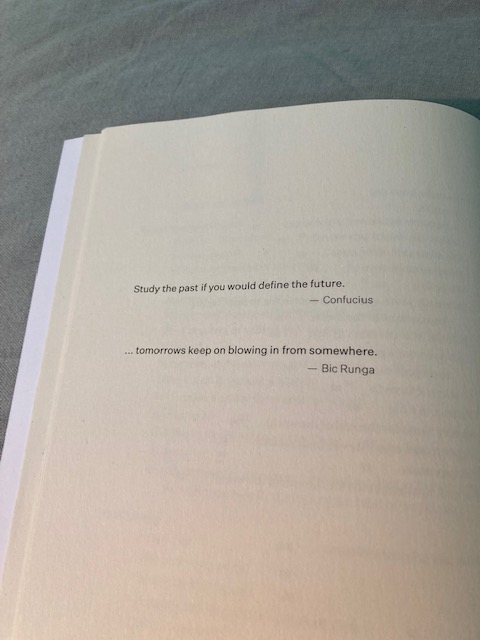
Paula: Your epigraphs signpost both past and future. This is important. Both in view of poetry and life. Like I have already said, many poets are examining the place and practice of poetry in our overwhelming and uncertain world. Are you writing poems? What do you hope for poetry, as either reader or writer, as editor of The Friday Poem?
Chris: It’s been wonderful seeing more people read and engage with poetry over the last few years both on the page or in person. I think a lot of this is a result of people not relying on old structures and established means of production, and just getting on with getting their work out there through new channels, or putting on innovative events and festivals and mixing poetry with other artforms. It’s proof that we can continue to challenge people’s perceptions of poetry and to find ways to introduce it into people’s everyday lives. But it’s more than just poetry being ‘cool’ again – a lot of work still needs to be done to address diversity, equity and accessibility. From my perspective as a writer, reader and editor, the future looks bright – and isn’t that what we want poetry to do? To show us the power of possibility and give us reasons to be hopeful.
I guess there’s always the pull of more to do—flags to fly and
words to scratch into the world’s longest stretch of concrete.
I guess what I’m saying is—I am not done with snakes and wolves;
I am not done with feathers or glitter on the roof of my mouth.
This is me begging for a fountain to taker all my wishes.
This is me speaking a storm into my every day.
from ‘Wish list—Permadeath’
Chris Tse was born and raised in Lower Hutt. He studied English literature and film at Victoria University of Wellington, where he also completed an MA in Creative Writing at the International Institute of Modern Letters. Tse was one of three poets featured in AUP New Poets 4 (2011), and his work has appeared in publications in New Zealand and overseas. His first collection How to be Dead in a Year of Snakes (2014) won the Jessie Mackay Award for Best First Book of Poetry, and his second book HE’S SO MASC was published to critical acclaim in 2018. He is co-editor of AUP’s Out Here: An Anthology of Takatāpui and LGBTQIA+ Writers from Aotearoa, published in 2021.
Poetry Shelf: Chris Tse reads from Super Model Minority
Poetry Shelf: Chris Tse’s ‘Identikit‘
Auckland University Press page
Chris Tse website
Standing Room Only interview RNZ National
Naomii Seah review at The Spin Off
Interview at NZBook Lovers
The Friday Poem at The Spin Off (April 8 2022, Majella Cullinane)
invoice
$100 less tax for
mince
1 pkt cheese
1 litre of milk
1 loaf of bread
2 rolls of loo paper
paid for
my poem
fall
gnarled burnt weathered
twisted toppled rotting
arms raised skyward
falling earthbound
this tree is dying
Apirana Taylor
Apirana Taylor is a nationally and internationally published poet, playwright, short story writer and novelist. He’s been Writer in Residence at Canterbury and Massey Universities. He tours globally presenting his poetry. He’s written and published poetry, plays, short stories, and novels and is included in many anthologies nationally and internationally.
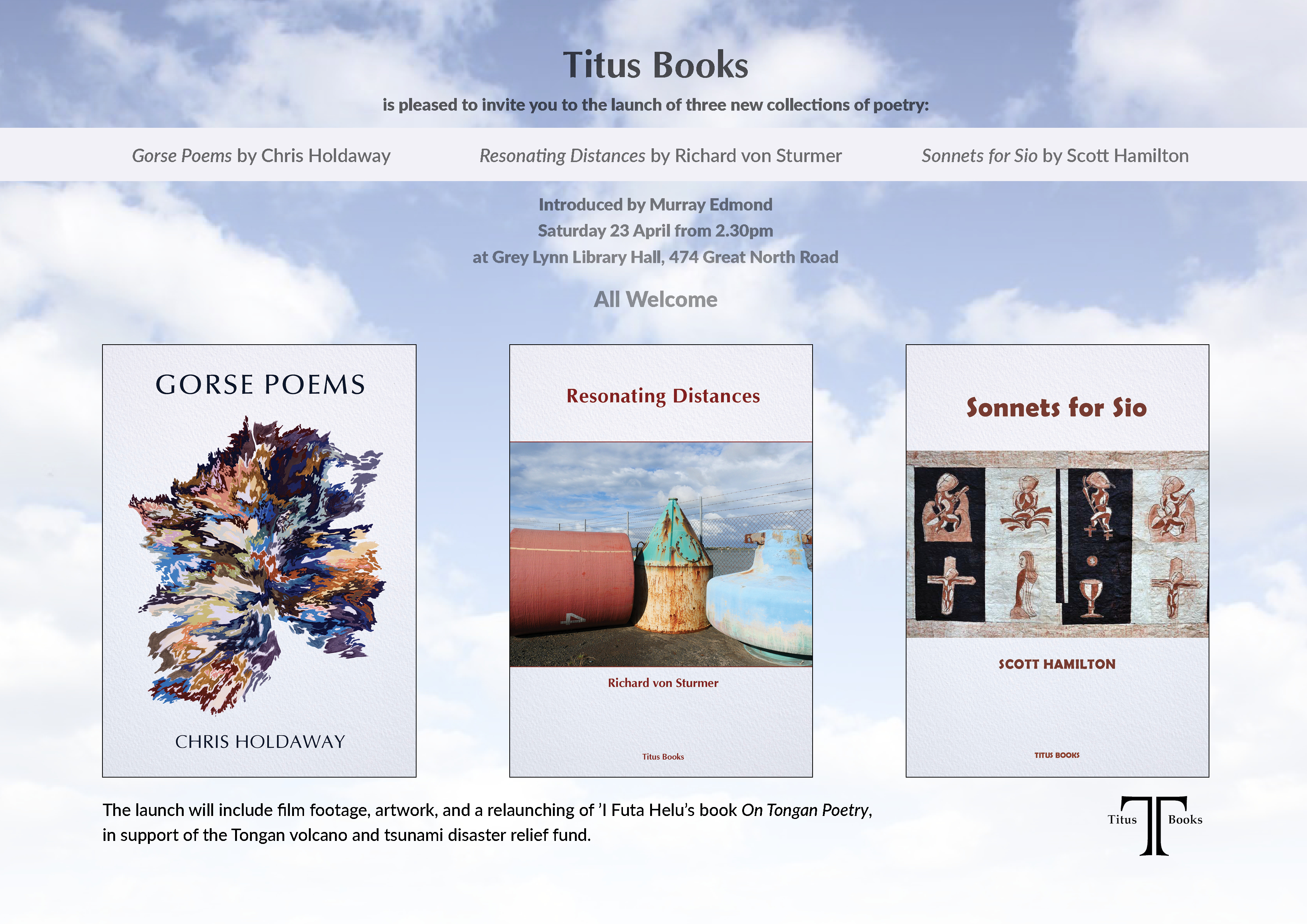
Titus Books
is pleased to invite you to the launch of three new collections of poetry:
Gorse Poems by Chris Holdaway
Resonating Distances by Richard von Sturmer
Sonnets for Sio by Scott Hamilton
Introduced by Murray Edmond
Saturday 23 April from 2.30pm
at Grey Lynn Library Hall, 474 Great North Road
All Welcome
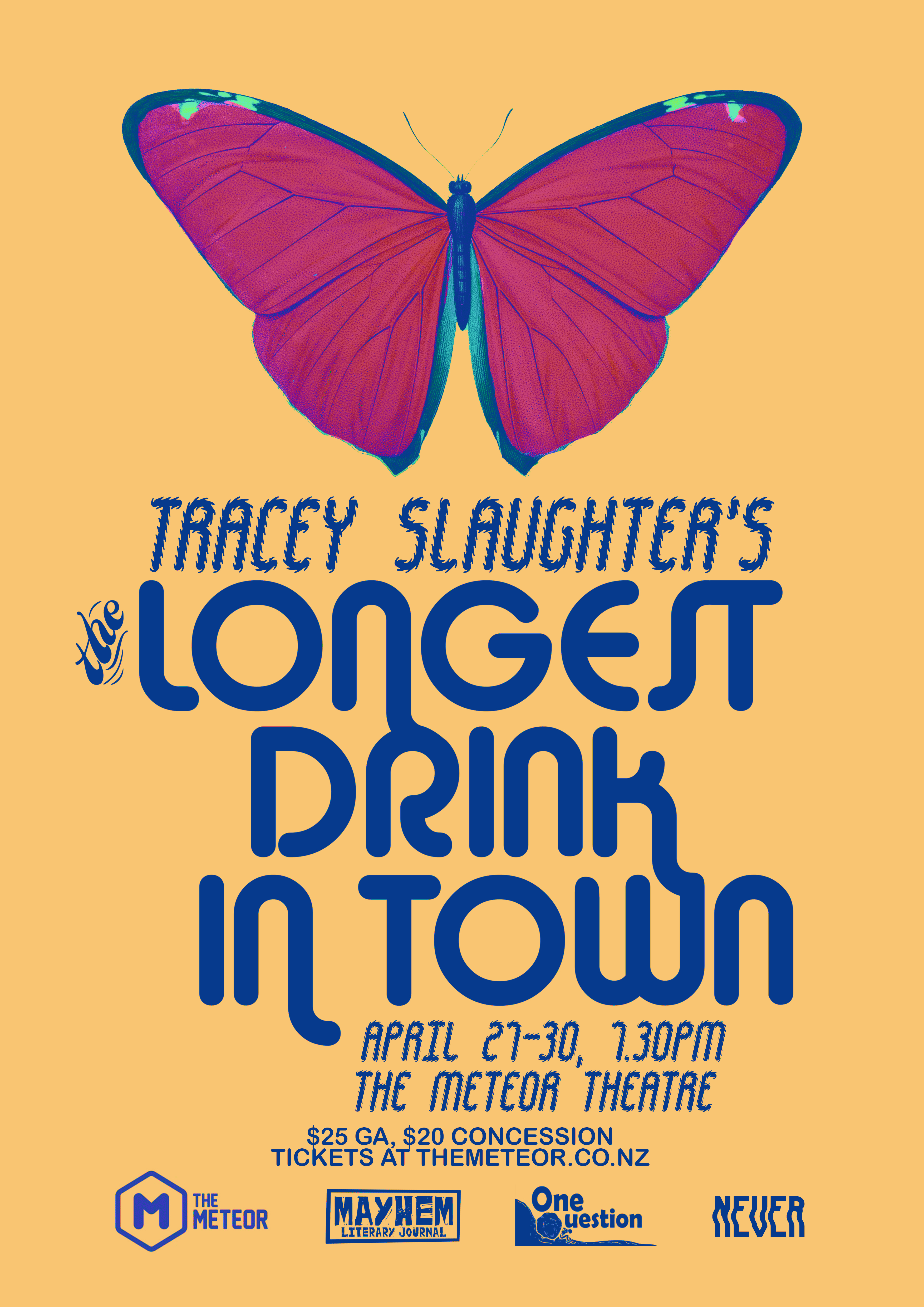
Acclaimed New Zealand author Tracey Slaughter presents The Longest Drink in Town, debuting at The Meteor Theatre from April 27th – 30th. A dark, lyrical and brooding snapshot of the fallout of a parental affair; The Longest Drink in Town marks the first of Slaughter’s works to be adapted for the stage.
On the inspiration behind The Longest Drink, Slaughter says, “The situation took place on the roadside of my own childhood: I’d been a passenger in my mother’s car to be delivered for ‘visitation,’ and my new stepmother met us at the drop-off point. The detonation was instant. The two women scrapping it out at the T-bone where a servo met a pub met a fleet of display homes – as a child all I could do was freeze in the gravel intersection and witness. That set-up became the nexus for a storm of childhood reactions to the everyday spectacle of a ‘broken home,’ taking me into stories that touched the dark core of what divorce is for the small players who don’t get to choose it. The ‘chick fight’ was more than just late Friday arvo entertainment. The scene transfixed me, and never left. It was inevitable that writing would one day drive me back there.”
Tracey Slaughter is the author of deleted scenes for lovers (2016), Conventional Weapons (2019), and most recently Devil’s Trumpet (2021). She’s received numerous awards, including the international Fish Short Story Prize, the Bridport Prize, the BNZ Katherine Mansfield Award, the Landfall Essay Competition and was the recipient of the Louis Johnson New Writers Bursary.
This exciting project is brought to you by One Question Theatre and Mayhem Literary Journal, who have lifted Slaughter’s prose from the page, without losing an atom of the yearning and the ache of her novella.
Co-directors’ Dave Taylor and Liam Hinton say of the project, “It’s a tremendous privilege to be gifted such a generous text and to have our shared hand in bringing it to life.”
On seeing the story alive on stage, Slaughter says, “Many of their stories were fragments of mine. But they weren’t just vehicles for my catharsis – they had bloodstreams and hair-ties, longings and school-shoes, ugly old dollies and busted hearts. They felt alive to me in the writing, and I loved them. To meet them now, walking round The Meteor, is an experience near indescribable. They’re not just suffering – they’re leaping with wildness, wriggling with mischief, and rocking with anger and lust. They are a joy to behold. I’ll always be intensely grateful to the group of actors who took this journey to bring my characters to life.”
Tracey Slaughter’s The Longest Drink in Town
Where: The Meteor Theatre (1 Victoria Street, Hamilton)
Time: April 27-30, 7:30pm
Book at themeteor.co.nz
For Mature Audiences – contains depictions of self-harm, sexual themes and strong language.

Apertures, Makyla Curtis
Through the eye of time
When I receive one of 40 precious copies of Makyla Curtis’ chapbook, Apertures, it comes carefully wrapped in layers: tissue, cellophane, paper. It is the prelude to digging down through the meticulous archeology of Curtis’ poetry.
As she journeys in ever widening circles to find the fragments that will fill in the gaps of who she is, she also finds spaces. From Auckland’s West Coast to Scotland’s North Sea, Curtis finds touchstones in the landscape. A hagstone that allows her to see through time. Greywacke stones that she piles into a cairn. Filmy ferns that she plucks and imprints onto the pages of the book itself.
on the shore I sweep my feet for a hagstone to cast a vision
to find a doorway in the rock, in the earth, in time
to cast a moment of an ancestor’s eye
Apertures is a work of art: one of several text-and-art pieces that Curtis made in fulfilment of her 2021 Master of Visual Arts project. The other pieces have been displayed in a recent exhibition at the Angela Morton Room at Takapuna Library (https://www.instagram.com/angelamorton.room/), along with videos, photographs and found objects all collected on Curtis’ journey of self discovery. Leanne Radojkovich, the Angela Morton Room’s curator, tells me the response to the exhibition has been warm, searching and curious: much like Curtis’ words on the page.
The book in my hand is small but heavy for its size. Its compact square form, made of heavy paper, are carefully bound and the pages open up to lie flat. The text is the dark blue-green of the ocean. Interspersed, allowing me to breathe between the intense experience of each poem, are pages of impressions: leaves, threads, wood in a delicate pink.
The poems advance and recede across the page, gradually revealing Curtis’ purpose and her journey. From beach to bush to council records, the ephemera are footprints left by migrant ancestors. Some are even physical objects, such as her great great grandmother’s sewing machine which she restores and then brings back into modern-day use. The act of making with a physical object connects her directly with the hand of her ancestors and creates a new history, a continuation of the old:
When you ask me what I am making I twist the threads through
the shuttle boat bobbin, we are the colour of rust
when the sky leans against us
I am threading us through
the eye of a 130 year old needle, I cannot see the gap
only feel it there.
Curtis’ purposeful journeying is a trail of stones for us to follow, one version of the search for identity that most of us undertake in our lives. In doing so she deals with difficult intersections: how did her ancestors’ path cross with that of Māori? How then does she reconcile their building of their own histories on top of those that were already there? But as with any journey, the spaces and silences are opportunities, too. Sometimes it’s just as satisfying not to know the whole story. To accept you will never know and grow yourself into the silences:
where there is a gap in things there is a threshold
this is where I go in a lacuna – through the gaps
in the rain and see across time in the holes in the leaves
their multitude is vast in possibilities – across the threshold
I am a different kind of whole, a tardigrade in every corner of the earth
connected at core essence; no longer isolated
on a patch of stolen land.
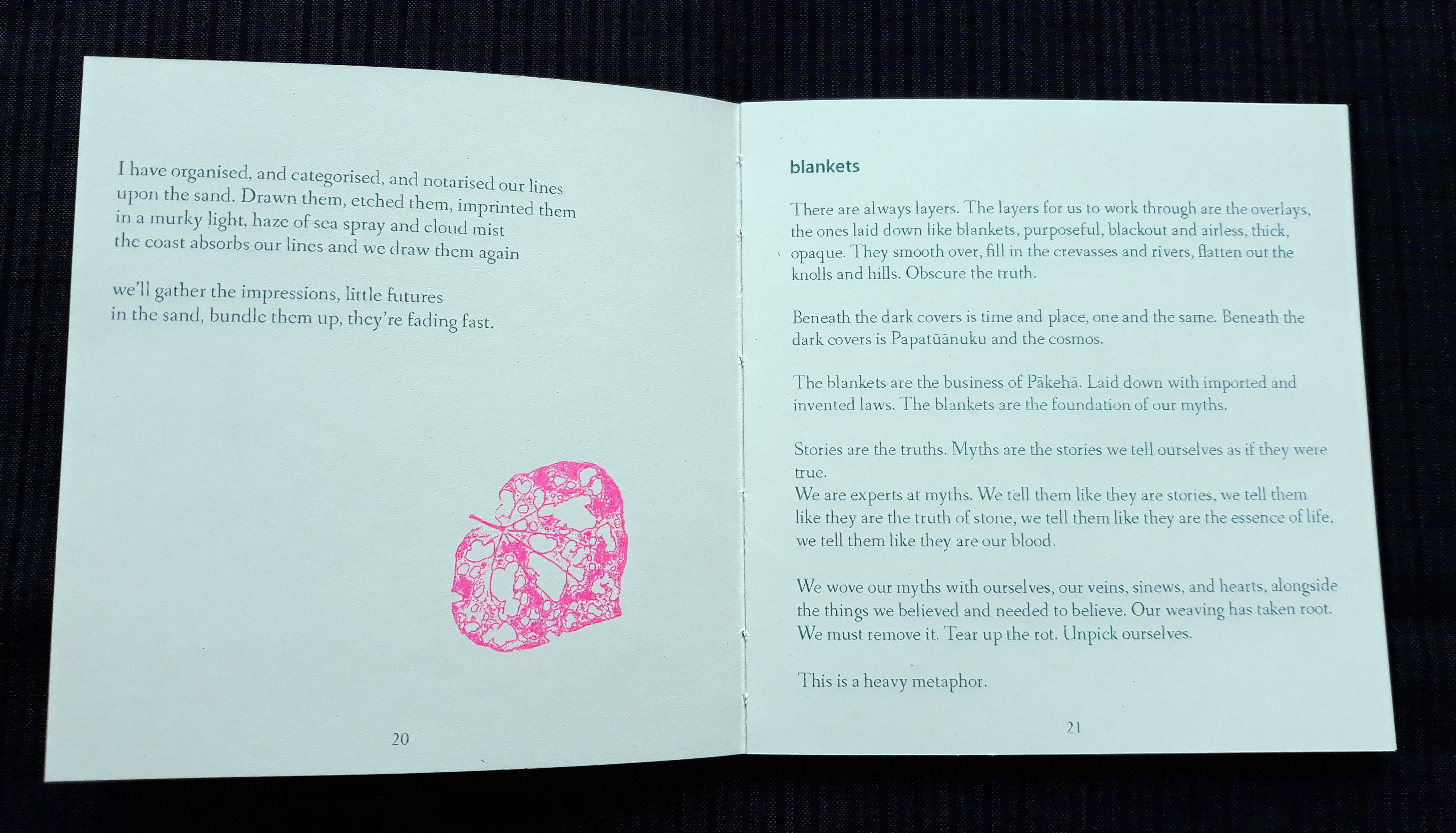
Apertures, pages 20-21
I sent some questions to Makyla after reading her work and seeing the exhibition.
When you embarked on your Master’s project, what were your initial driving questions? How did that shift over time?
My initial question, or goal, came out of my Master of Arts in English project: I was researching the interpretative possibilities of reading image and text together. I was looking at the work of Cilla McQueen and John Pule and the way their work intertwines image and text as a simultaneity of storytelling.
I wanted to try this theory out in my own artistic practice and chose to do a Master of Visual Arts as the grounding for that experiment. I have been studying te reo mē ngā tikanga Māori for a few years at a few different institutions, and asking a lot of questions about the history of Aotearoa and what it means to be Pākehā.
These two things came together while I was working on my MVA research project. In responding to your question, I’ve returned to the research question I constructed for an assessment early in 2019 and I talk about the ‘(im)possibility of simultaneous presence in Aotearoa and Alba (Scotland),’ and I think that remained a driving force. To be Pākehā is to be fully present in Aotearoa and guided by a Māori worldview, which means knowing where you are from. But in returning to Scotland (I lived there from 2008-2011), despite it being my mother’s birthplace, I was not seen as Scots. And so, there is a contradiction: for me, to be Pākehā is to be Scots, but in Scotland I am not Scots and I am not Pākehā.
The shifts over time were more about how I might explore my complicity in colonisation alongside ideas of identity and belonging here as a settler descendant. I began with wider questions about what a Pākehā identity might be, and then brought it in closer as to what my Pākehā identity might be.
The poems in Apertures have a sense of fluidity – the sense of place and time shifts constantly. What were your poetic influences, and what types of writing techniques did you experiment with?
I’m glad that fluidity comes across. I was looking for that ‘simultaneous presence.’ Cilla McQueen is a huge influence in that regard. Her poems (particularly those in Markings and Soundings) take you to McQueen’s ancestral home in the Western Hebrides of Scotland while keeping you in the South Island of New Zealand in her drawings. The places become kind of overlaid, and that becomes an identity in a way.
Other big influences while I was writing were Ruby Solly, Tōkū Pāpā (Kai Tahu), Roseanne Watt, Moder Dy (Shetlean), Frances Presley, Halse for Hazel (English), Natalie Harkin, Archival Poetics (Narungga). Early drafts of a lot of the poems included a lot more te reo Māori and Scots Gaidhlig, and those languages certainly guided me a lot, but ultimately, I didn’t feel it was quite appropriate for me to keep so much of them in the final poems.

Apertures, pages 24-25
The images in Apertures are contact prints of items you found on your journeys to places of significance to your family. How did you make them, and are they the same in each book?
There are a few different methods of print in the Apertures collection. I printed with found objects including threads, ferns, sliced driftwood, kawakawa leaves, but they’re not all ‘contact’ prints as you describe them, for example some are printed from the remnant ink impression. All, though, are a form of planograph monoprinting (printed from a flat printing plate or surface to create one-of-a-kind single prints that cannot be reproduced in the same method). The prints were photographed and digitised to be included in this book. The originals are in other artworks and single edition books. The images are all the same across the copies because the book was printed using risography (a digital duplicator, it uses screen printing methods but functions more like a photocopier).
When I read your poetry, I feel an urgency – a sense of searching for identity. The Pākehā search for identity in this country now seems to carry with it a sense of shame or shyness – I’ve had friends tell me they have ‘no’ identity. What’s your take on that?
There’s a term I used a lot when teaching at the university that I think was coined by Stephen Turner: ‘productive discomfort.’ This is the active side of the white guilt coin. ‘White guilt’ doesn’t help anyone, least of all Pākehā. The shame, or shyness, makes us inactive, and you can sink into it and drown in it. But productive discomfort allows for the unpleasant feeling of facing our complicity in colonisation of ngā tāngata Māori, but enables us to use it towards action and reparation, even if that reparation is small.
No one has ‘no’ identity. Everybody has culture. If you think you don’t have one, it just means yours is so ubiquitous that you haven’t had to think about it. Something that causes me great concern is that when people think they don’t have a culture or an identity, it can lead them to seek out and steal the culture of others. Cultural appropriation is a further act of colonisation and violence. We need to ward against that by exploring our own culture. I think that we Pākehā have been very lucky to have been given a unique identity that acknowledges that our ancestors are from elsewhere but that we can belong here in Aotearoa. Māori gave us this identity and I think it is an extraordinary gift and privilege. We can be proud to be Pākehā, but it should include that productive discomfort.
Your poems however show that you ultimately uncovered a richness and depth to your past, and a real sense of connection to Aotearoa through the actions of your ancestors. Was this an easy journey for you personally?
Overall, I have found the journey extremely rewarding so far. I been able to spend a lot of time with my Dad because the project was, for the purposes of the thesis, focused on my Dad’s side of the family. I’ve especially enjoyed that aspect. My Dad has come along on the journey with me as an active participant, asking a lot of the same questions as I have.
There have been some very joyful discoveries: learning about the owner of our heirloom sewing machine, Eliza Riley, and repairing the sewing machine to working order; finding an amazing photograph of my great grandparents Florence Annie and Ernest, with Florence’s parents Sarah Ann and Thomas, with Sarah’s sister and her husband and baby. And some very surprising discoveries: I found my great great great grandfather, Thomas Riley, in the Auckland Lunatic Asylum records. We’re still working through what we can find of Thomas Riley’s life; it may well be he was involved in the invasion of the Waikato before he was committed.
It isn’t easy, and I don’t think it should be. If it’s easy, I’m not asking hard enough questions! But it is rewarding, and I recommend anyone who doesn’t know much about their history, to give the search a go. And if you are Pākehā and can’t find your own ancestors, it’s a good idea to learn about our shared settler colonial history and use that to help understand your identity as Pākehā, because the wider history still shaped your identity and our present.
Tell me about how you typeset and printed your book and about your design choices.
I had been writing poetry throughout the project, and snippets of it was finding its way into the single edition books I was making. It wasn’t until February last year (’21) when I attended a workshop introducing the risograph machine at AUT that I thought of compiling the poems into a printed collection. So, the typesetting and design was informed by what I thought I could do using risography, and the fact that I would be handbinding the book (I used the French lace method). You can only print one colour at a time, and because I hadn’t done a lot with riso in the past, I decided on a straightforward split: teal for the text and pink for the images, and then brought them together for the cover. In the rest of the project I was working with Garamond, Bodoni, Univers, and assorted wooden type, because I was working with material type: metal and wooden moveable type, letterpress. But this was a digital design, and so I jumped at the chance to work with two of my favourite typefaces, both from leagueofmoveabletype.com: Fanwood and Raleway. That was, however, occasionally frustrating because Raleway doesn’t have any macrons so I had to add them manually. These two faces weren’t too much of a divergence, though, from the general feel. I think the added typefaces to the project here were enriching rather than distracting. They give the poetry collection its own voice, amid the voices of the other books that worked with text in a different way.
I’d love to know more about your research into letterpress, on this project and others. How did you develop your macron typeset, and what are future projects you’re contemplating?
The first ever language to be printed in Aotearoa was in te reo Māori. The grounding of language and print in this country is te reo Māori, and that is important to remember, especially while English remains dominant.
There have been two letterpress research projects I have conducted, the first was in 2016 and was the creation of a contemporary case for handsetting te reo Māori. The second was in 2019, an experiential research project to handset He Whakaputanga and Te Tiriti o Waitangi.
2016: I found it frustrating to handset metal type in te reo using an English lay out case: there aren’t enough k’s, and what k’s there are, are in a small compartment on the far left. Likewise, the p’s and w’s are relegated to smaller compartments. Meanwhile, the English case has e as the dominant vowel, when in Māori it is the a, and the s, h, d, c, y all take up prime real estate. Add to that the lack of macrons, and it was becoming clear I needed a new case to set from.
In 1834 William Colenso was hired by the Church Missionary Society to come to New Zealand and print Te Paipera (the Bible). He made numerous requests to his employers for the tools he would need on arrival, but they missed the memo and when he arrived one of the major things he was missing was type cases, the trays that hold the type. There are loads of different type case layouts, even just in English, but the premise is that the most often used letters are near the centre bar, and the less often used ones are in the outer compartments. Colenso had learned a little bit of te reo on the boat over, so he designed some new cases and had them built by a carpenter in Kororāreka. He filled the cases with the type his employer had ordered from England, but didn’t bother to unpack the English only letters. I used Colenso’s design of his upper and lower cases as the basis for my contemporary job case (upper and lower cases in the same tray) design, and built the case. We purchased some new type in Garamond with macrons from a typecaster in Upper Hutt. The case is now filled with the 14pt Garamond, and I used it to print a poem by Vaughan Rapatahana, and a poem by Cilla McQueen translated into te reo.
2019: In 2019, I commissioned a cabinet-maker in Kaiwaka to build Colenso’s cases based on drawings from 1890s. Then, using these cases I handset He Whakaputanga and Te Tiriti o Waitangi to look as like the original printed versions of these documents as I could (only bigger, I used 18pt). It was an experiential experiment. What was it like to print these documents using these type case layouts as they had been by Colenso in 1835 and 1840. For me, when I handset type, I get very close to the text, I address every letter individually and bring it together. It’s intimate and familiar, and it was an amazing way to get up close to these two documents: documents that are the basis of how I came to be living here in Aotearoa, and are a guide for how to do so.
NB. There’s often confusion with these projects that I designed a typeface for te reo, that is not so. These are all about the tray layout of where the material metal type is stored and where you get it from to handset with it. It would be similar to talking about the qwerty keyboard and alternative keyboard layouts.


Two images from a whole story in the eye of the sea, artist book, 390 x 220mm, silk-cotton pages, 14 leaves, hardcover with stab-binding
This book is one of several that you made, but the rest are much more limited edition, and are experimental in their choice of materials. Can you tell me about these and the process you used to make them?
My MVA project (titled ‘Folding Time’), was made up of a number of fabric printed hangings of collected and pressed ferns (‘Ink Herbarium’, ‘Pteridomania series’); the printing of HW and ToW and an accompanying zine with a collection of poetry, short essays and documentary photographs (Ka mua, ka muri); eight single edition books; the poetry collection Apertures (edition of 40); three essay zines; and two photo zines. Of the eight single edition books, one was digitally printed with a page for each site visit and field trip I conducted for the project between March 2019 – May 2021 (there were 45), and bound as a concertina book so that it can unfold into one very long page. Of the remaining seven, two are printed on rice paper and five are printed on silk-cotton fabric.
By your question I am assuming you are most interested in the five fabric books.
They are titled: advance / recede; a whole story in the eye of the sea; an aperture shows me an arrival; gaps / thresholds; and little archives. They’re handprinted using relief printing (letterpress – metal and wooden type) and planograph monoprinting (mentioned earlier) with found objects (threads, pressed leaves, sliced driftwood), and some lasercut mdf. When working with fabric, it’s all handprinted, usually on my kitchen table. Occasionally I used a Farley proofing press, but I found it more effective to print with the pressure of my hands. Some prints have the remnants of my finger marks (although those are more evident in the fabric hangings). A lot of the time I will print from the remnants of an impression. By that I mean that I ink up a plate, place a pressed fern, for example, on the plate, print that to produce a negative, or an outline (which I usually throw away) and then remove the fern and place the fabric against the plate. I get the remnant, or the shadow, or an ink impression. It’s a fun and beautiful way to print. Every print is a discovery.

advance / recede, artist book, 150 x 200mm, silk-cotton pages, 21 leaves, hardcover with stab-binding. Courtesy of the Angela Morton Room Collection, Takapuna Library
What new projects have come out of this course of investigation?
The where to from here is that now that I’m not bound by the confines of the thesis, I am exploring my mum’s side of the family. I’ve just moved to West Auckland, and this is where my mum grew up. Earlier this month (March 2022) my mum, Nana and I did a driving tour of West Auckland to look at the houses they lived in, and where they worked and studied, and I’ve begun conducting oral histories with them too. My maternal grandparents and my mum came to NZ in 1957 as ’£10 poms.’ It’s quite a different story to the six ships that brought my paternal family to NZ.
I recorded my journey in a blog (which I’ve been meaning to update) and on my Instagram @makylac
You can hear Makyla read from Apertures here
Renee Liang is a poet, playwright, paediatrician, medical researcher and essayist. She is the Asian Theme Lead and a named investigator on landmark longitudinal study Growing Up In NZ. As an established writer, Renee has collaborated on visual arts works, film, opera and music, produced and directed theatre works, worked as a dramaturge, taught creative writing and organized community-based arts initiatives such as New Kiwi Women Write, a writing workshop series for migrant women, and The Kitchen, a new program nurturing stories in local kitchens. Her work The Bone Feeder, originally a play, later adapted into an opera, was one of the first Asian mainstage works to be performed in NZ. Renee has written, produced and toured eight plays. In 2018 she was appointed a Member of the NZ Order of Merit for services to the arts, and won Next Woman of the Year for Arts and Culture.
Makyla Curtis is Scots Pākehā and lives in Tāmaki Makaurau. She is a poet, printer, and artist. Makyla is a volunteer compositor in letterpress at MOTAT, Museum of Transport and Technology. She has a Masters in English from the University of Auckland, and a Masters in Visual arts from Auckland University of Technology.


The moon that harms animals
It’s going to harm animals, this moon
rising so full and huge at dusk
over this little bald hill at the edge
of a field of stubble. Stalks and
black earth, already gleaned
and dark as the darkest desire
which will come on the animals tonight.
And here, in proof, is the ragdoll cat
carried draped over a child’s arm or
worn around the neck of another, sore
and torn, hardly bearing to be held
because of the savage bites she bears
for venturing, unstoppable, through the cat door
and yielding herself, in fealty, to the moon.
Elizabeth Smither
Elizabeth Smither’s most recent publication is a collection of short stories, ‘The Piano Girls’, (Quentin Wilson Publishing, 2021). A new collection of poems, ‘My American Chair’ will be published by AUP this year.
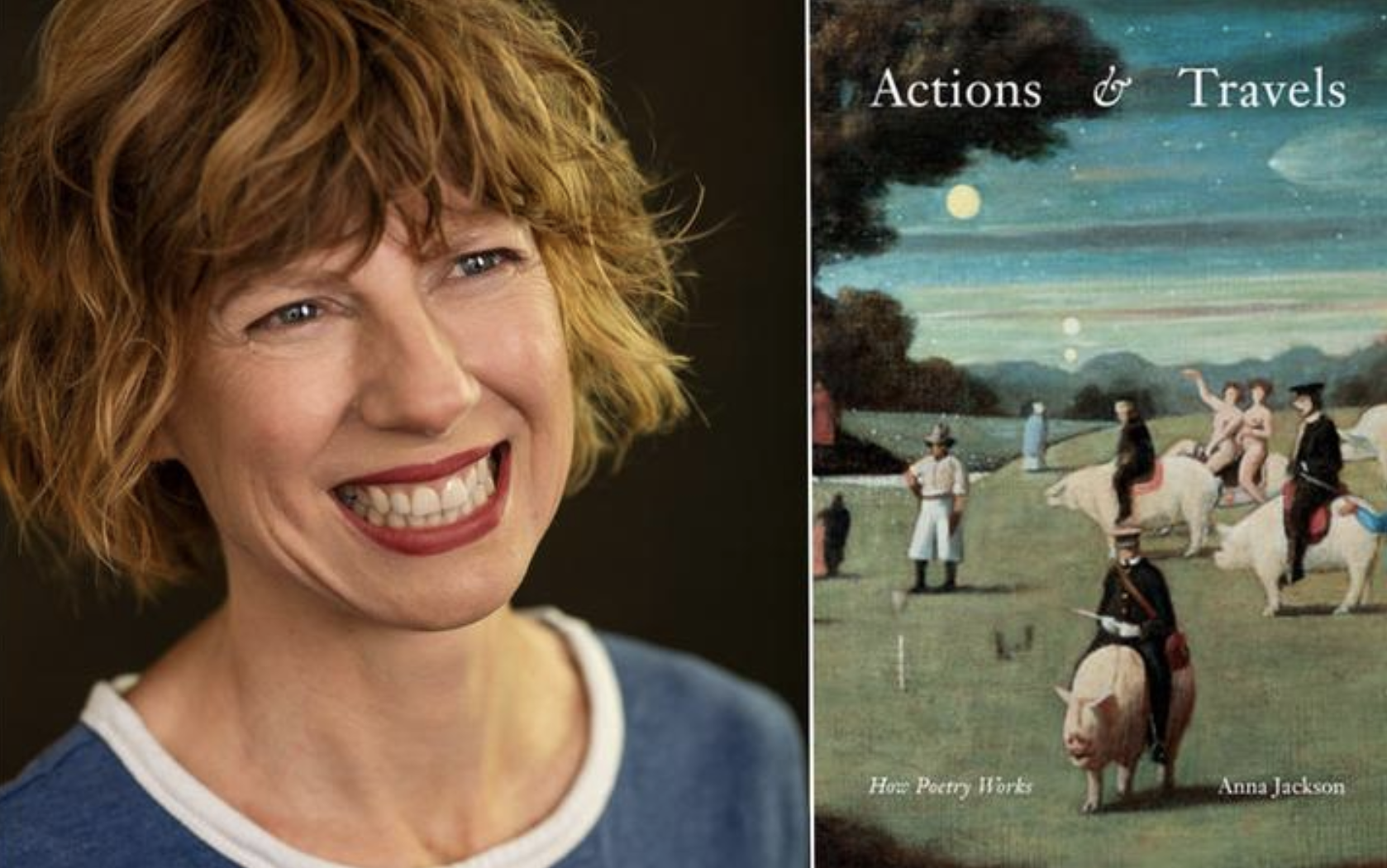
Saturday morning and I switch the radio on to hear Kim Hill in scintillating conversation with poet Anna Jackson. The aim was to explore Anna’s new book Actions & Travels: How Poetry Works (AUP). The result is a warm, articulate and joyful celebration of poetry. I loved it so much, I Iistened again this morning.
In the new book, Anna takes around 100 poems and considers what she loves about them, what the poems are doing. Kim Hill was intrigued and delighted by the unexpected inhabitants in each chapter. I saw them as little neighbourhoods with surprising guests that shone renewed light on the chapter theme and upon poetry itself.
A few gold nuggets but you need to hear the whole conversation:
Anna: I was ‘cutting the landscapes of poetry in different directions to see what those combinations would bring out in each poem’.
Anna on younger poets and ‘what it does to poetry to be so current and alive and shared and important’: ‘Poetry is an urgent medium of conversation that takes place not only on the page and between readers and at readings, but on social media as well.’
Anna after reading Maggie Smith’s much shared ‘Good Bones’ on air: ‘That’s the wish of poetry … What can we salvage? What’s beautiful? What can we will ourselves to see as beautiful without turning away from what’s terrible? What we know is real?’
Kim: ‘Have you read George Saunder’s A Swim in a Pond in the Rain? I liked your book in the same way I liked his book.’
Anna: ‘The more poems you read, the more qualities you’ll be likely to recognise.’
Listen to conversation with Kim Hill here, Saturday Morning RNZ National
Poetry Shelf conversation with Anna Jackson
Auckland University Press page
Anna Jackson website

Ōrongohau | Best New Zealand Poems 2021, edited and introduced by Kate Camp
The trees stand solitary. Clouds wring
the odd star out of the dark. We’re
walking on nothing. We’re the road, unlined.
Pippi Jean from ‘11.11pm’
This week I spent days reading and replying to all the children who sent me bird poems for Poetry Box’s March challenge. It is a sad glad task as so many children didn’t get picked to be posted, yet there were so many gold nugget poems. My Poetry Box aim is to nourish poetry at the grass roots, to encourage children and teachers to play with poetry. To explore poetry as a way to liberate words, to say what we think and feel, to see and hear with words. To break rules, to create rules. To let imaginations go flying and to draw upon memory. For a start.
I know what is like picking poems for anthologies, for Best NZ Poems, even books for the NZ Book Awards, and it is a painful pleasure, because not everyone gets picked, no matter how many best books and poems there are.
I do squirm and recoil from the word best with its unavoidable hierarchies and exclusions, its biases and neglects – especially how we edited and selected in the past. But still today, these leanings exist.
Despite my aversion to the concept of best, I am also grateful. I pick up poetry anthologies, journals, I scan book award lists, and I delve into Best NZ Poems because there are always rewards. I get to encounter poems/books I have loved, I get to hunt down poems/books I am not familiar with but tempt me, and I sigh over and return to astonishing poems/books that have not made the selector’s cut.
I am a selector every week on Poetry Shelf! And I know from emails how some poets find it tough when I don’t review their books or post their poems. This choosing tug is not easy.
Here I am back at our kitchen table watching the kererū squat greedily in the cabbage tree and I’m musing on the wide fields of poems published in 2021. The luminescent communities of poets writing, exchanging, conversing, publishing. It was a bonanza year on Poetry Shelf as I sought to counter the personal and global challenges of the year with themes and readings, and as many poems, interviews and reviews as I could manage. The poetry luminosity in Aotearoa is to be celebrated. This poem aliveness.
Poetry now is ‘an urgent medium of conversation that takes place’, Anna Jackson said to Kim Hill on the radio this morning. On the page, in performance, in social media. I love this. So many poets are writing with this sense of urgency, a need to half understand why we are writing it, a need to shine lights, and get personal, hold a hand out to the past, and a hand forward to the future. To find stable ground to stop the heart and mind shaking. To shake and tilt and free float.
And so with this peculiar introduction I celebrate the arrival of Best NZ Poems 2021. There are poems from books I have loved and engaged with deeply, there are poems by poets I have not yet read. It is a weekend road trip. A getaway car. A time to linger and imbibe and stall.

You can read editor Kate Camp’s comments on why each poem delighted her.
You can read the poems selected, and treat as a weekend retreat.
You can listen to some of the poets read.

 NZ Poetry Shelf