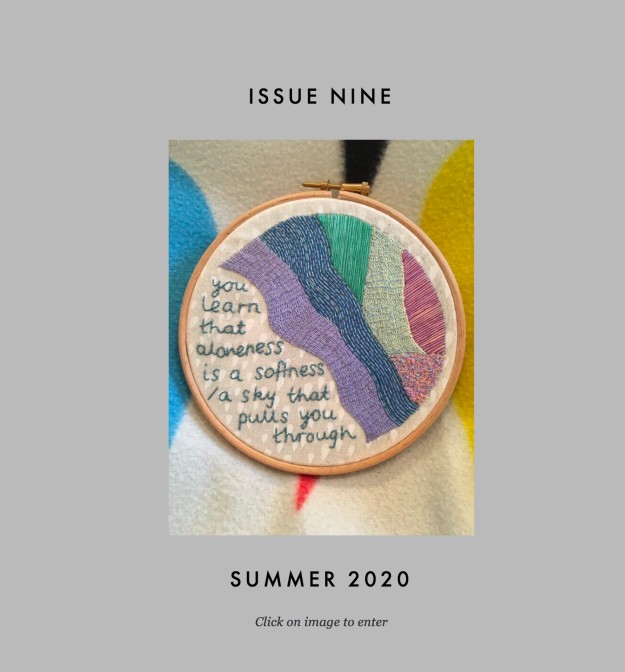
Not Very Quiet accepts poems from women poets in NZ and Australia. Here is a link to the latest issue which features a couple of well known Kiwi poets and emerging poets such as Sophia Wilson.

Not Very Quiet accepts poems from women poets in NZ and Australia. Here is a link to the latest issue which features a couple of well known Kiwi poets and emerging poets such as Sophia Wilson.
From Robyn Maree Pickens:
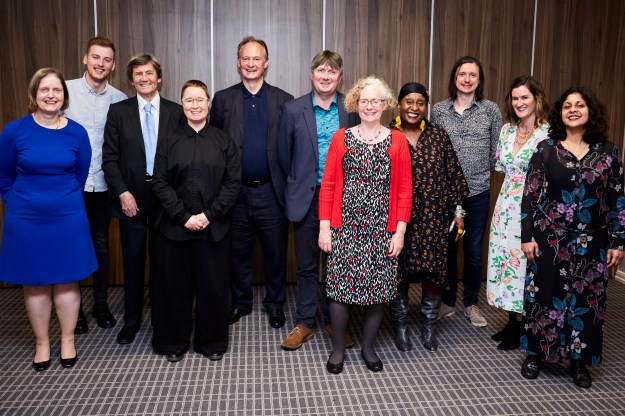
I was in Finland for a writing residency over January and February and stayed on in the Northern Hemisphere for the launch of the University of Leeds Brotherton Poetry Prize Anthology (published by Carcanet), which was meant to take place on the 23rd March at the University of Leeds Poetry Centre — and to be launched by UK poet laureate Simon Armitage (who was one of the competition judges). Understandably the launch was postponed, but only nine days beforehand. The new, tentative launch date is in the (UK) autumn, but it is unlikely that I will be able to attend this event (or who knows what the world will be like in a few weeks let alone a few months…). I had a very stressful but lucky return to NZ on 21st March and am now in self-isolation at an unfamiliar location, but that is another story…!
Five anthologised finalists in alphabetical order: Pete Green, Maeve Henry, Dane Holt (winner), Majella Kelly, Robyn Maree Pickens.
Judges: Simon Armitage, Malika Booker, Melvyn Bragg, Stella Butler, Vahni Capildeo and John Whale.
I have eight poems in the anthology.
This is an excerpt from Simon Armitage’s introduction:
“Robyn Maree Pickens writes a flexing and flowing poetry, unpredictable and daring at times, one that can shape-shift from a bold and abrupt comparison (‘a sea-urchin that looks like a vagina’) or a reference to Grindr, to something far more elusive and elliptical, as in the opening lines of The time has come for you to lip sync where she observes:
Here you are – pulling another foal out of the Ice Age
as the moon files its tongue down to a shimmer.
The poems are mesmerising and memorable, trippy but never blurred or vague.” (p x
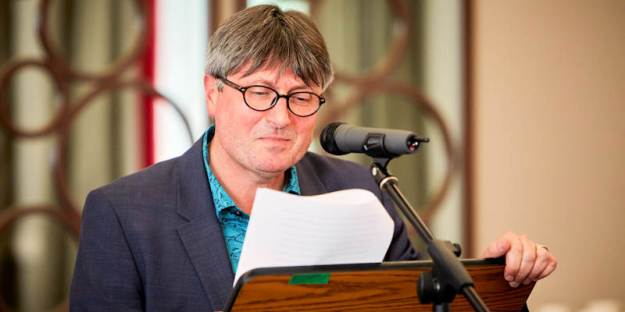
The award ceremony was on the 10th of June 2019 at the University of Leeds Poetry Centre with all of the judges and poets in attendance (I happened to be in Dublin for a conference last year just beforehand so was able to attend the event).
In the attached photo (from the award ceremony) I am fourth from the left.
Here is some general information about the prize prior to the announcement of the winners:
The Brotherton Poetry Prize is open to anyone in the world over the age of 18 who hasn’t yet published a full collection of poems (a chapbook or pamphlet does not count as a full collection). Entries to the competition should include no more than 200 lines of poetry in up to five individual poems.
The winner will receive £1,000 and the opportunity to develop their creative practice with the University of Leeds Poetry Centre.
Four runners-up will each receive £200.
The poems of the five shortlisted poets will be published as an anthology by Carcanet Press. All entrants who provide a UK postal address will receive a copy of the anthology on publication. The shortlisted poets will be invited to take part in a series of readings and events held at the University of Leeds and in other venues in Yorkshire.
All shortlisted poets will receive travel expenses up to £150 to cover expenses associated with the competition announcement. Expenses for UK-based poets associated with events may be reimbursed.
The Brotherton Poetry Prize is generously supported by the Charles Brotherton Trust.
Here is the announcement about the competition winners:
Selected from almost 400 entries, the winner of the Brotherton Poetry Prize was announced at an event last night, after all five shortlisted poets read one of their five submitted poems.
Mr Holt, 26, originally from Chesterfield in Derbyshire, said he was looking forward to working with Leeds’ Professor of Poetry.
“Simon Armitage was the first poet I ever read,” he added.
The prize, launched last year, aims to nurture previously unpublished poets. The runners-up were Sheffield-based Pete Green; Maeve Henry, from Oxford; Majella Kelly from Tuam in Ireland; and Robyn Maree Pickens, from Dunedin in New Zealand.
The choice was unanimous among the judges – writer and broadcaster Melvyn Bragg; poets and Douglas Caster Cultural Fellows Vahni Capildeo and Malika Booker; University Librarian Dr Stella Butler; University of Leeds Poetry Centre Director Professor John Whale, and Professor Armitage.
All of the finalists and judges were present to see the winner named.
how do we say farewell how
do we make sure that our loved
ones make it over the cape
when we can’t stay with them
in their last
it’s only two
metres
a
part
essa may ranapiri
essa told me they would like this poem to be the start of a conversation among Maaori and Pasifika writers. ‘Poetry can bring us together,’ they hope.
I am happy to offer a connecting space ‘for Maaori and Pasifika writers to deal with and or celebrate whatever during this time’.
paulajoygreen@gmail.com If I don’t answer your email within three or four days nudge me please.
essa may ranapiri, Ngāti Raukawa, is a poet from Kirikiriroa, Aotearoa. They graduated with an MA in Creative Writing from Victoria University of Wellington (2018) and their work has appeared in many local journals. They are the featured poet in Poetry Yearbook 2020 (Massey University Press). ransack has been longlisted for the Ockham NZ Book Awards 2020.
essa may ranapiri website
Victoria University Press page
The Pantograph Punch Jackson Nieuwland reviews ransack
RNZ interview
Poetry Shelf: essa reads ‘Glass Breaking’
essa on being at IIML with Tayi Tibble
paulajoygreen@gmail.com
Yesterday
Yesterday the trees spun
the lettuce seedlings spun
the pale clouds spun
the wailing cats spun
the sweet feijoas spun
the kererū spun
the words in the book spun
my head spun
my heart spun
I lay on the couch
and waited
31.03.20
Artwork: ‘Rehua’ by Robyn Kahukiwa
E ngā mana e ngā reo e ngā karangatanga maha o ngā hau whā. Ngāmihi atu ki a tātou katoa.
Over the past few months our whānau has experienced a harrowing time regarding my fathers health. For a while there, colour and laughter disappeared and everything seemed meaningless. I found my senses couldn’t handle anything overly loud, aggressive and I was unable to render up the energy to read whole books – instead, it was lines of poems (thematically written about something unrelated) rolling around in my head, giving me comfort as we sat in white corridors and I suppressed the urge to look up all the medical terms online.
Waterfall
I do not ask for youth, nor for delay
in the rising of time’s irreversible river
that takes the jewelled arc of the waterfall
in which I glimpse, minute by glinting minute,
all that I have and all that I am always losing
as sunlight lights each drop fast, fast falling.
I do not dream that you, young again,
might come to me darkly in love’s green darkness
where the dust of the bracken spices the air
moss, crushed, gives out an astringent sweetness
and water holds our reflections
motionless, as if for ever.
It is enough now to come into a room
and find the kindness we have for each other
— calling it love — in eyes that are shrewd
but trustful still, face chastened by years
of careful judgement; to sit in the afternoons
in mild conversation, without nostalgia.
But when you leave me, with your jauntiness
sinewed by resolution more than strength
— suddenly then I love you with a quick
intensity, remembering that water,
however luminous and grand, falls fast
and only once to the dark pool below.
Lauris Edmond
From Night burns with a white fire: the essential Lauris Edmond, eds Frances Edmond and Sue Fitchett, Steele Roberts 2017, poem originally published 1975 In Middle Air)
It’s specifically poetry by Lauris Edmond and John Donne that came.
‘Yesternight the sun went hence,
And yet is here today;’
from ‘Song; Sweetest I Do Not Go’ by John Donne
‘Minute by glinting minute’
from ‘Waterfall’ by Lauris Edmond
They may seem like random choices. But when I discovered Donne and Edmond as a teen they blew.my.mind. Nerdy much.
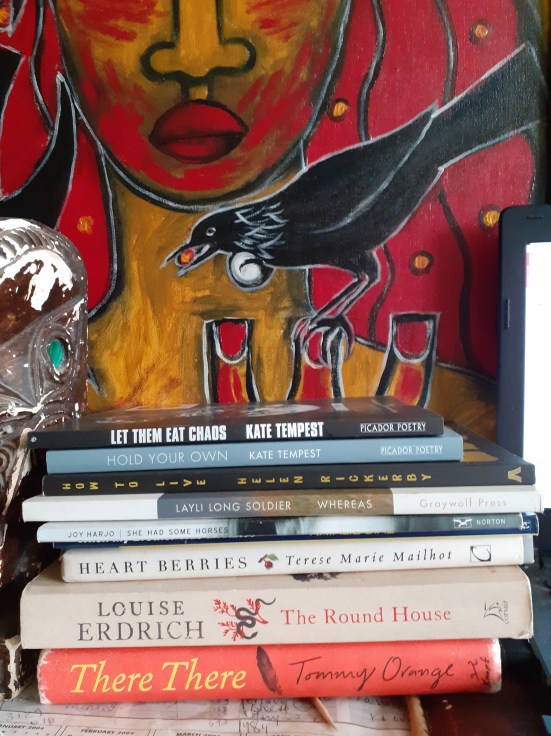
As things settled with Dad, the ground felt more solid instead of the instability we’d been living through and so, I found myself gradually returning to the joy of reading, starting with the pile of newly ordered poetry books (Helen Rickerby’s – How to Live and Kate OHMYGOD Tempest),ebook downloads and podcasts (The Slowdown and New Yorker: Poetry are favourites). Even as I eased back in, World News started to drown out and distract and, without even really being aware of it, I found myself reaching for and returning to the solidarity and familiarity of fellow Indigenous like the current American Poet Laureate Joy Harjo, Layli Long Soldier (Whereas), Natalie Diaz (When My Brother Was an Aztec), Ali Cobby Eckermann and because not all indigenous are print published (yet or maybe even ever – that’s another kōrero, the elitism of print publishing), Evelyn READHERNOW Araluen and; because Indigenous prose is poetic a.f – Tommy Orange (There, There), Richard Wagameese (Indian Horse, Medicine Walk), Terese Marie Mailhot (Heart Berries) and Louise Erdrich (The Round House) and the Spoken Word roopu 1491’s.
Of course, most of these writers/performers are contemporary and that’s purposeful on my part because our commonalities while based upon our shared experience of Colonial Violence is also shaped by our whakapapa to our ancestors, the richness of our respective cultures and our colonised realities. As I acknowledge, that we follow in the steps of those before us, as others follow us, I also recognise that responsibility, that underlying mihi, that humility in the work of these contemporary indigenous and, as we live through these days, I get huge comfort in that. I am comforted by Our shared survival, Our resilience and by Our ability to still be here after the most horrific intentional actions to kill us and our ability to articulate and call that out, while being in a state of constant forgiveness towards our own people because we know, we get it, we’re you as you are me.
It terrifies me as to what will happen if, this new enemy finds its way to my Iwi, to rural Māori communities, to the rural Māori community I love, to Prisons or to the many places around this country where people I love are. We won’t have a shitshow. This’ll be a modern day Scorched Earth. It’ll wipe us out. I can’t bear to think about that.
So, while knowing and feeling allathat, I do the only thing I can. I put one step in front of the other as I have these past months, walking alongside my whānau and my Dad facing what has to be faced because while terrified, the love I have for him is greater than my fear. My love is greater than my fear. Love is greater than fear.
May a vaccination be found/created. And soon.
Ngā manaakitanga na Maraea
I Give You Back
I release you, my beautiful and terrible
fear. I release you. You were my beloved
and hated twin, but now, I don’t know you
as myself. I release you with all the
pain I would know at the death of
my children.
You are not my blood anymore.
I give you back to the soldiers
who burned down my house, beheaded my children,
raped and sodomized my brothers and sisters.
I give you back to those who stole the
food from our plates when we were starving.
I release you, fear, because you hold
these scenes in front of me and I was born
with eyes that can never close.
I release you
I release you
I release you
I release you
I am not afraid to be angry.
I am not afraid to rejoice.
I am not afraid to be black.
I am not afraid to be white.
I am not afraid to be hungry.
I am not afraid to be full.
I am not afraid to be hated.
I am not afraid to be loved.
to be loved, to be loved, fear.
Oh, you have choked me, but I gave you the leash.
You have gutted me but I gave you the knife.
You have devoured me, but I laid myself across the fire.
I take myself back, fear.
You are not my shadow any longer.
I won’t hold you in my hands.
You can’t live in my eyes, my ears, my voice
my belly, or in my heart my heart
my heart my heart
But come here, fear
I am alive and you are so afraid
of dying.
Joy Harjo
Published in How We Became Human: New and Selected Poems: 1975 – 2001
(W.W. Norton and Company Inc., 2002).



 NZ Poetry Shelf